The Challenge
American independent schools are among this country’s greatest resources, models of innovation, excellence, and expanded opportunity, and for that reason, they enjoy uncommonly high levels of public support. And yet, they face challenges similar to those besetting other educational institutions, including public schools, colleges, and universities: rising polarization, intense politicization, and as a result, increased community conflict.[1]
These challenges include increasing litigation in the areas of admission, curriculum, student behavior, adult misconduct, risk management, and employment; the erosion of long-standing traditions of judicial deference to the independence of schools; loss of public confidence in the ability of teachers to provide instruction on sensitive or controversial subjects; and frequent, often hostile, attacks on schools from parent groups, lawmakers, and increasingly, the media.[2]
Well-organized parent groups at both public and private schools have mobilized to combat what they see as political bias in hiring, school programming, and curricula, sometimes in alliance with legislators seeking to curb the freedom of schools to establish programs and curricula. Independent schools have come under unprecedented levels of media scrutiny, and are regularly caricatured in the press. The 2021 cover story in a leading national publication, “Private Schools Have Become Truly Obscene,” captured the often hostile tone of this coverage, mischaracterizing independent schools as “indefensible” places of entitlement and entrenched privilege despite the fact that independent schools have become dramatically more accessible, more representative of the American public, and more welcoming to students of all backgrounds over the past several decades. In the 2023–24 school year alone, independent schools provided $3.24 billion in financial support to students and their families.[3]
Together, these trends have placed tremendous strains on independent school Boards, school leadership, and their faculties.Boards, for instance, found themselves more directly involved in the day-to-day operations of schools as they sought to meet the challenges of the recent pandemic and the urgent—and unprecedented—decisions that moment required. Long-standing traditions of school governance and shared understandings about the appropriate roles of Heads of School and their Boards have eroded. One in three Heads of School and one in five Trustees report that Boards fail to operate within the boundaries of their distinct roles.
Heads of School have sometimes struggled to reconcile the different interests of competing constituencies, meet the needs of a politicly diverse parent body, and bridge a growing divide between the political views of parents and teachers. Ninety-seven percent of school heads cite polarization as one of the leading challenges they face. Like their counterparts in American colleges and universities,they have faced considerable pressure to publicly address a wide range of social and political events, and to issue expressions of institutional solidarity and affirmation to various groups within their school communities. It should not surprise us that turnover among school leaders at all levels has increased, while length of tenure has declined. Levels of morale among those working in schools have likewise declined, with fewer and fewer young adults expressing interest in pursuing careers in education.[4]
Most significantly, schools have seen precipitous declines in the health and well-being of children. Students report, and medical data confirms, rising levels of anxiety and depression among young people, increasing levels of social isolation, and diminished opportunities for meaningful peer connection. Fear of peer censure, driven in large part by social media, has led to increasing levels of self-censorship among young people, a chilled speech climate, and, often, an atmosphere of wariness and suspicion.[5]
These trends raise important questions about the future of independent schools, their legitimacy, and the unique status they have been afforded as nonprofits, including:
- What should the role of schools and school leaders be in political and social affairs, especially during moments of intense political conflict?
- How is that role expressed in program, curriculum, instruction, and professional standards for faculty and school leaders?
- How do we create school climates that foster open, nonpartisan, courageous civic inquiry?
- How do we promote among students curiosity and open-mindedness, build intellectual resilience, and foster in them the willingness to explore—and express—their own convictions and commitments?
The Purpose: A Catalyst for Reflection and Intentionality
Although independent schools serve a small fraction of the American public, we hope this framework will prove useful to schools of all types: public, parochial, or charter. We hope that it will support Boards, school leaders, and faculty as they seek to enhance the expressive freedom of students, foster in them the habits of curiosity and critical analysis, and prepare them to thrive—and flourish—in a world of pluralistic contention.
The purpose of the framework is not to mandate a uniform approach to these complex issues—our schools are much too diverse for that—but to encourage conversation within school communities, offer a vehicle for institutional reflection and assessment, and provide an opportunity for shared understanding and consensus among various school constituencies and stakeholders.
Schools may adopt the framework (or parts of it), revise it in the context of their own missions, or reject it entirely. We view each of these outcomes as a positive one, and we will develop opportunities where schools can engage directly with the framework, including survey instruments to explore campus climates.
Three Pillars of Academic Pluralism
The challenges independent schools face are not new, nor are they unique. Since the early 20th century, colleges and universities have faced challenges similar to those that secondary schools are now navigating. To meet those, colleges and universities have, over time, developed a body of principles to navigate political and social conflict. These include the American Association of University Professors’ 1915 Declaration of Principles, the University of Chicago’s 1967 Report on the University’s Role in Political and Social Action (commonly known as the Kalven Report), Yale University’s 1974 Report of the Committee on Freedom of Expression (the Woodward Report), and the University of Chicago’s 2014 Report of the Committee on Freedom of Expression (the Chicago Principles). This body of thought has, in turn, led to other more recent statements of academic principle on such issues as campus speech, content warnings, and institutional neutrality and stance-taking at Stanford Law School,Cornell University, Massachusetts Institute of Technology, Princeton University, the University of Wyoming, Vanderbilt University, Northwestern, and Williams College, among many others.[6]
These statements of principle have a unique claim on the attention of independent schools and their students. Taken together, they outline the norms, standards, and values governing the colleges and universities into which many of our students will graduate and the ethos we hope to impart to them as young scholars and citizens, forming the core tenets of what we might think of as “academic pluralism.” Moreover, these time-tested principles have played an important role in preserving the integrity of these institutions through the ups and downs of political and social turmoil.
This framework draws on these founding documents, adapting them to the unique needs of all secondary schools and the students they serve, and updating them in light of contemporary research on the promotion of nonpartisan inquiry.
Unlike universities, schools are not principally concerned with research and the production of new knowledge. Their purpose is more crucial: to introduce young people to the values, practices, and conventions of disciplined inquiry—what the journalist Jonathan Rauch calls the “constitution of knowledge.” Initiation into these practices—including the value of expressive freedom as a source of creativity and human flourishing—is an essential precondition for learning, inquiry, and the testing of ideas.[7]
The framework rests on a simple assumption: that schools are, first and foremost, places of inquiry and exploration, preparing students for the freedom, rights, and responsibilities they will enjoy as adults. Teaching and learning are distinct from advocacy and activism, and nonpartisan teaching is vital to creating an intellectual climate within schools that promotes, sustains, and deepens courageous inquiry. Avoiding political entanglements that exceed a school’s reach and resources will help foster a climate of intellectual exploration free from political tilt or ideological bias, support student autonomy and self-formation, and provide educators with an invaluable design principle against which program, instruction, and curriculum can be assessed.[8]
The framework is structured on three pillars:
- A Commitment to Expressive Freedom
- A Commitment to Disciplined Nonpartisanship
- A Commitment to Intellectual Diversity
These mutually reinforcing pillars support the central goal of the framework: to form students as “distinct thinking individuals,” skilled in the habits of independent thought, conversant with the norms of disciplined inquiry, and empowered to discover, develop, and courageously express their own political and civic commitments.[9] The framework might be envisioned thus:
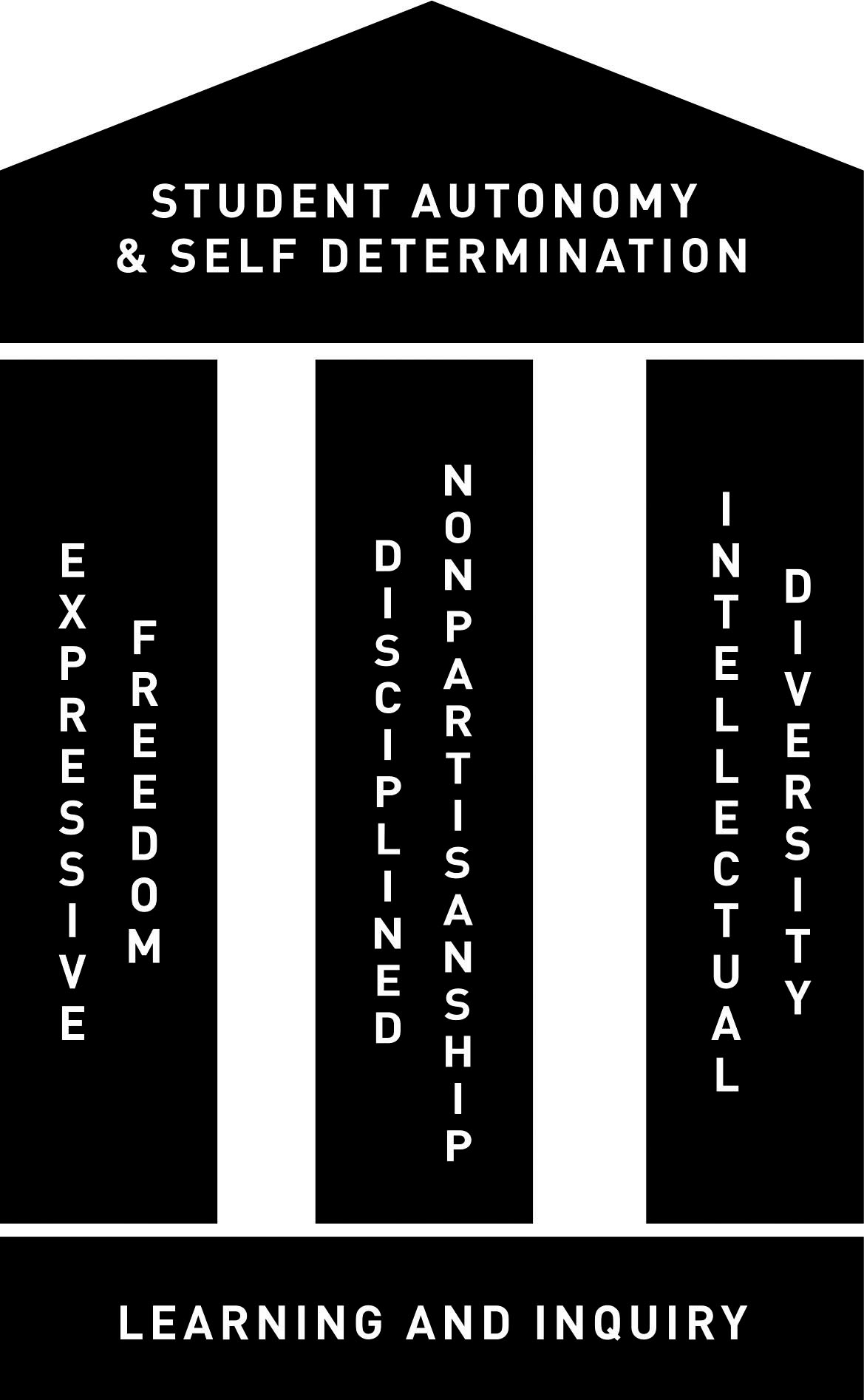
Our schools serve diverse populations, representing a range of values and beliefs, and they include students and families across a broad spectrum of political orientations. Through a renewed commitment to expressive freedom, disciplined nonpartisanship, and intellectual diversity—described below—independent schools can effectively serve politically and demographically diverse populations, continue to hold the trust and confidence of the public, and protect themselves from outside interference and attack.[10]
Educating for Expressive Freedom
There is abundant evidence that many Americans, particularly young Americans, have lost faith in the ideal of expressive freedom as a defining value. That loss of faith crosses political and party lines and extends deeply into our schools.[11]
Two arguments have been advanced against the ideal of expressive freedom in schools, both recent and pervasive. The first argument frames the school—and the classroom—as a therapeutic space and holds that the first priority of discourse should be to “cause no hurt.” Amna Khalid and Jeffrey Snyder call this the “safety and security model of learning.” The second objection is political. It holds that speech is itself a “weapon wielded by the powerful to subjugate the oppressed,” reinforcing relationships of subordination and hierarchy.[12]
Given the recent prominence of these ideas, it should not surprise us that overall support for expressive freedom among college-age students has declined over the last decade and that levels of self-censorship among young people, largely driven by fear of peer censure and amplified by social media, have increased among all student groups, with substantial impacts on student well-being. While students continue to voice support for the expression of unpopular views, only a slight majority of college-age students are confident in expressing disagreement with teachers and peers.[13]
Independent schools have a crucial role in reversing these trends by fostering norms of expressive freedom and inculcating in their students a robust understanding of the essential role that freedom plays when responsibly exercised, in advancing inquiry and knowledge. Schools, in this way, are much more important than colleges and universities, since it is there, during the formative years of adolescence and young adulthood, that the intellectual sensibilities of young people are shaped. To that end, schools should actively and intentionally seek to advance the ideal of expressive freedom with, as one university president remarks, “an eye to engagement and dialogue.”
We identify three dimensions of this expressive ideal. Each of these is essential, and each is meaningless without the others:
Conscientiousness of Expression:
Social media has dramatically changed the conditions under which young people engage with one another. A considerable body of research has demonstrated that social media use foments conflict and diminishes well-being. As Suzanne Nossel, the CEO of PEN America, remarks, “The speech promoted by engagement-driven algorithms is long on outrage and virtue signaling, short on nuance, balance, and basic politeness,” teaching young people “a discourse of absolutes—the antithesis of the pluralistic give-and-take that our society desperately needs.”[14]
Schools, Nossel suggests, should respond to this challenge by promoting an ethic of “conscientiousness.” This means:
- teaching young people to understand the impact of their speech on others;
- providing them with the skills—and opportunities to practice—speaking with consideration, civility, and temperateness;
- encouraging thoughtful self-regulation and civility;
- and charging them with actively co-creating with peers a climate of mutual respect where all voices are welcome and heard.[15]
Courage of Expression:
Expressive freedom is an essential bulwark against tyranny and injustice. Without it, we have no art, no literature, and no knowledge. When students are unable or fearful of speaking freely, they miss important opportunities to develop critical faculties of the mind.
It is therefore necessary to cultivate in students the dispositions to express confidently and courageously their own opinions and arguments, even when they run counter to prevailing orthodoxies, peer beliefs, and the threat of what the novelist Chimamanda Ngozi Adichie calls “social censure.”[16]
This includes:
- fostering in young people the ability to respond to views that seem unreasonable and upsetting;
- creating a climate where intellectual risk-taking, mistake-making, and question-asking are cherished;[17]
- and encouraging the broadest possible range of speech among students.
A commitment to expressive freedom necessarily excludes certain categories of speech—bullying, harassing, and threatening speech—that are legally prohibited. As the University of Chicago’s 2014 report notes: “The freedom to debate and discuss the merits of competing ideas does not, of course, mean that individuals may say whatever they wish, wherever they wish. The university may restrict expression that violates the law, that falsely defames a specific individual, that constitutes a genuine threat of harassment, that unjustifiably invades substantial privacy or confidentiality interests, or that is otherwise directly incompatible with the functioning of the university.” Those restrictions may also include the prohibition of slurs. As the Woodward Report states: “No member of the community with a decent respect for others should use, or encourage others to use, slurs and epithets intended to discredit another’s race, ethnic group, religion, or sex.”[18]
Toleration of Expression:
Two-thirds of college students believe it is sometimes acceptable to shout down a controversial speaker, while a quarter believes it is permissible to use violence to stop someone from speaking on campus. Yet toleration of upsetting and offensive speech is a time-proven way to peacefully manage conflict, promote dialogue, and foster understanding. That was the argument advanced by Frederick Douglass in his “Plea for Speech in Boston,” where he affirmed the right to listen. “To suppress speech,” he wrote, “is a double wrong: it violates the rights of the hearer as well as those of the speaker.” And it informed Pauli Murray’s defense of Alabama Governor George Wallace’s right to speak at Yale in 1963. More recently, Robert P. George and Cornel West have argued that “all of us should be willing—even eager—to engage with anyone who is prepared to do business in the currency of truth-seeking.” They write: “The more important the subject under discussion, the more willing we should be to listen and engage—especially if the person with whom we are in conversation will challenge our deeply held—even our most cherished and identity-forming beliefs.”
Fostering toleration of expression requires:
- cultivating in students a willingness to listen deeply and patiently, even in the face of provocation;
- encouraging students to engage regularly with arguments with which they disagree or find offensive, unwelcome, or wrong-headed;
- cultivating in them an ethic of generosity, a spirit of charity, and an assumption of good faith on the part of peers.
Each of these is a precondition for fostering in young people that rarest of qualities: a willingness to change one’s own views.[19]
Disciplined Nonpartisanship on the Part of School Leaders and Teachers
Over the last decade, many schools have expanded the scope of their mission to embrace a range of public purposes, actively committing to “building the capacities of students to advocate for social justice beyond the classroom.” Other schools have weathered accusations of conservative partisanship, particularly religious and “classical” schools embracing a more traditional curriculum. Faculty, as well, have become more outspoken—and assertive—on matters of social, economic, racial, and environmental justice, among other issues.
Nonpartisanship remains an essential means for securing and retaining the trust of a diverse public, and it is well-established across a range of professions as both a matter of principle and, in the case of independent schools, law. The University of Chicago’s Kalven Report famously advanced an argument for neutrality in political and social action. To protect their core mission—the discovery, improvement, and dissemination of knowledge—educational institutions, its authors wrote, “must maintain independence from political fashions, passions, and pressures.”[20]
Independent schools are governed by similar restraints. As a matter of law, schools registered as 501(c)(3)s must refrain from partisan political activity. That includes a legal obligation neither to support nor oppose political candidates or advocate on their behalf.[21]
Stance-Taking by School Leaders:
The first responsibility of school leaders, after ensuring the physical safety of students, is to create a space where curiosity and inquiry can take root and flourish. Public stance-taking on the part of school leaders can undermine that goal by establishing an orthodox view, chilling campus inquiry, and marginalizing those with dissenting views. This is particularly true during periods of heightened political controversy. School leaders, therefore, should adopt a position of studied, principled nonpartisanship on questions of social and public concern unrelated to their school’s core educational mission. When they do feel compelled to speak, they should do so with modesty, recognizing that stance-taking on issues of public controversy can inadvertently narrow the aperture of campus inquiry, preempt discussion and dialogue, and divide students into insiders or outsiders, depending on their views.[22]
Two caveats: First, silence by campus leaders on issues of public controversy or current events should not be taken as acquiescence or approval of a position or policy or as insensitivity to the suffering of others but as the necessary means of creating space for the expression of student uncertainty and of views that might otherwise remain unvoiced. As the Kalven Report emphasizes, the presumption against stance-taking derives “not from a lack of courage nor out of indifference … but out of respect for free inquiry and the obligation to cherish a diversity of viewpoint.”[23]
Second, public stance-taking on the part of Heads of School should not be confused with their obligation to uphold core values within their schools. School leaders can affirm and uphold the values that support a kind, caring, and inclusive community—a community free from bullying, harassment, and discrimination—without endorsing a particular political program or philosophy. The best way to educate for thoughtful citizenship and student engagement is to remain neutral on contested political and ideological questions that are open to reasonable disagreement.
Stance-taking by Faculty:
Independent school teachers rightly enjoy tremendous freedom in matters of instruction, curriculum, and the selection of classroom materials. This freedom distinguishes independent from public schools, where curriculum and instruction are subject to democratic oversight in the form of elected school boards and state legislatures. That freedom to teach is fundamental to independent schools and should be respected and honored.
At the same time, it is widely recognized that academic freedom is different from, and more limited than, freedom of speech, and that the expressive freedom of independent school teachers is bounded by specific academic duties, including a duty to the integrity of a teacher’s discipline or field of study and established norms of truth-seeking.
The autonomy of students and their right to be free from coercion is a core principle of all professional organizations that work with children—the educational equivalent of the medical profession’s Hippocratic Oath to do no harm. Students have a fundamental right to determine their own values free from coercion, ideological tilt, and inappropriate adult influence. As early as 1915, the AAUP “Declaration of Principles” warned that “the teacher ought … to be especially on his guard against taking unfair advantage of the student’s immaturity.” That restraint is even more important when working with younger students. They are more susceptible to adult influence, and they may not yet possess the critical skills or breadth of knowledge necessary to perceive bias in the presentation and selection of material, especially on questions of public controversy.[24]
The first duty of secondary/high school teachers, therefore, is to recognize the asymmetrical relationships of power that inhere in the teacher-student relationship, and the potential conflict of interest between a teacher’s duty to actively support a student’s intellectual growth and autonomy and the expression of their own partisan and political beliefs.
To that end, teachers should exercise considerable discretion when expressing their own views and beliefs in the classroom, using that freedom sparingly and only when it supports the intellectual agency of students.Diana Hess, Dean of the School of Education at the University of Wisconsin, calls this the “pedagogical tools approach.” Such an approach defers to the professional judgment of teachers in deciding when and how to share their views on a contested issue but recognizes the dangers on the part of teachers of over-sharing, grandstanding, and the unnecessary interjection of personal views.[25]
Overcoming the ubiquitous nature of political bias requires sustained and disciplined effort. Like professionals in related fields, teachers should adopt strategies that seek to mitigate, if not eliminate, political and partisan tilt in the curriculum, and embrace what Michael Walzer calls the “standard of liberality,”—the practice of alerting students to counterarguments, encouraging speculation, and inviting skepticism. Additionally, teachers ought to refrain from the introduction of material extraneous to their discipline, especially if it exceeds their expertise or classroom responsibilities.[26]
Faculty have a right to engage in political activities off-campus, outside of school activities, and on their own time. Yet teachers cannot reasonably expect privacy when speaking in their private capacity as citizens, especially on social media. Teachers at the secondary school level should, therefore, carefully consider how their extramural speech may impact students’ perception of their fairness, especially in matters of grading and evaluation, and their ability to mentor and care for students who may hold different beliefs.[27]
Intellectual Diversity in Schools
Most independent schools have long sought to graduate young people who are prepared for intellectual and civic leadership. That aspiration is most fully realized when students are given abundant and meaningful opportunities to engage with intellectually diverse arguments, perspectives, and views. Exposure to diverse and heterodox ideas inoculates students against unthinking conformity and uncritical orthodoxy, and remains a pre-condition for informed civic engagement.
Students are ill-served when they are shielded from the discussion of issues that are open, contested, and unsettled in the public sphere but closed on campus. Rather than protect students from new ideas or reflexively affirm existing beliefs and commitments, schools should routinely ask students to engage with material that discomfits, unsettles, and runs counter to prevailing orthodoxies. Schools, in short, should envision learning as a sustained encounter with the challenging and the unfamiliar. The classroom, in particular, is a place where established beliefs and commitments are explored and tested against competing arguments.
Intellectual diversity is not, as it is often framed, simply a matter of hiring an intellectually diverse faculty, as important as that might be. Rather, schools have a positive duty to expose students to a wide range of ideas and debates, both in the formal curriculum of the school, in their libraries, and in programming beyond the classroom. Nor should it be confused with what has been called “bothsidesism,” a superficial balance of views uninformed by scientific or scholarly consensus. The goal of an intellectually diverse curriculum is not reflexive balance or even completeness but the intentional inclusion of competing arguments and theories.[28]
The educational value of intellectual and argument diversity is well-established. It finds expression in the Greek idea that we learn best through discussion and Socratic questioning, in medieval religious traditions of disputation, and modern forms of dialectic.
Schools have a particular interest in advancing argument diversity since it is founded on longstanding assumptions common to the scholarly enterprise:
- That ideas and theories are always in dialogue and conversation with one another;
- That cultures and traditions of thought are themselves plural, hybrid, and heterogeneous rather than unitary or monolithic;
- That academic disciplines are themselves fields of contestation and argument;
- That the study of the past enlarges and enriches our understanding of the present.[29]
The 1915 Declaration speaks of the duty to set forth “justly and without suppression or innuendo the divergent opinions of other investigators … the best published expressions of the great historic types of doctrine upon the questions at hand.” It speaks not simply of exposing students to a range of arguments but of the need “to habituate them to looking not only patiently but methodically on both sides before adopting any conclusion upon controverted issues.” [30]
That call to curate diverse materials in support of open inquiry has since been taken up by a broad range of professional organizations. The Library Bill of Rights, first adopted in 1939, includes not only a principle of non-exclusion—“material should not be excluded because of the origin, background, or views of those contributing to their creation”—but also, and perhaps more importantly, a positive duty of providing materials “presenting all points of view on current and historical issues.”[31]
Intellectual diversity is a defining feature of all fields of study and disciplines, but it is crucial to the study of contemporary issues of justice and social change. As the 1915 Declaration notes, the partial or slanted presentation of a “controverted” issue is a special challenge in the domain of social science, as it remains today for disciplines that are openly political in their orientation. “The chief menace” to intellectual diversity, the Declaration notes, is no longer “ecclesiastical” censorship, as it once was (and occasionally still is), but political conformity and ideological orthodoxy, especially in the discussion of what the Declaration calls “grave issues in the adjustment of man’s social and economic relations.” In approaching these issues, the Declaration counsels not only patience and intellectual humility but also deep engagement with “that breadth of historic vision which it should be one of the functions of institutions of learning to cultivate.” In other words, questions of social and economic justice should be approached as open, unsettled, and informed by diverse traditions of thought, present and past.
Central to the project of creating intellectually diverse programs and curriculums is the active stewardship by teachers and schools of what the Declaration calls “all genuine elements of value in the past thought and life of mankind which are not in the fashion of the moment.” Schools should guard against what one scholar calls “the provincialism of the contemporary,” and embrace their essential role as stewards of historically diverse canons of thought and philosophy.[32]
Generally, the more a given program is engaged with issues of contemporary social and political controversy, the greater the need to open discussion to the full range of theories and perspectives. In as much as discussions of social justice are informed by contemporary theories of social and political transformation, they should be studied within the context of alternative and competing theories of change and social improvement; only then are students able to test their own views against competing ideas. That is why professional associations in history and social science have long emphasized diversity of thought and theory to check against bias and protect the intellectual autonomy of students. The American Historical Association’s Statement on Standards of Professional Conduct states that “students should be made aware of varying interpretations.” The American Political Science Association’s Statement on the Essential Role of Social Scientific Inquiry states that there can be no scholarly inquiry without “openness to diverse viewpoints and the possibility of robust disagreement.” And the American Library Association’s statement on the Freedom to Read states: “It is in the public interest for publishers and librarians to make available the widest diversity of views and expressions, including those that are unorthodox, unpopular, or considered dangerous by the majority.”[33]
Students crave opportunities to explore and discuss issues of historical debate, ethical complexity, and civic controversy, and embracing controversy in the classroom remains a proven way to excite and sustain student engagement.[34]
A range of fields offer models for the support of intellectual diversity in teaching and learning:
- Philosophy: The disciplinary norms of philosophy—the practices of “affective neutrality in the discussion of moral and political issues,” cognitive empathy (the ability to understand the reasoning of others and to fairly and generously reconstruct the arguments of others), precision in the definition of terms—all emphasize the understanding of diverse arguments.
- Law: Law education has long embraced Socratic dialogue and the case method as a way to broaden discussion on contested legal doctrine, including the sustained study of dissenting legal opinion.
- Debate: Debate-centered education encourages young people to consider heterodox arguments and perspectives, emphasizing the skills of listening and persuasion.
- Literary Study: Teachers of literature have long recognized the value of a diverse canon. The rediscovery of neglected works and authors and the more inclusive and expansive canon that resulted remains one of the greatest humanistic accomplishments of contemporary literary scholarship.[35]
Schools should strive for that same diversity of thought and expression in all disciplines, all fields of study, and all programming, but particularly in those primarily concerned with the sphere of human values.
The Call to Action
The values of expressive freedom, nonpartisanship, and intellectual diversity are already central to independent schools. One hope of this framework is that it will offer opportunities to highlight the work of faculty and schools across the country in each of these areas, and facilitate the sharing of effective practices.
If academic pluralism is to take full hold in our schools, teachers, school leaders, trustees, and parents will need to collaborate to advance it; there are exciting opportunities in almost every area of school life.
Boards can employ the framework to assess school mission and clarify priorities; schools can seek opportunities to educate parents about the value of intellectual diversity, school-wide approaches to expressive freedom, and stance-taking, and they can provide maximum transparency in the publication of curriculum and instructional standards. A commitment to such clarity will foster trust among various constituents and strengthen that sense of common purpose so essential for student well-being.
Schools can engage students in an active and central role in creating a culture of conscientious, courageous, and tolerant expression. Programmatically, schools can deepen practices that support dialogue and the exchange of views via school newspapers and other publications, forums and colloquia featuring speakers with competing views and opinions, programs in debate and public speaking, and simulations that require perspective-taking such as the Model United Nations, Model Congress, and historical role-play. Schools can provide students with orientations on the value of expressive freedom and educate them about the history of censorship and expressive freedom, including philosophical and legal debates around its value and limits.[36]
Schools can—and should—build upon existing efforts around inclusion by adopting intellectual diversity as a fundamental educational aim and by developing structures that promote confident, “purposeful pluralism,” including a school-wide emphasis on rhetoric and argument literacy. And they should, when necessary, reassess school practices that might inhibit intellectual risk-taking and chill expression, including overly permissive cell phone policies, expansive and punitive speech codes, restrictive discussion protocols, and curricular structures that sort students into what one scholar calls “intellectual affinity groups,” thereby shielding students from new and challenging ideas.[37]
Faculty most directly shape school culture, creating curriculum and modeling for students norms of academic inquiry. They will, therefore, play a defining role in leading these efforts. Schools must provide faculty with the resources and professional opportunities to study, augment, and advance intellectual diversity across all programs, particularly the classroom.
Those opportunities include developing:
- principles of course design that foster open inquiry;
- curricular structures that support engagement with diverse ideas, both past and present;
- common intellectual experiences that center argument diversity;
- and standards of instruction that minimize political and partisan tilt.
This framework, and the practices outlined within it, seeks to make the case for academic pluralism as an essential means for promoting independent thought and courageous inquiry. But it will take all of the energy, resourcefulness, and creativity of teachers to bring it fully to life in the lives of students. That is the important—and exciting—opportunity ahead, one for which the faculty of American independent schools is uniquely suited.