Books by Alexander Belov
Belov, A. (2025). Sails and rigging of Ancient Egyptian ships from the Predynastic period to the end of Antiquity., 2025
The sail is one of the oldest and most important inventions of mankind. For millennia, it was use... more The sail is one of the oldest and most important inventions of mankind. For millennia, it was used for discovery, trade, colonisation, and conquest. While oars are of limited use in high seas, the sail made moving on water a particularly quick and efficient way of travel. Harnessing the power of the wind and replicating the principle of a bird's wing, the sail is in deep harmony with nature.
While the exact date of the sail’s first appearance in the Nile Valley cannot be precisely established, numerous images of ships with probable sail prototypes are found on the vessels of the Gerzeh culture (c. 3600–3300 BC). Natural conditions along the Nile were generally favourable for navigation. The river’s current pulled the boats downstream, while the dominant winds from the north made it possible to move southwards, against the current. However, navigation on the Nile was never straightforward, not only due to the river’s changing hydrological regime (characterised by periods of flooding and drought) but also because of the presence of numerous drifting shoals. In addition, at any time of the year, sailors could be faced with dead calm or major storms.
In spite of the widespread opinion that ancient sails and rigging did not change much over the centuries, their meticulous analysis in the context of ancient Egyptian civilisation shows slow but steady development and improvement. In this monograph, their evolution is charted for a period spanning well over three thousand years. The available material convincingly proves that in ancient Egypt the sail followed an independent path of development without any traces of foreign borrowings, the latter only becoming manifest towards the end of the Dynastic period. The author's aim is to analyse the existing material on the subject and systematise the body of earlier research, which is fragmentary. The analysis of the collected material allows the suggestion of new hypotheses while complementing or reconsidering many ideas that were expressed in previous publications.
Iconography being the main source of information on the subject, the author relies on his extensive database of ancient Egyptian nautical representations that includes over three thousand high-resolution drawings and photographs. The monograph also paid close attention to written sources. Some of them have details about the materials and sizes of different parts of the rigging, and preserved ship logs record journey times, which help us gain a rough idea of how fast the ship was going. Archaeological material on the subject is rare, and each shred of evidence is precious. The chapters of the book devoted to the Late Period (664-332 BC) and the Ptolemaic Period (332-31 BC) include new archaeological material from the sunken city of Thonis-Herakleion. Since the sail was actively used on the Nile until recently, the ethnographic material is not negligible either and needs to be considered. Finally, and throughout the research, the author relies on his personal sailing experience in support of some of the proposed theories.
The evolution of rigging is often connected to the evolution of the ship’s hull since both are determined by the same natural, economic, and social factors. In some periods of ancient Egyptian history, the form of the hull was subject to serious modifications, although, in general, it does not show a forceful variability. However, the author provides a brief description of its characteristics at the beginning of each chapter in an attempt to trace potential influences on the rigging.
The monograph follows the same plan for each period of ancient Egyptian history. Each of these sections starts with an overview of the characteristic features of the rigging. It continues with an analysis of the spars, standing and running rigging, material and geometry of the sail and concludes with an assessment of the rigging performance. The monograph is illustrated by more that a hundred images, including a series of schematic drawings that show the main elements of the rigging for each of the periods considered. The text is written in an accessible style that is not only aimed at ancient navigation specialists but also at a wider circle of Egyptologists who sometimes encounter difficulties in interpreting nautical material. For the same reason, the text is accompanied by an extensive English glossary of maritime terms.
VERGNIEUX, R. and BELOV, A. (2025) Les scènes navales figurées sur les talatat du IXe pylône de Karnak. Le Caire., 2025
English / French
The rich decoration that adorned the talatat of the western mole of the 9th pyl... more English / French
The rich decoration that adorned the talatat of the western mole of the 9th pylon at Karnak constitute an invaluable source of iconographic information. Some of the scenes are nautical in character. They represent freighters, their crew and cargo and depict various navigational details with great precision and realism (mast blocks, stoppers, cleats). They show crews engaged in ship manoeuvres, mooring, cargo handling, and other naval activities. They provide new insights into the early years of Amenhotep IV/Akhtnaton’s reign and are of utmost importance for our understanding of the history of ancient naval technology. The iconographic study presented here is supplemented by reader-friendly 3D digital models of several of the boats depicted on the talatat, with particular reference to their rigging. The material analysed in the present volume is an important new contribution to our knowledge of Egyptian fluvial navigation at the end of the 18th Dynasty.
Chaque talatat issue du môle ouest du IXe pylône de Karnak constitue un riche matériel documentaire. Une fois assemblées entre elles, les talatat constituent des fragments de paroi, dont certains proviennent de scènes navales. Ces documents contiennent des informations nautiques avec des détails d’une très grande précision (bloqueurs, taquets, cadres, etc.). À chaque assemblage édité, c’est une fenêtre de compréhension qui s’ouvre sur la période inaugurée par l’avènement d’Amenhotep IV/Akhenaton et, de manière générale, sur l’évolution des techniques navales antiques. Les scènes éditées dans le présent ouvrage livrent une documentation inédite sur l’organisation à bord des navires, avec des équipages « en mouvement », du personnel affairé, des scènes d’amarrage ou encore diverses activités navales. L’étude des images s’appuie sur la réalisation d’une maquette numérique de plusieurs embarcations, afin d’analyser l’organisation des gréements. Les modèles numériques 3D permettent d’illustrer les analyses et de les rendre plus parlantes aux lecteurs. Ces scènes constituent un apport non négligeable de nouvelles sources documentaires sur la navigation fluviale égyptienne jusqu’à la fin de la XVIIIe dynastie.
Belov, A., 2019, Ship 17: a baris from Thonis-Heracleion. Oxford Centre for Maritime Archaeology Monograph 10. Ships and boats of the Canopic Region in Egypt. Oxford, 2019
A detailed analysis of the construction of ship 17, a Late Period vessel discovered by Franck God... more A detailed analysis of the construction of ship 17, a Late Period vessel discovered by Franck Goddio and a team from the Institut Europeen d'Archeologie Sous-Marine during underwater excavations at Thonis-Heracleion, a sunken city in Aboukir Bay, Egypt. Drawing upon Herodotus' description of boat-buiding, it is possible to state that ship 17 is a baris-boat built according to Ancient Egyptian original boat-building tradition.
Book Chapters by Alexander Belov
Belov, A., 2020, A note on the navigation area of the baris-type ships of Thonis-Heracleion, in E. Nantet (ed.) Sailing from Polis to Empire: Ships in the Eastern Mediterranean during the Hellenistic period, Nicosia., 2020
Free pdf version of this and other chapters of the book are available online at: https://www.open... more Free pdf version of this and other chapters of the book are available online at: https://www.openbookpublishers.com/product/978
The available data on Ancient Egyptian boatbuilding techniques during the Late (664-332 BC) and Ptolemaic Period (332-30 BC) received a considerable boost from the more than seventy Ancient Egyptian ships that were found on the site of Thonis-Heracleion in 2000. Many of these ships seem to belong to the baris-type as described in Herodotus in his Historia. This chapter is an attempt to determine the space of navigation of these ships by examining the direct evidence derived from their construction, as well as indirect evidence drawn from the state of the ships’ timbers and the results of reconstruction of their hulls, and of their propulsion and steering systems.
Belov, A., 2017, Egypt (1000 BCE to 300 CE), in S. K. Stein (ed.) ABC Clio Encyclopaedia 'The Sea in World History: Exploration, Travel, and Trade', Santa Barbara - Denver., Apr 2017
Evidence for Ancient Egyptian boatbuilding during the Late Period (664-332 BC) is very scarce and... more Evidence for Ancient Egyptian boatbuilding during the Late Period (664-332 BC) is very scarce and thus the description of Herodotus (“Histories” II.96, c.450 BC) of the local Egyptian boat called “baris” is of great interest. Different translations of this fragment caused much debate. Excavations by the European Institute of Underwater Archaeology in Egypt allowed locating over sixty shipwrecks in the harbour area and channels of the submerged city of Thonis-Heracleion and at least eighteen of them are dated to the Late Period. The construction of shipwreck 17 has been studied during three excavation seasons (2009-2011) and it shows many parallels with the description of Herodotus. This ressemblance starts with the construction material and continues with both longitudinal and transversal structure of the ship as well as with its steering and propulsion system. Shipwreck 17 provides new data that allows not only to consider in detail the construction of this ship but also to propose some general conclusions on the constructional principles and methods characteristic to the Late Period many of which remain unique to the Ancient Egyptian boatbuilding tradition. A three-dimensional modeling of this ship gives an opportunity to make an estimate of its technical characteristics.
Ivanov, S., Tolmacheva, E. (eds) And the earth is joyous. Essays in honor of Galina A. Belova / И земля в ликовании. Сборник статей в честь Г.А.Беловой. Moscow: 45-72, Nov 2015

The article gives preliminary information on the shipwrecks of the submerged Egyptian city of Her... more The article gives preliminary information on the shipwrecks of the submerged Egyptian city of Heracleion-Thonis excavated by the European Institute of Underwater Archaeology (IEASM). Underwater surveys started in 1996 in the Bay of Abukir allowed determining the outline of the submerged Canopic region, the circumstances and chronology of its submersion. From the 8th century B.C.E., this town was the custom and border post, and the emporion which controlled access to the Canopic channel, traded with the Greek regions and supervised foreign ships. More than sixty ships dating from the 6th to the 2nd centuries B.C.E. were discovered in the port regions and in the canals of the city bringing evidence on the intense maritime and fluvial activity in this coastal region. Initial analysis of the distribution of the ships of Heracleion-Thonis and some observations on their constructional peculiarities and on the choice of the building material is proposed. Ship 17 of Heracleion-Thonis is the first vessel to be excavated and is thoroughly analysed in the PhD thesis of A.Belov entitled ‘Studies of the Egyptian naval architecture of the Late Period. New archaeological evidence and an attempt at a 3D reconstruction’, which will be examined at the University of Bordeaux in autumn 2013. The ship shows many similarities with the description by Herodotus of the Egyptian river-going ship ‘baris’ (Histories, 2.96, c.450 BC).

Belova, G. A. (ed.) Culture of Egypt and of the Mediterranean countries in Anitiquity and in the Middle Ages. Symposium in memoria of T.N.Savelieva, Moscow: 33-53., 2009
""Since recent times the idea of the arrangement of the both major ports of ancient
Alexandria ... more ""Since recent times the idea of the arrangement of the both major ports of ancient
Alexandria was extremely obscure and based mainly on written sources. Despite relative abundance of such reports none of them (including even the most thorough description of Strabo) could be used for creating a reliable chart of port structures that had been disappeared under the waters of the Mediterranean approximately at the late IV AD. Today the application of the most modern archaeological technologies under water allows not only charting the remains of the visible ancient structures but also analyzing their construction peculiarities and gathering lots of valuable archaeological material. It should be pointed out that this data drastically changes the image of the ancient ports that existed in scientific literature only a couple of years ago.
Starting from 1992 the problem of ancient topography of the Great Port has been elaborated by European Institute of Underwater Archaeology (IEASM - Institut Européen d’Archéologie Sous-Marine), France. In the period of 1992-98 an international team has performed a series of surveys that included bathymetric, magnetometric and side-scan surveys. This complex approach allowed creating high-resolution map of the bottom of the harbor while analysis of wood, bone remains and pottery gave precious datations for each structure discovered. According to the survey the area in question experienced 6-8 meters of sea level rise due both to the sea transgression and seismic activities.
The orientation, dimensions, construction method and datation of the following objects are considered in the article: Diamond rock, other rocks at the entrance to the harbor, central reef, harbor main entrance, Lohias peninsula, the system of three harbors, Antirhodos island and other smaller objects. The position of the Faro lighthouse is discussed separately and the conclusion that its remains are hidden under the modern breakwater some several hundred meters to the east from the Keit-Bey fort is suggested.
The system of the three harbors gave to ancient vessels much flexibility in maneuver both under sail and row and permitted dividing harbor into “military” and “trade” parts, this fact being proved by written sources. Thus the structure of the Great Port of Alexandria can be considered as known, however this is not the case for the port of Eunostos – highly polluted and hidden under the modern West port of Alexandria. The problem of its structure is elaborated by the Center for Egyptological Studies since 2003. During the last season the remains of the large breakwaters that defended the port from the prevailing N and NW swell have been discovered. ""
Papers by Alexander Belov

Belov, A. 2022. Ploion Hellenikon (Greek Boat): a look from a city in the Nile’s Delta. Skyllis, 22, 21-30., 2024
The enigmatic term ploion hellenikon (Greek Boat) is known from eleven papyri from Egypt, the mos... more The enigmatic term ploion hellenikon (Greek Boat) is known from eleven papyri from Egypt, the most ancient of which dates to AD 206-207 and the most recent to AD 581. It has been earlier suggested that this term may designate a ship built according to Greek shipbuilding tradition as opposed to an ancient Egyptian one. Other hypotheses suggest that this term could refer to a small-tonnage ship or a decked ship that can transport cargo in its hold, a feature not present in indigenous ships. Archaeologists discovered a significant number of ancient ships from the Egyptian Late and Ptolemaic periods during the excavations of the submerged city of Thonis-Herakleion in the Nile Delta. We can distinguish these ships into two distinct groups based on their constructional features. While the first group is composed of Nilotic freighters built of local woods in a very particular fashion as described by Herodotus (2.96, baris), the second one includes the hulls that relied on pegged mortise-and-tenon joints and were built mainly with imported woods. However, these ships have a number of local constructional features. The analysis of this material supports the hypothesis that the term ploion hellenikon designated a ship built in Greek tradition as opposed to the Egyptian one. The article proposes a hypothesis focusing on the major constructional differences that may have led to this distinction.

Vergnieux, R., & Belov, A. (2025). Emerging from the Nile’s fog: Forgotten nautical reliefs from the Temple of Aton in Karnak Egypt and the Neighbouring Countries, 1, 2-11, 2025
The 18th Dynasty Temple of Aton in Karnak, constructed under the reign of pharaoh Amenhotep IV-Ak... more The 18th Dynasty Temple of Aton in Karnak, constructed under the reign of pharaoh Amenhotep IV-Akhenaton (1352-1336 BC), was built of small stone blocks of standard dimensions (about 52 × 26 × 22 cm) called talatat. After the demolition of the temple at the end of the Amarna period by the successors of Akhenaton, some of these blocks were reused in the foundations of the 9th Pylon of the Karnak Temple. In our days, some 12 thousand of them were extracted from the pylon by the Centre Français d'Étude des Temples de Karnak. They represent a giant archaeological puzzle, and computer-assisted data processing allowed for the restoration of a total of 135 reliefs that once adorned the walls of the proto-Amarnian temple. Among those are 16 painted reliefs referring to nautical contexts that provide valuable information on construction details of large Nilotic freighters, their rigging, crews, and cargo they transported. Their considerable dimensions are hinted at by the volume of this cargo, a sizeable number of through-beams and topping lifts, and large crews manning the vessels. Many scenes represent ships' manoeuvres and the handling of cargo. In addition to these scenes, several dozens of isolated talatat contain fragments of nautical representations, some of them unprecedented in comparative iconography. Several of the vessels depicted belonged to royal or ceremonial ships. These forgotten reliefs were worked out in high detail with the realism of Amarnian art and deserve to be included in the catalogue of ancient Egyptian river craft.
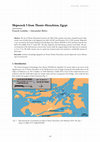
GODDIO, F. and BELOV, A. (2024) 'Ship 5 from Thonis-Heracleion, Egypt', in I. RADIĆ ROSSI, K. BATUR, T. FABIJANIĆ and D. ROMANOVIĆ (eds.), Sailing through History, Reading the Past – Imagining the Future, Proceedings of the 16th International Symposium on Boat & Ship Archaeology ISBSA 16, Zadar, ..., 2024
The site of Thonis-Heracleion located in the Nile's Delta contains more than a hundred ancient sh... more The site of Thonis-Heracleion located in the Nile's Delta contains more than a hundred ancient shipwrecks, most of which date to the Egyptian Late (664-332 BC) and Ptolemaic (332-31 BC) periods. Shipwreck 5 was excavated by the Institut Européen d'Archéologie Sous-Marine (IEASM) in 2019 and dates from the first half to the middle of the 4 th century BC. The ship caught fire and sank during a putative naval battle. The preserved portion of the hull measures seven by three meters while the original length of the ship may be estimated at 14 to 15 m. The hull's remains were in a good state of preservation and contained a considerable amount of thick ropes.
Belov, A., & Laemmel, S. (2024). Two one-armed wooden anchors from Egypt from the 5th- 4th c. BC and their сeramic сontexts. International Journal of Nautical Archaeology. doi: https://doi.org/10.1080/10572414.2024.2388518, 2024
Two one-armed wooden anchors were recently discovered in the submerged ancient city of Thonis-Her... more Two one-armed wooden anchors were recently discovered in the submerged ancient city of Thonis-Heracleion, in present-day northern Egypt. The anchors were well preserved in the clayish environment indicative of the ancient canals at the site. Archaeological finds of this particular anchor type remain rare. Preliminarily, the ceramic assemblages associated with both finds allow dating the contexts of their discovery to a period ranging from the end of the 5th to the first half of the 4th century BC.
Belova, G., & Belov, A. (2023). Previously unknown element in construction of Ancient Egyptian ships from the Late Period and its probable designation Египет и сопредельные страны, 4, 1-9. , 2023
Excavations of a submerged city of Thonis-Heracleion in the Nile's Delta brought to light numerou... more Excavations of a submerged city of Thonis-Heracleion in the Nile's Delta brought to light numerous ancient shipwrecks dating to the 8th-2nd centuries BC. Many of these ships show parallels with a Nilotic freighter baris as described by Herodotus (Hist. 2.96). Massive constructional pieces, apparently playing an important role in structure of a baris, were recently discovered at the bows of these ships. This new archaeological discovery allows reconsidering ancient Egyptian nautical terms applied to the bow of a ship and proposing the most probable word for a bow piece.
Belov, A. (2024). Bow piece construction of Ancient Egyptian baris (Herodotus Hist. 2.96). International Journal of Nautical Archaeology 53.2: 289-311, doi: 10.1080/10572414.2023.2292555, 2024
Many ships from Thonis-Heracleion, a submerged city on the Mediterranean coast of Egypt, show num... more Many ships from Thonis-Heracleion, a submerged city on the Mediterranean coast of Egypt, show numerous parallels with the construction of the Nilotic freighter baris as described by Herodotus (Hist. 2.96). During the spring mission of 2022 four massive constructional pieces of the bow from these ships were excavated and studied. Bow pieces played an important role in the structure of a baris. Obtained information complements the documentation of a baris as described by Herodotus and serves as a new architectural signature for this type of construction.
Белов, А. Парусная оснастка древнеегипетских кораблей с начала Третьего переходного периода до конца Античности (1069 г. до н. э.–конец V в. н.э.). Египет и сопредельные страны, 3, 1-30. doi: 10.24412/2686-9276-2023-00009., 2023
Статья (восьмая из серии, заключительная) посвящена основным особенностям парусной оснастки древн... more Статья (восьмая из серии, заключительная) посвящена основным особенностям парусной оснастки древнеегипетских кораблей с начала Третьего переходного периода до конца Античности (1069 г. до н. э. — конец V в. н. э.). Для этого периода характерно все возраставшее влияние греческой и римской традиций на исконно древнеегипетскую оснастку. В заключении рассмотрены основные этапы развития рангоута, такелажа и парусов древнеегипетских кораблей на протяжении почти шести тысячелетий.
Ключевые слова: древнее кораблестроение, древняя парусная оснастка, мореплавание в Древнем Египте, греко-римский период, византийский период.
Белов А. (2023) Парусная оснастка древнеегипетских кораблей в эпоху Рамессидов (1295 –1069 гг. до н.э.)., 2023
Статья (седьмая из цикла) посвящена основным особенностям парусной оснастки древнеегипетских кора... more Статья (седьмая из цикла) посвящена основным особенностям парусной оснастки древнеегипетских кораблей в эпоху Рамессидов (1295–1069 гг. до н. э.). В этот период происходил переход от парусной оснастки с нижним реем, характерной для всего предшествующего периода, к новой оснастке без нижнего рея. Статья включает в себя ссылки на основные работы о древнеегипетской речной навигации и мореплавании, многие выводы из которых дополнены или пересмотрены автором.
Ключевые слова: древнее кораблестроение, древняя парусная оснастка, мореплавание в Древнем Египте, Новое царство, эпоха Рамессидов.
Belov, A. (2023). Two bronze waterfowl figureheads from Thonis-Heracleion. International Journal of Nautical Archaeology. doi: 10.1080/10572414.2023.2217524, 2023
An intact bronze waterfowl figurehead, SCA1592, was found in the city of Thonis-Heracleion in 201... more An intact bronze waterfowl figurehead, SCA1592, was found in the city of Thonis-Heracleion in 2014 and received only brief comments in an exhibition catalogue. A fragment of a similar piece, SCA1561, has not been previously published. This article contains a detailed analysis of both pieces and cites the available comparanda from ancient Egypt. It also addresses the religious and aesthetic aspects of these figureheads.
Belov А. А. Under the Mediterranean II [in Russian] // Egypt and neighbouring countries 3 (2022): 67–72., 2022
Belov А. А. Harbour and Coastal Archaeology 2022 Mediterranean Harbour Cities I [in Russian] // Egypt and neighbouring countries 2 (2022): 95–100. , 2022


Uploads
Books by Alexander Belov
While the exact date of the sail’s first appearance in the Nile Valley cannot be precisely established, numerous images of ships with probable sail prototypes are found on the vessels of the Gerzeh culture (c. 3600–3300 BC). Natural conditions along the Nile were generally favourable for navigation. The river’s current pulled the boats downstream, while the dominant winds from the north made it possible to move southwards, against the current. However, navigation on the Nile was never straightforward, not only due to the river’s changing hydrological regime (characterised by periods of flooding and drought) but also because of the presence of numerous drifting shoals. In addition, at any time of the year, sailors could be faced with dead calm or major storms.
In spite of the widespread opinion that ancient sails and rigging did not change much over the centuries, their meticulous analysis in the context of ancient Egyptian civilisation shows slow but steady development and improvement. In this monograph, their evolution is charted for a period spanning well over three thousand years. The available material convincingly proves that in ancient Egypt the sail followed an independent path of development without any traces of foreign borrowings, the latter only becoming manifest towards the end of the Dynastic period. The author's aim is to analyse the existing material on the subject and systematise the body of earlier research, which is fragmentary. The analysis of the collected material allows the suggestion of new hypotheses while complementing or reconsidering many ideas that were expressed in previous publications.
Iconography being the main source of information on the subject, the author relies on his extensive database of ancient Egyptian nautical representations that includes over three thousand high-resolution drawings and photographs. The monograph also paid close attention to written sources. Some of them have details about the materials and sizes of different parts of the rigging, and preserved ship logs record journey times, which help us gain a rough idea of how fast the ship was going. Archaeological material on the subject is rare, and each shred of evidence is precious. The chapters of the book devoted to the Late Period (664-332 BC) and the Ptolemaic Period (332-31 BC) include new archaeological material from the sunken city of Thonis-Herakleion. Since the sail was actively used on the Nile until recently, the ethnographic material is not negligible either and needs to be considered. Finally, and throughout the research, the author relies on his personal sailing experience in support of some of the proposed theories.
The evolution of rigging is often connected to the evolution of the ship’s hull since both are determined by the same natural, economic, and social factors. In some periods of ancient Egyptian history, the form of the hull was subject to serious modifications, although, in general, it does not show a forceful variability. However, the author provides a brief description of its characteristics at the beginning of each chapter in an attempt to trace potential influences on the rigging.
The monograph follows the same plan for each period of ancient Egyptian history. Each of these sections starts with an overview of the characteristic features of the rigging. It continues with an analysis of the spars, standing and running rigging, material and geometry of the sail and concludes with an assessment of the rigging performance. The monograph is illustrated by more that a hundred images, including a series of schematic drawings that show the main elements of the rigging for each of the periods considered. The text is written in an accessible style that is not only aimed at ancient navigation specialists but also at a wider circle of Egyptologists who sometimes encounter difficulties in interpreting nautical material. For the same reason, the text is accompanied by an extensive English glossary of maritime terms.
The rich decoration that adorned the talatat of the western mole of the 9th pylon at Karnak constitute an invaluable source of iconographic information. Some of the scenes are nautical in character. They represent freighters, their crew and cargo and depict various navigational details with great precision and realism (mast blocks, stoppers, cleats). They show crews engaged in ship manoeuvres, mooring, cargo handling, and other naval activities. They provide new insights into the early years of Amenhotep IV/Akhtnaton’s reign and are of utmost importance for our understanding of the history of ancient naval technology. The iconographic study presented here is supplemented by reader-friendly 3D digital models of several of the boats depicted on the talatat, with particular reference to their rigging. The material analysed in the present volume is an important new contribution to our knowledge of Egyptian fluvial navigation at the end of the 18th Dynasty.
Chaque talatat issue du môle ouest du IXe pylône de Karnak constitue un riche matériel documentaire. Une fois assemblées entre elles, les talatat constituent des fragments de paroi, dont certains proviennent de scènes navales. Ces documents contiennent des informations nautiques avec des détails d’une très grande précision (bloqueurs, taquets, cadres, etc.). À chaque assemblage édité, c’est une fenêtre de compréhension qui s’ouvre sur la période inaugurée par l’avènement d’Amenhotep IV/Akhenaton et, de manière générale, sur l’évolution des techniques navales antiques. Les scènes éditées dans le présent ouvrage livrent une documentation inédite sur l’organisation à bord des navires, avec des équipages « en mouvement », du personnel affairé, des scènes d’amarrage ou encore diverses activités navales. L’étude des images s’appuie sur la réalisation d’une maquette numérique de plusieurs embarcations, afin d’analyser l’organisation des gréements. Les modèles numériques 3D permettent d’illustrer les analyses et de les rendre plus parlantes aux lecteurs. Ces scènes constituent un apport non négligeable de nouvelles sources documentaires sur la navigation fluviale égyptienne jusqu’à la fin de la XVIIIe dynastie.
Book Chapters by Alexander Belov
The available data on Ancient Egyptian boatbuilding techniques during the Late (664-332 BC) and Ptolemaic Period (332-30 BC) received a considerable boost from the more than seventy Ancient Egyptian ships that were found on the site of Thonis-Heracleion in 2000. Many of these ships seem to belong to the baris-type as described in Herodotus in his Historia. This chapter is an attempt to determine the space of navigation of these ships by examining the direct evidence derived from their construction, as well as indirect evidence drawn from the state of the ships’ timbers and the results of reconstruction of their hulls, and of their propulsion and steering systems.
Alexandria was extremely obscure and based mainly on written sources. Despite relative abundance of such reports none of them (including even the most thorough description of Strabo) could be used for creating a reliable chart of port structures that had been disappeared under the waters of the Mediterranean approximately at the late IV AD. Today the application of the most modern archaeological technologies under water allows not only charting the remains of the visible ancient structures but also analyzing their construction peculiarities and gathering lots of valuable archaeological material. It should be pointed out that this data drastically changes the image of the ancient ports that existed in scientific literature only a couple of years ago.
Starting from 1992 the problem of ancient topography of the Great Port has been elaborated by European Institute of Underwater Archaeology (IEASM - Institut Européen d’Archéologie Sous-Marine), France. In the period of 1992-98 an international team has performed a series of surveys that included bathymetric, magnetometric and side-scan surveys. This complex approach allowed creating high-resolution map of the bottom of the harbor while analysis of wood, bone remains and pottery gave precious datations for each structure discovered. According to the survey the area in question experienced 6-8 meters of sea level rise due both to the sea transgression and seismic activities.
The orientation, dimensions, construction method and datation of the following objects are considered in the article: Diamond rock, other rocks at the entrance to the harbor, central reef, harbor main entrance, Lohias peninsula, the system of three harbors, Antirhodos island and other smaller objects. The position of the Faro lighthouse is discussed separately and the conclusion that its remains are hidden under the modern breakwater some several hundred meters to the east from the Keit-Bey fort is suggested.
The system of the three harbors gave to ancient vessels much flexibility in maneuver both under sail and row and permitted dividing harbor into “military” and “trade” parts, this fact being proved by written sources. Thus the structure of the Great Port of Alexandria can be considered as known, however this is not the case for the port of Eunostos – highly polluted and hidden under the modern West port of Alexandria. The problem of its structure is elaborated by the Center for Egyptological Studies since 2003. During the last season the remains of the large breakwaters that defended the port from the prevailing N and NW swell have been discovered. ""
Papers by Alexander Belov
Ключевые слова: древнее кораблестроение, древняя парусная оснастка, мореплавание в Древнем Египте, греко-римский период, византийский период.
Ключевые слова: древнее кораблестроение, древняя парусная оснастка, мореплавание в Древнем Египте, Новое царство, эпоха Рамессидов.