Papers by Alexander Fedorov
Работая в разных жанрах, итальянский режиссер Франческо Мазелли (1930-2023) был одним из самых из... more Работая в разных жанрах, итальянский режиссер Франческо Мазелли (1930-2023) был одним из самых известных кинематографистов Европы («Дофины», «Равнодушные», «Подозрение», «История любви» и др.). В книге киноведа Александра Федорова впервые в отечественном искусствоведении рассказывается обо всех игровых полнометражных фильмах Франческо Мазелли. Для исследователей в области кинематографа и медиа, кинокритиков, киноведов, журналистов, преподавателей высшей школы, студентов, аспирантов, а также для широкого круга читателей, которые интересуются итальянским кинематографом. Рецензенты: профессор М. Целых, профессор А. Левицкая.
Режиссер Жак Дониоль-Валькроз (Jacques Doniol-Valcroze) поставил два десятка фильмов и сериалов и... more Режиссер Жак Дониоль-Валькроз (Jacques Doniol-Valcroze) поставил два десятка фильмов и сериалов и сыграл примерно столько же ролей в кино, но ни одна его режиссерская работа и ни один фильм с его участием не шли в советском кинопрокате. Как и многие иные режиссеры французской «новой волны» Жак Дониоль-Валькроз пришел в кино из кинокритики и киноведения. Вместе с Андре Базеном (1918-1958) и Эриком Ромером (1920-2010) он основал в 1951 году журнал Cahiers du cinéma и одновременно публиковал свои статьи о кино в популярных изданиях France Observateur, Cinémonde и La Revue du cinéma.
This article analyzes the creative path of one of the most famous Czechoslovak directors-Zbyněk B... more This article analyzes the creative path of one of the most famous Czechoslovak directors-Zbyněk Brynych (1927-1995): from his first experiments with newsreels to the "thaw" period; from his masterpieces of the 1960s to his emigration to the FRG, where (in the late 1960s and early 1970s) he directed several largely experimental films; from the period of his return to Czechoslovakia, where he became actively involved in the subject of "normalization", to the final period, when he spent the last years of his life making detective series on television in the FRG. Thus, from one of the leaders of the Czechoslovak New Wave of 1960s (Transport from Paradise, ... and the fifth horseman is Fear, I, Justice), Zbyněk Brynych in the 1970s-1980s turned into a rather ordinary director of ordinary films (What Color Is Love?, The Night of Orange Lights, Romance for a Crown, Anger, Accused and Suspect, Who Comes at Midnight, The Halftime of Happiness). The author concludes that the example of Zbyněk Brynych's winding creative path shows that the adaptation of an artist to the rules and opportunities of different periods of societies and countries can lead both to outstanding results and to the fading of the author's potential and desire to experiment.
Издание второе-дополненное. Данная монография посвящена польскому кинематографу и его отражению в... more Издание второе-дополненное. Данная монография посвящена польскому кинематографу и его отражению в зеркале советской и российской кинокритики. В приложениях даются также данные посещаемости польских фильмов в польском и советском кинопрокате. Монография* предназначена для преподавателей высшей школы, студентов, аспирантов, исследователей, кино/медиакритиков, журналистов, а также для круга читателей, которые интересуются проблемами кинематографа и кинокритики.
Пример извилистого творческого пути Збынека Брыныха показывает, что адаптация художника к правила... more Пример извилистого творческого пути Збынека Брыныха показывает, что адаптация художника к правилам и возможностям разных периодов социумов и стран может привести как к выдающимся результатам, так и к угасанию авторского потенциала и желания экспериментировать…
The article is a content analysis of texts from the magazine “Soviet Screen”
dedicated to foreign... more The article is a content analysis of texts from the magazine “Soviet Screen”
dedicated to foreign cinema in the period from 1925 to 1991 inclusive.
When presenting the results of content analysis of texts, the study authors
used specific units of counting. They became the following semantic units:
frequency of publications related to such genres as film reviews, surveys,
analytical articles, articles on the history of cinema, creative portraits
of filmmakers, interviews; the percentage of analyzed messages, that is,
texts about Western cinema in relation to the total text array of a given
publication. The counting procedure complied with standard methods of
classification into selected groups using the compilation of special tables
(including units of analysis and counting, frequency of use).

Во второй половине 1940-х и в 1950-х посещаемость французских фильмов в кинопрокате Франции нахо... more Во второй половине 1940-х и в 1950-х посещаемость французских фильмов в кинопрокате Франции находилась на пике. Жанровый спектр лидеров «золотых десяток» французского кинопроката был разнообразен, но в целом основывался на фильмах развлекательных жанров, в которых снимались любимцы французской публики.
Начиная с середины 1960-х посещаемость французских фильмов стала постепенно падать (во многом из-за конкуренции телевидения и голливудской продукции). Еще сильнее падение посещаемости кинозалов во Франции стало ощущаться в 1980-е годы. Здесь сказалась уже не только сильная конкуренция со стороны голливудской продукции и телевидения, но в основном – массовое распространение бытовой видеотехники, которая приковала к домашним экранам миллионы французов, ранее предпочитавших смотреть фильмы в кинотеатрах.
Во второй половине 1940-х в советском кинопрокате французских фильмов было очень мало. Во многом это было связано с тем, что именно в этот период на экранах СССР шли так называемые трофейные фильмы (в основном американские и немецкие).
В связи с тем, что к середине 1950-х показ так называемых трофейных фильмов (в основном – американских и немецких) в СССР был завершен, во второй половине 1950-х в советский кинопрокат стало выходить больше новых европейских фильмов, в том числе – французских. Пришедшая в СССР «оттепель» принесла существенные изменения в закупочную политику. Например, из первой десятки лидеров французского кинопроката 1958 года на экранах кинозалов СССР было показана ровно половина.
Работа советской закупочной кинокомиссии в 1960-х была довольно либеральной, что (особенно после старта «пражской весны» 1968 года) не могло пройти мимо консервативного крыла «идеологического фронта»: в советской прессе был опубликован ряд статей с резкой критикой прокатной политики относительно западной кинопродукции, «пропагандирующей буржуазный образ жизни».
Среди причин того, почему французские фильмы не попадали в советский кинопрокат, можно выделить следующие:
- табу на эротику, акцентированную религиозную и еврейскую тематику;
- опасение, что советские зрители могут как-то не так понять эпатажные, с точки зрения официальной советской морали сюжетные повороты, которые нередко встречались даже в значительных в художественном отношении фильмах;
- исключение из кандидатов на закупку фильмов с неприемлемой для советской идеологии трактовки русской и советской тематики и, соответственно, русских и советских персонажей;
- борьба советской цензуры с неверно (с ее точки зрения) расставленными идеологическими акцентами в военной тематике;
- нежелательность для советской цензуры фильмов, «пропагандирующих буржуазный образ жизни»;
- нежелательность появления на советских экранах образов обаятельных преступников;
- неприемлемость закупок новых фильмов с участием знаменитых актеров, публично критиковавших политику СССР;
- слишком высокие цены, предложенные французскими правообладателями;
Правда, в советский кинопрокат второй половины 1980-х – начала 1990-х стали всё чаще попадать французские фильмы, так или иначе нарушавшие былые цензурные табу. Это было связано с тем, что с приходом перестроечных времен работа закупочной комиссии Госкино СССР стала более либеральной и во многом стала ориентироваться на закупку высокохудожественных зарубежных фильмов, и уже перестали действовать прежние строгие идеологические и моральные запреты…
During the second half of the 1940s and into the 1950s, attendance at French films at the French ... more During the second half of the 1940s and into the 1950s, attendance at French films at the French box office was at its peak. The genre spectrum of the leaders of the "golden ten" of the French film distribution was diverse, but in general it was based on films of entertainment genres, which starred the favorites of the French public. Beginning in the mid-1960s, attendance at French films began to gradually decline (largely due to competition from television and Hollywood productions). An even greater decline in cinema attendance in France began to be felt in the 1980s. This was affected not only by strong competition from Hollywood products and television, but mainly by the massive distribution of household video equipment, which riveted millions of French people to their home screens, who previously preferred to watch films in cinemas. In the second half of the 1940s, there were very few French films in Soviet film distribution. This was largely due to the fact that it was during this period that so-called trophy films (mainly American and German) were shown on USSR screens. Due to the fact that by the mid-1950s the screening of so-called trophy films (mainly American and German) in the USSR was completed, in the second half of the 1950s more new European films, including French ones, began to be released in Soviet cinemas.. The "thaw" that
The article is a content analysis of texts from the magazine “Soviet Screen”
dedicated to foreign... more The article is a content analysis of texts from the magazine “Soviet Screen”
dedicated to foreign cinema in the period from 1925 to 1991 inclusive.
When presenting the results of content analysis of texts, the study authors
used specific units of counting. They became the following semantic units:
frequency of publications related to such genres as film reviews, surveys,
analytical articles, articles on the history of cinema, creative portraits
of filmmakers, interviews; the percentage of analyzed messages, that is,
texts about Western cinema in relation to the total text array of a given
publication. The counting procedure complied with standard methods of
classification into selected groups using the compilation of special tables
(including units of analysis and counting, frequency of use)
Статья представляет собой контент-анализ текстов жур-
нала «Советский экран», посвященных зарубеж... more Статья представляет собой контент-анализ текстов жур-
нала «Советский экран», посвященных зарубежному кине-
матографу в период с 1925 по 1991 год включительно. Пред-
ставляя результаты контент-анализа текстов, авторы
исследования использовали конкретные единицы счета. Ими
стали следующие смысловые единицы: частота публикаций,
относящихся к таким жанрам, как рецензии на фильмы,
обзоры, аналитические статьи, статьи по истории кино,
творческие портреты кинематографистов, интервью; про-
центная доля анализируемых сообщений, то есть текстов о
западном кино по отношению к общему текстовому массиву
данного издания. Процедура подсчета отвечала стандарт-
ным приемам классификации по выделенным группировкам с
использованием составления специальных таблиц (включаю-
щих единицы анализа и счета, частоту использования).
The abstract analyzes the content of the Soviet Screen magazine from 1969 to 1985, focusing on it... more The abstract analyzes the content of the Soviet Screen magazine from 1969 to 1985, focusing on its portrayal of Western cinema during the Soviet Union's "stagnation" period. The study finds that articles on Western cinema were heavily ideologized, emphasizing criticism of bourgeois cinema and its negative influence on audiences. This trend was less prominent than in the late 1960s due to significant political shifts, particularly after the 1968 events in Czechoslovakia. A crucial decree issued on January 7, 1969, by the Central Committee of the Soviet Communist Party mandated a more stringent opposition to bourgeois ideology and a vigorous promotion of communist ideals. This decree criticized media personnel for deviating from class criteria and sometimes promoting views contrary to socialist ideology. Additional resolutions in 1972 reinforced these directives, stressing the harmfulness of bourgeois ideology and the necessity for a rigorous ideological struggle against non-Marxist views and revisionist trends in literature and art. Consequently, Soviet Screen's management aligned closely with these resolutions, resulting in a marked decrease in content about Western cinema and an increase in critical coverage. Unlike during the 1960s Thaw, featuring Western movie stars on the magazine's cover became unthinkable. This period reflects the Soviet Union's broader efforts to control cultural narratives and suppress influences contrary to socialist values.
Based on the content analysis (in the context of the historical, socio-cultural and political sit... more Based on the content analysis (in the context of the historical, socio-cultural and political situation, etc.) of the texts published during the "perestroika" period of the Soviet Screen magazine (1986-1991), the authors came to the conclusion that materials on the subject of Western cinema on this stage can be divided into the following genres:-ideologized articles emphasizing criticism of bourgeois cinema and its harmful influence on the audience (1986-1987);-articles on the history of Western cinema;-biographies and creative portraits of Western actors and directors (as a rule, with positive ratings);-interviews with Western filmmakers (as a rule, with those who came to Moscow film festivals);-reviews of Western films (here we can note a violation of the old tradition: if in 1986-1987 the magazine still often negatively evaluated some "politically harmful bourgeois" films, then later Western film production was evaluated without regard to ideological stereotypes, moreover, even received a positive interpretation films that were previously rejected for ideological reasons);-articles about international film festivals and weeks of foreign cinema in the USSR, reviews of the current repertoire of Western national cinematographies (no longer divided into "progressive" and "bourgeois" cinematography);-short informational materials about events in Western cinema (from neutral reports to "yellow" gossip).
В данной статье мы остановимся на анализе материалов о зарубежном
кино, опубликованном в журнале ... more В данной статье мы остановимся на анализе материалов о зарубежном
кино, опубликованном в журнале «Советский экран» с 1925 по 1927 гг.,
когда его ответственными редакторами были: Кирилл Шутко (1884—
1941), Александр Курс (1892—1937), Вячеслав Успенский (1880—1929) и
Николай Яковлев (даты жизни неизвестны).
Rus sineması: Çok kısa bir tarihçe. Etkileşim, 13, 364-390. , 2024
RUSSIAN CINEMA: A VERY SHORT STORY
Based on content analysis (in the context of the historical, socio-cultural and political situati... more Based on content analysis (in the context of the historical, socio-cultural and political situation, etc.) of texts published during the "stagnant" period of the Soviet Screen magazine (1969-1985), the authors came to the following conclusions. Of the wide range of Hollywood and British films, Soviet film distribution in the period we analyzed included mainly films with an acute social message, critically showing Western realities. Therefore, it is not at all surprising that these films received maximum support in the Soviet Screen; articles by Soviet film critics emphasized the "progressive anti-bourgeois significance" of these films. It is very significant that, even when reviewing American films, which seemed to be completely far from politics, the reviewers of Soviet Screen demonstrated ideological approaches. Of course, among the reviews of American and British films in Soviet Screen, there also appeared texts that were devoid of a direct appeal to politics. "Apoliticalism" was especially evident in reviews devoted to film adaptations of classical works, which often took place in the 19th century and earlier. Frankly entertaining Hollywood and British films were released into Soviet distribution in the 1970s and the first half of the 1980s quite rarely. And here, Soviet Screen reviewers often sought to distance themselves from edifying political and ideological assessments, concentrating on a professional analysis of the artistic quality of this or that entertaining film. In Italian and French cinema, the Soviet Screen consistently gave preference to political films that "expose capitalist reality." Of course, Soviet Screen, as before, could not ignore the works of Federico Fellini, Luchino Visconti, Michelangelo Antonioni, Francois Truffaut and other outstanding masters of cinema. But here, too, the magazine's reviewers assessed their work mainly within the framework of Marxist ideological principles, on the basis of which even the films of such recognized masters as Federico Fellini were criticized. The sharp rejection of Soviet Screen reviewers was often caused by entertainment films with the participation of Jean-Paul Belmondo, which were reproached for promoting "supermanhood" and violence. The Soviet Screen's reviews of famous French and Italian comedies were more benevolent, but overall rather skeptical. Of course, the range of Western films, for one reason or another, did not reach the Soviet mass audience, was much wider than film distribution. And year after year, the editors of the magazine selected examples for criticism of bourgeois society and imperialism: films of an anti
The "Information for All" editorial house published new monograph "Evolution of theoretical film ... more The "Information for All" editorial house published new monograph "Evolution of theoretical film studies concepts in the Cinema Art journal (1931-2021)". This book is one from a series of articles and books on cinema published in recent years as part of the same research collective. New research "Evolution of theoretical film studies concepts in the Cinema Art journal (1931-2021)" supported by the Russian Science Foundation (grant No. 22-28-00317), and devoted to the analysis of transformations of theoretical concepts and is based on a review of materials presented on the pages of the Cinema Art journal. This analysis is very extensive and covers the period from the 1930s (when this journal first began to appear) to the present. The material of this book might be of interest for higher-school teachers, students, graduate students, researchers, film critics, cinema scholars, journalists, as well as for the wide range of readers who are interested in the history of cinema art, problems of cinema, film criticism and film sociology. In connection with the publication of the monograph Alexander Fedorov gave an interview to Professor Marina Tselykh.
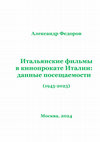
Какие итальянские игровые фильмы пользовались популярностью в кинопрокате Италии? Каковы данные п... more Какие итальянские игровые фильмы пользовались популярностью в кинопрокате Италии? Каковы данные посещаемости этих фильмов? На эти вопросы отвечает данный справочник.
Справочное издание предназначено для преподавателей высшей школы, студентов, аспирантов, исследователей, кинокритиков, киноведов, журналистов, а также для круга читателей, которые интересуются проблемами кинематографа, киносоциологии и киностатистики.
Рецензенты: профессор М. Целых, профессор А. Левицкая.
Fedorov, A.V. Italian films in the film distribution in Italy (1945-2023). Moscow: SM "Information for All", 2024. 68 p.
Which Italian feature films were popular in the Italian box-office? What are the attendance figures for these films? This guide answers these questions.
This edition is intended for educators, students, graduate students, researchers, film critics, cinema scholars, journalists, as well as for the readers who are interested in the problems of cinema, movies, sociology and statistics.
Reviewers: Professor M. Tselykh, Professor A. Levitskaya.
В данной статье мы остановимся на анализе теоретических концепций киноведения в журнале «Искусств... more В данной статье мы остановимся на анализе теоретических концепций киноведения в журнале «Искусство кино» в XXI веке), когда его главными редакторами были Даниил Дондурей (1947-2017) и Антон Долин (2017 - до весны 2022).
At the beginning of the twenty-first century, the editors of Cinema Art apparently realized that ... more At the beginning of the twenty-first century, the editors of Cinema Art apparently realized that the attempts to transform the magazine into a socio-political one, made at the end of the "perestroika" era and in the 1990s, had not yielded the expected dividends. As a result, the journal returned to the format of a cinematic publication. Hence the increase in the number of theoretical articles on cinema, which in the 21st century averaged eighteen a year. Daniil Dondurey (1947-2017), who directed Cinema Art until 2017, maintained the journal's course towards a sociological understanding of the media process, while attracting leading authors in the field. The film critic Anton Dolin, who replaced him in the second half of 2017, on the one hand re-emphasized political accents and also strengthened passages in the journal texts that opposed the authorities, and on the other hand began to pay much more attention to the genres of mass culture in film. Our analysis of the concepts of film studies (in the context of the socio-cultural, historical, political situation, etc.) in the journal Cinema Art in the 21st century has shown that the theoretical works on cinematic topics in this period can be divided into the following types-Articles, discussions devoted to the analysis of the theoretical heritage of the classics and the history of Soviet cinema (A
В данной статье мы остановимся на анализе теоретических концепций киноведения в журнале «Искусств... more В данной статье мы остановимся на анализе теоретических концепций киноведения в журнале «Искусство кино» (Cinema Art) эпохи «стагнации» (1969-1985), когда его ответственными редакторами были: Людмила Погожева (1913-1989), Е. Сурков (1915-1988), А. Медведев (1938-2022) и Ю. Черепанов (р. 1937).


Uploads
Papers by Alexander Fedorov
dedicated to foreign cinema in the period from 1925 to 1991 inclusive.
When presenting the results of content analysis of texts, the study authors
used specific units of counting. They became the following semantic units:
frequency of publications related to such genres as film reviews, surveys,
analytical articles, articles on the history of cinema, creative portraits
of filmmakers, interviews; the percentage of analyzed messages, that is,
texts about Western cinema in relation to the total text array of a given
publication. The counting procedure complied with standard methods of
classification into selected groups using the compilation of special tables
(including units of analysis and counting, frequency of use).
Начиная с середины 1960-х посещаемость французских фильмов стала постепенно падать (во многом из-за конкуренции телевидения и голливудской продукции). Еще сильнее падение посещаемости кинозалов во Франции стало ощущаться в 1980-е годы. Здесь сказалась уже не только сильная конкуренция со стороны голливудской продукции и телевидения, но в основном – массовое распространение бытовой видеотехники, которая приковала к домашним экранам миллионы французов, ранее предпочитавших смотреть фильмы в кинотеатрах.
Во второй половине 1940-х в советском кинопрокате французских фильмов было очень мало. Во многом это было связано с тем, что именно в этот период на экранах СССР шли так называемые трофейные фильмы (в основном американские и немецкие).
В связи с тем, что к середине 1950-х показ так называемых трофейных фильмов (в основном – американских и немецких) в СССР был завершен, во второй половине 1950-х в советский кинопрокат стало выходить больше новых европейских фильмов, в том числе – французских. Пришедшая в СССР «оттепель» принесла существенные изменения в закупочную политику. Например, из первой десятки лидеров французского кинопроката 1958 года на экранах кинозалов СССР было показана ровно половина.
Работа советской закупочной кинокомиссии в 1960-х была довольно либеральной, что (особенно после старта «пражской весны» 1968 года) не могло пройти мимо консервативного крыла «идеологического фронта»: в советской прессе был опубликован ряд статей с резкой критикой прокатной политики относительно западной кинопродукции, «пропагандирующей буржуазный образ жизни».
Среди причин того, почему французские фильмы не попадали в советский кинопрокат, можно выделить следующие:
- табу на эротику, акцентированную религиозную и еврейскую тематику;
- опасение, что советские зрители могут как-то не так понять эпатажные, с точки зрения официальной советской морали сюжетные повороты, которые нередко встречались даже в значительных в художественном отношении фильмах;
- исключение из кандидатов на закупку фильмов с неприемлемой для советской идеологии трактовки русской и советской тематики и, соответственно, русских и советских персонажей;
- борьба советской цензуры с неверно (с ее точки зрения) расставленными идеологическими акцентами в военной тематике;
- нежелательность для советской цензуры фильмов, «пропагандирующих буржуазный образ жизни»;
- нежелательность появления на советских экранах образов обаятельных преступников;
- неприемлемость закупок новых фильмов с участием знаменитых актеров, публично критиковавших политику СССР;
- слишком высокие цены, предложенные французскими правообладателями;
Правда, в советский кинопрокат второй половины 1980-х – начала 1990-х стали всё чаще попадать французские фильмы, так или иначе нарушавшие былые цензурные табу. Это было связано с тем, что с приходом перестроечных времен работа закупочной комиссии Госкино СССР стала более либеральной и во многом стала ориентироваться на закупку высокохудожественных зарубежных фильмов, и уже перестали действовать прежние строгие идеологические и моральные запреты…
dedicated to foreign cinema in the period from 1925 to 1991 inclusive.
When presenting the results of content analysis of texts, the study authors
used specific units of counting. They became the following semantic units:
frequency of publications related to such genres as film reviews, surveys,
analytical articles, articles on the history of cinema, creative portraits
of filmmakers, interviews; the percentage of analyzed messages, that is,
texts about Western cinema in relation to the total text array of a given
publication. The counting procedure complied with standard methods of
classification into selected groups using the compilation of special tables
(including units of analysis and counting, frequency of use)
нала «Советский экран», посвященных зарубежному кине-
матографу в период с 1925 по 1991 год включительно. Пред-
ставляя результаты контент-анализа текстов, авторы
исследования использовали конкретные единицы счета. Ими
стали следующие смысловые единицы: частота публикаций,
относящихся к таким жанрам, как рецензии на фильмы,
обзоры, аналитические статьи, статьи по истории кино,
творческие портреты кинематографистов, интервью; про-
центная доля анализируемых сообщений, то есть текстов о
западном кино по отношению к общему текстовому массиву
данного издания. Процедура подсчета отвечала стандарт-
ным приемам классификации по выделенным группировкам с
использованием составления специальных таблиц (включаю-
щих единицы анализа и счета, частоту использования).
кино, опубликованном в журнале «Советский экран» с 1925 по 1927 гг.,
когда его ответственными редакторами были: Кирилл Шутко (1884—
1941), Александр Курс (1892—1937), Вячеслав Успенский (1880—1929) и
Николай Яковлев (даты жизни неизвестны).
Справочное издание предназначено для преподавателей высшей школы, студентов, аспирантов, исследователей, кинокритиков, киноведов, журналистов, а также для круга читателей, которые интересуются проблемами кинематографа, киносоциологии и киностатистики.
Рецензенты: профессор М. Целых, профессор А. Левицкая.
Fedorov, A.V. Italian films in the film distribution in Italy (1945-2023). Moscow: SM "Information for All", 2024. 68 p.
Which Italian feature films were popular in the Italian box-office? What are the attendance figures for these films? This guide answers these questions.
This edition is intended for educators, students, graduate students, researchers, film critics, cinema scholars, journalists, as well as for the readers who are interested in the problems of cinema, movies, sociology and statistics.
Reviewers: Professor M. Tselykh, Professor A. Levitskaya.