Papers by Alireza Sardari
Iranian Journal of Archaeological Studies, 2024
The third millennium BCE in the Kur River basin of Fars is marked by the two cultures of Banesh a... more The third millennium BCE in the Kur River basin of Fars is marked by the two cultures of Banesh and Kaftari. Scholars have assumed a gap in the chronological sequence between these two periods, suggesting that sedentary communities became largely dispersed during this time span. Tol-e Qaleh, a settlement site from the third millennium BCE in the eastern Kur basin, was surveyed and excavated in 2021 and 2022. The earliest and latest contexts identified by the stratigraphic excavations represent the Banesh and the Shogha-Timuran, respectively. Through laboratory examinations of a distinct pottery type, namely the red ware dating to the Banesh, a transitional phase, and Kaftari period, the present study aimed at exploring the technological transformations in the pottery of the third millennium BCE at Tol-e Qaleh: Was there continuity in the industry, or is a discontinuity evident? To this end, eight pottery samples were subjected to X-ray fluorescence (XRF) and X-ray diffraction (XRD) tests as well as petrography. The previously established presence of "anorthite phase" in the local soil attested to the local provenance of the assemblages dating to the Banesh, transitional, and Kaftari periods at Tol-e Qaleh. Moreover, the results of chemical analyses suggested that the constituent elements of the potsherds remained consistent throughout the third millennium BCE at the site.
Near Eastern Archaeology, 2025
The Zāyandeh Rūd River played an important role in shaping the
society of ancient Isfahan, althou... more The Zāyandeh Rūd River played an important role in shaping the
society of ancient Isfahan, although the river basin had not been
well investigated archaeologically. In 2021 an archaeological
survey was conducted by the Isfahan Hydraulic Heritage Project
along the Zāyandeh Rūd River. Roughly thirty kilometers southeast
of the city of Isfahan, prehistoric pottery sherds attributed
to the Bakun period came to light on the surface of a tell-site
called Tappeh Ziar. The analysis and comparison of the sherds
show some interactions with the Fars prehistoric cultures, especially
the Kur River Basin during the fifth millennium BCE.
ICAR Journal, 2024
The Shiraz Intermountain Plain in the center of Fars province, Southern Zagros, is one of the int... more The Shiraz Intermountain Plain in the center of Fars province, Southern Zagros, is one of the interesting environments for studying ancient societies from the prehistoric era to the present. Some archaeological surveys in the area revealed human presence from the Paleolithic periods (about 40,000 years ago), as well as the recent archaeological excavations at two prehistoric sites of Eshkaft-e Ghad-e Barmshur (Paleolithic) and Tappeh Poustchi (6th and 5th millennia B.C), has presented convincing evidence in support of this hypothesis. Additionally, material culture (Pottery Assemblage) of other sites such as Tappeh Kutahi (6th millennium B.C) and Tappeh Shahgholibeigi (4th millennium B.C) have increased more documents relating prehistoric cultures of the plain. Therefore, based on the evidence we can establish a preliminary framework for prehistoric cultural sequence and local chronology of Shiraz plain through Paleolithic and Neolithic periods and archaeological phases of Archaic Fars (Mushki/Jari), early Fars (Shamsabad), middle and late Fars (Bakun) to early urbanization (Lapui) and it explains cultural transformations to Elamite period during 3th millennium B.C. Furthermore, in accordance with the research of interdisciplinary sciences such as Paleoclimatology, Paleohydrology, and Palynology (ancient vegetation) that have been done on the sediments of Maharlu Lake Basin, we attempt to evaluate the effects of climatically environmental conditions during the Holocene era on the ancient societies and human settlements and also to describe the nature of their interactions.
فصلنامه کواترنری ایران, 2019
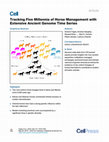
Cell
Horse domestication revolutionized warfare and accelerated travel, trade, and the geographic expa... more Horse domestication revolutionized warfare and accelerated travel, trade, and the geographic expansion of languages. Here, we present the largest DNA time series for a non-human organism to date, including genome-scale data from 149 ancient animals and 129 ancient genomes (R1-fold coverage), 87 of which are new. This extensive dataset allows us to assess the modern legacy of past equestrian civilizations. We find that two extinct horse lineages existed during early domestication, one at the far western (Iberia) and the other at the far eastern range (Siberia) of Eurasia. None of these contributed significantly to modern diversity. We show that the influence of Persian-related horse lineages increased following the Islamic conquests in Europe and Asia. Multiple alleles associated with elite-racing, including at the MSTN ''speed gene,'' only rose in popularity within the last millennium. Finally, the development of modern breeding impacted genetic diversity more dramatically than the previous millennia of human management.
Scientific Reports
the house mouse (Mus musculus) represents the extreme of globalization of invasive mammals. Howev... more the house mouse (Mus musculus) represents the extreme of globalization of invasive mammals. However, the timing and basis of its origin and early phases of dispersal remain poorly documented. to track its synanthropisation and subsequent invasive spread during the develoment of complex human societies, we analyzed 829 Mus specimens from 43 archaeological contexts in Southwestern Asia and Southeastern Europe, between 40,000 and 3,000 cal. BP, combining geometric morphometrics numerical taxonomy, ancient mitochondrial DnA and direct radiocarbon dating. We found that large late hunter-gatherer sedentary settlements in the Levant, c. 14,500 cal. BP, promoted the commensal behaviour of the house mouse, which probably led the commensal pathway to cat domestication. House mouse invasive spread was then fostered through the emergence of agriculture throughout the Near East 12,000 years ago. Stowaway transport of house mice to Cyprus can be inferred as early as
Bioarchaeology of the Near East, 2019
THE IRANIAN PLATEAU DURING THE BRONZE AGE, 2019
The book compiles a portion of the contributions presented during the symposium "Urbanisation, co... more The book compiles a portion of the contributions presented during the symposium "Urbanisation, commerce, subsistence and production during the third millennium BC on the Iranian Plateau", which took place at the Maison de l'Orient et de la Méditerranée in Lyon, the 29-30 of April, 2014. The twenty papers assembled provide an overview of the recent archaeological research on this region of the Middle East during the Bronze Age. The socio-economic transformation from rural villages to towns and nations has prompted many questions into this evolution of urbanisation. What was the impact of interactions between cultures in the Iranian Plateau and the surrounding regions (Mesopotamia, the South Caucasus, Central Asia, Indus Valley)? What was the overall context during the Bronze Age on the Iranian Plateau? What was the extent and means of the expansion of the Kuro-Araxe culture? How did the Elamite Kingdom become established? What new knowledge has been contributed by the recent excavations and studies undertaken in the east of Iran? What was the influence of the Indus Valley culture, known as an epicentre of urbanisation in South Asia? What are the unique characteristics of the ancient cultures in Iran?
Geo-archaeology arises from the integration of methods and abilities of archeology and geomorphol... more Geo-archaeology arises from the integration of methods and abilities of archeology and geomorphology. Evidences suggest that during the history of the earth, climatic conditions have undergone numerous changes in geographic characteristics, including geomorphic ones. Understanding the geomorphic phenomena and its effects on ancient habitats help in identifying human habitation patterns and therefore, managing archaeological heritages in a regional scale. Susiana plain in the north of Khuzestan province has been the longest site of the first and most extensive archaeological research in Iran. Susa, the foundation of the first cultural succession framework, has been introduced from prehistoric periods in southwestern of Iran. Based on the surveys and extensive excavations in Khuzestan, different sites have been identified with long-term occupancies, which in some way illuminate the settlement system of different periods of life in this area. Over a hundred years of excavation in Susa, the signs of settlements and communities have been identified, which prove that these settlements have begun since the middle of the 5th millennium BC, and continued steadily until the seventh century AH. Generally, human and natural changes can be the cause of the weakening of the settlements at any time period. Now, the question is which of these factors has influenced the weakening of the settlements of the western Susiana plain and what process has taken place? The purpose of this research is to investigate the role of the factors affecting these settlements. Susiana plain, as one of the most important human origins in the Middle East, is of great importance to those interested in the natural and ancient sciences. Geo-archaeological studies, and especially the use of geomorphological techniques to understand the pattern of human habitats, can be an effective step towards making the history of civilization clearer in this region, and in Iran. The methods used in this study were application of corona satellite images, field observations and luminescence optical lens experiments. Overall, the survey of the environment, review the totality of settlements and water resources, as a criterion for field deployments, have been used in this study. Therefore, the separation of historic or prehistoric periods is not so significant. Although the role of human factors in undermining certain important settlements is undeniable, but in the vastness of a plain with hundreds of scattered settlements, a greater reason is required. In addition, there is not enough evidence available from anthropologists about human factors yet. If we consider the importance of water in human societies and throughout the human history along with the environmental changes detailed in the discussion, it can be assumed that the natural changes were the main factor in undermining or destroying the
Tepe Qela Gap (also known as Ghala Gap ) in Azna: Lurestan, was excavated in 2009 aiming to estab... more Tepe Qela Gap (also known as Ghala Gap ) in Azna: Lurestan, was excavated in 2009 aiming to establish the chronological sequence for the Azna Plain located eastern of Central Zagros, which had been scarcely studied archaeologically until now. Considering the ecological diversity surrounding the plain, Tepe Qela Gap seems to have been an ideal place for the settlement of permanent villages but could also be suitable for nomadic and seminomadic people. The archaeozoological study of a large faunal assemblage, approximately 6500 items from this site, has provided evidence on the evolution of the subsistence economy of the site during various periods of occupation. The faunal spectra of Qela Gap from different periods, indicates that domesticated sheep/goat and cattle were the major source of animal resources. Among these domesticates it should be noted that cattle ratios are important and together with evidences of kill off patterns and osteological pathologies, we can hypothesise that these animals were used not only for food but also as draught animals, most probably, used for agricultural activities. This is a feature especially visible during the Bronze Age. The wild species, although not abundant (6%), were also part of the subsistence economy. Remains of wild sheep (Ovis orientalis), red deer (Cervus elaphus) or persian fallow deer (Dama mesopotamica), boar (Sus scrofa) and gazelle (Gazella subgutturosa) have been found and indicate that different ecosystems were exploited. Another important feature of the Qela Gap fauna is the discovery of a horse (Equus caballus) bone within the Neolithic Levels. In parallel to the archaeozoological analysis, the archaeobotanical studies are on-going and will provide a more complete picture of the subsistence economy of the site during the 5000 years of occupation.



Uploads
Papers by Alireza Sardari
society of ancient Isfahan, although the river basin had not been
well investigated archaeologically. In 2021 an archaeological
survey was conducted by the Isfahan Hydraulic Heritage Project
along the Zāyandeh Rūd River. Roughly thirty kilometers southeast
of the city of Isfahan, prehistoric pottery sherds attributed
to the Bakun period came to light on the surface of a tell-site
called Tappeh Ziar. The analysis and comparison of the sherds
show some interactions with the Fars prehistoric cultures, especially
the Kur River Basin during the fifth millennium BCE.