Books by Ana Eclair (nee Dragojlovic)
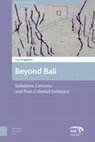
Beyond Bali explores Balinese subaltern citizens’ production of post-colonial intimacy both du... more Beyond Bali explores Balinese subaltern citizens’ production of post-colonial intimacy both during colonialism and as they continue to have effects in the present. Through a complex reification of claims to proximity and mutuality between themselves and the Dutch, diasporic subjects reconfigure kebalian (Balinese-ness) to encompass the personal, social, and cultural complexities involved in being persons and collectives of Balinese ethnicity in Dutch post-colonial society. Balinese subaltern citizens, whether former leftist political exiles, artists or everyday citizens, rather than criticizing, evoke colonial hierarchies of themselves as carriers of unique cultural traditions firstly promoted by the Dutch colonial policy (named 'Balinization’) to position themselves higher than the other foreigners in the Dutch post-colonial matrix of difference. From everyday encounters at work, schools, social gatherings, Indische cultural festivals and post-colonial commemorations - Balinese subaltern citizens engage in performances aiming to authenticate them as long-distance cultural specialists. Beyond Bali explores ways that people move in and inhabit the world as situated in historical contingencies, the circulation of materiality through diverse social worlds, and processes of moving and inhabiting the world in which national histories, objects, visual and performing arts are employed in processes of home-making.
Edited Collections by Ana Eclair (nee Dragojlovic)
The International Encyclopedia of Anthropology, 2018
Transformation of heterosexuality in the context of transnational mobility has been much neglecte... more Transformation of heterosexuality in the context of transnational mobility has been much neglected in the scholarly literature. In this themed issue we bring together four articles to contribute to the debates about negotiations of heterosexual sexual relations and practices between European and North American women and local men at holiday destinations. The focus is on Euro-North American women’s performances of heterosexuality as bound up with gender, race, age, and nationality. Each article uses ethnographic methods to demonstrate how transformation of heterosexuality is spatially and culturally contingent and contested in relation to normative expectations
of heterosexual love, sex, and romance regulating women’s sexuality both in the women travellers’ home countries and in the destination of the encounters. More broadly, articles in this themed issue contribute to the emerging literature aiming to rethink heterosexualities.
Colonial Re-Collections: Memories, Objects, Performances
Bijdragen tot de Taal-, Land- en Volkenkunde (Journal of the Humanities and Social Sciences of Southeast Asia
Reframing the Nation: Migration, Borders and Belonging
The Asia Pacific Journal of Anthropology, 2008
Indonesian Political Exiles
Review of Indonesian and Malaysian Affairs (RIMA), 44: 1, 2010
Papers by Ana Eclair (nee Dragojlovic)

Bodies and Suffering
This book is a critical response to a range of problems - some theoretical, others empirical - th... more This book is a critical response to a range of problems - some theoretical, others empirical - that shape questions surrounding the lived experience of suffering. It explores how moral and ethical questions of personal suffering are experienced, contested, negotiated and institutionalised. Bodies and Suffering investigates the moral labour and significance invested in actions to care for others, or in failing to do so. It also explores circumstances - personal, political and social - under which that which is perceived as non-moral becomes moral. Drawing on case studies and empirical research, Bodies and Suffering examines the idea of the suffering body across different cultures and contexts and the experience and treatment of these suffering bodies. The book draws on theories of affect, embodiment, the phenomenology of illness and moralities of care, to produce a nuanced understanding of suffering as being located across the assumed borders of time, space, bodies, persons and things. Suitable for bioethicists, medical anthropologists, health sociologists and body studies scholars, Bodies and Suffering will also be of use on health science courses as essential reading on suffering bodies, mental health and morality and ethics issues.
Queering and decolonising the museum: ‘In the Presence of Absence’ exhibition at the Stedelijk Museum
Memory Studies, Feb 1, 2023
This review engages with the recent ‘In the Presence of Absence’ exhibition (2020–2021), which wa... more This review engages with the recent ‘In the Presence of Absence’ exhibition (2020–2021), which was held at the Stedelijk Museum of Modern Art (Amsterdam, the Netherlands). By focusing on three artistic interventions included in the exhibition (Werker Collective’s ‘A Gestural History of the Young Worker’, Farida Sedoc’s ‘The Future Ain’t What it Used to Be’, and Jennifer Tee’s ‘Tampan Ship of Souls #2’ and ‘Tampan the Collected Bodies’), we aim to highlight ways of creatively queering and decolonizing artistic practices and spaces, including museums and conventional memory narratives.
An Archive of <i>Feelings</i> @ 20: An interview with Ann Cvetkovich
Memory Studies, Feb 1, 2023
Feminist and queer studies scholar Ann Cvetkovich’s trailblazing book An Archive of Feelings: Tra... more Feminist and queer studies scholar Ann Cvetkovich’s trailblazing book An Archive of Feelings: Trauma, Sexuality, and Lesbian Public Cultures has had an immense influence on the field of memory studies, inspiring new bodies of scholarship on queerness, trauma, and memory. In this interview, Cvetkovich discusses the impact that some of the book’s central concepts have had on the field of memory studies over the last 20 years. Cvetkovich also reflects on the role that An Archive of Feelings has had in bringing affect into feminist and queer work on sexuality, intimacy, and everyday life. Furthermore, she reflects on another of her groundbreaking books, Depression: A Public Feeling, in which she applies queer cultural analysis to unusual archives and writes critical memoir in order to situate depression as an historical category. The interview closes with Cvetkovich’s reflections on her current work on queer Indigenous approaches to trauma.
Bodies and Suffering: Emotions and Relations of Care
This book is a critical response to a range of problems - some theoretical, others empirical - th... more This book is a critical response to a range of problems - some theoretical, others empirical - that shape questions surrounding the lived experience of suffering. It explores how moral and ethical questions of personal suffering are experienced, contested, negotiated and institutionalised. Bodies and Suffering investigates the moral labour and significance invested in actions to care for others, or in failing to do so. It also explores circumstances - personal, political and social - under which that which is perceived as non-moral becomes moral. Drawing on case studies and empirical research, Bodies and Suffering examines the idea of the suffering body across different cultures and contexts and the experience and treatment of these suffering bodies. The book draws on theories of affect, embodiment, the phenomenology of illness and moralities of care, to produce a nuanced understanding of suffering as being located across the assumed borders of time, space, bodies, persons and things. Suitable for bioethicists, medical anthropologists, health sociologists and body studies scholars, Bodies and Suffering will also be of use on health science courses as essential reading on suffering bodies, mental health and morality and ethics issues.
Sukarno's Students': Reconfiguring Notions of Exile, Community and Remembering
Following the events of 1965-66, some of the Indonesian students who had been sent overseas to st... more Following the events of 1965-66, some of the Indonesian students who had been sent overseas to study remained in their countries of study while others moved across the Eastern bloc in search of a country in which to reside permanently. Some, who later on ...
‘Playing family’: unruly relationality and transnational motherhood
Gender Place and Culture, Apr 22, 2015
Scholarly literature on interpersonal relationships between tourist women and local men has been ... more Scholarly literature on interpersonal relationships between tourist women and local men has been largely discussed under the heteronormative framework of love and sexuality. However, the plenitude of ways in which these intimacies manifest themselves requires that we pay attention to the manifold forms of heterosexual relatedness that these intimacies generate. This article considers how intimate liaisons between Western women and Balinese men that commenced as holiday romances in Bali transform into unruly relationality and transnational motherhood. Focusing the analysis on women's narratives, the article explores how subjects engage in the production of sexual, reproductive, social and economic forms of transnational relatedness wherein the mother and child live permanently in the women's country of citizenship while the Balinese father remains in Bali. Rather than aspiring towards a monogamous relationship and cohabitation as heteronormativity prescribes, the article demonstrates how these non-conventional, transnational families perpetually challenge the nuclear family norm, boundaries of normative motherhood and dichotomies of home versus away.
Balinese Art, Religion, and Community in the Netherlands
Palgrave Macmillan eBooks, Oct 17, 2014
Since the early twentieth century a substantial body of scholarly work has concerned westerners t... more Since the early twentieth century a substantial body of scholarly work has concerned westerners traveling to Bali and their personal, artistic, spiritual, and political engagements with the Balinese.1 Many early travelers to Bali were western artists and anthropologists who later helped introduce Bali to the West. These early ethnographic accounts2 and popular writings about the uniqueness of the island, its peoples, and cultures played a significant role in the establishment of paradisiacal images of an essentially aesthetic and static Balinese culture. In 1937 the Mexican caricaturist Jose Miguel Covarrubias (1904–1957) wrote, for instance, that “everybody in Bali seems to be an artist. Coolies [sic] and princes, priests and peasants, men and women alike, can dance, play musical instruments, paint, or carve in wood and stone.”3 Bali’s representation as an artist’s haven and its long history as a tourist destination have helped to construct the island as culturally unique, a kind of “last paradise,” a site of timeless culture, and a place in which heated local debates about practices deemed “non-traditional” have been effectively obscured. The Balinese themselves have often chosen to reflect this image, for a variety of reasons.4 Following early-twentieth-century popular and ethnographic writings and the subsequent development of the tourist industry, a notion of Balinese identity was conceived in essential terms of nationality, religion, race, and ethnicity5—in terms, that is, of an “ultimate essence that transcends historical and cultural boundaries.”6
Afterword: Gender, violence, power
Gender, Violence and Power in Indonesia
Gender Place and Culture, Aug 10, 2021
This article examines how the traumatic experiences of previous Indo-European or Indische generat... more This article examines how the traumatic experiences of previous Indo-European or Indische generations shape future generations' intergenerational family dynamics and practices within home environments. By analysing life story interviews with Indo-Europeans from the first, second and third generation within twenty-one families, we illustrate how intergenerational hauntings are embodied, expressed and negotiated among various generations within home environments. The Indo-European diaspora has multi-generational 'mixed' Dutch-Indonesian ancestry and collective memories of the colonial Dutch East Indies, the Japanese occupation of Indonesia during the Second World War, the Indonesian National Revolution, and families' subsequent repatriation to the Netherlands. Shaped by their alleged success in having silently assimilated in the Netherlands, public narratives often neglect Indo-Europeans' daily realities and histories. We argue that personal and collective histories of war violence, racialized violence and displacement are deeply ingrained in Indo-European intergenerational and gendered family dynamics and practices in home environments. These intergenerational hauntings are imbued in both presence and absence in the various atmospheres and social and physical spaces of home.
Tracing Silences
Routledge eBooks, Apr 5, 2023
Open Access: Introduction
Tracing Silences
The practice of secrecy as a moral economy of care



Uploads
Books by Ana Eclair (nee Dragojlovic)
Edited Collections by Ana Eclair (nee Dragojlovic)
of heterosexual love, sex, and romance regulating women’s sexuality both in the women travellers’ home countries and in the destination of the encounters. More broadly, articles in this themed issue contribute to the emerging literature aiming to rethink heterosexualities.
Papers by Ana Eclair (nee Dragojlovic)