Talks by Andrej Radman
DigitalFUTURES Doctoral Consortium: What can architects learn from philosophy?; Session on Raymon... more DigitalFUTURES Doctoral Consortium: What can architects learn from philosophy?; Session on Raymond Ruyer
Although relatively unknown today, Raymond Ruyer (1902-1987) was a French philosopher whose ideas and works were significant influences on many of the better known philosophers, such as Gilbert Simondon, Gilles Deleuze and Félix Guattari, whom we have covered in this series. He is especially well known for his work on embryology, biology and informatics theory, and is the author of the book, Cybernetics and the Origin of Information. His philosophy is introduced by Andrej Radman (TU Delft) and Stavros Kousoulas (TU Delft)
The Masterclass is now available on our YouTube channel. You can find the links to the two parts ... more The Masterclass is now available on our YouTube channel. You can find the links to the two parts of the full-day event in the enclosed document.
Book Chapters by Andrej Radman
The Ecological Turn: Design, Architecture and Aesthetics beyond ‘Anthropocene’, 2022
The chapter is devoted to an ecological work of art; the proof that
senses, inventions and worlds... more The chapter is devoted to an ecological work of art; the proof that
senses, inventions and worlds are not to be considered in isolation.
It examines the process of folding an ‘uncanny valley’ into
an ‘inhabitable mountain’ across seven points. First: Amor fati,
the Nietzschean call to be worthy of what happens to us. Second:
Decoding and Reterritorialisation, the emergence of sensibilia
as expressive features. Third: Superjects and Objectiles, the
primacy/exteriority of relations. Fourth: Isomorphism without
Resemblance, the vital asymmetry between the virtual capacities
and actual properties. Fifth: Schizoanalysis, the non-entailment of
material inference, a.k.a. abduction. Sixth: Mutation of Boundary
Conditions, the downward causation of enabling constraints. Seventh:
Geology of Morals, recasting ethics as a problem of power,
not duty. To quote Le Clèzio, “Perhaps one day we will know that
there wasn’t any art but only medicine.”
Proceedings of the 2020 DigitalFUTURES, ed. P.F. Yuan et al. , 2021
The chapter draws on the anti-substantivist and anti-hylomorphic legacy of two significant Deleuz... more The chapter draws on the anti-substantivist and anti-hylomorphic legacy of two significant Deleuze and Guattari’s interlocutors: Raymond Ruyer and Gilbert Simondon. Ruyer vehemently opposed the logic of mechanicism without regressing to (active) vitalism. His masterpiece Neofinalism, yet to be fully appreciated in architectural circles, is an ode to multiplicity or ‘absolute form’. The title is to be read as a challenge to the hegemony of the step-by-step causation and partes-extra-partes mereology. According to Ruyer, non-locality is the key, not only to the question of subjectivity, but to the problem of life itself. Simondon too shies away from the metaphysics of presence. For him, the process of individuation cannot be grasped on the basis of the fully formed individual. In other words, the knowledge of individuation is the individuation of knowledge. Simondon’s highest ambition in On the Mode of Existence of Technical Objects was to integrate culture and technics (tekhne). The conviction that culture need not be antagonistic to technology is particularly pertinent to the ecologies of architecture. In the second half of the chapter, the affordance theory meets contemporary neurosciences.
Ambiances, Alloaesthesia: Senses, Inventions, Worlds. E-conference. Proceedings of the 4th International Congress on Ambiances, 2020
The philosophies of substance presuppose a subject which then encounters a datum. This subject th... more The philosophies of substance presuppose a subject which then encounters a datum. This subject then reacts to the datum. The process ontology presupposes a datum (firstness) which is met with feelings (secondness), and progressively attains the unity of a subject (thirdness). It is in this sense that our bodily experience is primarily an experience of the dependence of the actual presentational immediacy upon the virtual causal efficacy, and not the other way round. To put it bluntly, the world does not emerge from the subject, but processes of subjectification emerge from the interactions between the body and world. The chapter is meant to provide the basis for the panel that will stage an encounter between cognitive neurosciences and architecture.
Papers by Andrej Radman
A grin without a cat: Annual National Deleuze Conference 2017, AKI Academy of Art and Design, Enschede, 17–18 May 2017
University of the Arts ArtEZ, 2017
The philosophies of substance presuppose a subject which then encounters a datum. This subject th... more The philosophies of substance presuppose a subject which then encounters a datum. This subject then reacts to the datum. The process ontology presupposes a datum (firstness) which is met with feelings (second- ness), and progressively attains the unity of a subject (thirdness). It is in this sense that our bodily experience is primarily an experience of the dependence of the actual presentational immediacy upon the virtual causal efficacy, and not the other way round. To put it bluntly, the world does not emerge from the subject, but processes of subjectification emerge from the interactions between the body and world. The chapter is meant to provide the basis for the panel that will stage an encounter between cognitive neurosciences and architecture.
Noesis should not be mistakenly identified with cognition. It is essential to steer clear of conf... more Noesis should not be mistakenly identified with cognition. It is essential to steer clear of conflating cognition with recognition , which involves a stagnant affirmation of sameness or a repetitive process lacking in heterogeneity. In contrast, noetics shares a common root with noema, translating literally as 'meaning' or, in a broader sense, as 'sense.' However, it is important to note that sense is not pre-existing; its production is inherently embodied, embedded, enactive, extended, and affective (4EA). The transdisciplinary volume 'Noetics without a Mind' (NWM) expands on the 4EA approach of noesis by introducing a crucial technological dimension.
THE SPACE OF TECHNICITY: Theorising Social, Technical and Environmental Entanglements, 2024
Desperate times demand optimistic transdisciplinary measures. This volume unites a select group o... more Desperate times demand optimistic transdisciplinary measures. This volume unites a select group of thinkers who courageously traverse disciplinary boundaries. What brings them together is the least stratified ‘component’: a shared problem. It is a widely recognised that a problem gets the solution it merits. However, only a few acknowledge that a problem seldom neatly fits within a single discipline, nor does it conform to the principle of general equivalence. Handling its irreducibility and non-entailment is a skill possessed by very few. Even fewer take the quasi-causal capacity of what we term the ‘space of technicity’ seriously.
Contingency and Plasticity in Everyday Technologies, eds. N. Lushetich, I. Campbell and D. Smith (London: Rowman and Littlefield, 2023), pp. 89-105., 2023
Part II, ‘Spatial, Temporal, Aural, and Visual Technologies,’ delves into received ideas about no... more Part II, ‘Spatial, Temporal, Aural, and Visual Technologies,’ delves into received ideas about non-digital technologies such as those used for building spatial structures, manufacturing instruments, and constructing the aural and visual space. Bookended by Andrej Radman’s and Stavros Kousoulas’s architectural analyses, this section studies the technical and aesthetic stakes of the temporalities and spatialities of physical environments. Radman, to begin, takes as his target a perspective on the built environment where the relation between agent and architecture is grounded in the supposed unities of space, time, and consciousness. Through a theoretical apparatus developed from Simondon’s notion of allagmatics and via figures including Félix Guattari and Rem Koolhaas, Radman proposes to treat architecture as an ecological practice that facilitates the production of collective subjectivities. Radman’s call to reinvest discourses of digitality with a pathic dimension is echoed by Oswaldo Emiddio Vasquez Hadjilyra, who provides a transhistorical juxtaposition of some means by which material reality has been treated as an object of measure and computation. Vasquez’s studies, stretching from Pythagoras’s account of an aural-mathematical harmony to contemporary digital image making, highlight how the temporalities of computation are at the same time techniques of material transformation.
Footprint 36, 2025
Stavros Kousoulas and Andrej Radman are editing Footprint 36, dedicated to the topic of ‘Who’s St... more Stavros Kousoulas and Andrej Radman are editing Footprint 36, dedicated to the topic of ‘Who’s Stupid Now: Architecture, Intelligence and Transdisciplinarity’.
Rather than focusing on the essentialist question of what architectural intelligence is, we are interested in the pragmatics of how it occurs, who institutes it, and through which technicities it is archived and disseminated.
https://journals.open.tudelft.nl/footprint/announcement/view/400
A CALL FOR PARTICIPATION
8th December 2023
Faculty of Architecture, TU Delft
Architectural Intelligence, 2023
The chapter addresses the topic of architectural intelligence whose sole purpose is to create aff... more The chapter addresses the topic of architectural intelligence whose sole purpose is to create affordances and make experience 'stand on its own' , apart from architecture and distinct from the architect. The principles of sensation constitute the principles of composition of an existential niche whose structure reveals the genetic conditions of real experience. The argument is unpacked across three sections by reference to the Simondonian concept of allagmatics defined as the theory of operations. The first section 'Ticks and Cats' argues in favour of inserting an interval between the input and output, with the aim of debunking the mechanicist allegiance to linearity and promoting the concept of quasi-causality. In the second section 'Ducks and Rabbits' the affordance theory meets contemporary neurosciences to revamp the concept of metastability and plasticity. Its goal is to reframe the subject as the effect of (architectural) affect. The concluding radical empiricist section 'Zebras and Flies' revisits the lesson of the Leibnizian Monadology to tie sense to sensibility and matter to manner. The overall ambition of the chapter is to contest the philosophy of representation through the concept of difference and multiplicity.
Nw/0M, 2022
What power do we have over power? If technologies constitute our acquired ‘power’, then how could... more What power do we have over power? If technologies constitute our acquired ‘power’, then how could we know how to use them? Digitalisation literally affects knowledge of every kind: how to live (life-knowledge); how to produce (work-knowledge); and how to think (conceptual-knowledge). It is on this last mode of knowledge that ‘Noetics without a Mind’ focuses. The transdisciplinary colloquium is devoted to an understanding of noesis beyond the conventional approaches. It constitutes the first step towards the establishment of a transdisciplinary consortium that will regularly assemble to examine technologically produced memories and desires. The invited speakers and participants tackle the broad and complex spectrum of a contemporary, technologically invested understanding of noesis, providing a cutting edge and truly transdisciplinary contribution that manages to initiate an in-depth discussion and re-evaluation of our (formal and informal, institutionalised and radical) pedagogies. The colloquium’s invited speakers are Gregory Seigworth, John Protevi, Susanna Paasonen, Bodil Marie Stavning Thomsen, Libe García Zarranz, Valdimar J. Halldórsson, Setareh Noorani, Marc Boumeester and Alina Paias.
The Journal of Architecture, 2022
This tripartite article is devoted to the role of architectural heritage in the process of exo-so... more This tripartite article is devoted to the role of architectural heritage in the process of exo-somatisation or evolution by means other than life. The first part entitled 'Politics of Location' will provide a brief history of the Architecture Philosophy and Theory Group at Delft University of Technology (TU Delft) to situate my position following the lesson of Donna Haraway's 'situated knowledges'. The second part entitled 'Affects Before Subjects' addresses transdisciplinary architectural research and education, where I will make a case for the kind of learning that starts with 'leading out' (educere), in response to Claire Colebrook's proposition: 'The word "education" comes from the root e from ex, out, and duco, I lead. It means a leading out. [E]ducation is a leading out of what is already there in the pupil's soul'. After a call to debunk stereotypes, I will turn to concrete evidence of the affordance theory in practice through meta-modelling in the third and last part entitled 'Two Compasses, One World'. In the words of Reza Negarestani: 'Conception without praxis is unrealised abstraction and praxis without conception is a hollow impression of concreteness'.
Drawing on a range of philosophical texts, Andrej Radman brings together a collection of 11 of hi... more Drawing on a range of philosophical texts, Andrej Radman brings together a collection of 11 of his essays, published over the last decade, to show that when a society manipulates its matter it is not a reflection of culture; it is culture.
To speak of ecologies of architecture is to break with judgement for experience. As Gilles Deleuze put it in his book on Nietzsche, it is not about justification, ‘but a different way of feeling: another sensibility’. If to think differently we have to feel differently, then the design of the built environment has no other purpose but to transform us. While engineering is solution-oriented, architecture stays with the problem so as to tease out a creative potential.
TU Delft PhD Advanced Architecture Theory Research Seminar /
Ecologies of Architecture /
Andrej R... more TU Delft PhD Advanced Architecture Theory Research Seminar /
Ecologies of Architecture /
Andrej Radman and Stavros Kousoulas
We have recently witnessed a confession of a fellow architect with which we fully identify. We, t... more We have recently witnessed a confession of a fellow architect with which we fully identify. We, too, belong to the generation educated under the semiotic regime, which – as we will argue in our introduction – has run its course. We also believe that the idea of ‘architecture as language’ might have been useful as an analytical tool but never as a design mechanism. After all, creativity comes first and routinisation follows. As the title of Footprint 14 suggests, this is a general plea to have done with the hegemony of the linguistic signifier. Signifying semiotics is but a fraction of a much broader asignifying semiotics. We propose to approach the issue qua Spinozist practice of ethology, defined as the study of capacities, or – as we would like to think of it – a proto-theory of singularity. This is as much an ethical or political problem as it is an aesthetic one. It concerns what the cultural critic Steven Shaviro recently qualified as a primordial form of sentience that is non-...
Architectural Affects after Deleuze and Guattari, eds. M. Jobst and H. Frichot, 2020
In this chapter I explore the legacy of the American psychologist James Jerome Gibson, whose conc... more In this chapter I explore the legacy of the American psychologist James Jerome Gibson, whose concept of affordance continues to stir controversy even among the scholars of the Ecological School of Perception. Gibson was well aware of the difficulties in challenging the orthodoxies that he himself admitted to have contributed to. His neologism, akin to Deleuzian affect, is a key element in the ecological theory of immediate perception that constitutes an alternative to the digital information-processing paradigm. It is not merely a new term. It is a new way of organising the logos which forces one to think and act politically. What it signifies is that a mode of existence never pre-exists an event and that not all potentiality is an accrued value. This is a bitter pill to swallow for all those suffering from the ‘Occidental disease of transcendence’, aka ‘interpretosis’, which manifests itself in the relentless search for a beyond that will ground and found or otherwise justify what there is. Truth and falsity cannot be considered values that exist outside of the constitutive problematic field that endows them with sense. The unproductive way to relate to bodies by way of interpretation has to give way to the hands-on intervention into the (quasi)causal fabric of reality.
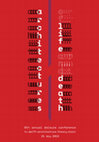
8th Annual National Deleuze Scholarship Conference, 2019
The Annual National Deleuze Scholarship Conference is a working symposium intended to bring toget... more The Annual National Deleuze Scholarship Conference is a working symposium intended to bring together scholars, students, researchers, activists, artists, and others whose work revolves around the philosophy of Gilles Deleuze. Each year the conference is hosted by a different university in the Netherlands. Previous editions addressed the following central themes:
2012. Deleuze and Cultural Studies. University of Utrecht
2013. Affect. Delft University of Technology
2014. Passions. Erasmus University Rotterdam
2015. Aesthetics. Radboud University Nijmegen
2016. Machinic Ecologies. University of Amsterdam
2017. Pedagogies. AKI, Enschede
2018. Politics of Sustainability. University of Utrecht
In 2019 the conference returns to TU Delft Faculty of Architecture, with a very distinguished guest speaker from Newcastle University, Professor Andrew Ballantyne, alongside our dear Professor Rosi Braidotti from Utrecht University.



Uploads
Talks by Andrej Radman
Although relatively unknown today, Raymond Ruyer (1902-1987) was a French philosopher whose ideas and works were significant influences on many of the better known philosophers, such as Gilbert Simondon, Gilles Deleuze and Félix Guattari, whom we have covered in this series. He is especially well known for his work on embryology, biology and informatics theory, and is the author of the book, Cybernetics and the Origin of Information. His philosophy is introduced by Andrej Radman (TU Delft) and Stavros Kousoulas (TU Delft)
Book Chapters by Andrej Radman
senses, inventions and worlds are not to be considered in isolation.
It examines the process of folding an ‘uncanny valley’ into
an ‘inhabitable mountain’ across seven points. First: Amor fati,
the Nietzschean call to be worthy of what happens to us. Second:
Decoding and Reterritorialisation, the emergence of sensibilia
as expressive features. Third: Superjects and Objectiles, the
primacy/exteriority of relations. Fourth: Isomorphism without
Resemblance, the vital asymmetry between the virtual capacities
and actual properties. Fifth: Schizoanalysis, the non-entailment of
material inference, a.k.a. abduction. Sixth: Mutation of Boundary
Conditions, the downward causation of enabling constraints. Seventh:
Geology of Morals, recasting ethics as a problem of power,
not duty. To quote Le Clèzio, “Perhaps one day we will know that
there wasn’t any art but only medicine.”
Papers by Andrej Radman
Rather than focusing on the essentialist question of what architectural intelligence is, we are interested in the pragmatics of how it occurs, who institutes it, and through which technicities it is archived and disseminated.
https://journals.open.tudelft.nl/footprint/announcement/view/400
To speak of ecologies of architecture is to break with judgement for experience. As Gilles Deleuze put it in his book on Nietzsche, it is not about justification, ‘but a different way of feeling: another sensibility’. If to think differently we have to feel differently, then the design of the built environment has no other purpose but to transform us. While engineering is solution-oriented, architecture stays with the problem so as to tease out a creative potential.
Ecologies of Architecture /
Andrej Radman and Stavros Kousoulas
2012. Deleuze and Cultural Studies. University of Utrecht
2013. Affect. Delft University of Technology
2014. Passions. Erasmus University Rotterdam
2015. Aesthetics. Radboud University Nijmegen
2016. Machinic Ecologies. University of Amsterdam
2017. Pedagogies. AKI, Enschede
2018. Politics of Sustainability. University of Utrecht
In 2019 the conference returns to TU Delft Faculty of Architecture, with a very distinguished guest speaker from Newcastle University, Professor Andrew Ballantyne, alongside our dear Professor Rosi Braidotti from Utrecht University.