Books by Anne Eakin Moss
Только между женщинами, 2023
Russian translation of Only Among Women, published by NLO, translated by Tatiana Azarkovich
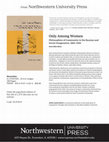
Northwestern University Press
This book investigates the idea of a community of women—a social sphere ostensibly free from the ... more This book investigates the idea of a community of women—a social sphere ostensibly free from the taint of money, sex or self-interest—that originates in the classic Russian novel between radicalism and conservatism, fuels mystical notions of unity in turn-of-the-century modernism, and finally assumes a place of privilege in Stalinist culture and especially cinema. Rethinking the significance—and surprising continuities—of gender in Russian and Soviet culture, Only Among Women relates this tradition to Western philosophies of community from Rousseau to Jean-Luc Nancy. In the 1860s, friendship among women came to figure an organic national collectivity in Tolstoy’s War and Peace yet also the revolutionary organization of Chernyshevsky’s radical novel What Is To Be Done? At the fin-de-siècle, women’s community came to be connected with new religious and philosophical notions of a unity transcending the individual, even as scenes of mutual understanding and non-linguistic communication among women in stories by Chekhov and Gorky envisioned a community at the bare minimum. Finally, in Stalinist propaganda of the 1930s, the notion of women’s community inherited from the Russian novel re-emerged in the image of harmonious female workers serving as a patriarchal model for loyal Communist citizenship.

In Progress: The Special Effects of Soviet Wonder
My book manuscript, The Special Effects of Soviet Wonder, investigates the incongruous visual sty... more My book manuscript, The Special Effects of Soviet Wonder, investigates the incongruous visual stylistics of Soviet cinema, arguing that the interface of the screen in Stalinist cinema establishes a profoundly different relationship between the worlds of spectator and spectacle than in Hollywood cinema from the same era. While Soviet avant-garde cinema of the 1920s employed self-referential techniques of montage and disruption to shock and estrange spectators, thereby to bring them to revolutionary consciousness, Socialist Realist films of the 1930s aimed to immerse their viewers in a vision of Soviet utopia and to shape their experience of the world. Soviet films appealed to sensibilities of the miraculous and spiritual despite the party-state’s anti-religious agenda, and resembled Hollywood’s most extravagant productions more than they did the Soviet agitational docudramas of the 1920s. Combining both close and aggregative examination of Soviet films from 1927-40, as well as of the theoretical and technical writings of its filmmakers, I show how direct address, gesture, metacinematic expression, special effects, framing, mirroring and other deictic operations establish a very different picture of the ontology and the phenomenon of film as medium than the view so often composed from Western cinema alone.
Articles by Anne Eakin Moss
Legacies of Protest Art in Iran: The Revolutionary Art Workshop of 1979
Public Culture, 2024
This article examines the art practice of a group of professors and students—who later came to be... more This article examines the art practice of a group of professors and students—who later came to be known as Group 57—at the Fine Arts College of the University of Tehran during the revolutionary period of 1978 to 1980. Through interviews with artists and art historical research, the authors describe the artists’ workshop where they produced posters against the Shah, the United States, and imperialism. Their posters drew on the bold colors, clear text, symbolic imagery, and easy reproducibility of international radical poster art and the early Russian revolutionary avant‐garde. The authors recover these aesthetic and intellectual connections in the academic and professional training of the artists and in the art historical context of the posters themselves, examining the posters’ recent and more distant influences, and reinscribing the artists in the history of Iranian art and international art history. The authors also point toward connections between Group 57 and protest art in Iran today.
Cinema’s "Miracles": Film Tricks and the Production of Soviet Wonder
Film History, 2020
This article investigates the treatment of cinematic special effects or kinotriuki (film tricks) ... more This article investigates the treatment of cinematic special effects or kinotriuki (film tricks) in Soviet cinema of the 1930s, focusing on the film The New Gulliver (1935), an adaptation of Gulliver's Travels by director Alexander Ptushko that used cutting-edge techniques to combine live action and stop-motion animation. It argues that film tricks in both fantastic and dramatic genres of Soviet cinema served to generate a form of wonder akin to that inspired by the religious miracle, but transferred to the miraculous feats of the party-state, with implications for the comparative study of special effects and cinematic experience.
Zeitschrift für Medien- und Kulturforschung (Journal for Media and Cultural Research, Bauhaus U), 2019
In 1984, Paul Virilio contentiously claimed that “War is cinema, and cinema is war.” This article... more In 1984, Paul Virilio contentiously claimed that “War is cinema, and cinema is war.” This article examines link posited by Virilio and others between the camera shot and gun shot, arguing that this link operates differently in the context of Soviet vs. Western fantasies of agency, community and technology. While Hollywood and Western cinema are willing to cast into doubt the agency of the gun and frustrate the spectator’s desire to hit the target, Soviet cinema insists that Soviet guns usually hit their mark. And moreover, that for Soviet spectators, to see is implicitly to act and to possess, not to sit passively in the dark. Zeitschrift für Medien- und Kulturforschung (Journal for Media and Cultural Research, Bauhaus U) 10.2 (Fall 2019): 25-38.
Chapter 7. A Woman With A Movie Camera: Chantal Akerman’S Essay Films
The Essay Film, 2016
If subjectivity in the essay film is always only citational and deferred, what trace does gender ... more If subjectivity in the essay film is always only citational and deferred, what trace does gender leave? I examine that trace in the essay films of Chantal Akerman, focusing on News from Home (1976) as well as her 1993 film D’Est (From the East), a travelogue of Eastern Europe after the fall of the Berlin Wall and the Soviet Union. I also put Akerman's essay films in dialogue with the techniques and aspirations of Dziga Vertov's documentary style.
Refocus: The Films of Andrei Tarkovsky, 2021
Update! This article has been published in the volume Refocus: The Films of Andrei Tarkovsky, ed.... more Update! This article has been published in the volume Refocus: The Films of Andrei Tarkovsky, ed. Sergei Toymentsev, Edinburgh University Press in February 2021. https://edinburghuniversitypress.com/book-refocus-the-films-of-andrei-tarkovsky.html
But unfortunately they published the wrong version of my text. This is the revised, improved version of my text. I encourage you to consult and cite the published volume, but I'm glad to make available here my updated working version of the article.
The permeable screen: Soviet cinema and the fantasy of no limits
Screen, 2018
This essay seeks a revised understanding of the film medium in the formal stylistics of Soviet ci... more This essay seeks a revised understanding of the film medium in the formal stylistics of Soviet cinema in the Stalinist 1930s, which, in their direct confrontation of the spectator and their simultaneous striving for immersive illusionism, share a common impulse both with both 3-D blockbuster moviemaking of today, as well as with the immersive desires of virtual reality. An analysis of Sergei Eisenstein's 1947 essay ‘On stereocinema’ accompanies close analysis of representative works of Socialist Realist cinema from the 1930s, culminating an examination of the immersive and confrontational effects in the almost parodic 1940 film Svetlyy put'/The Radiant Path, directed by Eisenstein's former assistant, Grigory Aleksandrov. I put this historical analysis in dialogue with contemporary issues in film phenomenology and the ‘post-medium condition’. Socialist Realist cinema stands to enhance our understanding of both the signifying possibilities of the medium and how it acts upon the spectator.
Studies in Russian and Soviet Cinema, Jan 1, 2009
This article analyses the topos of women's community in Stalinist JìIms of the late 7930s. Iú sho... more This article analyses the topos of women's community in Stalinist JìIms of the late 7930s. Iú shows how these films both eroticized the groups of women on sueen and asked spectators to feel themselves a part of them through the powerfully ffictive functions of the cinematic apparatus, Further, by diverting the erotic gaze to Stakn and the PartylState, these JìIms posed a dilemma to the contemporary spectator as to how he or she was supposed to negotiate the fantasies presented on screen. The article argues that groups of women established possibilities for identification and avenues for desire that undermined normative gender roles, asking men to be just as much a member of Stalin's 'hqrem' a.s women, and potentially opening qvenues of lesbian desire for women.
Slavic and East European journal, Jan 1, 2009
Russian literature offers lillie precedent for the vivid representation of women's friendship in ... more Russian literature offers lillie precedent for the vivid representation of women's friendship in Leo Tolstoy's mW(/IId Peace. Tatiana and Olga barely interact in EI'geny OJ/Cgill,1 Turgcncv depicts solitary heroines, of whom OdinlsQva of Fathers alld SOliS is emblematic for her numc. 1 In V. F. Odoe\,sky's satirical "society tates," women's interactions consist primarily of mali~ cious gossip and cynical competition over males.) The female characters of War (Ind Peace. however. engage in a complex web of relationships, the development of which can be seen as a fomlally coherent subplot wilhin the novel. The scope of Tolstoy's rad ical experiment in the novel fonn made room for, and perhaps even requi red, the elaboration of women's relations. of The Sentimental commonplace of women's friendship in European novels certainly invited Tolstoy's emulnt ion nnd attempt nt transcendence. While women's friendships in the Westem novel were "rarely a locus of compelling narrative suspense" (Marcus 79-80), in lJIar and Peace Tolstoy subjects the re-
Reviews by Anne Eakin Moss
What 20 Days in Mariupol Documents
Docalogue.com, 2024
What 20 Days in Mariupol documents is not only the devastating impact of Russia’s full-scale inva... more What 20 Days in Mariupol documents is not only the devastating impact of Russia’s full-scale invasion of Ukraine in its first days on shocked and unprepared civilians in an important port city. Nor is it only the grimly heroic efforts of AP journalists to report all the horrors they witnessed from a besieged city. What it documents beyond all this is the extent to which disinformation has come to sever seeing from believing in the 21st century, and what documentary film can still do to repair that relationship.
"Remarks on The Palgrave Handbook of Russian Thought and the woman question"
Studies in East European Thought, 2022
Review essay about a new collection of essays on "Russian Thought" focusing on its representation... more Review essay about a new collection of essays on "Russian Thought" focusing on its representation of questions of gender and gender representation.
Film Review, School No. 3 (Shkola no. 3, 2016, dir. Yelizaveta Smith and Georg Genoux)
KinoKultura, 2022
Review of School No. 3 (Ukraine, 2016) for Focus on Ukraine
Film Review, Plai. A Mountain Path (Plai, 2022, dir. Eva Dzhyshyashvili)
KinoKultura, 2022
Film Review, Plai. A Mountain Path (Plai, dir. Eva Dzhyshyashvili) in KinoKultura 81 (July 2022),... more Film Review, Plai. A Mountain Path (Plai, dir. Eva Dzhyshyashvili) in KinoKultura 81 (July 2022), Focus: Contemporary Ukrainian Documentary
Review of Ilana Shub Sharp, Esfir Shub: pioneer of documentary filmmaking
Studies in Russian and Soviet Cinema, 2022
JSTOR is a not-for-profit service that helps scholars, researchers, and students discover, use, a... more JSTOR is a not-for-profit service that helps scholars, researchers, and students discover, use, and build upon a wide range of content in a trusted digital archive. We use information technology and tools to increase productivity and facilitate new forms of scholarship. For more information about JSTOR, please contact [email protected].
Recent Lectures by Anne Eakin Moss
Immersive Storytelling and the Operative Ontology of Soviet Cinema
IKKM Lecture Series, 2019
This lecture introduces my book project's intervention into the contemporary understanding of cin... more This lecture introduces my book project's intervention into the contemporary understanding of cinema as an experience and particularly the screen as its means of transmission, support, or constraint via a look back to the formative decade of the 1930s in Soviet and Hollywood cinema. Today’s technological and stylistic move to immersive and ubiquitous cinematic experience, simultaneous with film theory’s turn away from narrative and semiotic readings of film, and towards focus on affect, the haptic, and the somatic effects of cinema, have led some critics to propose the advent of a “post-medium condition,” of which the permeable screen might be seen as symptomatic. If the cinema screen today has meaning at all, it serves less as a formal problem with which to engage like the fourth wall, and rarely as an index or register of light on celluloid film, but instead creates an environment, generating an atmosphere shared with the spectator, or an interface, offering a point of interaction. I argue that Stalinist cinema, in its production, sense-making and reception generated a mode of existence that opens new ways of thinking about media today. Delivered January 23, 2019 at the Internationales Kolleg für Kulturtechnikforschung und Medienphilosophie (International Research Institute for Cultural Technologies and Media Philosophy, Bauhaus U, Weimar, Germany).



Uploads
Books by Anne Eakin Moss
Articles by Anne Eakin Moss
But unfortunately they published the wrong version of my text. This is the revised, improved version of my text. I encourage you to consult and cite the published volume, but I'm glad to make available here my updated working version of the article.
Reviews by Anne Eakin Moss
Recent Lectures by Anne Eakin Moss