Books, Edited Volumes & Special Issues by Apostolos Lampropoulos
Synthesis. An Anglophone Journal of Comparative Literary Studies, 2025

Schwules Museum, Berlin, 2021
This promise of intimacy, which always involves a risk, exists in a historical, political, and cu... more This promise of intimacy, which always involves a risk, exists in a historical, political, and cultural context. The ubiquity of digital media shapes our encounters or even replaces them. HIV / AIDS and the treatment of the virus have fundamentally changed queer intimacy: fear and paranoia have been replaced with a culture of care. The medical progress that has made HIV/AIDS a chronic disease, the arrival of PrEP and its efficient protection against infection, and the emergence of new sex cultures like chemsex have all offered new possibilities for experimentation with intimacy. And yet since early 2020, Covid-19 severely challenges and restricts us. Contacts are avoided and parties are no longer celebrated. Intimacy seems to be in retreat. Intimacy is something that we are in danger of losing. Intimacy: New Queer Art from Berlin and Beyond presents over 30 artistic positions that negotiate queer intimacy in different ways, from photographs to paintings, sculptures, video-and sound-installations. These artworks invite us to rethink how we look at intimacy; they allow us to witness past intimacies, and they help us to imagine what it means to share intimacy again after the crisis. However temporary, exciting, or perilous it might look on museum walls, intimacy is nevertheless a way of anticipating a queer future.
![Research paper thumbnail of May Chehab - Apostolos Lampropoulos (dir.) : AutoBioPhagies, Bern, Peter Lang (« Littératures de langue française », n. 18), 2011, x + 271 p. [ISBN 978-3-0343-1022-2].](https://attachments.academia-assets.com/66254300/thumbnails/1.jpg)
De Feuerbach à Derrida, de la gastronomie au cannibalisme et de la saveur à la terreur, cette étu... more De Feuerbach à Derrida, de la gastronomie au cannibalisme et de la saveur à la terreur, cette étude décline les différentes postures du sujet mangeant. Plus précisément, et résolument ancré dans un corps placé au centre du présent volume, c’est d’abord un sujet phagique jouissif qui triomphe dans l’autobiographie gastronomique. Mais l’étude examine également les modalités d’apparition d’un sujet dysphorique, émietté, spectralisé ou vampirisé, aussi bien dans les littératures de l’éclatement de soi que dans les mises en spectacle des déchirements identitaires de l’art corporel. Les contributions permettent enfin de voir comment la métaphore (auto)phagique, pathologique chez les grands lecteurs, toujours digestive, voire stercoraire, se littérarise dans une quotidienneté diarique recyclée ad nauseam, se redéfini philosophiquement dans un rapport circulaire au monde et voit son essence sondée par la philosophie anti-idéaliste et postmoderne. Enrichies de l’apport de disciplines différentes, les AutoBioPhagies aspirent en effet à réunir ce que la tradition occidentale a désuni : les deux fonctions principales de la bouche, celle de la parole et celle de la nourriture.
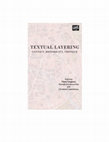
Textual Layering: Contact, Historicity, Critique sets out to rethink our relation to textual trad... more Textual Layering: Contact, Historicity, Critique sets out to rethink our relation to textual tradition against the background of several contemporary developments, including the emergence of digital culture, the increasing spectacularization of psychic as well as social life, the renegotia-tion of historical thinking, and the precarious position of the theoretical humanities within academia. To this end, the volume reinvests the concept of "layering," a concept currently used in a wide range of fields, including metaphor studies and linguistics, cybernetics, the social sciences, art, and architecture. Drawing on existing definitions of "layering," the chapters in this book return to and re-appraise some of the most crucial concerns in the post-1960s theoretical scene: that is, concerns over the strained interplay between writing and the body; textuality and history; critique, différance and the feminine; memory, trace, and the immemorial. The aim of the diverse-often polemical-analyses carried out in this volume is to reactivate the critical force of textual tradition today through a renewed appreciation of its historical embeddedness, its libidinal sources, as well as its complex economy of separation and contact, dia-chronicity and synchronicity, (re)layering and de-layering.
Contributors: Frances Restuccia, John Lechte, Judith Wambacq, William Watkin, Micheal Beehler, Brendan Moran, Adnan Mahmutovic, Marios Constantinou, Gertrude Postl, Tina Chanter, S. K. Keltner, Kalliopi Nikolopoulou, Elena Tzelepis.
![Research paper thumbnail of Jean-Paul Engélibert - Apostolos Lampropoulos - Isabelle Poulin (dir.) : Débordements. Littérature, arts, politique, Bordeaux, Presses universitaires de Bordeaux (coll. « Modernités », n. 46), 2022, 244 p. [ISBN 979-10-300-0732-9].](https://attachments.academia-assets.com/88172631/thumbnails/1.jpg)
La métaphore du débordement suggère à la fois une fonction de l’oeuvre littéraire ou artistique, ... more La métaphore du débordement suggère à la fois une fonction de l’oeuvre littéraire ou artistique, voire une aptitude qui lui est inhérente, et une façon de rappeler ses limites ou de lui imposer un certain contour, de la mettre en contact avec le monde vers lequel elle déborde tout en la séparant de lui, ne serait-ce qu’artificiellement. Toutes sortes de « bords » peuvent aider à penser le monde des arts et ses ambivalences, à différents niveaux de réalité : l’artiste est pris entre la sensation que l’art « déborde », ne lui laissant aucun dehors à saisir, et l’impérieuse nécessité où il se trouve de « déborder » lui-même ; le lecteur ou spectateur est pris dans des réseaux complexes de cercles savants plus ou moins conscients du vaste hors-champ constitué par tous ceux qui n’ont pas l’art dans leurs vies et n’ont aucune pensée de ses enjeux politiques ; diverses institutions, enfin, hiérarchisent et « bordent » les gestes critiques.
Le présent volume interroge ces différents acteurs, dans le sillage de cheminements critiques familiers, émanant d’artistes comme l’écrivain Italo Calvino ou le plasticien Jorge Méndez Blake (dont une oeuvre illustre la couverture), ou de philosophes comme Jacques Derrida et Jacques Rancière. La première section, Traductions critiques : mots et figures du débordement, interroge le rapport entre langue et action et à travers lui les moyens de l’écrivain. La deuxième section, Gestes critiques : interprétation et performance, pose l’horizon d’une réception dans l’espace public du théâtre ou de la rue, aborde la question du débordement comme « confluence ». La troisième section, Débordement dans le genre, propose une déclinaison de la notion de genre à travers les représentations des femmes au XVIIe siècle et le croisement des questions du genre, de la race et de la classe sociale dans les littératures du début du XXIe siècle. La dernière section, Au bord du contemporain, interroge spécifiquement la façon dont le récit contemporain travaille les cadres.
L’ambition du volume n’est pas seulement de parler des débordements, d’en faire la liste ou d’en rappeler la diversité. Il montre que ce sont surtout des occasions de rencontres, des invitations à des assemblées publiques et à des croisements de corps et de voix.
Ecriture picturale, écriture musicale de la littérature et des autres arts, 2017
Si les arts résonnent en écho les uns aux autres, cependant ils ne correspondent pas directement ... more Si les arts résonnent en écho les uns aux autres, cependant ils ne correspondent pas directement entre eux, ainsi que le remarque Jean-Luc Nancy dans les Muses (1993), et leurs réalisations sensorielles sont autres. Dans ce cadre, le présent volume, écrit par des chercheurs de diverses disciplines, essaie de faire apparaître des liens entre les arts en passant par l’idée qu’une écriture propre à l’art comme les réécritures du corps humain, infusent les arts musicaux, plastiques ou littéraires.
La première partie du volume, théorique, s’interroge sur les paradigmes esthétiques dans le temps (l’époque romantique est proposée comme s’expliquant par la force d’une forme qui saisit aussi bien Brahms que Caspar David Friedrich) et fait l’hypothèse d’une sémiosis transmodale, de germes de sens qui sont à la source d’œuvres relevant d’arts divers (Simondon, Rastier). La seconde observe les liens entre plusieurs arts à partir du visuel, montrant que l’usage de la photographie et du dessin comme source du texte, introduit une distance et un éclairage synthétique après coup : sont proposés des liens entre Virginia Woolf et la photographie, Rembrandt et Genet, une comparaison entre Visconti et Godard. La troisième partie s’intéresse à la communauté possible des modes d’écriture entre littérature et musique : comment Bach influence-t-il Nancy Huston ; comment la musique est-elle « tarabuste », aux oreilles de Pascal Quignard ? Elle se termine par une réflexion théorique sur la réception de la musique contemporaine qui permet peut-être de considérer l’art, non seulement comme défini par l’artiste, mais aussi par la perception qu’en fait une auditrice, qui met en place une « conduite de l’écoute », qu’on éprouvera à partir d’une composition contemporaine d’Elizabeth Anderson.
Chapters & Articles by Apostolos Lampropoulos
Synthesis. An Anglophone Journal of Comparative Literary Studies, 2025
The opening of deconstruction to the reinvention of the future, not as a messianic yet-to-come, b... more The opening of deconstruction to the reinvention of the future, not as a messianic yet-to-come, but as a future that is present and seeks representation and recognition, is what we identify as the at large of deconstruction. Deconstruction is not merely a performance of the repressed contradictions and silenced aporias that reveal the center of the text elsewhere but is primarily an affirmation of the coming of what the text has excluded.

Apostolos Lampropoulos, "Intimacy between/with the Sans-Terre and the ‘austere lands’ of a Hospitable Thinking", Derrida Today 18.2 (2025): 181–204.
Derrida Today 18.2 (2025): 181–204, 2025
This article addresses the question of intimacy between/with the sans-terre
(a term inspired by ... more This article addresses the question of intimacy between/with the sans-terre
(a term inspired by Bruno Latour), of homeless intimacy, and of intimacy in austere and inhospitable lands. Reading through Jacques Derrida’s seminars on Hospitality, it questions the very idea of a deterritorialized, displaced or homeless, intimacy and argues for the elaboration of homeliness through intimacy. Deviating from the idea of an ‘exposed privacy’, it develops the hypothesis that home making intimacy is based on familiarity without family and reflects on the idea that intimacy takes place where the home is, whether it is a temporary abode or not, attempting to reverse the order of things: home, were it to be (contact with) someone’s body and not a place, might be where intimacy happens. Moreover, it suggests some positions on the limits of contemporary representations of intimacy between/with the sans-terre.
Drawing on Jean-Luc Nancy's later thought (mainly in texts such as Sexistence, The Deconstruction... more Drawing on Jean-Luc Nancy's later thought (mainly in texts such as Sexistence, The Deconstruction of Sex, and "Touche-touche"), this chapter suggests a programmatic approach to the notion of "critical intimacy." It places special emphasis on representations of queer corporeal, and often sexual, intimacies, echoing Nancy's position that "sexual liberation brings out into the open as much misery as jubilation." It focuses on three main aspects of critical intimacy, illustrating them with brief references to theoretically informed art and literature. Firstly, the chapter tackles what one might term "trouble in/of intimacy," which is to be seen less as an aporia, and more as an incitement to explore as yet uncharted, and therefore potentially troubling, intimacies. Secondly, it explores what caring for the sex of others might mean, and by that it addresses the limits of politicized intimacies. Thirdly, it formulates some positions for thinking an ethics of withdrawal based on Nancy's expeausition, not in order to set up a new being-together following a separation, but mostly, as seems appropriate after Nancy's death, as a way of maintaining a with within a living-apart.
In this chapter, I will be walking through contemporary ruins such as empty buildings and abandon... more In this chapter, I will be walking through contemporary ruins such as empty buildings and abandoned airports. I will also be dealing with fragments of the lives of the numerous others who have recently been in the vicinity of these buildings and of ourselves, leaving behind them material fragments such as musical instruments, toys, bicycles, and clothes, but also snapshots of their faces, voices and odours. I will be doing this in the context of cultural and critical responses triggered by the so-called refugee crisis. These responses are numerous: one can think of initiatives such as the International Cities of Refuge Network (ICORN 2019) which, as explained on the homepage of its website, has been conceived of as "an independent organization of cities and regions offering shelter to writers and artists at risk," or initiatives undertaken by institutional actors such as curators, galleries and museums, but also grassroots initiatives. The crisis has embedded itself, leaving an ongoing mark, in such diverse initiatives, often above and beyond their conflicting positions
Des yeux au coeur, l'intime comme exercice en théorie cielam.univ-amu.fr/malice/articles/yeux-coe... more Des yeux au coeur, l'intime comme exercice en théorie cielam.univ-amu.fr/malice/articles/yeux-coeur-lintime-exercice-en-theorie Des yeux au coeur, l'intime comme exercice en théorie Apostolos Lampropoulos-Université Bordeaux-Montaigne-Plurielles 2/20 notions qui pourraient bien nuancer leurs liens. S'il est déjà difficile de dire à qui appartient un corps et de quoi un corps est une partie, alors la notion d'un « corps propre » pourrait aussi, dans ce contexte, passer pour une contradiction dans les termes. Ce questionnement est inhérent à certaines écritures de soi et, plus précisément, dans le cas du genre atypique et fascinant que l'on pourrait appeler les récits de soi théoriques. Parmi les exemples les plus significatifs figurent les deux textes qui formeront le corpus de cet article : « Savoir » de Hélène Cixous qui fait partie du volume Voiles (1998) qu'elle a coécrit avec Jacques Derrida et L'Intrus (2000) de Jean-Luc Nancy. « Savoir » de Cixous relate l'impact d'une opération au laser intervenant sur la myopie de la narratrice et, en un sens plus large, sur son propre regard, sur sa manière de se voir elle-même et de voir sa mère. Une bonne partie de ce court texte tourne autour des voiles qui empêchaient sa vision et ne sont découverts qu'a posteriori. De l'autre côté, L'Intrus deJean-Luc Nancy se concentre sur la transplantation cardiaque de l'auteur et sur le traitement de son cancer. D'abord publié en 2000, il a été complété par deux postfaces (la première pour l'édition de 2005 et la seconde pour celle de 2010) qui servent aussi de preuve de la survie de l'auteur. Le texte a inspiré un film de Claire Denis, également intitulé L'Intrus (2004), que Nancy lui-même décrivait comme une adoption plutôt que comme une adaptation. L'Intrus de Nancy nous rappelle ce que signifie devenir étranger à soi ou porter un étranger en soi, mais aussi comment l'on doit se perdre soi-même afin de survivre. En outre, le texte décrit comment l'on peut être touché de l'intérieur en ouvrant la part intime de soi-même à une véritable invasion de ce qui était ordinairement compris comme étranger.
Articuler hospitalité et intimité est, à mes yeux, un choix pertinent et difficile. Rendre son fo... more Articuler hospitalité et intimité est, à mes yeux, un choix pertinent et difficile. Rendre son foyer accessible à quelqu'un d'autre, lui céder une partie de son espace, relever le défi de l'hospitalité quelle que soit sa forme me semble indissociable de l'expérience d'une certaine intimité avec elle ou lui. Accueillir est aussi débloquer, ne serait-ce que partiellement, la voie vers l'intimité du chez-soi : les pièces les plus centrales ou les moins accessibles d'un foyer, les placards ou les tiroirs les mieux cachés d'une maison familiale, les rayons les plus poussiéreux d'une bibliothèque, les sous-entendus ou les entre-les-lignes les plus insaisissables d'une société ou d'une culture . Dans une articulation de l'hospitalité avec l'intimité, cette dernière ne serait plus entendue comme synonyme de l'herméticité d'une vie privée ou d'un domicile, mais plutôt comme une invitation ou une autorisation à y pénétrer. Vu que, par définition, l'hospitalité trouble l'ordre des choses établi en peuplant les espaces les plus privés ou en diversifiant les populations les plus homogènes, elle ne peut qu'être une remise en question de l'intimité comme isolement, tranquillité ou retrait. Plus encore, vu que l'hospitalité est, dans un sens derridien, liée à la venue inopinée de l'arrivant qui déstabilise l'intimité de quelqu'un (d'une personne, d'une famille, d'une société ou d'une nation), elle déclenche en même temps une intimité imprévisible avec quelqu'un, entre des personnes jusqu'alors inconnues qui vont désormais négocier, expérimenter et tester leur proximité. Dans une articulation de l'hospitalité et de l'intimité, il s'agit de l'intimité du contact, de la mise en relation, du partage et de la coprésence, souvent improgrammables. Mais il se peut également qu'il s'agisse d'une intimité de la tension, de la dispute et de la querelle, de la proximité excessive et difficile à tolérer, une intimité de trop à laquelle les intimes involontaires auraient hâte de mettre fin.

Apostolos Lampropoulos, “Cosmopolitanism, Ghostpitality, and Some (Un)Critical Intimacies”, in Coste, Didier – Kkona, Christina – Pireddu, Nicoletta (eds): Migrating Minds: Theories and Practices of Cultural Cosmopolitanism, London, Routledge, 2021, p. 181-191. DOI: 10.4324/9781003144632-18. The documenta 14 Reader (R) is a 700-page anthology and one of the two main publications of docum... more The documenta 14 Reader (R) is a 700-page anthology and one of the two main publications of documenta 14 (d14), a major contemporary art exhibition that took place in 2017 between the cities of Kassel, Germany and Athens, Greece, for a duration of 100 days in each city. The Reader was made available in German, Greek, and English and was co-edited by Quinn Latimer (editor-in-chief of publications for d14) and Adam Szymczyk (the artistic director of the exhibition). Refl ecting on the theoretical companion to an exhibition while paying less attention to the artworks themselves might sound like a paradoxical enterprise. Nevertheless, the Reader is a vital part of a thought-provoking curatorial process and a key element of a broader theoretico-political experiment. It introduces d14 as a haunting reappearance and conceptualizes it through the duty of radical openness. Indicatively, it is framed by two exhibited quotes (I will explain this term soon): in the fi rst pages one reads Szymczyk's assertion that, "an elusive and haunting apparition, documenta is a phantom of sorts" (28), while the book almost closes with Derrida's phrase, "let us say yes to who or what turns up , before any determination, before any anticipation, before any identifi cation " ("Hospitality" 662). Additionally, the Reader develops through reminiscent voices that have never been heard or are still waiting to be heard. The latter are eloquently evoked in the fi rst text of the book, Darwish's "To the Reader": "My hands are anger / my mouth is anger / the blood of my arteries a juice of anger. / O my reader / do not ask me to whisper, / do not expect musical delight" (15). A Book in/ as Context 1 The Reader comprises 3 diff erent types of material: fi rst, 25 theoretical, critical, or literary texts, either newly commissioned or foundational (Lotringer, Preciado, Flaubert, Birrell, Bennett, Negri, and others), the last excerpt being from Dufourmentelle and Derrida's Of Hospitality ; second, 7 "folios" containing visual elements (paintings, drawings, and photographs) accompanied by short descriptions and organized around topics such as race and hunger, gold, revolution, or Greco-German
Hospitality in/as Art, 2020
Λόγου Κάριν [ 201 ] Οι θάνατοι της λογοτεχνίας είναι ανέφικτοι και αναγκαίοι Απόστολος Λαμπρόπουλ... more Λόγου Κάριν [ 201 ] Οι θάνατοι της λογοτεχνίας είναι ανέφικτοι και αναγκαίοι Απόστολος Λαμπρόπουλος Πανεπιστήμιο Bordeaux Montaigne Θεωρητικό στιγμιότυπο πρώτο 1 . Το 2010 η Kάριν Μπόκλουντ άνοιγε με το κείμενό της «Η ιστορική μελέτη της λογοτεχνίας είναι ανέφικτη και αναγκαία» 2 τον τόμο Χώρες της θεωρίας. Ιστορία και γεωγραφία των κριτικών αφηγημάτων. Στο κείμενο αυτό, αφηγούνταν την τριβή της με τη θεωρία ως σημαντικό μέρος της σχέσης της με τη λογοτεχνία και, ειδικότερα, με την ιστορική μελέτη των παλαιότερων κειμένων. Περιέγραφε επίσης μια διεργασία απομάγευσης που την απομάκρυνε από τη θεωρητική ζέση των πρώτων βημάτων της στην έρευνα και της επέτρεπε μια, όχι και τόσο παράδοξη εντέλει, μετριοπαθή και θεωρητικοποιημένη κριτική της θεωρίας. Έκλεινε με το συμπέρασμα ότι «η ιστορική μελέτη της λογοτεχνίας είναι πιθανώς ανέφικτη θεωρητικά· αλλά είναι και αναγκαία, αν θέλουμε να μιλήσουμε για κάτι πέρα από τον εαυτό μας». 3 Υπήρχαν τουλάχιστον δύο λόγοι για τους οποίους ένα, όχι ιδιαίτερα ενθουσιώδες για τη θεωρία, κείμενο άξιζε να ανοίξει έναν τόμο που στόχευε να ανανεώσει τη δυναμική της θεωρίας στον ελληνόφωνο χώρο εκείνη τη χρονική στιγμή. Πρώτον, ο λόγος περί τέλους της θεωρίας και ο προβληματισμός σχετικά με το τι επιφυλάσσει μια μεταθεωρητική εποχή είχαν ήδη καταλάβει σημαντικό μέρος της βιβλιογραφίας τη δεκαετία που έκλεινε 4 . Δεύτερον, η οικονομική και κοινωνικοπολιτική κρίση που θα κλιμακωνόταν λίγο αργότερα είχε ήδη αρχίσει να φέρνει στο προσκήνιο πολιτικές εκδοχές της θεωρίας που εμπλούτιζαν 1 Προγενέστερες εκδοχές αυτού του κειμένου είχαν παρουσιαστεί κατά τη διάρκεια διαλέξεων στο Αριστοτέλειο Πανεπιστήμιο Θεσσαλονίκης και στο Πανεπιστήμιο Ιωαννίνων. Όλες οι μεταφράσεις παραθεμάτων από τα κείμενα στα οποία αναφέρομαι είναι δικές μου, εκτός, προφανώς, από αυτές που προέρχονται από ήδη μεταφρασμένα κείμενα στα οποία παραπέμπω. 2 Κάριν Μπόκλουντ-Λαγοπούλου, «Η ιστορική μελέτη της λογοτεχνίας είναι ανέφικτη και αναγκαία», στο Χώρες της θεωρίας. Ιστορία και γεωγραφία των κριτικών αφηγημάτων, επιμ. Απόστολος Λαμπρόπουλος και Αντώνης Μπαλασόπουλος (Αθήνα: Μεταίχμιο, 2010) 29-47. 3 Mπόκλουντ-Λαγοπούλου, αυτόθι, 47. 4 Η εμβληματικότερη, ίσως, δημοσίευση, ακριβώς στο μέσο εκείνης της δεκαετίας, ήταν η ανθολογία των Daphne Patai και Will H. Corral, επιμ., Theory's Empire: An Anthology of Dissent (Νέα Υόρκη: Columbia University Press, 2005). Οι θάνατοι της λογοτεχνίας -Απόστολος Λαμπρόπουλος [ 202 ]
Punctum. International Journal of Semiotics, 2017
During the last decades, touch has become the epicenter of serious critical attention and of vari... more During the last decades, touch has become the epicenter of serious critical attention and of various creative practices. Within this context, this paper revisits Peter Greenaway's film The Pillow Book that explores calligraphic practices on human skin and Wim Delvoye's artistic project Art Farm that consisted in the tattooing of pigs and their transforming into objects of art. Both of these works are articulated through writing taking place on the skin and consequently contact between humans or between humans and animals is established. Furthermore, a sense of uniqueness of the written body is developed, and the possibility of intimacy is renegotiated through writing on the palimpsest skin. The paper focuses on touch as a process of sharing (both in the sense of dividing and partaking of) and of the creation of intimacy. It aims to answer questions such as the following: what does it mean to touch someone through writing or through tattooing the skin? Under which conditions can one talk about intimacy? Who is receiving, hosting or excluding whom during, and through, the act of touching? What difference does it make to touch a human's or an animal's skin? When does touching come to an end and what are the consequences of un-touching? In a nutshell, this paper seeks to understand the multiple dynamics of touching as an act of separating, of coming together, and of creating a common space and an in-between.



Uploads
Books, Edited Volumes & Special Issues by Apostolos Lampropoulos
Contributors: Frances Restuccia, John Lechte, Judith Wambacq, William Watkin, Micheal Beehler, Brendan Moran, Adnan Mahmutovic, Marios Constantinou, Gertrude Postl, Tina Chanter, S. K. Keltner, Kalliopi Nikolopoulou, Elena Tzelepis.
Le présent volume interroge ces différents acteurs, dans le sillage de cheminements critiques familiers, émanant d’artistes comme l’écrivain Italo Calvino ou le plasticien Jorge Méndez Blake (dont une oeuvre illustre la couverture), ou de philosophes comme Jacques Derrida et Jacques Rancière. La première section, Traductions critiques : mots et figures du débordement, interroge le rapport entre langue et action et à travers lui les moyens de l’écrivain. La deuxième section, Gestes critiques : interprétation et performance, pose l’horizon d’une réception dans l’espace public du théâtre ou de la rue, aborde la question du débordement comme « confluence ». La troisième section, Débordement dans le genre, propose une déclinaison de la notion de genre à travers les représentations des femmes au XVIIe siècle et le croisement des questions du genre, de la race et de la classe sociale dans les littératures du début du XXIe siècle. La dernière section, Au bord du contemporain, interroge spécifiquement la façon dont le récit contemporain travaille les cadres.
L’ambition du volume n’est pas seulement de parler des débordements, d’en faire la liste ou d’en rappeler la diversité. Il montre que ce sont surtout des occasions de rencontres, des invitations à des assemblées publiques et à des croisements de corps et de voix.
La première partie du volume, théorique, s’interroge sur les paradigmes esthétiques dans le temps (l’époque romantique est proposée comme s’expliquant par la force d’une forme qui saisit aussi bien Brahms que Caspar David Friedrich) et fait l’hypothèse d’une sémiosis transmodale, de germes de sens qui sont à la source d’œuvres relevant d’arts divers (Simondon, Rastier). La seconde observe les liens entre plusieurs arts à partir du visuel, montrant que l’usage de la photographie et du dessin comme source du texte, introduit une distance et un éclairage synthétique après coup : sont proposés des liens entre Virginia Woolf et la photographie, Rembrandt et Genet, une comparaison entre Visconti et Godard. La troisième partie s’intéresse à la communauté possible des modes d’écriture entre littérature et musique : comment Bach influence-t-il Nancy Huston ; comment la musique est-elle « tarabuste », aux oreilles de Pascal Quignard ? Elle se termine par une réflexion théorique sur la réception de la musique contemporaine qui permet peut-être de considérer l’art, non seulement comme défini par l’artiste, mais aussi par la perception qu’en fait une auditrice, qui met en place une « conduite de l’écoute », qu’on éprouvera à partir d’une composition contemporaine d’Elizabeth Anderson.
Chapters & Articles by Apostolos Lampropoulos
(a term inspired by Bruno Latour), of homeless intimacy, and of intimacy in austere and inhospitable lands. Reading through Jacques Derrida’s seminars on Hospitality, it questions the very idea of a deterritorialized, displaced or homeless, intimacy and argues for the elaboration of homeliness through intimacy. Deviating from the idea of an ‘exposed privacy’, it develops the hypothesis that home making intimacy is based on familiarity without family and reflects on the idea that intimacy takes place where the home is, whether it is a temporary abode or not, attempting to reverse the order of things: home, were it to be (contact with) someone’s body and not a place, might be where intimacy happens. Moreover, it suggests some positions on the limits of contemporary representations of intimacy between/with the sans-terre.