Books by Christoph Schaub

De Gruyter, 2019

This study traces how an internationalist world literature of the labor movement was represented ... more This study traces how an internationalist world literature of the labor movement was represented and put into practice in the Weimar Republic. It contributes to a theory of world literature, reinforces the intersectional category of class for analyzing representations of a split modernity, and opens up new perspectives on the literature of the working class for poetology, literary history, and cultural history.

Papers by Christoph Schaub

Research paper thumbnail of Arbeitende Klasse und Diversität. Über persönliche Erzählungen in der Gegenwartsliteratur (Klasse und Kampf; Streulicht)

Zeitschrift für interkulturelle Germanisitik, 2024

The article examines representations of class society and the working class that have recently em... more The article examines representations of class society and the working class that have recently emerged in contemporary German literature. In this strand of writing, issues of class are articulated through progressive, and even left-wing, identity politics that emphasize diversity, intersectionality, and the struggle against discrimination and domination. Focusing on the anthology Klasse und Kampf (2021; Class and Struggle), edited by Maria Barankow and Christian Baron, and Deniz Ohde's novel Streulicht (2020; Sky Glow), the article demonstrates how writers use personal stories, related in autofictional and auto(socio)biographical modes, in order to construct a more diverse representation of the working class. It argues that these ways of narrating class society are so pervasive because they tie in with a broader discourse about diversity that revolves around social justice and individual authenticity at the same time.

in: Re-imagining Class: Intersectional Perspectives on Class Identity and Precarity in Contemporary Culture. Ed. Michiel Rys / Liesbeth François. Leuven: Leuven University Press, 2024

Anthropozäne Literatur. Poetiken – Themen – Lektüren, ed. Gabriele Dürbeck, Simon Probst and Christoph Schaub, 2022

Dieser Aufsatz argumentiert, dass die Frage nach einer anthropozänen Literatur bisher aus zwei ve... more Dieser Aufsatz argumentiert, dass die Frage nach einer anthropozänen Literatur bisher aus zwei verschiedenen Perspektiven thematisiert worden ist: 1) der Perspektive anthropozäner Lektüren und 2) den Versuchen, die
formalen und thematischen Eigenschaften zu bestimmen, aufgrund derer ein Text als anthropozän bezeichnet werden kann. Durch beide Ansätze ergeben sich allerdings Probleme für Versuche, anthropozäne Literatur zu definieren. Vor diesem Hintergrund diskutiert der Aufsatz Christoph Ransmayrs Atlas eines ängstlichen Mannes (2012). Er zeigt zuerst, dass dieser Text die Grundlage für vielversprechende anthropozäne Lektüren darstellt. Zugleich argumentiert der Aufsatz, dass ein Verständnis des Textes selbst als anthropozän Ransmayrs Projekt missverstehen würde.

in Literary Representations of Precarious Work, 1840 to the Present, ed. Bart Philipsen and Michiel Rys, 2021

Under conditions of neoliberal globalization, the term 'slum' has made a remarkable comeback. It ... more Under conditions of neoliberal globalization, the term 'slum' has made a remarkable comeback. It has been prominently placed, for example, in the "Cities without Slums Action Plan" by the Cities Alliance, founded in 1999 and hosted by the UNOPS, and has also been used by Mike Davis in his widely read Planet of Slums (2007). While the term had first come into wider usage in attempts to describe poverty in nineteenth-century English industrial cities and had later been "effectively banned from the social sciences," it is today used in many different languages (Pike 2016, 198-199). The term also circulates in contemporary German literature (Schaub

Zeitschrift für deutsche Philologie , 2021
This article discusses the role of various media in literary works and in Christoph Ransmayr’s pr... more This article discusses the role of various media in literary works and in Christoph Ransmayr’s production process, in particular the digital cartography in “Der fliegende Berg” (‘The Flying Mountain’) and the telescopic observation in “Atlas eines ängstlichen Mannes” (‘Atlas of an Anxious Man’). The article shows that Ransmayr’s texts essentially deal with the question of how different media contribute to the creation of different world relationships. Self-reflexive and alterity-oriented world relationships are positively coded in the texts.

Research paper thumbnail of Zwischen Geschichtsphilosophie und Ethnographie Stadtkulturen und frühe Globalisierung in Siegfried Kracauers Feuilletontexten der Weimarer Republik

KulturPoetik, 2020

This article examines Siegfried Kracauers discussions and representations of early globalization ... more This article examines Siegfried Kracauers discussions and representations of early globalization in his short city texts from the Weimar Republic. It argues that Kracauer anticipates assumptions predominant in contemporary theories of globalization and thus should be part of a yet to be written history of globalization theory avant la lettre. Specifically, the article demonstrates that we find in Kracauers city texts an association of early globalization with the seemingly contradictory processes of cultural hybridization and homogenization. Kracauer is able to capture this multidimensionality of cultural globalization because he employs deductive and inductive approaches (philosophy of history, urban ethnography) in his engagement with dissimilar phenomena of transnational urban culture (New Building, harbor cities). The article closes by suggesting that fragments of a media theory of globalization can be detected in Kracauers writings as well.

Research paper thumbnail of World Literature and Socialist Internationalism in the Weimar Republic: Five Theses

New German Critique, 2021

Largely overlooked in the booming scholarship on world literature, literary globalization, and tr... more Largely overlooked in the booming scholarship on world literature, literary globalization, and transnational modernism, a world literature of socialist internationalism was imagined, written, theorized, and practiced in the aftermath of World War I, representing the first attempt to actualize the idea of world literature under the auspices of a social and political mass movement. This article develops and illustrates five theses about this internationalist world literature. It thereby sketches aspects of the history of internationalist world literature in Germany between 1918 and 1933 and formulates historical, historiographical, poetological, and literary and cultural theoretical interventions into the field of world literature studies. In particular, the article develops the notions of the transnational literary counterpublic and of realist modernism while tracing ideas about transnational class literatures and nonnormative imaginaries of the proletariat.

German Studies Review, 2021

The article develops the notion of the transnational and multilingual feature song (TMFS), in whi... more The article develops the notion of the transnational and multilingual feature song (TMFS), in which rappers feature guest rappers performing in a different language and often located in a different country. It theorizes the TMFS as a musical-literary form of German and European rap music that emerged from early hip-hop's performance practices and through which rappers perform hip-hop communities under the conditions of the genre's globalization and technological reproducibility. It then discusses the TMFS in the music of Freundeskreis and DJ Tomekk. The TMFS allows for an examination of the "multidirectionality" (Nitzsche) of global hip-hop based on a specific musical-literary form.

Research paper thumbnail of Modernistischer Realismus der Arbeiterbewegungsliteratur

Realisms of the Avant-Garde, ed. Moritz Baßler e tal, 2020

Die Rezeption der literarischen Produktion der Arbeiterbewegung seit der Novemberrevolution von 1... more Die Rezeption der literarischen Produktion der Arbeiterbewegung seit der Novemberrevolution von 1918/1919 ist in Deutschland und über dieses hinaus von einem literaturtheoretischen Diskurs bestimmt worden, der eine an die Realismen des neunzehnten Jahrhunderts anschließende Literatur und eine avantgardistische bzw. modernistische Tradition einander gegenüberstellt. 1 Varianten dieser normästhetischen Dichotomie finden sich in dem an Franz Mehring angelehnten, insbesondere von Gertrud Alexander vertretenen Literaturverständnis der kommunistischen Tageszeitung Die Rote Fahne, in Georg Lukácsʼ Ablehnung der Dokumentarverfahren Ernst Ottwalts und Willi Bredels in der späten Weimarer Republik, im sogenannten Expressionismus-Streit des Exils und in der Programmatik des sozialistischen Realismus, die eine sozialistische Weltliteratur von jeglicher modernistischen Tendenz freihalten wollte. 2 Diese die öffentlichen Debatten des linken literarischen Feldes strukturierende Dichotomie überschattete historisch zum einen weitaus flexiblere Realismusauffassungen von Arbeiterbewegungsschriftstellern wie Bertolt Brecht und Anna Seghers, die von einer Pluralität realistischer Formen ausgingen und zu diesen ausdrücklich avantgardistische Verfahren zählten. 3 Sie verhinderte zum anderen die literaturgeschichtliche Analyse einer durch das Zusammentreffen von Avantgarden und Arbeiterbewegung entstehenden Form realistischen Schrei

Zeitschrift für interkulturelle Germanistik 11.1, 2020
Against the backdrop of a new transnational discourse about slums since the early 2000s, the arti... more Against the backdrop of a new transnational discourse about slums since the early 2000s, the article analyses representations of slums located in South Africa, India, and Brazil in texts of three contemporary writers: Thomas Meinecke, Yoko Tawada, and Ilija Trojanow. Their works are engaged in a positive recoding of the cultures of slums as sites of multilingualism , hybridity, and cosmopolitanism. They provide alternative literary representations of slums and add to the existing knowledge about them. The article identifies narrative, thematic , and cultural-political elements that are characteristic for these authors' representations of slums. These elements may serve as steppingstones for a more comprehensive treatment of such heterogenous urban spaces of globalization in literary studies.

Research paper thumbnail of The Limits of Connectivity: Literary Knowledge of Globalization in Thomas Meinecke's Hellblau

The Germanic Review: Literature, Culture, Theory 94.4, 2019
The article analyzes the propositional and non-propositional knowledge of globalization in Thomas... more The article analyzes the propositional and non-propositional knowledge of globalization in Thomas Meinecke's novel Hellblau (2001). This literary knowledge has two dimensions. First, Hellblau, formulates a knowledge about non-hegemonic forms of cultural globalization, which understands minorities and their subcultures as agents of globalization processes. Second, Hellblau supplements the predominant view of globalization as increasing connectivity by emphasizing that such a perspective needs to be brought together with an insistence on issues of social division and cultural dis-connection. Such knowledge is articulated through the text's literary from and can be located in tensions between the protagonists' critical discourse and parts of the novel that I term exploration narratives. Hellblau makes a literary contribution to globalization theory by showing the limits of the often-cited paradigm of global interconnectivity.

Research paper thumbnail of A World in Miniatures: Judith Schalansky’s Atlas of Remote Islands

Other Globes: Past and Peripheral Imaginations of Globalisation. Ed. Simon Ferdinand, Irene Villaescusa, and Esther Pereen. Cham: Palgrave Macmillan 2019, 249-266.

Judith Schalansky’s Atlas of Remote Islands (Atlas der abgelegenen Inseln, 2009) constructs an al... more Judith Schalansky’s Atlas of Remote Islands (Atlas der abgelegenen Inseln, 2009) constructs an alternative knowledge of the world in a globalization age. The article analyzes the text’s propositional world-knowledge as it appears on a discursive level as well as its non-propositional world-knowledge as produced through the text’s aesthetic form. The article analyzes how Schalansky’s short prose texts develop an alterity-oriented world-knowledge. It then shows how Atlas’s literary-visual form foregrounds selectiveness, inexhaustibility, and heterogeneity, and demonstrates the text’s relative independence from the need to organize places and events through a narrative progression in time and space. These thematic and formal properties enable the text to construct a world-knowledge that presents readers with an alternative to extant globalization narratives insofar as it resists their drive towards a comprehension of the planet in terms of completeness, homogenization, abstraction, and totalization.

Composing Modernist Connections in China and Europe, ed. Chunjie Zhang, Routledge, 2019
Research paper thumbnail of Labor Movement Modernism: Proletarian Collectives between "Kuhle Wampe" and Working-class Performance Culture

Modernism/ modernity, 2018

The article discusses interrelations between working-class performance culture and the German ava... more The article discusses interrelations between working-class performance culture and the German avant-gardist film "Kuhle Wampe or Who owns the World?" (1932). Co-produced by Slatan Dudow, Bertolt Brecht, Hanns Eisler, and Ernst Ottwalt, "Kuhle Wampe" contributed to the left-wing projects of producing a cinematic counter-hegemony to commercial film and creating alternative images of the proletarian masses. The film did so, the article argues, by appropriating the aesthetics of working-class performances and reimagining them through the editing techniques of modernist cinema. Contributing to the new modernist studies, the article understands the film as a form of labor movement modernism that articulated modernist aesthetics to imagine modernity from the standpoint of proletarian collectives and represented a particular emergent way of relating to and transforming modernity in the 1920s and 1930s.

Research paper thumbnail of Re-Imagining the World in an Era of Globalization: Christoph Ransmayr’s "Atlas eines ängstlichen Mannes"

Monatshefte, 2018

This article analyzes literary world-making in Christoph Ransmayr’s Atlas eines ängstlichen Manne... more This article analyzes literary world-making in Christoph Ransmayr’s Atlas eines ängstlichen Mannes against the background of current debates about globalization and from a planetary studies perspective. Performing a particular response to time-space compression and to imaginaries of cultural homogenization, Ransmayr’s text expands what is intelligible as part of the planetary condition and decelerates the pace at which it can be perceived. The text’s poetics favor isolation over interconnection; they suspend temporal linearity and instead emphasize a layering through which different histories, at times even different temporalities, are present at the same time in the same place. Through its representation of history and geography, Atlas destabilizes Eurocentric meaning-making. It constructs an imaginary of planetary belonging that goes beyond cosmopolitanism’s anthropocentric framework while never moving explicitly into ethical or political spheres.

Research paper thumbnail of Verhinderte Selbsterforschung und Ethnographie des Urbanen in der Weimarer Republik: Karl Grünbergs »Brennende Ruhr« und Klaus Neukrantz’ »Barrikaden am Wedding«

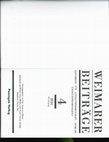
Weimarer Beiträge , 2016

Der Aufsatz untersucht, wie kommunistische Romane der späten Weimarer Republik auf die Ethnograph... more Der Aufsatz untersucht, wie kommunistische Romane der späten Weimarer Republik auf die Ethnographie des Urbanen reagierten, die erst durch die Erforschung proletarischer Räume historisch entstand. Für die kommunistische Literatur der späten Weimarer Republik exemplarische Romane wie Karl Grünbergs "Brennende Ruhr" und Klaus Neukrantz’ "Barrikaden am Wedding" adaptieren Motive und Figuren ethnographischer Reiseliteratur und stellen den Fremdbeschreibungen der Ethnographie des Städtischen eine Poetik der proletarischen Selbsterforschung gegenüber. Indem diese Texte aus politischen Gründen jedoch einen kategorischen Unterschied zwischen proletarischer und bürgerlicher Kultur setzen, muss diese Selbsterforschung als verhindert gelten. Dem Diskurs der Romanen entgeht die an diesen Texten selbst zu beobachtende kulturelle Hybridität der eigenen literarischen Produktion und ihres gegenkulturellen Projektes.

Internationales Archiv für Sozialgeschichte der deutschen Literatur (IASL), 2016
Focusing on the book club "Universum-Bücherei für Alle" and Kurt Kläber’s novel "Passagiere der I... more Focusing on the book club "Universum-Bücherei für Alle" and Kurt Kläber’s novel "Passagiere der III. Klasse," this article reconstructs attempts by communist writers and cultural activists to produce an internationalist world literature during the Weimar Republic. In contrast to theories of world literature that often ignore such non-canonical traditions, marginalize social class, and emphasize culture, this article argues that world literature theory needs to theorize the relations between world literature, politics, and social stratification.

Research paper thumbnail of Aesthetics, Masses, Gender: Anna Seghers's Revolt of the Fishermen of St. Barbara

New German Critique 124, 42:1 (2015)

Recent modernism studies have largely ignored the literature of the workers' movement. They perpe... more Recent modernism studies have largely ignored the literature of the workers' movement. They perpetuate a historically influential dichotomy between modernism and workers' movement literature that can be traced back to the Weimar Republic. The article situates Anna Seghers's Revolt of the Fishermen of St. Barbara at the intersection of modernism and workers' movement literature and argues that such literature should be understood as part of a broadly conceived literary modernism. Reorienting modernist aesthetics toward a poetics of collectivity and viewing modernity through a spatial poetics resonant with contemporary minority studies, The Revolt of the Fishermen constructs alternative representations of proletarian masses, social transformation, and gender. The story subtly undermines masculine visions of revolutionary agency and pays special attention to the role of working-class women in the struggle. This sets the text simultaneously apart from most workers' movement authors and many Weimar women writers who focused on individual white-collar workers.