Books by David Kloos

Becoming Better Muslims: Religious Authority and Ethical Improvement in Aceh, Indonesia (Princeton: Princeton University Press), 2018
How do ordinary Muslims deal with and influence the increasingly pervasive Islamic norms set by i... more How do ordinary Muslims deal with and influence the increasingly pervasive Islamic norms set by institutions of the state and religion? Becoming Better Muslims offers an innovative account of the dynamic interactions between individual Muslims, religious authorities, and the state in Aceh, Indonesia. Relying on extensive historical and ethnographic research, David Kloos offers a detailed analysis of religious life in Aceh and an investigation into today’s personal processes of ethical formation.
Aceh is known for its history of rebellion and its recent implementation of Islamic law. Debunking the stereotypical image of the Acehnese as inherently pious or fanatical, Kloos shows how Acehnese Muslims reflect consciously on their faith and often frame their religious lives in terms of gradual ethical improvement. Revealing that most Muslims view their lives through the prism of uncertainty, doubt, and imperfection, he argues that these senses of failure contribute strongly to how individuals try to become better Muslims. He also demonstrates that while religious authorities have encroached on believers and local communities, constraining them in their beliefs and practices, the same process has enabled ordinary Muslims to reflect on moral choices and dilemmas, and to shape the ways religious norms are enforced.
Arguing that Islamic norms are carried out through daily negotiations and contestations rather than blind conformity, Becoming Better Muslims examines how ordinary people develop and exercise their religious agency.
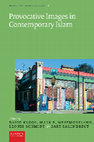
Provocative Images in Contemporary Islam, 2023
How do images provoke? And why? This volume aims to inspire thought by examining the relationship... more How do images provoke? And why? This volume aims to inspire thought by examining the relationship between images and Islam in a variety of social, political, and geographic settings.
Perhaps, the cover image of this book provokes you, the reader of this book. Does an image of a mural on the wall of Marcus Books in Oakland, California, represent contemporary images of Islam? Does the iconic image of El-Hajj Malik El-Shabazz, aka Malcolm X, photographed while holding a rifle in defense of his home, contribute to or complicate images in and of Islam? Does the cover unduly sensationalize the image or does it, rather, arouse pride in particular Muslim legacies of knowledge and liberation? To what extent does it confirm normative narratives? To what extent does it disrupt such narratives, allowing new imaginaries to take hold?
Moving beyond a common visual concern within Religious Studies with art, aesthetic value, and perceptions of beauty or coherence, this volume shows how, when, and why images dare, shock, terrorize, confront, challenge, mock, shame, taunt, or offend, either intentionally or unintentionally, and as such lead to both confrontation and affective religious engagement. Exploring and experimenting with the relationship between text and image, the contributions draw attention simultaneously to the messiness of everyday life and to highly targeted, disruptive interventions that mark religious contestation in an era of escalating mobility and digital multiplicity. The volume thus illuminates an insight that has received little attention so far: provocation is among religion’s most significant mediations.
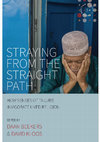
Straying from the Straight Path: How Senses of Failure Invigorate Lived Religion, ed. Daan Beekers and David Kloos (New York and Oxford), 2018
If piety, faith, and conviction constitute one side of the religious coin, then imperfection, unc... more If piety, faith, and conviction constitute one side of the religious coin, then imperfection, uncertainty, and ambivalence constitute the other. Yet, scholars tend to separate these two domains and place experiences of inadequacy in everyday religious life – such as a wavering commitment, religious negligence or weakness in faith – outside the domain of religion ‘proper.’
Straying from the Straight Path breaks with this tendency by examining how self-perceived failure is, in many cases, part and parcel of religious practice and experience. Responding to the need for comparative approaches in the face of the largely separated fields of the anthropology of Islam and Christianity, this volume gives full attention to moral failure as a constitutive and potentially energizing force in the religious lives of both Muslims and Christians in different parts of the world.

This book examines the relationship between the state state implementation of Shariʿa and diverse... more This book examines the relationship between the state state implementation of Shariʿa and diverse lived realities of everyday Islam in contemporary Aceh, Indonesia. With chapters covering topics ranging from NGOs and diaspora politics to female ulama and punk rockers, the volume opens new perspectives on the complexity of Muslim discourse and practice in a society that has experienced tremendous changes since the 2004 Indian Ocean tsunami. These detailed accounts of and critical reflections on how different groups in Acehnese society negotiate their experiences and understandings of Islam highlight the complexity of the ways in which the state is both a formative and a limited force with regard to religious and social transformation.
Contributors are: Dina Afrianty, R. Michael Feener, Kristina Groβmann, Reza Idria, David Kloos, Antje Missbach, Benjamin Otto, Jan-Michiel Otto, Annemarie Samuels and Eka Srimulyani.
Journal articles and book chapters by David Kloos
Bijdragen tot de Taal-, Land- en Volkenkunde 181 (1): 325-356., 2025
Twentieth-century Southeast Asia saw the emergence of ustazah-female Islamic teachers-as certifie... more Twentieth-century Southeast Asia saw the emergence of ustazah-female Islamic teachers-as certified professionals with a distinctly public presence and considerable social status. Their authority was contingent on Muslim women's social mobility and political emancipation as much as their newly acquired access to formal Islamic education. Analysing the remarkable life and memoir of Ustazah Khaironnisah binti Mohd Ali (1933-2017), the first headmistress of the women's section of the prestigious al-Mashoor Islamic school in Penang, Malay(si)a, this article demonstrates that women's Islamic authority simultaneously built on and clashed with contemporary notions of success and urban professionalism. Debunking the stereotypical image of the ustazah as a figure whose role was limited to religious guidance and pastoral care in local communities and private spaces and showing how women's religious authority straddled institutionalized Islam and political activism, it reveals the salience in the twentieth century of newly emerging and competing Muslim femininities in Malaysia and beyond.
Social Analysis, 2025
In Malaysia, women Islamic preachers use various rhetorical devices and performative styles to (r... more In Malaysia, women Islamic preachers use various rhetorical devices and performative styles to (re)shape Islamic gender norms. Focusing on preacher, novelist, and influencer Fatima Syarha, who offers compelling guides for pious life and professional ambition, this article asks how these preachers establish their authority in a public sphere that has become increasingly polarized between secular liberalism and religious conservatism. The answer, it argues, lies in the maximization of the creative possibility of genre to simultaneously extend and subtly subvert religious traditions. Crafting experimental and flexible genres through mixing theology, self-help, and fictionalized accounts of the religious self, some of these women preachers develop new registers of authority. Creatively experimenting with the presentation of the self, they situate women simultaneously at the center and at the receiving end of the Islamic tradition.
Indonesia, 2025
This introductory article lays the groundwork for the special issue on "Social Media and Society ... more This introductory article lays the groundwork for the special issue on "Social Media and Society in Indonesia." It examines the co-constitutive relationship between social media and Indonesian society, focusing on their mutual shaping within enduring socio-cultural dynamics. The article calls for a nuanced understanding of how technologies are localized and how diverse "social media publics" emerge in the Indonesian context. It begins by tracing the social and material histories of Indonesian social media and subsequently explores three key themes that emerge from the curated collection: the business and labor of cultivating social media publics; social media's political publics; and social media's religious publics. Challenging dominant narratives of social media as a homogenous phenomenon, the article positions Indonesia as a critical lens for analyzing and reimagining global social media discourse.
History and Anthropology , 2023
This article takes the first ever Indonesian Congress of Women Islamic Scholars (Kongres Ulama Pe... more This article takes the first ever Indonesian Congress of Women Islamic Scholars (Kongres Ulama Perempuan Indonesia, KUPI), and its methodology for formulating religious opinions, as an entry point for analysing the challenge of challenging male, male-centred, and patriarchal authority in Islam. Although a recent initiative, KUPI must be understood in the context of a long and often contentious history of Indonesian secular activists and Islamic scholars (men and women) sounding each other out and seeking common ground in their efforts to reinterpret religious sources and develop new ideas about the position of women in society. Studying the event ethnographically as a site of public communication and exchange – of religious knowledge, views, and experiences – , and contextualizing it in the history of Indonesian Islamic practices and institutions, we argue that the main significance of KUPI lies in the way in which it expands the global Islamic feminist project from a scholarly and intellectual movement into a locally resonant and potentially impactful social movement.
History and Anthropology, 2023
This article introduces a special issue on practices of religious and scholarly knowledge exchang... more This article introduces a special issue on practices of religious and scholarly knowledge exchange in Southeast Asia and the Caribbean. In both regions, the makings of religion have been informed by unsettling encounters between religious experts on the one hand and academic scholars of, and in, religion on the other. These encounters, we argue, can be revealed and productively analyzed through a focus on sites of learning and exchange, such as schools and universities, temples and monasteries, holy shrines, conferences and workshops, but also texts and archives. At such sites, alternative actors, referred to in this special issue as ‘strategic amateurs and accidental experts’, often emerge as unexpected agents of religious change. After explaining the central theme and approach, we draw together and synthesize two strands of argument found in the separate articles, respectively the centrality of moral geographies and geographic imaginations to the making of religion and the intriguing role played by performances of expertise, either as a form of gatekeeping in religious communities and institutions or as alternative sources of religious knowledge and authority. The article concludes with a reflective note on the role of scholars in both fortifying and destabilizing understandings of region and religion.
American Anthropologist, 2021
Mass involvement of women in Islamic associations and public religious expressions has led to an ... more Mass involvement of women in Islamic associations and public religious expressions has led to an unprecedented demand for women Islamic authorities. Yet, paradoxically, the global Islamic revival has also strengthened conservative norms with regard to the exposure of women’s bodies and voices. In Malaysia, women Islamic popular preachers navigate, and to some extent obviate, this tension between publicity and modesty by cultivating a professional style. In the context of mass education, mass mediatization, and a public sphere saturated with techno-political language, these women combine religious guidance with knowledges and performances more commonly associated with nonreligious professions. They perceive their work and careers as an accumulation of professional skills. They work from offices as well as traditional religious institutions. And they provide specialized, often paid services ranging from conventional religious teaching and preaching to professionalized Islamic healing and media performances. The increasing salience of a professional persona in women’s preaching requires an analysis that moves beyond pious exemplarity – a central concern of many anthropological studies of women’s religious authority – and that recognizes the central role of professional style and associated performances in the shaping of new Muslim femininities.
Itinerario: Journal of Imperial and Global Interactions, 2021
This article draws attention to the case of Aceh to analyse the mechanisms through which ideologi... more This article draws attention to the case of Aceh to analyse the mechanisms through which ideologically driven geographic imaginings obscured the role of place and class in colonial and anti-colonial violence in Indonesia. Its main perspective is the region's West Coast. In the course of the long and brutal Dutch-Acehnese war (1873-1942), the West Coast of Sumatra was transformed from a dynamic centre of trade, commerce, and religious renewal into a colonial frontier. Violent resistance persisted in this area as the Dutch involved themselves in and exacerbated local contestations for authority and resources. Colonial discourse worked to conceal these complexities, foregrounding an image of the West Coast as a remote, backwards, and inherently dangerous place, prone to a violent Muslim millenarianism.
Towards a New Malaysia: The 2018 Election and Its Aftermath, 2020
This chapter provides an ethnographic account of the campaigns of women candidates in Islamist pa... more This chapter provides an ethnographic account of the campaigns of women candidates in Islamist parties during Malaysia's 14th general elections in 2018 (GE14). It analyses a tension between, on the one hand, the perception that a woman is more able than a man to "touch the hearts" of voters and, on the other hand, the supposed electoral advantages, emanating from an increasingly highly-educated and socially mobile electorate, of a professional "aura." In order to be successful, it is argued, women in Islamist politics must reconcile stereotypical ideals of Muslim-Malay femininity with a professional persona.
American Ethnologist, 2019
In Malaysia women exercise authority as they combine professional expertise with Islamic knowledg... more In Malaysia women exercise authority as they combine professional expertise with Islamic knowledge to engage with contentious religious debates. In the context of transformations caused by mass education and mass mediatization, professional experts without Islamic (seminary) education-such as doctors, lawyers, and psychologists-can successfully claim religious authority and establish themselves as part of the Islamic public sphere. This creates possibilities for women. Contemporary cultures of professionalism enable them to challenge long-standing configurations of religious authority, including the perception that this authority is (primarily or necessarily) male. Their performances, although not without constraints, require an analysis that moves anthropological debates about women's roles and autonomies beyond a Foucauldian concern with discourse and the modes of (self-)disciplining and resistance associated with it.
In: Straying from the Straight Path: How Senses of Failure Invigorate Lived Religion, ed. Daan Beekers and David Kloos, pp. 1-19. New York and Oxford: Berghahn Books, 2018
In this introductory chapter we introduce the theme of moral failure, by which we denote the expe... more In this introductory chapter we introduce the theme of moral failure, by which we denote the experiences of shortcoming, inadequacy and imperfection that are often at the heart of lived religion. We argue that a critical exploration of senses of failure in everyday religious lives offers a possibility for transcending a dichotomy that has emerged within both the anthropology of Islam and the anthropology of Christianity, that between pursuits of ethical perfection and the ambivalences of everyday life. Much work on religious ethics stresses the opposition between religious and non-religious ethical repertoires, effectively placing experiences of imperfection outside of the domain of religious experience ‘proper’. In contrast, we contend that moral failure is often part and parcel of, and productively contributes to, processes of ethical formation. In this introduction, we outline this dialectics of religious pursuits, which is addressed in different ways by each of the contributions to this special issue.
In: Straying from the Straight Path: How Senses of Failure Invigorate Lived Religion, ed. Daan Beekers and David Kloos, pp. 90-106. New York and Oxford: Berghahn Books, 2018
This chapter analyses the conspicuous not-praying of a young man in Aceh, Indonesia, a place wher... more This chapter analyses the conspicuous not-praying of a young man in Aceh, Indonesia, a place where normative Islam has recently moved to the very forefront of the public domain. Acknowledgment of his own religious negligence, I show, played a central role in his understanding of personal religiosity, his intention of becoming a better Muslim, and his transformation from a relatively unbound youth to an adult with increasing social and individual responsibilities. I use this case to demonstrate the significance of a more broadly shared religious ethics in Aceh, in which future expectations, and the moral values of sincerity and intention, are valued over and above obvious shortcomings in outward behaviour. The basic sense that things might change, I argue, constitutes an important creative and motivating force within Acehnese social and religious life. It calls attention, moreover, to a generally under-recognized flexibility toward ethical formation in contexts that have been strongly affected by the global Islamic revival.
Asian Studies Review, 2016
This article introduces a special issue on female Islamic authority
in contemporary Asia. It prov... more This article introduces a special issue on female Islamic authority
in contemporary Asia. It provides an overview of the literature on
religious authority in Islam and briefly lays out which modes of
female religious authority have been more accepted than others in
the schools of jurisprudence. Based on the articles included in this
issue, the introduction makes two chief observations. First, in contrast
to the overwhelming consensus among experts of Islamic law that
women may serve as muftūn (plural of muftī), in most Muslim-majority
societies today women are either seldom found in this role, or where
there are muftīyāt (female muftūn), their role is confined to women’s
issues. Second, while a growing body of academic studies has drawn
attention to the recent phenomenon of state-instituted or -supported
programs that train women in Islamic authority, little attention has
been paid to the question of how communities react to such programs.
The special issue is a call to study female religious authority from the
bottom up, in order to better understand why believers, whether men
or women, ascribe religious authority to women in some contexts and
situations, but overwhelmingly still prefer male religious authority
over female, despite the permissiveness for female juristic expertise
in Islamic law.
Asian Studies Review, 2016
This article analyses the relationship between gender and religious
authority in contemporary Ace... more This article analyses the relationship between gender and religious
authority in contemporary Aceh, Indonesia. It focuses on the lives
and careers of two female Islamic teachers in different parts of
the province. Their authority, it is argued, derives from expertise
acquired from prestigious centres of religious learning, careful (if not
always successful) negotiation of formal institutions – including the
state – and their status as local community leaders. Their views and
experiences raise urgent questions about the position of women
in Acehnese society and the influence of (the rise of) normative
Islam and the state. By asking what, exactly, is “female” about female
Islamic authority, and what is not, this article addresses a persistent
dichotomy in the literature on Southeast Asia between formal (state
and religious) discourses and institutions as a source of male authority
and more informal, localised practices and social relations as a domain
of female authority.
In: Voyage of Discovery: Exploring the Collections of the Asian Library at Leiden University, ed. Alexander Reeuwijk. Leiden: Leiden University Press, 2017
Visual Anthropology Review, 2015
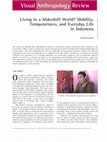
This article uses material from “Recording the Future: An Audiovisual Archive of Everyday Life in... more This article uses material from “Recording the Future: An Audiovisual Archive of Everyday Life in Indonesia in the 21st Century” (RtF) in order to explore the creative and emotional processes through which ordinary Indonesians try to make places “their own.” Employing the notion of “makeshift” as an analytical category, I analyze how modes of improvisation and senses of temporariness are visualized in the RtF archive. By doing so, I centralize the everyday conditions and experiences of a seemingly amorphous but increasingly significant class of Indonesian domestic migrants in search of an income and a place to live. Integrating visual materials and textual analysis, I argue that these experiences are based, on the one hand, on a willingness to leave and the ability to adapt and, on the other hand, on a fundamental desire for a stable and regular life.
In: Citizenship and Democratization in Southeast Asia, ed. Ward Berenschot, Henk Schulte Nordholt and Laurens Bakker, pp. 178-207. Leiden: Brill, 2016



Uploads
Books by David Kloos
Aceh is known for its history of rebellion and its recent implementation of Islamic law. Debunking the stereotypical image of the Acehnese as inherently pious or fanatical, Kloos shows how Acehnese Muslims reflect consciously on their faith and often frame their religious lives in terms of gradual ethical improvement. Revealing that most Muslims view their lives through the prism of uncertainty, doubt, and imperfection, he argues that these senses of failure contribute strongly to how individuals try to become better Muslims. He also demonstrates that while religious authorities have encroached on believers and local communities, constraining them in their beliefs and practices, the same process has enabled ordinary Muslims to reflect on moral choices and dilemmas, and to shape the ways religious norms are enforced.
Arguing that Islamic norms are carried out through daily negotiations and contestations rather than blind conformity, Becoming Better Muslims examines how ordinary people develop and exercise their religious agency.
Perhaps, the cover image of this book provokes you, the reader of this book. Does an image of a mural on the wall of Marcus Books in Oakland, California, represent contemporary images of Islam? Does the iconic image of El-Hajj Malik El-Shabazz, aka Malcolm X, photographed while holding a rifle in defense of his home, contribute to or complicate images in and of Islam? Does the cover unduly sensationalize the image or does it, rather, arouse pride in particular Muslim legacies of knowledge and liberation? To what extent does it confirm normative narratives? To what extent does it disrupt such narratives, allowing new imaginaries to take hold?
Moving beyond a common visual concern within Religious Studies with art, aesthetic value, and perceptions of beauty or coherence, this volume shows how, when, and why images dare, shock, terrorize, confront, challenge, mock, shame, taunt, or offend, either intentionally or unintentionally, and as such lead to both confrontation and affective religious engagement. Exploring and experimenting with the relationship between text and image, the contributions draw attention simultaneously to the messiness of everyday life and to highly targeted, disruptive interventions that mark religious contestation in an era of escalating mobility and digital multiplicity. The volume thus illuminates an insight that has received little attention so far: provocation is among religion’s most significant mediations.
Straying from the Straight Path breaks with this tendency by examining how self-perceived failure is, in many cases, part and parcel of religious practice and experience. Responding to the need for comparative approaches in the face of the largely separated fields of the anthropology of Islam and Christianity, this volume gives full attention to moral failure as a constitutive and potentially energizing force in the religious lives of both Muslims and Christians in different parts of the world.
Contributors are: Dina Afrianty, R. Michael Feener, Kristina Groβmann, Reza Idria, David Kloos, Antje Missbach, Benjamin Otto, Jan-Michiel Otto, Annemarie Samuels and Eka Srimulyani.
Journal articles and book chapters by David Kloos
in contemporary Asia. It provides an overview of the literature on
religious authority in Islam and briefly lays out which modes of
female religious authority have been more accepted than others in
the schools of jurisprudence. Based on the articles included in this
issue, the introduction makes two chief observations. First, in contrast
to the overwhelming consensus among experts of Islamic law that
women may serve as muftūn (plural of muftī), in most Muslim-majority
societies today women are either seldom found in this role, or where
there are muftīyāt (female muftūn), their role is confined to women’s
issues. Second, while a growing body of academic studies has drawn
attention to the recent phenomenon of state-instituted or -supported
programs that train women in Islamic authority, little attention has
been paid to the question of how communities react to such programs.
The special issue is a call to study female religious authority from the
bottom up, in order to better understand why believers, whether men
or women, ascribe religious authority to women in some contexts and
situations, but overwhelmingly still prefer male religious authority
over female, despite the permissiveness for female juristic expertise
in Islamic law.
authority in contemporary Aceh, Indonesia. It focuses on the lives
and careers of two female Islamic teachers in different parts of
the province. Their authority, it is argued, derives from expertise
acquired from prestigious centres of religious learning, careful (if not
always successful) negotiation of formal institutions – including the
state – and their status as local community leaders. Their views and
experiences raise urgent questions about the position of women
in Acehnese society and the influence of (the rise of) normative
Islam and the state. By asking what, exactly, is “female” about female
Islamic authority, and what is not, this article addresses a persistent
dichotomy in the literature on Southeast Asia between formal (state
and religious) discourses and institutions as a source of male authority
and more informal, localised practices and social relations as a domain
of female authority.