Synopsis
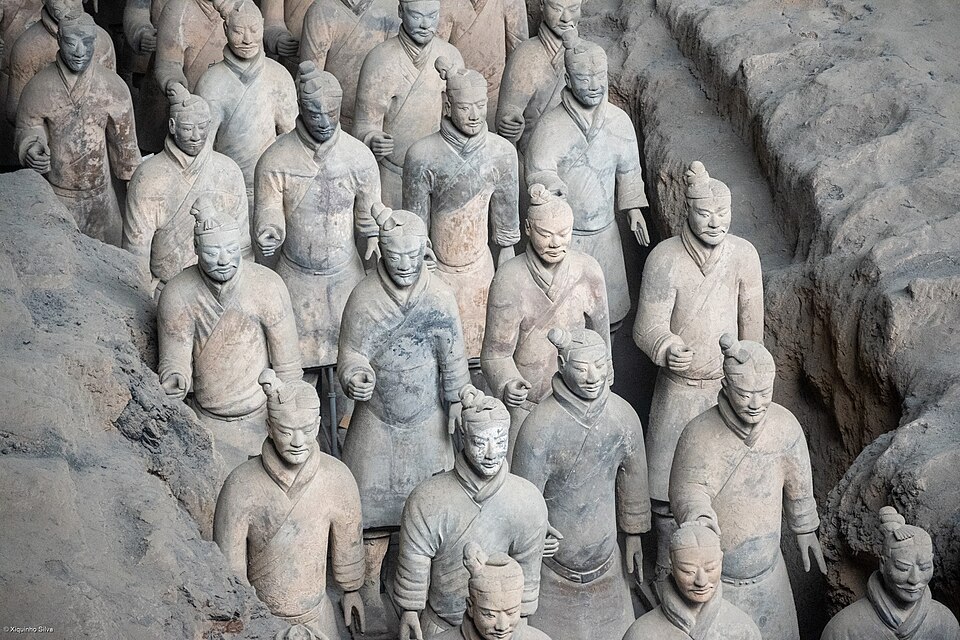
The Terracotta Army near Xi'an was discovered in 1974. Approximately 8,000 life-size terracotta warriors guard the tomb of China's First Emperor. Called the 'Eighth Wonder of the World.' A UNESCO World Heritage Site since 1987.
Overview
The Terracotta Army (兵马俑), officially known as the Terracotta Army of the Mausoleum of the First Qin Emperor, is located 1.5 kilometers east of the Mausoleum of Qin Shi Huang in Lintong District, Xi'an, Shaanxi Province. It is one of China's first batch of Major Historical and Cultural Sites Protected at the National Level and one of China's first World Heritage Sites.
The Terracotta Army pits are an important component of the Mausoleum of Qin Shi Huang — large sacrificial pits that were accidentally discovered in 1974 by local farmers digging a well. To date, four pits have been excavated, covering a total area of approximately 25,000 square meters, containing about 8,000 terracotta warriors, horses, and wooden chariots.
The Mausoleum of Qin Shi Huang was built between 246 BC and 208 BC, spanning 39 years. It is the first imperial mausoleum in Chinese history that is grand in scale, carefully planned, and well preserved. Over 200 foreign heads of state and government officials have visited the Terracotta Army, making it a "golden business card" of ancient Chinese civilization.
In 1987, the Mausoleum of the First Qin Emperor and the Terracotta Army pits were inscribed on UNESCO's World Cultural Heritage List.
History
| Period | Event |
|---|---|
| 246 BC | Construction of the Mausoleum of Qin Shi Huang begins |
| 208 BC | Mausoleum completed after 39 years of construction |
| March 1974 | Terracotta Army pits accidentally discovered by local farmers digging a well |
| 1979 | Museum of the Terracotta Army opens to the public |
| 1987 | Inscribed as UNESCO World Cultural Heritage |
| 2010 | Emperor Qinshihuang's Mausoleum Site Museum officially opens |
Main Pits
| Pit | Area | Features |
|---|---|---|
| Pit 1 | ~14,260 sq m | Largest pit, primarily infantry, ~6,000 warriors arranged in rectangular military formation |
| Pit 2 | ~6,000 sq m | Mixed兵种 pit with infantry, cavalry, crossbowmen, and charioteers; ~1,300 warriors |
| Pit 3 | ~520 sq m | Command post pit; ~68 warriors, numerous bronze weapons discovered |
| Pit 4 | Unfinished | Empty pit; likely left incomplete due to the peasant uprising at the end of the Qin Dynasty |
Pit 1
Pit 1 is the largest of the Terracotta Army pits, measuring 230 meters east to west, 62 meters north to south, and approximately 5 meters deep, covering an area of about 14,260 square meters. The pit primarily contains infantry warriors — approximately 6,000 terracotta figures arranged in a rectangular military formation of grand scale. Pit 1 was the first to be excavated and opened to the public.
Pit 2
Pit 2, located northeast of Pit 1, covers approximately 6,000 square meters and contains a mix of military branches. The pit includes infantry, cavalry, crossbowmen, and charioteers — about 1,300 terracotta warriors and over 80 wooden chariots. Excavation of Pit 2 began in 1976 and demonstrates the Qin army's diverse military organization.
Pit 3
Pit 3, located west of Pit 1, covers approximately 520 square meters and served as the command center for the Terracotta Army. The pit contains about 68 warriors and has yielded a large number of bronze weapons. The layout of Pit 3 resembles a military command center.
Characteristics of the Warriors
The terracotta warriors have distinctive features:
- Thousand Faces: Each warrior has a unique facial expression, hairstyle, and beard, demonstrating the extraordinary craftsmanship of Qin Dynasty artisans
- Life-size: Warriors stand approximately 1.8-2.0 meters tall, matching real human proportions
- Military Branches: General warriors, military officer warriors, infantry warriors, cavalry warriors, and crossbowmen each have different costumes and poses
- Polychrome Painting: The warriors were originally painted in vivid colors, but oxidation after excavation caused the paint to fade
Mausoleum of Qin Shi Huang
The Mausoleum of Qin Shi Huang is located at the northern foot of Mount Li and is the tomb of Ying Zheng, the first emperor of China. The mausoleum garden was modeled after the layout of the Qin capital Xianyang, with inner and outer walls:
- Inner City: Circumference approximately 2.5 kilometers
- Outer City: Circumference approximately 6.3 kilometers
- Burial Mound: Current height approximately 40 meters (originally 76 meters)
The underground palace of the Mausoleum has not yet been formally excavated. According to the "Records of the Grand Historian" (史记), the palace floor was designed with "mercury representing the hundred rivers, the Yangtze, the Yellow River, and the great sea," along with numerous precious burial objects.
Practical Information
| Item | Details |
|---|---|
| Location | Qinling Street, Lintong District, Xi'an, Shaanxi Province |
| Best Season | Spring (Mar-May) and Autumn (Sep-Nov) |
| Suggested Visit Duration | 3-4 hours |
| Admission | Peak season (Mar-Nov) ~150 RMB, Off-season (Dec-Feb) ~120 RMB |
| Transportation | Bus 306 from Xi'an Railway Station ~1 hour; or Metro Line 9 to Huaqingchi Station then transfer |
| Nearby Attractions | Huaqing Pool, Mount Li, Lintong Museum |
World Heritage
In 1987, the Mausoleum of the First Qin Emperor and the Terracotta Army pits were inscribed by UNESCO as a World Cultural Heritage Site. UNESCO's evaluation noted:
- The Terracotta Army is an outstanding representative of ancient Chinese sculptural art
- The discovery of the Terracotta Army is one of the most important archaeological discoveries of the 20th century
- The Mausoleum of the First Qin Emperor and the Terracotta Army are an important symbol of Chinese civilization
References
- Emperor Qinshihuang's Mausoleum Site Museum: https://www.bmy.com.cn/
- Baidu Baike: https://baike.baidu.com/item/兵马俑
- Wikipedia: https://zh.wikipedia.org/wiki/秦始皇兵马俑
- Shaanxi Cultural Heritage Bureau: https://wwj.shaanxi.gov.cn/wbxx/bkydww/sjwhyc/
Stills & Gallery
Comments (0)