Governance of REDD by Dr Cecilia Luttrell
SUMMARY International negotiations for reducing emissions from deforestation and forest degradati... more SUMMARY International negotiations for reducing emissions from deforestation and forest degradation and the enhancement of forest carbon stocks (REDD+) under the UN Framework Convention on Climate Change (UNFCCC) were finally concluded in 2015. However, due to the complex design and implementation processes of REDD+ policies and measures, including benefit sharing at national and subnational levels, several challenges exist for sustainably reducing emissions while simultaneously managing the provision of social and environmental side-objectives. We review the realities of REDD+ implementation in 13 REDD+ candidate countries and the risks related to REDD+ policies and benefit sharing based upon a synthesis of the findings presented in 'country profiles' that were developed between 2009 and 2013 as part of the Center for International Forestry Research's (CIFOR) Global Comparative Study on REDD+. We find that REDD+ policies in all countries studied are at high risk of ineffectiveness, inequity and inefficiency. By classifying these risks and understanding not only their impacts on different stakeholder groups, but also the consequences for achieving specific objectives, countries can identify solutions in order to address these shortcomings in their implementation of REDD+.
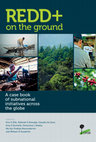
In this chapter, we synthesize what these diverse experiences tell us about the capability of RED... more In this chapter, we synthesize what these diverse experiences tell us about the capability of REDD+ to deliver on its goals, including the role of subnational initiatives and how they integrate with national REDD+ through their choice of (i) scale and (ii) MRV systems. Our research on these initiatives also gives us insights into the challenges of (i) financing interventions, (ii) clarifying tenure, and (iii) designing social safeguards. In particular, our rich data on household livelihoods and village conditions allow us to identify common patterns as well as heterogeneity that must be taken into account in the design of social safeguards. For each of these five issues, we first note some of the key insights from the literature and then summarize what we have learned from the case studies. We close with a section assessing whether REDD+ still has the potential to be the path-breaking solution to deforestation that generated so much hope and enthusiasm seven years ago.
Operationalizing safeguards in
national REDD+ architectures
remains a major challenge
in most ... more Operationalizing safeguards in
national REDD+ architectures
remains a major challenge
in most REDD+ countries,
particularly in the area of benefit
sharing. Effective, efficient and
equitable outcomes of REDD+
require effective, efficient and
equitable implementation of
safeguards.
Benefit sharing (BS) approaches in community forestry (CF) are differentiated into: rights alloca... more Benefit sharing (BS) approaches in community forestry (CF) are differentiated into: rights allocation-based, input-based
and performance-based, from initiation to implementation and each approach has specific and complementary roles in
ensuring effectiveness, efficiency and equity of benefit sharing mechanisms (BSMs).
•
Rights allocation-based BSMs provide a more sustainable incentive than payment-based incentives for maintaining
involvement in CF under conditions of inadequate financing. Maintaining the sustainability of payment-based incentives
is problematic because of the need to price incentives correctly relative to transaction and opportunity costs. The need to
compensate for opportunity costs is less relevant under rights-based BSMs.
•
The type of rights matters. Clear, comprehensive and secure tenure rights that include rights to access, withdraw, manage
and exclude, induces strong collective action.
•
Effectiveness and efficiency of BSMs can be enhanced by structuring benefits as incentives to change behavior, particularly
when compared to some input-based incentives that are not directly linked to halting of deforestation and degradation.
•
Equity in BSM can be enhanced if revenues are allocated for development activities such as community infrastructure and
facilities and social services and by explicitly weighting for the poor, women and marginalized groups.
•
Though there can be equity trade-offs compared to funding individual payments, our case studies suggest a preference
for development activities, especially if such payments are not that significant compared to current shared benefits.
•
Transaction costs and the failure to compensate for these act as a barrier to smallholders and the poor
•
For equity and long-term commitment, opportunity costs are important in deciding how benefits are shared, particularly
if land-use competition is high. There are different types of opportunity costs (i.e. the opportunity costs of revenues from
behavior change of individual household versus the rent of alternative land uses in the area included in a REDD+ scheme)
and these differences should be considered in the design.

An Assessment Framework for Benefit Sharing Mechanisms to Reduce Emissions from Deforestation and Forest Degradation within a Forest Policy Mix: Assessment Framework for REDD+ BSM
Environmental Policy and Governance 27(5):436-452, 2017
Policy instruments for implementing the Reducing Emissions from Deforestation and Forest Degradat... more Policy instruments for implementing the Reducing Emissions from Deforestation and Forest Degradation and the enhancement of forest carbon stocks (REDD+) mechanism operate within an orchestra of policy mixes that affect the forest and other land sectors. How will policymakers choose between the myriad of options for distributing REDD+ benefits, and be able to evaluate its potential effectiveness, efficiency and equity (3Es)? This is a pressing issue given the results-based aspect of REDD+. We present here a three-element assessment framework for evaluating the outcomes and performance of REDD+ benefit sharing mechanisms, using the criteria of effectiveness, efficiency and equity: (1) the structures (objective and policies) of a REDD+ benefit sharing mechanism; (2) the broader institutional and policy contexts underlying forest governance; (3) outcomes of REDD+ including emission reductions, ecosystem service provision and poverty alleviation. A strength of the assessment framework is its flexible design to incorporate indicators relevant to different contexts; this helps to generate a shared working understanding of what is to be evaluated in the different REDD+ benefit sharing mechanisms (BSMs) across complex socio-political contexts. In applying the framework to case studies, the assessment highlights trade-offs among the 3Es, and the need to better manage access to information, monitoring and evaluation, consideration of local perceptions of equity and inclusive decisionmaking processes. The framework does not aim to simplify complexity, but rather serves to identify actionable ways forward towards a more efficient, effective and equitable implementation and re-evaluation of REDD+ BSMs as part of reflexive policymaking. Copyright © 2017 John Wiley & Sons, Ltd and ERP Environment
Beyond opportunity costs: who bears the implementation costs of reducing emissions from deforestation and degradation?
Các phương án tiếp cận chia sẻ lợi ích: Kết quả so sánh sơ bộ tại 13 nước đang thực hiện REDD+
¿ Cómo vinculamos las necesidades del pais con las fuentes de financiamiento?
Các bản thông tin tóm tắt của CIFOR cung cấp các thông tin khoa học ngắn gọn chính xác về các chủ... more Các bản thông tin tóm tắt của CIFOR cung cấp các thông tin khoa học ngắn gọn chính xác về các chủ đề hiện tại trong nghiên cứu lâm nghiệp CIFOR Số 44, Tháng 1 năm 2012
Lessons from Payments for Ecosystem Services for REDD+ Benefit-Sharing Mechanisms
Where benefits and costs accrue at different scales, financial intermediaries are needed to facil... more Where benefits and costs accrue at different scales, financial intermediaries are needed to facilitate relations between global-scale buyers and local-scale providers of carbon sequestration and storage. These intermediaries can help to collect and distribute payments and to promote the scheme to potential beneficiaries. The benefits distributed should compensate for the transaction, opportunity and implementation costs incurred by stakeholders for providing ecosystem services. Therefore, calculating the costs and understanding who incurs them are essential for benefit sharing. Targeting benefits according to a set of criteria that match the objectives of the specific mechanism increases the mechanisms efficiency. As the level of performance-based payments may not be able to compete with the opportunity costs of highly profitable land uses, performance-related benefit-sharing mechanisms should be focused on areas with moderate opportunity costs. Benefits should be divided into upfront payments to cover startup costs and to give an initial incentive for participation, and payments upon delivery of ecosystem services to ensure adherence to conditionality.
Pembelajaran bagi REDD+ dari berbagai tindakan untuk mengendalikan pembalakan liar di Indonesia: Laporan Ringkas
Quem deve se beneficiar e por que?: Discursos sobre a reparticao de beneficios de REDD+
La aplicación de salvaguardas en los sistemas nacionales de distribución de beneficios de REDD+: Lecciones sobre efectividad, eficiencia y equidad
¿ Cómo medimos y monitoreamos la degradación forestal?



Uploads
Governance of REDD by Dr Cecilia Luttrell
national REDD+ architectures
remains a major challenge
in most REDD+ countries,
particularly in the area of benefit
sharing. Effective, efficient and
equitable outcomes of REDD+
require effective, efficient and
equitable implementation of
safeguards.
and performance-based, from initiation to implementation and each approach has specific and complementary roles in
ensuring effectiveness, efficiency and equity of benefit sharing mechanisms (BSMs).
•
Rights allocation-based BSMs provide a more sustainable incentive than payment-based incentives for maintaining
involvement in CF under conditions of inadequate financing. Maintaining the sustainability of payment-based incentives
is problematic because of the need to price incentives correctly relative to transaction and opportunity costs. The need to
compensate for opportunity costs is less relevant under rights-based BSMs.
•
The type of rights matters. Clear, comprehensive and secure tenure rights that include rights to access, withdraw, manage
and exclude, induces strong collective action.
•
Effectiveness and efficiency of BSMs can be enhanced by structuring benefits as incentives to change behavior, particularly
when compared to some input-based incentives that are not directly linked to halting of deforestation and degradation.
•
Equity in BSM can be enhanced if revenues are allocated for development activities such as community infrastructure and
facilities and social services and by explicitly weighting for the poor, women and marginalized groups.
•
Though there can be equity trade-offs compared to funding individual payments, our case studies suggest a preference
for development activities, especially if such payments are not that significant compared to current shared benefits.
•
Transaction costs and the failure to compensate for these act as a barrier to smallholders and the poor
•
For equity and long-term commitment, opportunity costs are important in deciding how benefits are shared, particularly
if land-use competition is high. There are different types of opportunity costs (i.e. the opportunity costs of revenues from
behavior change of individual household versus the rent of alternative land uses in the area included in a REDD+ scheme)
and these differences should be considered in the design.