Conference Presentations by Dr Lara Torres

Commoning Situated Knowledge: Co-Teaching-and-Learning the ‘Design-Led Upcycling’ of Waste Clothing

State-of-the-Art Upcycling Research and Practice, 2021

This study examines the introduction of a ‘design-led upcycling’ group project into an establishe... more This study examines the introduction of a ‘design-led upcycling’ group project into an established design and enterprise curriculum structure with students on BA (Hons) fashion and textile design at the University of Portsmouth, UK. It reflects the common experience and situated knowledges of academic, technical staff and students contextualised within the changing imperatives of design education. Academics and technicians re-evaluated their established teaching and support methods in relation to upcycling in design.

Research paper thumbnail of 'Fashion // Intersections: Bodies, Cultures, Spaces' Conference, July 15, 2016 at the London College of Fashion  Title: Bridging the Gap Between Theory and Practice: artistic research methods for interdisciplinary fashion practices | Abstract Fashion Intersecctions Lara Torres
'Fashion // Intersections: Bodies, Cultures, Spaces' Conference, July 15, 2016 at the London College of Fashion Title: Bridging the Gap Between Theory and Practice: artistic research methods for interdisciplinary fashion practices | Abstract Fashion Intersecctions Lara Torres

The nature of academic studies of contemporary fashion practices is one of constant change and re... more The nature of academic studies of contemporary fashion practices is one of constant change and reflection on the processes of investigation, where the questions raised evolve in response to the developed practices. Being an emerging field, there are disagreements and tensions around the concept of artistic research itself (Borgdorff, 2007). Practice-based research is by definition empirical, and the vast majority of the literature proposes that practitioner knowledge of fashion is predominantly 'tacit' knowledge.However, the process described in this paper seeks to extend fashion practice methods by placing greater emphasis on reflection and theory. This paper describes the relevance of artistic research for fashion studies as a form of knowledge production, identifying new ways of approaching such studies, via the intersection of the fashion, fine art, and film disciplines. I seek to extend the potential for fashion practitioners to communicate their criticality through an understanding of the effect of critical reflection upon meaning within their work (Schön, 1983). This research paper is conducted as part of the emerging field of artistic research; as such, it poses questions embodied within specific artistic processes, as Borgdorff stated, employing hermeneutic methods that reveal the tacit knowledge used to develop them (2007). Practice-based artistic research implies that the researcher documents and disseminates the research processes and outcomes in an appropriate manner to the research community and the wider public. This article addresses these methods, searching for transparency within them.

Research paper thumbnail of Fashion in the expanded field: strategies for critical fashion | Abstract for the conference 'The End of Fashion'
This paper focuses on current strategies for critical fashion practices in an expanded field of f... more This paper focuses on current strategies for critical fashion practices in an expanded field of fashion. In the late 20 th century and early 21 st century, the field of fashion studies has increasingly scrutinized the relationship between fine art and fashion within an art museum context. Drawing a parallel with Rosalind Krauss's notion of sculpture in the expanded field (Krauss, 1979), this paper documents the development of interdisciplinary fashion practices since the early 1990s, suggesting that an expanded field allows fashion practitioners to engage in a critical discussion of the fashion system. As a fashion practitioner focusing on non-productivist interdisciplinary techniques across multiple media (the fashion film, sculpture, installation, and performance), I test this notion by developing parallels between contemporary fashion and Krauss's 1979 diagnosis. Most literature connecting fashion and art focuses on defining this relationship. Some authors (Geczy and Karaminas) discuss the evolution of fashion image-makers throughout the 20th century as having moved from depicting perfection and elegance to articulating fashion's ephemerality via digital media formats (2012). In this context, according to Healy, the cinematic/video apparatus has given fashion designers and curators the possibility to construct atmospheric environments and facilitated interdisciplinary practices (2013), where clothes are presented as part of a larger work signifying the fashion idea (Healy, 2013). With the advent of the digital age amidst growing concerns regarding sustainability and the fast fashion system, could this mean the end of a certain form of fashion related to production and consumption? Indeed, a postmodern understanding of fashion might suggest open-ended explorations of a possible new role for the designer within a post-product society (Margolin,1998). This paper argues for the relevance of establishing theories of interdisciplinary practice to better understand the contemporary field of fashion, challenging assumptions about fashion's role in the 21st Century.

Drafts by Dr Lara Torres

Research paper thumbnail of Fashion Ontology: Researching the Possibilities for Knowing through an Expanded Fashion Practice

Fashion Ontology: Researching the Possibilities for Knowing through an Expanded Fashion Practice

Fashion Knowledge (Book) Theories, Methods, Practices and Politics, 2022

A Fashion Ontology, Researching the possibilities for knowing through an expanded fashion practic... more A Fashion Ontology, Researching the possibilities for knowing through an expanded fashion practice 20th century art was dominated by undefined borders between artistic practices. The need to name and organize art was acted upon not only due to methodological reasoning but also to perpetuate the status quo and its associated hierarchies. Inevitably, the boundaries between Fine Arts and Applied Arts became redefined. It is through the subordination of fashion to a Post-Duchampian understanding of what fashion practices are, that this paper will concentrate on discussions surrounding the definition of fashion. The aim of this study is to voice the concerns of fashion practitioners in the early 21st century, thereby testing the boundaries of the discipline. Interdisciplinary and wide ranging, this 'paper-as-installation' fills a gap in practice-based-research by bridging practice and theory. The research methodology developed within this practice extends the potential of film as a means by which to explore theoretical possibilities for knowing through expanded fashion practice. Within a context of heightened concerns about climate change and environmental issues induced by mass-production, fast-fashion, and global fashion distribution and consumption, the proposed work challenges the understanding of fashion as the creation of garments, objects and environments. Instead, by deconstructing underlying assumptions and exposing the limitations of current market-driven fashion design processes, this project suggests that fashion production may shift to the formation of new philosophical and theoretical notions via which the discipline may further evolve in socially and environmentally responsible ways.

Thesis by Dr Lara Torres

Research paper thumbnail of Towards a practice of unmaking The essay film as critical discourse for fashion in the expanded field

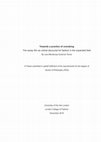
Towards a practice of unmaking The essay film as critical discourse for fashion in the expanded field, 2018

Abstract Going against the traditional productivist nature of fashion design, this practice-based... more Abstract Going against the traditional productivist nature of fashion design, this practice-based Ph.D. proposes a strategy for critical fashion practices in a research context at the intersection of fashion, fine arts and film methodologies. This interdisciplinary strategy investigates fashion in the expanded field, exploring fashion practice as a form of critical thinking, questioning the fashion system itself: a practice of unmaking, the purpose of this research is to develop a practice-based method of producing an essay film as an artistic reflection critically discussing the problems of the fashion system, providing new insights into the way a fashion designer develops new approaches that can expand the action spaces available for fashion. Since the etymology of the word ‘fashion’ relates it to the Latin factio, meaning ‘making’ or ‘doing,’ to ‘unmake’ fashion carries in itself a paradox; it is both a metaphorical undoing and a methodological one, a practice of fashion resistance by not producing clothing, a deconstruction of fashion in order to understand what it’s made of – like unpicking the seams of a jacket in order to analyse its construction. It de-constructs underlying assumptions regarding a transition to post-productivism, exposing the limitations of current market-driven fashion design processes. Drawing on Rosalind Krauss’s notion of sculpture in the expanded field (1979),  as used in the discourse on cinema (Bardon et al., 2015), this research documents the development of experimental fashion films since the 1980s and the interdisciplinary fashion practices that stand at the edge of the fashion discipline. It investigates how thought experiments can steer the creative process towards a critique of fashion, drawing from modernist conceptual and de-materialised art practices towards the development of a conceptual fashion. The research methodology developed within the practice extends the potential of communicating through the essay-film format in order to critique fashion within the contemporary context of heightened concerns about climate change and environmental issues induced by mass-production, fast-fashion, and global fashion distribution and consumption. This is developed through a juxtaposition of allegorical images resembling a thought process: the fashion image is used as a thinking-form for constructing a critique of its own systems. The thesis emphasises the importance of taking a critical stance to fashion due to the lack of self-reflection within current fashion practices, synthesising a body of knowledge to inform practitioners of experimental, critical fashion while revealing complexities within the communication of these concerns, proposing fashion as the representation of a deconstructive thought where dress itself becomes ‘immaterial’.

Book Chapters by Dr Lara Torres

Research paper thumbnail of The Body as Factory: A post-productivist fashion practice through film
Crafting Anatomies: Archives, Dialogues, Fabrications Edited by Katherine Townsend, Rhian Solomon and Amanda Briggs-Goode, Bloomsbury, 2020

This chapter discusses approaches to expanded fashion practices. The central focus here is not ma... more This chapter discusses approaches to expanded fashion practices. The central focus here is not making garments, but a post-productivist stance, with implications in relation to the production of fashion and its associated meaning. There is an attempt to see fashion beyond its commercial limitations, and instead use fashion film to speculate on our bodies as well as how we perform our materials, clothing, and wardrobes to materialise and dematerialise ourselves. This chapter carefully negotiates film as a useful critical tool, building on fashion’s own ability for image-making, where fashion colludes with dominant narratives. Power is enacted symbolically through bodies via a language of signs that non-verbally convey meanings about individuals; such fashion discourses can be diverted to critically address fashion itself as a system. This exploratory chapter surveys some of the objects, ideas and approaches my practice-as-research into material and immaterial fashion through the semiotics of fashion.

Papers by Dr Lara Torres

Research paper thumbnail of Thinking through making: Material Driven Design Pedagogies in Postgraduate Fashion Craft Education

28th IFFTI Annual Conference 2026: Cultural connections for sustainable fashion futures: rebuild, renew, regenerate, 2026

This study explores how material-led pedagogies support postgraduate fashion education learning. ... more This study explores how material-led pedagogies support postgraduate fashion education learning. Anchored in the MA Fashion Artefact course at London College of Fashion, it draws on New Materialism (Vaccari, 2022; Braidotti, 2013) and Material Driven Design (Bak-Andersen, 2018; Karana et al., 2015) to position materials as active agents in learning. The research asks: How do multidisciplinary, material-led, practice-based pedagogies facilitate ecologically responsive learning in postgraduate fashion education? An action research methodology underpins the study, enabling iterative cycles of reflection, observation, and refinement. The researchers, embedded in the teaching environment, examine how studio-based methods evolve through material engagement and collaborative learning. Seven participants from three consecutive cohorts (three current students and four alumni) offer perspectives from different stages of development. The curriculum foregrounds materials as co-participants in the design process. Rather than imposing predetermined ideas, students respond to material behaviour through experimentation, allowing form and meaning to emerge through making in a hands-on, material-first approach. Students working with locally sourced or culturally significant materials such as indigenous resources, animalderived elements, or traditional craft techniques reported heightened connections to place, identity, and ancestral knowledge. Some extended their practice through collaborations with artisans beyond academia, broadening learning into community-led contexts. Findings suggest that by positioning materials as active collaborators, students challenge conventional hierarchies of knowledge while enriching cultural responsiveness and ecological awareness. By framing making as a dialogic process, the study highlights the potential of material-driven design education to support regenerative, inclusive, and decolonising pedagogical practices within fashion, craft, and design education.

Research paper thumbnail of The body as factory: a post-productivist fashion practice through film

The body as factory: a post-productivist fashion practice through film

This chapter discusses approaches to expanded fashion practices. The central focus here is not ma... more This chapter discusses approaches to expanded fashion practices. The central focus here is not making garments, but a post-productivist stance, with implications in relation to the production of fashion and its associated meaning. There is an attempt to see fashion beyond its commercial limitations, and instead use fashion film to speculate on our bodies as well as how we perform our materials, clothing, and wardrobes to materialise and dematerialise ourselves. This chapter carefully negotiates film as a useful critical tool, building on fashion’s own ability for image-making, where fashion colludes with dominant narratives. Power is enacted symbolically through bodies via a language of signs that non-verbally convey meanings about individuals; such fashion discourses can be diverted to critically address fashion itself as a system. This exploratory chapter surveys some of the objects, ideas and approaches my practice-as-research into material and immaterial fashion through the semiotics of fashion.

Research paper thumbnail of Fashion Ontology: Researching the Possibilities for Knowing through an Expanded Fashion Practice

Intellect Books, Apr 6, 2022

Undefined borders between ar.s.c prac.ces dominated the XX century. The need to name and organize... more Undefined borders between ar.s.c prac.ces dominated the XX century. The need to name and organize arts was perpetuated not only due to methodological reasoning but also to perpetuate the status quo and associated hierarchies. The inevitable dialogue between Fine Arts and Applied Arts was redefined and inevitably changed. It is through the subordina.on of fashion to a Post-Duchampian understanding of what fashion prac.ces are, that this paper will concentrate on discussions surrounding defini.on of fashion. The aim of this chapter is to voice the concerns of fashion prac..oners/researchers in the early 21st century, tes.ng the boundaries of the discipline. Interdisciplinary and wide ranging, this 'paper-as-installa.on' fills a gap in prac.ce-based-research, bridging prac.ce and theory. The research methodology developed within the prac.ce extends the poten.al of film, communica.ng between prac.ce and theory in order to explore the possibili.es for knowing through expanded fashion prac.ce, in a context of heightened concerns about climate change and environmental issues induced by mass-produc.on, fast-fashion, and global fashion distribu.on and consump.on. Therefore, challenging the understanding of fashion, not just as accomplished garments, but instead as the produc.on of new philosophical and theore.cal condi.ons in which the discipline can further adjust, evolve, and challenge in socially and environmentally responsible ways. Deconstruc.ng underlying assump.ons and exposing the limita.ons of current market-driven fashion design processes. Introduc4on: Prac4ce-based ar4s4c fashion research Ar.s.c research, unlike other academic models of research, produces knowledge based on the experience of the prac.ce of an ar.st. As such, methodologies are less well established. The ra.onale for using par.cular methods and procedures in discovering and recording research informa.on are oNen ques.oned, and there is s.ll a propensity to view ar.s.c knowledge as less academic. My prac.ce, as other ar.s.c prac.ce-based research prac.ces, is par.cular to the way I work and as such cannot be transmiPed by models based on repe..on as in scien.fic research methodologies. However, the emphasis on the singular and unique in the aesthe.c domain does not imply that research is impossible: 'aNer all, ar.s.c research does sa.sfy a number of fundamental research criteria, such as a focus on communica.on, a (self) cri.cal aUtude, and an emphasis on autonomous research' (Balkema and Slager, 2004:13). Although the ar.s.c researcher's prac.ce is one that is singular, the research methods used to explore it and the prac..oner's reflec.on can be disseminated via the prac.ce itself and through the prac..oner's wriPen reflec.ons. The research findings are generalizable because they offer other prac..oners a way to reflect upon and explore their own prac.ce. Based on this understanding, I have been using

The Body as Factory

Crafting Anatomies
Research paper thumbnail of Fashion in the Expanded Field: Strategies for Critical Fashion Practices

Journal of Asia-Pacific Pop Culture

This article focuses on current strategies for critical fashion practices in an expanded field of... more This article focuses on current strategies for critical fashion practices in an expanded field of fashion. In the late twentieth century and early twenty-first century, the field of fashion studies has increasingly scrutinized the relationship between fine art and fashion within an art museum context. Drawing a parallel with Rosalind Krauss's notion of sculpture in the expanded field, this article documents the development of interdisciplinary fashion practices, suggesting that an expanded field allows fashion practitioners to engage in a critical discussion of the fashion system. As a fashion practitioner focusing on nonproductivist interdisciplinary techniques across multiple media (fashion and film, sculpture, installation, and performance), I test this notion by developing parallels between contemporary fashion and Krauss's 1979 diagnosis. This article argues for the relevance of establishing theories of interdisciplinary practice to better understand the contemporary field of fashion, challenging assumptions about fashion's role in the twenty-first century. Keywords-critical fashion practice, fashion in the expanded field, conceptual fashion, fashion and art Fashion today seems to consist of a vast array of complex and elusive phenomena where the boundaries have become harder to map. Anna-Sophie Berger, Ruby Hoette, Elisa Van Joolen, and Lucia Cuba, among many others, are part of a new generation of fashion practitioners who it is already difficult to address as being fashion designers. Their works seem to have inherited the inherent criticality of their experimental predecessors such as Martin Margiela, Hussein Chalayan, Viktor & Rolf, or Bless, but they have taken it slightly farther by somehow escaping a market-centered fashion framework and focusing more on process and ideas than on product, prioritizing concepts and experimentation over the final product. According to the Dutch fashion curator and theorist José Teunissen, "ever since the 1960s there seems to have been a steady blurring of the borders between art and fashion," 1 and in recent years, fashion has been given a platform in spaces that originally showcased art. There has been a broadening set of exhibitions emerging worldwide that have been exploring the boundaries between art and fashion. Key exhibitions have included Biennale di Firenze (1996), curated by Germano Celant; Fast Forward: Mode in den Medien (1999), curated by Ulrike Tschabitzer and Christian Muhr at Künstlerhaus, Wien; Addressing the Century (1999),

Commoning Situated Knowledge: Co-Teaching-and-Learning the ‘Design-Led Upcycling’ of Waste Clothing

Lecture Notes in Production Engineering, 2021

This study examines the introduction of a ‘design-led upcycling’ group project into an establishe... more This study examines the introduction of a ‘design-led upcycling’ group project into an established design and enterprise curriculum structure with students on BA (Hons) fashion and textile design at the University of Portsmouth, UK. It reflects the common experience and situated knowledges of academic, technical staff and students contextualised within the changing imperatives of design education. Academics and technicians re-evaluated their established teaching and support methods in relation to upcycling in design.