Synopsis
The Wudang Mountains are a Taoist sacred site and the birthplace of Wudang Tai Chi. The Ancient Building Complex was inscribed as UNESCO World Cultural Heritage in 1994.
Overview
The Wudang Mountains (武当山), also known as Taihe Mountains, are located in Danjiangkou City, Shiyan, Hubei Province, and are one of China's most important Taoist sacred sites. Covering approximately 400 square kilometers, the main peak — Tianzhu Peak (Heavenly Pillar Peak) — reaches 1,612 meters in elevation, earning it the nickname "A Single Pillar Supporting the Sky."
The Wudang Mountains are a sacred site of the Quanzhen School of Taoism, praised as "an unparalleled scenic spot and the first immortal mountain under heaven." The Ancient Building Complex of the Wudang Mountains was inscribed on UNESCO's World Cultural Heritage List in 1994.
The Wudang Mountains are world-famous for Wudang martial arts (Wudang Quan), and Wudang Tai Chi is one of the most important styles of traditional Chinese martial arts. Legend says Wudang martial arts were founded by the Taoist monk Zhang Sanfeng during the Yuan-Ming transition, with the core philosophy of "using stillness to overcome motion, using softness to overcome hardness, and using four ounces to deflect a thousand pounds."
History
| Period | Event |
|---|---|
| Tang Dynasty | Taoism begins spreading in the Wudang Mountains |
| Song Dynasty | Wudang Taoism gradually flourishes |
| Yuan Dynasty | Taoist monk Zhang Sanfeng cultivates on Wudang; legend says he founded Wudang martial arts |
| Ming Yongle era (1412) | Emperor Chengzu (Zhu Di) commissions construction of Wudang palaces and temples on a grand scale |
| 1994 | Ancient Building Complex of the Wudang Mountains inscribed as UNESCO World Cultural Heritage |
Main Attractions
| Attraction | Features |
|---|---|
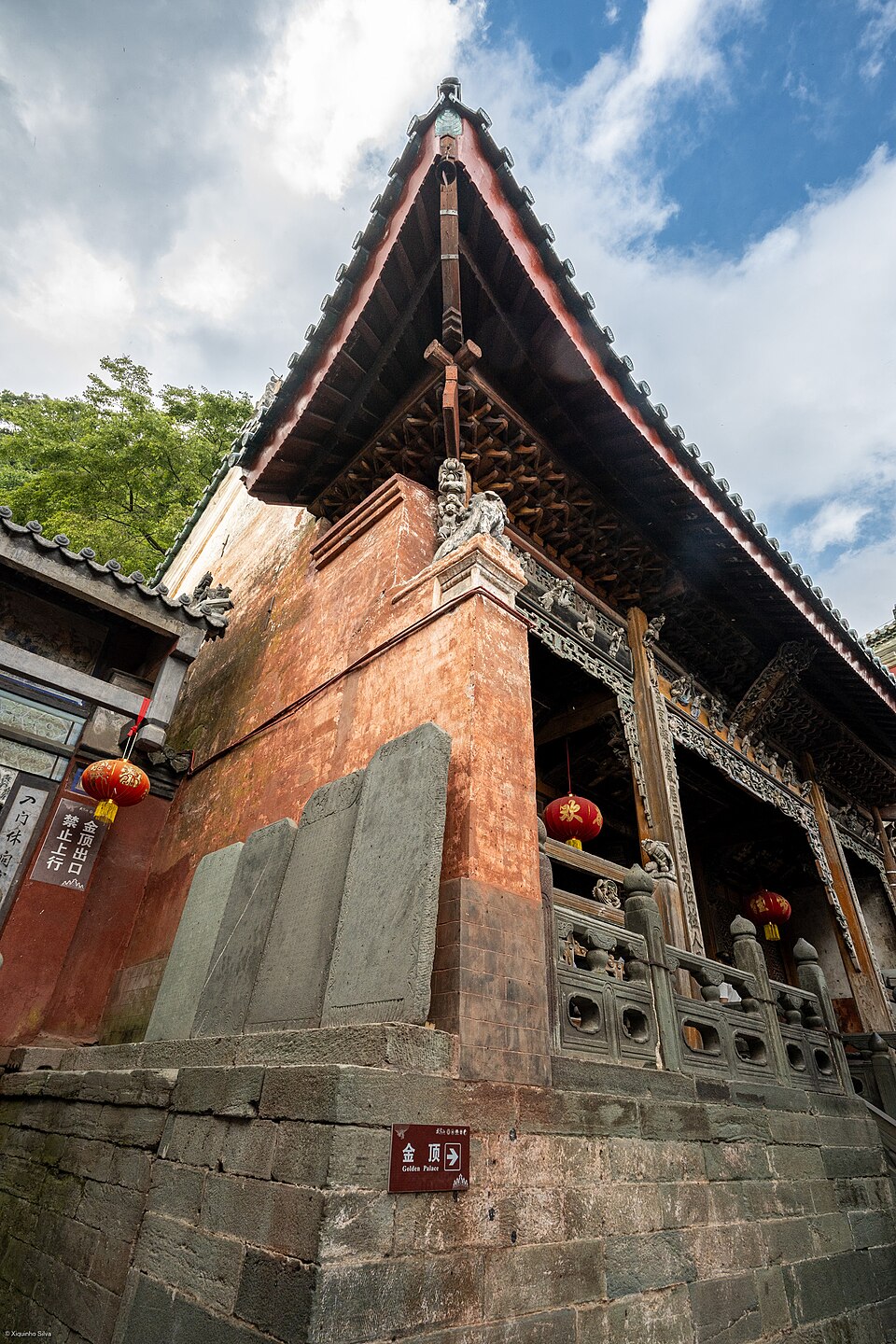
| Golden Hall (Golden Summit) | Located at the top of Tianzhu Peak, built in 1416 during the Yongle era; China's largest surviving bronze-cast gilded hall |
| Purple Cloud Palace (Zixiao Palace) | The best-preserved palace complex in Wudang, built during the Yongle era |
| Southern Cliff Palace (Nanyan Palace) | The most beautiful of Wudang's 36 cliffs; known as "the palace hanging on the cliff" |
| Prince's Slope (Taizi Po) | The largest building complex in Wudang |
| Yuxu Palace | The largest of Wudang's nine palaces |
| Xiaoyao Valley | The main venue for Wudang martial arts performances |
| Needle Grinding Well | Legend says Zhang Sanfeng attained enlightenment here while grinding a needle |
Wudang Martial Arts
Wudang martial arts (Wudang Quan) is one of the most important styles of traditional Chinese martial arts, along with Shaolin martial arts as the two main branches of Chinese kung fu.
Characteristics of Wudang martial arts:
- Using stillness to overcome motion: Not taking the initiative, focusing on defense and counterattack
- Using softness to overcome hardness: Deflecting hard attacks with soft movements
- Four ounces to deflect a thousand pounds: Using minimal force to overcome great power
- Cultivating both internal and external: Focusing on both outer techniques and inner cultivation
Wudang Tai Chi is the representative form of Wudang martial arts. Legend attributes its creation to the Taoist monk Zhang Sanfeng, though this claim remains debated among scholars. Wudang Tai Chi emphasizes "using stillness to overcome motion, using softness to overcome hardness, and arriving first despite moving last." It serves both health-preserving and martial arts purposes.
In 2025, the 8th Wudang Tai Chi International Friendship Competition and International Wudang Tai Chi Cultural Festival was held on the Wudang Mountains, attracting Tai Chi practitioners from around the world.
Practical Information
| Item | Details |
|---|---|
| Location | Danjiangkou City, Shiyan, Hubei Province |
| Best Season | Spring (Mar-May) and Autumn (Sep-Nov) |
| Suggested Duration | 2-3 days |
| Admission | ~130 RMB (excluding cable car and shuttle bus) |
| Shuttle Bus | ~70 RMB (mandatory) |
| Golden Summit | ~27 RMB |
| Purple Cloud Palace | ~15 RMB |
| Cable Car | Up ~80 RMB, Down ~70 RMB |
| Transportation | Bus from Shiyan city to Wudang ~1 hour |
World Heritage
In 1994, the Ancient Building Complex of the Wudang Mountains was inscribed by UNESCO as a World Cultural Heritage Site. UNESCO's evaluation noted:
- The Ancient Building Complex of the Wudang Mountains is an outstanding representative of Yuan and Ming Dynasty architectural art in China
- The Wudang complex is closely related to Taoist culture, reflecting ancient Chinese philosophical thought
- The architectural layout of the Wudang Mountains perfectly integrates with the natural environment
References
- Baidu Baike: https://baike.baidu.com/item/武当山
- Wikipedia: https://zh.wikipedia.org/wiki/武当山
- UNESCO: https://whc.unesco.org/en/list/704/
- China Intangible Cultural Heritage: https://www.ihchina.cn/project_details/13787/
Stills & Gallery
Comments (0)