Huangshan (Yellow Mountain)
Synopsis
Huangshan in Anhui is a UNESCO dual World Heritage Site famous for its Five Wonders: unique pines, peculiar rocks, sea of clouds, hot springs, and winter snow.
Overview
Huangshan (黄山, Huángshān), originally known as Yishan (Mount Yi), is a mountain range in southern Anhui Province in eastern China and one of the country's most famous mountain scenic areas. The mountain was renamed "Huangshan" (Yellow Mountain) in honor of the legendary Yellow Emperor (Huang Di), who is said to have practiced alchemy here and ascended to heaven.
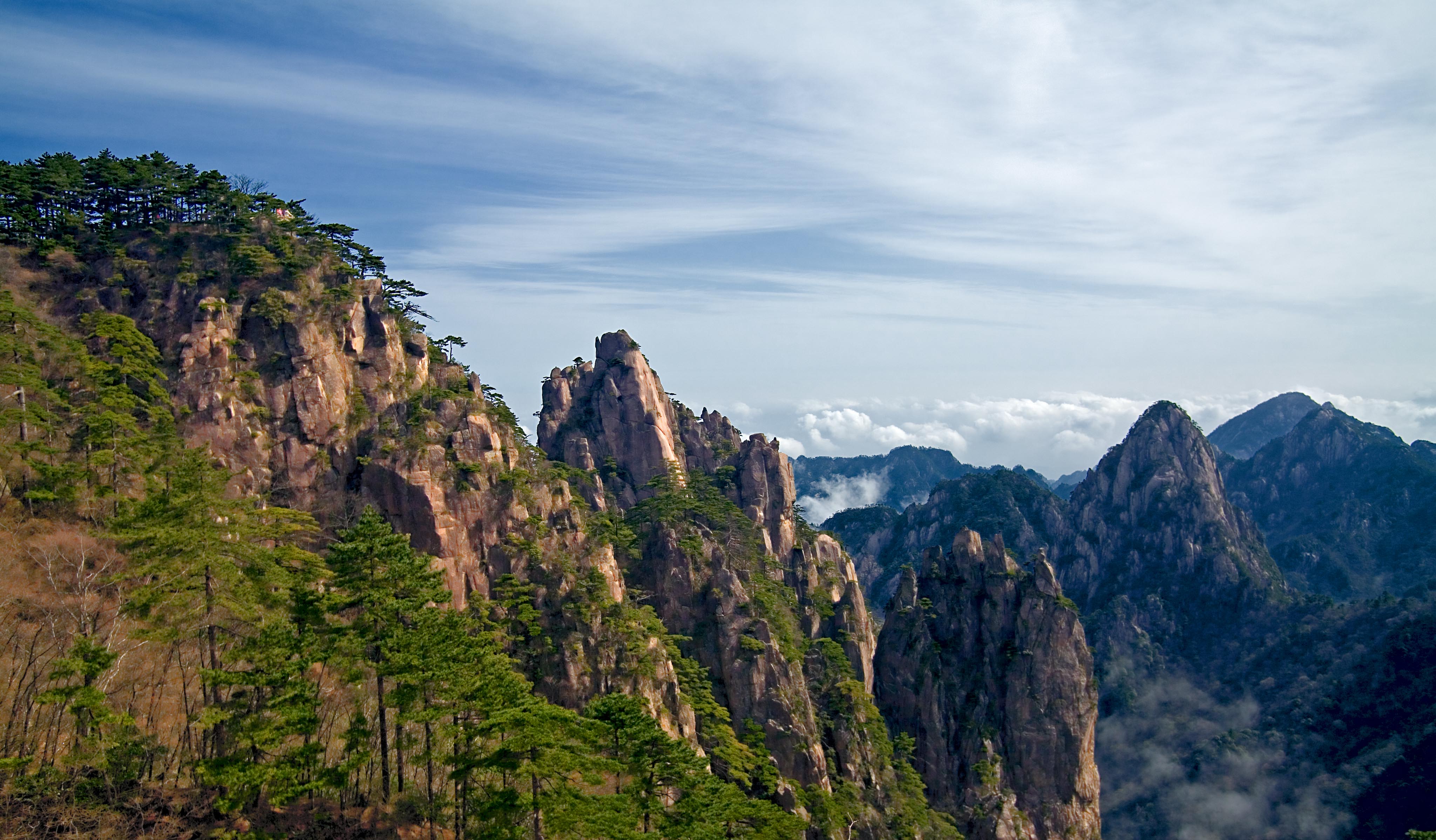
Huangshan is celebrated for its "Five Wonders": uniquely-shaped pines, peculiar granite peaks, sea of clouds, hot springs, and winter snow. A famous Chinese saying captures its reputation: "After visiting the Five Great Mountains, no other mountain is worth seeing; after visiting Huangshan, even the Five Great Mountains are not worth seeing."
The scenic area covers approximately 160 square kilometers with an additional 490 square kilometers of buffer zone. The highest peak, Lotus Peak (Lianhua Feng), rises to 1,864 meters, followed by Bright Peak (Guangming Ding) at 1,860 meters and Celestial Peak (Tiandu Feng) at 1,829 meters — collectively known as Huangshan's Three Great Peaks. Huangshan was inscribed as a UNESCO World Cultural and Natural Heritage Site in 1990 and became a UNESCO Global Geopark in 2004.
Huangshan has been a major source of inspiration for traditional Chinese painting and literature. Since the Tang Dynasty, countless poets, writers, and artists have visited the mountain and left behind masterpieces, making Huangshan an iconic symbol of Chinese culture.
Key Attractions
Huangshan is renowned for its "Five Wonders":
Unique Pines: The Huangshan pine (Pinus hwangshanensis) is the most representative feature of the mountain. These remarkable trees grow directly out of rock crevices, demonstrating extraordinary vitality. The most famous is the Welcoming-Guest Pine (Ying Ke Song), over 1,000 years old, with branches extending outward as if greeting visitors — it has become the emblem of Huangshan. Other notable pines include the Seeing-Off Guest Pine, Black Tiger Pine, and Twin Pine.
Peculiar Rocks: Over hundreds of millions of years, Huangshan's granite has been weathered into extraordinary shapes. The "Monkey Gazing at the Sea" — a boulder resembling a monkey peering into the cloud sea; the "Flying-Over Rock" — a 120-ton boulder perched on a cliff edge as if fallen from the sky; "Dream Brush Producing Flowers"; and "Immortal Drying Boots" are just a few of the countless remarkable rock formations.
Sea of Clouds: Huangshan offers spectacular sea of clouds views approximately 200 days per year. When clouds fill the valleys, peaks emerge from the mist like islands in an ocean. Locals divide the cloud sea into five areas: "East Sea," "South Sea," "West Sea," "North Sea," and "Heaven Sea." The best viewing spots include Bright Peak and Lion Peak.
Hot Springs: Located at the foot of Purple Cloud Peak, Huangshan's hot springs maintain a constant temperature of 42°C (107.6°F) year-round. Rich in carbonates, the waters are said to help prevent skin, joint, and nerve illnesses. The springs have been known as "spiritual springs" since ancient times, with legends attributing their discovery to the Yellow Emperor himself.
Winter Snow: Huangshan's winter landscape is equally breathtaking. When snow blankets the mountain, pines are draped in silver, and rocks are coated in white, the entire mountain transforms into a silver fairy-tale world.
Three Great Peaks
Lotus Peak (1,864m) is Huangshan's highest summit, named for its resemblance to a blooming lotus flower. From the summit, visitors can enjoy panoramic views of the entire Huangshan area, with the Yangtze River visible as a silver ribbon in the distance.
Bright Peak (1,860m) is the second highest peak and one of the best locations for watching sunrise and the sea of clouds. Its relatively flat and open terrain makes it an ideal observation point, and it houses the Huangshan Meteorological Station.
Celestial Peak (1,829m) is known for its precipitous terrain, earning it the title "Capital of the Immortals." The peak features thousands of stone steps, with the steepest sections approaching vertical — climbing Celestial Peak tests both physical fitness and courage.
History & Culture
During the Qin Dynasty, Huangshan was known as "Yishan" (Mount Yi). In 747 AD, during the Tang Dynasty, Emperor Xuanzong issued an imperial decree renaming it "Huangshan" to commemorate the legend of the Yellow Emperor practicing alchemy on the mountain. According to legend, the Yellow Emperor "cultivated moral character and refined Pills of Immortality" here before ascending to heaven, which is how the mountain received its name.
Huangshan features over 60,000 stone steps carved into the mountainside, said to be more than 1,500 years old. Since its renaming in the Tang Dynasty, Huangshan gradually became a pilgrimage site for literati and artists. The great Tang Dynasty poet Li Bai visited and wrote poems about Huangshan. The Ming Dynasty traveler Xu Xiake visited Huangshan twice and coined the immortal phrase: "After visiting the Five Great Mountains, no other mountain is worth seeing; after visiting Huangshan, even the Five Great Mountains are not worth seeing."
Huangshan has also been a vital subject of Chinese ink-wash painting. From Shitao in the Ming Dynasty to modern masters Huang Binhong and Liu Haisu, generations of painters have used Huangshan as their teacher, creating the distinctive "Huangshan School" of painting.
Practical Information
| Item | Details |
|---|---|
| Location | Tangkou Town, Huangshan District, Huangshan City, Anhui |
| Opening Hours | Peak season (Mar-Nov): 6:00-17:30; Off-season (Dec-Feb): 7:00-16:30 |
| Admission | Peak: 190 yuan/person; Off-season: 150 yuan/person (cable cars sold separately) |
| Best Season | All seasons: Spring for azaleas, Summer retreat, Autumn foliage, Winter snow |
| Transport | ~1 hour from Huangshan City (Tunxi) to scenic area; Huangshan Airport has domestic flights; High-speed rail to Huangshan North Station |
| Visit Duration | Recommended 2-3 days (mountain-top accommodation for sunrise viewing) |
| Cable Cars | Yungu Cableway, Yuping Cableway, Taiping Cableway, Xihai Grand Canyon Sightseeing Cableway |
Cultural Significance
Huangshan represents the highest paradigm of Chinese landscape aesthetics and has profoundly influenced the development of traditional Chinese art and literature. It is not merely a scenic area but a symbol of Chinese culture and spiritual aspiration. In 1990, Huangshan was inscribed on the UNESCO World Heritage List under both cultural and natural criteria — a rare dual designation.
In 2002, Huangshan was named a "sister mountain" to Jungfrau in the Swiss Alps, serving as a bridge for cultural exchange between famous mountains of China and the world.
Huangshan's aesthetic value and cultural influence extend far beyond geographical boundaries, making it one of China's most brilliant natural calling cards on the world cultural stage.
References
- Wikipedia - Huangshan
- UNESCO World Heritage - Mount Huangshan
- Baidu Baike - 黄山
- Huangshan Scenic Area Official Website
- The New York Times - Huangshan travel feature
Stills & Gallery
Comments (0)