This site displays a prototype of a “Web 2.0” version of the daily Federal Register. It is not an official legal edition of the Federal Register, and does not replace the official print version or the official electronic version on GPO’s govinfo.gov.
The documents posted on this site are XML renditions of published Federal Register documents. Each document posted on the site includes a link to the corresponding official PDF file on govinfo.gov. This prototype edition of the daily Federal Register on FederalRegister.gov will remain an unofficial informational resource until the Administrative Committee of the Federal Register (ACFR) issues a regulation granting it official legal status. For complete information about, and access to, our official publications and services, go to About the Federal Register on NARA's archives.gov.
The OFR/GPO partnership is committed to presenting accurate and reliable regulatory information on FederalRegister.gov with the objective of establishing the XML-based Federal Register as an ACFR-sanctioned publication in the future. While every effort has been made to ensure that the material on FederalRegister.gov is accurately displayed, consistent with the official SGML-based PDF version on govinfo.gov, those relying on it for legal research should verify their results against an official edition of the Federal Register. Until the ACFR grants it official status, the XML rendition of the daily Federal Register on FederalRegister.gov does not provide legal notice to the public or judicial notice to the courts.
- Regulations.gov DataEnhanced Content - Regulations.gov Data

FederalRegister.gov retrieves relevant information about this document from Regulations.gov to provide users with additional context. This information is not part of the official Federal Register document.
Reimagining and Improving Student Education (RISE) Committee
- Docket ID
- ED-2025-OPE-0944
- Supporting Documents
- Information Collection Requirement: Forms and Instruments
- Information Collection Requirement: Supporting Statement
AGENCY:
Office of Postsecondary Education, Department of Education.
ACTION:
Notice of proposed rulemaking.
SUMMARY:
The Secretary proposes to amend the regulations for the Federal student loan programs authorized under title IV of the Higher Education Act (HEA) of 1965, as amended (the title IV, HEA programs) to implement the statutory changes to the title IV, HEA programs included in the One Big Beautiful Bill Act (OBBB) signed into law by President Trump on July 4, 2025. These changes include establishing new loan limits for graduate students, professional students, and parents, and phasing out the Graduate PLUS Program. The Department notes that the term “professional student” as used in this Notice of Proposed Rulemaking (NPRM) is intended solely to distinguish those programs that we propose would be eligible for higher loan limits, as required by the OBBB. The designation, or lack thereof, of a program as “professional” does not reflect a value judgment by the Department regarding whether a borrower graduating from the program is considered a “professional.” This NPRM only interprets the phrase “professional student” as used in the context of the loan limits established by the OBBB. The OBBB also simplifies the current broken and confusing myriad of Federal student loan repayment plans by phasing out the existing Income-Contingent Repayment (ICR) plans, creating a new tiered standard repayment plan option, and implementing a new income-driven repayment plan known as the Repayment Assistant Plan. The OBBB also enables borrowers in default who have previously rehabilitated a defaulted loan a second chance to rehabilitate their loan(s) and resume repayment.
DATES:
We must receive your comments on or before March 2, 2026.
ADDRESSES:
Submit your comments through the Federal eRulemaking Portal at www.regulations.gov. The Department of Education (Department) will not accept comments submitted by fax or by email or comments submitted after the comment period closes. To make sure that the Department does not receive duplicate copies, please submit your comment only once. Additionally, please include the Docket ID at the top of your comments.
Information on using Regulations.gov, including instructions for submitting comments, is available on the site under “FAQ.” If you require an accommodation or cannot otherwise submit your comments via Regulations.gov, please contact regulationshelpdesk@gsa.gov or by phone at 1-866-498-2945. If you are deaf, hard of hearing, or have a speech disability and wish to access telecommunications relay services, please dial 7-1-1.
Privacy Note: The Department's policy is to make all comments received from members of the public available for public viewing in their entirety on the Federal eRulemaking at www.regulations.gov. Therefore, commenters should include in their comments only information that they wish to make publicly available. Additionally, commenters should not include in their comments any personally identifiable information (PII) in comments about other individuals. For example, if your comment describes an experience of someone other than yourself, please do not identify that individual or include any personal information that identifies that individual. The Department reserves the right to redact a portion of a comment or the entire comment at any time if any PII about other individuals is included.
FOR FURTHER INFORMATION CONTACT:
Tamy Abernathy, Office of Postsecondary Education, 400 Maryland Ave. SW, 5th Floor, Washington, DC 20202. Telephone: (202) 245-4595. Email: NegRegNPRMHelp@ed.gov.
SUPPLEMENTARY INFORMATION:
I. Executive Summary
The Secretary proposes to implement the amendments made to the HEA relating to the Federal student loan programs made by the OBBB through these regulations.
These proposed regulations would revise the Direct Loan Program under 34 CFR part 685 by amending annual and aggregate loan limits for graduate, professional, and parent loan borrowers. The proposed regulations would also implement two new streamlined student loan repayment plans for new borrowers, the “Repayment Assistance Plan” and the “Tiered Standard” repayment plan. The proposed regulations also make conforming amendments to current regulations on consolidation, deferment, forbearance, and Public Service Loan Forgiveness (PSLF). The proposed regulations also provide borrowers in default a second opportunity to rehabilitate their loans and resume repayment, even if they previously rehabilitated a defaulted loan.
A brief summary of these proposed regulations is available at https://www.regulations.gov/document/ED-2025-OPE-0944.
II. Summary of the Major Provisions of This Regulatory Action
These proposed regulations would:
- Amend §§ 674.39, 682.215, and 682.405 to allow loan rehabilitation twice per each loan borrowed under the Federal Perkins Program, Federal Family Education Loan Program, and the Direct Loan Program.
- Amend § 685.102 to include new definitions for the following terms:expected time to credential, graduate student,professional student, and program length.
- Amend § 685.200 to include Direct PLUS Loan eligibility for graduate and professional students.
- Amend § 685.201 to establish the limited Direct PLUS Loan eligibility for a graduate or professional student.
- Amend § 685.203 to include new Direct Loan annual and aggregate limits, create a new lifetime maximum aggregate limit, establish less than full-time reduction of annual loan limits, and permit institutions to limit borrowing for specific programs.
- Amend § 685.204 to clarify conditions and borrower eligibility for the unemployment deferment and the economic hardship deferment.
- Amend § 685.205 to establish the modified eligibility criteria for borrowers to receive a forbearance.
- Amend § 685.208 to establish the terms for the Tiered Standard repayment plan, set the minimum payment for the Tiered Standard repayment plan, and restructure each Fixed repayment plan's terms under their respective plan.
- Amend § 685.209 to establish terms for the Repayment Assistance Plan and sunset ICR plans and conditions.
- Amend § 685.210 to provide information to borrowers about choosing a repayment plan.
- Amend § 685.211 to establish miscellaneous repayment provisions including the minimum payment increase for the Income-Based Repayment (IBR) plan.
- Amend § 685.219 to clarify that repaying under the Repayment Assistance Plan will qualify for PSLF if all other eligibility criteria are met.
- Amend § 685.220 to provide terms and repayment plan eligibility for consolidation loans. ( printed page 4255)
- Amend § 685.221 to clarify when a borrower may be eligible for an alternative repayment plan.
- Amend § 685.303 to waive the substantially equal disbursement requirement for an institution when a borrower has less than full-time enrollment for the academic year and is subject to the schedule of reductions.
While the Department is proposing the regulations in a consolidated NPRM, it considers each to be a discrete change independent of other proposed changes. Consistent with 34 CFR 685.109, “[i]f any provision of this subpart or its application to any person, act, or practice is held invalid, the remainder of the subpart or the application of its provisions to any person, act, or practice will not be affected thereby.”
Cost and Benefits:
As further detailed in the Regulatory Impact Analysis (RIA), the proposed regulations would have significant impacts on students, borrowers, educational institutions, and taxpayers.
Under the proposed revisions, borrowers would benefit from new loan repayment terms, such as monthly interest cancellation and principal payment subsidies under the Repayment Assistance Plan. New caps on Federal loans for graduate and professional education, as well as caps on Parent PLUS Loans, will rein in increases in graduate student and parent borrowing and put downward pressure on tuition prices at institutions. These new loan limits will encourage institutions to evaluate the true cost of their programs and create efficiencies where necessary to allow students to enroll and fund their education within the boundaries of the new, responsible, loan limits determined by Congress and/or the institution. Changes to student loans enacted in the OBBB will result in significant savings to the taxpayer by reducing the excessive subsidy costs of loan forgiveness and other high-cost terms and conditions. Specifically, the new annual and lifetime caps on borrowing will reduce taxpayer exposure for loans that could potentially be forgiven under the Department's Public Service Loan Forgiveness Program, Closed School Loan Discharges, Borrower Defense to Repayment discharges, death of the borrower discharges, total and permanent disability discharges, time-based forgiveness discharges under income-based repayment, and discharges that may occur in bankruptcy. The Department estimates that from 2021 to 2025, it forgave $199 billion in student debt as a result of these provisions.
These proposed regulations would reduce outlays received from Direct Loans for institutions of higher education and certain groups of students. There are four main cost areas. First, the OBBB requires institutions to reduce annual loan limits in direct proportion to the percentage of full-time status that the student is enrolled. Prior to the OBBB, part-time students who were enrolled at least half-time could receive the same annual loan amount as students attending full-time. That provision will save taxpayers money by reducing the amounts borrowed by part-time students. Students will also receive less funds as credit balances as a result of the reduced borrowing. Institutions will, as a result, receive less revenue from loans made by the Department on behalf of students. Second, the OBBB limits excessive borrowing by graduate and professional students due to the elimination of unlimited borrowing under the Graduate PLUS Program, maintaining current borrowing limits of $20,500 for graduate students (but limiting borrowing to $100,000 in aggregate), and targeting higher loan limits of $50,000 annually ($200,000 in aggregate) to students enrolled in professional degree programs. Third, the OBBB streamlines the existing myriad of forbearance and deferment options while also limiting the time that borrowers can spend in certain forbearances. These changes should result in more time in active repayment by borrowers, as well as streamlining deferment and forbearance options to the benefit of borrowers, Federal student loan servicers, and taxpayers. Fourth, parents of undergraduate students will also no longer have unlimited borrowing under the Parent PLUS Loan program, which will now be capped at $20,000 per student each year ($65,000 aggregate limit per student). Now parent borrowers, in addition to student borrowers, will have common sense limits on the amount they can borrow to finance their children's postsecondary education.
III. Invitation to Comment
We invite you to submit comments regarding these proposed regulations. Please clearly identify the specific section or sections of the proposed regulations that each of your comments address and arrange your comments in the same order as the proposed regulations. The Department will not accept comments submitted after the comment period closes.
The following tips are meant to help you prepare your comments:
- Please be concise but include objective sources of support for your claims.
- Explain your views as clearly as possible and refrain from using any profanity.
- Refer to specific sections and subsections of the proposed regulations throughout your comments, particularly in any headings that are used to organize your submission.
- Explain why you agree or disagree with the proposed regulatory text and support these reasons with data-driven evidence, including the depth and breadth of your personal or professional experiences. We encourage commenters to include supporting facts, research, and evidence in their comments. When doing so, commenters are encouraged to provide citations to the published materials referenced, including active hyperlinks. Likewise, commenters who reference materials which have not been published are encouraged to upload relevant data collection instruments, data sets, and detailed findings as a part of their comment. Providing such citations and documentation will assist us in analyzing the comments.
- Where you disagree with the proposed regulatory text, suggest alternatives, including regulatory language, and your rationale for the alternative suggestion.
- Do not include PII such as Social Security numbers or loan account numbers for yourself or for others in your submission.
Mass Writing Campaigns: In instances where individual submissions appear to be duplicates or near duplicates of comments prepared as part of a writing campaign, the Department will post one representative sample comment along with the total comment count for that campaign to Regulations.gov. The Department will consider these comments along with all other comments received.
In instances where individual submissions are bundled together (submitted as a single document or packaged together), the Department will post all the substantive comments included in the submissions along with the total comment count for that document or package to Regulations.gov. A well-supported comment is often more informative to the agency than multiple form letters.
Public Comments: The Department invites you to submit comments on all aspects of the proposed regulatory language specified in this Notice of Proposed Rulemaking (NPRM), and in the Regulatory Impact Analysis and Paperwork Reduction Act sections. ( printed page 4256)
The Department may, at its discretion, decide not to post or to withdraw certain comments and other materials that contain promotion of commercial services or products, or are spam.
We may not address comments outside of the scope of these proposed regulations in the final regulations. Comments that are outside of the scope of these proposed regulations are comments that do not discuss the content or impact of the proposed regulations or the Department's evidence or reasons for the proposed regulations.
Comments that are submitted after the comment period closes will not be posted to Regulations.gov or addressed in the final regulations.
We invite you to assist us in complying with the requirements of (E.O.)s 12866 and 13563 and their overall requirement of reducing regulatory burden that might result from these proposed regulations. Please let us know of ways we could reduce potential costs or increase potential benefits while preserving the effective and efficient administration of the Department's programs and activities.
During and after the comment period, you may inspect public comments about these proposed regulations by accessing Regulations.gov.
Assistance to Individuals with Disabilities in Reviewing the Rulemaking Record: On request, we will provide an appropriate accommodation or auxiliary aid to an individual with a disability who needs assistance to review the comments or other documents in the public rulemaking record for these proposed regulations. If you want to schedule an appointment for this type of accommodation or auxiliary aid, please contact the Information Technology Accessibility Program Help Desk at ITAPSupport@ed.gov to help facilitate.
Clarity of the Regulations
Executive Order (E.O.) 12866 and the Presidential memorandum “Plain Language in Government Writing” require each agency to write regulations that are easy to understand. The Secretary invites comments on how to make the regulation easier to understand, including answers to questions such as the following:
- Are the requirements in the proposed regulations clearly stated?
- Do the proposed regulations contain technical terms or other wording that interferes with their clarity?
- Does the format of the proposed regulations (grouping and order of sections, use of headings, paragraphs) aid or reduce its clarity?
- Would the proposed regulations be easier to understand if we divided them into additional (but shorter) sections? (A “section” is preceded by the symbol “§ ” and a numbered heading; for example, § 668.2 General definitions.)
- Could the description of the proposed regulations in theSUPPLEMENTARY INFORMATION section of this preamble be more helpful in making the proposed regulations easier to understand? If so, how?
- What else could we do to make the proposed regulations easier to understand?
- To send any comments that concern how the Department could make these proposed regulations easier to understand, see the instructions in theADDRESSES section.
IV. Background
The OBBB, which President Trump signed into law on July 4, 2025, makes extensive statutory changes to fix broken and unnecessarily complex aspects of the Federal student loan programs in the areas of loan limits, repayment plans, and related provisions in title IV. Among other changes, the OBBB sets a new lifetime borrowing cap (approximately $257,500 for most borrowers), eliminates new Graduate PLUS Loans, eliminates unlimited borrowing under the PLUS program for parents, maintains current annual limits under the Direct Loan Program for undergraduate and graduate students, increases annual loan limits for professional degree students, establishes aggregate limits for graduate students, professional degree students, and parents of undergraduates, and reduces annual loan amounts for students enrolled less than full-time. For repayment, the OBBB simplifies and streamlines the current confusing patchwork of repayment plan options for future borrowers to two flexible options: a new Tiered Standard plan for fixed monthly payments over a 10 to 25-year term, and a new income-driven plan called the Repayment Assistance Plan that does not put borrowers deeper in debt by preventing negative amortization over the life of the loan. Confusing, outdated (and in some cases unlawful) repayment plans are phased out, including several existing income-contingent plans, ICR, PAYE, and SAVE (which has been held unlawful in federal court. See Missouri v. Biden, 112 F.4th 531, 538 (8th Cir. 2024)).
This notice of proposed rulemaking complies with Section 492 of the HEA, which requires the Secretary to obtain public input and conduct negotiated rulemaking before issuing proposed regulations for the title IV, HEA programs. To meet those requirements and implement the new statutory directives provided for in the OBBB, the Department convened the Reimagining and Improving Student Education (RISE) negotiated rulemaking Committee. The Committee was composed of representatives of institutions, students and borrowers, State officials, financial aid administrators, loan servicers, and consumer and civil rights organizations. The Committee met over multiple sessions in the fall of 2025 and reached consensus on the entirety of the regulatory text described in this NPRM. In accordance with the protocols established by the Committee, the Department has incorporated the regulatory amendatory text that was mutually agreed upon into this NPRM. Building on the statutory and regulatory history, and the RISE Committee's consensus language, this NPRM conforms Direct Loan rules to the changes enacted in the OBBB by revising loan limit provisions, restructuring repayment options (including IBR and adding the new Repayment Assistance Plan), updating PSLF eligibility and qualifying payment rules, and aligning consolidation, deferment, forbearance, and borrower relief provisions with the new framework.
V. Authority for This Regulatory Action
When Congress passes legislation amending statutory provisions regarding programs administered by an agency, that agency is tasked with implementing those changes in its regulations. The OBBB amended portions of the HEA related to the Federal student loan programs administered by the Department. The Secretary has been granted the broad authority by Congress to implement federal student aid programs under title IV of the HEA, including amendments made by the OBBB. See 20 U.S.C. 1221e-3, see also 20 U.S.C. 1082, 3441, 3474, 3471. In order to carry out functions otherwise vested in the Secretary by law or by delegation of authority pursuant to law, and subject to limitations as may be otherwise imposed by law, the Secretary is authorized to make, promulgate, issue, rescind, and amend rules and regulations governing the manner of operations of, and governing the applicable programs administered by, the Department. See20 U.S.C. 1221e-3. These programs include the Federal student loan programs authorized by the HEA. ( printed page 4257)
Waiver of HEA Master Calendar Requirements
Congress may waive, modify, or rescind requirements in the HEA that require the Department to follow certain processes and procedures when engaging in informal notice-and-comment rulemaking. Specifically, when Congress imposes a statutory deadline that is irreconcilable with other procedural requirements, like in the APA or HEA, then those other procedures have been implicitly waived by Congress. See, e.g., Asiana Airlines v. F.A.A., 134 F.3d 393, 398 (D.C. Cir. 1998); Methodist Hospital of Sacramento v. Shalala, 38 F.3d 1225, 1237 (D.C. Cir. 1998) (finding that certain parts of the APA procedural framework had been waived when Congress gave an agency direction that conflicts with and is irreconcilable with the APA). Indeed, the Harmonious-Reading Canon provides that statutes should be interpretated in a way that renders them compatible, not contradictory. See Scalia & Garner, Reading Law, 180 (2012). As such, the Department does not read statutes to create instructions that directly conflict. Where Congress has given an agency specific direction in a statute that could not be followed if the agency also followed another part of the APA (or HEA, as is relevant here), then the provision is waived.
Here, the OBBB was enacted on July 4, 2025. The OBBB directs the Department to implement roughly a dozen provisions by July 1, 2026. Many of these provisions are not self-executing and could not be implemented absent the Department promulgating regulations to provide details for institutions on how to comply with the OBBB. Congress gave the Secretary discretion within the OBBB to implement the provisions impacting the Federal student loan programs and knew that its commands were not self-executing when directing the Secretary to take action. Congress expected the Secretary to act via rulemaking before July 1, 2026, to enable these provisions to actually go into effect.
The master calendar in the HEA provides that regulatory changes initiated by the Secretary affecting the programs under title IV of the HEA must be published in final form by November 1st in order for them to go into effect by July 1st of the following year. 20 U.S.C. 1089(c)(1). Section 492 of the HEA requires the Department to undertake negotiated rulemaking as part of any regulation under title IV of the HEA. In order to conduct negotiated rulemaking, the Department must have a public hearing (providing notice to the public), solicit nominations from the public to serve on a negotiated rulemaking Committee, select non-Federal negotiators, hold negotiations, develop an NPRM and submit it for review by the Office of Information and Regulatory Affairs (OIRA), publish an NPRM (with at least a 30 day comment period), and then publish a final rule that responds to any substantive comments received. As detailed below, the fastest possible timeframe in which the negotiated rulemaking process for the RISE rulemaking packages could have occurred is 149 days, which is irreconcilable with the timeline allowed by the enactment of the OBBB, due to the fact that there were 120 days between July 4, 2025, (the day the OBBB was enacted), and November 1, 2025, (the publication date of the final rule required by the master calendar).
It would not have been possible for the Department to undertake every step of the negotiated rulemaking process by November 1, 2025, in order to implement the provisions that become effective in the OBBB by July 1, 2026, which is the statutory effective date. Congress was aware of this temporal impossibility when they passed the OBBB, yet Congress decided that these provisions would still go into effect on July 1, 2026. Because these provisions are not self-implementing and cannot go into effect unless the Department promulgates a final rule, the OBBB implicitly waives the master calendar.
For example, Congress directed the Department to publish a schedule of reductions for part-time students to reduce their annual loan eligibility. (Sec. 81001 of the OBBB, P.L. 119-21). The Department announced in DCL: GEN-25-04, published on July 18, 2025, that the schedule of reductions will be issued by the Secretary and used to determine the reduction in the annual loan limits for students who are enrolled less than full-time for subsequent academic years (2026-2027 and beyond). The Department will publish the schedule of reductions in the final rule. This provision was effective upon enactment; however, the 2025-2026 award year had already begun prior to President Trump signing the bill and Federal student loans for that year had already been calculated and initially disbursed. In addition, Congress left open to regulation important details in the Repayment Assistance Program relating to how the Department should treat married borrowers' income, and whether the Department should essentially double count their income when calculating repayment rates. Moreover, in codifying a regulatory definition for professional student that is open-ended, Congress did not fully address what types of programs should be considered professional programs or graduate programs. Indeed, the statute's operative definition of professional degree broadly describes what a professional student is and includes an illustrative list of degrees that meet that operative definition. 34 CFR 668.2 (Noting that the professional degrees “include but are not limited to” the degrees listed). The definition of graduate degree is interrelated to the definition of professional degree, in that a degree is a graduate degree if it awards a graduate credential but is not a professional degree.
With these important details unanswered by the plain text of the OBBB, it is clear that the policy scheme set forth in the HEA made by the OBBB cannot be implemented absent regulatory action by the Department.
At the same time, even though the requirements of negotiated rulemaking are onerous, it is possible to undergo negotiated rulemaking and publish a final rule at least 30 days prior to the effective date of these OBBB provisions on July 1, 2026. Therefore, the OBBB does not waive negotiated rulemaking nor any provision in the APA. For provisions in the OBBB that become effective July 1, 2027, and beyond, Congress did not implicitly repeal the master calendar because it is possible for the Department to publish a final rule that complies with the master calendar to implement those provisions. Nonetheless, the Department is conducting rulemaking relating to those provisions that go into effect in 2027 and beyond due to the interconnected nature of these provisions as they relate to Federal student aid programs.
VI. Public Participation
Section 492 of the HEA, 20 U.S.C. 1098a, requires the Secretary to obtain public involvement in the development of proposed regulations affecting the title IV, HEA programs. Prior to developing this NPRM, the Department obtained advice and recommendations from individuals and representatives of groups involved in the title IV, HEA programs. This outreach included a 30-day public comment period, one day of public hearings, and culminated in nine days of in-person negotiated rulemaking at the Department's headquarters in Washington, DC. Further details regarding these efforts are provided below.
On July 25, 2025, the Department published in the Federal Register (90 ( printed page 4258) FR 35261) a notice of our intent to hold a public hearing and to establish two negotiated rulemaking Committees to consider regulatory changes to the title IV, HEA programs included in the OBBB with one Committee focusing on topics regarding annual and aggregate loan limits, loan deferment, forbearance, and repayment, among others, related to Federal student loans.
Public Comments and Hearings
We received 1,864 written comments in response to the Federal Register notice. Additionally, we held a virtual public hearing on August 7, 2025. A total of 57 individuals testified virtually at the hearing.
You may view the written comments submitted in response to the July 29, 2025 “Intent to Establish Negotiated Rulemaking Committees; Correction” correction notice (90 FR 35652), by visiting the Federal eRulemaking Portal at Regulations.gov, within docket ID ED-2025-OPE-0151. Instructions for finding comments are also available on the site under “FAQ.”
Transcripts of the public hearings can be accessed at https://www.ed.gov/laws-and-policy/higher-education-laws-and-policy/higher-education-policy/negotiated-rulemaking-for-higher-education-2025-2026.
Negotiated Rulemaking
On July 25, 2025, we published a notice in the Federal Register announcing our intent to establish one Committee to prepare these proposed regulations (90 FR 35261). The notice set forth a schedule for Committee meetings and requested nominations for individual, non-Federal negotiators to serve on the negotiated rulemaking Committee. In the notice, we also announced the topics that the Committee would address.
We chose members of the negotiated rulemaking Committee from individuals nominated by groups involved in the title IV, HEA programs. We selected individuals with demonstrated expertise or experience with the student loan program. The negotiated rulemaking Committee included the following members, representing their respective constituencies:
- Legal assistance organizations that represent students and borrowers, consumer advocates, and civil rights groups that represent students: Ashley Naporlee, Lead Attorney, Consumer Protection Team, Legal Aid Society of San Diego, and Tamar Hoffman (alternate), Staff Attorney, Homeownership and Consumer Rights Unit, Community Legal Services of Philadelphia.
- Student loan servicers, collection agencies, lenders, and guaranty agencies: Alexander Ricci, President, National Council of Higher Education Resources, and Lori Hartung (alternate), Regional Sales Executive, Education Computer Systems, Inc.
- Organizations representing taxpayers and the public interest: Alexander Holt, Senior Advisor on Higher Education, Committee for a Responsible Federal Budget, and Dr. Andrew Gillen (alternate), Research Fellow, Cato Institute.
- Private nonprofit institutions of higher education including institutions eligible to receive Federal assistance under Title III and Title V of the HEA tribal colleges and universities, and historically black colleges and universities: Jenna Colvin, President, Georgia Independent College Association, and Patti Kohler (alternate), Vice President of Financial Aid, Western Governors University.
- Proprietary institutions of higher education, as defined in34 CFR 600.5: Dr. Andy Vaughn, President and Chief Executive Officer, Alliant International University, and Jeffrey Bodimer (alternate), Vice President of Regulatory Compliance and Financial Aid, Post University.
- Public institutions of higher education including institutions eligible to receive Federal assistance under Title III and Title V of the HEA, tribal colleges and universities, and historically black colleges and universities: Dr. Timothy B. King, Vice Provost for Student Success, Jacksonville State University, and Matthew Ellsworth (alternate), Director of Financial Aid, Western Carolina University.
- State officials, including State student grant agencies, State higher education executive officers, and representatives of authorizing agencies: Scott Kemp, Student Loan Advocate, State Council of Higher Education for Virginia, and Dr. Bennett Boggs (alternate), Commissioner, Missouri Department of Higher Education & Workforce Development.
- Student loan borrowers, including borrowers in school, deferment, forbearance, delinquent, default, and currently in repayment: Deborah Lilly, Senior Project Manager, UnitedHealthcare, and Emeka Oguh (alternate), Chief Executive Officer, PeopleJoy.
- Student loan borrowers who are veterans, U.S. military service members, or groups representing them: Faisal Sulman, Legal Fellow, Student Veterans of America, and Robert H. Carey, Jr. (alternate), Executive Director, National Defense Committee.
The Committee discussion was led by Tamy Abernathy, Director of the Policy Coordination Group of the Department and supported by the Department's Office of General Counsel and Office of Postsecondary Education, with Annmarie Weisman of Federal Student Aid serving as facilitator for the Committee.
The negotiated rulemaking Committee for these proposed regulations met from September 29 to October 3, 2025, and November 3 to November 6, 2025, which concluded the negotiations on November 7, 2025, a day earlier than originally scheduled. The Committee reviewed and discussed draft regulations prepared by the Department, as well as alternative regulatory language and suggestions proposed by Committee members. Additionally, during each negotiated rulemaking meeting, some non-Federal negotiators shared feedback that they had received from stakeholders in their respective constituencies. This approach facilitated the inclusion of a wide array of ideas and perspectives, which contributed to the development of the consensus language.
Under the organizational protocols for negotiated rulemaking agreed to by all members of the Committee, if the Committee reaches consensus on the proposed regulations, the Department agrees to publish, without substantive alteration, a defined group of regulations on which the Committee reached consensus—unless the Secretary reopens the process or provides a written explanation to the participants stating why she has decided to depart from the agreement reached during negotiations. In this instance, consensus is considered to be the absence of dissent by any member of the negotiated rulemaking Committee (abstaining members are not considered to be dissenting from the proposal). The Committee reached consensus on the entirety of the draft regulations on November 6, 2025. As a result, this NPRM reflects the consensus language without any substantive changes.
Further information on the negotiated rulemaking process can be found at: https://www.ed.gov/laws-and-policy/higher-education-laws-and-policy/higher-education-policy/negotiated-rulemaking-for-higher-education-2025-2026.
VI. Significant Proposed Regulations
We discuss substantive issues under the sections of the proposed regulations to which they pertain. While we generally do not address technical, ( printed page 4259) minor, or legal changes to the proposed amendatory text, there are a few areas where we determined technical corrections were necessary and we fully explain those later in the sections where the corrections have been made in this NPRM.
Federal Perkins Loan Program
Loan Rehabilitation (§ 674.39)
Statute: Section 82003(a)(2) of the OBBB amends
Section 464(h)(1)(D) of the HEA to provide that loan rehabilitation for defaulted Federal Perkins loans is limited to a maximum of two times per loan. Section 82003(a)(3) of the OBBB provides that the effective date of this statutory change is July 1, 2027.
Current Regulations: Section 674.39 contains the general terms and conditions pertaining to loan rehabilitation in the Federal Perkins Loan Program. Specifically, § 674.39(e) provides that a borrower may rehabilitate a defaulted Federal Perkins Loan only one time.
Proposed Regulations: The Department proposes to amend the regulations in § 674.39(e) to provide that on or after July 1, 2027, a borrower may rehabilitate a defaulted loan a maximum of two times. This means that a borrower who has previously rehabilitated a defaulted loan but who has subsequently defaulted may begin the process of rehabilitating a loan on or after July 1, 2027, to bring their loan back into good standing and resume repayment.
Reasons: The proposed regulations reflect the changes made by Section 82003(a)(2) of the OBBB, which amended Section 464(h)(1)(D) of the HEA to update the loan rehabilitation limits for the Federal Perkins Loan Program. Additionally, Section 82003(a)(3) of the OBBB provides that the effective date of this statutory change takes effect beginning on July 1, 2027. Because borrowers with outstanding Federal Perkins Loans would now have the ability to rehabilitate a defaulted loan a maximum of two times beginning July 1, 2027, we believe that the regulations should reflect the number of times a borrower may rehabilitate this type of loan before and after July 1, 2027.
Accordingly, the Department proposes to bifurcate the limitations on loan rehabilitations for the Federal Perkins Loan Program: proposed § 674.39(e)(1) would retain the limitation in the current regulations that would be in effect prior to July 1, 2027, whereby a borrower can only obtain the benefit of loan rehabilitation once for a defaulted Federal Perkins Loan. Proposed § 674.39(e)(2) would provide that on or after July 1, 2027, a borrower may rehabilitate a defaulted Federal Perkins Loan a maximum of two times. This bifurcation would make clear the number of times a borrower may rehabilitate based on the date of rehabilitation.
During the negotiated rulemaking sessions, non-Federal negotiators focused on how the Department should treat traditional loan rehabilitations completed during the COVID-19 payment pause, particularly for purposes of the statutory limit on the number of rehabilitations available to a borrower. Negotiators emphasized that some borrowers completed “real” rehabilitations during the pause—often in circumstances where Fresh Start later became available—and urged the Department to make certain that those COVID-period rehabilitations would not count against the borrower's total number of rehabilitation attempts, given the unusual operational environment and the availability of alternative default-resolution pathways during the pandemic. We explained that, while Fresh Start [1] is a distinct initiative and does not constitute rehabilitation, a borrower who completed a rehabilitation during the payment pause, is considered to have completed the rehabilitation process once. During this time, borrowers were only permitted to rehabilitate their loans one time under the statute. Therefore, because those borrowers completed rehabilitation in accordance with statutory requirements, the Department does not have the authority to disregard the rehabilitation when applying the statutory maximum. However, under the OBBB, effective July 1, 2027, the statute has increased the limit of rehabilitations to twice.
Federal Family Education Loan (FFEL) Program
Loan Rehabilitation Agreement (§ 682.405)
Statute: Section 82003(a)(1) of the OBBB amends section 428F(a)(5) of the HEA to change the loan rehabilitation limit in that section to reflect that a defaulted loan may be rehabilitated twice. Prior to the OBBB, such loans could only be rehabilitated once. Section 82003(a)(3) of the OBBB provides that the effective date of this statutory change is July 1, 2027.
Current Regulations: Section 682.405 contains the general terms and conditions of rehabilitation of defaulted loans made through the Federal Family Education Loan (FFEL) program, which are administered by a guaranty agency. Section 682.405(a)(3) provides that if a borrower's FFEL program loan is being collected through administrative wage garnishment (AWG) while the borrower is also rehabilitating that loan under a rehabilitation agreement, the guaranty agency must continue AWG until the borrower makes five qualifying monthly payments under such rehabilitation agreement. After receiving the fifth monthly payment, the guaranty agency suspends the AWG order. Such a borrower may only obtain the benefit of a suspension of AWG while also attempting to rehabilitate a defaulted FFEL program loan once. Section 682.405(a)(4) provides that after the FFEL program loan has been rehabilitated, the borrower regains eligibility and the benefits afforded to non-defaulted borrowers, including access to certain deferments, from the date of the rehabilitation. Section 682.405(a)(4) further provides that for any loan that is rehabilitated on or after August 14, 2008, the borrower cannot rehabilitate the loan again if the loan returns to default status following the rehabilitation.
Proposed Regulations: The Department proposes to amend the regulations at § 682.405(a)(3)(iii)(B) to provide that on or after July 1, 2027, a borrower may only obtain the suspension of AWG benefit one time per each attempt to rehabilitate a defaulted loan. Furthermore, the Department also proposes that a loan may only be rehabilitated once between August 14, 2008, through June 30, 2027. On or after July 1, 2027, a loan may be rehabilitated a maximum of two times over the loan's lifetime, regardless of when the loan was made.
Reasons: The regulations are amended to reflect the changes made by the OBBB. The Department also amends proposed § 682.405(a)(3)(iii) to correct an administrative error that includes adding paragraph (A) and (B). This proposed additional language is needed to distinguish the number of times a FFEL borrower may rehabilitate their defaulted loans before and after June 30, 2027, and its impact on the suspension of AWG. Accordingly, we revised current § 682.405(a)(3)(iii) to proposed § 682.405(a)(3)(iii)(A), which would only apply for loans on or before June 30, 2027, and state that a borrower may only obtain the benefit of a suspension of AWG while also attempting to rehabilitate a defaulted loan once. ( printed page 4260) Proposed § 682.405(a)(3)(iii)(B) would apply to loans obtained on or after July 1, 2027, and states that a borrower may only obtain the suspension of AWG benefit one time per each attempt to rehabilitate a defaulted loan. We believe separating these provisions at the subparagraph level would make clear that suspension of AWG remains available for one eligible rehabilitation through June 30, 2027, and provides that the suspension would be available for up to a maximum two rehabilitations per loan on or after July 1, 2027.
Income-Based Repayment Plan (§ 682.215)
Statute: Section 82001(f)(1)(B) of the OBBB amends Section 493C(a)(3) of the HEA to eliminate the requirement that FFEL borrowers must have a partial financial hardship to be eligible for IBR. Section 82001(g) of the OBBB amends Section 428(b)(9)(A)(v) of the HEA to remove the partial financial hardship requirement from IBR for FFEL Loans. The OBBB also creates the definition of applicable amount in Section 493C(a)(3) of the HEA. These provisions were effective upon enactment, and the Department has already taken steps to eliminate the requirement that borrowers show a partial financial hardship to participate in existing IDR plans.
Current Regulations: Section 682.215 contains the regulations on the IBR plan for FFEL program loans. Section 682.215(a) provides the definitional terms that are applicable to the IBR plan, including a definition of partial financial hardship. Section 682.215(b) provides the terms and conditions of the IBR plan, including a borrower's eligibility for the IBR plan and the calculation of a borrower's monthly payment under the plan. In current regulations, to enroll in the IBR plan, the borrower must have a partial financial hardship and the borrower's monthly loan payments are limited to no more than 15 percent of the amount by which the borrower's adjusted gross income exceeds 150 percent of the poverty line income applicable to the borrower's family size, divided by 12.
Section 682.215(d) provides for changes in a borrower's payment amount if a borrower no longer has a partial financial hardship or if a borrower elects to repay their loans under a different repayment plan. Section 682.215(e) provides the eligibility documentation, verification, and notification requirements to determine a borrower's initial or continued eligibility for the IBR plan or to calculate a monthly payment under such plan. Finally, Section 682.215(f) provides the loan forgiveness provisions under the IBR plan: in general, a borrower receives forgiveness of the remaining balance of their loans after the borrower has made 300 qualifying monthly payments (or 25 years) under IBR.
Proposed Regulations: To conform the regulations to changes of the HEA that were enacted by the OBBB, we are proposing to amend the regulations at § 682.215(a)(4) to remove the definition of partial financial hardship and include a new definition of applicable amount. Applicable amount would mean for the purposes of the IBR plan, 15 percent of the result obtained by calculating, on at least an annual basis, the amount by which the adjusted gross income of the borrower and the borrower's spouse (if applicable) exceeds 150 percent of the poverty guideline. We also propose to amend the terms and conditions of the IBR plan in § 682.215(b), including a borrower's eligibility for the IBR plan and the calculation of a borrower's monthly payment under the IBR plan by removing references to partial financial hardship, and where appropriate, replacing references to partial financial hardship with a provision of the applicable amount calculated under IBR. Finally, we propose to amend the forgiveness provisions in IBR plan in § 682.215(f) by removing references to partial financial hardship.
Reasons: The regulations are amended to reflect the changes made by the OBBB, including the definition of applicable amount. The term applicable amount by and large supplants partial financial hardship, and we propose making conforming changes throughout § 682.215 by removing partial financial hardship or removing the concepts of partial financial hardship by using applicable amount instead. Additionally, the Department removed the definition of partial financial hardship in § 682.215(a)(4) and removed the term throughout the section.
William D. Ford Federal Direct Student Loan (Direct Loan) Program
Definitions (§ 685.102)
Statute: Section 81001(2) of the OBBB amends Section 455(a) of the HEA and defines the following terms: expected time to credential, graduate student,professional student, and program length.
Current Regulations: Section 685.102 contains the definitions that apply to 34 CFR part 685. Specifically, § 685.102(a)(1) provides a list of common definitions for all the title IV, HEA programs in 34 CFR part 668 (Student Assistance General Provisions) that also apply to 34 CFR part 685.
Proposed Regulations: To implement the new provisions enacted in the OBBB, we propose to add several new definitions for the purposes of the Direct Loan Program. We propose to add in § 685.102(b) the following new definitions: expected time to credential; graduate student;professional student; and program length.
We propose to define expected time to credential to mean the expected time for a student to complete a program that is the lesser of (1) three academic years or (2) the period determined by calculating the difference between the length of the academic program and the period the student already completed in that academic program.
We propose to define graduate student to mean a student who is enrolled in a program of study that is above the baccalaureate level and awards a graduate credential (other than a professional degree) upon completion of the program. Above the baccalaureate level means that the program ordinarily requires, as a prerequisite for enrollment, that a student first obtain a baccalaureate degree. For the purposes of dual degree programs that allow individuals to complete a bachelor's degree and either a graduate or professional degree within the same program, a student is considered an undergraduate student for at least the first three years of that program. 34 CFR 668.2(b).
We propose to define professional student to mean a student enrolled in a program of study that awards a professional degree upon completion of the program. In defining professional student, we apply the definition of a professional degree in 34 CFR 668.2 that was in effect on July 4, 2025, and clarify that such degrees meet the following elements: signifies both completion of the academic requirements for beginning practice in a given profession and a level of professional skill beyond that which is normally required for a bachelor's degree; is generally at the doctoral level; requires at least six academic years of postsecondary education coursework for completion, including at least two years of post-baccalaureate level coursework; generally requires professional licensure to begin practice; and, includes a four-digit program Classification of Instructional Program (CIP) code, as assigned by the institution or determined by the Secretary, in the same intermediate group in certain fields. We also propose that a professional degree only includes ( printed page 4261) degrees in the following fields: [2] Pharmacy (Pharm.D.), Dentistry (D.D.S. or D.M.D.), Veterinary Medicine (D.V.M.), Chiropractic (D.C. or D.C.M.), Law (L.L.B. or J.D.), Medicine (M.D.), Optometry (O.D.), Osteopathic Medicine (D.O.), Podiatry (D.P.M., D.P., or Pod.D.), Theology (M.Div., or M.H.L.), and Clinical Psychology (Psy.D. or Ph.D.). Finally, we propose that a professional student may not receive title IV aid as an undergraduate student for the same period of enrollment and must be enrolled in a program leading to a professional degree. The Department seeks comment on its analysis relating to the professional degrees it included in or excluded from the professional student definition. Specifically, it would be useful to have feedback on how the Department applied the operative definition of professional student and utilized the context of the illustrative list of degrees when interpreting the definition.
We propose to define program length to mean the minimum amount of time in weeks, months, or years that is specified in the catalog, marketing materials, or other official publications of an institution for a full-time student to complete the requirements for a specific program of study.
Reasons: In the definition of expected time to credential (implementing Section 455(a)(8)(B) of the HEA, added Section 81001 of the OBBB), we begin the definition with “From July 1, 2026.” Section 455(a)(3)(C), (4), (5), and (6) of the HEA, added by Section 81001 of the OBBB, terminates the Department's authority to make Federal Direct PLUS Loans to graduate and professional students, imposes new annual and aggregate limits for Federal Direct Unsubsidized Loans made to graduate and professional students, and imposes new annual and aggregate limits for Federal Direct PLUS Loans. Each of these statutory provisions takes effect on July 1, 2026. Therefore, the definition of expected time to credential, begins with “July 1, 2026” because the term is used in regard to the limited exception to Sections 455(a)(3)(C), (4), (5), and (6) of the HEA, added by Section 81001 of the OBBB, for currently enrolled students.
Additionally, in paragraph (1) of the definition of expected time to credential, we propose adding a cross reference to the definition of the term academic year in 34 CFR 668.3. Because this definition applies to loan limits, we believe using this cross reference to academic year, as defined in § 668.3, would be consistent with existing policy such as that reflected in § 685.203(h), where the loan limit period applies to an academic year as defined in 34 CFR 668.3.
Changes enacted in the OBBB, effective for loans made on or after July 1, 2026, limit borrowing amounts for graduate students to an annual limit of $20,500, with an aggregate lifetime limit of $100,000. For those students enrolled in professional degree programs, the annual limit is $50,000, with an aggregate lifetime limit of $200,000.
Due to the significant difference between the loan limits for graduate students compared to the limits for students enrolled in professional degree programs, institutions, relevant trade associations, and other stakeholders have been seeking to have graduate degree programs that have historically not been identified as first professional or professional degree programs to be classified as such, since the OBBB was signed into law.[3] Labeling such programs as professional degrees would significantly increase the amount of Federal student loans that a borrower may have access to more than doubling the annual loan limit and doubling the lifetime access for graduate students.
In the definition of graduate student ( see Section 455(a)(4)(C)(i) of the HEA), we include the clause that a graduate student is a “student enrolled in a program of study that is above the baccalaureate level” to make clear that the academic program needs to be above the baccalaureate level to be considered eligible for the higher graduate student loan limits. This proposed change incorporates the current definition of graduate or professional student in § 668.2 and a long-standing policy for the Federal Pell Grant, Federal Supplemental Opportunity Grant (FSEOG), and student loan programs that a graduate student is a student who is enrolled in a program or course above the baccalaureate level. Words and phrases typically carry their ordinary and everyday meaning. Scalia & Garner, Reading Law: The Interpretation of Legal Texts, 69 (2012). The term “graduate” in this context ordinarily means an advanced college degree program that requires, as a condition of enrollment, that a student must have graduated from a lower-level postsecondary program (otherwise known as an “undergraduate degree”). The common understanding of the nomenclature “graduate” in this context has always implicitly referred to individuals who have graduated from a baccalaureate degree program, as opposed to graduates of certificate degree or associate's degree programs.[4] Both baccalaureate degrees and associate's degrees are undergraduate degrees, but an associate's degree is not sufficient for a student to enroll in a graduate degree program. Here, we provide that a graduate student must be a student enrolled in a program above the baccalaureate level.
For the purpose of the Direct Loan limits established in section 81001 of the OBBB, Congress made it clear that “ a graduate student, who is not a professional student,” will continue to receive the current loan limit of $20,500 for unsubsidized loans after July 1, 2026. 20 U.S.C. 1087e(a)(4)(A)(i). The OBBB made no change in the annual loan limit for Direct Unsubsidized Loans for which graduate students can qualify.
To distinguish between graduate students and professional students, Section 81001 of the OBBB amends Section 455(a) of the HEA by defining a professional student to mean “a student who is enrolled in a program of study that awards a professional degree (as that term is defined under section 668.2 of title 34, Code of Federal Regulations, and in effect on the date of enactment of July 4, 2025), upon completion of the program.” The OBBB defines graduate student as “a student ( printed page 4262) enrolled in a program of study that awards a graduate credential (other than a professional degree) upon completion of the program.”
The definition of professional degree in 34 CFR 668.2 that is referenced in 20 U.S.C. 1087e(a)(4)(C)(ii) and was in effect on the OBBB date of enactment of July 4, 2025, reads as follows:
Professional degree: A degree that signifies both completion of the academic requirements for beginning practice in a given profession and a level of professional skill beyond that normally required for a bachelor's degree. Professional licensure is also generally required. Examples of a professional degree include but are not limited to Pharmacy (Pharm.D.), Dentistry (D.D.S. or D.M.D.), Veterinary Medicine (D.V.M.), Chiropractic (D.C. or D.C.M.), Law (L.L.B. or J.D.), Medicine (M.D.), Optometry (O.D.), Osteopathic Medicine (D.O.), Podiatry (D.P.M., D.P., or Pod.D.), and Theology (M.Div., or M.H.L.).
In applying this long-standing definition to the new loan limits for graduate and professional students, the inclusion of the phrase in the definition that “[e]xamples of a professional degree include but are not limited to . . .” suggests that the list of examples provided in the definition need not be exhaustive. Conversely, the list is not completely open-ended, as it provides an illustrative list and a three-part test to draw upon.
Rather than constructing a definition for professional student, Congress borrowed and codified the Department's regulatory definition of the term “professional degree” in 34 CFR 668.2. This definition served a very limited purpose in the Department's regulations, and the Department has not identified any interest in the prior use of the term “professional degree” that will be impaired by its adoption below. However, the Department seeks public feedback on whether any pre-existing interest in the regulation will be affected.
In adopting this definition of “professional degree,” Congress incorporated a variety of words and phrases that may, without context, appear ambiguous or vague on their face or as applied to specific degree programs. The Department must identify the best reading of the statute using the tools of statutory construction.
The operative definition provided in the OBBB establishes a three-part test: First, the degree must signify completion of the academic requirements for beginning practice in a given profession. The word “signify” means to be a sign of something ( https://www.merriam-webster.com/dictionary/signify). Here, it means when the degree is completed, the recipient has completed all academic requirements to begin practicing in a profession, even if some additional training is required.
Second, the profession the graduate enters must require a level of professional skill beyond what is normally required for a bachelor's degree. This means that the profession must require skill(s) that students who only have a bachelor's degree (or training below a bachelor's degree level) would not normally have. The term “normally” connotes that this rule will be followed in almost every circumstance, but it does not rule out the possibility per se of some exception to the rule.
Third, the profession that a degree holder would enter after graduating generally requires professional licensure. This means that before beginning practice, the degree recipient must obtain additional authorization to begin practicing, which would typically flow from a government or standard setting organization. Like the second part, the third part requires licensure “generally,” which connotes that this rule will be followed in almost every circumstance, but it does not rule out the possibility per se of some exception to the rule.
In addition to the operative test, the definition also provides for an illustrative list of advanced degrees that are professional degrees and meet the definition. These degrees were codified by Congress into the definition as examples, meaning the Department does not need to do additional interpretive work to know that these specific degree programs qualify as professional degrees. Accordingly, the proposed rule designates each of the degrees on this list as a professional degree for purposes of eligibility for the higher Direct Loan Program limits.
The illustrative list of degrees also provides additional contextual clues that the Department may rely upon when discerning the facial or as applied meaning of the operative test to any specific degree program. For example, while the operative definition does not explicitly state that a degree must generally be at the doctoral-level to be considered a professional degree, the illustrative list of degrees suggests that this must be the case, as it contains only three non-doctoral degrees L.L.B. (a law degree no longer conferred by American institutions of higher education), as well as the two listed theology degrees (the M.Div. and the M.H.L.).[5]
In the same way, we assume that Congress does not write statutes in a vacuum, but rather “ legislates against the backdrop of existing law.” McQuiggin v. Perkins, 569 U.S. 383, 398, n. 3 (2013). Here, rather than charting a new course and writing a statute anew, without mooring to previously established statutes, Congress inserted a cross- reference to a long-established Department regulation that defines professional degree. In doing so, under the prior construction canon, we assume that the words and phrases in the definition that the Department has already given authoritative construction to, are to be understood as being adopted by Congress. See, e.g., Bragdon v. Abbott, 524 U.S. 624, 645 (1998) (“When administrative and judicial interpretations have settled the meaning of an existing statutory provision, repetition of the same language in a new statute indicates, as a general matter, the intent to incorporate its administrative and judicial interpretations as well.”); Sekhar v. United States, 570 U.S. 729, 733, 133 S. Ct. 2720, 2724, 186 L. Ed. 2d 794 (2013) (“[I]f a word is obviously transplanted from another legal source, whether the common law or other legislation, it brings the old soil with it.” (quoting Felix Frankfurter, Some Reflections on the Reading of Statutes, 47 Colum. L.Rev. 527, 537 (1947)).
Against that backdrop, we explore the history of the adoption of the regulation in 34 CFR 668 to provide context as to what Congress implicitly incorporated into the OBBB. When the regulation was promulgated in 2007, the definition of professional degree in 34 CFR 668.2 was based on the long-standing definition of a first-professional degree used by the Department's National Center for Education Statistics (NCES). The 2007 Integrated Postsecondary Education Data System (IPEDS) Glossary defined first-professional degrees as meeting all of the following criteria: (1) completion of the academic requirements to begin practice in the profession; (2) at least 2 years of college work prior to entering the program; and (3) a total of at least 6 academic years of college work to complete the degree program, including ( printed page 4263) prior required college work plus the length of the professional program itself.
Additionally, at the time, NCES considered the first- professional degree as one which “encompasses certain occupationally specific and closely regulated degree programs including the following: medicine (M.D.), chiropractic (DC or DCM.), dentistry (D.D.S. or D.M.D.), optometry (O.D.), osteopathic medicine (D.O.), pharmacy (Pharm.D.), podiatry (Pod.D. or D.P.M.), veterinary medicine (D.V.M.), law (LL.B. or J.D.), and theology (M.Div., M.H.L., or B.D.)” ( Graduate and First-Professional Students: 2007-08, Susan Choy, et al, https://nces.ed.gov/pubs2011/2011174.pdf).
Prior to that, there had been little change in the criteria for first-professional degrees and in the 10 fields and accompanying degrees that NCES identified as specific examples of such degrees. Such criteria were used for reporting on such programs in IPEDS, and its predecessor survey, the Higher Education General Information Survey (HEGIS).
Against this backdrop, in defining professional degree in 34 CFR 668.2, in 2007, the Department proposed in the NPRM to add a definition of first-professional degree “based on the definition currently used by the National Center for Education ( sic) Statistics” (72 FR 44621). In response to a public comment requesting that the Department consider altering several definitions proposed in the NPRM, including first-professional degree, so that the terms used reflected the layman's language and terminology used in the Department's Federal Student Aid Handbook for student financial aid administrators, the Department agreed with the comment that it was not necessary to specify whether a professional degree is a first-professional degree for the title IV, HEA purposes, and the Department dropped the word “first,” but retained the term “professional degree” and made no changes to the definition proposed in the NPRM. (72 FR 62016). The definition of professional degree has not been further amended since November 1, 2007.
In overturning Chevron deference in Loper Bright Enters. v. Raimondo, 603 U.S. 369 (2024), the Supreme Court emphasized that Chevron had fostered “unwarranted instability in the law, leaving those attempting to plan around agency action in an eternal fog of uncertainty.” Id. at 411. The Court explained that Chevron had enabled administrative agencies to change course even when Congress had not authorized them to do so. Id. However, the Court did not abandon all reliance on agency interpretations of statute, explaining that interpretations issued by agencies “which have remained consistent over time, may be especially useful in determining the statute's meaning.” Id. at 370 (citing American Trucking Assns., 310 U.S. at 549).
Here, Congress adopted and codified an agency regulation that had been remarkably consistent over time, as it remained unaltered for nearly 20 years, and changes to it before then had been minimal. With that said, the regulation existed in a different context and served a different role in that it had no bearing on Federal student loan eligibility. In that sense, the rule existed in a paradigm where there were no significant legal consequences for a degree being counted, or not, as a professional degree. In addition to its longstanding nature, the comparative lack of legal consequences when the regulation was promulgated serves as some indicia of evidence that the interpretation represents a balanced and fair reading of what a professional degree is. The agency was, in promulgating the rule, free from outside pressure from students and institutions that have a financial incentive to insist upon a broader interpretation that includes more degree programs. While certainly not dispositive, these facts along with the Department's longstanding interpretation, provide “useful evidence in determining the statute's meaning.” Loper Bright, 603 U.S. at 370.
At the same time, by its own terms, the list of degrees in the definition need not be exhaustive and merely includes an illustrative list of degrees. The Department does not necessarily claim that the included list of professional degrees represents all professional degrees being offered by institutions, just those that the Department has identified as meeting the statutory definition. Indeed, the definition states that “Examples of a professional degree include but are not limited to” the degrees listed. This provides clear clues that the Department may, so long as the operative definition and context allow, add additional degrees to the list of professional degrees through regulation.
At the same time, context is key. And we are bound to adhere closely to the text of the statute. The interpretive canon noscitur a sociis is instructive in this context. It provides that words and phrases are “known by its associates,” or, when a word or phrase is “susceptible of multiple and wide-ranging meanings,” it is “given more precise content by the neighboring words with which it is associated.” United States v. Williams, 553 U.S. 285, 294 (2008). Here, the illustrative list of degrees Congress provided do just that; they provide context for the types of degrees that Congress considered to have met its definition of professional degree for the purposes of higher loan limits. So, the Department must consider what these degrees have in common and the context those commonalities provide. Id.
Degrees on the example list in 34 CFR 668.2 may be fairly compared to any degrees not on the list. If any given degree is similar to degrees on the list, that provides additional evidence that the degree at hand may be a professional degree. If any given degree is dissimilar to degrees on the list, that provides evidence that the degree at hand may not be a professional degree. Of course, this comparative exercise is not dispositive; the degree must also meet the bounds of the operative test of professional degree to be categorized as such. This exercise of running the degree through the operative definition, then comparing and contrasting it to the list of degrees cited in 34 CFR 668.2, appropriately takes into account the broader statutory scheme and ensures that the Department interprets the statute in accordance with the intent.
During the negotiated rulemaking process, members of the RISE Committee provided several examples of degree programs and certain fields for consideration as to whether those would qualify in the same general class as those programs stated as examples of professional degrees.
Several members of the Committee suggested the Doctorate in Clinical Psychology as another specific example of a professional degree program, noting that such programs meet all of the criteria in the definition of professional degree in 34 CFR 668.2. Additionally, they noted that, in the definition of qualifying graduate program in 34 CFR 668.2, Clinical Psychology programs are specifically included with other professional degree programs requiring postgraduate training to obtain licensure, including medicine (M.D.), dentistry (D.D.S. or D.M.D.), and osteopathic medicine (D.O.), and therefore are in the same class as these programs which are also specifically identified as professional degree programs.
Committee members also noted that a doctorate in Clinical Psychology is explicitly required for licensure to practice as a clinical psychologist in every state.
Further, several members of the Committee suggested using the Classification of Instructional Programs ( printed page 4264) (CIP) (a system originally developed by the Department's NCES for tracking and reporting fields of study and program completion activity) to identify additional degree programs that meet the definition of professional degree in 34 CFR 668.2. The CIP is an integral part of institutions' annual IPEDS data reporting of professional degree and other programs, as every postsecondary school that receives Federal student aid funds must use CIP codes to report their program data to the government. The CIP is the accepted Federal government standard on instructional program classifications and is used in a variety of education information surveys and databases, as well as by State agencies, national associations, academic institutions, and employment counseling services for collecting, reporting, and analyzing instructional program data.[6]
The CIP coding taxonomy, for instructional programs is organized on three levels: (1) A two-digit series of 48 general fields that groups a large number of related programs; (2) A four-digit series nested within each two-digit series which represent groupings of programs that have comparable content and objectives, within those two-digit fields; (3) A six-digit series which assigns unique six-digit codes to specific instructional programs. Six-digit CIP codes are the most specific program classifications under the taxonomy and institutions participating in the title IV, HEA programs are required to report completion data in IPEDS for each of their programs using the six-digit CIP code. Id, at 2. In some cases, instructional programs may be found in one or more series. For instance, a person can receive a degree in Statistics from a program that focuses on mathematical models; this program would be coded under code 27.0501 (Statistics, General). On the other hand, a person can receive a degree in Statistics from a program which focuses on the applications of statistical methods to the description, analysis, and forecasting of business data; this degree would be coded under code 52.1302 (Business Statistics).[7]
CIP codes generally apply to all levels of certificates and degrees. In some cases, however, degrees were specified in the examples for certain CIP codes in which Federal agencies needed to be able to obtain data on the number of degrees awarded in a particular field of study. For example, CIP code 51.1201 (Medicine) lists Medicine (MD) as an example.
The Doctorate in Clinical Psychology and each of the 10 fields and associated degrees identified in the definition of professional degree in 34 CFR 668.2 has a unique six-digit CIP code in the current CIP taxonomy. Members of the Committee suggested that the scope of the professional degree program defined in the proposed regulation include programs that meet the requirements for professional degree that are within the intermediate four-digit grouping of programs for each of these six-digit CIP codes, as assigned by the institution or determined by the Secretary. We agreed with the Committee members that such an approach would accurately include other advanced degree programs in these 4-digit intermediate CIP groupings that met all requirements for a professional degree as defined in 34 CFR 668.2. Under the proposed regulations, such advanced programs would be considered in the general class with the professional degree programs in Clinical Psychology and the fields and degrees identified in the professional degree definition.
The Department believes 4-digit CIP groupings are the most appropriate level for classifying programs for two reasons.
Specifically, NCES defines 2-digit CIP codes as “the most general groupings of related programs.” Comparatively, the 4-digit CIP series is defined as “groupings of programs that have comparable content and objectives.” [8] After examining the groupings, the Department believes that using 4-digit CIP groupings are closely related to the examples of professional programs listed in CFR 668.2 to qualify for the higher loan limits.
To provide an illustrative example, the proposed rule allows all programs with the 4-digit CIP code “01.80” to qualify for the higher loan limits. In this case, there is just one such program in the 4-digit CIP grouping 01.80: Veterinary Medicine. However, if all programs in the same 2-digit CIP family were used, programs that are not connected to a professional practice would be included, such as “Horticulture Science” (01.01.03), “Plant Sciences” (01.11.01), “Soil Chemistry” (01.12.02), “Brewing Science” (01.10.03), and “Dairy Science” (01.09.05), to name a few.
Veterinary medicine is categorically different from these other types of agricultural programs. The National Center for Education Statistics describes a veterinary medicine program as “a program that prepares individuals for the independent professional practice of veterinary medicine, involving the diagnosis, treatment, and health care management of animals,” while describing, for example, a horticultural science program as “a program that focuses on the scientific principles related to the cultivation of garden and ornamental plants, including fruits, vegetables, flowers, and landscape.” [9] Given the substantial difference in a program that prepares individuals to medically treat animals and a program that trains students on scientific principles related to gardening, the Department believed it would be illogical to include all programs sharing the same 2-digit CIP family.
In the Department's view, the explicit incorporation of a four-digit program CIP code into the regulatory definition of “professional degree” is not inconsistent with the statutory definition. Indeed, it would make explicit what is already implicitly a common element among the statute's illustrative examples of professional degrees. Furthermore, the CIP code taxonomy has administrative benefits for the Department and institutions given its wide use that make its use practically convenient. In sum, adopting this element would ease administrative burden and is consistent with the statutory framework.
During negotiated rulemaking, the Department also considered whether other degree programs met, or did not meet, the definition of professional degree used in 34 CFR 668.2 for the purposes of defining the term professional student. During negotiations with non-Federal negotiators, we considered and discussed whether a wide range of degree programs met the operative test, taking into consideration the context of the broader statute. A substantial discussion centered around the need for workers in specific fields, however, the definition of professional degree used in 34 CFR 668.2 considered only the characteristics of the program and the requirements of the profession; it did not consider the need for workers in a given field. Congress did not instruct ( printed page 4265) the Department to take need into account when determining which programs are eligible for the higher loan limits. Therefore, the Department only considers its own historical practice, the characteristics of the existing programs, and the requirements of the profession when determining which degree programs did not meet the professional degree definition. Finally, the Department is hesitant to classify degrees that lead to employment that must be supervised by a licensed professional, and cannot be performed independently, as professional degrees within this definition. Although this decision may be subject to public critique and unpopular, it is once again informed by the characteristics of programs in 34 CFR 668.2.
During negotiations and as part of public comment, the Department heard from many who claimed that certain degree programs should be considered professional degree programs for the purposes of the higher Direct Loan limits under the OBBB. The Department considered these programs and found that the following degree programs did not meet the professional degree definition for one or more reasons:
Business (MBA): The Department determined that an MBA would not satisfy the professional degree definition because it is not required for entrance into a specific profession, nor is there an accompanying licensure for MBA graduates. While the coursework a student completes while obtaining an MBA may satisfy certain prerequisite licensure requirements (such as the completion of 150 credit hours of coursework, which is required to obtain licensure as a certified public accountant) [10] an MBA is not explicitly required for licensure in any field.
Education (M.Ed./Ed.D./Ed.S.): The Department determined that the M.Ed. and Ed.D. would not satisfy the professional degree definition because they are not required for entrance into a specific profession and are not required for licensure. While several states require teachers to ultimately obtain a master's degree to maintain their license, no state requires an M.Ed. (or similar master's degree) to begin work as a teacher. Likewise, while an Ed.D. may offer the possibility of career advancement to the degree holder, the degree is not in any way required for entrance into a specific profession or a prerequisite for licensure in a field.
Occupational therapy (MSOT/OTD): The Department determined that an MSOT or OTD would not satisfy the professional degree definition because, for example, the degree is not specifically required to enter the field. Boards, though not states, may include an MSOT or OTD as one possible condition for eligibility for licensure, but an individual may also be eligible to sit for the boards necessary to obtain licensure if they have a bachelor's or a master's in a related field.[11] Therefore, an MSOT or OTD is not required to enter the profession in the same manner as the enumerated professional degrees.
Naturopathic medicine (N.D.): The Department determined that an N.D. did not satisfy the professional degree definition because the regulatory landscape surrounding naturopathic medicine is unsettled. Currently, only 23 states, the District of Columbia, Puerto Rico, and the U.S. Virgin Islands license naturopathic physicians.[12] Furthermore, the practice of naturopathy is explicitly banned in three states. Fla. Stat. § 458.305; S.C. Code Ann. § 40-31-10; and Tenn. Code Ann. § 63-6-205. While universal licensure of practitioners in a given field by every state is not required for a degree to be a professional degree, because of the fact that less than half of states license naturopathic physicians and some states ban the practice of naturopathy entirely, the Department determined that an N.D. cannot clearly be said to be required for entrance into a specific profession or lead to licensure at this moment in time.
Nursing (MSN/DNP): The Department determined that neither the MSN nor the DNP would satisfy the professional degree definition because, for example, the degrees are not necessary for entrance into the nursing profession. While holders of an MSN or a DNP may obtain licensure as a nurse practitioner, students entering degree programs which lead to an MSN, or a DNP, are already licensed nurses when they begin the degree program.[13] Therefore, Department does not believe that the MSN or the DNP satisfy a core aspect of the definition of professional degree.
Additionally, while the Department acknowledges that nurse practitioners engage in different forms of work than other nurses, the Department is hesitant to treat them as being distinct for the purpose of this regulation, primarily due to the fact that their practice authority (and therefore, their scope of work) differs substantially from state to state. For example, full practice authority states permit all nurse practitioners to evaluate patients; diagnose, order, and interpret diagnostic tests; and initiate and manage treatments, including prescribing medications and controlled substances, under the exclusive licensure authority of the state board of nursing, while restricted practice authority states require career-long supervision, delegation, or team management by another health provider in order for the nurse practitioners to provide patient care.[14] Because a substantial portion of states substantially restrict the types of work that can be performed by nurse practitioners and require them to be supervised by physicians, just as other nurses are, the Department believes that nurse practitioners cannot be said to be part of a distinct profession, meaning that the MSN and DNP are not requirements for entrance into a profession.
Finally, the Department does not believe that the statute permits the classification of degrees as “professional” when the degree leads to employment where the employee must be supervised by another professional who has, as required by their license and degree, more education, training, and qualifications than the person being supervised.
None of the state-required degrees in the illustrative list in the regulation that was codified by the OBBB require another profession to supervise their practice.[15] In that, the list provides support for the idea that professional degrees enable those who obtain them, after licensure, to practice in an unsupervised manner. As noted above, a substantial portion of states significantly restrict the types of work that can be performed by nurse practitioners and generally require them ( printed page 4266) to be supervised by or enter into formal collaboration agreements with physicians,[16] even in states where nurse practitioners have full practice authority ( i.e., where nurse practitioners are authorized to “evaluate patients, diagnose, order and interpret diagnostic tests and initiate and manage treatments—including prescribing medications—under the exclusive licensure authority of the state board of nursing”).[17] Such practice authority is often more limited in scope than that of medical doctors, i.e., several states where nurse practitioners possess full practice authority preclude them from prescribing medications unless they have a formal relationship with a physician.[18] Likewise, a substantial portion of the states where nurse practitioners possess full practice authority condition a nurse practitioner's ability to exercise that authority on the nurse practitioner having completed a requisite number of “transition to practice hours” where the nurse practitioner must be supervised by a physician. This is very different from residency requirements in fields such as medicine, dentistry, and clinical psychology, where a resident is supervised by another member of their own profession.[19] For these reasons, the Department believes it would be inaccurate to classify an MSN or a DNP as meeting the definition of professional degree.
Physical therapy (DPT): The Department determined the DPT would not satisfy the professional degree definition. The Department notes that historically, licensed therapists did not require doctoral degrees, and that the progression from a master's level degree to the DPT degree is a relatively modern development.[20] As a result, the Department has never included these degrees in the definition of professional degree. The adoption of the DPT in the physical therapy profession pre-dates the changes made to the definition in 34 CFR 668.2, yet the Department did not make updates to that definition as discussed above. This context is important, and the Department finds it to be dispositive regarding the interpretation. To that end, for the reasons cited above and because the Department's interpretation here has “remained consistent over time” and represents the “the longstanding practice of the government,” the Department does not think it is appropriate to expand the interpretation of professional degree here to include DPT. See Loper Bright Enters., 603 U.S. at 386; NLRB v. Noel Canning, 573 U.S. 513, 525 (2014).
Physician assistant (MSPAS): The Department determined that the MSPAS would not satisfy the professional degree definition because, for example, of the unsettled regulatory landscape regarding licensure and scope of practice of physician assistants. A physician assistant's scope of practice varies from state to state. While a handful of states allow physician assistants to practice and prescribe medication independent of physician supervision, the majority require a physician assistant to collaborate with (or be directly supervised by) a physician or other health care provider in order to practice and prescribe medication.[21] Additionally, of the five states that allow a physician assistant to practice independent of supervision by or collaboration with a physician, several only allow independent practice after the physician assistant has completed a requisite number of hours of postgraduate clinical experience in collaboration with a physician, which differs from residency requirements in fields such as medicine, dentistry, and clinical psychology, where the resident is supervised by another member of their own profession.[22]
As discussed above, the Department does not believe the statute permits the classification of degrees as professional where the degree leads to employment where the employee must be supervised by another licensed professional who is, by virtue of their licensure, more qualified or skilled than the person being supervised. This is because none of the degrees on the illustrative list in the codified definition of professional degree require another professional to supervise their practice. Therefore, because the overwhelming majority of states substantially restrict the practice of physician assistants and require them to collaborate with, or be supervised by, physicians, the Department believes it would be inaccurate to treat an MSPAS as a professional degree.
Public health (MPH): The Department determined that the MPH would not satisfy the professional degree definition because, for example, it is not required for entrance into a specific profession and does not lead to licensure.
Social work (MSW/DSW): The Department has determined that MSW and DSW would not meet the professional degree definition because neither degree is generally required to obtain an entry-level licensure in the social work field or to begin work in a profession. A person may obtain work as a social worker after earning a bachelor's degree.[23] Most states license BSW holders as certified social workers, making the baccalaureate level degree the one necessary to begin practice in the social work profession.[24] In addition, individuals who are licensed with a BSW may later obtain an MSW with only one year of additional coursework, for a total of five years of education compared to six years as provided for in the professional degree definition.[25]
The Department is aware that individuals who have earned an MSW or DSW may obtain work as a clinical social worker, which allows an individual to perform similar work in a supervisory role or to take on heavier caseloads.[26] In some cases, a clinical social worker may perform work that is different than other social workers, but the Department does not believe the statute permits the classification of clinical social work as a separate and distinct profession, as opposed to a specialization or concentration.[27]
Pilot Training and Licensure: The Department considered whether students training to be pilots are professional students but found that these programs fail the operative test and are foreclosed upon due to compelling legislative history. Part 141 of title 14 is a statute administered by the Federal Aviation Agency concerning ( printed page 4267) the training and certification of airplane pilots.
There are “few principles of statutory construction are more compelling than the proposition that Congress does not intend sub silentio to enact statutory language that it has earlier discarded in favor of other language.” I.N.S. v. Cardoza-Fonseca, 480 U.S. 421, 442-43, 107 S. Ct. 1207, 1219, 94 L. Ed. 2d 434 (1987) (quoting Nachman Corp. v. Pension Benefit Guaranty Corporation, 446 U.S. 359, 392-393 (1980) (Stewart, J., dissenting)).
When the OBBB passed the House of Representatives (House), the bill contained borrowing limits on Direct Loans for both graduate and professional students. In defining professional students, the House provided that a professional student is a student: enrolled in a program of study that awards a professional degree upon completion of the program, or [. . .] provides the training described in part 141 of title 14, Code of Federal Regulations (or any successor regulation).
The Senate subsequently removed the reference to Part 141 of Title 14, replacing it with its own definition, which was subsequently agreed to by the House and enacted into law. In other words, Congress considered the notion that students enrolled in pilot training or degree programs could be professional students, but it discarded that concept in favor of other language.
This is the kind of legislative history that the court in Cardoza-Fonseca described as being among the most compelling principles to discern otherwise vague text. The exceptions in the operative test are narrow. Because pilot training programs generally do not require the completion of or training beyond what is normally provided for in a baccalaureate degree, these programs fail the operative test. To the degree there was any uncertainty, this legislative history sures up any lingering doubt. Congress considered adding pilot training in the House-passed version of the OBBB, but the Senate removed this language from the final version of the OBBB. Therefore, the Department cannot go against demonstrable evidence of Congressional intent by determining that students enrolled in pilot training programs are professional students for the purposes of higher loan limits when it is clear that Congress intentionally excluded them from the definition of professional student.
In the definition of program length (Section 455(a)(8)(C) of the HEA), we included the term “full-time” as found in the statutory definition because we believe that Congress intended program length to be based on whatever is published in the institution's official publication and consistent to how program length is used in other title IV contexts (such as Student Right to Know disclosures in 34 CFR 668, subpart D). Therefore, the Department is including “full-time” in the definition of program length.
Borrower Eligibility (§ 685.200)
Statute: Section 81001(1)(C) of the OBBB amends Section 455(a)(3)(C) of the HEA by terminating graduate and professional students' eligibility for the Direct PLUS Loan program for any period of instruction beginning on or after July 1, 2026.
Current Regulations: Section 685.200 contains the regulations on borrower eligibility for the Direct Loan Program, which are comprised of the following components: the Direct Subsidized Loan Program; Direct Unsubsidized Loan Program; Direct PLUS Loan Program; and the Direct Consolidation Loan Program. Section 685.200(b) provides the eligibility criteria for student PLUS borrowers ( i.e., graduate or professional students) including whether the student is enrolled, or accepted for enrollment, on at least a half-time basis at an eligible institution; the student is an eligible student under the requirements in 34 CFR part 668; if applicable, the student meets the requirements of receiving a loan despite obtaining a total and permanent disability discharge and is qualified to obtain a college or career education by completing a high school education in a homeschool setting or meets an ability-to-benefit alternative; the student has received a determination of their annual loan maximum eligibility under the Direct Unsubsidized Loan Program and, for periods of enrollment beginning before July 1, 2012, the Direct Subsidized Loan Program; and, the student does not have adverse credit.
Proposed Regulations: The Department proposes to restructure the regulations at § 685.200(b) to provide the eligibility criteria for a Direct PLUS Loan to student PLUS borrowers. First, the Department proposes to revise § 685.200(b)(1) to provide that a graduate student or professional student is eligible to receive a Direct PLUS Loan only if the student meets the enumerated criteria in § 685.200(b)(1)(i) through (v). The Department further proposes to redesignate current § 685.200(b)(1) through (5) as § 685.200(b)(1)(i) through (v), respectively.
Second, the Department proposes adding a new § 685.200(b)(2)(i) to provide that beginning on July 1, 2026, a graduate student or professional student may not borrow a Direct PLUS Loan. The Department proposes adding § 685.200(b)(2)(ii) as an exception to the rule that prevents graduate or professional students from borrowing a Direct PLUS Loan under § 685.200(b)(2)(i). A graduate student or professional student may borrow a Direct PLUS Loan during the period of the student's expected time to credential, if the student is enrolled in a program of study at an institution as of June 30, 2026; and, a Direct Loan was made to the student for such program of study prior to July 1, 2026.
Finally, the Department proposes to add § 685.200(b)(3) that provides that if the student withdraws or otherwise ceases to be enrolled in the program of study at any point after receiving the exception under § 685.200(b)(2)(ii), that student cannot borrow a Direct PLUS Loan. In other words, the regulation allows a borrower who is enrolled in a program of study and who has participated in the Direct Loan Program to continue to participate in the program on the same terms until they complete their degree or withdraw. This is often referred to as “grandfathering” current participants under those same terms and conditions. The grandfathering provisions do not apply to any student who withdraws, even if they subsequently reenroll in the same program.
Reasons: These regulations are amended to reflect the changes made by the OBBB to phase out the Graduate PLUS Program. Accordingly, our proposed regulatory restructuring in § 685.200(b)(1) would allow graduate and professional students to continue to borrow under the Direct PLUS Loan program before July 1, 2026, or if they meet the limited exception for current borrowers further discussed below. The regulatory restructuring in § 685.200(b)(2)(i) would make clear that beginning on or after July 1, 2026, a graduate student or professional student may not borrow a Direct PLUS Loan to conform with the changes the OBBB made to the HEA.
Because Section 455(a)(3)(C) of the HEA contains an interim exception whereby a graduate student or professional student could obtain a Direct PLUS Loan on or after July 1, 2026, we included regulations at § 685.200(b)(2)(ii) explaining the terms and conditions for borrowing loans under this exception. A borrower who withdraws or otherwise ceases to be enrolled would lose continued eligibility for the Direct PLUS Loan program under this interim exception. As such, to distinguish between ( printed page 4268) withdrawals and leaves of absence, we included a cross-reference to a withdrawal or ceasing to be enrolled in accordance with § 668.22. This cross-reference preserves certain borrowers' eligibility under the interim exception, such as a borrower who is a servicemember called to active-duty and receives a leave of absence from their institutions because of military orders. In this case, the servicemember would not be subject to the new loan limits and would continue to have access to Direct PLUS Loans.
Additionally, under the OBBB, if a graduate student received a Direct Unsubsidized Loan for enrollment in a graduate program before July 1, 2026, they would be eligible for the interim exception for continued enrollment in that same program after July 1, 2026.
Obtaining a Loan (§ 685.201)
Statute: Section 81001(1)(C) of the OBBB amends Section 455(a)(3)(C) of the HEA by phasing out graduate and professional students' eligibility for the Direct PLUS Loan program for any period of instruction beginning on or after July 1, 2026. Section 455(a)(8) of the HEA lists the conditions under which graduate and professional students may continue to access Direct PLUS Loans during the interim exception period.
Current Regulations: Section 685.201 includes regulations on how a borrower obtains a Direct Loan. Section 685.201(b) provides the application criteria for a Direct PLUS Loan and § 685.201(b)(2) specifies that for a graduate or professional student to apply for a Direct PLUS Loan, the student must complete a Free Application for Federal Student Aid (FAFSA®) and complete a Direct PLUS Loan master promissory note (MPN).
Proposed Regulations: To implement the changes to Section 455(a)(3)(C) of the HEA, we propose to redesignate current § 685.201(b)(2) as § 685.201(b)(2)(i) with a clause that paragraph (b)(2)(i) applies to graduate or professional students applying for a Direct PLUS Loan before July 1, 2026. We further propose to add § 685.201(b)(2)(ii) to provide that on or after July 1, 2026, a graduate student or professional student may only apply for a Direct PLUS Loan if the student meets the exception in § 685.200(b)(2)(ii). That exception allows Direct PLUS Loan eligibility for a graduate student or professional student during the period of the student's expected time to credential, if the student is enrolled in a program of study at an institution as of June 30, 2026, and, a Direct Loan was made for such program of study prior to July 1, 2026.
Reasons: The proposed regulations reflect the changes enacted in the OBBB. To conform with Section 455(a)(3)(C) of the HEA regarding the termination of the authority to make Direct PLUS Loans to graduate students and professional students, the Department has proposed regulations at § 685.201 to outline when a graduate student or professional student may apply for a Direct PLUS Loan for a period of enrollment that begins on or after July 1, 2026.
The Department proposes to make a technical correction under § 685.201(b)(2). During negotiated rulemaking, the RISE Committee reached consensus on the draft regulations in § 685.201. Due to an administrative error, the Department believes that § 685.201(b)(2) requires subparagraphs (i) and (ii) to distinguish borrowers' access to Direct PLUS Loans before and after July 1, 2026. The consensus language in § 685.201 did not distinguish borrowers' access to Direct PLUS Loans before and after July 1, 2026. In subparagraph (b)(2)(i), we propose to add “Before July 1, 2026,” to make clear that subparagraph applies before that date. In subparagraph (b)(2)(ii), we are not adding any additional text but instead redesignate to that appropriate subparagraph level. Accordingly, we revised current § 685.201(b)(2) to proposed § 685.201(b)(2)(i) which would read as follows: “Before July 1, 2026, for a graduate or professional student to apply for a Direct PLUS Loan, the student must complete a Free Application for Federal Student Aid and submit it in accordance with instructions in the application. The graduate or professional student must also complete the Direct PLUS Loan MPN.” Proposed § 685.201(b)(2)(ii) would read as follows: “On or after July 1, 2026, a graduate student or professional student may only apply for a Direct PLUS Loan if the student satisfies the conditions set forth in § 685.200(b)(2)(ii).” We believe separating these provisions at the subparagraph level would make clear that, beginning on July 1, 2026, graduate and professional students may only obtain a Direct PLUS Loan if they meet the interim exception requirements.
Loan Limits (§ 685.203)
Statute: Section 81001(1)(A) and (B) of the OBBB amends Section 455(a)(3) and (4) of the HEA to include new annual limits of Direct Unsubsidized Loans for graduate and professional students for periods of enrollment beginning on or after July 1, 2026. Section 81001(2) of the OBBB adds Section 455(a)(4)(B) to the HEA to provide the aggregate limits of the amount of Direct Unsubsidized Loans graduate students and professional students may receive for periods of enrollment beginning on or after July 1, 2026. Section 81001(2) of the OBBB adds Section 455(a)(5) to the HEA to establish new annual and aggregate limits of Direct PLUS Loans parent borrowers may receive beginning on or after July 1, 2026. Section 81001(2) of the OBBB adds Section 455(a)(6) to the HEA and establishes a new lifetime maximum aggregate limit for the total amount of title IV loans. The lifetime cap is based upon the aggregate principal balance of all loans taken and would include origination fees but would not include any interest accrued. Section 81001(2) of the OBBB amends HEA Section 455(a) to add Section 455(a)(7)(A), which establishes an annual loan limit when a student is enrolled less than full-time in an academic year. Section 81001(2) of the OBBB added Section 455(a)(7)(B) to the HEA and provides additional rules regarding institutionally determined loan limits. Section 81001(2) of the OBBB added HEA Section 455(a)(8), which provides an interim exception under which loan limits that are effective July 1, 2026, do not apply.
Current Regulations: Section 685.203 contains the regulations on loan limits in the Direct Loan Program. Section 685.203(b) and (c) provides the loan limits and additional eligibility for Direct Unsubsidized Loans; in the case of graduate or professional students for a loan period beginning on or after July 1, 2012, the annual loan limit may not exceed $8,500; however, § 685.203(c)(2)(v) provides additional eligibility for graduate and professional students in amounts up to $12,000 making a total annual limit of $20,500. Section 685.203(e) provides the aggregate limits for unsubsidized loans; in the case of graduate or professional students, the aggregate loan limit is $138,500.
Section 685.203(f) provides the Direct PLUS Loans annual limit; in the case of graduate or professional students, the annual limit that a graduate or professional student may borrow for a Direct PLUS Loan for an academic year may not exceed the student's cost of attendance less other financial assistance. Section 685.203(g) provides the Direct PLUS Loans aggregate limit; in the case of graduate or professional students, the aggregate limit that a graduate or professional student may borrow for a Direct PLUS Loan may not ( printed page 4269) exceed the student's cost of attendance less other financial assistance for the entire period of enrollment.
Finally, Section 685.203(j) provides the maximum loan amounts in the Direct Loan Program. The amount of Direct Loans that a borrower may receive cannot exceed the student's estimated cost of attendance minus other financial assistance.
Proposed Regulations: The Department proposes to implement the changes enacted in Section 81001 of the OBBB by amending § 685.203. With respect to Direct Unsubsidized Loan limits, we propose to clarify in § 685.203(b)(2)(iii) that in the case of a graduate or professional student for a period of enrollment beginning on or after July 1, 2012, and ending on or before June 30, 2026, the total amount the student may borrow for any academic year of study under the Direct Unsubsidized Loan Program must not exceed $8,500. As explained above, § 685.203(c)(2)(v) provides additional Direct Unsubsidized Loan eligibility for graduate and professional students to $12,000, making a total annual limit of $20,500. Similarly, we propose to clarify in § 685.203(c)(2)(v) that in the case of a graduate or professional student for a period of enrollment through June 30, 2026, the additional Direct Unsubsidized Loan eligibility would be $12,000. We propose to add § 685.203(b)(2)(iv), which would provide the loan limits for graduate students and professional students for periods of enrollment beginning on or after July 1, 2026.
Specifically, a graduate student, who is not a professional student, for a period of enrollment beginning on or after July 1, 2026, may borrow up to $20,500 for any academic year under the Direct Unsubsidized Loan Program. A professional student, for a period of enrollment beginning on or after July 1, 2026, may borrow up to $50,000 for any academic year under the Direct Unsubsidized Loan Program. These loan limits, however, would not apply for certain borrowers who are grandfathered into the prior loan limits. Specifically, we propose to add § 685.203(b)(2)(iv)(B) that the loan limits in effect on July 1, 2026, would not apply to student borrowers during the period of the student's expected time to credential if the student is enrolled in a program of study at an institution as of June 30, 2026, and a Direct Loan was made prior to July 1, 2026, for such program of study. Under proposed § 685.203(b)(2)(iv)(C), this exception to the loan limit would not apply if the student withdraws in accordance with the regulations in § 668.22 for returning title IV funds or otherwise ceases to be enrolled in the program of study at any point after receiving the exception.
With respect to the aggregate loan limits for Direct Unsubsidized Loans, we propose to amend § 685.203(e)(3) to provide that for a graduate or professional student for periods of enrollment beginning before July 1, 2026, their aggregate loan limit is $138,500. This amount includes any loans for undergraduate study, minus any Direct Subsidized Loan, Subsidized Federal Stafford Loan, and Federal Supplemental Loan for Undergraduate Students (SLS) Program loan amounts, if applicable. We propose to add § 685.203(e)(4) to include the aggregate loan limits for a graduate student for a period of enrollment beginning on or after July 1, 2026. Specifically, a graduate borrower who is not and has never been a professional student at an institution would have an aggregate loan limit of $100,000. A graduate student who is or has been a professional student at an institution would have an aggregate loan limit of $200,000, minus any amount borrowed as a professional student. We also propose to add § 685.203(e)(5) that would provide, for a professional student, for a period of enrollment beginning on or after July 1, 2026, their aggregate loan limit would be $200,000, minus any Direct Subsidized Loan, Subsidized Federal Stafford Loan, and Federal SLS Program loan amounts and any amounts such student borrowed as a graduate student, if applicable. Similar to the earlier example, these aggregate loan limits would not apply in certain circumstances. We propose to add § 685.203(e)(6) that the loan limits in effect on July 1, 2026, would not apply to graduate student or professional student borrowers during the period of the student's expected time to credential if the student is enrolled in a program of study at an institution as of June 30, 2026, and a Direct Loan was made prior to July 1, 2026, for such a program of study. Under proposed § 685.203(e)(7) this exception to the aggregate loan limit would not apply if the graduate student or professional student withdraws in accordance with the regulations about the return of title IV funds in § 668.22 or otherwise ceases to be enrolled in the program of study at any point after receiving the exception.
With respect to the annual loan limits for Direct PLUS Loans, we propose to clarify the annual limits before July 1, 2026. We propose to amend § 685.203(f)(1) to provide that the total amount of all Direct PLUS Loans that a parent, or parents, may borrow on behalf of each dependent undergraduate student, or that a graduate or professional student may borrow, for any academic year of study for a period of enrollment beginning before July 1, 2026, must not exceed the cost of attendance minus other estimated financial assistance for the student. This provision maintains the current lifetime loan limits under current regulations at § 685.203(f) for these existing borrowers, while providing a date after which these limits will be phased out for new loans. We also propose to add to § 685.203(f)(2), the annual limits for parents of dependent undergraduates on or after July 1, 2026. Specifically, we propose to add new language to § 685.203(f)(2)(i) stating that for periods of enrollment beginning on or after July 1, 2026, the total amount of all Direct PLUS Loans that all parents may borrow on behalf of each dependent student for an academic year of study may not exceed $20,000, minus other financial assistance for the student. Similar to the earlier examples, these Direct PLUS annual loan limits would not apply in certain circumstances. We propose to add a new paragraph, § 685.203(f)(2)(ii), that provides that the loan limits in effect on July 1, 2026, would not apply to parent borrowers who borrowed a loan on behalf of a dependent student during the period of the student's expected time to credential if the following conditions are met: (1) the student is enrolled in a program of study at an institution as of June 30, 2026, and, (2) a Direct Loan was made to the parent borrower on behalf of the dependent student or to a dependent student prior to July 1, 2026, for such a program of study. Under proposed § 685.203(f)(2)(iii), this exception to the Direct PLUS annual loan limit would not apply to the parent borrower if the student withdraws in accordance with the regulations in § 668.22 about returning title IV funds or otherwise ceases to be enrolled in the program of study at any point after receiving the exception. Under proposed § 685.203(f)(3), the Direct PLUS annual limits for graduate students and professional students on or after July 1, 2026, would be found in § 685.200.
With respect to the aggregate limits for Direct PLUS Loans, we propose to provide for aggregate limits before July 1, 2026. We propose to amend § 685.203(g)(1) to provide that the total amount of all Direct PLUS Loans that a parent or parents may borrow on behalf of each dependent student, or that a graduate or professional student may borrow for a period of enrollment beginning before July 1, 2026, for enrollment in an eligible program of ( printed page 4270) study must not exceed the student's cost of attendance minus other estimated financial assistance for that student for the entire period of enrollment. We also propose to add aggregate limits for parents of dependent undergraduates on or after July 1, 2026. Specifically, we propose to add § 685.203(g)(2), which provides that for periods of enrollment beginning on or after July 1, 2026, the total amount of all Direct PLUS Loans that all parents may borrow on behalf of each dependent student must not exceed $65,000, without regard to any amounts repaid, forgiven, canceled, or otherwise discharged on any such loan. We would also provide that any amount of loan funds that have been returned by the institution, or the borrower, will not count against the aggregate loan limit. Similar to earlier examples, these Direct PLUS aggregate loan limits for parent borrowers would not apply in certain circumstances. We propose to add § 685.203(g)(3) that the loan limits in effect on July 1, 2026, would not apply to parent borrowers during the period of the student's expected time to credential if the student is enrolled in a program of study at an institution as of June 30, 2026, and a Direct Loan was made to the parent borrower on behalf of the dependent student, or to the dependent student prior to July 1, 2026, for such a program of study. Under proposed § 685.203(g)(4) this exception to the Direct PLUS aggregate loan limit would not apply to the parent borrower if the student withdraws in accordance with the return of title IV funds in § 668.22 or otherwise ceases to be enrolled in the program of study at any point after receiving the exception. We also propose to clarify that, for the purposes of the Direct PLUS aggregate loan limits, a student who changes majors within the same degree or certificate program remains enrolled in the same program of study. This includes a student enrolled in a bachelor's degree program who changes majors but remains enrolled in a bachelor's degree program at the same institution. Students are generally not admitted to undergraduate institutions in a manner that binds them to a specific major; they can switch majors without generally seeking new admittance to the institution. As such, they are in the same program of study for the purposes of this grandfathering provision. On the contrary, it would not include a student who is enrolled in an associate's degree program, but who transfers into a bachelor's degree program even if the student remains at the same institution or even in the same program. In comparison to undergraduate school, graduate and professional school admittance is significantly different. Students in a graduate program cannot generally switch to a different degree program without submitting a new application for admittance. As such, when they switch graduate programs, they are switching programs of study, even if they are attending the same institution. Accordingly, graduate or professional students who change programs would not be grandfathered into the aggregate loan limits. Under proposed § 685.203(g)(6), the Direct PLUS aggregate limits for graduate students and professional students for periods of enrollment beginning on or after July 1, 2026, would be found in § 685.200.
With respect to the maximum loan amounts, we propose to add the lifetime maximum aggregate limits that would be effective July 1, 2026. We propose to add § 685.203(j)(2), which would provide that effective July 1, 2026, the lifetime maximum aggregate amount of all title IV loans that a student may borrow, excluding Federal PLUS loans or Federal Direct PLUS Loans, would be $257,500 without regard to any amounts repaid, forgiven, canceled, or otherwise discharged on such loans. We propose that any amount of loan funds that have been returned by the institution, or the borrower, would not count against this lifetime maximum aggregate loan limit. Similar to the earlier examples, this lifetime maximum aggregate loan limit would not apply to certain students who are grandfathered into the old system. As such, we propose to add § 685.203(j)(3), which would provide that the loan limits effective on July 1, 2026, would not apply to student borrowers during the period of the student's expected time to credential if the student is enrolled in a program of study at an institution as of June 30, 2026, and a Direct Loan was made for such program of study prior to July 1, 2026. Under proposed § 685.203(j)(4) this exception to the lifetime maximum aggregate loan limit would not apply to the borrower if the student withdraws in accordance with the return of title IV funds regulations in § 668.22 or otherwise ceases to be enrolled in the program of study at any point after receiving the exception.
We also propose to add a new provision to determine the appropriate loan limit if a certain academic program awards both a graduate degree and professional degree. Under proposed § 685.203(l), if a student is enrolled in a program that awards both a graduate degree and professional degree, the student would be considered a professional student for the purposes of loan eligibility if more than 50 percent of the credit hours in that academic program count toward the professional degree. Specifically, this calculation is based upon the entire course of study and does not need to be calculated during each academic term. A student may be a professional student notwithstanding whether the student's courseload for a given semester is comprised of more than 50 percent of the credits that count toward a professional degree.
Finally, we propose to add two new loan limit provisions in proposed § 685.203(m) including an annual award year loan limit provision for less than full-time enrollment and a provision for institutionally determined loan limits. Under proposed § 685.203(m)(1), if a student is enrolled in an eligible program (except for a non-term program) at an institution on a less than a full-time basis during an academic year, the amount of any Direct Loan that student may borrow for an academic year or its equivalent would be reduced in direct proportion to the degree to which that student is not so enrolled on a full-time basis, as of the date the institution determined the student's eligibility for the disbursement, rounded to the nearest whole percentage point. The formula to determine the reduced annual loan limit percentage is equal to the number of credit hours enrolled for an academic year divided by the number of credit hours considered full-time (by that institution) for that academic year for the program of study and then multiplied by 100.
Under proposed § 685.203(m)(1)(i), for a period of enrollment of less than an academic year ( i.e., fall semester only), the institution would be required to calculate the Direct Loan eligibility that student may borrow for the term in which the borrower is enrolled, or its equivalent, in direct proportion to the degree to which that student is not so enrolled on a full-time basis for that term as determined by the institution.
The steps an institution would be required to take include:
- Determine the borrower's eligibility for a disbursement of a Direct Loan for the term;
- Calculate the amount of the academic year loan limit under this section that the term represents; and
- Reduce the borrower's Direct Loan amount based on less than full-time enrollment for that term at that institution.
The formula to determine the term's loan limit equals the number of credit hours enrolled for the term divided by the number of credit hours that is considered full-time at that institution (as determined by the institution) for ( printed page 4271) that term for the program of study; multiply that value by 100, which equals the percentage of the reduction that should be applied to the single term loan amount the borrower is eligible to receive ( e.g., student is enrolled 6 hours and 12 hours is considered full-time. Take 6 hours and divide that by 12 hours which equals .5. Then, take .5 and multiply it by 100 and that equals 50 percent. Fifty percent, rounded to nearest whole percentage point, if needed, equals the percentage of the scheduled reduction required). You would then take that percentage and multiply it by the amount of eligibility the borrower has for one term to determine amount of the loan the borrower may receive. If the annual amount was $3,000; one term of loan eligibility prior to the reduction would be $1,500. Multiply $1,500 by .5, which equals $750. Therefore, the amount the borrower is eligible to receive based on the schedule of reductions for less than full-time enrollment = $750.
Finally, we propose to add § 685.203(m)(2), which would provide that beginning on July 1, 2026, an institution may limit the total amount of Direct Loans that a student, or a parent on behalf of such student, may borrow for a specific program of study for an academic year, as long as any such limit is applied consistently to all students enrolled in that program of study. An institution that chooses to limit borrowing under this provision would be required to document their decision and follow standard requirements for record retention. The institution would also be required to provide clear and conspicuous information describing any program of study that is subject to the loan limitation and explain the need for such limitation to current and prospective students, including, but not limited to, sharing information via publication in the institution's course catalog, publication on institution's website(s), and award notifications. We propose that prior to limiting borrowing under this provision, the institution would be required to notify any student who plans to enroll or is enrolled in the program that is subject to this limitation. Additionally, the Department would propose that, for the purposes of the institutionally determined loan limits, program of study means eligible program.
Reasons: In general, Section 81001 of the OBBB amended Section 455(a) of the HEA and established the new loan limits for borrowers. Due to these statutory changes to the loan limits, the Department proposes to make conforming changes to the regulations as further discussed below.
To help guide readers, we are providing a high-level summary of the statutory changes to the loan limits in a chart shown below. These new loan limits take effect on July 1, 2026.
( printed page 4272)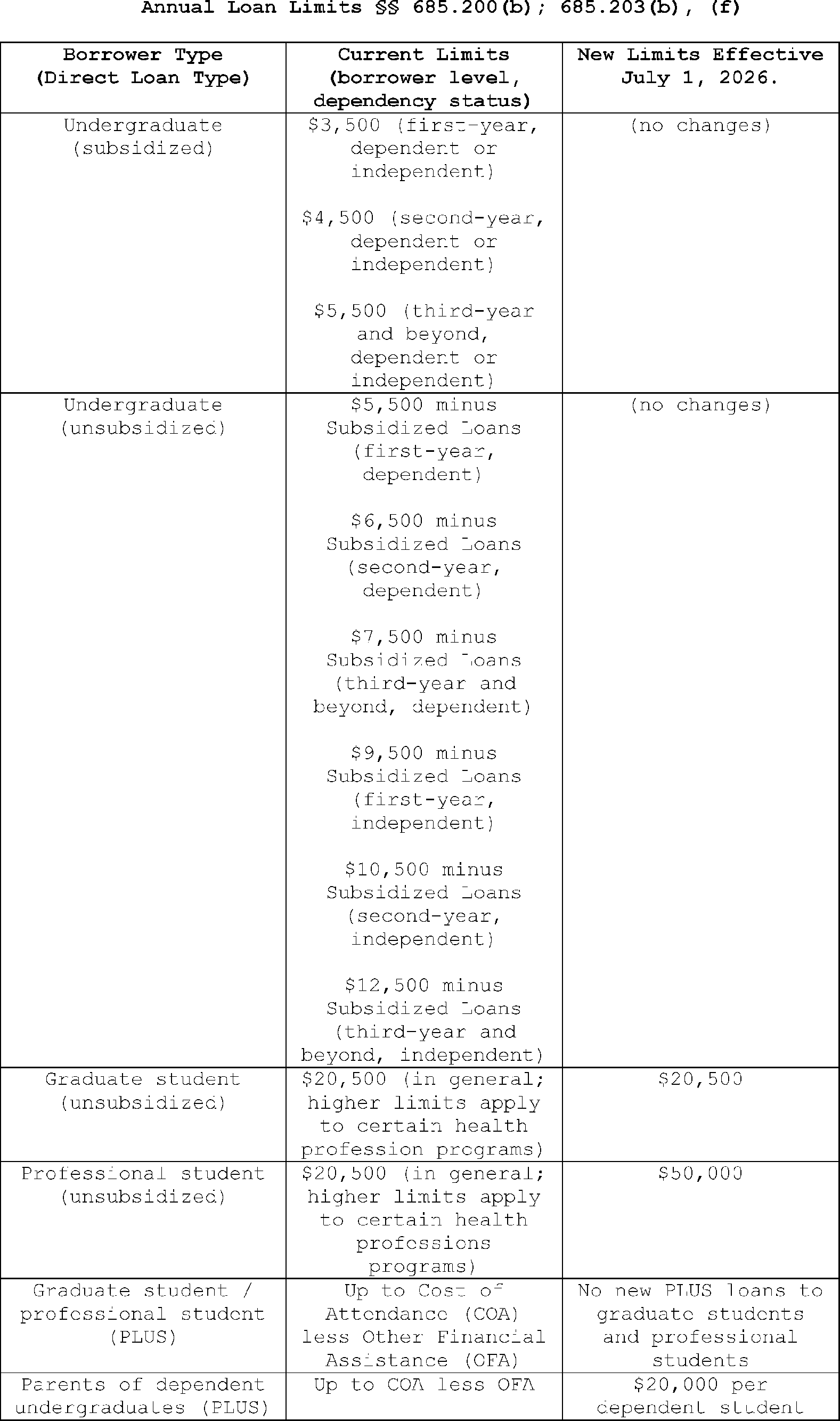
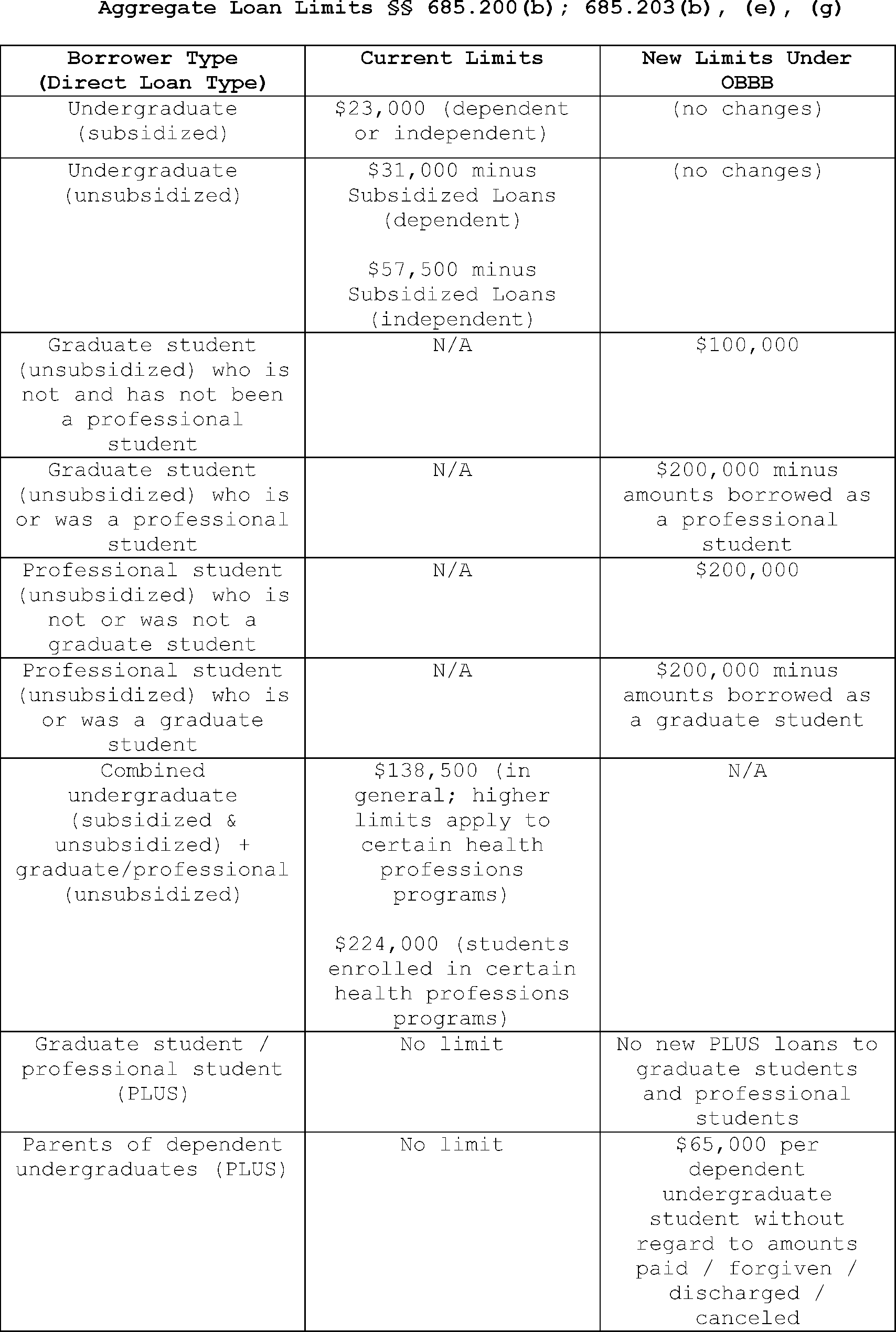
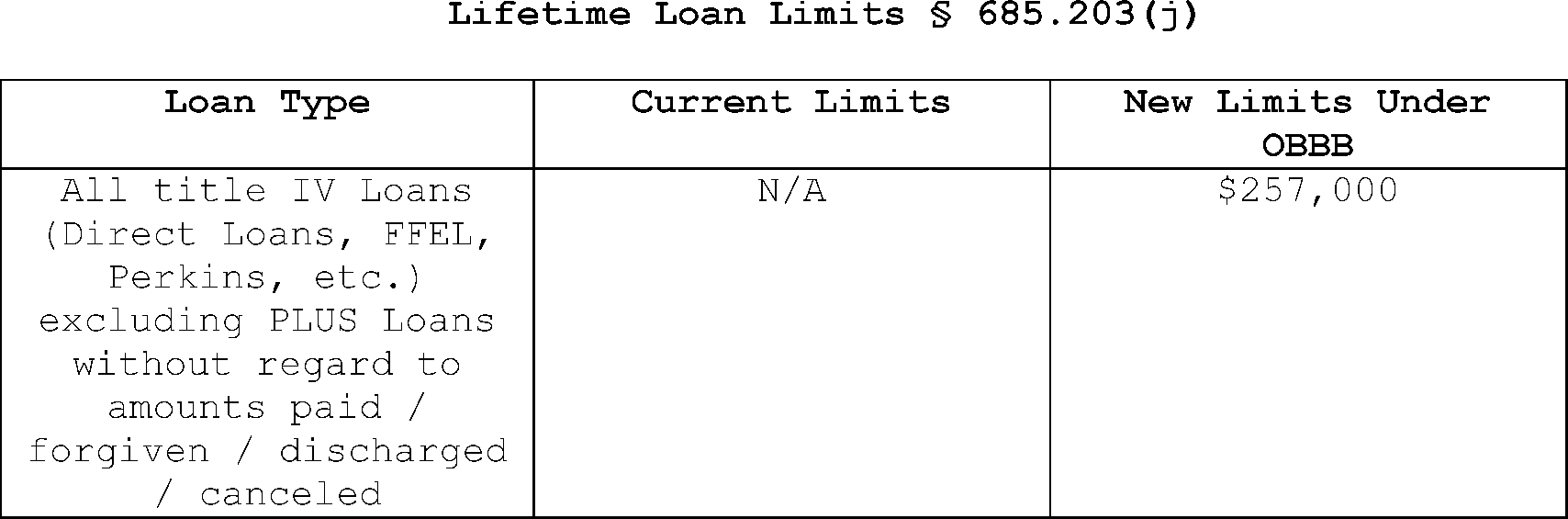
With respect to annual and aggregate limits for Direct Unsubsidized Loans for graduate and professional students, because of the statutory changes to the HEA, the Department's proposed regulations codify the new Direct Unsubsidized Loan annual and aggregate limits based on whether the borrower is a graduate student or professional student. We discuss the definitions of graduate student and professional student elsewhere in this document.
The Department wishes to make a technical correction under § 685.203(e)(4)(ii). During negotiated rulemaking, the RISE Committee reached consensus on the draft regulations in § 685.203. However, after reviewing the statute, the Department determined that § 685.203(e)(4)(ii) needed to be amended. Section 81001(2) of the OBBB added Section 455(a)(4)(B)(i)(II)(bb) to the HEA to state that for a period of enrollment beginning on or after July 1, 2026, the aggregate limit for a graduate student who is (or has been) a professional student at an institution, is $200,000, minus any amounts such student borrowed as a professional student. The consensus language in § 685.203(e)(4)(ii) erroneously stated that the aggregate limit for a graduate student who is or has been a professional student at an institution, is $200,000, minus any amounts such student borrowed as a graduate student. In subparagraph (e)(4)(ii), we propose to replace “graduate” with “professional” to make clear that it is minus any amounts such student borrowed as a professional student to accurately reflect the statute. Accordingly, we revised proposed § 685.203(e)(4)(ii) to read as follows: “(ii) who is or has been a professional student at an institution, $200,000, minus any amounts such student borrowed as a professional student.” We believe making this technical correction would make clear that, for a period of enrollment beginning on or after July 1, 2026, the aggregate limit for a graduate student who is or has been a professional student at an institution, is $200,000, minus any amounts such student borrowed as a professional student.
While this is a minor, technical change, the Department complied with the requirements in 20 U.S.C. 1098a(b)(2), which requires the Department whenever making a change from the consensus regulatory text to “provide a written explanation to the participants in that [negotiated rulemaking] process why the Secretary has decided to depart from such agreements.”
During negotiated rulemaking, the Committee discussed joint degree programs, in which a student earns both a graduate and a professional degree upon completion, such as a joint MBA and JD program. In response, the Department set the baseline that if more than 50 percent of the credit hours count toward the professional degree, the student would be considered a professional student for purposes of higher loan limits. As the Department explained during the first week of negotiations, the Department was concerned about the potential for abuse where graduate degree programs could be disguised as professional degree programs in order to gain access to the higher loan limits. Section 81001(c)(ii) of the OBBB provides that a “professional student” means a student enrolled in a program of study that awards a professional degree. The Department believes looking holistically at the academic program to determine whether the majority of the program counts toward the professional degree would allow us to assess the appropriate loan limit. In this case, we propose that if more than 50 percent of the credit hours count toward the professional degree, it would render such program a professional degree program. This is because if over 50 percent of the credits from a program are being earned toward a professional degree, the preponderance of a student's academic work is on earning a professional degree. The Department believes when most of a student's time is focused on professional credits, that it is sufficient to classify the student as a professional student for the purposes of the Direct Loan Program. The Department construes the phrase “enrolled in a program of study that awards a professional degree” in this context to mean a student who is spending more than half of their coursework working toward a professional degree. If a student is spending less than half of their coursework working toward a professional degree, most of their time is spent on a non-professional program. To allow any student enrolled in professional degree coursework, without considering what percentage of a student's total enrollment the professional coursework represents, to be considered a professional degree contravenes the intent of the statute by enabling students to enroll in such programs but not make serious attempts at taking the necessary coursework required to complete the program, while working primarily on a graduate degree program. The Department seeks comments on alternative approaches on how to classify joint degree programs for the purposes of Direct Loan eligibility.
Regarding the interim exceptions, we note that Section 455(a)(8) of the HEA contains obligatory terms and says the loan limits “shall not apply” if certain criteria are met, and accordingly, a borrower does not have the option to choose whether the new loan limits would apply to them. Students who meet the interim exception in proposed § 685.203(b)(2)(iv)(B) would be subject to the legacy loan limit provisions in Section 455(a)(3)(A)(ii) of the HEA. As an illustrative example, a professional student who enrolled in a program of study on or after July 1, 2026, is eligible for a Direct Unsubsidized Loan limit of $50,000 per year, but a professional student who was enrolled in the same program of study before that time (and ( printed page 4275) remains enrolled in that program of study at the same institution), would be subject to the legacy loan limit of $20,500 per year.
We also note that if a borrower withdraws or ceases to be enrolled in the eligible program at the same institution, the interim exception would no longer apply as the exception is only available to borrowers who remain enrolled in a program of study as required by Section 81001 of the OBBB. If a borrower withdraws, the borrower is no longer enrolled. And the borrower would then be subject to the loan limits in § 685.203(b)(2)(iv)(A), if the borrower were to re-enroll or matriculate at another institution. As such, we believe including a cross reference to a withdrawal as described in § 668.22 is instructive to borrowers. This policy would preserve certain borrowers' access to the interim exception, such as a borrower who is a servicemember called to active-duty and takes a leave of absence due to her military orders. In this case, she would not be subject to the loan limits in § 685.203(b)(2)(iv)(A).
The Department's proposed regulations codify new Direct PLUS Loan annual and aggregate limits for parent borrowers found in the OBBB. We also preserve the annual and aggregate limits for Direct PLUS Loans for periods of enrollment beginning before July 1, 2026. Separately in this NPRM, we discuss how the OBBB terminates graduate and professional students' access to the Direct PLUS Loan program for any period of instruction beginning on or after July 1, 2026.
Section 455(a)(5)(B) of the HEA provides that the aggregate limit for parent borrowers is $65,000 per dependent student, without regard to any amounts repaid, forgiven, canceled, or otherwise discharged on any such loan. The Department believes Congress' intent in using the words “without regard to any amounts repaid, forgiven, canceled, or otherwise discharged on any such loan” was to make certain that only the loan funds the borrower actually received are included in the aggregate limit. For example, students who received a false certification discharge for identity theft did not actually receive loan funds. The Department would not include loan amounts discharged under false certification in the parent borrower's aggregate limit and, similarly, we would not include loan amounts discharged under false certification in the lifetime maximum aggregate limit in § 685.203(j).
The OBBB also established a new lifetime aggregate limit; following, the Department has proposed regulations here to codify the new lifetime maximum aggregate limit. As part of the regulations on lifetime limits, the Department will make certain that only funds actually received by the borrower will count toward this lifetime aggregate limit. To enforce this principle, as a high-level overview, the Department would review all amounts disbursed minus any amounts that were returned by the institution or the borrower. We included a provision in § 685.203(j)(2) proposing that any amount of loan funds that have been returned by the institution, or the borrower, will not count against that borrower's lifetime maximum aggregate loan limit. Because the borrower did not receive the benefit of those funds that were returned to the Secretary, we believe those amounts should not be counted toward this lifetime maximum aggregate limit so that we remain consistent with historical precedent.
The OBBB also introduces a loan limit for borrowers who are enrolled on a less than full-time basis. The Department proposes to codify the Direct Loan eligibility on a less than full-time enrollment basis and a corresponding schedule of reductions. Section 455(a)(7) of the HEA requires the Secretary to publish a schedule of reductions for institutions to calculate the student's Direct Loan eligibility for the purposes of determining the amount of loan funds the borrower is eligible to receive for the `less than full-time enrollment status' provision. Therefore, the Department's regulations at § 685.203(m)(1) would provide additional information about these provisions and serve as the example of the schedule of reductions for students enrolling less than full-time.
Consistent with the OBBB, the proposed regulations include a formula that uses the number of credit hours in which the student is enrolled for the academic year divided by the number of credit hours that constitute full-time enrollment, as determined by the institution, for that academic year in the student's program of study, expressed as a percentage. The resulting percentage is then applied to the student's annual loan limit for that academic year. This proposal would implement Congress's direction that the annual loan limit be reduced in direct proportion to the student's enrollment status, rather than allowing a student who attends only part of the year or at reduced enrollment to receive the same annual loan amount as a full-time student.
The RISE Committee discussed the formula for less than full-time enrollment in detail and walked through several examples of how to properly apply this formula. The Department explained during negotiations that the language contained within this NPRM explicitly sets the required annual loan-limit for when a borrower enrolls less than full-time in the academic year. The Department explained that, in addition to this loan limit, a borrower must also meet all other eligibility criteria to receive a Federal student loan. The OBBB intentionally created an academic year requirement and not a per-term or per-disbursement schedule. We made the formula easily translatable to what the institution defines as full-time for the academic (award) year and easily divisible by the relevant number of terms. For an undergraduate student, current section 668.2 defines full-time as at least 24 credit hours. Using 24 credit hours as the baseline for full-time and factoring in enrollment for the complete academic year, an undergraduate borrower who enrolls nine hours in the fall and fifteen hours in the spring would be considered as full-time for the academic year and would be eligible for the full amount of eligibility and not subject to a reduction for less than half-time, which would equal 50 percent of the annual loan limit. A student's maximum disbursement eligibility for each term will be equal to the proportion of the full academic year and reduced by the percentage the student is enrolled less than full-time.
Section 455(a)(7)(A) of the HEA applies to the loan amount “for an academic year, or its equivalent.” The proposed text in § 685.203(m)(1) includes a corresponding formula for determining the proportion of the annual loan limit that applies to a single term at the receiving institution and then applying the less than full-time reduction to that amount in order to address situations in which a loan period is shorter than a full academic year such as when a student transfers mid-year.
The Department, in negotiations, also clarified situations relevant to a borrower who transfers enrollment to a different institution and how the new annual loan limit should be applied to the subsequent term of enrollment. The Department also walked through example schedules of reductions. For these transfer students, the new institution would determine what share of the academic year loan limit that term represents; and then reduce the Direct Loan based on the student's enrollment status in that term. The institution would use the schedule of reductions formula for the term of enrollment, which takes the number of credits ( printed page 4276) enrolled in that term for that program of study divided by the total number of credits that the institution considers full-time enrollment for that term in the program. This structure provides institutions with a clear, formula-based method for applying the statutory requirement to the portion of the annual loan limit for which it is disbursing. Institutions are familiar with the common practice of adjusting a student's aid package to reflect one term of enrollment or awarding aid to a student who has transferred from one institution to another. The concept of determining aid for one semester is not new. As such, creating the schedule of reductions for one term of enrollment was the appropriate action to address the new annual loan limit for less than full-time enrollment for students who fluctuate their attendance between institutions or only enroll in one term.
During negotiations, the Department answered several questions about the application of the schedule of reductions across differing academic calendars and payment period structures. These questions were relevant to the scope of regulations at § 685.203(m)(1), and the Department discusses the applicability of the schedule of reductions to programs contained in these regulations below. For non-term clock hour and credit-hour programs, the Department believes existing title IV disbursement rules are already tightly linked to academic progress. Students in these programs generally may not receive subsequent disbursements until they complete the required number of clock or credit hours, and institutions calculate payment periods and disbursements based on hours completed rather than fixed terms of time.
During the second week of the RISE Committee, the Department discussed the application of the schedule of reductions for students who are enrolled in subscription-based programs. Under a subscription-based program, the first two subscription periods of the programs are treated as terms for purposes of the title IV, HEA fund disbursements and there is no requirement for a student to complete a specified amount of coursework before receiving the disbursement for the second subscription period. However, in the third and subsequent subscription periods, disbursements are treated similarly to clock-hour and other non-term programs. Students in such programs cannot receive subsequent disbursements until they have earned the credits associated with the period, so the amount of loans a student can receive is already constrained by their actual pace and enrollment. Given that none of the non-Federal negotiators had specific experience with subscription-based programs, we removed reference to such programs in the regulations for schedule of reductions and are seeking specific feedback from institutions that use this type of academic calendar during the public comment period. The Department welcomes all relevant feedback on such programs and the relevancy of the schedule of reductions, or whether additional provisions are necessary to specifically address unique aspects of subscription-based programs. Specifically, we invite comments that ponder how the schedule of reductions would work at a subscription-based institution.
Section 455(a)(7)(A) of the HEA also ties the reduction to the student's enrollment status as of the date the institution determines the student's eligibility for a disbursement. A cross-reference to the general disbursement rules in § 668.164(b)(3) is also included. Under § 668.164, before each disbursement of title IV funds, an institution (or its third-party servicer) must confirm that the student is eligible, including confirming the student's enrollment status for that payment period.
The Department's proposed regulations therefore require institutions to apply the schedule of reductions formula using the student's actual enrollment at the time of disbursement, not just the enrollment that was anticipated when the institution originally packaged the annual loan. In the RISE Committee discussions, the Department explained that institutions typically build an award package based on the student's intended full-time enrollment for the academic year, but before a second or subsequent disbursement, as is already required, the school must re-check enrollment status to determine eligibility for the second or subsequent disbursement. If the student is enrolled for fewer credits than full-time at that point, the institution must reduce that disbursement so that the total loan for the academic year reflects the student's actual enrollment status. Likewise, if the student withdrew or dropped credits after the first disbursement that caused the student to be enrolled less than full-time for that term, the institution must reduce the subsequent disbursement in accordance with the schedule of reductions formula to make certain the student's annual amount disbursed is equal to the student's enrollment status.
By anchoring the reduction to the disbursement eligibility date in § 668.164(b)(3), the regulations ensure that:
- students who remain full-time across the academic year may still receive the full annual loan limit;
- students whose enrollment falls below full-time before a disbursement will have their annual loan amount reduced in proportion to their updated enrollment; and
- institutions are not required to predict future enrollment beyond what they already do under the existing aid packaging process.
This approach reflects the RISE Committee's concern that part-time and less than full-time students should receive the amount of loan eligibility they “earn” based on their enrollment over the academic year, while avoiding retroactive recalculations that would be difficult to administer and confusing for borrowers.
The Department's proposed regulations would codify the institutionally determined loan limits established in the OBBB. Financial aid administrators have long supported this approach as a means of helping to prevent borrowers from incurring unreasonable levels of debt.[28] Institutions already have the authority under § 685.301(a)(8), on a case-by-case (or student-by-student) basis, to reduce a Direct Loan or choose not to originate a loan. However, the new institutionally determined loan limit regulations provide further flexibility as to when, and how, an institution may limit borrowing under the new OBBB statutory authority. Additionally, the Department's proposed regulations in § 685.203(m)(2)(ii) through (iv) provide requirements to ensure the Department complies with the statutory requirements and that institutions provide borrowers with adequate information about the programs that may be subject to institutionally determined loan limits, thereby ( printed page 4277) providing borrowers with information to make informed choices.
By requiring institutions to document their decision and follow customary record retention requirements, the Department would be able to examine if the institution is applying their policy consistently to all students enrolled in that academic program. Furthermore, an institution would be required to notify students prior to limiting a current or prospective student's eligibility for a Direct Loan. We believe that these additional measures help ensure transparency in the process and would allow students to make an informed decision on whether to continue in their academic program or seek other means to finance their education.
The Department believes that the institution's decision to reduce the loan limit for a specific program of study would occur before the start of the new academic year so that there is adequate time to notify current and prospective students who enroll in that program prior to those students being subjected to the reduced loan limit.
Section 428H of the HEA and Loan Limits for Certain Health Professionals
Section 428H(d)(2)(A) of the HEA established loan limits for Federal Unsubsidized Stafford Loans made to graduate, professional, and independent postbaccalaureate students prior to July 1, 2010, and the HEA authorized the Secretary to increase loan limits for students “engaged in specialized training requiring exceptionally high costs of education.” Under this authority, the Secretary previously increased the aggregate loan limits for graduate and professional students enrolled in certain approved health profession programs (as defined by Section 703(a) of the Public Health Act). The Department first published these increased limits in DCL 98-L-209 (August 1, 1998). The Department last updated the increased limits in 2008 (DCL GEN-08-04 (April 18, 2008)).
Section 455(a)(1) of the HEA provides that “loans made to borrowers under Part D of the HEA shall have the same terms, conditions, and benefits, and be available in the same amounts, as loans made to borrowers, and first disbursed on June 30, 2010 under sections 428, 428B, 428C, and 428H” of the HEA, “unless otherwise specified in this part.” Section 455(a)(4) of the HEA, added by the OBBB, established new annual and aggregate limits for Federal Direct Unsubsidized Stafford Loans made to graduate and professional students “beginning on July 1, 2026.” Because the limits set forth in Section 455(a)(4) explicitly apply to all Federal Direct Unsubsidized Stafford Loans made to graduate and professional students on or after July 1, 2026, including those enrolled in health profession programs, the increased annual and aggregate loan limits established by the Secretary for graduate and professional students enrolled in certain approved health profession programs will not apply to loans made on or after July 1, 2026.
Notwithstanding the aforementioned, graduate and professional students enrolled in certain approved health profession programs and who meet the criteria for the interim exception under proposed § 685.203(b)(2)(iv)(B) regarding unsubsidized annual loan limits or § 685.203(e)(6) regarding unsubsidized aggregate loan limits will still be eligible for the increased loan limits during their expected time to credential. This is because the new loan limits effective on or after July 1, 2026, will not apply to these borrowers so long as they remain enrolled in their program of study. Consequently, they will retain access to the loan limits for loans made before July 1, 2026, including the increased unsubsidized loan amounts due to the high-cost nature of their program of study through the interim exception period. While a longstanding and widely used definition, the Department is aware that the definition of “professional student” has caused some confusion. The Department particularly invites commenters to suggest alternative terminology for this and related terms to ensure it is clear that this provision was designed by Congress to reduce borrowing for certain types of students and is not a value judgement about the professional nature of programs or occupations themselves.
Deferment (§ 685.204)
Statute: Section 82002 of the OBBB amends Section 455(f) of the HEA, titled “Deferment; Forbearance,” to sunset the authority for unemployment and economic hardship deferments for new Direct Loans while preserving these deferments for existing borrowers.
Current Regulations: Section 685.204 contains the regulations on deferments for Direct Loan borrowers. Section 685.204(f) provides the eligibility criteria, including the timeframes in which the borrower may receive an unemployment deferment. Section 685.204(f) further provides the borrower qualifications, including the manner on how to apply for an unemployment deferment and other rules that pertain to borrowers receiving an unemployment deferment.
Section 685.204(g) provides the eligibility criteria for the economic hardship deferment, including the cumulative maximum periods a borrower may receive an economic hardship deferment and the periods of time in which the Secretary grants an economic hardship deferment.
Proposed Regulations: The Department proposes to restructure the regulations at § 685.204(f)(1) to provide the eligibility criteria for an unemployment deferment based on loan disbursement date. We propose to redesignate current § 685.204(f)(1) as § 685.204(f)(1)(i) and provide that for loans disbursed before July 1, 2027, a borrower is eligible for an unemployment deferment during periods that, collectively, do not exceed the three years in which the borrower is seeking and unable to find full-time employment. We further propose to add new § 685.204(f)(1)(ii) to provide that for loans disbursed on or after July 1, 2027, a borrower may not receive an unemployment deferment. We also propose to add “the” after “For” in § 685.204(f)(3).
The Department proposes to restructure the regulations at § 685.204(g)(1)(i) and (ii) to provide the eligibility criteria for an economic hardship deferment based on the loan disbursement date. Specifically, we propose to revise the current § 685.204(g)(1)(i) to provide that for Direct Loans disbursed before July 1, 2027, a borrower is eligible for economic hardship deferments that, collectively, do not exceed three years. We further propose to redesignate current § 685.204(g)(1)(ii) as § 685.204(g)(1)(iii). Finally, we propose to add a new § 685.204(g)(1)(ii) to provide that for Direct Loans disbursed on or after July 1, 2027, a borrower may not receive an economic hardship deferment.
Reasons: The regulations are amended to reflect the changes made by the OBBB. Specifically, the OBBB provides that, for those borrowers with loans first disbursed before July 1, 2027, they may continue to receive unemployment and economic hardship deferments, subject to existing duration limits, but borrowers with loans first disbursed on or after that date are not eligible for those deferments. We note that an individual borrower could have split eligibility ( i.e., they could have a loan before July 1, 2027, which is eligible for unemployment deferment, and a loan on or after July 1, 2027, which would not be eligible for that same deferment). These statutory changes require conforming amendments to § 685.204 so that the Department's regulations on ( printed page 4278) deferment reflect the revised HEA framework and operate consistently with the OBBB repayment and hardship-relief system.
Current Section 685.204(f) and (g) provide unemployment and economic hardship deferments for eligible Direct Loan borrowers, generally for up to three years. These provisions describe the circumstances in which a borrower may receive an unemployment deferment, including when the borrower is seeking and unable to find full-time employment, and the criteria for receiving an economic hardship deferment. The deferments have functioned as short-term protections for borrowers who experience job loss, very low income, or other qualifying hardships.
To conform our regulations to the OBBB, the Department proposes to revise § 685.204(f) and (g) so that eligibility for unemployment and economic hardship deferments depends on the loan's first disbursement date. Proposed § 685.204(f)(1)(i) and (g)(1)(i) would provide that a borrower with Direct Loans first disbursed before July 1, 2027, remains eligible for unemployment and economic hardship deferments during periods that collectively do not exceed three years, consistent with current rules. New § 685.204(f)(1)(ii) and (g)(1)(ii) would provide that a borrower with Direct Loans first disbursed on or after July 1, 2027, may not receive unemployment or economic hardship deferments. The Department also proposes minor conforming edits, including revisions to cross-references and clarifying words, to improve internal consistency and readability without altering the substance of borrower protections for loans that remain eligible for deferment.
During the RISE Committee, the Department explained that the OBBB preserves unemployment and economic hardship deferments only for borrowers whose loans are first disbursed on or before July 1, 2027, and that the regulations would need to reflect that distinction by loan disbursement date. Committee materials and discussion summarized the Department's intent to maintain access to these deferments for legacy borrowers while ending their availability for new loans, and to coordinate this change with related proposals on forbearance limits, rehabilitation, and the new repayment framework. After reviewing the draft amendments to § 685.204(f) and (g), the Committee did not raise objections when presented with the amendatory text in week two of the negotiations.
By limiting unemployment and economic hardship deferments to Direct Loans first disbursed before July 1, 2027, the proposed amendments to § 685.204 implement the OBBB's statutory changes, preserve existing expectations for borrowers with legacy loans, and clarify that future borrowers must rely primarily on simplified repayment options and targeted hardship-relief authorities rather than on status-based deferments. This structure is intended to reduce regulatory complexity, improve alignment between deferment provisions and the new repayment system, and provide a clearer set of protections for both current and future borrowers.
These revisions would give borrowers, institutions, and servicers a more transparent and administrable deferment framework that aligns with the new repayment structure under the OBBB, clarifies when deferment is available, and supports smoother transitions between deferment, active repayment, and periods that may count toward forgiveness.
Forbearance (§ 685.205)
Statute: Section 82002 of the OBBB amends Section 455(f) of the HEA, “Deferment; Forbearance,” to limit the use of forbearance for future borrowers, effective for loans made on or after July 1, 2027.
Current Regulations: Section 685.205 contains the regulations on forbearances for Direct Loan borrowers; § 685.205(c) provides the periods of forbearance. Under § 685.205(c)(1), the Secretary grants forbearance for a period of up to one year and under § 685.205(c)(2), a borrower may request to renew the forbearance, and it will remain valid for the duration of the period in which the borrower meets the criteria for the forbearance.
Proposed Regulations: The Department proposes to restructure the regulations at § 685.205(c)(1) to provide the period of forbearance and a limited period of forbearance for loans disbursed on or after July 1, 2027. Specifically, we propose to redesignate current § 685.205(c)(1) as § 685.205(c)(1)(i). We also propose to add § 685.205(c)(1)(ii) that provides for loans disbursed on or after July 1, 2027, and notwithstanding the granting of forbearance for a period of up to one year, the Secretary grants forbearance for a period that does not exceed nine months within a 24-month period for a general forbearance. Such forbearance would begin the first month for which the forbearance is granted.
Reasons: The Department proposes to amend Section 685.205 to reflect the changes made by the OBBB. Under these amendments, loans made on or after July 1, 2027, are eligible for general forbearance for no more than nine months within any 24-month period, while earlier cohorts with legacy loans retain access to the longer forbearance periods authorized under current law. The Department must therefore revise § 685.205 to reflect these new statutory limits and to distinguish between legacy borrowers and borrowers whose loans are made under the OBBB framework.
Currently, § 685.205 allows the Secretary to grant forbearance when a borrower is unable to make required monthly payments. Under § 685.205(c)(1), the Secretary may grant a forbearance for a period of up to one year. Under § 685.205(c)(2), the borrower may request a renewal of a forbearance period so long as the borrower continues to meet the criteria for forbearance.
Consistent with the OBBB, the Department proposes to restructure § 685.205(c)(1) to set different limits on general forbearance based on loan disbursement date, while preserving existing rights for legacy borrowers. As described to the RISE Committee, the Department would redesignate current § 685.205(c)(1) as § 685.205(c)(1)(i), under which borrowers with loans disbursed before July 1, 2027, may continue to receive general forbearance for periods of up to one year at a time, subject to existing renewal rules. The Department would then add § 685.205(c)(1)(ii), providing that for loans disbursed on or after July 1, 2027, the Secretary may grant general forbearance for no more than nine months within any 24-month period.
The Department also proposes conforming edits in § 685.205(a) and (b) to cross-reference the new paragraph (c)(1) to make this limit required for borrower-requested general forbearances.
In its presentations to the RISE Committee, the Department explained that the nine-month limit applies only to general, discretionary forbearances requested by the borrower under § 685.205(a)(1) and does not apply to processing or other administrative forbearances initiated by the Department or a servicer. Non-Federal negotiators raised questions about how distinct types of forbearances such as processing forbearances while an income-driven repayment application is pending or administrative forbearances during a total and permanent disability discharge review would interact with the new limit. The Department clarified that processing, and administrative, forbearances would not count against the nine-month general forbearance cap, ( printed page 4279) while borrower-requested discretionary forbearances would count, and confirmed that cancer deferment and Total and Permanent Disability-related administrative forbearances are not impacted by the cap.
The RISE Committee also reviewed the proposed text for § 685.205 during its two sessions. Department staff described the restructuring of § 685.205(c)(1) into separate provisions for loans disbursed before and on or after July 1, 2027, and emphasized that borrowers with loans disbursed before July 1, 2027, would retain access for up to one year of general forbearance per loan, while borrowers with later loans would be limited to nine months. Like deferments, we note that an individual borrower could have split eligibility ( i.e., they could have a loan eligible for forbearance made before July 1, 2027, but a loan made on or after July 1, 2027, would not be eligible for that same forbearance). The RISE Committee expressed concern about borrower confusion and servicing errors, particularly the risk that servicers might misclassify forbearances in ways that could cause borrowers to exhaust their nine-month limit inadvertently. In response, the Department reiterated that the cap applies only to borrower-requested general forbearances and noted that existing oversight and error-correction processes would continue to apply.
These proposed changes to § 685.205 are intended to work in concert with the broader OBBB repayment and relief framework, including the new Repayment Assistance Plan. At the same time, the proposed nine-month limit for loans disbursed on or after July 1, 2027, retains general forbearance as a short-term tool for unexpected disruptions, while reducing the risk that borrowers will spend years in forbearance accumulating interest instead of enrolling in affordable repayment plans. For borrowers with loans made before July 1, 2027, the rule preserves access to longer forbearance periods consistent with current regulations, providing a gradual transition to the new statutory framework and honoring existing expectations. Collectively, these revisions would create a more transparent and disciplined forbearance framework that aligns with the OBBB's repayment structure, reduces the risk that borrowers are inappropriately placed or kept in prolonged forbearance, and clarifies how forbearance periods affect interest, capitalization, and a borrower's progress toward potential forgiveness.
Fixed Payment Repayment Plans (§ 685.208)
Statute: Section 82001(b)(1)(A) of the OBBB amends Section 455(d)(1) of the HEA to limit access to the standard, graduated, and extended repayment plans to borrowers who only have outstanding Direct Loans and do not receive another Direct Loan on or after July 1, 2026. Section 82001(b)(3) of the OBBB further amends Section 455(d)(6) of the HEA which terminated and limited the Secretary's repayment authority and sunsets repayment plans that were available before July 1, 2026. Section 455(d)(7)(A)(i) of the HEA would be the only fixed payment repayment plan available to borrowers who receive a Direct Loan made on or after July 1, 2026.
Current Regulations: Section 685.208 contains the regulations on fixed payment repayment plans for Direct Loan borrowers. Section 685.208(a) provides a general overview of fixed payment repayment plans under which a borrower's required monthly payment amount is determined based on the amount of the borrower's Direct Loans, the interest rates on the loans, and the repayment plan's maximum repayment period. Section 685.208(b) and (c) provide the terms of the standard repayment plans based on Direct Loan type and date of entering repayment; § 685.208(d) and (e) provide the extended repayment plans based on Direct Loan type and date of entering repayment; and § 685.208(f), (g), and (h) provide the graduated repayment plans based on Direct Loan type and date of entering repayment. Section 685.208(i) and (j) provide the repayment periods for the fixed payment repayment plans based on the outstanding balance of a borrower's Direct Loans. Finally, § 685.208(k) provides that the repayment period for any of the fixed payment repayment plans excludes periods of authorized deferments or forbearances.
Proposed Regulations: The Department proposes to restructure the regulations at § 685.208 to provide the fixed payment repayment plans based on when the Direct Loan was made. We propose to revise current § 685.208(b) as the header for fixed repayment plans for Direct Loans made before July 1, 2026. Proposed § 685.208(b) would also contain the following fixed repayment plans: standard, graduated, extended, and tiered standard. We also propose to revise current § 685.208(c) as the header for fixed repayment plans for Direct Loans made on or after July 1, 2026. Proposed § 685.208(c) will contain only the tiered standard repayment plan. We also propose to include the repayment period within each fixed repayment plan.
Reasons: The regulations are amended to reflect changes made to the HEA by the OBBB. Among the changes in § 685.208, our proposal to organize the regulatory text by when a Direct Loan was made and the fixed repayment plans available to the borrower for that loan would streamline information so that all information about each of the respective repayment plans ( i.e., the standard, graduated, or extended repayment plans) are in a central location in regulation and are contained together. Each fixed payment repayment plan would also contain the appropriate repayment period applicable for that plan and other terms such as authorized periods of deferment and forbearances that are included in the repayment period. This provides structure and consistency to this regulatory subsection.
Congress specified the new standard repayment plan in Section 455(d)(7)(A)(i) of the HEA to be one of the two repayment plans available to new borrowers on or after July 1, 2026. We propose to name the new fixed payment repayment plan the Tiered Standard repayment plan. The Tiered Standard repayment plan would be the only fixed repayment plan available to borrowers who receive a Direct Loan made on or after July 1, 2026. The Tiered Standard repayment plan, including the prescribed repayment periods specified in the law, is added in proposed § 685.208(b).
Consistent with these two statutory provisions that amended the HEA, in § 685.208(b)(1) through (b)(7), we limit access to the standard, graduated, and extended plans on the condition that the borrower does not receive a new Direct Loan on or after July 1, 2026.
The repayment period for the Tiered Standard repayment plan is enumerated in statute and ranges from a period of 10 years to 25 years based on the total outstanding principal balance at the time the borrower enters repayment under the plan. However, in certain circumstances, that term is recalculated. If a borrower in the Tiered Standard repayment plan obtains new loans that would be repaid under Tiered Standard repayment plan, the repayment period is recalculated using the outstanding principal balance for all eligible loans as of the date that the new Direct Loan enters the Tiered Standard repayment plan. Similarly, a borrower enrolled in Tiered Standard repayment plan, who changes to a repayment plan that is not the Tiered Standard repayment plan (or defaults on their loan) and then re- ( printed page 4280) enrolls in Tiered Standard repayment plan would also have their repayment period recalculated based on the total outstanding balance of eligible loans on the date the borrower re-enrolls in the Tiered Standard repayment plan. Section 455(d)(7)(A)(i)(II) of the HEA bases the applicable repayment period on the total outstanding principal of all the borrower's Direct Loans “at the time the borrower is entering repayment” under the Tiered Standard repayment plan, and inclusion of that additional loan would require an amortization of all the outstanding principal for all the borrower's Direct Loans. A borrower in the Tiered Standard repayment plan who enters a period of authorized deferment or forbearance would not be considered to have left the Tiered Standard repayment plan and would not need to have the repayment period recalculated.
During the first session of the RISE Committee, some Committee members expressed concerns about borrowers being placed into Tiered Standard repayment plan, which is not a qualifying repayment plan for PSLF purposes. Section 455(d)(7)(B) of the HEA requires the Secretary to place a borrower in the Tiered Standard repayment plan if the borrower does not select a repayment plan for loans made on or after July 1, 2026; accordingly, a borrower who is on track to receive PSLF would need to proactively select a PSLF qualifying repayment plan if their loan qualifies for such a plan. Section 455(m)(1)(A) of the HEA and the regulations at 34 CFR 685.219(b) enumerate the PSLF qualifying repayment plans, and the Tiered Standard repayment plan is not listed as one of the PSLF qualifying repayment plans. The Department will make certain that information in communications to borrowers who are seeking PSLF clearly states that the Tiered Standard repayment plan would not qualify as an eligible repayment plan for the purposes of the PSLF program.
Minimum Payments
Section 428(b)(1)(L)(i) of the HEA provides that the total amount of the annual payments made by a borrower during any year of a repayment period with respect to the aggregate amount of all loans made to that borrower must not be less than $600 or the balance of all such loans, whichever amount is less. This provision creates a mandatory minimum monthly payment of $50 per month per borrower under the Tiered Standard repayment plan. Section 455(a)(1) of the HEA, as amended, 20 U.S.C. 1087e(a)(1), otherwise known as,
Parallel Terms and Conditions provision, states that unless otherwise specified in this part, loans made to borrowers under this part shall have the same terms, conditions, and benefits . . . as loans made to borrowers . . . under section 428 . . .
And Section 82001 of the OBBB, Public Law 119-21, which amended Section 455(d)of the HEA to create the Tiered Standard repayment plan, does not specify a minimum monthly payment amount. Therefore, by operation of the Parallel Terms and Conditions provision of the HEA, the monthly payment amount is imputed into the language of the Tiered Standard repayment plan.
Income-Driven Repayment Plans (§ 685.209)
Statute: Section 82001(b) of the OBBB amends Section 455(d)(1) of the HEA to limit access to certain IDR plans for borrowers who only have outstanding Direct Loans and do not receive another Direct Loan on or after July 1, 2026. Section 82001(c)(1) of the OBBB further amends Section 455(d) and (e) of the HEA, which terminated and limited the Secretary's repayment authority to make income-contingent repayment available and sunset those ICR plans before July 1, 2028. Section 82001(a) provides for the transition of borrowers in an ICR plan to other IBR plans. Section 82001(d) of the OBBB adds Section 455(q) to the HEA, which provides the authority and overall framework for the Repayment Assistance Plan. Section 82001(f) of the OBBB amends Section 493C(a)(3) of the HEA to eliminate partial financial hardship as a condition of entry into IBR. Section 82001(c)(2)(D) of the OBBB amended Section 494(a)(2) of the HEA regarding the procedure and requirements for requesting Federal tax information (FTI) from the Internal Revenue Service (IRS) for purposes of determining eligibility for the IDR plans, including the Repayment Assistance Plan.
Current Regulations: Section 685.209 contains the regulations on IDR plans for Direct Loan borrowers. Section 685.209(a) provides a general overview of the four IDR plans under which a borrower's required monthly payment amount is determined based on the borrower's income and family size. Currently, the four IDR plans are: the Saving on a Valuable Education (SAVE) plan, which replaced the Revised Pay As You Earn (REPAYE) plan; the Income-Based Repayment (IBR) plan; the Pay As You Earn (PAYE) Repayment plan; and the Income-Contingent Repayment (ICR) plan.[29] Section 685.209(b) enumerates definitional terms pertaining to IDR plans. Section 685.209(c) provides the borrower eligibility criteria for each of the IDR plans. Section 685.209(d) stipulates the loans eligible to be repaid under each of the IDR plans while § 685.209(e)(1) provides how the Secretary treats a borrower's income for purposes of calculating a borrower's monthly payment amount under an IDR plan, and § 685.209(e)(2) provides whose loan debt is includable for purposes of adjusting a borrower's monthly payment amount in an IDR plan. Section 685.209(f) provides how the Secretary calculates the monthly payment amounts for each of the IDR plans, and § 685.209(g) provides adjustments to those monthly payment amounts.
Section 685.209(h) provides how the Secretary treats interest accrual on a borrower's loans depending on the IDR plan. Section 685.209(j) provides how the Secretary capitalizes unpaid, accrued interest under the various IDR plans. Section 685.209(k) provides the forgiveness timelines under which a borrower receives forgiveness of the remaining balance of the borrower's Direct Loan after satisfying the requisite number of monthly payments or the equivalent over a period of years based on the type of IDR plan. Section 685.209(k) also provides when a borrower receives a month of credit toward forgiveness for the various IDR plans. Finally, § 685.209(l) provides the application and annual recertification procedures of a borrower's income and family information for purposes of calculating a monthly payment under an IDR plan and includes the consequences of failing to recertify.
Proposed Regulations: The Department proposes to include repayment plan provisions in § 685.209, including most of the terms and conditions of the newly created Repayment Assistance Plan, and other changes made by the OBBB.
With respect to the IDR plans, we propose to amend § 685.209(a) to add the newest IDR plan: the Repayment Assistance Plan. We also propose to restructure the definitions section in § 685.209(b) by providing definitional terms applicable to the Repayment Assistance Plan. We propose to add the following new definitions and amend existing definitions: applicable amount; base payment; dependent; eligible loan; excepted consolidation loan; excepted ( printed page 4281) loan; excepted PLUS loan; family size; monthly payment or the equivalent; and new borrower. We propose to remove the definition of partial financial hardship from the list of definitions in § 685.209(b).
With respect to borrower eligibility for IDR plans, we propose to amend § 685.209(c)(1) to make clear that, except under certain circumstances for borrowers in IBR or the Repayment Assistance Plan, defaulted loans may not be repaid under an IDR plan. We propose to amend § 685.209(c)(2), (4), and (5) to provide that through June 30, 2028, borrowers may repay under the PAYE and ICR plans if they meet the criteria in each of those ICR plans and have not received a Direct Loan on or after July 1, 2026. Where appropriate, we propose removing partial financial hardship, and in its place the borrower must elect to have their aggregate monthly payment recalculated so as not to exceed the applicable amount. We also propose in § 685.209(c)(6) that any Direct Loan borrower may repay under the Repayment Assistance Plan if the borrower has loans eligible for repayment under the plan. Finally, we provide a transition period for borrowers in an income-contingent repayment plan (ICR, PAYE, SAVE) to elect to repay under a different repayment plan.
With respect to loans eligible to be repaid under IDR plans, we propose to amend § 685.209(d)(1) and (3) to provide that through June 30, 2028, borrowers may repay select Direct Loans under certain ICR plans. We propose to amend § 685.209(d)(1), (2), and (3) to make clear when a borrower may repay excepted consolidation loans under IDR plans. We propose to add § 685.209(d)(4) to clarify the loans eligible to be repaid under the Repayment Assistance Plan. And we make clear in proposed § 685.209(d)(5) that only Direct Loans made before July 1, 2026, may be repaid under the PAYE, IBR, and ICR plans. We also propose to amend § 685.209(e) to specify how the Secretary would treat income and loan debt for the purposes of calculating a monthly payment under the IDR plans, including by adding how loan debt and income are treated for purposes of the Repayment Assistance Plan.
With respect to how monthly payment amounts are calculated for the various IDR plans, we propose to amend § 685.209(f)(2) and (3) to clarify that a borrower's repayment period could exceed the 10-year standard repayment plan timeframe while repaying under the IBR or PAYE plans when their payment is no longer based on an amount calculated using their income. We also propose to add § 685.209(f)(5), which governs the applicable monthly payment amount required under the Repayment Assistance Plan and clarifies it must be equal to the borrower's base payment, divided by twelve, less $50 for each dependent of the borrower. We also propose to add § 685.209(g)(3), where we would adjust monthly payment amounts calculated under the Repayment Assistance Plan and propose that if the adjusted monthly payment as calculated is less than $10, the monthly payment would be $10.
With respect to treatment of interest and interest subsidies under the various IDR plans, we propose to add in § 685.209(h) a cross-reference to the Repayment Assistance Plan that if a borrower's calculated monthly payment under an IDR plan is insufficient to pay the accrued interest on the borrower's loans, we would charge the remaining accrued interest to the borrower. We also propose to add § 685.209(h)(4), which would state that under the Repayment Assistance Plan, during all periods of repayment on all loans being repaid under the Repayment Assistance Plan, we would not charge the borrower accrued interest that is not covered by the borrower's on-time payment of the amount due for that month. However, we would provide under § 685.209(h)(4)(ii), that if a borrower's payment is credited to a future monthly payment, and the payment equals or exceeds the on-time monthly payment amount made under the Repayment Assistance Plan, we would charge the borrower accrued interest that is not covered by the borrower's on-time payment of the amount due for that month. Under proposed § 685.209(j)(1), we would add the Repayment Assistance Plan as one of the IDR plans where the Secretary does not capitalize unpaid accrued interest in accordance with interest capitalization regulations at § 685.202.
With respect to loan forgiveness under the IDR plans, we propose to amend § 685.209(k)(4) to specify under which IDR plans a borrower may receive a month of credit toward IDR forgiveness. Specifically, we propose to add § 685.209(k)(4)(i)(B), which would provide that making a payment on or before June 30, 2028, under the PAYE, or ICR, plan or having a monthly payment obligation of $0 would give a borrower a month of credit toward forgiveness for IBR. We also propose to add § 685.209(k)(7), which would provide that under the Repayment Assistance Plan, a borrower receives forgiveness of the remaining balance of the borrower's loans after the borrower has satisfied 360 monthly payments over a period of at least 30 years. We propose to specify in § 685.209(k)(8) the terms and conditions of receiving forgiveness under the Repayment Assistance Plan and specify the monthly payment or their equivalents that would give a borrower a month of credit toward forgiveness under the Repayment Assistance Plan.
With respect to applying for an annual recertification procedure in IDR plans, we propose to codify procedures when the Secretary may implement certification and automatic recertification for enrollment in the Repayment Assistance Plan. We propose to add § 685.209(l), which are the conditions under which a borrower must provide documentation or information to the Secretary related to the borrower's income and number of dependents of the borrower for purposes of enrolling in the Repayment Assistance Plan.
Finally, we propose to add new provisions in § 685.209 under new § 685.209(o). First, we propose in § 685.209(o)(1) for the PAYE plan and the Repayment Assistance Plan, if the borrower's monthly payment amount is not sufficient to pay any of the principal due, the payment of that principal is postponed. We further add in § 685.209(o)(2) the provisions of matching principal payments under the Repayment Assistance Plan, which would provide that when the borrower is not in a period of deferment or forbearance, for each month the borrower makes an on-time monthly payment and the outstanding principal balance is reduced by less than $50, the Secretary reduces such total outstanding principal of the borrower by an amount that is equal to the lesser of $50 or the monthly payment made and then subtracting that figure from the amount of the monthly payment that is applied to such total outstanding principal balance. We also propose to specify in § 685.209(o)(3) that for the purposes of the Repayment Assistance Plan, we would consider a payment to be “on-time” if the payment is received on or before the due date for the current month and satisfies the due date for the current month, but after the due date for the previous month. We would also specify how we would treat loan payments made in excess of on-time payments under the Repayment Assistance Plan for purposes of receiving the matching principal payment or interest subsidy, monthly credit toward PSLF, or forgiveness under the Repayment Assistance Plan.
Reasons: Throughout § 685.209, we conform the IDR plans to the statutory ( printed page 4282) changes. Other changes are discussed in greater detail below.
In response to Congress eliminating the partial financial hardship requirement for IBR eligibility and introducing the definition of applicable amount, the Department removed the definition of partial financial hardship from § 685.209(b) and eliminated the term throughout the section.
The term applicable amount by and large supplants partial financial hardship, and we make conforming changes throughout § 685.209 by removing partial financial hardship or concepts of partial financial hardship and in its place including applicable amount. In accordance with other statutory changes to definitional terms in Section 493C of the HEA, we added the definitions of excepted consolidation loan, excepted loan, and excepted PLUS loan in § 685.209(b). We believe the addition of these terms in our regulations clarifies borrowers' eligibility for IDR plans, as Parent PLUS borrowers may not access some repayment plans. By adding excepted loan to our definitions, we clarify that a Direct Consolidation Loan that repaid an excepted PLUS loan (or another consolidation loan that repaid a Parent PLUS Loan) is itself considered an excepted loan.
Section 455(q) provides definitions for the terms base payment and dependent, which were added to the Repayment Assistance Plan in § 685.209(b). These terms are critical to determining how the Department would calculate a payment under the Repayment Assistance Plan, including the actual calculation based on a borrower's AGI in the definition of base payment and defining who is considered a dependent for purposes of adjusting a borrower's payment under the plan. We also modified the definitions of family size and monthly payment or the equivalent to help ensure that these terms are applicable to IDR plans except the Repayment Assistance Plan. As previously noted, the definition of base payment and dependent specify how a payment is calculated under the Repayment Assistance Plan, making the definitions of family size and monthly payment or the equivalent unnecessary for purposes of the Repayment Assistance Plan.
We propose to modify the definition of new borrower for the IBR plan to clarify that receipt of a new Direct Loan on or after July 1, 2026, would prevent a borrower from continuing to repay under the borrower's current IBR plan. Given that Section 455(d) of the HEA now limits access to certain repayment plans for borrowers who do not receive a new Direct Loan on or after July 1, 2026, and IBR for new borrowers is conditioned for borrowers after 2014, we put a finite timeframe in the definition of new borrower between 2014 and 2026 to ensure that the regulatory definition matches that of the statute.
Therefore, we revised the definition of a “new borrower” for the IBR plan to include only those who receive a new Direct Loan between 2014 and June 30, 2026, because obtaining a new Direct Loan on or after July 1, 2026, makes a borrower ineligible to continue repaying under the IBR plan.
This approach makes certain that our regulatory definition aligns with the statutory requirements in Section 455(d) of the HEA.
We propose to amend § 685.209(c)(1) to clarify that, except in certain circumstances for borrowers in IBR or the Repayment Assistance Plan, defaulted loans generally cannot be repaid under an IDR plan, a change proposed to align with the statute. Throughout § 685.209, we provide sunset dates for the SAVE, PAYE, and ICR plans (collectively the income-contingent repayment plans) because the statute makes clear that borrowers would not be eligible for those ICR plans on or after July 1, 2028. Continued access to these ICR plans is also predicated on the condition that a borrower does not receive a Direct Loan on or after July 1, 2026, as the statute commands and our regulations reflect throughout. Finally, we added a new § 685.209(c)(7) to conform with Section 82001(a) of the OBBB, which provides for a transition period for borrowers in an ICR plan or an administrative forbearance associated with an ICR plan to another plan before July 1, 2028. Our proposed regulations would implement the statutory changes that transition borrowers to other repayment plans.
With a new definition of excepted consolidation loan, we make clear under which IDR plans those borrowers with such excepted consolidation loans would be eligible to pay under. We believe our term excepted consolidation loan is simpler to understand as the term is defined further above.
With respect to monthly payment amounts, we included conditions in § 685.209(f)(2) and (3) that clarify a borrower's capped number of monthly payments may exceed 10 years. Prior to enactment of the OBBB, a borrower's monthly payment under IBR and PAYE would have been the lesser of the applicable percentage of the borrower's discretionary income or, what the borrower would have paid under 10-year standard repayment plan when they began repaying under IBR or PAYE. Through our proposed regulations in § 685.209(f)(2) and (3), we make clear that the borrower's capped amount of monthly payments under the 10-year standard repayment plan could exceed 10 years.
With respect to calculating a monthly payment for the purposes of the Repayment Assistance Plan, because the OBBB added Section 455(q)(4)(B)(i) to the HEA, we included in proposed § 685.209(f), with nearly identical verbiage as the statute, how we would calculate a monthly payment for the Repayment Assistance Plan. That amount is equal to the base payment, divided by 12, minus $50 for each of the borrower's dependents.
The Department's proposed regulations also align with the statutory changes to application and annual recertification procedures for IDR plans. The OBBB expands the Secretary's authority to use FTI to determine eligibility for IDR plans. The Department provides in regulations the process by which we obtain the borrower's (and their spouse, if applicable) consent to obtain the information needed to determine eligibility for an IDR plan. We also include a provision for the borrower to opt-out of disclosing their FTI and instead provide alternative documentation of income to reflect the ability of a borrower to opt-out of the FTI disclosure process.
With respect to the Repayment Assistance Plan, throughout § 685.209, we included the terms and conditions of the Repayment Assistance Plan in the appropriate subsections. Consistent with the other IDR plans, the Department's regulations codify the applicable terms and conditions of the Repayment Assistance Plan at these subsection levels to streamline the IDR plans implementing regulations and reduce borrower confusion.
To help guide readers, we are providing a high-level summary comparing selected plan features between existing IDR plans and the Repayment Assistance Plan. The new loan repayment provisions generally take effect on July 1, 2026.
( printed page 4283)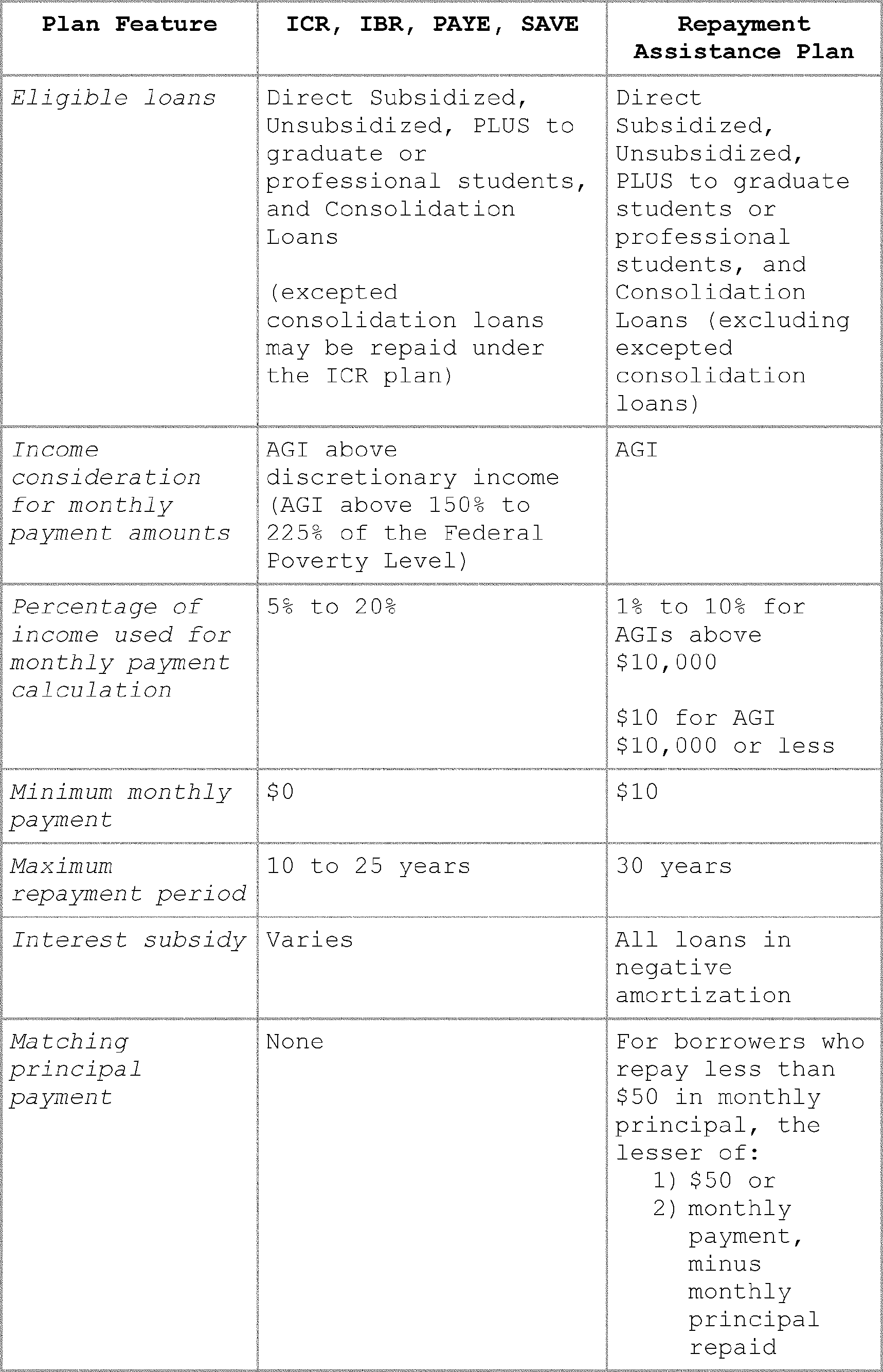
Some key distinctions that are unique only to the Repayment Assistance Plan include: the concept of “on-time,” the provision for matching principal payments, and special provisions on interest subsidy.
Section 455(q) of the HEA uses the phrase “on-time applicable monthly payment” in several places when discussing payments made under the Repayment Assistance Plan. Only payments made “on-time” are entitled to the principal match and the interest subsidy benefits, and only “on-time” payments count toward loan forgiveness through both the Repayment Assistance Plan and the PSLF program. However, Section 455(q) does not define the term “on-time.” The Department proposes, at § 685.209(o)(3), that a payment made under the Repayment Assistance Plan should be considered on-time if the payment is received on or before the due date for the current month and satisfies the due date for the current month, but after the due date for the previous month. This proposed language makes clear to borrowers the conditions under which a payment made for a month would be considered on-time for that month and how excess funds are treated. During the second session of negotiations, the RISE Committee expressed concerns about borrower payments that exceed the scheduled payment and how those excess funds would be treated, as well as how they would be treated for the purposes of eligibility for the special provisions in the Repayment Assistance Plan, such as the interest subsidy or the matching principal payment benefit. In general, the Department believes that a payment received in excess would not be considered an on-time payment under the Repayment Assistance Plan unless the borrower opts out of advancing the due date, as explained below. By advancing the due date because of a prepayment, you do not have a monthly balance due (until the amount of the prepayment no longer covers the monthly payment amount due) and those months are not considered as on-time payments. In drafting the NPRM, the Department noticed that the consensus text in § 685.209(o)(3) did not explain that a borrower would not receive a matching principal and interest subsidy for payments made without a due date, that is, payments that are made in excess of the necessary payment or those that are paid in advance when a due date has already been satisfied periods without a due date. The borrower may need to opt out of advancing the payment due date if they wish to receive a matching payment. While, in publishing this NPRM, the Department invites comments on the entirety of the proposed text, we particularly invite comments that seek to assist the Department in clarifying this provision and that may aid in resolving any potential borrower confusion that may arise from this process.
Section 685.209 proposes the new statutory framework for IDR plans, including the Repayment Assistance Plan, and aligns the changes made by the OBBB to Section 455(d) of the HEA. Specifically, Section 455(d)(7)(A)(i)(II) of the HEA requires that, under the Tiered Standard repayment plan, the repayment period is determined based on the total outstanding principal of all the borrower's Direct Loans at the time the borrower enters repayment under this plan. If a borrower receives an additional Direct Loan and enters or re-enters the Tiered Standard repayment plan, the repayment period must be recalculated to reflect the combined outstanding principal of all Direct Loans at that point of entry. This would make certain that the amortization schedule and repayment terms are appropriately adjusted to the borrower's total loan debt and provides a consistent and equitable approach to repayment for all borrowers under the Tiered Standard repayment plan.
Because § 685.211(a) specifies that amounts received in excess of amounts due are considered prepayments and outlines the subsequent actions the Secretary would take (including advancing the due date of the next payment unless the borrower requests otherwise), the Department believes that these prepayments are only considered on-time under the Repayment Assistance Plan if made without advancing the due date. If a borrower opts out of advancing the due date, any prepayments would count toward the matching principal payment benefit and interest subsidy (to the degree that the borrower would be eligible for such subsidies).
To enable borrowers to make informed decisions on how to make prepayments, the Department would provide the borrower an option to opt-out of advancing the due date to receive the benefit of the matching principal payment or interest subsidy for the Repayment Assistance Plan. We believe this strikes the right balance to give borrowers discretion as to how they wish their prepayments to be treated and to ensure that such prepayment comports to the statute.
The Repayment Assistance Plan has unique provisions on matching principal payment and interest subsidy. We reiterate that prepayments would not count for the matching principal payment and interest subsidy, unless the borrower requests not to advance the due date and makes a subsequent payment. This is because the Repayment Assistance Plan bases receipt of these two benefits upon receiving an on-time payment, as discussed earlier. Relatedly, if a borrower chooses to advance the due date while repaying under the Repayment Assistance Plan, they would still receive credit toward forgiveness under the Repayment Assistance Plan and the PSLF program but not receive the matching principal payment or interest subsidy because payment made without a corresponding due date cannot be considered an on-time payment. In general, Section 455(q)(1)(E) of the HEA provides that a borrower repaying under the Repayment Assistance Plan receives forgiveness of the remaining balance of the borrower's loans after the borrower has satisfied 360 monthly payments, or the equivalent, over a period of at least 30 years. For purposes of the Repayment Assistance Plan, prepayments would count toward the 360 monthly payments necessary to obtain forgiveness under the Repayment Assistance Plan. We note that with respect to the number of prepayments that may count as a qualifying monthly payment toward forgiveness under § 685.209(k)(8), the number of prepayments borrower can make is limited to the number of months until their next recertification date. Similarly, prepayments would also count toward a qualifying monthly payment for purposes of PSLF in § 685.219. These proposed regulations make certain borrowers receive the benefits of receiving credit toward the required 360 payments required for forgiveness when prepaying.
Section 455(q) of the HEA, which establishes the Repayment Assistance Plan, is constructed similarly to Section 493C(a), which authorizes the Secretary to establish the IBR plans and uses a similar rationale for the calculation of monthly payment amounts. In both cases, the HEA provides that monthly payment amounts will be based upon the AGI of the borrower or, if a borrower is married and files a joint Federal income tax return, the combined AGI of the borrower and their spouse. ( Section 493C(a)(1)(3) and Section 493C(d); Section 455(q)(4)). In neither case does the HEA specifically provide for the proration of such a borrower's monthly payment if the borrower and their spouse both have student loan debt.
Despite the lack of statutory language expressly directing the Secretary to ( printed page 4285) prorate the monthly payment amounts for married borrowers who both have Federal student loan debt and file a joint Federal tax return; current regulations provide for such an adjustment for borrowers repaying under certain IDR plans. See § 685.209(e)(2)(i) and (g)(1)(i). The Department first adopted this approach in regulations promulgated in 2009. See74 FR 36567 (Jul. 23, 2009). The Department wished to avoid unfairly penalizing married borrowers, as absent proration, the monthly loan payment for each spouse would increase proportionately to the other spouse's income, effectively counting each income twice and resulting in each borrower making substantially higher payments.
Similarly, while HEA Section 455(q) does not provide for proration for the Repayment Assistance Plan monthly payment amounts for borrowers who are married and filing jointly, because the Department has previously interpreted Section 493C to allow for proration of monthly payment amounts for such borrowers repaying under the IBR plans, the Department believes that it is proper and permissible to take the same approach here. The prior construction canon provides that when a words or phrases have been interpreted in an authoritative manner in the past, if those words or phrases are used by Congress again in a new statute, they are presumed to carry that same meaning in the new statute. See Bragdon v. Abbott, 524 U.S. 624, 645 (1998) (“When administrative and judicial interpretations have settled the meaning of an existing statutory provision, repetition of the same language in a new statute indicates, as a general matter, the intent to incorporate its administrative and judicial interpretations as well.”)
Here, we presume that Congress was aware of the proration approach used in the IBR plans (especially given the fact that Congress also amended Section 493C in the OBBB), and that Congress wanted to incorporate that same proration scheme in the Repayment Assistance Plan by using similar words and phrases relating to repayment calculations pertaining to married couples. And as a result, Congress used a similar statutory construction in crafting Repayment Assistance Plan. Had Congress intended to bar proration, we would have expected it to do so explicitly, as Congress does not typically make implicit changes to existing interpretations of statute. We presume that Congress was aware of this interpretation of the statute and would have altered it when amending this section, had it intended a different result. Given that the Repayment Assistance Plan, like the IBR plans authorized by Section 493C, bases a borrower's monthly payment amount on the borrower's (and, if applicable, the borrower's spouses') AGI, and the fact that neither Section 455(q) or Section 493C reference proration of monthly payment amounts for borrowers who are married and filing jointly, it would be inconsistent for the Department to read Section 493C as allowing proration and Section 455(q) as not allowing proration.
Choice of Repayment Plan (§ 685.210)
Statute: Section 82001(d)(7) of the OBBB amends Section 455(d) of the HEA to specify that the Tiered Standard repayment plan and the Repayment Assistance Plan would be available for Direct Loans made on or after July 1, 2026.
Current Regulations: Section 685.210 contains the regulations on a Direct Loan borrower's choice of repayment plans upon entering repayment and the provisions under which a borrower may change repayment plans. Specifically, § 685.210(a) provides the borrower's ability to initially select a repayment plan of their choice for which that borrower is eligible. If a borrower does not select a repayment plan, the Secretary will assign the appropriate standard repayment plan; that is, either standard repayment on a ten-year repayment period or for Direct Consolidation Loans, a longer period depending on the outstanding balance. All of a borrower's Direct Loans must be repaid together under the same repayment plan, with certain exceptions allowed for PLUS Loans made to parent borrowers. Section 685.210(b) provides the borrower's ability to change repayment plans.
Proposed Regulations: The Department proposes to include provisions in § 685.210 that reflect the changes from the OBBB, and to restructure where needed. We propose to redesignate current § 685.210(a)(1) as § 685.210(a)(1)(i). We also propose to add § 685.210(a)(1)(ii), which provides that borrowers with Direct Loans made on or after July 1, 2026, may select the Tiered Standard repayment plan if those Direct Loans are otherwise eligible to be repaid under that plan or select the Repayment Assistance Plan if those Direct Loans are otherwise eligible to be repaid under that plan. We also propose to amend § 685.210(a)(2) to provide the conditions if a borrower does not select a repayment plan. Current § 685.210(a)(2) would be redesignated as § 685.210(a)(2)(i) to provide that, for Direct Loans made before July 1, 2026, if a borrower does not select a repayment plan, the Secretary designates the applicable standard repayment plan; either standard repayment on a ten-year repayment period or for Direct Consolidation Loans, a longer period depending on the outstanding balance for the borrower. We propose to add § 685.210(a)(2)(ii) that would provide that, for Direct Loans made on or after July 1, 2026, if a borrower does not select a repayment plan, the Secretary designates the Tiered Standard repayment plan for the borrower. We also propose to add the following paragraphs: Section 685.210(a)(2)(iii)(A), which would provide that a borrower of a Direct PLUS Loan or an excepted consolidation loan that is not eligible for repayment under the Repayment Assistance Plan must repay the Direct PLUS Loan or excepted consolidation loan separately from other Direct Loans obtained by the borrower that are being repaid under the Repayment Assistance Plan; and, § 685.210(a)(2)(iii)(B), which would provide that a borrower who has received an excepted loan made on or after July 1, 2026, must repay the excepted loan under the Tiered Standard repayment plan and may repay the other Direct Loans separately from such excepted loan.
With respect to changing repayment plans, we propose to amend § 685.210(b) to limit the conditions under which a borrower may change repayment plans. Specifically, we propose to amend §§ 685.210(b)(1), (b)(2), (b)(3), and (b)(4)(ii) to clarify that those conditions apply only to Direct Loans made before July 1, 2026. We also propose to amend § 685.210(b)(4) to limit the conditions for borrowers repaying under the IBR plan and wish to pay under a different plan: under proposed § 685.210(b)(4)(i), we would provide that for Direct Loans made before July 1, 2026, if a borrower no longer wishes to pay under the IBR plan, the borrower must pay under the standard repayment plan or the Repayment Assistance Plan. We propose to clarify in § 685.210(b)(4)(i) that for the standard repayment plan, the Secretary recalculates the borrower's monthly payment based on the time remaining under the applicable repayment period and in proposed § 685.210(b)(4)(i)(B), we update a cross- reference to the repayment period under the standard repayment plan.
We propose to add § 685.210(b)(5), which would provide that for Direct Loans made on or after July 1, 2026, a borrower may change repayment plans at any time after the loan has entered repayment by notifying the Secretary. We further propose to add ( printed page 4286) § 685.210(b)(5)(i) to provide that a borrower who is enrolled in the Tiered Standard repayment plan may change to the Repayment Assistance Plan. We further propose to add § 685.210(b)(5)(ii) to provide that a borrower who is enrolled in the Repayment Assistance Plan may change to the Tiered Standard repayment plan.
Reasons: The regulations are amended to reflect the changes made by the OBBB. The OBBB limits those loans to repayment under either the Tiered Standard repayment plan or the Repayment Assistance Plan and removes authority for other repayment plans for those loans. As a result of these statutory changes, the Department proposes to amend § 685.210 to codify the borrowers' choice between these two repayment plans, to describe the plan the Secretary assigns when a borrower does not select a plan, and to update the conditions under which borrowers with loans made before and after July 1, 2026, may change repayment plans so that the regulations align with the statute.
Under current § 685.210, a borrower entering repayment may select any repayment plan for which the borrower is eligible, and if the borrower does not choose a plan, the Secretary assigns the borrower to the standard 10-year repayment plan (or, for consolidation loans, a longer standard period based on the outstanding balance). All the borrower's Direct Loans generally must be repaid together under the same plan, with limited exceptions for certain PLUS loans, and borrowers may change repayment plans subject to conditions in § 685.210(b). In light of the OBBB's two-plan structure for new loans, we propose to distinguish more clearly between Direct Loans made before July 1, 2026, which have broader repayment options, and Direct Loans made on or after that date, which are limited by statute to the Tiered Standard repayment plan and the Repayment Assistance Plan.
We proposed to amend § 685.210(a)(1)-(2) to codify the initial choice of repayment plans for borrowers with new loans. For Direct Loans made on or after July 1, 2026, a borrower may select either the Tiered Standard repayment plan under § 685.208(c)(1) or the Repayment Assistance Plan under § 685.209, provided the loans are otherwise eligible for those plans. If a borrower with such loans does not select a repayment plan, the Secretary would designate the Tiered Standard repayment plan. This approach implements the OBBB's requirement that new loans be repaid only under the standard plan or Repayment Assistance Plan while preserving borrower choice between those two options.
Designating the Tiered Standard repayment plan as the default plan when a borrower does not choose a plan is consistent with the statute's directive to offer a standard amortizing option, and as the RISE Committee discussions emphasized, providing simplified, predictable payments for borrowers who do not actively select an IBR plan.
We also proposed to revise § 685.210(a)(3) to incorporate the new statutory framework for “excepted loans,” including Direct PLUS Loans and certain consolidation loans that are not eligible for the Repayment Assistance Plan under amended HEA Sections 455(d) and 493C(b). As reflected in the RISE Committee discussion drafts, all Direct Loans obtained by one borrower must generally be repaid together under the same plan, but borrowers with Direct PLUS Loans or excepted consolidation loans that are not eligible for the Repayment Assistance Plan may repay those loans separately from other Direct Loans that are repaid under the Repayment Assistance Plan. For excepted loans made on or after July 1, 2026, the proposed regulations require repayment under the Tiered Standard repayment plan and allow other Direct Loans to be repaid separately from those excepted loans. These changes are intended to carry out the OBBB's limits on the Repayment Assistance Plan eligibility for Parent PLUS Loans and certain consolidation loans while responding to the RISE Committee's concerns surrounding preserving clear rules for mixed portfolios and avoiding forced migration of legacy loans into the new two-plan structure.
We further propose to revise § 685.210(b) to align borrowers' ability to change repayment plans with the new statutory framework and to maintain protections for borrowers with existing loans. For Direct Loans made before July 1, 2026, proposed § 685.210(b)(1)-(4) would preserve borrowers' current ability to change to any repayment plan for which they are eligible, subject to existing conditions for defaulted loans and for borrowers leaving the IBR plan. These provisions maintain flexibility for legacy borrowers and reflect the OBBB's direction that the existing menu of repayment plans continues to apply to loans made before July 1, 2026, even as those plans sunset for new loans. During the RISE negotiations, Committee members provided scenarios that involved borrowers with loans made before, and after, July 1, 2026, and requested confirmation that those borrowers could continue to change repayment plans for older loans, including moving between IBR and the Repayment Assistance Plan where permitted, without being required to collapse all loans into a single, new-loan framework. The proposed text is intended to provide that assurance.
We also propose to add § 685.210(b)(5) to govern changes in repayment plans for Direct Loans made on or after July 1, 2026. Under the Repayment Assistance Plan, a borrower with new loans may change plans at any time after the loans have entered repayment by notifying the Secretary, but only between the Tiered Standard repayment plan and the Repayment Assistance Plan. Borrowers who were initially placed in the Tiered Standard repayment plan, including those who did not select a plan, may later opt into the Repayment Assistance Plan, and borrowers enrolled in the Repayment Assistance Plan may move back to the Tiered Standard repayment plan. This structure provides borrowers ongoing flexibility to adjust their repayment strategy as their circumstances change, while honoring the OBBB's prohibition on offering additional repayment plans for new loans beyond the standard plan and the Repayment Assistance Plan.
Ultimately, we proposed conforming edits to cross-references and terminology in § 685.210 to reflect the new Tiered Standard repayment plan, the Repayment Assistance Plan, and the revised definition of “remaining repayment period” that now references both fixed repayment plans under § 685.208, and alternative repayment plans under § 685.221. These changes improve internal consistency and make it easier for borrowers, servicers, and institutions to understand how choice of repayment plan interacts with other statutory and regulatory provisions, such as consolidation under § 685.220 and PSLF under § 685.219.
The proposed amendments to § 685.210 implement the OBBB's two-plan framework for new loans, preserve reasonable plan-change options for existing borrowers, and respond to feedback from the RISE Committee requesting to simplify repayment choices while protecting borrowers with mixed cohorts and excepted loans.
Miscellaneous Repayment Provisions (§ 685.211)
Statute: Section 82003(a)(1) of the OBBB amended Section 428F(a)(5) of the HEA by increasing the number of times a borrower may rehabilitate a defaulted FFEL or Direct Loan from one time to two times. Section 82003(b) amended Section 428F(a)(1)(B) of the HEA to establish a $10 minimum ( printed page 4287) monthly payment for rehabilitation of a Direct Loan beginning July 1, 2027. Section 82001(d) of the OBBB added Section 455(q)(1)(B) to the HEA that provides the order of precedence the Department applies payments in the Repayment Assistance Plan.
Current Regulations: Section 685.211 contains miscellaneous repayment provisions pertaining to the Direct Loan Program. Section 685.211(a)(1) provides the order of precedence when a Secretary applies a borrower's loan payment under an IDR plan. Section 685.211(d) provides repayment provisions pertaining to defaulted Direct Loans, including in § 685.211(d)(3), which outlines the actions the Secretary may take in the collection of a defaulted loan and the repayment plan the Secretary may designate for said defaulted borrower. Finally, § 685.211(f) contains the terms of rehabilitation of defaulted Direct Loans, including: in § 685.211(f)(1), listing the minimum payments that the Secretary considers a reasonable and affordable payment; in § 685.211(f)(11), indicating how administrative wage garnishment (AWG) interacts with the borrower's attempt to rehabilitate a defaulted loan; and, in § 685.211(f)(12), which lists the number of times a borrower may rehabilitate a defaulted loan.
Proposed Regulations: The Department proposes to include in § 685.211 the provisions that would provide application of payments for the respective repayment plans, the treatment of defaulted loans that are not excepted consolidation loans ( i.e., consolidation loans that repaid a Parent PLUS Loan), establish minimum payment amounts for Direct Loan borrowers in default, designate the Repayment Assistance Plan as the repayment plan for borrowers who default, and increase the number of times a borrower may rehabilitate a defaulted Direct Loan from one to two times.
Specifically, we propose to amend § 685.211(a)(1)(ii) to include how the Secretary applies a payment made under the Repayment Assistance Plan in the following order: accrued interest; collection costs and late charges; then to loan principal.
With respect to the treatment of defaulted loans that are not excepted consolidation loans and borrowers' access to certain IDR plans, we propose to amend § 685.211(d)(3)(ii) to clarify the types of Direct Consolidation loans that are eligible for this treatment: that is, Direct Consolidation loans that are not excepted consolidation loans. We further clarify the IDR plans available to borrowers who default on these loans: the Secretary may designate the Repayment Assistance Plan or the IBR plan for the borrower.
With respect to loan rehabilitation and minimum payment amounts, we propose to amend the regulations at § 685.211(f)(1) to provide the minimum payment amounts based on a trigger date. Under proposed § 685.211(f)(1)(i)(A) and (B), for a borrower who is attempting to rehabilitate a defaulted loan before July 1, 2027, the Secretary initially considers the borrower's reasonable and affordable payment amount to be an amount equal to the minimum payment required under the IBR plan, except that if this amount is less than $5, the borrower's monthly payment is $5, and on or after July 1, 2027, that minimum payment would be $10.
Under proposed § 685.211(f)(11)(iii)(B), on or after July 1, 2027, a borrower may only obtain the benefit of a suspension of AWG while also attempting to rehabilitate a defaulted loan a maximum of twice per loan. We further clarify the number of times a borrower may rehabilitate a defaulted Direct Loan: before July 1, 2027, and in proposed § 685.211(f)(12)(i)(A), a borrower may rehabilitate a defaulted Direct Loan only one time; and on or after July 1, 2027, and in proposed § 685.211(f)(12)(i)(B), a borrower may rehabilitate a defaulted Direct Loan only twice per loan.
Reasons: The regulations are amended to reflect the changes made by the OBBB. These proposed regulations expand the number of times a borrower may rehabilitate a defaulted loan and establish a $10 minimum monthly payment for rehabilitating a Direct Loan beginning on or after July 1, 2027. The OBBB also created the Repayment Assistance Plan and aligned the treatment of payments made under that plan with the existing income-driven repayment framework, including borrowers in default. To codify these statutory changes, we would specify the application of payments made under the Repayment Assistance Plan to the monthly amount due, clarify the repayment plans the Secretary may designate for certain defaulted Direct Loans, revise the minimum “reasonable and affordable” payment for rehabilitation, and update the limits for a suspension of AWG and rehabilitation on a defaulted Direct Loan.
We note that although our proposed regulations establish a $10 minimum monthly payment for rehabilitation of a Direct Loan beginning on or after July 1, 2027, the minimum monthly payment for a FFEL Program Loan rehabilitation remains at $5. Those regulations may be found at § 682.405.
The OBBB created the Repayment Assistance Plan as a new income-driven option and aligned it with existing statutory rules for payment application under IDR plans. To implement those changes, we propose to amend § 685.211(a)(1) so that references to how the Secretary applies a borrower's payment under the IBR plan also apply to payments made under the Repayment Assistance Plan. In the amended text, we add the Repayment Assistance Plan alongside IBR and clarify that, for these plans, the Secretary applies payments first to accrued interest, then to collection costs and late charges, and finally, to principal.
During the RISE Committee negotiations, non-Federal negotiators asked the Department to clearly spell out how payments made under the Repayment Assistance Plan would be treated, to avoid confusion about whether payments would first reduce principal or first cover interest and fees. The discussion draft language for § 685.211(a)(1) was updated to explicitly insert the Repayment Assistance Plan into the payment-application order and to reorganize the subparagraphs to more clearly distinguish interest, costs and late charges, and principal. These clarifications are intended to make the regulations easier to read, align with the statutory treatment of the Repayment Assistance Plan as an income-driven plan, and support consistent servicing practices across repayment plans.
To carry out this structure, we propose to amend § 685.211(d)(3)(ii) to clarify that when a borrower defaults on a Direct Subsidized Loan, Direct Unsubsidized Loan, a Direct Consolidation Loan that is not an “excepted consolidation loan” ( i.e., one that repaid a Parent PLUS Loan, as defined in § 685.209), or a student Direct PLUS Loan, the Secretary may designate the Repayment Assistance Plan or IBR for the borrower instead of ICR.
This change responds to the Committee's interest in providing that defaulted borrowers are not left in obsolete or less favorable plans and that they can access the modern IDR framework as they work their way out of default. At the same time, the proposed language respects the statutory limitations for excepted consolidation loans that repaid a Parent PLUS Loan, which remain ineligible for certain income-driven plans. By explicitly naming the Repayment Assistance Plan and IBR, and by cross-referencing the excepted consolidation loan definition in § 685.209, the proposal gives ( printed page 4288) servicers clear operational direction and helps borrowers understand which plans may be used to resolve a default.
During negotiations, non-Federal negotiators urged the Department to automatically place borrowers into an IDR plan after they either completed loan rehabilitation or consolidated their defaulted loan. These non-Federal negotiators also requested that the Department automatically recertify borrowers' FTI in subsequent years and choose a repayment plan as part of the rehabilitation agreement. They expressed concern that borrowers may resolve a default but fail to enroll in, or remain in, an affordable repayment plan, which may increase the likelihood of a second default.
The Department remains committed to providing borrowers who rehabilitate their defaulted loans with a clear path to affordable repayment. However, the Department cannot do so unilaterally. The HEA does not authorize the Secretary to select a repayment plan for a borrower who is no longer in default. Therefore, once a borrower is no longer in default, they must choose a repayment plan on their own behalf. Furthermore, the HEA does not authorize the Secretary to use borrowers' FTI information for the purpose of enrolling or recertifying their eligibility for an ICR or IBR plan without their affirmative consent, as Section 494(a) of the HEA, 20 U.S.C. 1098h, requires that “as [a] condition of eligibility for [income-contingent or income-based] repayment plan . . . individuals . . . affirmatively approve” FTI disclosures. 20 U.S.C. 1098h(a)(2). Consequently, rehabilitated borrowers must take action to select a repayment plan after finalizing their rehabilitation and provide their affirmative approval for the disclosure and use of their FTI.
Within these constraints, the Department intends to provide opportunities for borrowers to select a repayment plan earlier during loan rehabilitation and consolidation. The Department plans to enhance self-service tools so that borrowers can more easily enroll in income-driven repayment when their loans return to good standing and allow borrowers to authorize the use of FTI for purposes of determining eligibility for and maintaining enrollment in IDR plans. We believe these measures address the RISE Committee members' concerns for borrowers who are transitioning out of default and into an IDR plan.
These amendments would give borrowers and servicers a clearer and more uniform set of payment-handling rules under § 685.211, so that regular payments and prepayments are credited consistently, counted appropriately for purposes such as delinquency, default, income-driven repayment, and PSLF, and applied in a way that aligns with the new repayment structure under the OBBB.
The OBBB amended the rehabilitation provisions to allow a borrower to rehabilitate a defaulted Direct Loan a maximum of two times and to increase the minimum payment amount used to determine a “reasonable and affordable” rehabilitation payment. Because of these statutory changes in the HEA, the Department proposes to amend § 685.211(f)(1) and (12) to reflect the statute. During the second session of the RISE Committee negotiations, non-Federal negotiators requested that borrowers be permitted to begin their rehabilitation before July 1, 2027, and so long as it is completed after July 1, 2027, completion would be permitted as one of the allowances toward the second rehabilitation. We note that the effective date for the second rehabilitation attempt cannot begin until July 1, 2027, because the changes to the HEA regarding loan rehabilitations take effect beginning on July 1, 2027 (emphasis added) as provided in Section 82003(a)(3) of the OBBB, and, as such, a borrower cannot begin a second rehabilitation until on or after the effective date.
The Department explained during negotiations that the intent of these changes is to give borrowers in default an additional chance to cure a default and reenter repayment, while avoiding repeated cycles of default and rehabilitation that can undermine the purpose of rehabilitation. During negotiations, non-Federal negotiators questioned if a borrower used the pathway of the Fresh Start initiative [30] to return their defaulted loans to repayment status in 2022, whether that instance would be considered to have rehabilitated their defaulted loans and if that using this would be considered toward the borrower's limit of rehabilitation. The Department clarified that participation in the Fresh Start initiative is not a rehabilitation. As discussed with the RISE Committee, a borrower who resolved a default solely through Fresh Start would still have two opportunities to rehabilitate later default(s) under the new statutory framework. Any actual rehabilitation completed during the payment pause or at another time—where the borrower entered into a rehabilitation agreement and made the required payments—is a rehabilitation for purposes of the OBBB limit and counts toward the borrower's rehabilitations. These clarifications were made as a response to the RISE Committee's concerns and are consistent with the commitment the Department made to explain this unique situation further in the preamble and on the Department's website that Fresh Start itself does not count as one of the rehabilitations permitted under the OBBB.
Non-Federal negotiators asked the Department to clarify how borrowers who complete loan rehabilitation would move into IDR plans, including the Repayment Assistance Plan. Specifically, these non-Federal negotiators were interested in how the Department would treat prepayments for purposes of the matching principal and interest subsidy under the Repayment Assistance Plan. They stressed that borrowers who have successfully resolved a default should have a straightforward path into affordable repayment and that the Repayment Assistance Plan benefits should not be lost because a borrower paid ahead on their loan. We discuss how the Department treats prepayments under the Repayment Assistance Plan in the section titled “Income-Driven Repayment Plans” (§ 685.209) in this proposed rule.
As discussed above, borrowers who exit default may select an IDR plan, including the Repayment Assistance Plan, and may authorize the Department to use FTI to determine their eligibility and payment amounts. To accomplish this, we intend to design processes for rehabilitation and consolidation so that borrowers are informed of their repayment options, can authorize the use of FTI to enroll in the Repayment Assistance Plan, and can complete these steps through accessible channels, including online self-service tools, as well as describing such processes and requirements in greater detail in guidance and communications to borrowers.
With respect to the Repayment Assistance Plan, non-Federal negotiators asked how the Department will treat borrowers who make a lump-sum prepayment on their loan and also continue to make their required monthly payments on time. The statute and these regulations provide that the Secretary may make matching principal and interest subsidy payments for borrowers who make monthly on-time payments under the Repayment Assistance Plan. We intend to clarify in the regulations and servicer instructions that a borrower's eligibility for the ( printed page 4289) Repayment Assistance Plan matching payments is contingent upon (1) the borrower having a monthly payment due, and (2) the borrower making that payment on time. The matching principal and interest subsidy is not based on whether the borrower has previously made prepayments that reduce the number or size of future installments. Likewise, borrowers may not receive subsidies while in periods of nonpayment, like in-school deferment or the six-month grace period. A borrower who continues to have scheduled monthly payments due and makes those payments on time will continue receiving the matching principal and interest subsidy, if all other eligibility criteria is met, even if the borrower has previously paid ahead on the loan.
The RISE Committee also addressed how many times a borrower may rehabilitate a defaulted Direct Loan and how often they may receive the benefit of a temporary suspension of AWG while attempting rehabilitation. In line with those discussions and consistent with OBBB, the Department proposes to amend § 685.211(f)(11) and (12) to:
- Clarify that before July 1, 2027, a borrower may obtain the benefit of a suspension of AWG while attempting to rehabilitate a defaulted Direct Loan only once;
- Provide that, on or after July 1, 2027, a borrower may obtain the benefit of a suspension of AWG while attempting to rehabilitate a defaulted Direct Loan a maximum of two times per loan; and
- Clarify that for defaulted Direct Loans rehabilitated on or after August 14, 2008, and before July 1, 2027, a borrower may rehabilitate the loan only once, while for defaulted Direct Loans on or after July 1, 2027, a borrower may rehabilitate the loan a maximum of two times, and not again if the loan returns to default after the second rehabilitation.
The RISE Committee highlighted that borrowers in default may face multiple, overlapping collection tools—such as AWG and the Treasury Offset Program—which may make it harder to complete rehabilitation successfully. Non-Federal negotiators asked the Department to consider stopping collections sooner once a borrower demonstrates good-faith efforts to rehabilitate. The Department noted that it already stops AWG after five voluntary payments, uses discretion to sequence other collection tools, and respects borrower choice, including when disclosing FTI needed for certain repayment plans.
By codifying the number of rehabilitations and the number of times AWG may be suspended during rehabilitation, the proposed regulations would provide borrowers with up to two opportunities to exit default.
Several non-Federal negotiators asked the Department to include proposed regulations that would cease AWG upon completion of the rehabilitation agreement and once the borrower begins making the agreed upon payments. They argued that continuing to garnish wages while a borrower is successfully making voluntary payments would create unnecessary hardship and discourage borrowers from completing rehabilitation. The Department recognizes that the use of AWG during rehabilitation must be balanced against the need to support borrowers' successful completion of rehabilitation and their transition to affordable repayment. Under § 685.211(f)(1), borrowers need to make nine voluntary payments to complete rehabilitation. The Department intends to provide greater detail on our website and provide additional information about AWG through materials sent to the borrowers during the rehabilitation process.
Additionally, these same non-Federal negotiators also requested that the Department automatically enroll borrowers in e allowing the release of FTI process from the IRS at the time a borrower enters the rehabilitation agreement, so that the borrower could more easily move into an IDR plan once the loan is returned to good standing ( i.e., after the ninth payment has been completed).
The Department is exploring ways to obtain consent from the borrower to disclose their FTI information to the Department at the time of rehabilitation to facilitate a borrower's enrollment into an affordable repayment plan once their loans are returned to good standing. We believe these operational approaches can support the goal, identified by non-Federal negotiators, of increasing successful transitions from default into sustainable repayment.
Public Service Loan Forgiveness (§ 685.219)
Statute: Section 82004(b)(1) through (3) of the OBBB amends Section 455(m)(1)(A) of the HEA to specify the qualifying repayment plans that are eligible for the purposes of PSLF. Section 82004(3) of the OBBB amends Section 455(m)(1)(A)(v) of the HEA to clarify that only “on-time” payments made under the Repayment Assistance Plan will also qualify for PSLF.
Current Regulations: Section 685.219 contains the provisions of the Public Service Loan Forgiveness Program (PSLF). Under § 685.219(b), we define qualifying repayment plan as an IDR plan under § 685.209.
Proposed Regulations: The Department proposes to amend § 685.219. Specifically, proposed § 685.219(b) would expand the definition of a qualifying repayment plan for PSLF purposes, to include the new Repayment Assistance Plan and to codify that the ICR plans are scheduled to sunset on July 1, 2028; therefore, only payments made on or before June 30, 2028, would count toward PSLF. We propose to amend § 685.219(c), borrower eligibility, to correct corresponding cross references that payments made on a 10-year standard repayment plan under § 685.208(b)(1) and payments made on the consolidation loan standard repayment qualify for PSLF forgiveness.
Proposed § 685.219(c)(2)(v), clarifies that when a borrower is enrolled in the Repayment Assistance Plan under § 685.209, the time spent under one of the forbearances or deferments listed, would not be considered as having made a monthly payment toward PSLF for the purposes of forgiveness. In effect, the change prevents borrowers from counting months toward time to forgiveness when not making on-time payments.
Proposed § 685.219(g)(6) would clarify that months during which a borrower is enrolled in the Repayment Assistance Plan under § 685.209 are not eligible for reconsideration credit. This amendment would make certain that such months may not be counted toward PSLF through the reconsideration process, even when the borrower was employed full-time by a qualifying employer.
Reasons: The regulations are amended to reflect the changes made by the OBBB. Under the PSLF program, a borrower working in qualifying public service could have the remaining balance of their Direct Loans forgiven after they have made the equivalent of 120 qualifying monthly payments under a qualifying repayment plan. The OBBB added the Repayment Assistance Plan as a qualifying repayment plan for the PSLF program. Accordingly, the Department proposes to codify in 685.219(b) that the Repayment Assistance Plan is a qualifying repayment plan for the PSLF program and that payments made under current qualifying repayment plans will continue to count until June 30, 2028.
In addition, Congress specified in Section 455(m)(1)(A)(v) of the HEA, as added by Section 82004(3) of the OBBB, that only “on-time payments” made under the Repayment Assistance Plan ( printed page 4290) may be treated as qualifying PSLF payments. To implement this requirement, the Department proposes to clarify in § 685.219(b) and (c) how “on-time payments” under the Repayment Assistance Plan are determined, consistent with the existing PSLF framework for qualifying payments. Under the proposed regulations, a payment made under the Repayment Assistance Plan would be considered “on-time” for PSLF purposes if it meets the same timing and amount conditions that apply to other qualifying payments under § 685.219. We believe this approach reaffirms Congress's decision to limit PSLF credit under the Repayment Assistance Plan to on-time payments, while providing clear, administrable standards for borrowers and servicers and maintaining alignment with the broader PSLF qualifying payment rules.
With respect to on-time payments under the Repayment Assistance Plan and how prepayments would be treated for PSLF purposes, as we explain above that if a borrower prepays, and the due date advances while on the Repayment Assistance Plan, they would still receive credit toward forgiveness for PSLF and the Repayment Assistance Plan but would not receive the matching principal payment or interest subsidy.
These changes would provide borrowers, employers, and servicers with a clearer and more predictable PSLF framework under § 685.219 that aligns with the OBBB amendments; therefore, the risk of miscounted qualifying payments is reduced so that borrowers who meet the statutory requirements would receive timely forgiveness.
Consolidation (§ 685.220)
Statute: Section 82005(a)(1)-(3) of the OBBB amended Section 455(g) of the HEA to reflect repayment plan eligibility for Direct Consolidation Loans. Section 82005(b) of the OBBB provides that the effective date of this statutory change is July 1, 2028.
Current Regulations: This section establishes the rules for Direct Consolidation Loans under the Direct Loan Program, including which loans can be consolidated, borrower eligibility, how loan consolidation is processed, interest rates, repayment terms, and other specific provisions ( e.g., joint consolidation loans). Section 685.220(d) sets the borrower eligibility rules for getting a Direct Consolidation Loan, including permissible loan status, limits on judgments and garnishments, as well as when and how existing consolidation loans can be reconsolidated ( e.g., to access ICR, IBR, PSLF, or non-interest active-duty benefits). Section 685.220(h) provides that a borrower may choose among the available repayment plans for a Direct Consolidation Loan, and change plans later, under the referenced repayment sections. Section 685.220(i) explains when the repayment period for Direct Consolidation Loan starts and how its length is determined (including special rules for loans made before and after July 1, 2006, and establishes a grace period rule for certain older consolidations.
Proposed Regulations: The Department proposes to amend § 685.220 to permit defaulted borrowers to consolidate their loans for the purpose of obtaining access to IDR plans to address their default. Before July 1, 2028, defaulted borrowers may consolidate to gain access to the IDR plans. On or after July 1, 2028, defaulted borrowers may consolidate to gain access to the IBR plan or the Repayment Assistance Plan.
Specifically, we propose to amend § 685.220(d)(2)(i) by creating two clauses that further clarify borrower eligibility for a Direct Consolidation Loan before and after July 1, 2028, respectively, clause (A) and (B). Clause A would provide that before July 1, 2028, a borrower that has a Federal Consolidation Loan that is in default or has submitted to the guaranty agency by the lender for default aversion and wants to consolidate the Federal Consolidation Loan into the Direct Loan program may do so for the purpose of obtaining an ICR plan or an IBR plan. However, new clause (B) will state that a borrower, on or after July 1, 2028, that meets the same eligibility criteria, may consolidate for the purpose of obtaining the IBR plan or the Repayment Assistance Plan.
We further propose to amend § 685.220(h) to clarify the available repayment plans a borrower may choose for a Direct Consolidation Loan, and available plans a borrower may change to later. We will create two new paragraphs, (1) and (2), which would specify the two timeframes. By creating paragraph (1) we modify the existing subsection to specify a Direct Consolidation Loan made before July 1, 2026. By creating paragraph (2) we add the available repayment plans a borrower may choose between: the Tiered Standard repayment plan, or the Repayment Assistance Plan, in accordance with §§ 685.208, 685.209 and may change repayment plans in accordance with § 685.210(b) for a Direct Consolidation Loan made on or after July 1, 2026. Lastly, we propose to amend § 685.220(i), the repayment period, by making corresponding cross references changes to the citations currently listed in section (i).
Reasons: The Department proposes to amend § 685.220 to reflect the changes made by the OBBB. Section 82001(e) of the OBBB, which amends Section 455(g) of the HEA to limit the repayment plans available to Federal Direct Consolidation Loans made on or after July 1, 2026, and related amendments to Sections 455(d) and 493C of the HEA, require conforming changes to the Department's consolidation regulations in § 685.220.
Consistent with these statutory requirements and the discussion during the RISE Committee sessions, the Department proposes three primary amendments to § 685.220. First, we revise § 685.220(d) to implement the OBBB's statutory authority for defaulted borrowers to use consolidation as a route into income-driven repayment. The proposed text clarifies that, because consolidation is generally an option for borrowers to get out of default, defaulted borrowers may consolidate their loans for the purpose of obtaining access to IDR plans to resolve the default. Before July 1, 2028, such borrowers may consolidate to gain access to existing income-driven plans, and on or after July 1, 2028, they may consolidate to gain access to the Repayment Assistance Plan. This responds to Committee feedback that regulations should preserve a meaningful consolidation-based path out of default while aligning with the new statutory dates and plan structure.
The Department wishes to make a technical correction under § 685.220(d)(2)(i)(B). During negotiated rulemaking, the RISE Committee reached consensus on the draft regulations in § 685.220. After reviewing the statute, we believe that § 685.220(d)(2)(i)(B) needs to be amended.
Although Section 82001(c)(2)(B) of the OBBB amended Section 428C(a)(3)(B)(i)(V)(aa) of the HEA to say that a borrower may obtain a Direct Consolidation Loan for the purposes of obtaining access to the Repayment Assistance Plan or IBR on or after 2028, Section 455(g)(3) of the HEA provides that a Direct Consolidation Loan made on or after July 1, 2026, may only be repaid under Repayment Assistance Plan or the Tiered Standard repayment plan. Therefore, a borrower who obtains a Direct Consolidation Loan on or after July 1, 2026, for purposes of getting out of default may only select the Repayment Assistance Plan. Accordingly, we propose § 685.220(d)(2)(i)(B) to read as follows:
( printed page 4291)On or after July 1, 2028, the borrower has a Federal Consolidation Loan that is in default or has been submitted to the guaranty agency by the lender for default aversion, and the borrower wants to consolidate the Federal Consolidation Loan into the Direct Loan Program for the purpose of obtaining the Repayment Assistance Plan; or.
We believe this correction would make clear that, on or after July 1, 2028, a borrower who chooses the path of consolidation to rectify their default may only select the Repayment Assistance Plan because it is the only repayment plan that would be available to them.
Second, we revise § 685.220(h) to align the repayment-plan options for Direct Consolidation Loans with the OBBB's streamlined menu of plans for loans “made on or after July 1, 2026.” Under the proposal, a Direct Consolidation Loan made before July 1, 2026, may continue to be repaid under the full set of fixed and income-driven plans for which the borrower is eligible, reflecting the legacy repayment structure and avoiding disruption for existing borrowers.
For Direct Consolidation Loans made on or after July 1, 2026, borrowers would be limited to the Tiered Standard repayment plan and the Repayment Assistance Plan, consistent with the amended HEA provisions governing repayment plans for new loans and the Department's broader effort, as discussed with the RISE Committee, to simplify choices for new borrowing. This approach carries out the OBBB's directive to restrict plan options for new loans while preserving previously available options for earlier consolidation loans and ensuring that regulatory treatment of consolidation loans is consistent with the new framework for “excepted loans” and “excepted consolidation loans” defined in §§ 685.209 and 685.210.
Third, we propose revisions to § 685.220(i) to update cross-references and clarify how the Secretary determines the repayment period for consolidation loans in light of the OBBB's limits on repayment plans and loan types. These amendments maintain the existing structure under which the repayment term for a Direct Consolidation Loan is based on the borrower's total eligible education debt while updating citations and terminology to conform to the revised fixed -payment provisions in § 685.208 and the new statutory categories of loans and repayment plans. The Department did not identify substantive issues regarding repayment-period calculations during the RISE Committee negotiations. These edits are necessary to avoid confusion to make certain that repayment-period rules for consolidation loans remain internally consistent and aligned with the amended HEA.
Collectively, these amendments to § 685.220 implement the OBBB's consolidation-related directives by codifying a statutory consolidation pathway into income-driven repayment for defaulted borrowers, limiting repayment-plan choices for new Direct Consolidation Loans to the Tiered Standard repayment plan and the Repayment Assistance Plan consistent with the OBBB repayment system.
Alternative Repayment Plans (§ 685.221)
Statute: Section 82001(f) of the OBBB amends Sections 493C and 455(q)of the HEA to redefine “excepted consolidation loan,” revise the formula for the applicable payment amount, update the terms under which borrowers and loans are eligible for income-based repayment, and establish new annual eligibility and automatic recertification procedures.
Current Regulations: Section 685.221 sets out the Secretary's authority and rules for using an alternative repayment plan for a Direct Loan, including how such plans are structured and the requirement that the loan be repaid within 30 years (excluding deferment and forbearance). Section 685.221(a) provides the Secretary the authority to grant a borrower an alternative repayment plan if the borrower demonstrates, to the Secretary's satisfaction, the repayment plans under §§ 685.208 and 685.209 do not adequately accommodate the borrower's exceptional circumstances.
Proposed Regulations: The Department proposes to amend § 685.221 to condition a borrower's potential eligibility for an alternative repayment plan to a borrower who has not received a Direct Loan on or after July 1, 2026, and who otherwise would meet the conditions. Specifically, we propose to amend § 685.221(a) to add a condition that the Secretary may provide an alternative repayment plan to a borrower who has not received a Direct Loan on or after July 1, 2026. Additionally, we propose to add new subsection (e) to further clarify that the alternative repayment plan only applies to Direct Loans made before July 1, 2026.
Reasons: The regulations are amended to reflect the changes made by the OBBB. Section 82001(f) of the OBBB amended Section 493C(a)(2) of the HEA to redefine “excepted consolidation loans,” thereby limiting which loans may enter IBR or Repayment Assistance Plan. These statutory changes necessitate conforming revisions to § 685.221 so that the alternative repayment plan remains a narrow safety valve for Direct Loans made before July 1, 2026. The revisions also make sure that the alternative repayment plan does not function as a de facto additional repayment option for new or excepted loans under the OBBB framework.
During the RISE Committee negotiations, the Department explained that, because the OBBB sunsets alternative repayment plans for new loans and the regulations establish the Tiered Standard repayment plan and the Repayment Assistance Plan as the primary choices for new borrowers, the alternative repayment plans should remain a rare, case-by-case safety valve limited to Direct Loans made before July 1, 2026; non-Federal negotiators did not raise objections to this approach. In the RISE Committee discussion paper on miscellaneous loan repayment provisions and PSLF, the Department therefore proposed to amend § 685.221 by: (1) revising paragraph (a) to condition eligibility for an alternative repayment plan on the borrower not having received a Direct Loan on or after July 1, 2026, and demonstrating that the plans in §§ 685.208 and 685.209 are not adequate to accommodate the borrower's exceptional circumstances; and (2) adding paragraph (e) to make clear that an alternative repayment plan “shall only apply to Direct Loans made before July 1, 2026.” During the RISE Committee session on September 29, 2025, the Department presented these changes as part of a broader effort to set sunset dates for the legacy arrangements and to limit alternative repayment plans to loans made before July 1, 2026. Negotiators acknowledged this approach was consistent with the statutory mandate.
The Department further refined this proposal during the RISE Committee by clarifying the date-based limitation in § 685.221(a) (that the borrower has not received a Direct Loan on or after July 1, 2026) and inserting new § 685.221(e) to state expressly that repayment under this section applies only to Direct Loans made before July 1, 2026. These changes preserve a limited, case-specific mechanism for addressing exceptional circumstances for legacy borrowers, while ensuring that borrowers with loans made on or after July 1, 2026, select among the Tiered Standard repayment plan and the Repayment Assistance Plan (or Tiered Standard only for excepted loans), consistent with the OBBB's simplified repayment ( printed page 4292) structure. Aligning § 685.221 with these statutory requirements clarifies the scope of available repayment options, prevents the alternative repayment plan from duplicating or displacing the new primary repayment pathways for future borrowers, and promotes continuity and equitable treatment for borrowers whose loans and repayment histories predate the OBBB.
Processing Loan Proceeds (§ 685.303)
Statute: Section 81001(2) amends Section 455(a)(7) of the HEA to limit a borrower total annual amount of Direct Loans for which they may be eligible and corresponding edits were required for loan disbursements.
Current Regulations: Section 685.303 provides the rules for processing Direct Loan proceeds to borrowers. Specifically, § 685.303(d)(5) provides that an institution must disburse Direct Loan proceeds in substantially equal installments, and no installment may exceed one-half of the loan.
Proposed Regulations: We propose to waive the requirement in § 685.303(d)(5) for institutions to disburse Direct Loans in substantially equal installments for borrowers who are subject to the award year loan limit for less than full-time enrollment and the institution would disburse in accordance with the schedule of reductions.
Reasons: The regulations are amended to reflect the changes made by the OBBB. Section 81001(2) of the OBBB added Section 455(a)(7) to the HEA that limits a borrower from receiving the total annual amount of Direct Loans for which they may be eligible if they are enrolled on a less than full-time basis. According to Section 455(a)(7)(A), this reduction for a less than full-time enrollment provision is applicable notwithstanding any other Direct Loan and FFEL Program Loan statutory provisions. After reviewing the rules on the requirement to disburse Direct Loan proceeds in substantially equal disbursements, the Department believes providing an exception to this disbursement requirement is necessary to fulfill the intent of Congress to reduce a Direct Loan for less than full-time enrollment.
VII. Regulatory Impact Analysis
Executive Orders 12866 and 13563
Under E.O. 12866, the Office of Management and Budget (OMB) must determine whether a regulatory action is “significant” and, therefore, subject to the requirements of the E.O. and subject to review by OMB. Section 3(f) of E.O. 12866 defines a “significant regulatory action” as an action likely to result in a rule that may:
(1) Have an annual effect on the economy of $100 million or more or adversely affect in a material way the economy, a sector of the economy, productivity, competition, jobs, the environment, public health or safety, or State, local, or Tribal governments or communities;
(2) Create a serious inconsistency or otherwise interfere with an action taken or planned by another agency;
(3) Materially alter the budgetary impacts of entitlements, grants, user fees, or loan programs or the rights and obligations of recipients thereof; or
(4) Raise novel legal or policy issues arising out of legal mandates, the President's priorities, or the principles stated in the E.O.
The Department estimates the downward net budgetary impacts to be −$439.7 billion from changes in transfers between the Federal Government and student loan borrowers resulting from changes in annual and lifetime loan limits; the introduction of Repayment Assistance Plan and Tiered Standard repayment plans, and additional repayment plan changes; proration for less than full-time enrollment; the elimination of economic hardship and unemployment deferments; limitations on the length of discretionary forbearance; and the definition of a professional student. Quantified economic impacts include annualized transfers of −$45.5 million at 3 percent discounting and −$47.6 million at 7 percent discounting, paperwork burden ($12.5/$18.6 million) administrative updates to Government systems ($10.4/$12.1 million) and staffing ($5.5/$6.0) at 3 percent and 7 percent discounting, respectively. Therefore, based on our estimates, the Office of Information and Regulatory Affairs (OIRA) has determined that this proposed rule is “economically significant” under section 3(f)(1) of E.O. 12866 and subject to OMB review 3(f)(1).
We have also reviewed these regulations under E.O. 13563, which supplements and explicitly reaffirms the principles, structures, and definitions governing regulatory review established in E.O. 12866. To the extent permitted by law, E.O. 13563 requires that an agency:
(1) Propose or adopt regulations only on a reasoned determination that their benefits justify their costs (recognizing that some benefits and costs are difficult to quantify);
(2) Tailor its regulations to impose the least burden on society, consistent with obtaining regulatory objectives and considering, among other things, and to the extent practicable, the costs of cumulative regulations;
(3) In choosing among alternative regulatory approaches, select those approaches that maximize net benefits (including potential economic, environmental, public health and safety, and other advantages; distributive impacts; and equity);
(4) To the extent feasible, specify performance objectives rather than the behavior or manner of compliance a regulated entity must adopt; and
(5) Identify and assess available alternatives to direct regulation, including economic incentives, such as user fees or marketable permits, to encourage the desired behavior, or provide information that enables the public to make choices.
E.O. 13563 also requires an agency “to use the best available techniques to quantify anticipated present and future benefits and costs as accurately as possible.” OIRA has emphasized that these techniques may include “identifying changing future compliance costs that might result from technological innovation or anticipated behavioral changes.”
This proposed rule is not expected to be an E.O. 14192 regulatory action because it does not impose any more than de minimis net regulatory costs. E.O. 14192 directs agencies of the executive branch to be prudent and financially responsible in the expenditure of funds, from both public and private sources, and to alleviate unnecessary regulatory burdens placed on the American people. In line with those goals, this proposed rule estimates quantified economic impacts include annualized transfers of −$45.5 billion at 3 percent discounting and −$47.6 billion at 7 percent discounting.
Consistent with OMB Circular A-4, we compare the proposed regulations to the current regulations. In this Regulatory Impact Analysis (RIA), we discussed the need for regulatory action, potential costs and benefits, net budget impacts, and the regulatory alternatives we considered.
Elsewhere in this section under the Paperwork Reduction Act (PRA) of 1995, we identify and explain burdens specifically associated with information collection requirements. We estimate a net increase of 6,474,114 burden hours annually. For purposes of the RIA, we assume these tasks are conducted by Postsecondary Education Administrators with 2024 median wages of $49.98. This wage is multiplied by two to account for overhead and benefits, resulting in hourly costs of $99.96. This implies annual costs of ( printed page 4293) $318.6 million in year one, $222.3 million in year two, $45.3 million in year three, and recurring cost reductions of −$60.9 million from year four. Some burden detailed in the PRA involves systems changes that are not expected to be recurring costs that were split over the first three years with 45 percent of the burden in the first year, 40 percent in the second and the remaining 15 percent in the third year. Recurring costs were estimated to start in FY2027 and contributed to the difference between year one and year two costs. In some areas, we are not currently able to estimate costs and benefits related to paperwork burden. However, these effects are described qualitatively. More detail is provided in the PRA section.
Costs and Benefits: As further detailed in the Regulatory Impact Analysis, the proposed regulations would have significant costs and benefits to students, borrowers, educational institutions, and taxpayers.
First, the OBBB reduces Federal loan access for students attending less than full-time. Under prior policy, these students could borrow as if they were attending full-time. This provision would reduce revenue for institutions and access to loans for students, which could require that they make changes to their pricing and program offerings. Part-time students may also make different educational choices in response to the lost loan access. Second, the OBBB would affect the decisions and behavior of graduate and professional students, and the institutions who enroll them, due to the new graduate and professional loan limits. These limits will have the largest effect on students and institutions where private lenders are unwilling to fully replace lost access to Federal loans. Third, the OBBB reduces forbearance and deferment options for borrowers, which may increase defaults and delinquencies, although other policy changes in the OBBB may mitigate the effects of these outcomes. Fourth, parents of undergraduates have new limits on the amount of loans they may borrow through the Parent PLUS Loan program. That change is likely to cause some institutions to modify their prices and program offerings and could also cause students to change their educational choices.
There are numerous benefits from the proposed regulations. First, borrowers and students will benefit through new loan repayment terms, such as monthly interest subsidization and principal payment matching under the Repayment Assistance Plan, and the ability to rehabilitate defaulted loans a second time. Second, new limits on Federal loans for graduate and professional students, and caps on Parent PLUS Loans, will also discourage institutions from raising tuition prices. These new loan limits will also discourage institutions from offering high-cost, low-value credentials that cannot attract loans from private sources, putting more downward pressure on prices that institutions are able to charge. Third, the regulations will produce significant savings to the taxpayer by reducing loan forgiveness benefits under income-driven repayment options and by capping loans for graduate and professional students which is explained in greater detail in the Regulatory Impact Analysis section. The reduction in loan forgiveness benefits are also likely to reduce moral hazard in the loan program because students will bear more of the costs of the debt they take out.
In this RIA, we discuss the need for regulatory action, the potential costs and benefits of the proposed regulations, the net budget impacts, and the regulatory alternatives we considered in cases where the Department had discretion. Throughout this RIA, we compare the proposed regulations to a pre-statutory baseline under which the OBBB has not been enacted, unless otherwise stated.
1. Need for Regulatory Action
These proposed regulations are needed to implement certain provisions of the OBBB that affect students, borrowers, and the title IV, HEA program participants. The OBBB amended numerous provisions of the HEA affecting the terms and eligibility criteria for students and institutions of higher education that participate in the Federal student loan program. The Department has limited discretion in implementing many provisions in the OBBB. Many of the changes included in these proposed regulations simply modify the Department's regulations to reflect statutory changes made by the OBBB.
In some cases, the Secretary has exercised her limited discretion to implement certain provisions of the OBBB. Areas of limited discretion include the treatment of married borrowers repaying under the Repayment Assistance Plan and the definition of a professional student for the purposes of qualifying for higher annual and aggregate loan limits. These areas of discretion are included in the discussion of alternatives section.
2. Summary
( printed page 4294)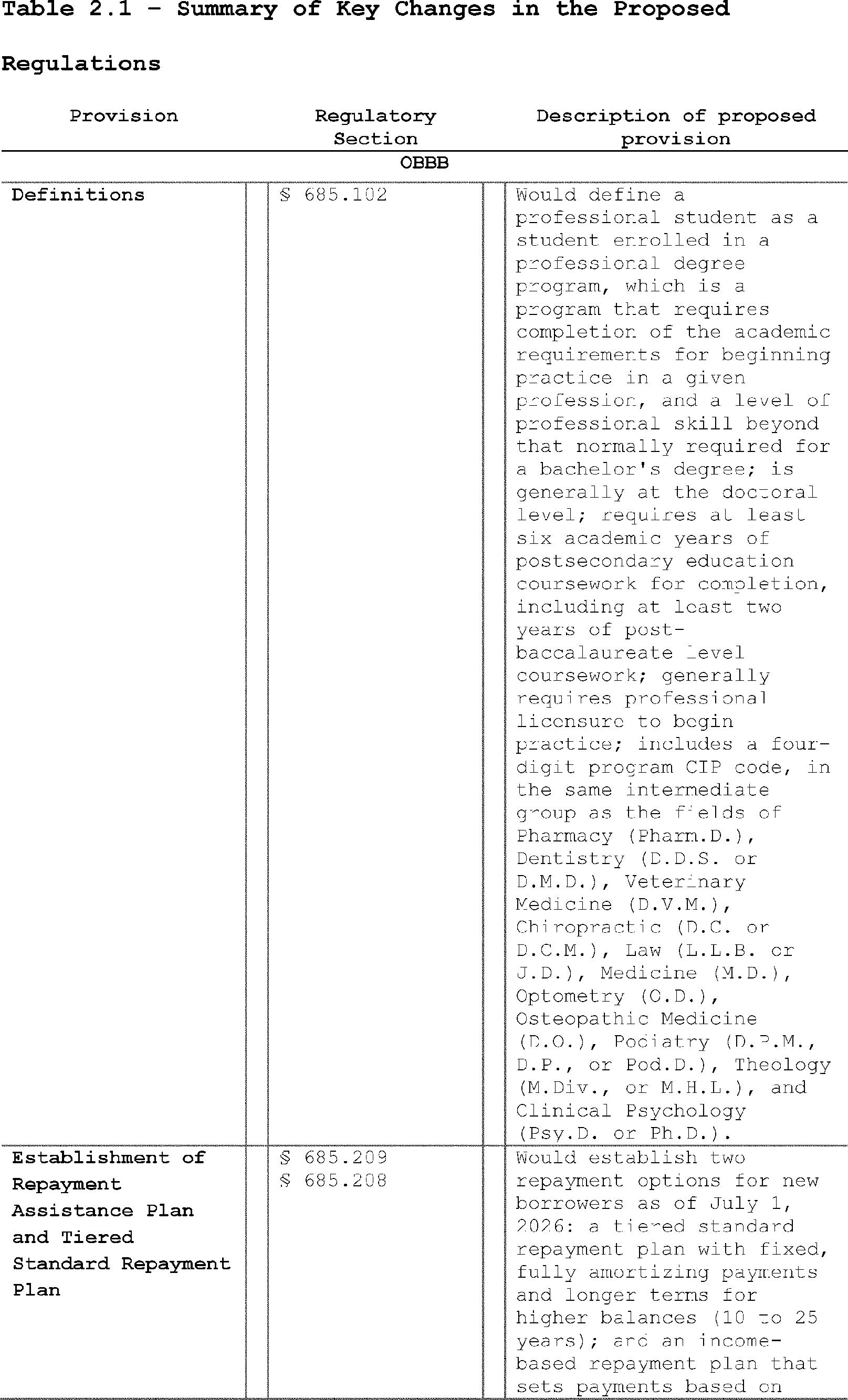
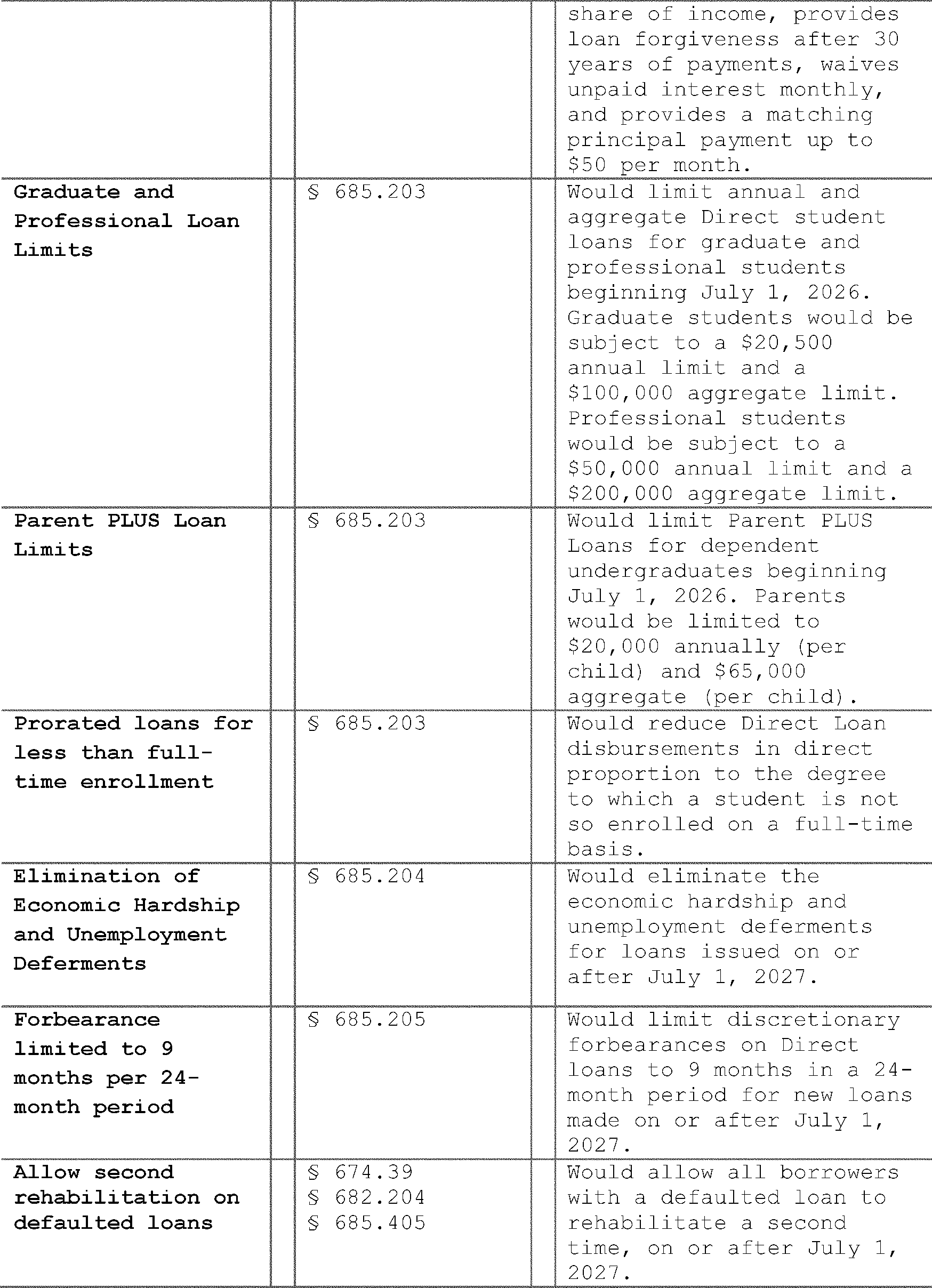
3. Discussion of Costs and Benefits
The proposed regulations change many provisions related to the terms and benefits available to borrowers in the Federal student loan program, resulting in both costs and benefits for students, borrowers, institutions, private companies, and taxpayers. Note that costs to one party which are completely offset by benefits to another party are classified as transfers, as required by OMB Circular A-4.
The provisions in the OBBB that produce significant costs or benefits include new annual and aggregate loan limits for graduate and professional students, as well as parents who borrow under the Parent PLUS Program. Under the policy preceding the OBBB, loans to these borrowers were available up to the full cost of attendance with no aggregate limit. The OBBB also reduces the ( printed page 4296) amount of loans students may receive when they enroll less than full-time. Prior policy made no distinction between full-time and less than full-time attendance with respect to loan eligibility; students attending on at least a half-time basis could receive the same loan disbursement as if they were attending full-time.[31]
The OBBB also replaces all prior IDR plans in the Federal student loan program for new borrowers and loans with a new plan, the Repayment Assistance Plan. Features of the Repayment Assistance Plan will result in costs for some borrowers but benefits for others. The OBBB also reduces forbearance and deferment benefits for borrowers in the Federal student loan program but allows borrowers to receive additional loan rehabilitation benefits.
Costs of the Proposed Regulations
The proposed regulations would impose costs on students, institutions, the Department, and private companies.
A major source of costs for both institutions and borrowers is the reduction in student loans disbursements that will occur as a result of the policy changes enacted by the OBBB. Between 2026-2035, the Department estimates that the proposed regulations will result in 9.9 million fewer non-consolidated student loans issued, and a total reduction in non-consolidated Federal student loan disbursements by $223.9 billion (Table 3.1). This decline is driven by the reduction in loan disbursements in Graduate Stafford and Graduate PLUS Loans ($171 billion) and Parent PLUS Loans ($49 billion). As shown in Table 3.1 the reduction in non-consolidated loans also decreases future consolidation loan volume, which does contribute to the net budget impact of the changes.
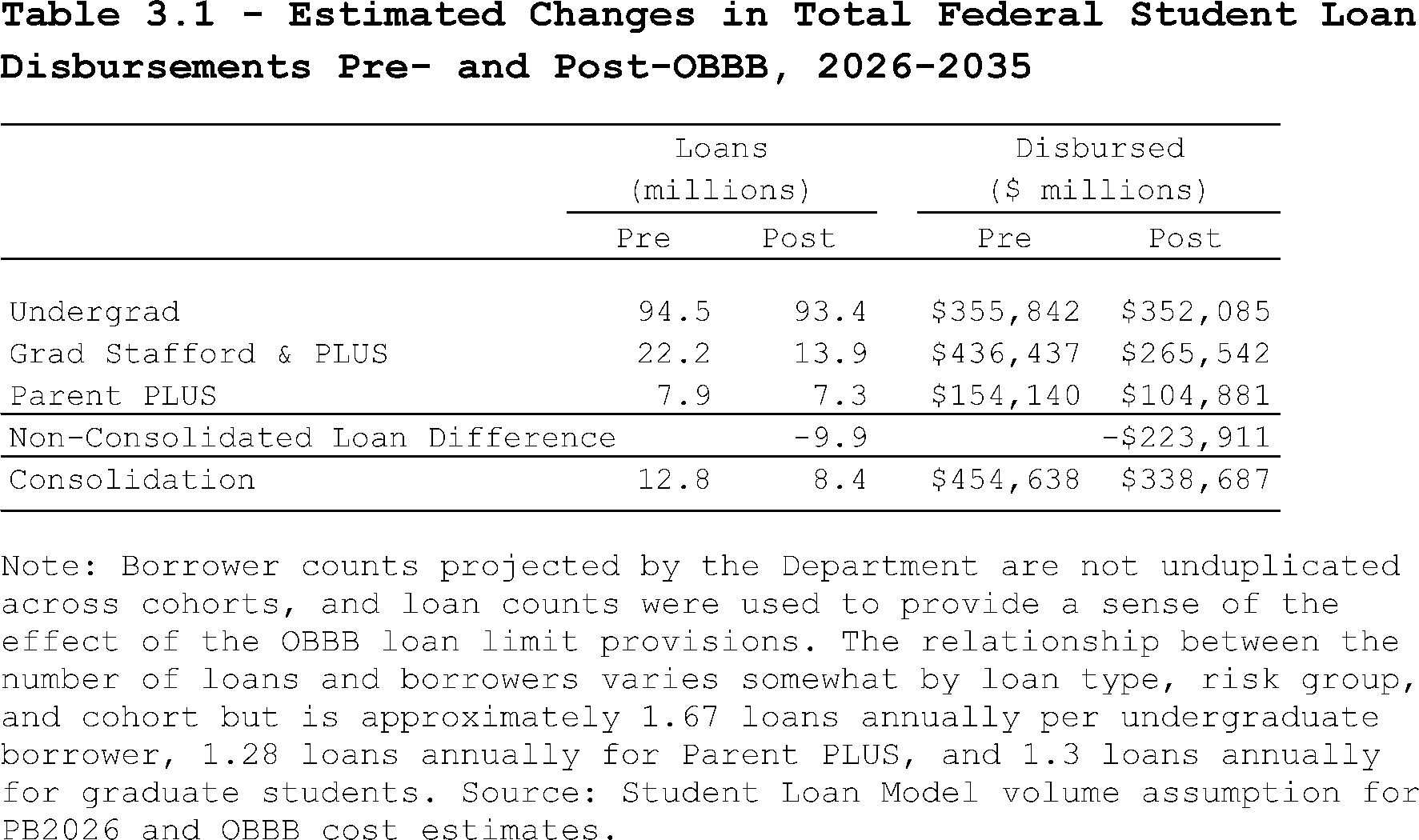
The reduction in loan volume is due to several policy changes imposed by the OBBB. First, prior to the OBBB, graduate students and parents of dependent undergraduates were able to borrow up to an institution's full cost of attendance annually and with no aggregate limit. Beginning July 1, 2026, the OBBB imposes annual and aggregate limits on these loans. Annual limits for graduate students, professional students, and parents are $20,500, $50,000, and $20,000, respectively. The aggregate limits are $100,000, $200,000, and $65,000 (per dependent student of the parent), respectively. The new loan limits do not apply to borrowers who are currently enrolled in higher education programs who had received Federal loans made prior to July 1, 2026. In other words, the new limits apply only to new borrowers on or after July 1, 2026.
Second, a reduction in loan volume will occur due to the proration of loans for students enrolled less than full-time. Beginning July 1, 2026, the OBBB imposes new loan limits for students enrolled less than full-time. Specifically, a student will only be able to borrow up to a prorated annual limit based on the individual borrower's enrollment status. Prior to the OBBB, undergraduate and graduate students could borrow up to the full annual loan limit, as long as they were enrolled at least half-time.
Table 3.2 describes the number of borrowers and loan volume that could be affected by the proration provision using Department data from FY 2025. Of the $92.7 billion in nonconsolidation Federal student loans disbursed in FY 2025, $84 billion was disbursed to full-time students. The remaining disbursements ($8.7 billion) were to students enrolled less than full-time and would therefore be subject to the prorated annual loan limit beginning July 1, 2026.
( printed page 4297)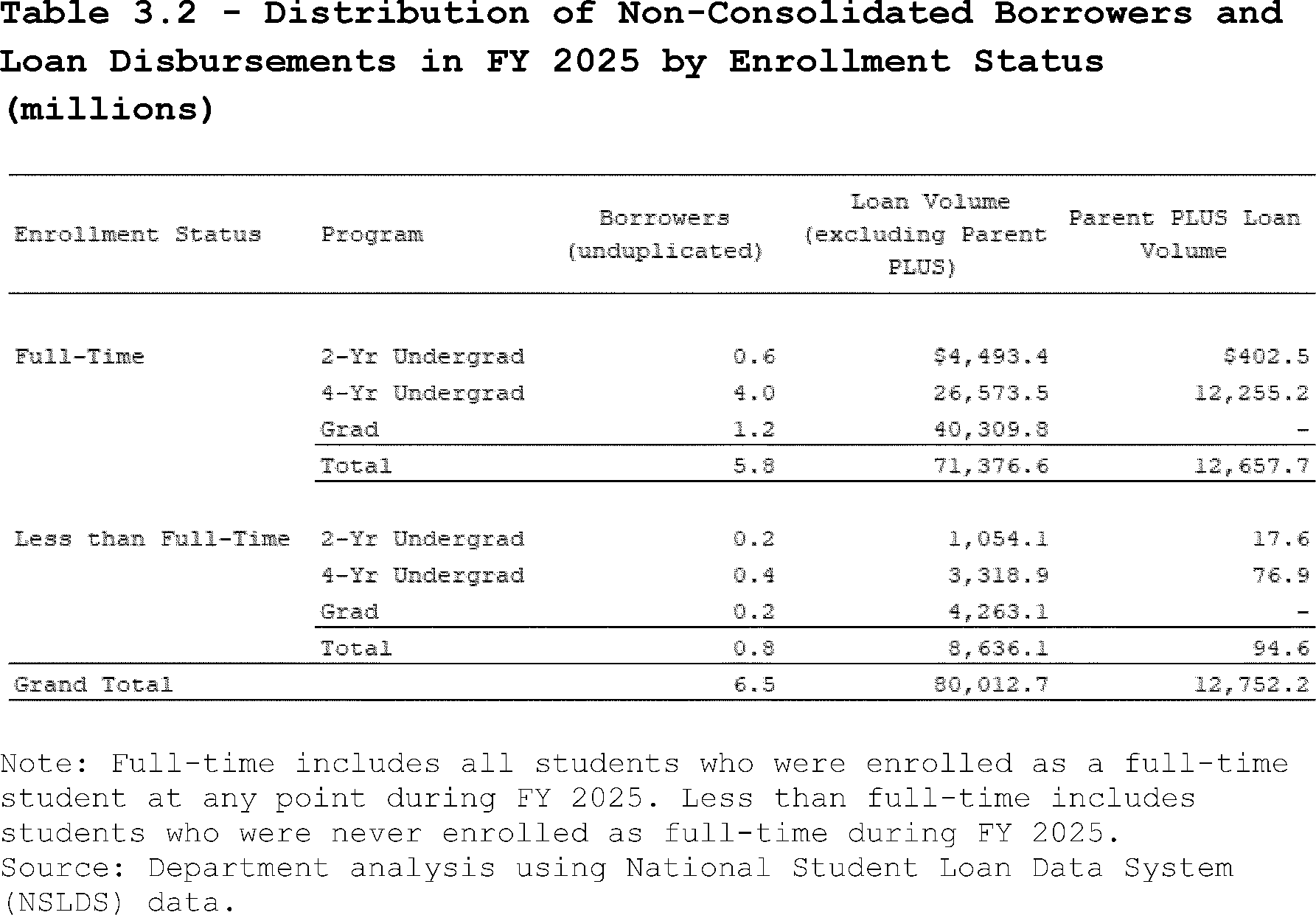
These loan limits will create several new costs for borrowers relative to pre-OBBB policy. First, borrowers may have to reduce their enrollment due to the inability to afford the cost of their program. This could delay the time it takes students to finish their program. Second, students may need to seek other forms of financing to maintain their enrollment, such as by pursuing employment while enrolled or taking out private loans. Private loans may have less favorable terms than Federal student loans, meaning some students and parents who utilize these financing options could face higher interest rates and fees. Third, some students and parents may not be able to secure non-Federal loans to replace the borrowing capacity lost under the OBBB, whether that be because non-Federal lenders deem the programs and institutions the students attend to be financially risky, or because the borrowers do not have adequate credit histories or cannot obtain a co-signer. Some of these borrowers may have to drop out of their program due to their inability to afford their program through alternative means. These effects will require some affected borrowers to reconsider their enrollment and financing decisions. These, in turn, may have further effects, such as on timing of on when individuals enter the labor force and their career choices.
The changes to Federal student loan limits create indirect costs for institutions. Institutions of higher education will receive less loan revenue from the Federal government if those loans are used to cover education expenses paid directly to the institution, such as tuition and fees. While that revenue may be replaced by students securing other sources of financing or using more of their own funds to pay for postsecondary education, some of it may not be replaced. This will cause a loss of revenue for institutions. These institutions are likely to incur costs determining their best response to these changes, which may include reducing tuition prices or restructuring their programs. Table 3.3 shows that loan disbursements to institutions will differ across sector and may be largest for institutions that enroll large shares of graduate students.
( printed page 4298)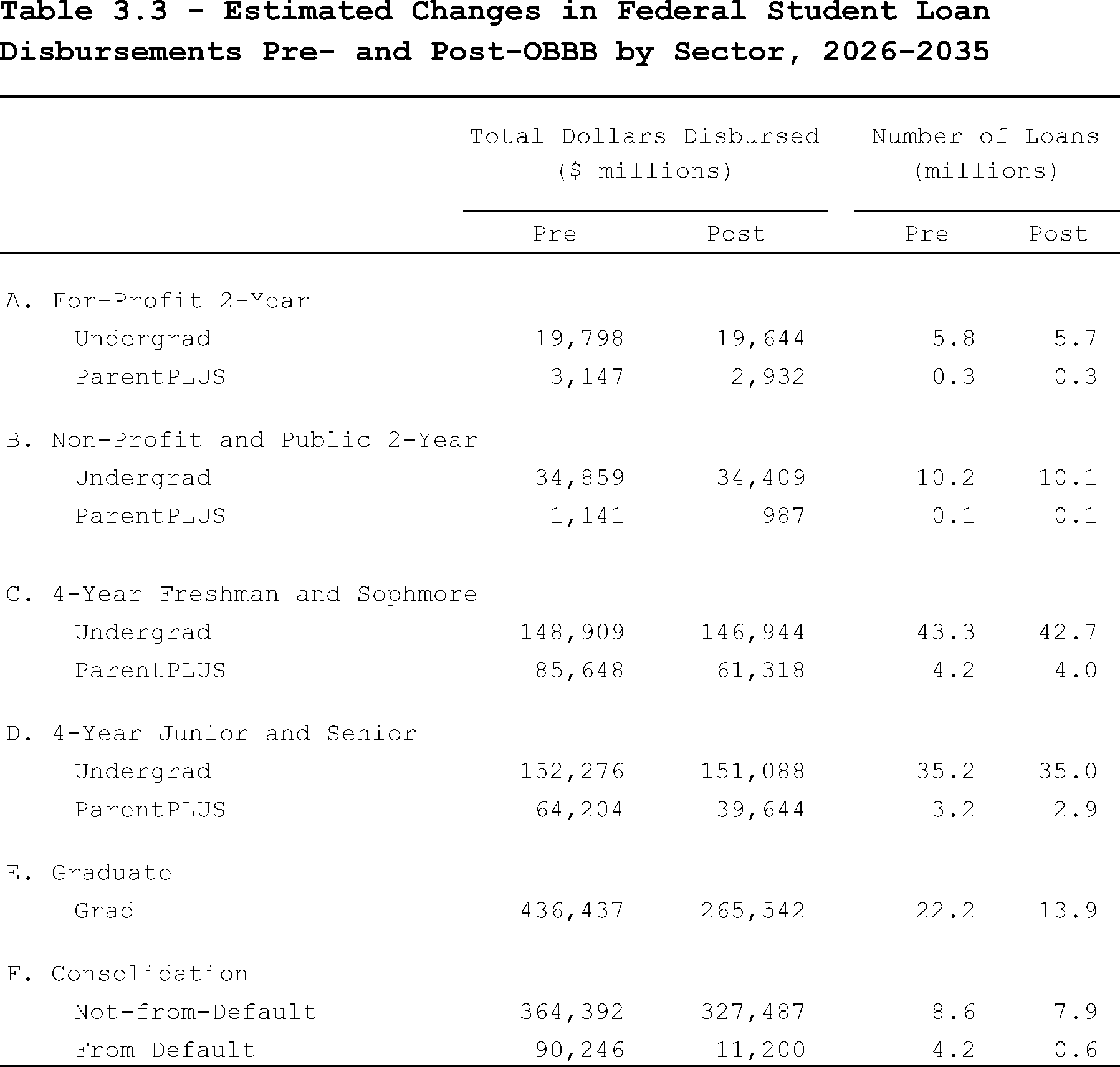
Beyond the costs associated with changes to Federal student loan limits, another source of costs to borrowers are through changes to student loan repayment plans. The OBBB creates a new student loan repayment plan, the Repayment Assistance Plan, which replaces all prior IDR plans beginning on July 1, 2026. The Repayment Assistance Plan will create new costs for borrowers relative to a pre-OBBB baseline. Borrowers' payments in the Repayment Assistance Plan are calculated on a sliding scale relative to their incomes, ranging from 1 percent for borrowers with $10,000 of annual income, to 10 percent for borrowers earning $100,000 or more. Although those terms will result in similar monthly payments for many borrowers compared with some prior IDR plans, monthly payments will be higher for all borrowers compared to repayment terms that were available under the SAVE plan.[32]
Some low-income borrowers will also face higher costs under the Repayment Assistance Plan compared to any prior IDR plan due to higher monthly payments. Unlike prior IDR plans, there is no exempted income under the Repayment Assistance Plan. This means monthly payments are calculated using the borrower's entire income. The Repayment Assistance Plan also includes a minimum payment amount, which requires borrowers earning less than $10,000 annually to pay $10 per month. Prior IDR plans allowed borrowers to make $0 payments if their incomes were below the level of exemption.
The Repayment Assistance Plan also reduces loan forgiveness benefits relative to prior IDR plans. Some of that loss in benefits is, however, offset by the Repayment Assistance Plan's interest subsidies and new principal payment matching discussed later in the RIA. The Repayment Assistance Plan provides loan forgiveness to borrowers who make a total of 360 on-time payments in the plan. Prior IDR plans generally provided loan forgiveness after 20 or 25 years of payments, although the SAVE plan would have provided loan forgiveness in as early as 10 years for undergraduate borrowers with lower balances.
A final repayment-related cost for borrowers results from changes to forbearance options. The OBBB reduces the time that a borrower may use a forbearance to 9 months in any 24-month period. Prior policy allowed ( printed page 4299) borrowers 12-month forbearances for up to three years. The OBBB also eliminates the economic hardship deferment and unemployment deferment as options for borrowers with new loans made on or after July 1, 2027. As with changes to loan limits, changes to repayment may affect enrollment, financing, and labor market decisions for affected borrowers.
The proposed regulations will also impose administrative costs on the Department to implement the changes to the Federal student loan program (Table 2.1). We estimate that, based on comparable changes made in the past, those administrative costs would average approximately $23.86 million (using a 3 percent discount rate, Table 4.4) in systems modifications, contract change requests, and staffing costs on an annual basis over the 2026-2035 period. The majority of these estimated costs, 62 percent, will be incurred during the first three years of implementation.
The Department will incur administrative costs as it works with the private companies that administer the Federal student loan program (loan servicers) to update their systems, training, and communications to implement and operate the two new repayment plans in the OBBB: the Repayment Assistance Plan and the Tiered Standard plan by July 1, 2026. The Department is also updating its systems for loan origination and repayment tracking to align them with the changes to loan limits and repayment plans. One of these systems, the Common Origination and Disbursement (COD) system, is designed to support origination, disbursement, and reporting for Direct Loan, Federal Pell Grant, and the Teacher Education Assistance for College and Higher Education (TEACH) Grant programs. The system uses a single “Common Record” (XML format) for efficiency and eliminating duplicate student and borrower data, providing a centralized system for title IV program administration used by the Department and all institutions across the country that participate in the delivery of Federal student aid. The other system that will be updated, the National Student Loan Data System (NSLDS), is the central database for all Federal student aid, tracking title IV loans and grants (like Pell Grants) through their entire lifecycle, from approval to repayment or closure. The system provides an integrated view for students, schools, and servicers to manage aid, loan status, balances, and enrollment. It consolidates data from schools, lenders, and programs, enabling users to access loan history, disbursement details, and servicer information via the FSA Partner Connect portal.
The COD system and NSLDS must be modified to reflect the terms of the new repayment plans (which include new features, such as matching principal payments), new annual and lifetime loan limits for graduate and professional students and Parent PLUS Loans, and elimination of Graduate PLUS Loans. For the COD system, these changes include updates to current fields and the collection of additional fields, such as modifications to grade level definitions. In addition, new system edits will be added to account for loan limit exceptions and other changes. For NSLDS, these changes reflect new reporting requirements for servicers and system changes to account for new aggregate loan limits and exceptions that must now be tracked to determine borrower eligibility. In addition, NSLDS will be updated to account for new pre-and-post screening processes related to aggregate loan limits and new academic levels that account for the different loan limits for graduate and professional students.
While most of the administrative costs the Department will incur implementing the OBBB occur in the first few years, the Department will incur long-term administrative costs maintaining the Department's COD, NSLDS, and other system changes in future years to account for ongoing development, operations, and maintenance. The Department does not estimate that it will incur a large increase in long-term administrative costs with respect to payments to loan servicers. The Department pays loan servicers based on monthly borrower counts and the Department does not expect the number of student loan borrowers to change significantly in the future due to changes in the OBBB. The Department will, however, incur additional costs to monitor data reported by loan servicers. The Department expects to incur additional administrative costs to train and support institutions of higher education that now must align their procedures and systems with the new loan disbursement policies in the OBBB.
Benefits of the Proposed Regulations:
The proposed regulations provide benefits to students, borrowers, and taxpayers. These benefits include potentially lower tuition costs for students, simplified repayment terms for student loan borrowers, and lower costs for taxpayers. Benefits to students and borrowers are discussed first, followed by the benefits to taxpayers.
The first benefit to students and borrowers stems from the new limits on Federal student loans for graduate and professional programs. Research finds that these loan limits could provide an incentive to institutions to limit tuition increases, benefitting current and future students.[33] Due to the pressure these loan limits may have on tuition, more students may be able to enroll in graduate school, persist to graduation, and incur lower costs.
A Federal Reserve Bank of Philadelphia Working Paper (2024) indicated that higher net prices are associated with higher student borrowing, and that this relationship is particularly evident at the graduate program level, where annual borrowing limits generally do not bind. The paper suggests that tuition inflation alone does not explain changes in borrowing. While the correlation does not establish causation, it may reflect bidirectional dynamics, including both higher prices driving greater student borrowing and expanded capacity for student borrowing.[34] The paper suggests factors beyond rising sticker prices may drive borrowing, with students sometimes choosing more expensive higher-quality programs or institutions with better amenities, leading to higher net costs and greater borrowing.
Similarly, the OBBB's limits on graduate loans will help reduce the number of degree programs that result in low earnings relative to the prices institutions charge. Prior research has found that approximately 43 percent of master's degrees and 23 percent of doctoral and professional degrees do not increase students' earnings enough to justify the costs of those programs.[35] Because private lenders' decisions to provide credit is in large part based on students' future ability to repay, some of these low-value programs are unlikely to attract private loans to fully replace lost Federal student loans and are therefore expected to shrink in both size and number.[36] Such an outcome will ( printed page 4300) increase earnings for individuals throughout the economy, as students shift towards programs that provide a stronger return on investment or choose not to enroll in postsecondary education and instead enter the labor force. In turn, such an outcome will reduce taxpayer subsidies for individuals who would otherwise use loans to finance these lower earning credentials.
Borrowers will also benefit through changes to repayment provisions. The first repayment-related benefit for borrowers is the new provision that allows borrowers who default on Federal student loans to rehabilitate a second time. Prior to the OBBB, borrowers were allowed to rehabilitate a defaulted loan only once. Under rehabilitation, a borrower makes a series of nine on-time payments that fulfill the rehabilitation agreement and return their loans to good standing, and the Department then requests that the credit reporting bureau remove the default from the borrower's record. A second rehabilitation will benefit borrowers by providing borrowers who re-default a pathway to return their loans to good standing and, in turn, increase their ability to purchase a home, automobile, or other items financed through consumer credit markets as result of the removal of the default from their record. This provision will also allow defaulted borrowers to avoid administrative wage garnishments, the Treasury Offset Program, and collection fees associated with defaulted loans.
The second repayment-related benefit for borrowers is through the new loan repayment terms provided under the Repayment Assistance Plan. These benefits stem from several provisions. First, relative to most existing IDR plans (such as IBR but not SAVE), some borrowers using the Repayment Assistance Plan will see a reduction in their calculated monthly payment. Table 3.4 shows that relative to IBR (for new borrowers as of 2014), monthly payments are lower under the Repayment Assistance Plan for borrowers with adjusted gross incomes between $30,000 and $70,000. For borrowers with an adjusted gross income lower than $30,000, monthly payments only differ marginally, by approximately $10 to $22 per month.
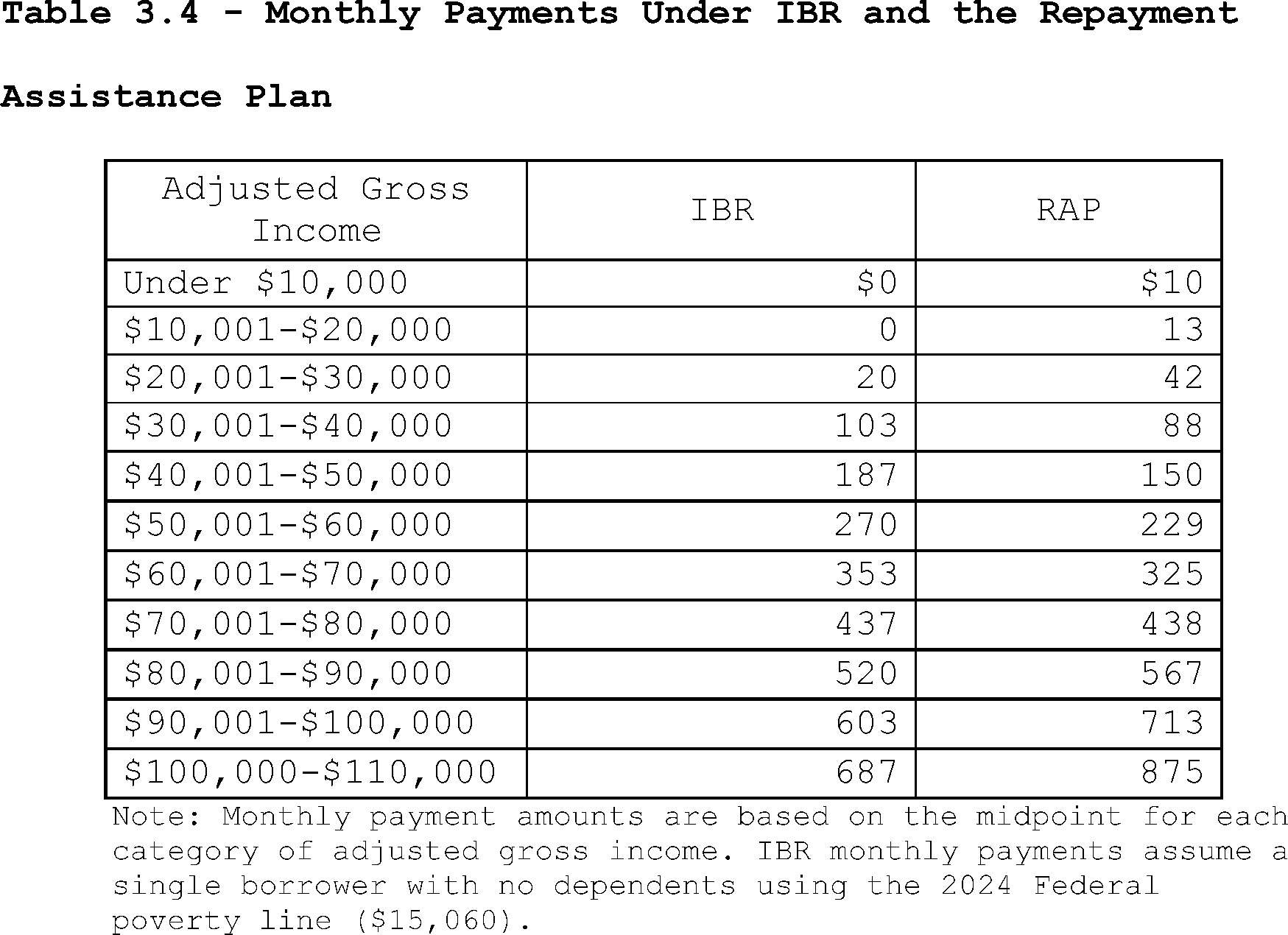
Second, some borrowers will receive new benefits under the Repayment Assistance Plan that have historically not been available on prior IDR plans. The Repayment Assistance Plan waives unpaid interest for borrowers with on-time payments that do not fully cover accruing interest. That benefit applies to all loan types at any point in repayment. Prior IDR plans generally did not waive all unpaid interest on all types of loans at any point in repayment (with the exception of the SAVE plan).
Third, the Repayment Assistance Plan includes a new principal subsidy for borrowers who are not reducing their principal balance. Under this plan, the Department matches borrowers' payments dollar-for-dollar, up to $50 in loan principal reduction each month. No prior IDR plan included a principal subsidy such as the one included in the Repayment Assistance Plan.
Together, these provisions prevent borrowers' loan balances from increasing while they repay under the Repayment Assistance Plan, and some of these policies would disproportionately benefit low-income borrowers. Unlike prior IDR plans, the loan balances of borrowers using the Repayment Assistance Plan will decline each month if they make an on-time payment, because their unpaid interest is first fully waived, and the Department then reduces their principal balance equal to the payments the borrower makes, up to $50.
To better understand these benefits, the Department simulated how future cohorts of borrowers would benefit ( printed page 4301) under the Repayment Assistance Plan relative to existing repayment plans. The Department used data from the College Scorecard and Integrated Postsecondary Education Data System (IPEDS) to create a synthetic cohort of borrowers. Using Census Bureau data, the Department projected earnings and employment, marriage, spousal debt, spousal earnings, and family size for each borrower up to age 60. Using these projections, payments under different loan repayment plans can be calculated for the full length of time between repayment entry, and full repayment or forgiveness.
( printed page 4302)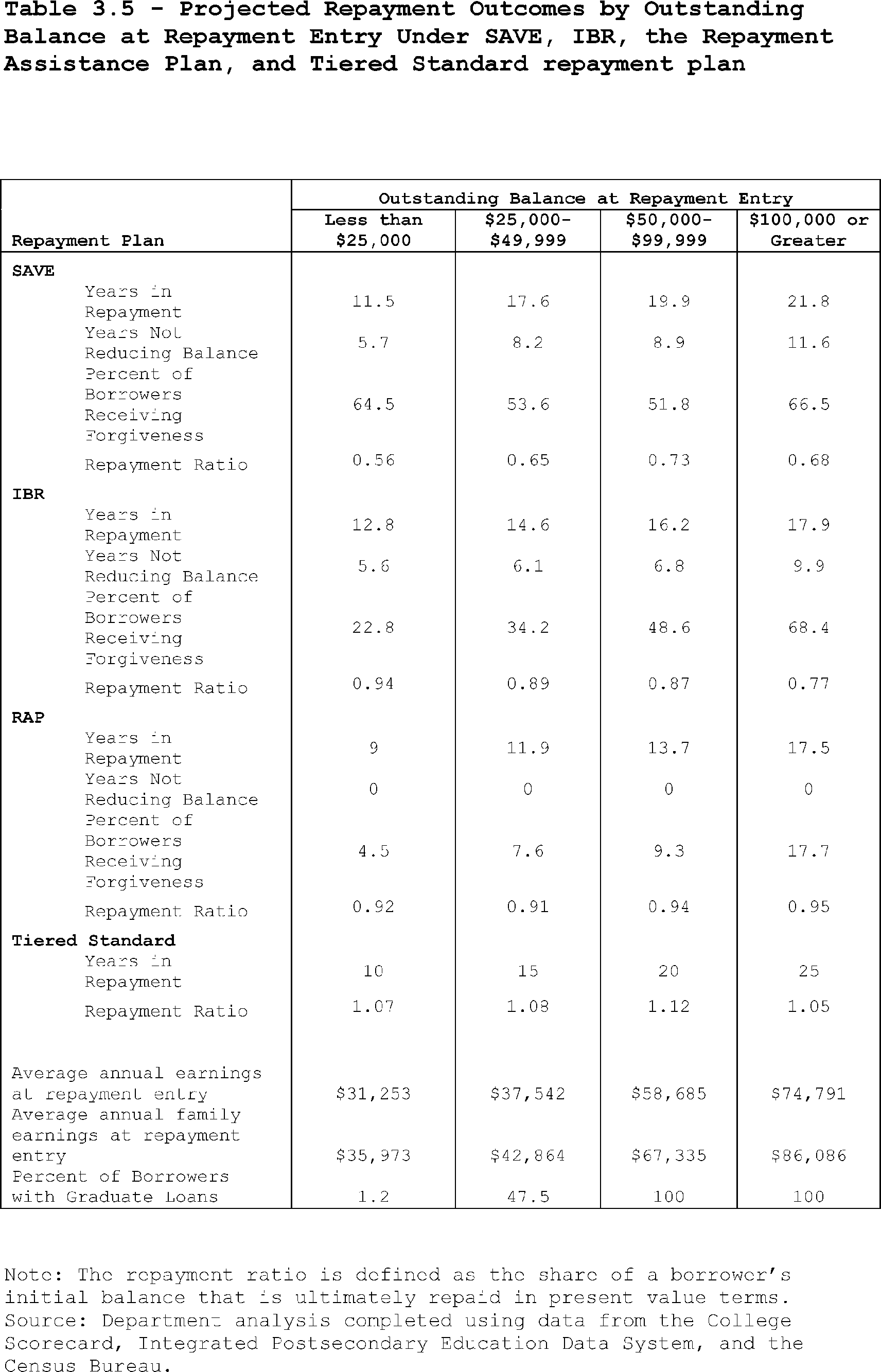
Using these simulations, Table 3.5 illustrates borrower repayment outcomes across different repayment plans. Under the Repayment Assistance Plan, borrowers spend fewer years both in repayment and where they are not reducing their loan balance, on average, relative to other types of income-driven repayment plans. Further, for borrowers with initial loan balances less than $50,000, borrowers will fully repay their loans faster under the Repayment Assistance Plan while paying a similar amount (in present value terms) than they would under IBR, as shown by the repayment ratio in able 3.5.
The changes in the OBBB also produce significant savings to taxpayers. These savings are summarized in Table 3.6 (note that interactive budget effects are not included in these estimates). The largest benefits to taxpayers—which are the focus of the following discussion—come from changes to student loan repayment plans. These changes are estimated to save taxpayers $121.8 billion in modifications to cohorts from 1994-2025, and another $246.5 billion in outlays between 2026-2035.
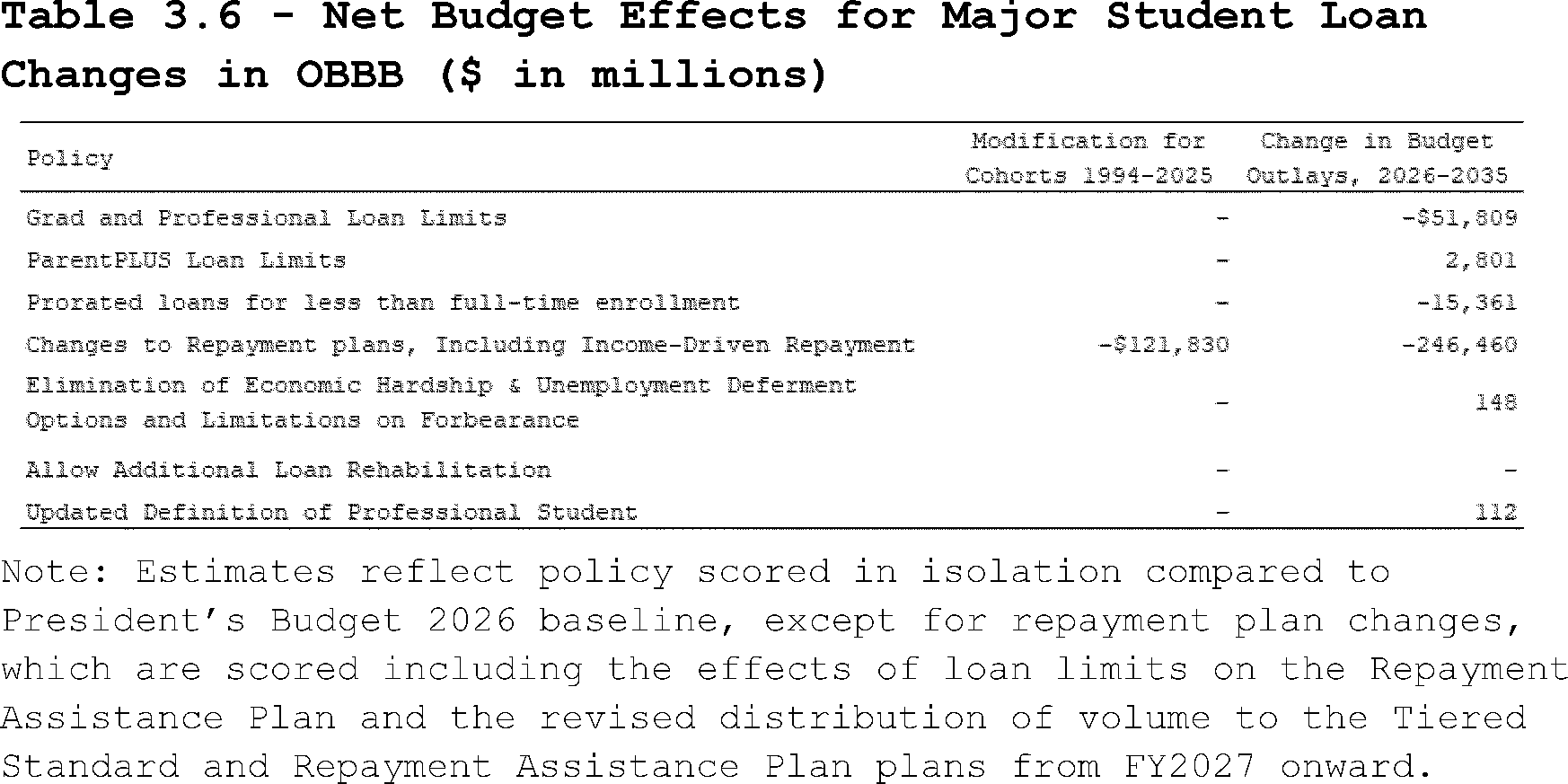
These changes to repayment plans benefit taxpayers for several reasons. First, the OBBB eliminates the SAVE plan, producing significant savings.[37] Eight million borrowers had enrolled in SAVE, and more than half (4.5 million) qualified for a $0 monthly payment.[38] These borrowers must now enroll in a different repayment plan and will begin making larger payments than under SAVE.
Second, under the Repayment Assistance Plan, larger proportions of loans will be repaid, saving taxpayers money. This is seen in the average repayment ratio (defined as the share of a borrower's initial balance that is ultimately repaid in present value terms) shown in Table 3.5. Under the Repayment Assistance Plan, the repayment ratio is consistently higher than other IDR plans. This is because the Repayment Assistance Plan requires borrowers to repay their loans for longer (30 years instead of 10 to 25 years under prior plans) before qualifying for loan forgiveness, because monthly payments are calculated using a borrower's full income, and because there is a minimum monthly payment requirement.
Third, the Repayment Assistance Plan also requires borrowers with higher incomes to make higher monthly payments than prior IDR plans, and the income brackets used to determine the monthly payment amount under the Repayment Assistance Plan are not indexed to inflation. Together, these changes will increase the amount borrowers are expected to repay in future years, reducing costs to taxpayers. Lastly, these features will discourage over-borrowing, as the terms of the Repayment Assistance Plan reduce the moral hazard associated with IDR relative to previous plans with shorter repayment periods and lower total payments.[39] Similarly, these features are likely to discourage institutions from offering programs that lead to low earnings relative to students' debts because borrowers will now bear more of their loan repayment costs. That in turn will benefit taxpayers and the broader economy by better aligning higher education costs with graduates' potential earnings. Due to the terms of the Repayment Assistance Plan, fewer borrowers are likely to use this new plan than would have repaid under prior IDR plans.
To better understand these benefits, the Department modeled the share of loan volume repaid through different repayment plans using the cohort of loans entering repayment in 2030. These estimates are shown in Table 3.7. Prior to the OBBB, the Department estimated that, for loans entering repayment in 2030, 59 percent of unsubsidized graduate loans and 67 percent of Graduate PLUS Loans were expected to be repaid through an IDR plan. After the OBBB, the Department now estimates that, for the same cohort, 47 percent of ( printed page 4304) unsubsidized graduate loans and 55 percent of Graduate PLUS Loans will be repaid through an IDR plan. The Department estimates that graduate borrowers will enroll in the standard repayment plan at higher rates (relative to pre-OBBB policy), reducing the amount of loan volume that could be forgiven.
( printed page 4305)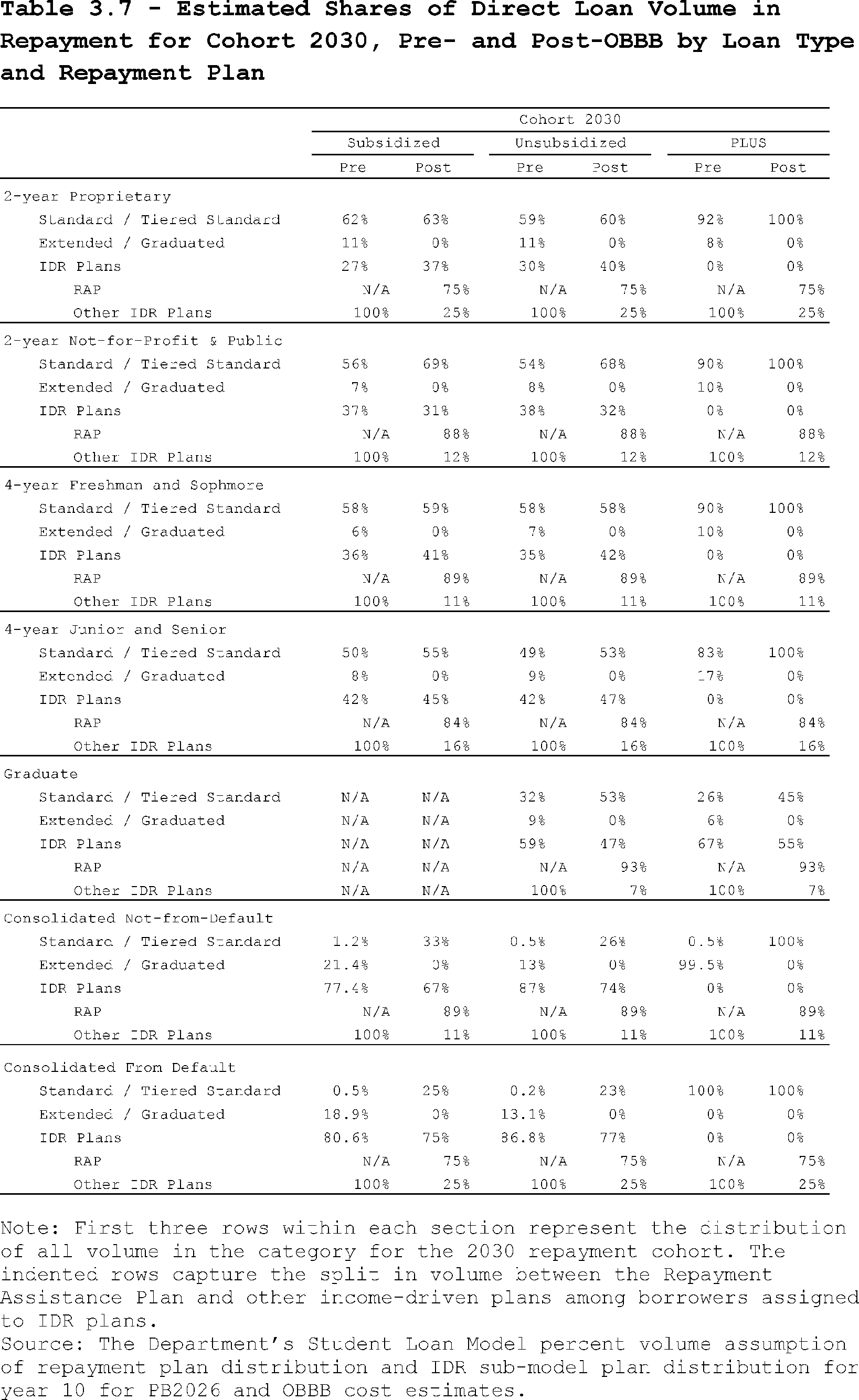
Table 4.1 provides an estimate of the net Federal budget impact of these proposed regulations that are summarized in Table 2.1 of this RIA. ( printed page 4306) This includes both the effects of a modification to existing loan cohorts and costs for loan cohorts from 2026 to 2035. A cohort reflects all loans originated in a given fiscal year. Consistent with the requirements of the Credit Reform Act of 1990, budget cost estimates for the Federal student loan programs reflect the estimated net present value of all future non-administrative Federal costs associated with a cohort of loans. The baseline for estimating the cost of these final regulations is the President's Budget for 2026 (PB2026) as modified for the effects of the OBBB and the PSLF final rule published on October 31, 2025. There was a modification executed in September 2025 to reflect the provisions of the OBBB as understood at that time, and without the PSLF regulation in that baseline. We will describe that score in this Net Budget Impact along with the score of discretionary changes made in the negotiations, primarily related to the definition of professional student for the application of higher loan limits. The Department expects to have an updated baseline for the President's Budget for FY 2027 before publication of the final rule and does expect some changes in the scores of the provisions against that new baseline.
( printed page 4307)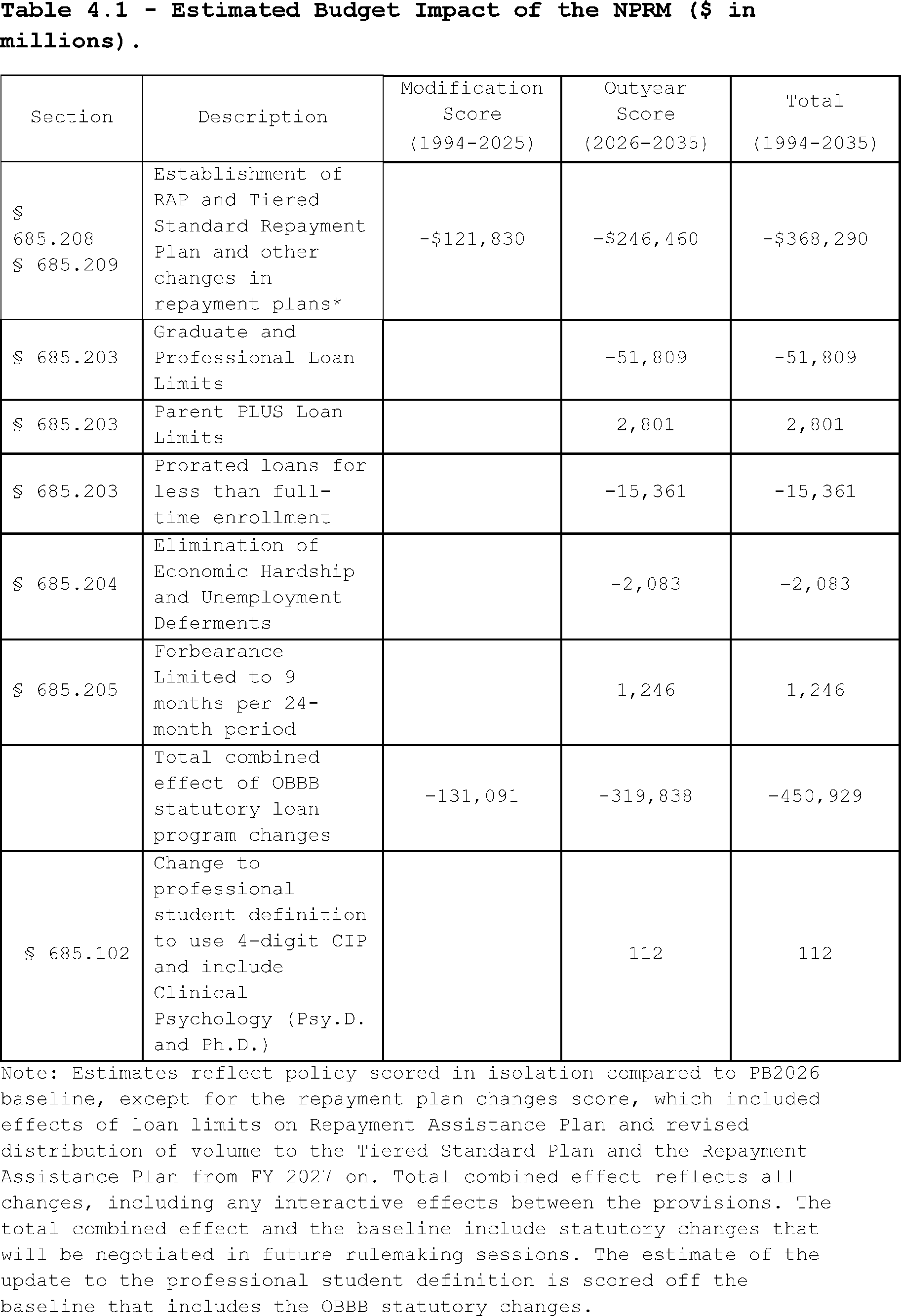
As noted, the proposed regulations implement several provisions of the OBBB including the introduction of the Repayment Assistance Program, the ( printed page 4308) Tiered Standard repayment plan, and associated eligibility provisions for borrowers with all loans disbursed before July 1, 2026, and those with loans disbursed on or after July 1, 2026; elimination of the availability of economic hardship and unemployment deferments for loans disbursed on or after July 1, 2027; discretionary forbearances limited to a period that does not exceed nine months within a 24-month period; annual and aggregate loan limits; the ability to undergo a second loan rehabilitation; definition of qualifying payments for the purposes of the PSLF program to include ICR plans only up to July 1, 2028 and the Repayment Assistance Plan, and certain deferments not counting towards PSLF fulfillment under the Repayment Assistance Plan; elimination of Graduate PLUS Loans with some grandfathering for existing borrowers; and other provisions as detailed and described in this NPRM.
Overall, these provisions have a net budget impact of −$319 billion between outyears 2026 and 2035, and of an additional $131 billion in modifications from 1994 to 2025 (Table 4.1). Several provisions reduce transfers from the Federal government to borrowers, such as the modifications to repayment plans, the new loan limits for graduate and professional students, and the proration for less than full-time students. Other provisions increase transfers from the Federal government to borrowers, such as the new loan limits for parent borrowers on behalf of dependent undergraduate students and the modifications to forbearance options.
As noted in the Methodology for Budget Impact section of this RIA, the score for this proposed regulation involved multiple assumptions in the Department's student loan modeling, and there can be significant interaction among the provisions such as loan limits affecting the score of the repayment plan changes. The one additional item that has a budget impact relative to the original score of the provisions related to student loans in the OBBB is the definition of a professional student. The original estimate was based on a definition that specified 6-digit CIP codes; the proposed definition is slightly broader and would use 4-digit CIP codes with the inclusion of Clinical Psychology.
Methodology for Budget Impact: The Department estimated the net budget impact of the proposed provisions in this NPRM through changes to several assumptions involved in its student loan modeling, including predicted volumes, the percentage of volumes assigned to different repayment plans, deferments and forbearance, the IDR sub model which includes changes to PSLF, and updated calculations within the Student Loan Model (SLM) for the Tiered Standard repayment plan. The possibility of a second rehabilitation was evaluated by adding second rehabilitation activities into the collection assumption. The assumed population for the second rehabilitation included borrowers who have previously rehabilitated their loans and subsequently consolidated them. We used the payment data from the first rehabilitation to model potential second rehabilitation activity, which resulted in a 0.035 percent increase in all payments. This did not affect the subsidy rates for loans at the 2-digit decimal place for scoring a budget impact and is therefore not specified in Table 4.1. Specific changes related to key provisions are described in this section.
Loan Volumes: All estimates in the Department's student loan modeling are driven off a set of actual (for existing cohorts) and projected loan volumes. The proposed regulations implement several significant changes to projected loan volumes, especially the changes to annual and aggregate loan limits and the elimination of Graduate PLUS Loans. Within the loan volumes assumption, we ensured that Parent PLUS borrowers with loans starting on or after July 1, 2026, do not exceed the $20,000 annual limit per dependent student and the $65,000 aggregate limit. Field of study and enrollment data is not available within our loan assumption model, therefore a scenario for both the graduate loans limits of $20,500 annually and $100,000 aggregate and the professional loan limits of $50,000 annually and $200,000 aggregate were created and combined at the point of aggregation, using factors based on school-certified enrollment data from the National Student Loan Data System (NSLDS). Similarly, enrollment data from NSLDS was used to determine the percentage of all volume that would exceed half-time limits for affected borrowers. This percentage was used to decrease aggregated volumes.
Repayment Plan Assignment: Another significant factor in estimating the impact of the provisions implemented in the proposed regulations is the percent of volume assigned to the various repayment plans. This is done through the one assumption that assigns volume in the SLM to the standard, extended, graduated, and all IDR plans. Distribution among IDR plans is done in the IDR sub model and is detailed in the description of the methodology for those provisions. For borrowers with loans made on or after July 1, 2026, affected by the OBBB, the assumption was changed to assign loan volume to the Tiered Standard repayment plan or the IDR category which would be the Repayment Assistance Plan for those borrowers. The Department did not have specific data to estimate whether loan volume in the graduated and extended plans in the baseline would move to the Repayment Assistance Plan or the Tiered Standard repayment plan. For example, we do not have income information for borrowers in repayment on all non-IDR plans to assess if they might be better off in the Repayment Assistance Plan or the Tiered Standard repayment plan. For the OBBB modification score presented in Table 4.1, the assumption was that borrowers would evenly split between the two remaining repayment plan options.
This is an assumption we expect to update for the estimate of the final rule, likely assuming those in extended repayment would choose the Tiered Standard repayment plan as the structure is fairly similar. Those previously assumed to be in graduated repayment will be divided between the two options, likely with more going to Tiered Standard repayment plan than the Repayment Assistance Plan. The Department welcomes comments on the assumed distribution between the two repayment plans available for those with loans disbursed on or after July 1, 2026.
The Repayment Assistance Plan and changes to Income-Driven Repayment Plans: The introduction of the Repayment Assistance Plan and the changes to the availability or terms of existing repayment plans are estimated through changes to the IDR sub model. This is the same process used to estimate previous changes to IDR plans including, most recently, the SAVE plan that remains in the baseline for the OBBB estimate. The negative net budget impact of the changes to the income-driven repayment plans comes from the difference in expected payments under the baseline distribution of income-driven plans and the options available following implementation of the OBBB provisions.
For borrowers in the IDR sub model with loan originations on or after July 1, 2026, payments are calculated based on the terms of the Repayment Assistance Plan. Key provisions that affect the change in payments include the 1 percent of income per $10,000 in AGI payment calculation, non-accrual of interest when monthly payments are made, thirty years of payments timeline to forgiveness, principal reduction up to $50 monthly, $50 reductions in ( printed page 4309) payments per dependent, and changes in the treatment of deferments and forbearances. Loan limit provisions also affect these borrowers and reduce the balances for some borrowers, which potentially reduced their flow of payments compared to the baseline. The combination of the changes results in a much higher percentage of borrowers paying off their balances than receiving forgiveness compared to the baseline. In the President's Budget for FY 2026 that includes the SAVE plan, we estimated that approximately 5.5 percent of borrowers entering repayment in FY 2026 would pay their loans in full. Those entering repayment in FY 2026 are likely to have income-based option besides Repayment Assistance Plan, but the paid-in-full percentage for that cohort increases to 6.2 percent even with a choice of plan. For borrowers entering repayment in FY 2030, who are much more likely to have the Repayment Assistance Plan as their only income-driven repayment option, that percentage increases to 44.5 percent.
As noted previously, one change made during the RISE negotiated rulemaking that affected the definition of professional student was the expansion to define programs for that purpose at the 4-digit CIP level and to include Clinical Psychology. This expanded the professional student category from the interpretation used for the Department's initial score of the OBBB legislation that assumed a 6-digit CIP code definition without Clinical Psychology. The Department evaluated borrowers who had entered repayment in 2021 to 2024 in the designated CIP codes by credential level and total loan amount upon entering repayment to generate a percentage in those categories considered professional. The IDR sub model does not have program level information, so the percentage across all the CIP codes is applied by the debt ranges (up to $100k, $101-$150k, $151-$175k, $176-$200k, more than $200k) to randomly assign graduate borrowers in the IDR sub model to professional or graduate status for the application of loan limits. The $112 million estimate for the budget impact of the professional/graduate definition in Table 4.1 reflects the change from the 6-digit CIP to 4-digit CIP with Clinical Psychology. The change in percentages applied is shown in Table 4.2.
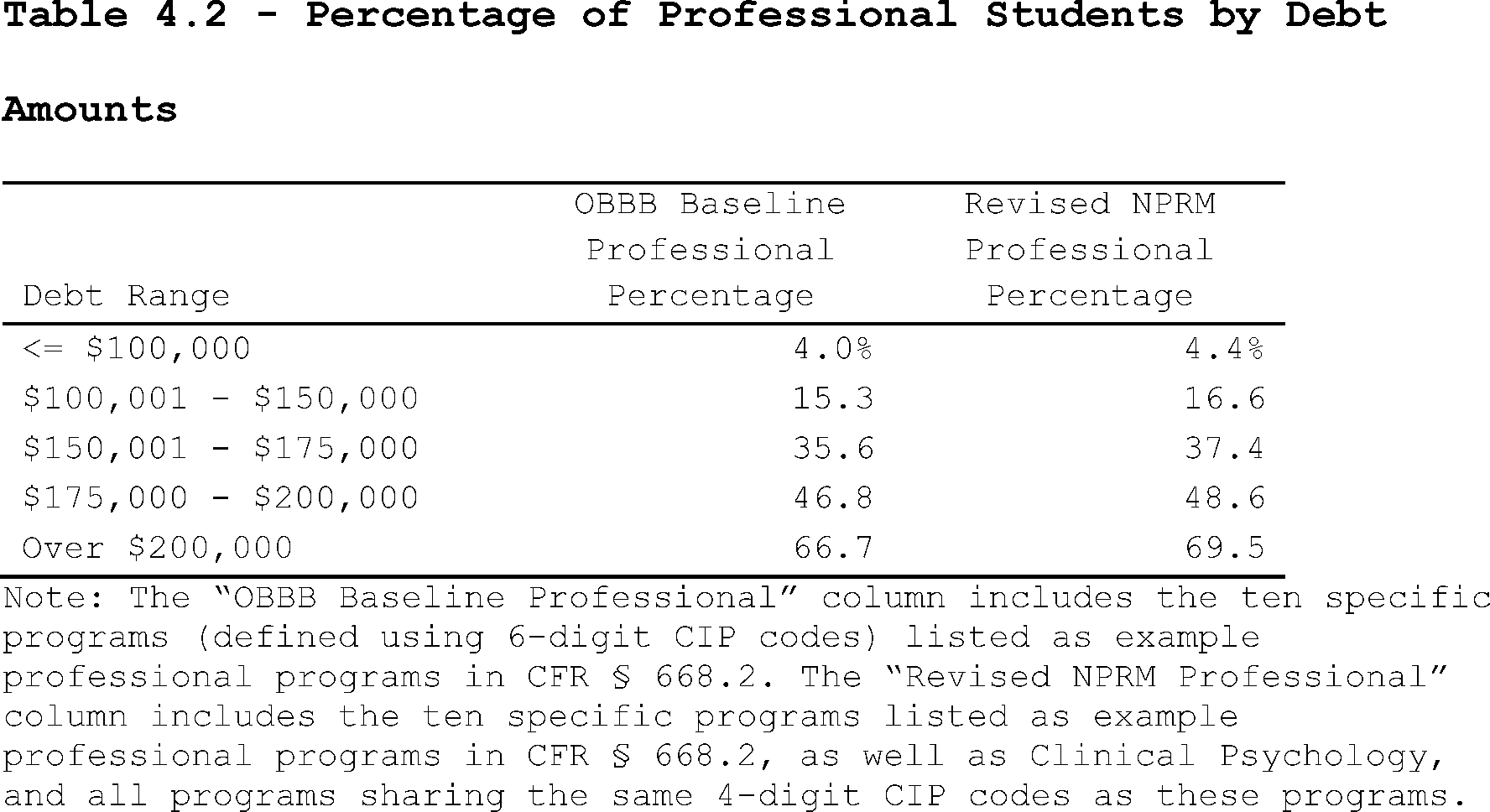
Along with the new provisions related to the Repayment Assistance Plan, the OBBB affected existing income-driven repayment plan availability. Borrowers who did not meet the statutory requirements for 10-percent IBR by being a new borrower as of July 1, 2014, will have the option of 15-percent IBR and 25 years to repayment. These changes also increase payments and the percentage of borrowers who fully pay off their loans in the model compared to the baseline.
The IDR sub model has the features of the existing plans built in, so the major updates for these estimates were to include the Repayment Assistance Plan as an option and to assign borrowers to the plans available to them. Incorporating the features of the Repayment Assistance Plan was straightforward and involved bringing the Repayment Assistance Plan features coded in the part of the model handling those required to be in the Repayment Assistance Plan into the program for those with a choice.
For the choice of IBR or the Repayment Assistance Plan, we adapted the process we have used in recent cycles to make the choice of plan. While under the baseline, the choice of plan is determined by the net present value of payments over the life of the loan under the different plans, for the choice of the Repayment Assistance Plan versus IBR we compared payments for FY 2027 and beyond for the first three years of the Repayment Assistance Plan availability and the total payments made during the life of the loans. If both conditions were lower for the Repayment Assistance Plan, the borrower would choose to switch into that plan. We also assumed that borrowers eligible for 10 percent IBR would stay in that plan. With this approach, approximately 3 percent of borrowers with a choice selected the Repayment Assistance Plan. For the estimate of the OBBB statute that is reflected in Table 4.1, this choice was made up-front and did not change. This selection process is one area we may update for the final rule to better reflect that borrowers with the choice can move back and forth between IBR and the Repayment Assistance Plan. This selection process and the changes to the availability of existing plans were the significant contributors to the ( printed page 4310) modification score in the Repayment Assistance Plan row of Table 4.1.
Tiered Standard repayment plan: Estimates for the Tiered Standard repayment plan were scored through applying changes to the SLM calculations. The percent volume assumption was changed to include a new plan and to distribute loan volume entering repayment from FY 2027 on to the Tiered Standard repayment plan and the IBR plans, which would be assigned to the Repayment Assistance Plan in the IDR sub model. The lower and upper bounds for the maturity term table were adjusted. As the tiers are based on the amount of debt, we created a new distribution of volume to the breakouts shown in Table 4.3.
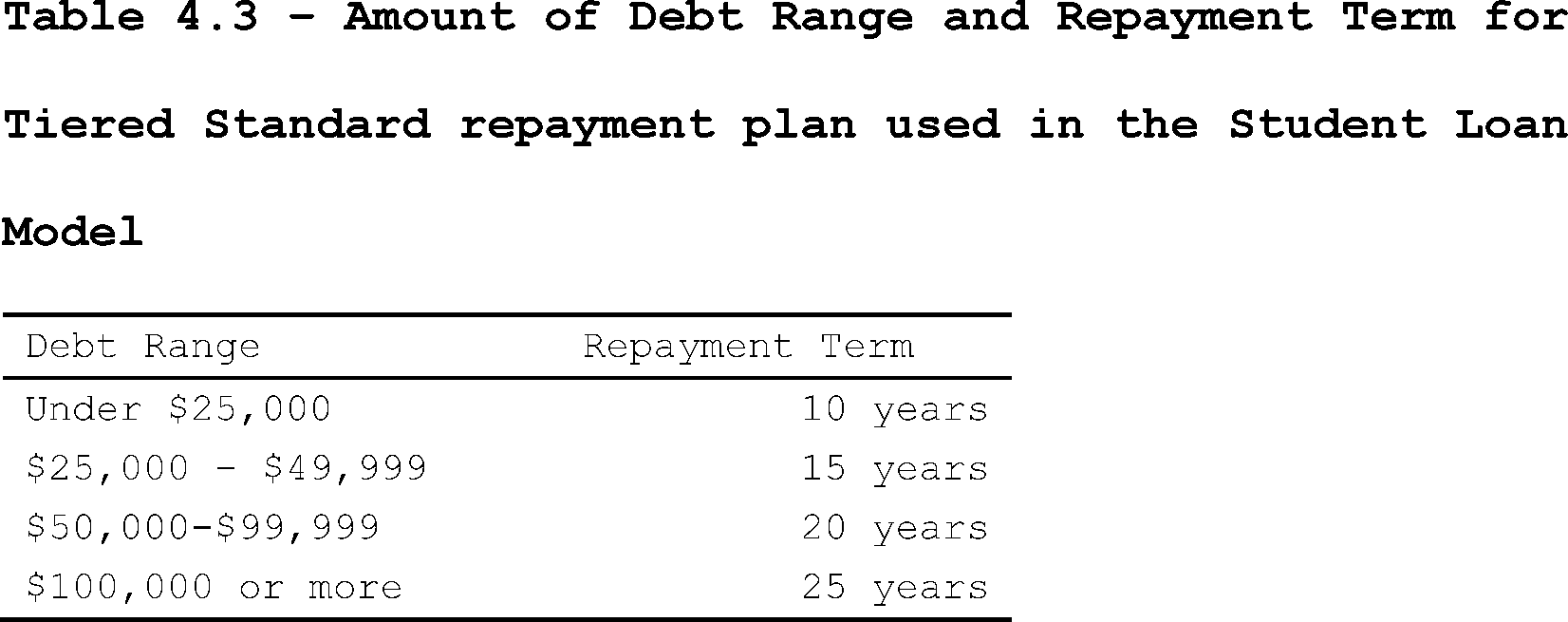
This changed the maturity term in the SLM and generated a different cashflow than that associated with the percentage of volume that was assigned to the standard, extended, or graduated repayment plans under the baseline, resulting in the downward cost estimate in Table 4.1.
Deferments and Forbearances: Deferments and forbearances outside of IDR plans are handled through an assumption that generates separate deferment and forbearance rates by program (Direct Loan or FFEL), population (non-consolidated, consolidated not-from-default, consolidated-from-default), loan type, budget risk group (Two-Year Public and Not-for-Profit, Two-Year Proprietary, Four-Year Freshmen and Sophomore, Four-Year Junior and Senior, and Graduate Student), and years between origination and entering repayment. NSLDS data from multiple files are combined to identify the timing and nature of all events affecting each loan. Deferments are identified either through the loan deferment table or based on a specific status from the loan status table. Similarly, forbearances are identified either through the loan forbearance table or based on a specific status from the loan status table. Rates are calculated as the balance in deferment and forbearance divided by the total principal loan amount outstanding at the start of each fiscal year. Beginning balances and average balances in deferment and forbearance in each year are then aggregated by population, program, loan type, risk group, and years in repayment. Deferment and forbearance rates past FY 2025 are forecasted using a logistic regression model. The response is the number of dollars in deferment/forbearance (successes) divided by the number of dollars outstanding (trials). Separate equations are estimated by population, program, and loan type.
To estimate the effect of the changes implemented by the proposed regulations, the Department removed the unemployment deferment factor from the regression models predicting outyear deferments. The effect of the removal of economic hardship deferments was calculated by calibrating the results from the adjusted regressions without unemployment deferments. This was done by multiplying those outyear deferment rates by 91.13 percent to reflect the removal of the estimated 8.87 percent of deferments categorized as an economic hardship.
The limitation on discretionary forbearances to no more than 9 months during any 24-month period was estimated by calibrating the forbearance rate. Discretionary forbearances represent about 19 percent of forbearances in the Department's data. The calibration factor was calculated as shown in the following expression:
0.81 * original forbearance + 0.19 * (original forbearance * 75 percent) = 0.81 * original forbearance + 0.1425 * original forbearance = 0.9524 * original forbearance.
The effects of these changes that reduce the deferment and forbearance outyear rates without any other OBBB changes are −2.1 billion and 1.2 billion, respectively.
Accounting Statement:
Consistent with OMB Circular A-4, we have prepared an accounting statement showing the classification of the expenditures associated with the provisions of these proposed regulations. Table 4.4 provides our best estimate of the changes in annualized effects that may result from these proposed regulations. Expenditures are classified as transfers from the Federal government to affected student loan borrowers.
( printed page 4311)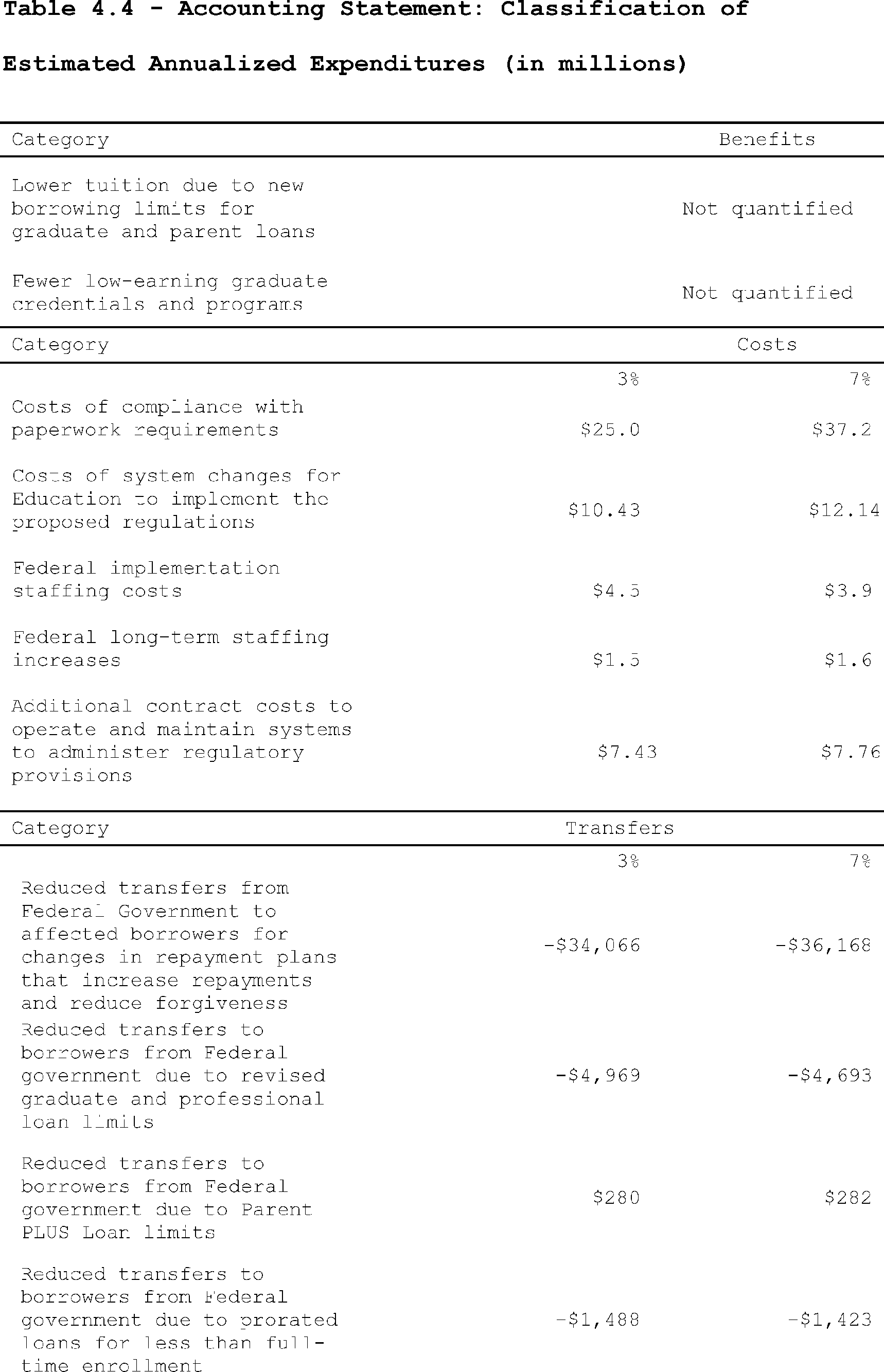
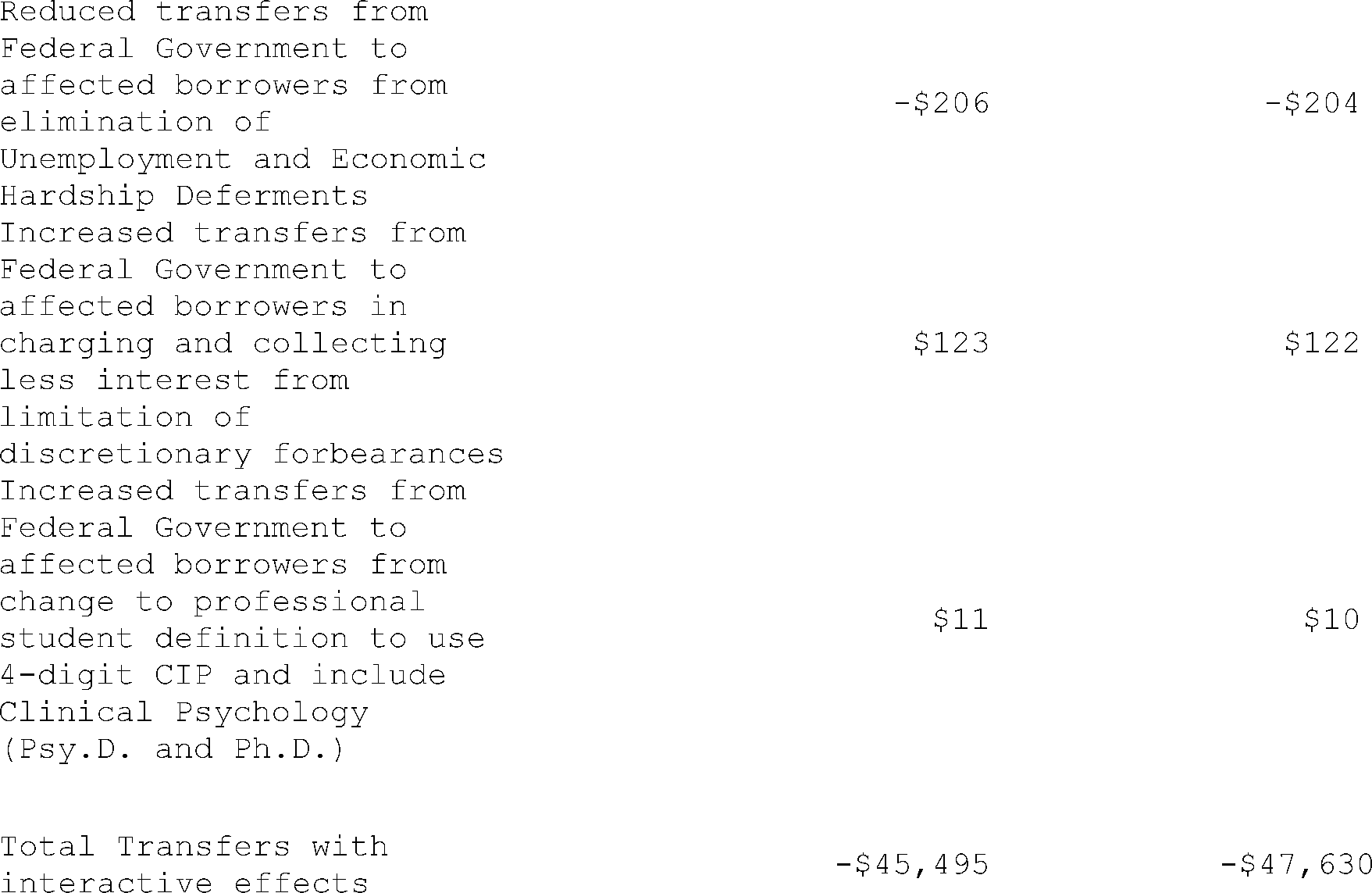
5. Alternatives Considered
As part of the development of these proposed regulations, the Department engaged in the negotiated rulemaking process in which we received comments and proposals from non-Federal negotiators representing numerous impacted constituencies. These included higher education institutions, State officials, legal assistance organizations, student loan servicers, student loan borrowers, and organizations representing taxpayer and public interests. Non-Federal negotiators submitted a variety of proposals relating to the issues under discussion. Information about these proposals is available on our negotiated rulemaking website at: https://www.ed.gov/laws-and-policy/higher-education-laws-and-policy/higher-education-policy/negotiated-rulemaking-for-higher-education-2025-2026.
Most of these proposed regulations implement statutory provisions of the OBBB where the Department does not have discretion. There are two areas under the OBBB where the Department exercised discretion and the alternatives the Department considered have significant impact:
(1) Whether payments in the Repayment Assistance Plan for married borrowers who each have student debt are calculated on each spouse's respective income or calculated on their combined income; and
(2) Defining a professional student, which allows certain degree programs to access higher annual and aggregate loan limits than a graduate program.
While there are other provisions of the OBBB where the Department also exercised more limited discretion in implementing the law, the alternatives considered in those cases do not result in significant impact. Therefore, our discussion of alternatives considered by the Department is limited to the two areas listed above.
Payments Under the Repayment Assistance Plan for Married Borrowers Filing Joint Tax Returns
Like prior IDR plans, the Repayment Assistance Plan requires the Department to calculate monthly payments for borrowers using their “adjusted gross income” for the most recent tax year as defined in Section 62 of the Internal Revenue Code of 1986, except that, in the case of a married borrower who files a separate Federal income tax return, the term does not include the adjusted gross income of the borrower's spouse. In cases where only one tax filer has a student loan in a married household that files a joint tax return, payments under the Repayment Assistance Plan are calculated on the household's combined adjusted gross income. The OBBB is, however, silent as to how payments in the Repayment Assistance Plan should be calculated when both filers have Federal student loans.
The Department considered two options for how payments under the Repayment Assistance Plan should be calculated for married individuals who each have Federal student loans. In one, the monthly payments would be calculated for each borrower based on the married filers' joint income. Under this approach, borrowers effectively owe double payments on their loans; each borrower has a payment calculated on the couples' combined income. The Repayment Assistance Plan's progressive payment calculation, that charges higher rates as income increases, creates an additional penalty because married borrowers would pay a higher share of their incomes when their incomes are combined. For example, consider a married couple where each individual has an adjusted gross income of $27,500 (or $55,000 combined) and each individual has $20,000 in student debt (or $40,000 combined). Under the terms of the Repayment Assistance Plan, each individual would have a $229 monthly payment (a combined monthly payment of $458). While these borrowers could file separate Federal income tax returns to address this issue, and each pay $46 per month ($92 combined), they could then face higher taxes as a result.
In the other approach, a total combined loan payment for the couple would be calculated based on the filers' joint income and then that payment ( printed page 4313) would be divided between each filer based on the share of the total Federal student loan balance each held. Put another way, a single payment is calculated off the combined income, and then it is prorated among the two borrowers based on the share of the combined Federal student loan balance. The couple in the example above with a $55,000 income would instead owe $229 per month on their combined Federal student loans, not $458. The Department adopted this proration approach in 2009 when implementing the Income-Based repayment plan and that policy has been in place since for all IDR plans.[40]
The Department proposes to maintain the proration approach for married borrowers who use the Repayment Assistance Plan. The Department believes that the alternative creates two penalties for borrowers: it first “double counts” married borrowers' income and then assesses them a higher payment threshold due to their higher incomes. This excessive marriage penalty undermines the intent of the Repayment Assistance Plan, which is to provide borrowers with an income-based repayment option to help make certain loans affordable. Although the Repayment Assistance Plan allows these borrowers to file separate income tax returns to reduce their payments, the Department believes that option can be burdensome and costly for tax filers and should be reserved for borrowers in extenuating circumstances, not the normal course of action for borrowers using the Repayment Assistance Plan. Given the large penalty in the monthly payments married borrowers would face if they filed a joint tax return while using Repayment Assistance Plan, the Department is concerned that many borrowers would be forced to file separate tax returns for the Repayment Assistance Plan to work as Congress intended. The Department's data on past IDR plan use shows that only 8 percent of married borrowers repaying in IDR file separate tax returns, suggesting that separate filing is uncommon.[41]
The Department's baseline budget estimates of the OBBB and the Repayment Assistance Plan assumed that the Department's longstanding policy to allow prorated payments would continue in the Repayment Assistance Plan. Therefore, the Department's proposal in this NPRM to maintain the proration policy would not increase budgetary costs relative to either the pre-statutory baseline or the current-law baseline.
Professional Student Loan Limits
The OBBB terminated the Graduate PLUS Loan program that allowed graduate and professional students to borrow up to the full cost of attendance, with no aggregate limit. In place of that policy, the OBBB establishes new annual and aggregate loan limits for Direct loans for students enrolled in graduate or professional degree programs. Graduate students may borrow $20,500 annually with an aggregate limit of $100,000. Professional students may borrow $50,000 annually with an aggregate limit of $200,000.
The OBBB defines a professional degree as those described under Section 668.2 of title 34, CFR effective July 4, 2025. That definition states that a professional degree, “signifies both completion of the academic requirements for beginning practice in a given profession and a level of professional skill beyond which is normally required for a bachelor's degree.” It states that professional licensure is also generally required. It then lists 10 specific fields of study that are included but notes that it is not limited to those.
The Department considered several options that would expand the list of professional degree programs beyond those listed in section 668.2, including one proposed by non-Federal negotiators. These options, including the Department's proposal, are discussed in the following sections and summarized in Table 5.1. We compare the impact of these options to a baseline option, which the Department also considered, where professional degree programs are defined as only the 10 examples listed in section 668.2.
( printed page 4314)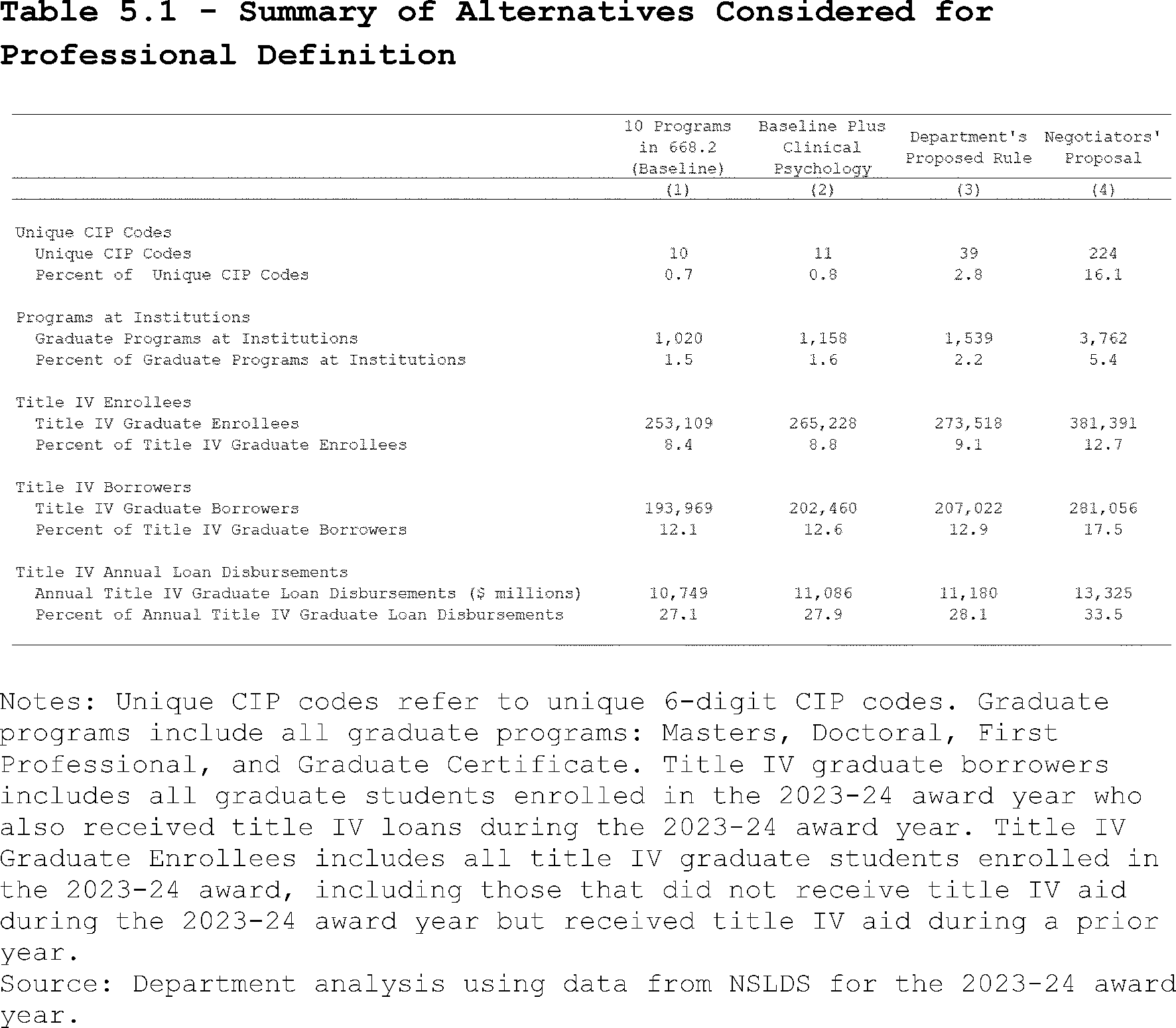
Under the baseline option, only programs from 10 unique 6-digit CIP codes would qualify for the $50,0000 annual and $200,000 aggregate loan limit: Pharmacy (Pharm.D.), Dentistry (D.D.S. or D.M.D.), Veterinary Medicine (D.V.M.), Chiropractic (DC or DCM.), Law (L.L.B. or J.D.), Medicine (M.D.), Optometry (O.D.), Osteopathic Medicine (D.O.), Podiatry (D.P.M., D.P.), and Theology (M.Div., or M.H.L.).[42] In this baseline case, all other graduate programs would be subject to the $20,500 annual and $100,000 aggregate limit.
Students enrolled in these programs represent 12.1 percent of Federal student loan borrowers in all graduate and professional programs, and 27.1 percent of all loan dollars disbursed to borrowers in these programs (Table 5.1).[43] Statistics on loan disbursements made to borrowers in these 10 programs during the 2023-24 award year are shown in Table 5.2. In aggregate, these programs received $10.7 billion in Federal student loan disbursements. Relative to pre-OBBB policy, between one-third and two-thirds of borrowers in these programs typically borrowed above $50,000 annually. Post-OBBB, future borrowers would not be able to borrow at these levels due to the new loan limits for professional students.
( printed page 4315)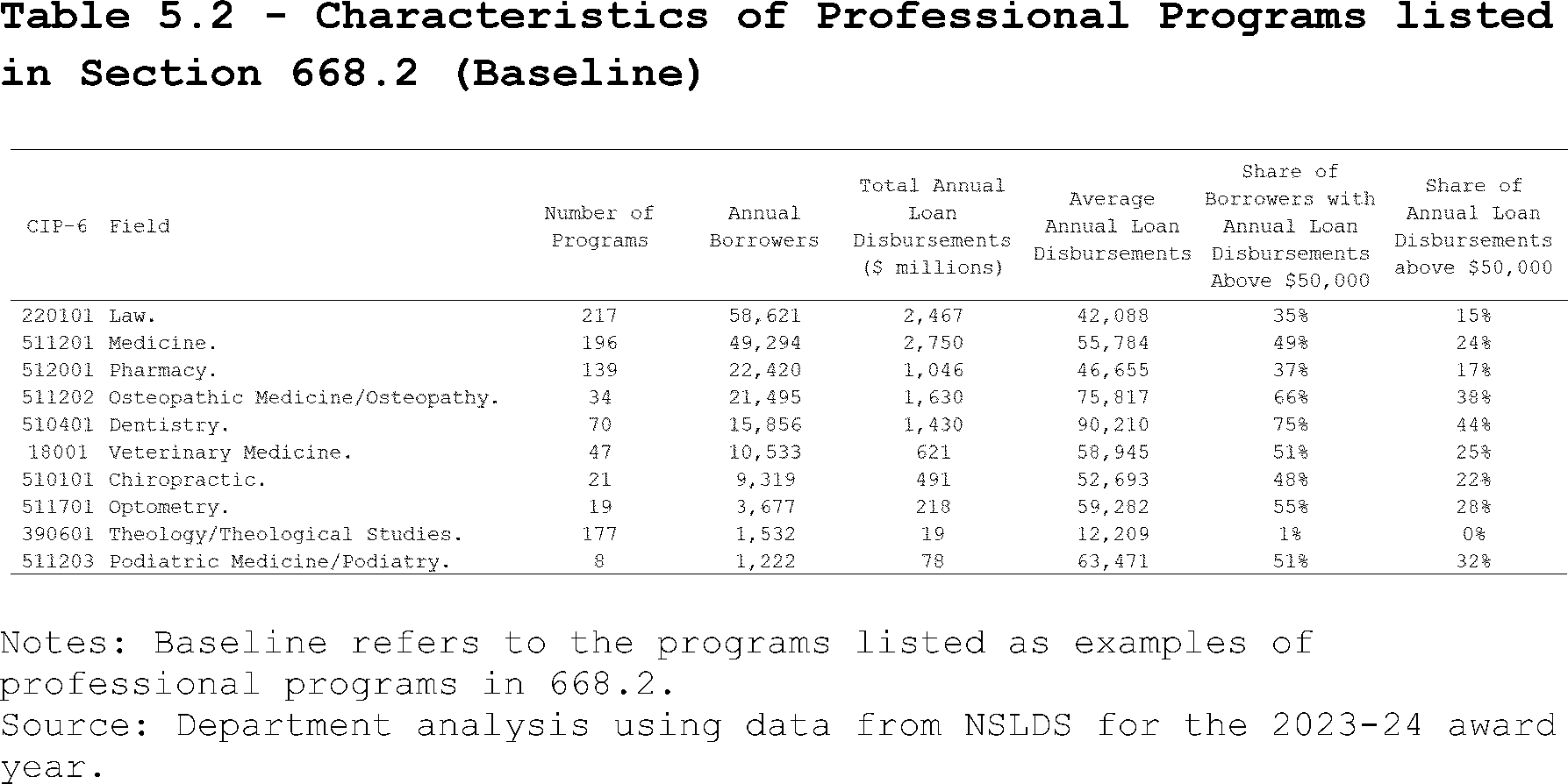
Department's Proposed Definition of a Professional Degree Program
The Department initially considered expanding the baseline list of 10 programs to include one additional program at the 6-digit CIP level: Clinical Psychology.[44] Under this option, 12.6 percent of graduate borrowers attend one of these 11 programs, or about 0.5 percentage points more than the baseline 10 programs listed in Section 668.2 (Table 5.1).
The Department ultimately opted to propose a broader definition to include all programs that are adjacent to the 10 programs listed in 668.2 at the 4-digit CIP code level and Clinical Psychology that also meet program length and licensure requirements for a professional degree. In total, programs within 38 unique 6-digit CIP codes meet this definition. The Department's proposed definition encompasses 12.9 percent of the Federal student loan borrowers in graduate programs, 0.8 percentage points more than the baseline 10 programs listed in Section 668.2.[45]
The characteristics of these programs that meet the Department's proposed definition are listed in the top panel of Table 5.3. In total, graduate students in these programs received $11.2 billion in Federal student loan disbursements during the 2023-24 award year. Across these programs, fewer than 15 percent of annual loan disbursements were in excess of $50,000, suggesting that the loan limit will have a binding effect on relatively few borrowers.
Negotiators' Proposed Professional Degree Definition
The Department considered a proposal from RISE Committee non-Federal negotiators that would define a professional student more broadly than the Department's proposals.[46] The negotiators' proposal would define a professional program as any program within the same two 2-digit CIP code as the 10 programs listed in section 668.2 (an “adjacent field”) that also meets a program length requirement of at least 80 credit hours. The proposal adds Clinical Psychology to the list of eligible 2-digit CIP codes.
The bottom panel of Table 5.3 provides summary information about the programs included in the negotiators' proposal. The non-Federal negotiators' proposal includes programs in 219 unique 6-digit CIP codes (compared with 38 under the Department's proposal) that cover 17.5 percent of graduate student borrowers. Unlike the Department's proposed definition, the non-Federal negotiators' definition includes all professional programs in health care and health care-related fields and therefore encompasses several large fields with high levels of borrowing, such as physical therapy and nursing. Over 24,000 professional and doctoral students in physical therapy borrowed nearly $1 billion in Federal student loans in the 2023-24 award year.
( printed page 4316)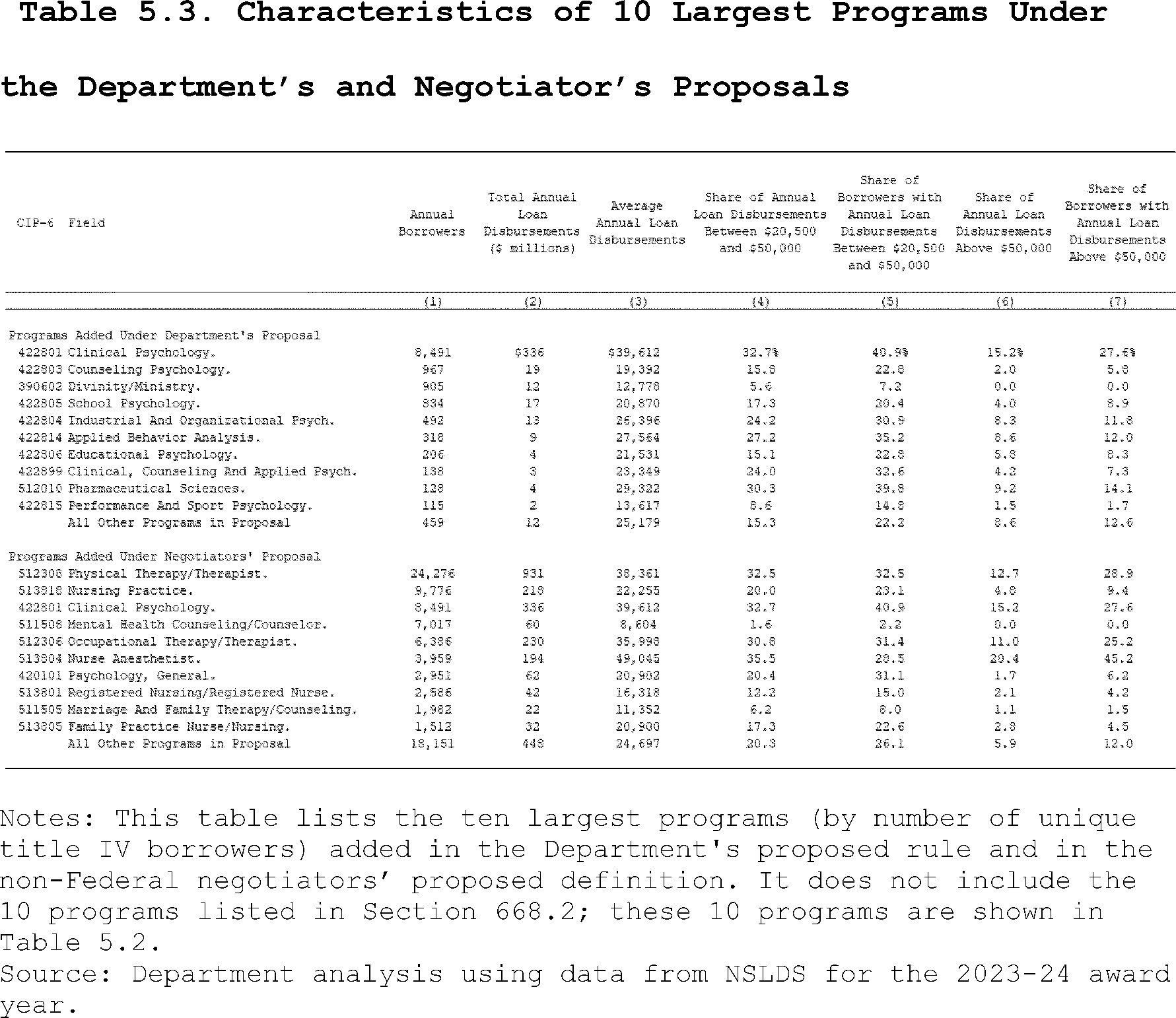
In addition to examining the numbers and types of programs included in the alternative definitions of a professional degree, the Department also estimated the budget costs and increased in loan disbursements for each of the alternatives (Table 5.4 and Table 5.5, respectively). We again compare these impacts relative to a definition limited to only the 10 programs listed in Section 668.2.
The Department's proposed definition would increase outlays by $112 million over the 10-year budget window relative to restricting professional degrees to only the 10 programs listed in Section 668.2 (Table 5.4). Loan disbursements would increase by $961 million between 2026-2035 under the Department's proposal, mostly due to the addition of programs in Clinical Psychology (Table 5.5). Conversely, the non-Federal negotiators' proposal would increase outlays by $1.12 billion in the 2026-2035 budget window, relative to the cost of limiting professional programs to only the 10 programs in section 668.2 (Table 5.4). Additionally, the non-Federal negotiator's proposal would increase loan disbursements by an estimated $9.79 billion, relative to the same baseline (Table 5.5). Programs in physical therapy and nursing account for a large share of the projected increase in loan disbursements and budget costs relative to the Department's proposal and the baseline 10 programs.
( printed page 4317)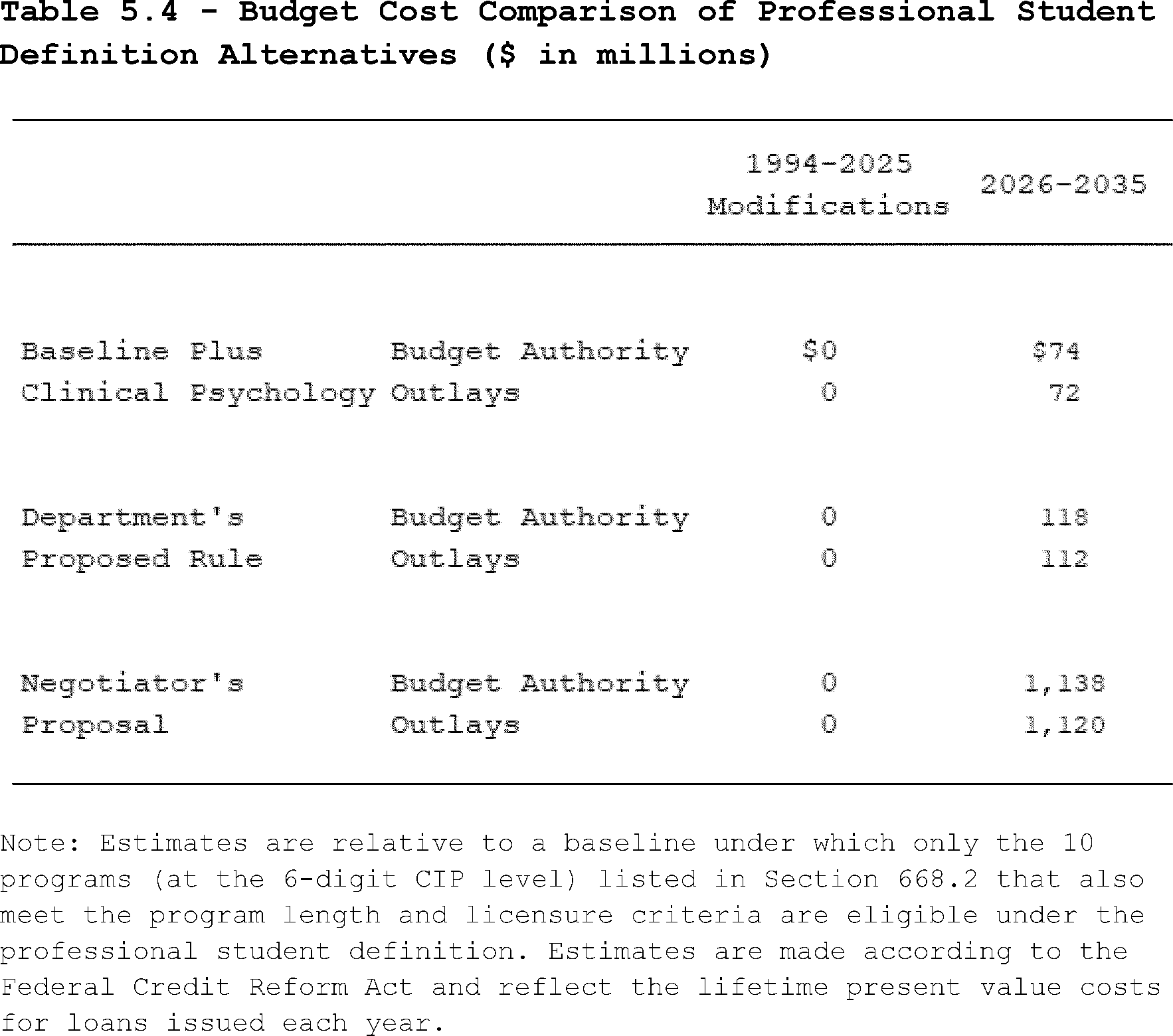
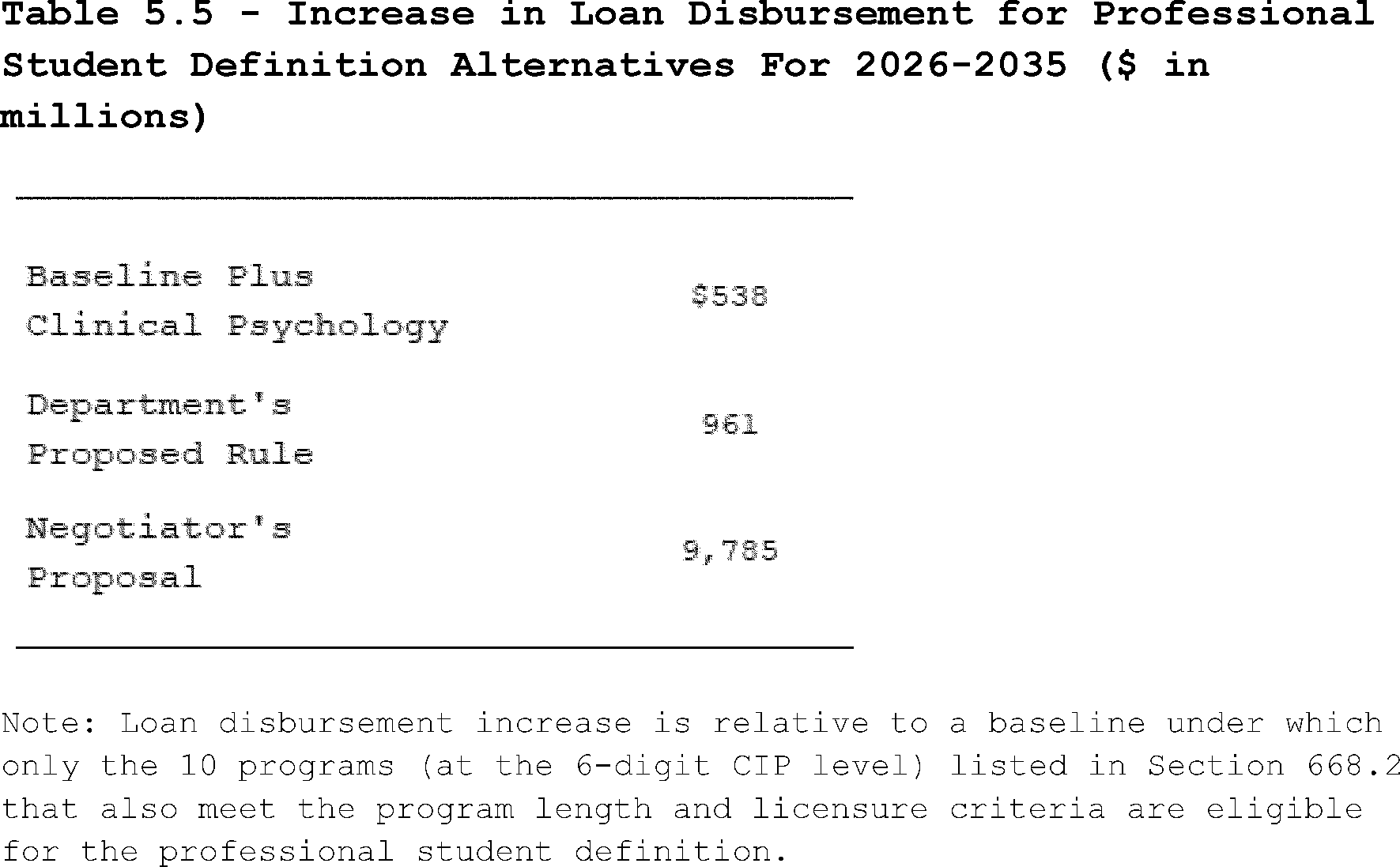
Regulatory Flexibility Act
This section considers the effects that the proposed regulations may have on small entities in the Educational Sector as required by the Regulatory Flexibility Act (RFA, 5 U.S.C. et seq., Public Law 96-354) as amended by the Small Business Regulatory Enforcement Fairness Act of 1996 (SBREFA). The purpose of the RFA is to establish as a principle of regulation that agencies should tailor regulatory and informational requirements to the size of entities, consistent with the objectives of a particular regulation and applicable statutes.
The RFA generally requires an agency to prepare a regulatory flexibility analysis of any rule subject to notice and comment rulemaking requirements under the Administrative Procedure Act (APA) or any other statute unless the agency certifies that the rule will not have a “significant impact on a substantial number of small entities.”
This proposed rule amends the regulations for the Federal student loan programs authorized under the title IV, HEA programs to implement the statutory changes to the title IV, HEA programs included in the OBBB signed into law on July 4, 2025. These changes include establishing new loan limits for graduate students, professional students, and parents. The OBBB also simplifies the current broken and confusing myriad of Federal student loan repayment plans by phasing out the existing Income-Contingent Repayment plans, creates a new tiered standard repayment plan option, and implements a new income-driven repayment plan known as the Repayment Assistance Plan.
As we describe below, the Department anticipates that this regulatory action will have a significant economic impact on a substantial number of small entities. We therefore present this Initial Regulatory Flexibility Analysis. Our analysis focuses on the loan limit components of the OBBB and the proposed regulation, as those would have the most economically significant implications for small entities.
Description of, and, Where Feasible, an Estimate of the Number of Small Entities to Which the Regulations Will Apply
The Small Business Administration (SBA) defines “small institution” using data on revenue, market dominance, tax filing status, governing body, and population. The majority of entities to which the Office of Postsecondary Education's (OPE) regulations apply are postsecondary institutions, which do not report such data to the Department. As a result, for purposes of this NPRM, the Department proposes to continue defining “small entities” by reference to enrollment, to allow meaningful comparison of regulatory impact across all types of higher education institutions. We construct four different categories of small entities for the purposes of classifying higher education institutions: (1) Extremely Small (1-249 FTE, full-time equivalent student enrollees); (2) Very Small (250-499 FTE); (3) Moderately Small (500-749 FTE); and (4) Small (750-999 FTE).
Table 5.6 summarizes the number of institutions affected by these proposed regulations. In total, 53 percent of institutions are classified as small institutions under the enrollment-based definition. Specifically, 33 percent are Extremely Small (1-249 FTE), 9 percent are Very Small (250-499 FTE), 6 percent are Moderately Small (500-749 FTE), and 5 percent are Small (750-999 FTE). The remaining 47 percent of institutions are not in one of these categories.
As seen in Table 5.7, small entities (all four categories combined) in the public sector generate $3.5 billion in institutional revenues annually, small entities (all four categories combined) in the private non-profit sector generate $12.3 billion in institutional revenues annually, and small entities (all four categories combined) in the for-profit sector generate $4.2 billion in institutional revenues annually. An outsized share of these revenues come from institutions in the largest category of small entities (institutions with 750-999 FTE). These institutions make up just 9 percent of all institutions classified as a small entity (having fewer than 1,000 FTE) but comprise 38 percent of the annual revenues generated by these institutions.
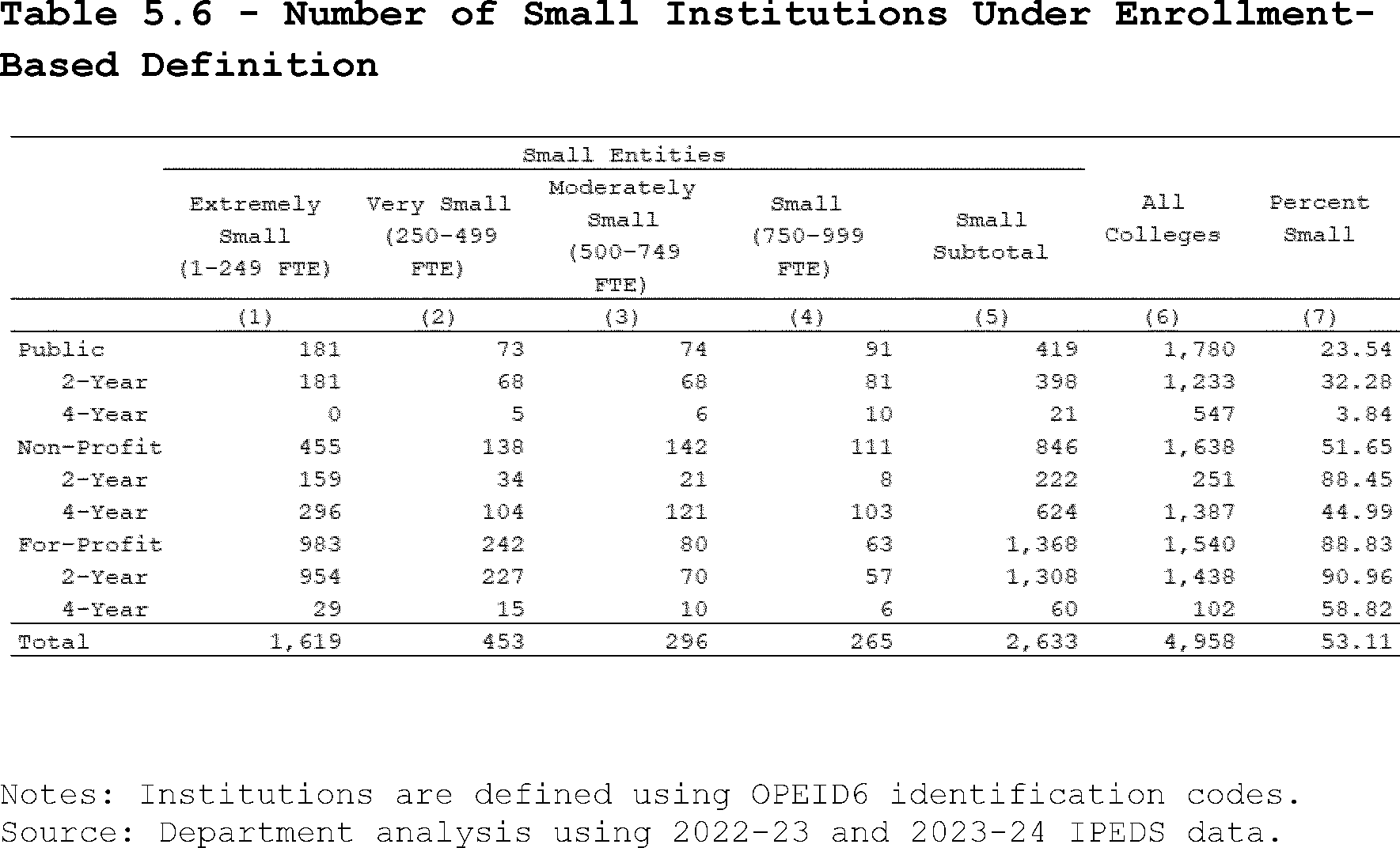
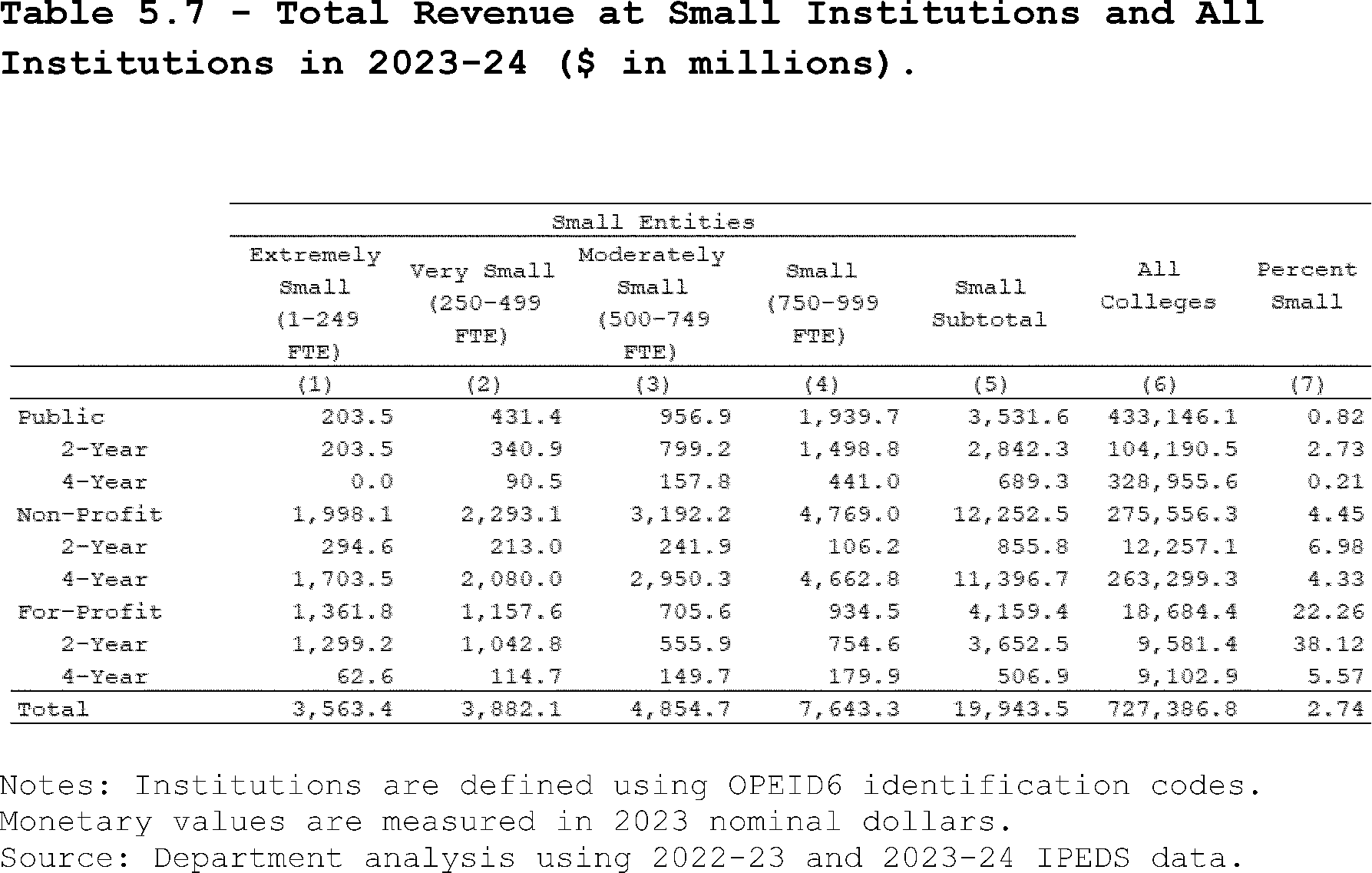
Table 5.8 shows the estimated change in annual loan disbursements from the Department to small entities as a result of the new loan limits established in the OBBB. As noted in the previous section, the OBBB includes new annual and aggregate loan limits for graduate and professional students as well as parents of dependent undergraduate students who use the Parent PLUS Program. The annual limits, as described in the previous section, are $20,500 for graduate students, $50,000 for professional students as defined in the proposed regulation, and $20,000 for parents borrowing on behalf of their dependent undergraduate student.
Among all small entities (institutions with 1-999 FTE), the percentage of annual loan volume that exceeds the annual loan limits established under the Act approximately 13.9 percent on average, though there is variation across institutional sectors. Among private non-profit small entities, the average share of annual loan volume above the limit is 21 percent, whereas the share of annual volume above the limit at public and for-profit small entities is between 4 percent-6 percent. These values represent an estimate of the share of annual Federal student loan disbursements to small entities that will no longer be issued due to the OBBB's loan limits for graduate students and parent borrowers.
Federal student loans can comprise a significant portion of institutions' revenue, including small institutions, if such funds are used to pay tuition and other costs billed directly by the institution. However, it is important to note that not all Federal loan disbursements contribute to institutional revenues. Sometimes, Federal loan dollars are used to pay for other items, like housing, transportation, and food, which do not always go to the institution the student attends. Therefore, the new loan limits could result in a reduction in institutional revenue unless those direct costs are funded by other sources, such as grants, non-Federal loans, or personal savings. Due to data limitations, we are unable to estimate reliably the share of Federal loan disbursements to small entities that the institution receives and therefore are unable to reliably estimate the share of small entities' revenue affected by the loan limit reduction. Table 5.8 presents the maximum amount of revenue that could be affected, but the actual amount will be lower and may vary by institution.
( printed page 4320)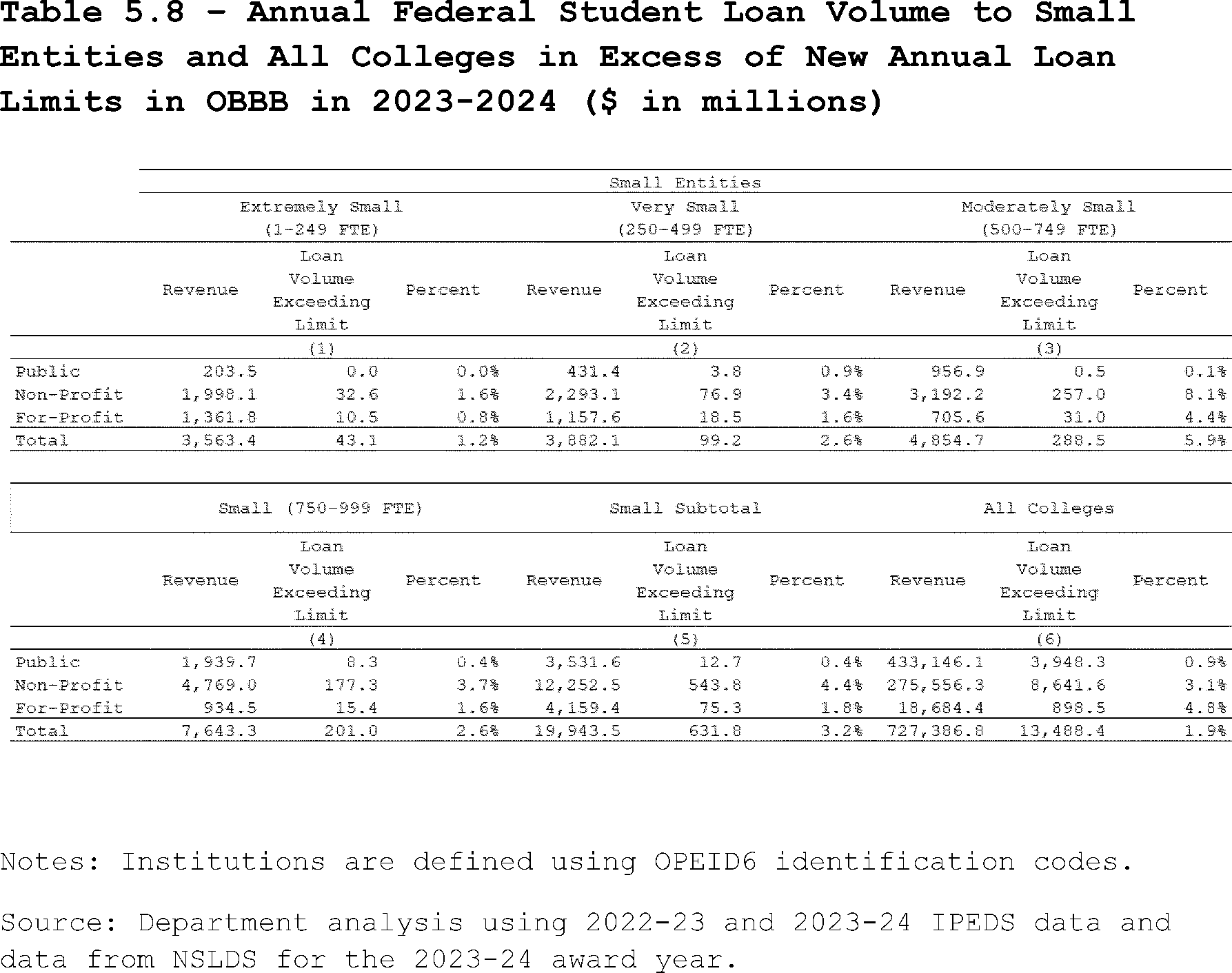
Description of the Projected Reporting, Recordkeeping, and Other Compliance Requirements of the Regulations, Including of the Classes of Small Entities That Will Be Subject to the Requirement and the Type of Professional Skills Necessary for Preparation of the Report or Record
The regulations are unlikely to result in additional reporting, recordkeeping, or additional compliance requirements for small entities beyond the paperwork burden as described in the Paperwork Reduction Act section.
Identification, to the Extent Practicable, of all Relevant Federal Regulations That May Duplicate, Overlap, or Conflict With the Regulations
The regulations are unlikely to conflict with or duplicate existing Federal regulations.
Alternatives Considered (Small Entities)
The Department examined whether the proposed rule could incorporate other options or changes to the rule intended to make compliance less burdensome for small institutions of higher education. Specifically, the Department considered whether small institutions of higher education could be exempted from the changes to the statue in the proposed rule, or whether they could be granted a delayed start date to the changes, particularly those changes related to the reductions in student loan limits in the OBBB. The Department does not have discretion in the OBBB to exempt certain institutions of higher education from the OBBB requirements. The statute also establishes the effective date for the changes to the Federal student loan program and does not leave flexibility to the Department to consider granting a delay in compliance for small entities that may benefit from such a delay. Therefore, the Department determined that none of these options would be permissible under the statute. The agency invites comments on reasonable alternatives that are consistent with the stated objectives of the statute.
The Department acknowledges that this analysis defines small entities based on institutions' enrollment. The Department is interested in comments addressing this approach and other alternatives if they were to more fully capture the impact of the proposed rule on small entities. The Department welcomes comments and data from the public that may help it improve its impact analyses for small entities with respect to the changes in this proposed rule.
Paperwork Reduction Act of 1995
As part of its continuing effort to reduce paperwork and respondent burden, the Department provides the general public and Federal agencies with an opportunity to comment on proposed and continuing collections of information in accordance with the Paperwork Reduction Act of 1995 (PRA) (44 U.S.C. 3506(c)(2)(A)). This helps make certain that: the public understands the Department's collection instructions, respondents can provide the requested data in the desired format, reporting burden (time and financial resources) is minimized, collection instruments are clearly understood, and the Department can properly assess the impact of collection requirements on respondents.
This Notice of Proposed Rulemaking amends existing collections of information that contain reporting or recordkeeping burden. The Department, through this proposed regulation, seeks comment on revisions to the following existing information collections:
( printed page 4321)
The proposed regulation will also modify other existing information collections. However, at this time it is unclear what changes will be made to these existing collections. In the below table, we identify information collections that we anticipate will also be modified by these regulations. The Department will separately seek public comment on the proposed revisions to these collections before changes go into effect.
( printed page 4322)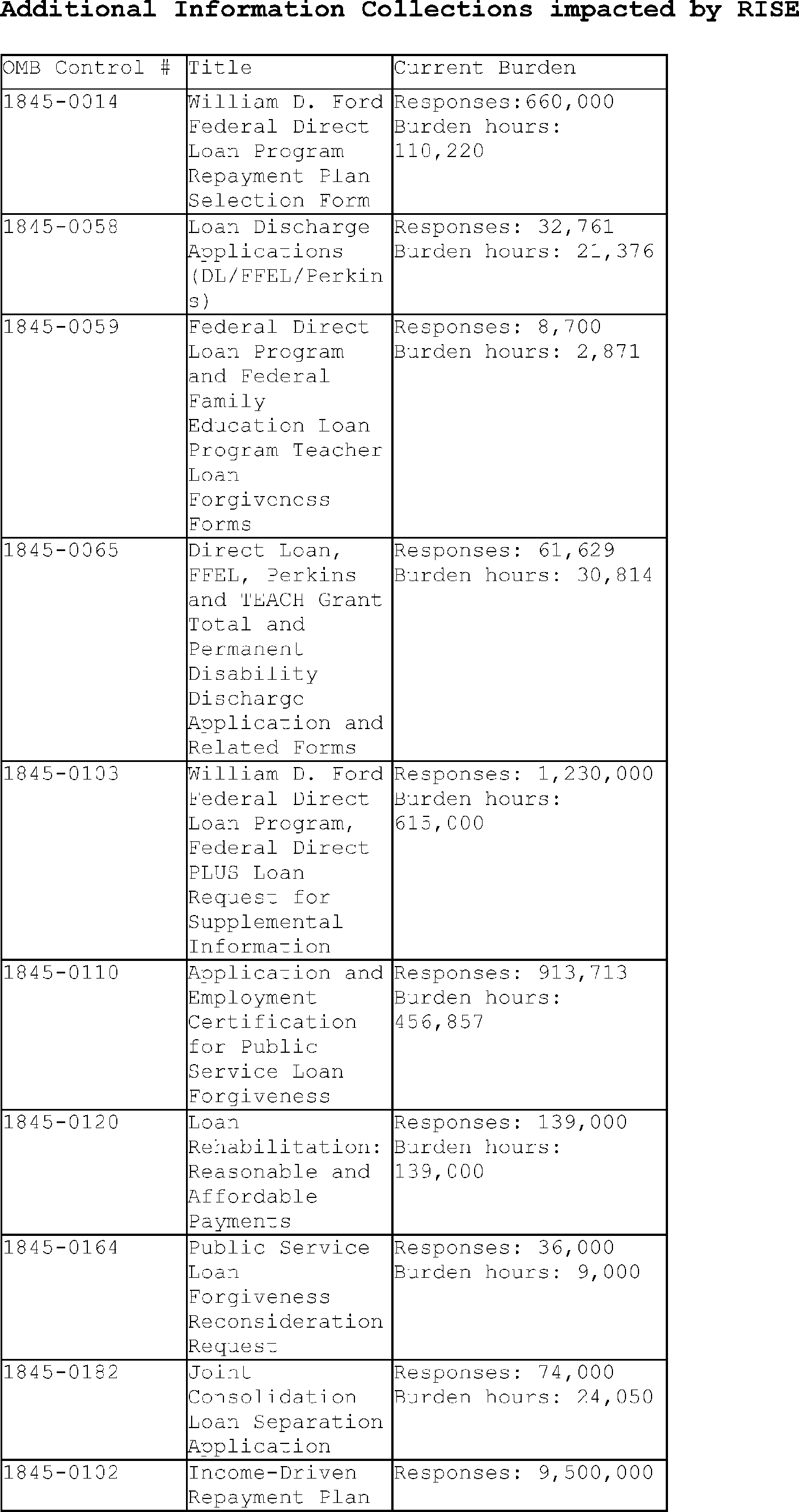
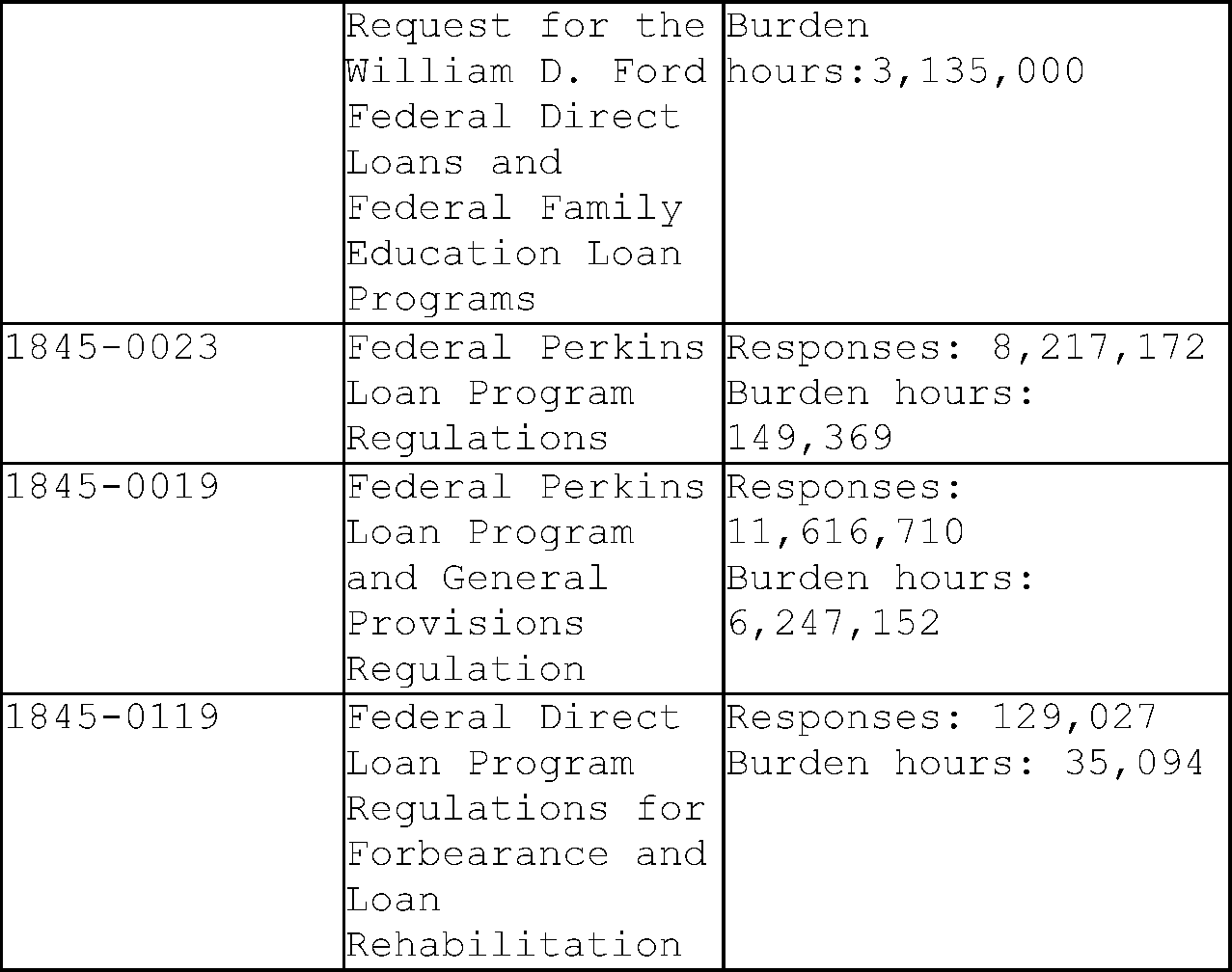
Below we identify the provisions in the proposed regulation that may have an impact on information collections.
§ 685.102 Definitions
Proposed § 685.102 would add the following new definitions: expected time to credential; graduate student; professional student; and program length. To comply, institutions will be required to update their internal systems and policies to bifurcate and update the definition of graduate or professional student in order to determine a student's annual and aggregate loan limits. We expect the associated burden on institutions will be minimal. Institutions already differentiate graduate students from baccalaureate students while packaging aid. The proposed regulation would not create a new burden for schools as they already have a process to differentiate students in their systems. We believe separating graduate and professional student would only slightly alter the burden already assigned to this type of activity within this regulation.
Proposed § 685.102, will require institutions to update their internal system definitions of expected time to credential and program length. We believe the burden to conform with these new definitions will be minimal as the proposed definitions serve to provide consistency and clarity of these terms rather than change them.
In sum, to conform to all definitions in proposed § 685.102, institutions would be required to review the new definitions, update internal policies and procedures, modify systems, perform basic testing, and train staff. We believe there will be a small increase in burden of approximately 300 hours per institution in order to implement these regulations. This additional burden is assigned to this regulatory collection, 1845-0021.
§ 682.215 Income-Based Repayment
Proposed 682.215(b) would amend the terms and conditions of the IBR plan to remove any references to partial financial hardship to conform with changes from the OBBB Section 82001(f)(1)(B). This will decrease burden on borrowers as they will no longer be required to demonstrate a partial financial hardship to apply for an IDR plan, including the IBR plan. Updates to the IDR form and burden estimates on individual borrowers will be completed and made available for comment in a separate public comment notice issued under OMB Control #1845-0102 Income-Driven Repayment Plan Request for the William D. Ford Federal Direct Loans and Federal Family Education Loan Programs before being made available for use by the effective date of the regulations.
Likewise, loan servicers will no longer have to determine that the borrower meets the partial financial hardship requirement before placing a borrower in the income-based repayment plan, nor will they be required to make annual redeterminations of partial financial hardship status.
The proposed elimination of the partial financial hardship requirement will reduce burden on loan servicers. When partial financial hardship was first implemented, the Department estimated there would be an increase of 90,286 burden hours on loan servicers. Because these partial financial hardship determinations will no longer be required under this proposed regulation, the Department would remove all 90,286 hours of burden from this regulatory collection, 1845-0021.
§ 685.201 Obtaining a Loan
Before July 1, 2026, for a graduate or professional student to apply for a Direct PLUS Loan, the borrower would complete a FAFSA and submit it in accordance with instructions in the application. The borrower would also complete the Direct PLUS Loan Request and the Direct PLUS Loan MPN.
Proposed 685.201 would align the regulations with the changes to section 81001(1)(C) of the OBBB, which amends section 455(a)(3)(C) of the HEA by terminating graduate and professional students' access to the Direct PLUS Loan program for any period of instruction beginning on or after July 1, 2026 (except for those current students who qualify for the interim exception).
By discontinuing the Graduate PLUS Loan program for new students and those who do not qualify for the interim exception for certain students, the Department proposes removing an entire category of loan processing requirements for servicers and institutions. This will reduce burden in any collection related to PLUS loans, including the 1845-0021 collection.
In the 2024-25 award year, there were 2,020 title IV eligible schools who ( printed page 4324) originated and disbursed at least one Graduate PLUS Loan. Of those, 124 proprietary schools made an average of 465 Graduate PLUS Loans; 1,341 private schools made an average of 279 Graduate PLUS Loans; and 555 public schools made an average of 413 Graduate PLUS Loans.
Title IV eligible schools may still participate in the Direct PLUS Loan program. Proposed § 685.201 would disqualify graduate and professional students from eligibility, but parents of dependent undergraduate students remain eligible to borrow Parent PLUS Loans. Therefore, this specific loan program will not be eliminated it its entirety. Because of this, we estimate there would be a 620-hour reduction in burden per title IV institution participating in the Direct PLUS Loan Program. This would remove approximately 1,252,400 hours of burden from the 1845-0021 William D. Ford Federal Direct Loan Program collection.
Additional reductions in burden on individual borrowers stemming from proposed § 685.201 will be assessed to OMB Control #1845-0103 William D. Ford Federal Direct Loan Program, Federal Direct PLUS Loan Request for Supplemental Information and OMB Control #1845-0129 PLUS Adverse Credit Reconsideration Loan Counseling. As previously mentioned, once regulations are finalized, these updates will be completed and made available for comment through a separate public comment notice before these requirements are in effect.
§ 685.220 Consolidation
Section 82001(e) of the OBBB made statutory changes to permit defaulted borrowers to consolidate their loans for the purposes of obtaining access to the IBR or Repayment Assistance Plan plans to fix the default. The Department proposes to amend § 685.220 to conform with these statutory changes. Before July 1, 2028, defaulted borrowers may consolidate to gain access to the IBR and/or ICR plans. On or after July 1, 2028, defaulted borrowers may consolidate to gain access to the IBR plan or the Repayment Assistance Plan.
Proposed § 685.220 would ensure defaulted borrowers are able to consolidate into the Direct Loan Program and defines which repayment plans they have access to, including the Repayment Assistance Plan. Increases in burden to individual borrowers will be assessed under OMB Control #1845-0007 William D. Ford Federal Direct Loan Program (Direct Loan Program) Promissory Notes and related form, which the Department will seek comment on in a separate public comment notice.
Servicers are already in the practice of limiting repayment plans available to defaulted borrowers. We do not believe that the particular change in proposed 685.220 will have an impact on the burden hours or number of respondents currently assessed to OMB Control #1845-0021.
§ 685.211 Miscellaneous, § 674.39 Loan Rehabilitation, and § 682.405 Loan Rehabilitation Agreement
Three of the proposed regulations would allow a borrower to rehabilitate and/or receive the benefit of a suspension of AWG for a second time: Sections 674.39, 682.405, and 685.211. This widens eligibility for loan rehabilitation and thus adds burden to servicers who process rehabilitations. The Department estimates that approximately 91,700 additional borrowers would successfully rehabilitate their loan for a second time. If a servicer spends 8 hours on each borrower's loan rehabilitation, this adds 733,600 burden hours for loan servicers under this regulatory collection, 1845-0021 William D. Ford Federal Direct Loan Program regulations.
Once regulations are final, updates to burden on individuals due to the increased number of respondents for loans eligible for rehabilitation and/or administrative wage garnishment will be assessed under form changes to OMB Control #1845-0120 Loan Rehabilitation: Reasonable and Affordable Payments. The Department will seek comment on this in a separate public comment notice.
§ 685.208 Fixed Repayment
The Department proposes to restructure 685.208 to provide fixed repayment plans based on when the Direct Loan was made. Loans made before July 1, 2026, will contain the following fixed repayment plans: standard, graduated, and extended. Loans made on or after July 1, 2026, would only have the Tiered Standard repayment plan as a fixed repayment plan option. Updates would be made to the form and the burden assessed under OMB Control #1845-0014 William D. Ford Federal Direct Loan Program Repayment Plan Selection Form. These updates will be completed and made available for comment through a separate public comment notice before the requirements are in effect.
This will also require servicers to update their systems, including eligibility logic for the updated repayment plans, train staff, and make edits to communications materials. Based upon experience with prior repayment plan changes, the Department estimates it will take a total of 1,500 hours for servicers to update their systems to comply with the changes in repayment plan options. This would result in 9,000 additional burden hours that would be assessed to OMB Control #1845-0021 William D. Ford Federal Direct Loan Program regulations.
§ 685.210 Choice of Repayment Plan
Proposed 685.210 would change the eligible repayment plans available for loans made on or after July 1, 2026. Updates will be made to the form and the burden assessed under OMB Control #1845-0014 William D. Ford Federal Direct Loan Program Repayment Plan Selection Form. These updates will be completed and made available for comment through a separate public comment notice before requirements go into effect.
Additional burden on servicers due to changes to repayment plans in their systems was accounted for in § 685.208.
§ 685.200 Borrower Eligibility
Section 81001 of the OBBB amended Section 455(a)(3)(C) of the HEA by eliminating the graduate and professional Direct PLUS Loan Program for new loans made on or after July 1, 2026. This proposed regulation would decrease burden on institutions and individuals.
Section 685.200 requires Direct PLUS Loan applicants who have been denied a Direct PLUS Loan due to an adverse credit history determination to complete enhanced Direct PLUS Loan counseling and submit documentation of extenuating circumstances to the Secretary to request a review of their loan application. Proposed 685.200 would result in a change in burden for institutions. Because graduate and professional students would no longer be eligible for PLUS loans there will be a reduction in the number of PLUS loans originated by institutions and therefore a reduction of respondents to form OMB Control #1845-0129 PLUS Adverse Credit Reconsideration Loan Counseling. The Department will seek approval for this modification through a separate public comment notice before the requirements are in effect.
§ 685.204 Deferment
Proposed § 685.204 would update the eligibility criteria for an economic hardship deferment based on loan disbursement date. Section 82002 of the OBBB amends section 455(f) of the HEA to remove the authority for unemployment and economic hardship ( printed page 4325) deferments for Direct Loans made on or after July 1, 2027. The proposed changes would decrease burden related to the deferment processes. Updates will need to be made to the current deferment forms under OMB Control #1845-0011 Federal Student Loan Program Deferment Request Forms and its associated burden. This form update will be completed and made available for comment through a separate public comment notice before requirements go into effect.
§ 685.205 Forbearance
Section 82002 of the OBBB amends Section 455(f) of the HEA to limit the use of forbearance for future borrowers with loans made on or after July 1, 2027. Proposed § 685.205 would decrease the burden related to the forbearance process due to the new limitations on the use of forbearance. Updates would need to be made to OMB Control #1845-0018 Federal Student Loan Program: Internship/Residency and Loan Debt Burden Forbearance Forms and its associated burden. The Department will seek comment on this form update in a separate public comment notice before requirements go into effect.
§ 685.221 Alternative Repayment
Section 82001(b) of the OBBB amended Section 455(d)of the HEA to define which repayment plans are available to borrowers with loans made on or after July 1, 2026, thereby limiting which loans may use the alternative repayment plan to borrowers with Direct Loans made before July 1, 2026. We do not believe this proposed regulation would require a change to burden estimates for loan servicers. The alternative repayment plan was promulgated into regulation for borrowers with extreme circumstances. There is no OMB control number assigned to this repayment plan because the annual number of respondents does not meet the minimum required by OMB. As a result, the Department does not anticipate there will be enough borrowers who meet the alternative repayment plan requirements each year to have an impact on burden for servicers.
§ 685.203 Loan Limits
To conform with changes from the OBBB, proposed § 685.203 would require updates to loan limits. Additionally, due to the changes proposed in § 685.203, the Department proposes to waive the requirement in § 685.303(d)(5) that prevents Direct Loans from being disbursed in any amount other than substantially equal installments when a borrower is enrolled for less than full-time enrollment. These changes will create burden on institutions. A school may need to make significant changes to implement revised disbursement requirements including the ability to accommodate uneven disbursements between periods of enrollment.
Proposed § 685.203(m) addresses when a student is enrolled in an eligible program on a less than full-time basis that would require a school to calculate and reduce a borrower's loan disbursement amount based upon less than full-time enrollment status. Schools are already required to package title IV aid evaluating for half-time or greater enrollment and less than half-time enrollment and adjusting, as needed.
The Department estimates that changes proposed in § 685.203 will take 950 hours per institution or servicer to complete creating a total of 5,350,400 additional burden hours assigned to the 1845-0021 William D. Ford Federal Direct Loan Program collection.
§ 685.209 Income-Driven Repayment
Section 685.209 proposes several modifications to the administration of IDR plans. First, we propose a new repayment plan, the Repayment Assistance Plan, to be added to 685.209 of the Direct Loan regulations. This repayment plan would be available to all Direct Loan borrowers regardless of when the borrower received their loan except for excepted Direct Loans. The legacy plans of PAYE, IBR, and ICR would only be available to borrowers with Direct Loans made before July 1, 2026. This regulation may alter the current IDR form. Any adjustments to burden calculation and number of respondents due to revisions to income-driven repayment regulations will be captured under OMB Control #1845-0102 Income-Driven Repayment and the Department will seek public comment on this in a separate notice before requirements go into effect. Proposed 685.209 would also require loan servicers to update their systems and policies and procedures to comply with the modified regulations. This includes changes related to repayment plan eligibility and monthly payment calculations.
We estimate it will take servicers 700 hours to complete systems programming and integration; 190 hours for testing; 50 hours for edits to letters or communication material; and 600 hours for project management for a total of 1,540 burden hours. Currently there are six loan servicers, which would create 9,240 additional burden hours assessed to this regulatory collection, 1845-0021 William D. Ford Federal Direct Loan Program regulations.
§ 685.219 Public Service Loan Forgiveness Program (PSLF)
The Department proposes to amend § 685.219 Public Service Loan Forgiveness in accordance with amendments made by 82004(b)(1) through (3) of the OBBB to specify the qualifying repayment plans for the purposes of PSLF. Proposed § 685.219 expands the definition of a qualifying repayment plan for PSLF by adding two new categories: (1) income-contingent repayment plans, but only for payments made on or before June 30, 2028, and (2) the new Repayment Assistance Plan under § 685.209. This will require updates to burden assessed to OMB Control #1845-0110 Application and Employment Certification for Public Service Loan Forgiveness. The Department will update this form through a separate public comment notice before requirements go into effect.
Collection of Information
We provide below our preliminary estimates for potential burden changes and potential costs associated with changes to information collections impacted by this proposed regulation. We note these estimates may change once the regulation is finalized. The Department will also update any burden and cost estimates in the public comment notices seeking changes to these collections. For institutions, we used the median hourly wage for Education Administrators, Postsecondary (11-9033) from the U.S. Bureau of Labor Statistics. In 2024 this was $49.98.
( printed page 4326)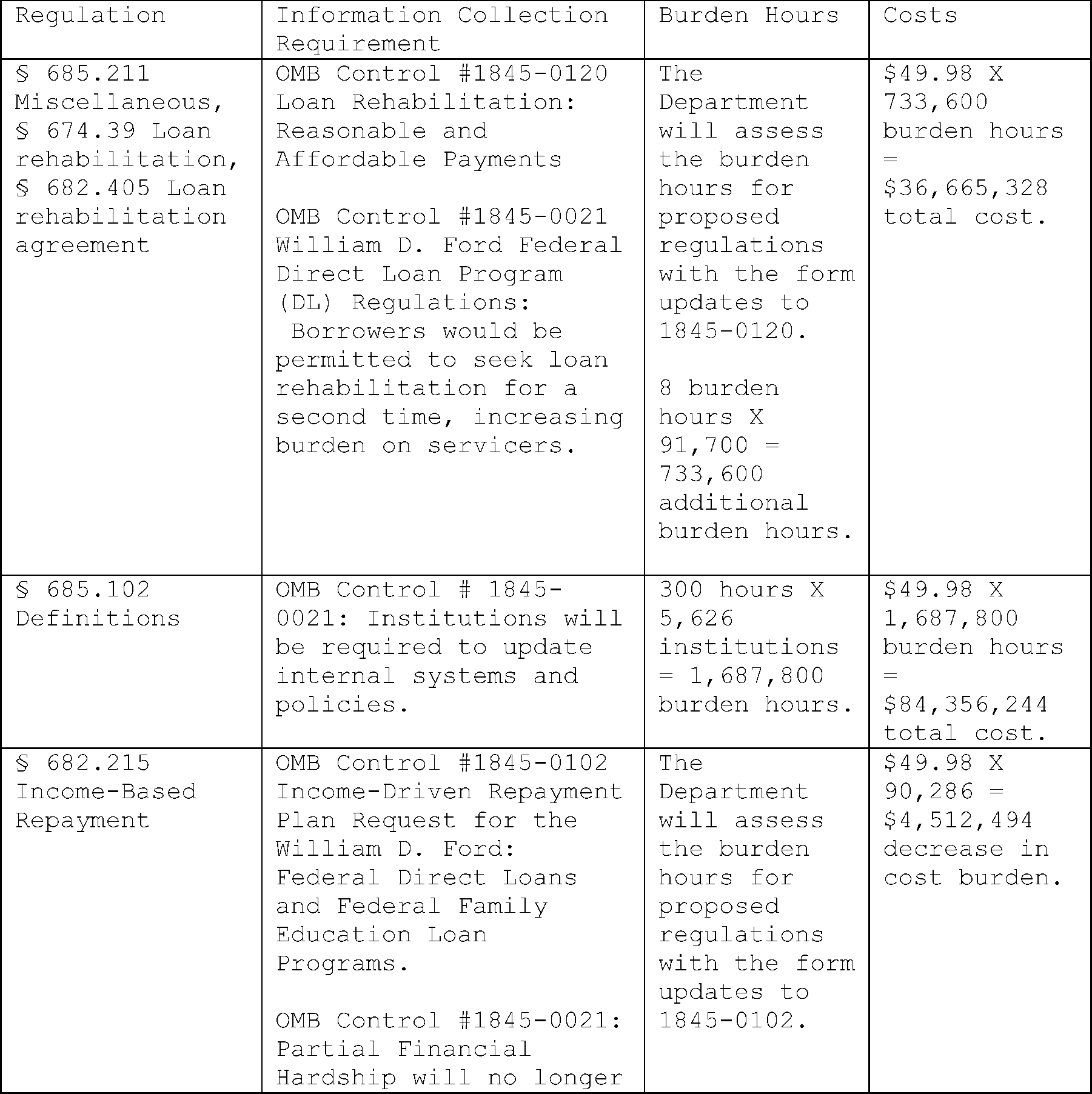
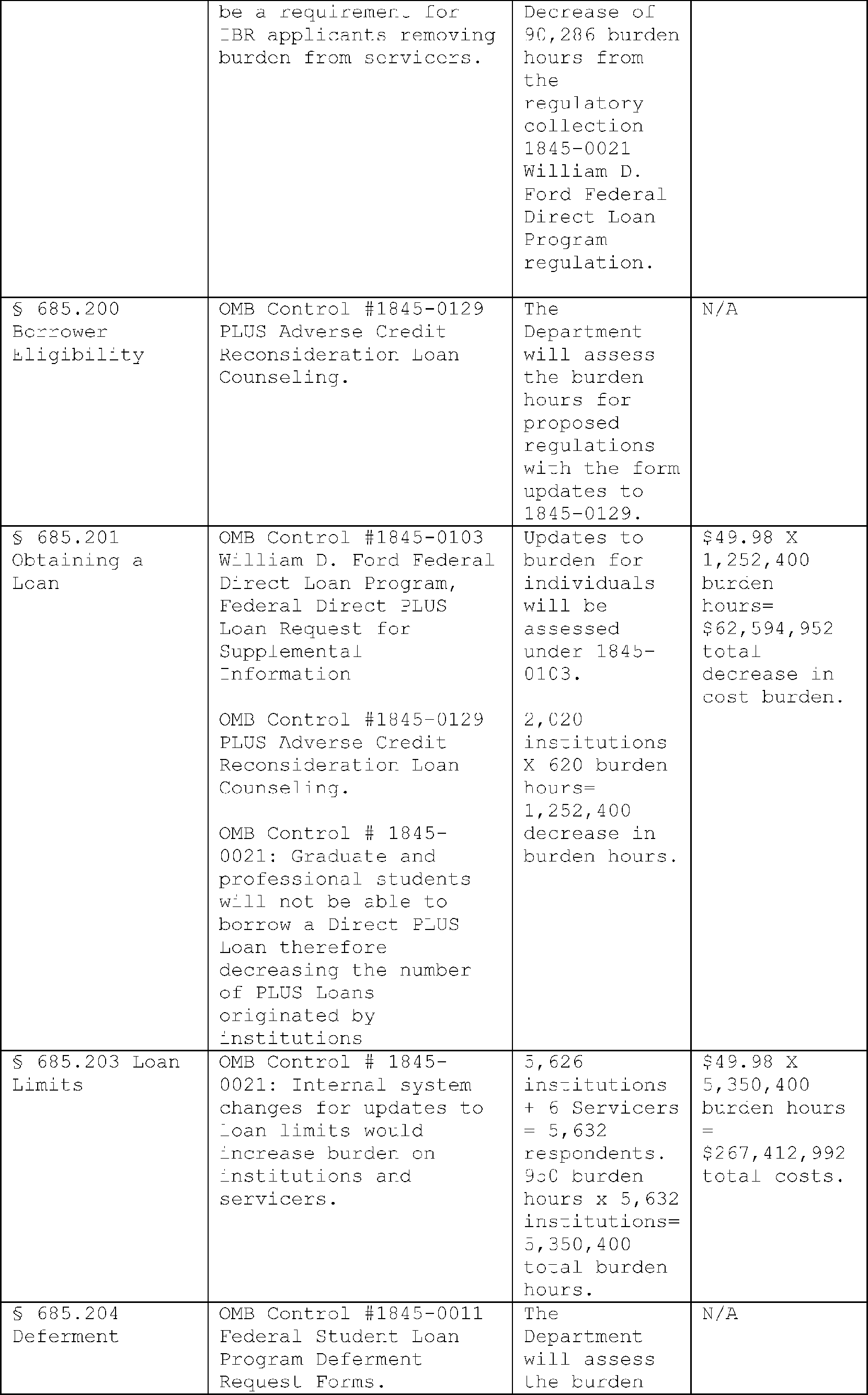
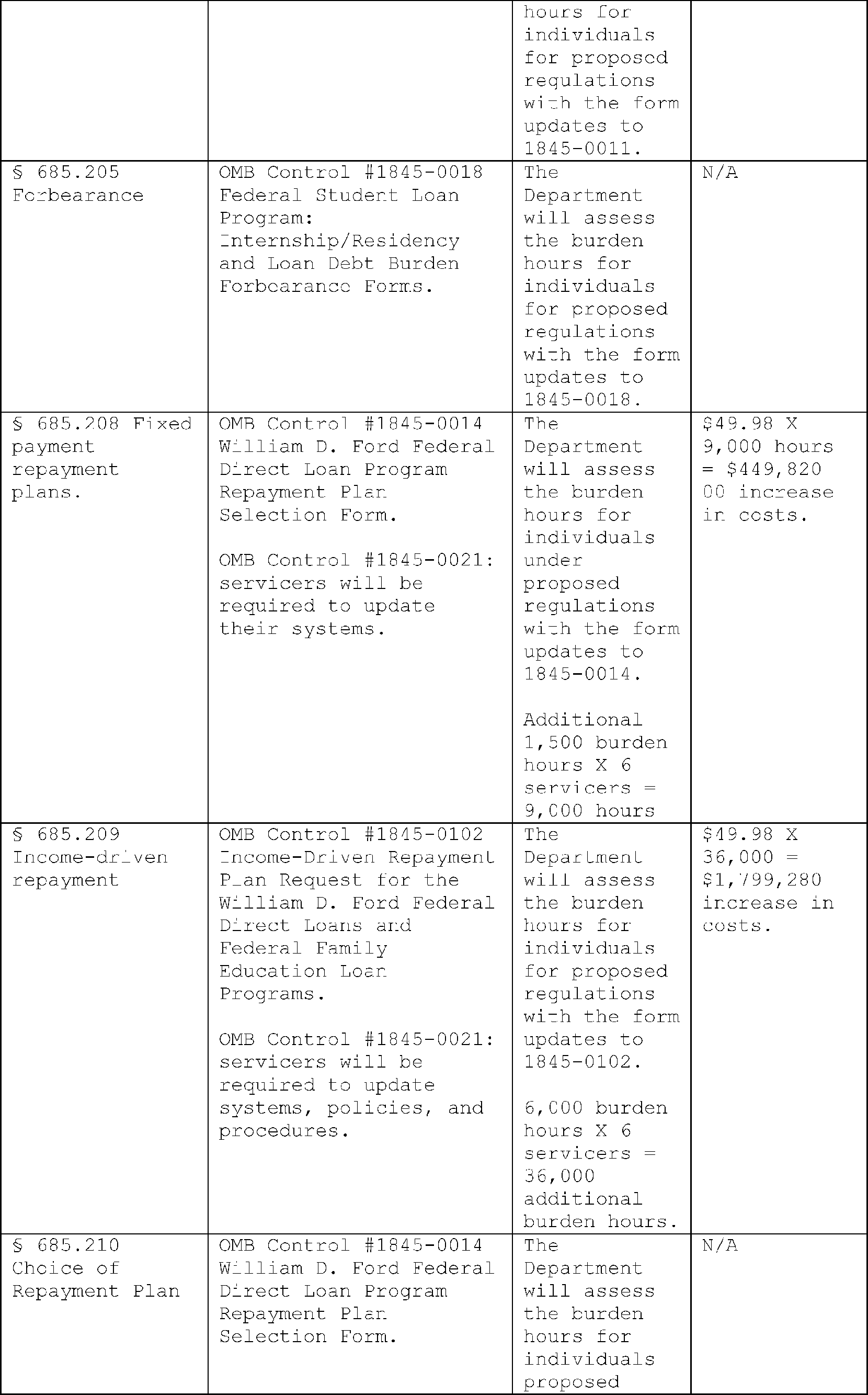
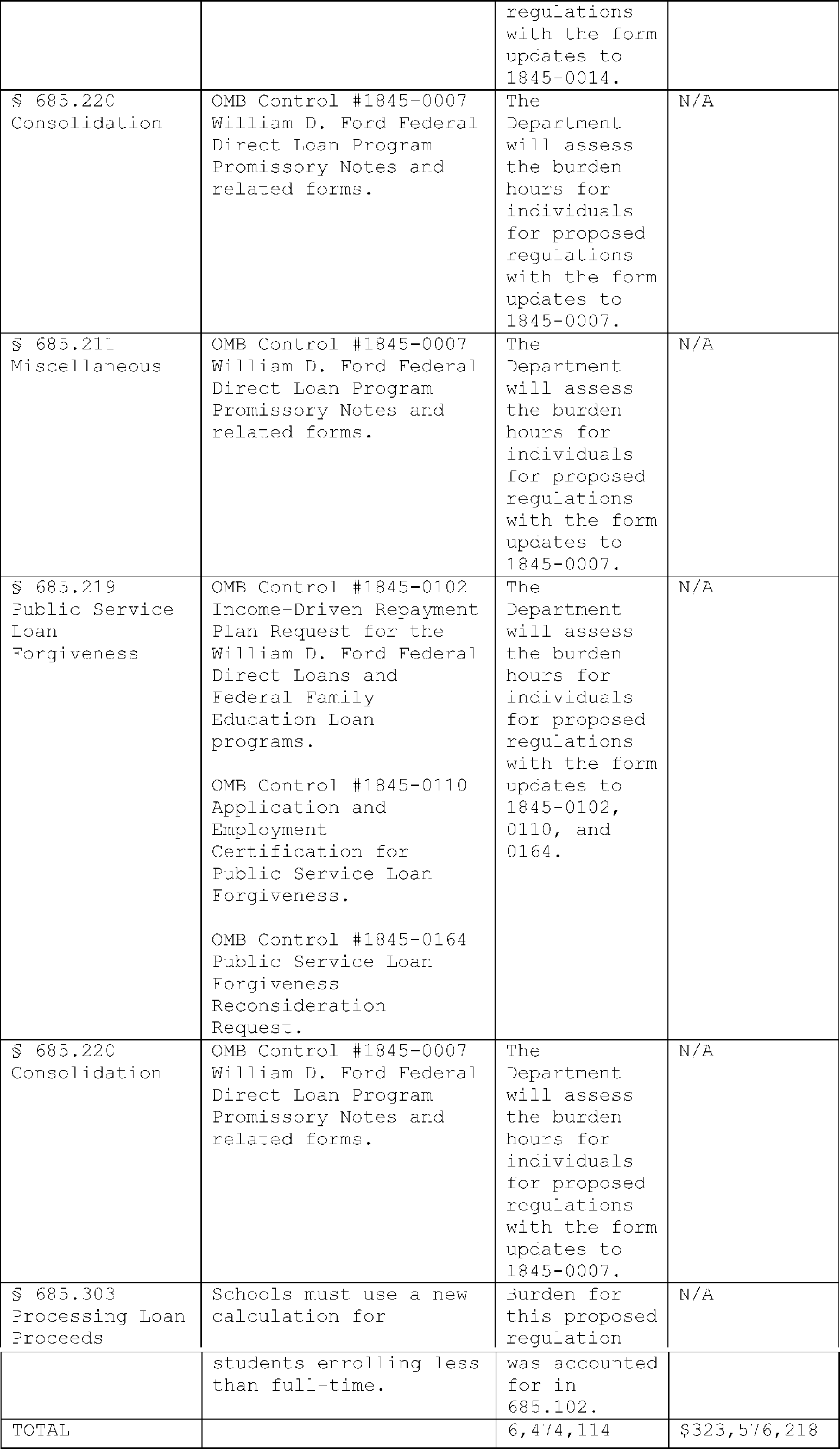
Certain proposed regulations in this notice add approximately 7,816,800 hours of burden; other adjustments in proposed regulation reduce the burden ( printed page 4330) by approximately 1,342,686 hours. This results in a net increase of 6,474,114 burden hours assessed to 1845-0021 William D. Ford Federal Direct Loan Program Regulations.
A Federal agency may not conduct or sponsor a collection of information unless OMB approves the collection under the PRA and the corresponding information collection instrument displays a currently valid OMB control number. Notwithstanding any other provision of law, no person is required to comply with or is subject to penalty for failure to comply with, a collection of information if the collection instrument does not display a currently valid OMB control number.
In the final regulations we will display the control numbers assigned by OMB to any information collection requirements proposed in this NPRM and adopted in the final regulations.
Intergovernmental Review
This program is subject to E.O. 12372 and the regulations in 34 CFR part 79. One of the objectives of the E.O. is to foster an intergovernmental partnership and strengthen Federalism. The E.O. relies on processes developed by State and local governments for coordination and review of proposed Federal financial assistance.
This document provides early notification of our specific plans and actions for this program.
Assessment of Education Impact
In accordance with section 411 of the General Education Provisions Act, 20 U.S.C. 1221e-4, the Secretary requests comments on whether these final regulations would require transmission of information that any other agency or authority of the United States gathers or makes available.
Federalism
E.O. 13132 requires us to provide meaningful and timely input by State and local elected officials in the development of regulatory policies that have Federalism implications. “Federalism implications” means substantial direct effects on the States, on the relationship between the National Government and the States, or on the distribution of power and responsibilities among the various levels of government. The proposed regulations do not have Federalism implications.
Accessible Format: On request to the program contact person(s) listed under FOR FURTHER INFORMATION CONTACT , individuals with disabilities can obtain this document in an accessible format. The Department will provide the requestor with an accessible format that may include Rich Text Format (RTF) or text format (txt), a thumb drive, an MP3 file, braille, large print, audiotape, or compact disc, or other accessible format.
Electronic Access to This Document: The official version of this document is the document published in the Federal Register . You may access the official edition of the Federal Register and the Code of Federal Regulations at www.govinfo.gov. At this site you can view this document, as well as all other documents of this Department published in the Federal Register , in text or Adobe Portable Document Format (PDF). To use PDF, you must have Adobe Acrobat Reader, which is available free at the site.
You may also access documents of the Department published in the Federal Register by using the article search feature at www.federalregister.gov. Specifically, through the advanced search feature at this site, you can limit your search to documents published by the Department.
List of Subjects in 34 CFR Parts 674, 682, and 685
- Administrative practice and procedure
- Annual and aggregate loan limits
- Colleges and universities
- Federal Family Education Loan (FFEL) Program
- Federal Perkins Loan Program
- Less than full-time enrollment
- Loan consolidation
- Education
- Reporting and recordkeeping requirements
- Student aid
- William D Ford Direct Loan Program
Nicholas Kent,
Under Secretary of Education.
For the reasons discussed in the preamble, the Secretary of Education proposes to amend parts 674, 682, and 685 of title 34 of the Code of Federal Regulations as follows:
PART 674—FEDERAL PERKINS LOAN PROGRAM
1. The authority citation for part 674 is revised to read as follows:
2. Section 674.39 is amended by revising paragraph (e) (1) and adding paragraph (e)(2).
The revision reads as follows:
(e) (1) On or before June 30, 2027, the borrower may rehabilitate a defaulted loan only one time.
(2) On or after July 1, 2027, the borrower may rehabilitate a defaulted loan a maximum of two times.
PART 682—FEDERAL FAMILY EDUCATION LOAN (FFEL) PROGRAM
3. The authority citation for part 682 is revised to read as follows:
4. Section 682.215 is amended by revising paragraphs (a)(4), (b)(1), (b)(5)-(7), (d)(1), (e)(1)-(6), and (f)(1). The revision reads as follows:
(a) * *
(4) Applicable amount means, for the purposes of the IBR plan, 15 percent of the result obtained by calculating, on at least an annual basis, the amount by which the adjusted gross income of the borrower and the borrower's spouse (if applicable) exceeds 150 percent of the poverty guideline.
(b) * * *
(1) For the Income-Based Repayment plan, a borrower may elect to have their aggregate monthly payment recalculated to not exceed the applicable amount. The borrower's aggregate monthly loan payments are limited to no more than 15 percent of the amount by which the borrower's AGI exceeds 150 percent of the poverty line income applicable to the borrower's family size, divided by 12. The loan holder adjusts the calculated monthly payment if—
(i) Except for borrowers provided for in paragraph (b)(1)(ii) of this section, the total amount of the borrower's eligible loans includes loans not held by the loan holder, in which case the loan holder determines the borrower's adjusted monthly payment by multiplying the calculated payment by the percentage of the total outstanding principal amount of the borrower's eligible loans that are held by the loan holder;
(ii) Both the borrower and the borrower's spouse have eligible loans and filed a joint Federal tax return, in which case the loan holder determines—
(A) Each borrower's percentage of the couple's total eligible loan debt;
(B) The adjusted monthly payment for each borrower by multiplying the calculated payment by the percentage determined in paragraph (b)(1)(ii)(A) of this section; and
(C) If the borrower's loans are held by multiple holders, the borrower's adjusted monthly payment by multiplying the payment determined in paragraph (b)(1)(ii)(B) of this section by the percentage of the total outstanding principal amount of the borrower's eligible loans that are held by the loan holder; ( printed page 4331)
(iii) The calculated amount under paragraph (b)(1), (b)(1)(i), or (b)(1)(ii) of this section is less than $5.00, in which case the borrower's monthly payment is $0.00; or
(iv) The calculated amount under paragraph (b)(1), (b)(1)(i), or (b)(1)(ii) of this section is equal to or greater than $5.00 but less than $10.00, in which case the borrower's monthly payment is $10.00.
(5) Except as provided in paragraph (b)(4) of this section, accrued interest is capitalized at the time the borrower chooses to leave the income-based repayment plan or when the applicable amount exceeds the maximum amount calculated under paragraph (d)(1)(i) of this section.
(6) If the borrower's monthly payment amount is not sufficient to pay any principal due, the payment of that principal is postponed until the borrower chooses to leave the income-based repayment plan or when the applicable amount exceeds the maximum amount calculated under paragraph (d)(1)(i) of this section.
(7) The special allowance payment to a lender during the period in which the borrower has their aggregate monthly payment recalculated to not exceed the applicable amount, under the income-based repayment plan, is calculated on the principal balance of the loan and any accrued interest unpaid by the borrower.
(d) * * *
(1) If a borrower's applicable amount exceeds the maximum amount calculated under paragraph (d)(1)(i) of this section, the borrower may continue to make payments under the income-based repayment plan, but the loan holder must recalculate the borrower's monthly payment. The loan holder also recalculates the monthly payment for a borrower who chooses to stop making income-based payments. In either case, as a result of the recalculation—
(i) The maximum monthly amount that the loan holder requires the borrower to repay is the amount the borrower would have paid under the FFEL standard repayment plan based on a 10-year repayment period using the amount of the borrower's eligible loans that was outstanding at the time the borrower began repayment on the loans with that holder under the income-based repayment plan; and
(ii) The borrower's repayment period based on the recalculated payment amount may exceed 10 years.
(e) * * *
(1) The loan holder recalculates the borrower's aggregate monthly payment to not exceed the applicable amount for the year the borrower elects the Income-Based Repayment plan and for each subsequent year that the borrower remains on the plan. To make this determination, the loan holder requires the borrower to—
(i) Provide documentation, acceptable to the loan holder, of the borrower's AGI;
(ii) If the borrower's AGI is not available, or the loan holder believes that the borrower's reported AGI does not reasonably reflect the borrower's current income, provide other documentation to verify income;
(iii) If the spouse of a married borrower who files a joint Federal tax return has eligible loans and the loan holder does not hold at least one of the spouse's eligible loans—
(A) Confirm that the borrower's spouse has provided consent for the loan holder to obtain information about the spouse's eligible loans from the National Student Loan Data System; or
(B) Provide other documentation, acceptable to the loan holder, of the spouse's eligible loan information; and
(iv) Annually certify the borrower's family size. If the borrower fails to certify family size, the loan holder must assume a family size of one for that year.
(2) After determining the borrower's aggregate monthly payment for the year the borrower initially elects the plan and for any subsequent year that the borrower remains on the Income-Based Repayment plan, the loan holder must send the borrower a written notification that provides the borrower with—
(i) The borrower's scheduled monthly payment amount, as calculated under paragraph (b)(1) of this section, and the time period during which this scheduled monthly payment amount will apply (annual payment period);
(ii) Information about the requirement for the borrower to annually provide the information described in paragraph (e)(1) of this section, if the borrower chooses to remain on the income-based repayment plan after the initial year on the plan, and an explanation that the borrower will be notified in advance of the date by which the loan holder must receive this information;
(iii) An explanation of the consequences, as described in paragraph (e)(1)(iv) and (e)(7) of this section, if the borrower does not provide the required information;
(iv) An explanation of the consequences if the borrower no longer wishes to repay under the income-based repayment plan; and
(v) Information about the borrower's option to request, at any time during the borrower's current annual payment period, that the loan holder recalculate the borrower's monthly payment amount if the borrower's financial circumstances have changed and the income amount that was used to calculate the borrower's current monthly payment no longer reflects the borrower's current income. If the loan holder recalculates the borrower's monthly payment amount based on the borrower's request, the loan holder must send the borrower a written notification that includes the information described in paragraph (e)(2)(i) through (e)(2)(v) of this section.
(3) For each subsequent year that a borrower remains on the income-based repayment plan, the loan holder must notify the borrower in writing of the requirements in paragraph (e)(1) of this section no later than 60 days and no earlier than 90 days prior to the date specified in paragraph (e)(3)(i) of this section. The notification must provide the borrower with—
(i) The date, no earlier than 35 days before the end of the borrower's annual payment period, by which the loan holder must receive all of the information described in paragraph (e)(1) of this section (annual deadline); and
(ii) The consequences if the loan holder does not receive the information within 10 days following the annual deadline specified in the notice, including the borrower's new monthly payment amount as determined under paragraph (d)(1) of this section, the effective date for the recalculated monthly payment amount, and the fact that unpaid accrued interest will be capitalized at the end of the borrower's current annual payment period in accordance with paragraph (b)(5) of this section.
(4) Each time a loan holder recalculates the borrower's monthly payment amount for a subsequent year that the borrower wishes to remain on the plan, the loan holder must send the borrower a written notification that provides the borrower with—
(i) The borrower's recalculated monthly payment amount, as determined in accordance with paragraph (d)(1) of this section;
(ii) An explanation that unpaid accrued interest will be capitalized in accordance with paragraph (b)(5) of this section; and
(iii) Information about the borrower's option to request, at any time, that the loan holder recalculate the monthly payment amount, if the borrower's financial circumstances have changed ( printed page 4332) and the income amount used does not reflect the borrower's current income, and an explanation that the borrower will be notified annually of this option. If the loan holder recalculates the borrower's monthly payment amount based on the borrower's request, the loan holder must send the borrower a written notification that includes the information described in paragraph (e)(2)(i) through (e)(2)(v) of this section.
(5) For each subsequent year that a borrower remains on the income-based repayment plan, the loan holder must send the borrower a written notification that includes the information described in paragraph (e)(4)(iii) of this section.
(6) If a borrower who is currently repaying under another repayment plan selects the income-based repayment plan but does not provide the documentation described in paragraphs (e)(1)(i) through (e)(1)(iii) of this section, the borrower remains on his or her current repayment plan.
(f) * * *
(1) To qualify for loan forgiveness after 25 years, the borrower must have participated in the income-based repayment plan and satisfied at least one of the following conditions during that period—
(i) Made reduced monthly payments as provided in paragraph (b)(1) of this section, including a monthly payment amount of $0.00, as provided in paragraph (b)(1)(iii) of this section;
(ii) Made reduced monthly payments or stopped making income-based payments as provided in paragraph (d)(1) of this section;
(iii) Made monthly payments under any repayment plan, that were not less than the amount required under the FFEL standard repayment plan described in § 682.209(a)(6)(vi) with a 10-year repayment period for the amount of the borrower's loans that were outstanding at the time the loans initially entered repayment;
(iv) Made monthly payments under the FFEL standard repayment plan described in § 682.209(a)(6)(vi) based on a 10-year repayment period; or
(v) Received an economic hardship deferment on eligible FFEL loans.
5. Amend § 682.405 by revising paragraphs (a)(3) and (4) to read as follows:
(a) * * *
(3) * * *
(iii)(A) Through July 1, 2027, a borrower may only obtain the benefit of suspension of administrative wage garnishment while also attempting to rehabilitate a defaulted loan once.
(B) On or after July 1, 2027, a borrower may only obtain the benefit of suspension of administrative wage garnishment one time per each attempt to rehabilitate a defaulted loan.
(4) (i) After the loan has been rehabilitated, the borrower regains all benefits of the program, including any remaining deferment eligibility under section 428(b)(1)(M) of the Act, from the date of the rehabilitation.
(ii) A loan may only be rehabilitated once between August 14, 2008, through June 30, 2027. On or after July 1, 2027, a loan may only be rehabilitated a maximum of two times over the loan's lifetime, regardless of when the loan was made.
PART 685—WILLIAM D. FORD FEDERAL DIRECT LOAN PROGRAM
6. The authority citation for part 685 is revised to read as follows:
7. Section 685.102 is amended by adding new definitions in (b).
Add “ Expected time to credential:” after “Estimated financial assistance:” and before “ Federal Direct Consolidation Loan Program (Direct Consolidation Loan Program):”
Add “ Graduate student:” after “ Grace period:” and before “ Guaranty agency:”
Add “ Professional student:” after “ Period of enrollment:” and add “ Program length:” after “ Professional student:” and before Satisfactory repayment arrangement:”
The revisions read as follows:
(b) * * *
Expected time to credential: From July 1, 2026, the expected time for a student to complete a program that is equal to or the lesser of—
(1) three academic years, as defined in 34 CFR 668.3; or
(2) the period determined by calculating the difference between—
(i) the program length for the program of study in which the individual is enrolled; and
(ii) the period of such program of study that such individual has completed as of the date of the determination under paragraph (2) of this definition.
Graduate student: A student enrolled in a program of study that is above the baccalaureate level and awards a graduate credential (other than a professional degree) upon completion of the program.
Professional student: A student enrolled in a program of study that awards a professional degree upon completion of the program;
(1) A professional degree is a degree that:
(i) Signifies both completion of the academic requirements for beginning practice in a given profession, and a level of professional skill beyond that normally required for a bachelor's degree;
(ii) Is generally at the doctoral level, and that requires at least six academic years of postsecondary education coursework for completion, including at least two years of post-baccalaureate level coursework;
(iii) Generally requires professional licensure to begin practice; and
(iv) Includes a four-digit program CIP code, as assigned by the institution or determined by the Secretary, in the same intermediate group as the fields listed in paragraph (2)(i) of this definition.
(2) A professional degree may be awarded in the following fields:
(i) Pharmacy (Pharm.D.), Dentistry (D.D.S. or D.M.D.), Veterinary Medicine (D.V.M.), Chiropractic (DC or DCM.), Law (L.L.B. or J.D.), Medicine (M.D.), Optometry (O.D.), Osteopathic Medicine (D.O.), Podiatry (D.P.M., D.P., or Pod.D.), Theology (M.Div., or M.H.L.), and Clinical Psychology (Psy.D. or Ph.D.). ( printed page 4333)
(3) A professional student under this definition:
(i) May not receive title IV aid as an undergraduate student for the same period of enrollment; and
(ii) Must be enrolled in a program leading to a professional degree under paragraph (2) of this definition.
Program length: The minimum amount of time in weeks, months, or years that is specified in the catalog, marketing materials, or other official publications of an institution for a full-time student to complete the requirements for a specific program of study.
8. Section 685.200 is amended by revising paragraph (b)(1) to include a new introductory sentence, renumbering the subordinate remaining sentences to (i-iv) and adding new paragraphs (2) and (3).
The revisions read as follows:
(b) Student PLUS borrower.
(1) A graduate student or professional student is eligible to receive a Direct PLUS Loan if the student meets the following requirements:
(i) The student is enrolled, or accepted for enrollment, on at least a half-time basis in a school that participates in the Direct Loan Program.
(ii) The student meets the requirements for an eligible student under 34 CFR part 668.
(iii) The student meets the requirements of paragraphs (a)(1)(iv) and (a)(1)(v) of this section, if applicable.
(iv) The student has received a determination of his or her annual loan maximum eligibility under the Direct Unsubsidized Loan Program and, for periods of enrollment beginning before July 1, 2012, the Direct Subsidized Loan Program; and
(v) The student meets the requirements that apply to a parent under paragraphs (c)(2)(viii)(A) through (G) of this section.
(2)(i) Beginning on July 1, 2026, a graduate student or professional student may not borrow a Direct PLUS Loan.
(ii) The limitation for making new Federal Direct PLUS Loan awards described in paragraph (b)(2)(i) of this section shall not be applicable to student borrowers during the period of the student's expected time to credential, if—
(A) the student is enrolled in a program of study at an institution as of June 30, 2026; and
(B) a Direct Loan was made for such program of study prior to July 1, 2026.
(3) If the student withdraws in accordance with § 668.22 or otherwise ceases to be enrolled in the program of study at any point after receiving the exception under paragraph (b)(2)(ii) of this section, the limitations under paragraph (b)(2)(i) shall apply.
9. Section 685.201 is amended by revising (b)(2)(ii).
The revisions read as follows:
(b) * * *
(2) * * *
(i) Before July 1, 2026, for a graduate or professional student to apply for a Direct PLUS Loan, the student must complete a Free Application for Federal Student Aid and submit it in accordance with instructions in the application. The graduate or professional student must also complete the Direct PLUS Loan MPN.
(ii) On or after July 1, 2026, a graduate student or professional student may only apply for a Direct PLUS Loan if the student satisfies the conditions set forth in § 685.200(b)(2)(ii).
10. Section 685.203 is amended by revising paragraphs (b)(2), (c)(2), (e), (f), (g), and (j); and adding new paragraphs (l) and (m).
The revisions read as follows:
(b) * * *
(2) * * *
(iii) In the case of a graduate or professional student for a period of enrollment beginning on or after July 1, 2012, and ending on or before June 30, 2026, the total amount the student may borrow for any academic year of study under the Direct Unsubsidized Loan Program may not exceed $8,500.
(iv) Loan Limits for Graduate and Professional Students for Periods of Enrollment Beginning On or After July 1, 2026
(A)( 1) A graduate student, who is not a professional student, for a period of enrollment beginning on or after July 1, 2026, may borrow up to $20,500 for any academic year under the Direct Unsubsidized Loan Program.
( 2) A professional student, for a period of enrollment beginning on or after July 1, 2026, may borrow up to $50,000 for any academic year under the Direct Unsubsidized Loan Program.
(B) The limitations in effect on July 1, 2026, for annual loan limits as described in paragraph (b)(2)(iv)(A) of this section shall not be applicable to student borrowers during the period of the student's expected time to credential if—
( 1) the student is enrolled in a program of study at an institution as of June 30, 2026; and
( 2) a Direct Loan was made prior to July 1, 2026, for such a program of study.
(C) If the student withdraws in accordance with § 668.22 or otherwise ceases to be enrolled in the program of study at any point after receiving the exception under paragraph (b)(2)(iv)(B) of this section, the limitations under paragraph (b)(2)(iv)(A) shall apply.
(c) * * *
(2) * * *
(v) In the case of a graduate or professional student for a period of enrollment through June 30, 2026, $12,000.
(e) * * *
(3) For a graduate or professional student for periods of enrollment beginning before July 1, 2026, $138,500, including any loans for undergraduate study, minus any Direct Subsidized Loan, Subsidized Federal Stafford Loan, and Federal SLS Program loan amounts.
(4) For a graduate student for a period of enrollment beginning on or after July 1, 2026—
(i) who is not and has never been a professional student at an institution, $100,000.
(ii) who is or has been a professional student at an institution, $200,000, minus any amounts such student borrowed as a professional student.
(5) For a professional student for a period of enrollment beginning on or after July 1, 2026, $200,000, minus any Direct Subsidized Loan, Subsidized Federal Stafford Loan, and Federal SLS Program loan amounts and any amounts such student borrowed as a graduate student, if applicable.
(6) The limitations for aggregate loan limits described in paragraphs (e)(4) and (e)(5) of this section shall not be applicable to student borrowers during the period of the student's expected time to credential, if—
(i) the student is enrolled in a program of study at an institution as of June 30, 2026; and
(ii) a Direct Loan was made for such program of study prior to July 1, 2026.
(7) If the student withdraws in accordance with § 668.22 or otherwise ceases to be enrolled in the program of study at any point after receiving the exception under paragraph (e)(6) of this section, the limitations under paragraphs (e)(4) or (e)(5) shall apply, as applicable.
(f) Direct PLUS Loans annual limit.
(1) Annual Limits Before July 1, 2026. The total amount of all Direct PLUS Loans that a parent or parents may borrow on behalf of each dependent student, or that a graduate or professional student may borrow, for any academic year of study for a period of enrollment beginning before July 1, 2026, may not exceed the cost of attendance minus other estimated financial assistance for the student.
(2) Direct PLUS Annual Limits for Parents of Dependents Undergraduates On or After July 1, 2026
(i) For periods of enrollment beginning on or after July 1, 2026, the total amount of all Direct PLUS Loans that all parents may borrow on behalf of each dependent student for any academic year of study may not exceed $20,000 minus other financial assistance (as defined in Section 480(i) of the Act) for the student.
(ii) The limitation for annual loan limits described in paragraph (f)(2)(i) of this section shall not be applicable to parent borrowers, who borrowed a loan on behalf of a dependent student, during the period of the student's expected time to credential, if—
(A) the student is enrolled in a program of study at an institution as of June 30, 2026; and
(B) a Direct Loan was made to the parent borrower for such program of study on behalf of the dependent student, or a Direct Loan was made to the dependent student for such program of study.
(iii) If the student withdraws in accordance with § 668.22 or otherwise ceases to be enrolled in the program of study at any point after receiving the exception under paragraph (f)(2)(ii) of this section, the limitations under paragraph (f)(2)(i) of this section shall apply to the parent borrower of that dependent student.
(iv) For the purposes of this subparagraph (f), a student who changes majors within the same degree or certificate shall be considered to be enrolled in the same program of study.
(3) Direct PLUS Annual Limits for Graduate Students and Professional Students On or After July 1, 2026. The Direct PLUS annual limits for graduate students and professional students for periods of enrollment beginning on or after July 1, 2026, can be found at § 685.200(b)(2) and (3).
(g) Direct PLUS Loans aggregate limit.
(1) Aggregate Limits Before July 1, 2026. The total amount of all Direct PLUS Loans that a parent or parents may borrow on behalf of each dependent student, or that a graduate or professional student may borrow for a period of enrollment beginning before July 1, 2026, for enrollment in an eligible program of study may not exceed the student's cost of attendance minus other estimated financial assistance for that student for the entire period of enrollment.
(2) Direct PLUS Aggregate Limits for Parents of Dependent Undergraduates On or After July 1, 2026. For periods of enrollment beginning on or after July 1, 2026, the total amount of all Direct PLUS Loans that all parents may borrow on behalf of each dependent student may not exceed $65,000, without regard to any amounts repaid, forgiven, canceled, or otherwise discharged on any such loan. Any amount of loan funds that have been returned by the institution, or the borrower will not count against the aggregate loan limit under this paragraph (g)(2).
(3) The limitation for aggregate loan limits described in paragraph (g)(2) of this section shall not be applicable to parent borrowers during the period of the student's expected time to credential, if—
(i) the student is enrolled in a program of study at an institution as of June 30, 2026; and
(ii) a Direct Loan was made to the parent for such program of study on behalf of the dependent student, or a Direct Loan was made to the dependent student for such program of study prior to July 1, 2026.
(4) If the student withdraws in accordance with § 668.22 or otherwise ceases to be enrolled in the program of study at any point after receiving the exception under paragraph (g)(3) of this section, the limitations under paragraph (g)(2) of this section shall apply.
(5) For the purposes of this paragraph (g), a student who changes majors within the same degree or certificate shall be considered to be enrolled in the same program of study.
(6) Direct PLUS Aggregate Limits for Graduate Students and Professional Students On or After July 1, 2026. The Direct PLUS aggregate limits for graduate students and professional students for periods of enrollment beginning on or after July 1, 2026, can be found at § 685.200(b)(2) and (3).
(j) Maximum loan amounts.
(1) In no case may a Direct Subsidized, Direct Unsubsidized, or Direct PLUS Loan amount exceed the student's estimated cost of attendance for the period of enrollment for which the loan is intended, less—
(i) The student's estimated financial assistance for that period; and
(ii) In the case of a Direct Subsidized Loan, the borrower's expected family contribution for that period.
(2) Effective July 1, 2026, the lifetime maximum aggregate amount of loans made, insured, or guaranteed under the Act that a student may borrow, excluding Federal PLUS loans or Federal Direct PLUS Loans, shall be $257,500 without regard to any amounts repaid, forgiven, canceled, or otherwise discharged on such loans. Any amount of loan funds that have been returned by the institution, or the borrower, will not count against the lifetime maximum aggregate loan limit in this paragraph (j)(2).
(3) The limitation for lifetime maximum aggregate loan limits described in paragraph (j)(2) of this section shall not be applicable to student borrowers during the period of the student's expected time to credential, if—
(i) the student is enrolled in a program of study at an institution as of June 30, 2026; and
(ii) a Direct Loan was made for such program of study prior to July 1, 2026.
(4) If the student withdraws in accordance with § 668.22 or otherwise ceases to be enrolled in the program of study at any point after receiving the exception under paragraph (j)(3) of this section, the limitations under paragraph (j)(2) of this section shall apply.
(l) For the purposes of this section, if a student is enrolled in a program that awards both a graduate degree and professional degree, the student shall be considered a professional student if more than 50 percent of the credit hours in that program count toward the professional degree.
(m) Additional Rules for Loan Limits.
(1) Less Than Full-Time Enrollment. Notwithstanding any provision of 34 CFR parts 682 or 685, in any case in which a student is enrolled in an eligible program (except for a non-term program) at an institution on a less than a full-time basis during any academic year, the amount of any Direct Loan that student may borrow for an academic year or its equivalent shall be reduced in direct proportion to the degree to which that student is not so enrolled on a full-time basis, as of the date the institution determined the student's eligibility for the disbursement in accordance with 34 CFR 668.164(b)(3), rounded to the nearest whole percentage point, as follows:
( printed page 4335)
(i) Periods of Enrollment that are Less than a Full Academic Year. For a period of enrollment of less than an academic year as defined under § 668.3, the institution must calculate the Direct Loan eligibility that student may borrow for the term in which the borrower is enrolled, or its equivalent, in direct proportion to the degree to which that student is not so enrolled on a full-time basis for that term.
(A) The institution shall first determine the amount of the academic year loan limit under this section that the term represents.
(B) The institution shall then determine the borrower's eligibility for a disbursement of a Direct Loan for the term, in accordance with 34 CFR 668.164(b)(3).
(C) The institution shall then reduce the borrower's Direct Loan amount based on less than full-time enrollment for that term at that institution, as follows:

(2) Institutionally Determined Loan Limits
(i) Beginning on July 1, 2026, an institution may limit the total amount of Direct Subsidized, Unsubsidized, and PLUS loans that a student, or a parent on behalf of such student, may borrow for a program of study for an academic year, as long as any such limit is applied consistently to all students enrolled in that program of study.
(ii) An institution that limits the total amount of Direct Loans for an eligible program under paragraph (m)(2)(i) of this section must document its decision and follow the record retention and examination requirements in 34 CFR 668.24.
(iii) An institution must provide clear and conspicuous information describing any program of study that is subject to the loan limitation and explain the need for such limitation to current and prospective students, including, but not limited to: publication in the institution's course catalog, publication on institution's website(s), and award notifications.
(iv) Prior to taking such action under paragraph (m)(2)(i) of this section, an institution must notify the student who plans to enroll or is enrolled in the program subject to this limitation.
(v) For purposes of this paragraph (m)(2), program of study means eligible program.
11. Section 685.204 is amended by revising paragraphs (f) and (g) to read as follows:
(f) Unemployment deferment.
(1) (i) For loans disbursed before July 1, 2027, a Direct Loan borrower is eligible for a deferment during periods that, collectively, do not exceed three years in which the borrower is seeking and unable to find full-time employment.
(ii) For loans disbursed on or after July 1, 2027, a borrower may not receive an unemployment deferment.
(3) For the purposes of obtaining an unemployment deferment under paragraph (f)(2)(ii) of this section, the following rules apply:
(i) * * *
(g) Economic hardship deferment.
(1)(i) For loans disbursed before July 1, 2027, a Direct Loan borrower who has experienced or will experience an economic hardship in accordance with paragraph (g)(2) of this section, is eligible for a deferment during periods that, collectively, do not exceed three years.
(ii) For loans disbursed on or after July 1, 2027, a borrower may not receive an economic hardship deferment under paragraph (g) of this section.
(iii) An economic hardship deferment is granted for periods of up to one year at a time, except that a borrower who receives a deferment under paragraph (g)(2)(iv) of this section may receive an economic hardship deferment for the lesser of the borrower's full term of service in the Peace Corps or the borrower's remaining period of economic hardship deferment eligibility under the 3-year maximum.
12. Section 685.205 is amended by revising paragraph (c)(1) The revisions read as follows:
(c) Period of forbearance.
(1) (i) The Secretary grants forbearance for a period of up to one year.
(ii) For loans disbursed on or after July 1, 2027, and notwithstanding paragraph (c)(1)(i) of this section, the Secretary grants forbearance for a period that does not exceed nine months within a 24-month period for forbearances under paragraph (a)(1) of this section. The forbearance under this paragraph (c)(1)(ii) begins on the first month for which the forbearance is granted.
13. Section 685.208 is amended by revising and republishing the section in its entirety.
The revisions read as follows:
(a) General.
Under a fixed payment repayment plan, the borrower's required monthly payment amount is determined based on the amount of the borrower's Direct Loans, the interest rates on the loans, and the repayment plan's maximum repayment period.
(b) Fixed Repayment Plans for Direct Loans Made Before July 1, 2026.
(1) Standard repayment plan for all Direct Subsidized Loan, Direct Unsubsidized Loan, and Direct PLUS Loan borrowers, who have not received a Direct Loan on or after July 1, 2026, and for Direct Consolidation Loan borrowers who entered repayment before July 1, 2006, and have not received a Direct Loan on or after July 1, 2026. ( printed page 4336)
(i) Under this repayment plan, a borrower must repay a loan in full within ten years from the date the loan entered repayment by making fixed monthly payments.
(ii) A borrower's payments under this repayment plan are at least $50 per month, except that a borrower's final payment may be less than $50.
(iii) The number of payments or the fixed monthly repayment amount may be adjusted to reflect changes in the variable interest rate identified in § 685.202(a).
(iv) The repayment period for the repayment plan described in this paragraph (b)(1) does not include periods of authorized deferment or forbearance.
(2) Standard repayment plan for Direct Consolidation Loan borrowers entering repayment on or after July 1, 2006, and who have not received a Direct Loan on or after July 1, 2026.
(i) Under this repayment plan, a borrower must repay a loan in full by making fixed monthly payments over a repayment period that varies with the total amount of the borrower's student loans, as described in paragraph (b)(2)(iii) of this section.
(ii) A borrower's payments under this repayment plan are at least $50 per month, except that a borrower's final payment may be less than $50.
(iii) Repayment period under this paragraph (b)(2). If the total amount of the Direct Consolidation Loan and the borrower's other student loans, as defined in § 685.220(i), is—
(A) Less than $7,500, the borrower must repay the Consolidation Loan within 10 years of entering repayment;
(B) Equal to or greater than $7,500 but less than $10,000, the borrower must repay the Consolidation Loan within 12 years of entering repayment;
(C) Equal to or greater than $10,000 but less than $20,000, the borrower must repay the Consolidation Loan within 15 years of entering repayment;
(D) Equal to or greater than $20,000 but less than $40,000, the borrower must repay the Consolidation Loan within 20 years of entering repayment;
(E) Equal to or greater than $40,000 but less than $60,000, the borrower must repay the Consolidation Loan within 25 years of entering repayment; and
(F) Equal to or greater than $60,000, the borrower must repay the Consolidation Loan within 30 years of entering repayment.
(iv) The repayment period for the repayment plan described in this paragraph (b)(2) does not include periods of authorized deferment or forbearance.
(3) Extended repayment plan for all Direct Loan borrowers who entered repayment before July 1, 2006, and who have not received a Direct Loan on or after July 1, 2026.
(i) Under this repayment plan, a borrower must repay a loan in full by making fixed monthly payments within an extended period of time that varies with the total amount of the borrower's loans, as described in paragraph (b)(4)(iv) of this section.
(ii) A borrower makes fixed monthly payments of at least $50, except that a borrower's final payment may be less than $50.
(iii) The number of payments or the fixed monthly repayment amount may be adjusted to reflect changes in the variable interest rate identified in § 685.202(a).
(iv) Repayment period under this paragraph (b)(3). If the total amount of the borrower's Direct Loans is—
(A) Less than $10,000, the borrower must repay the loans within 12 years of entering repayment;
(B) Greater than or equal to $10,000 but less than $20,000, the borrower must repay the loans within 15 years of entering repayment;
(C) Greater than or equal to $20,000 but less than $40,000, the borrower must repay the loans within 20 years of entering repayment;
(D) Greater than or equal to $40,000 but less than $60,000, the borrower must repay the loans within 25 years of entering repayment; and
(E) Greater than or equal to $60,000, the borrower must repay the loans within 30 years of entering repayment.
(v) The repayment period for the repayment plan described in this paragraph (b)(3) does not include periods of authorized deferment or forbearance.
(4) Extended repayment plan for all Direct Loan borrowers entering repayment on or after July 1, 2006, and who have not received a Direct Loan on or after July 1, 2026.
(i) Under this repayment plan, a new borrower with more than $30,000 in outstanding Direct Loans accumulated on or after October 7, 1998, must repay either a fixed annual or graduated repayment amount over a period not to exceed 25 years from the date the loan entered repayment. For this repayment plan, a new borrower is defined as an individual who has no outstanding principal or interest balance on a Direct Loan as of October 7, 1998, or on the date the borrower obtains a Direct Loan on or after October 7, 1998.
(ii) A borrower's payments under this plan are at least $50 per month and will be more if necessary to repay the loan within the required time period.
(iii) The number of payments or the monthly repayment amount may be adjusted to reflect changes in the variable interest rate identified in § 685.202(a).
(iv) Repayment period under this paragraph (b)(4). If the total amount of the borrower's Direct Loans is—
(A) Less than $10,000, the borrower must repay the loans within 12 years of entering repayment;
(B) Greater than or equal to $10,000 but less than $20,000, the borrower must repay the loans within 15 years of entering repayment;
(C) Greater than or equal to $20,000 but less than $40,000, the borrower must repay the loans within 20 years of entering repayment;
(D) Greater than or equal to $40,000 but less than $60,000, the borrower must repay the loans within 25 years of entering repayment; and
(E) Greater than or equal to $60,000, the borrower must repay the loans within 30 years of entering repayment.
(v) The repayment period for the repayment plan described in this paragraph (b)(4) does not include periods of authorized deferment or forbearance.
(5) Graduated repayment plan for all Direct Loan borrowers who entered repayment before July 1, 2006, and who have not received a Direct Loan on or after July 1, 2026.
(i) Under this repayment plan, a borrower must repay a loan in full by making payments at two or more levels within a period of time that varies with the total amount of the borrower's loans, as described in paragraph (b)(5)(iv) of this section.
(ii) The number of payments or the monthly repayment amount may be adjusted to reflect changes in the variable interest rate identified in § 685.202(a).
(iii) No scheduled payment under this repayment plan may be less than the amount of interest accrued on the loan between monthly payments, less than 50 percent of the payment amount that would be required under the standard repayment plan described in paragraph (b)(1) of this section, or more than 150 percent of the payment amount that would be required under the standard repayment plan described in paragraph (b)(1) of this section.
(iv) Repayment period under this paragraph (b)(5). If the total amount of the borrower's Direct Loans is—
(A) Less than $10,000, the borrower must repay the loans within 12 years of entering repayment; ( printed page 4337)
(B) Greater than or equal to $10,000 but less than $20,000, the borrower must repay the loans within 15 years of entering repayment;
(C) Greater than or equal to $20,000 but less than $40,000, the borrower must repay the loans within 20 years of entering repayment;
(D) Greater than or equal to $40,000 but less than $60,000, the borrower must repay the loans within 25 years of entering repayment; and
(E) Greater than or equal to $60,000, the borrower must repay the loans within 30 years of entering repayment.
(v) The repayment period for the repayment plan described in this paragraph (b)(5) does not include periods of authorized deferment or forbearance.
(6) Graduated repayment plan for Direct Subsidized Loan, Direct Unsubsidized Loan, and Direct PLUS Loan borrowers entering repayment on or after July 1, 2006, and who have not received a Direct Loan on or after July 1, 2026.
(i) Under this repayment plan, a borrower must repay a loan in full by making payments at two or more levels over a period of time not to exceed ten years from the date the loan entered repayment.
(ii) The number of payments or the monthly repayment amount may be adjusted to reflect changes in the variable interest rate identified in § 685.202(a).
(iii) A borrower's payments under this repayment plan may be less than $50 per month. No single payment under this plan will be more than three times greater than any other payment.
(iv) The repayment period for the repayment plan described in this paragraph (b)(6) does not include periods of authorized deferment or forbearance.
(7) Graduated repayment plan for Direct Consolidation Loan borrowers entering repayment on or after July 1, 2006, and who have not received a Direct Loan on or after July 1, 2026.
(i) Under this repayment plan, a borrower must repay a loan in full by making monthly payments that gradually increase in stages over the course of a repayment period that varies with the total amount of the borrower's student loans, as described in paragraph (j)(b)(7)(iii) of this section.
(ii) A borrower's payments under this repayment plan may be less than $50 per month. No single payment under this plan will be more than three times greater than any other payment.
(iii) Repayment period under this paragraph (b)(7). If the total amount of the Direct Consolidation Loan and the borrower's other student loans, as defined in § 685.220(i), is—
(A) Less than $7,500, the borrower must repay the Consolidation Loan within 10 years of entering repayment;
(B) Equal to or greater than $7,500 but less than $10,000, the borrower must repay the Consolidation Loan within 12 years of entering repayment;
(C) Equal to or greater than $10,000 but less than $20,000, the borrower must repay the Consolidation Loan within 15 years of entering repayment;
(D) Equal to or greater than $20,000 but less than $40,000, the borrower must repay the Consolidation Loan within 20 years of entering repayment;
(E) Equal to or greater than $40,000 but less than $60,000, the borrower must repay the Consolidation Loan within 25 years of entering repayment; and
(F) Equal to or greater than $60,000, the borrower must repay the Consolidation Loan within 30 years of entering repayment.
(iv) The repayment period for the repayment plan described in this paragraph (b)(7) does not include periods of authorized deferment or forbearance.
(8) Tiered Standard repayment plan for Direct Loan borrowers who received a Direct Loan before July 1, 2026, and also received a Direct Loan that was made on or after July 1, 2026.
(i) Under this repayment plan, a borrower must repay a loan in full by making fixed monthly payments over a repayment period that varies with the total amount of the borrower's Direct Loans, as described in paragraph (b)(8)(ii) of this section.
(ii) A borrower's payments under this repayment plan are at least $50 per month, except that when a borrower's balance is less than $50, the minimum payment will be equal to the outstanding amount due.
(iii) Repayment period. Under this repayment plan, if the total amount of Direct Loans at the time the borrower is entering repayment, is—
(A) Less than $25,000, the borrower must repay the Direct Loan within 10 years of entering repayment;
(B) Equal to or greater than $25,000 but less than $50,000, the borrower must repay the Direct Loan within 15 years of entering repayment;
(C) Equal to or greater than $50,000 but less than $100,000, the borrower must repay the Direct Loan within 20 years of entering repayment; and
(D) Equal to or greater than $100,000, the borrower must repay the Direct Loan within 25 years of entering repayment.
(c) Fixed Repayment Plans for Direct Loans Made On or After July 1, 2026.
The fixed repayment plans under this paragraph (c) shall only apply to Direct Loans made on or after July 1, 2026.
(1) Tiered Standard repayment plan for Direct Loan borrowers who received a Direct Loan on or after July 1, 2026.
(i) Under this repayment plan, a borrower must repay a loan in full by making fixed monthly payments over a repayment period that varies with the total amount of the borrower's Direct Loans, as described in paragraph (c)(1)(ii) of this section.
(ii) A borrower's payments under this repayment plan are at least $50 per month, except that when a borrower's balance is less than $50, the minimum payment will be equal to the outstanding amount due.
(iii) Repayment period. Under this repayment plan, if the total amount of Direct Loans at the time the borrower is entering repayment, is—
(A) Less than $25,000, the borrower must repay the Direct Loan within 10 years of entering repayment;
(B) Equal to or greater than $25,000 but less than $50,000, the borrower must repay the Direct Loan within 15 years of entering repayment;
(C) Equal to or greater than $50,000 but less than $100,000, the borrower must repay the Direct Loan within 20 years of entering repayment; and
(D) Equal to or greater than $100,000, the borrower must repay the Direct Loan within 25 years of entering repayment.
14. Section 685.209 is amended by revising and republishing the section in its entirety to read as follows:
(a) General.
Income-driven repayment (IDR) plans are repayment plans that base the borrower's monthly payment amount on the borrower's income and family size. The five IDR plans are—
(1) The Revised Pay As You Earn (REPAYE) plan, which may also be referred to as the Saving on a Valuable Education (SAVE) plan;
(2) The Income-Based Repayment (IBR) plan;
(3) The Pay As You Earn (PAYE) Repayment plan; and
(4) The Income-Contingent Repayment (ICR) plan; and
(5) The Repayment Assistance Plan.
(b) For the purposes of this section, the following terms apply:
(1) Applicable amount means—
(i) For a borrower who is not a new borrower under the IBR plan, 15 percent of the result obtained by calculating on at least an annual basis, the amount of the borrower's adjusted gross income, and the borrower's spouse's adjusted gross income if married filing jointly, ( printed page 4338) that exceeds 150 percent of the poverty guideline;
(ii) For a new borrower under the IBR plan, 10 percent of the result obtained by calculating on at least an annual basis, the amount of the borrower's adjusted gross income, and the borrower's spouse's adjusted gross income if married filing jointly, that exceeds 150 percent of the poverty guideline; or
(iii) For any borrower under the PAYE plan, 10 percent of the result obtained by calculating on at least an annual basis, the amount of the borrower's adjusted gross income, and the borrower's spouse's adjusted gross income if married filing jointly, that exceeds 150 percent of the poverty guideline.
(2) Base payment, under the Repayment Assistance Plan, means the amount of the applicable base payment for a borrower with an adjusted gross income—
(i) not more than $10,000, is $120;
(ii) more than $10,000 and not more than $20,000, is 1 percent of such adjusted gross income;
(iii) more than $20,000 and not more than $30,000, is 2 percent of such adjusted gross income;
(iv) more than $30,000 and not more than $40,000, is 3 percent of such adjusted gross income;
(v) more than $40,000 and not more than $50,000, is 4 percent of such adjusted gross income;
(vi) more than $50,000 and not more than $60,000, is 5 percent of such adjusted gross income;
(vii) more than $60,000 and not more than $70,000, is 6 percent of such adjusted gross income;
(viii) more than $70,000 and not more than $80,000, is 7 percent of such adjusted gross income;
(ix) more than $80,000 and not more than $90,000, is 8 percent of such adjusted gross income;
(x) more than $90,000 and not more than $100,000, is 9 percent of such adjusted gross income; and
(xi) more than $100,000, is 10 percent of such adjusted gross income.
(3) Dependent, for the purposes of the Repayment Assistance Plan, means an individual who qualifies as a dependent under section 152 of the Internal Revenue Code of 1986, as amended, and who were claimed on the borrower's Federal income tax return. For a borrower who filed a Federal tax return as married filing separately, “dependent” shall only include the dependents claimed on the borrower's return.
(4) Discretionary income means the greater of $0 or the difference between the borrower's income as determined under paragraph (e)(1) of this section and—
(i) For the REPAYE plan, 225 percent of the applicable Federal poverty guideline;
(ii) For the IBR and PAYE plans, 150 percent of the applicable Federal poverty guideline; and
(iii) For the ICR plan, 100 percent of the applicable Federal poverty guideline.
(5) Eligible loan, for purposes of determining the applicable amount and for adjusting the monthly payment amount in accordance with paragraph (g) of this section means—
(i) Any outstanding loan made to a borrower under the Direct Loan Program, except for a Direct PLUS Loan made to a parent borrower, or an excepted consolidation loan; and
(ii) Any outstanding loan made to a borrower under the FFEL Program, except for a Federal PLUS Loan made to a parent borrower, or an excepted consolidation loan.
(6) Excepted consolidation loan, means—
(i)
(A) A FFEL or Direct Consolidation Loan if such consolidation loan repaid a FFEL or Direct PLUS Loan made to a parent borrower on behalf of a dependent student; or
(B) A FFEL or Direct Consolidation Loan that repaid a FFEL or Direct Consolidation loan described under paragraph (b)(6)(i)(A) of this definition that repaid a FFEL or Direct PLUS Loan made to a parent borrower on behalf of a dependent student; and
(ii) Excludes a loan described under paragraphs (b)(6)(i)(A) or (B) of this definition that was being repaid under the ICR, PAYE, or IBR plans on any date on or after July 4, 2025, through and including June 30, 2028. For purposes of paragraph (b)(6)(ii) of this definition, being repaid means at least one payment was made under the ICR, PAYE, or IBR repayment plans.
(7) Excepted loan means any outstanding loan that is—
(i) a Federal Direct PLUS Loan made to a parent borrower on behalf of a dependent student; or
(ii) a Federal Direct Consolidation Loan, if it repaid an excepted PLUS loan (as defined in this section) or an excepted consolidation loan (as defined in this section).
(8) Excepted PLUS loan means any outstanding loan that is a FFEL or Direct PLUS Loan made to a parent borrower on behalf of a dependent student.
(9) Family size means, for all IDR plans except the Repayment Assistance Plan, the number of individuals that is determined by adding together—
(i)
(A) The borrower;
(B) The borrower's spouse, for a married borrower filing a joint Federal income tax return;
(C) The borrower's children, including unborn children who will be born during the year the borrower certifies family size, if the children receive more than half their support from the borrower and are not included in the family size for any other borrower except the borrower's spouse who filed jointly with the borrower; and
(D) Other individuals if, at the time the borrower certifies family size, the other individuals live with the borrower and receive more than half their support from the borrower and will continue to receive this support from the borrower for the year for which the borrower certifies family size.
(ii) The Department may calculate family size based on FTI reported to the Internal Revenue Service.
(10) Income means either—
(i) The borrower's and, if applicable, the spouse's, Adjusted Gross Income (AGI) as reported to the Internal Revenue Service; or
(ii) The amount calculated based on alternative documentation of all forms of taxable income received by the borrower and provided to the Secretary.
(11) Income-driven repayment plan means a repayment plan in which the monthly payment amount is primarily determined by the borrower's income.
(12) Monthly payment or the equivalent under the PAYE, ICR, and IBR plans means—
(i) A required monthly payment as determined in accordance with paragraphs (k)(4)(i) through (iii) of this section;
(ii) A month in which a borrower receives a deferment or forbearance of repayment under one of the deferment or forbearance conditions listed in paragraph (k)(4)(iv) of this section; or
(iii) A month in which a borrower makes a payment in accordance with procedures in paragraph (k)(6) of this section.
(13) New borrower means—
(i) For the purpose of the PAYE plan, an individual who—
(A) Has no outstanding balance on a Direct Loan Program loan or a FFEL program loan as of October 1, 2007, or who has no outstanding balance on such a loan on the date the borrower receives a new loan after October 1, 2007; and
(B) Receives a disbursement of a Direct Subsidized Loan, a Direct Unsubsidized Loan, a Direct PLUS Loan made to a graduate or professional student, or a Direct Consolidation Loan on or after October 1, 2011, except that ( printed page 4339) a borrower is not considered a new borrower if the Direct Consolidation Loan repaid a loan that would otherwise make the borrower ineligible under paragraph (13)(i)(A) of this definition.
(ii) For the purposes of the IBR plan, an individual who has no outstanding balance on a Direct Loan or FFEL program loan before July 1, 2014 and obtains no new loan on or after July 1, 2026, or who has no outstanding balance on such a loan on the date the borrower obtains a loan after July 1, 2014 but before July 1, 2026.
(14) Poverty guideline refers to the income categorized by State and family size in the Federal poverty guidelines published annually by the United States Department of Health and Human Services pursuant to 42 U.S.C. 9902(2). If a borrower is not a resident of a State identified in the Federal poverty guidelines, the Federal poverty guideline to be used for the borrower is the Federal poverty guideline (for the relevant family size) used for the 48 contiguous States.
(15) Support includes money, gifts, loans, housing, food, clothes, car, medical and dental care, and payment of college costs.
(c) Borrower eligibility for IDR plans.
(1) Except as provided in paragraphs (d)(2) and (d)(4) of this section, defaulted loans may not be repaid under an IDR plan.
(2) Through June 30, 2028, a Direct Loan borrower who has not received a Direct Loan on or after July 1, 2026, may repay under the REPAYE plan if the borrower has loans eligible for repayment under the plan;
(3)
(i) Except as provided in paragraph (c)(3)(ii) of this section, any Direct Loan borrower may repay under the IBR plan if the borrower has loans eligible for repayment under the plan and elects to have their aggregate monthly payment amount recalculated to not exceed the applicable amount when the borrower initially enters the plan.
(ii) A borrower who has made 60 or more qualifying repayments under the REPAYE plan on or after July 1, 2024, may not enroll in the IBR plan.
(4) Through June 30, 2028, a borrower may repay under the PAYE plan only if the borrower—
(i) Has loans eligible for repayment under the plan;
(ii) Is a new borrower;
(iii) Elects to have their aggregate monthly payment amount recalculated to not exceed the applicable amount when the borrower initially enters the plan;
(iv) Was repaying a loan under the PAYE plan on July 1, 2024. A borrower who was repaying under the PAYE plan on or after July 1, 2024, and changes to a different repayment plan in accordance with § 685.210(b) may not re-enroll in the PAYE plan; and
(v) Has not received a Direct Loan on or after July 1, 2026.
(5)
(i) Except as provided in (c)(5)(ii) or (c)(5)(iii) of this section, and through June 30, 2028, a borrower may enroll under the ICR plan only if the borrower—
(A) Has loans eligible for repayment under the plan;
(B) Was repaying a loan under the ICR plan on July 1, 2024. A borrower who was repaying under the ICR plan on or after July 1, 2024, and changes to a different repayment plan in accordance with § 685.210(b) may not re-enroll in the ICR plan unless they meet the criteria in paragraphs (c)(5)(ii) or (c)(5)(iii); and
(C) Has not received a Direct Loan on or after July 1, 2026.
(ii) (A) Through June 30, 2028, a borrower may choose the ICR plan to repay a Direct Consolidation Loan disbursed on or after July 1, 2006, and that repaid a parent Direct PLUS Loan or a parent Federal PLUS Loan.
(B) Paragraph (c)(5)(ii)(A) of this section shall not apply if that borrower received a Direct Loan on or after July 1, 2026.
(iii) (A) Through June 30, 2028, a borrower who has a Direct Consolidation Loan disbursed on or after July 1, 2025, which repaid a Direct Parent PLUS Loan, a FFEL Parent PLUS Loan, or a Direct Consolidation Loan that repaid a consolidation loan that included a Direct Parent PLUS or FFEL Parent PLUS Loan may not choose any IDR plan except the ICR plan.
(B) Paragraph (c)(5)(iii)(A) of this section shall not apply if that borrower received a Direct Loan on or after July 1, 2026.
(6) Any Direct Loan borrower may repay under the Repayment Assistance Plan if the borrower has loans eligible for repayment under the plan.
(7) Transition from Income-Contingent Repayment Plans
(i) Before July 1, 2028, a borrower repaying Direct Loans under the PAYE, and ICR plan, respectively, under paragraphs (a)(1), (a)(3), or (a)(4) of this section, or who is in an administrative forbearance (as defined under § 685.205(b)) associated with PAYE, or ICR, must elect to repay those Direct Loans under one of the following repayment plans for which they are otherwise eligible before July 1, 2028:
(A) the Repayment Assistance Plan under paragraph (a)(5) of this section;
(B) the IBR plan under paragraph (a)(2) of this section;
(C) the standard repayment plans under § 685.208(b)(1) or (b)(2);
(D) the graduated repayment plans under § 685.208(b)(5), (b)(6), or (g)(7);
(E) the extended repayment plans under § 685.208(b)(3) or (b)(4); or
(F) through June 30, 2028, the PAYE and ICR plans, respectively, under paragraphs (a)(3) and (a)(4) of this section.
(ii) A borrower who elects to repay their loans under paragraph (c)(7)(i) of this section shall begin repaying under the terms of their elected repayment plan on July 1, 2028. Notwithstanding the foregoing, the borrower may elect to repay their loans earlier than July 1, 2028.
(iii) (A) In the case of a borrower who does not select a repayment plan under paragraph (c)(7)(i) of this section by July 1, 2028, the Secretary shall require the loans to be repaid under the following repayment plans:
( 1) the Repayment Assistance Plan under paragraph (a)(5) of this section, for the Direct Loans eligible to be repaid under such repayment plan; or
( 2) the IBR plan under paragraph (a)(2), for the Direct Loans that are ineligible to be repaid under the Repayment Assistance Plan.
(B) The Secretary will require the borrower to repay their Direct Loans that are in a repayment status in PAYE, or ICR or an administrative forbearance associated with PAYE, or ICR repayment plan under the terms of the applicable plan under paragraphs (c)(7)(iii)(A)( 1) or ( 2) of this section on July 1, 2028.
(d) Loans eligible to be repaid under an IDR plan.
(1) Through June 30, 2028, the following loans are eligible to be repaid under the REPAYE and PAYE plans: Direct Subsidized Loans, Direct Unsubsidized Loans, Direct PLUS Loans made to graduate or professional students, and Direct Consolidation Loans that are not excepted consolidation loans;
(2) The following loans, including defaulted loans, are eligible to be repaid under the IBR plan: Direct Subsidized Loans, Direct Unsubsidized Loans, Direct PLUS Loans made to graduate or professional students, and Direct Consolidation Loans that are not excepted consolidation loans.
(3) Through June 30, 2028, the following loans are eligible to be repaid under the ICR plan: Direct Subsidized Loans, Direct Unsubsidized Loans, Direct PLUS Loans made to graduate or professional students, and all Direct Consolidation Loans (including ( printed page 4340) excepted consolidation loans), except for Direct PLUS Consolidation Loans made before July 1, 2006.
(4) The following loans, including defaulted loans, are eligible to be repaid under the Repayment Assistance Plan: Direct Subsidized Loans, Direct Unsubsidized Loans, Direct PLUS Loans made to graduate or professional students, and Direct Consolidation Loans that are not excepted consolidation loans.
(5) Notwithstanding the conditions under paragraphs (d)(1) through (d)(3) of this section, only Direct Loans made before July 1, 2026, may be repaid under the PAYE, IBR, and ICR plans.
(e) Treatment of income and loan debt—
(1) Income.
(i) For purposes of calculating the borrower's monthly payment amount under the Repayment Assistance Plan, REPAYE, IBR, and PAYE plans—
(A) For an unmarried borrower, a married borrower filing a separate Federal income tax return, or a married borrower filing a joint Federal tax return who certifies that the borrower is currently separated from the borrower's spouse or is currently unable to reasonably access the spouse's income, only the borrower's income is used in the calculation.
(B) For a married borrower filing a joint Federal income tax return, except as provided in paragraph (e)(1)(i)(A) of this section, the combined income of the borrower and spouse is used in the calculation.
(ii) For purposes of calculating the monthly payment amount under the ICR plan—
(A) For an unmarried borrower, a married borrower filing a separate Federal income tax return, or a married borrower filing a joint Federal tax return who certifies that the borrower is currently separated from the borrower's spouse or is currently unable to reasonably access the spouse's income, only the borrower's income is used in the calculation.
(B) For married borrowers (regardless of tax filing status) who elect to repay their Direct Loans jointly under the ICR Plan or (except as provided in paragraph (e)(1)(ii)(A) of this section) for a married borrower filing a joint Federal income tax return, the combined income of the borrower and spouse is used in the calculation.
(2) Loan debt.
(i) For the REPAYE, IBR, PAYE plans and the Repayment Assistance Plan, the spouse's eligible loan debt is included for the purposes of adjusting the borrower's monthly payment amount as described in paragraph (g) of this section if the spouse's income is included in the calculation of the borrower's monthly payment amount in accordance with paragraph (e)(1) of this section.
(ii) For the ICR plan, the spouse's loans that are eligible for repayment under the ICR plan in accordance with paragraph (d)(3) of this section are included in the calculation of the borrower's monthly payment amount only if the borrower and the borrower's spouse elect to repay their eligible Direct Loans jointly under the ICR plan.
(f) Monthly payment amounts.
(1) For the REPAYE plan, the borrower's monthly payments are—
(i) $0 for the portion of the borrower's income, as determined under paragraph (e)(1) of this section, that is less than or equal to 225 percent of the applicable Federal poverty guideline; plus
(ii) 5 percent of the portion of income as determined under paragraph (e)(1) of this section that is greater than 225 percent of the applicable poverty guideline, prorated by the percentage that is the result of dividing the borrower's original total loan balance attributable to eligible loans received for the borrower's undergraduate study by the original total loan balance attributable to all eligible loans, divided by 12; plus
(iii) For loans not subject to paragraph (f)(1)(ii) of this section, 10 percent of the portion of income as determined under paragraph (e)(1) of this section that is greater than 225 percent of the applicable Federal poverty guidelines, prorated by the percentage that is the result of dividing the borrower's original total loan balance minus the original total loan balance of loans subject to paragraph (f)(1)(ii) of this section by the borrower's original total loan balance attributable to all eligible loans, divided by 12.
(2) For new borrowers under the IBR plan and for all borrowers on the PAYE plan, the borrower's monthly payments are the lesser of—
(i) 10 percent of the borrower's discretionary income, divided by 12; or
(ii) What the borrower would have paid on a 10-year standard repayment plan based on the eligible loan balances and interest rates on the loans at the time the borrower began paying under the IBR or PAYE plans, except that the borrower may repay such loans in excess of 10 years.
(3) For those who are not new borrowers under the IBR plan, the borrower's monthly payments are the lesser of—
(i) 15 percent of the borrower's discretionary income, divided by 12; or
(ii) What the borrower would have paid on a 10-year standard repayment plan based on the eligible loan balances and interest rates on the loans at the time the borrower began paying under the IBR plan, except that the borrower may repay such loans in excess of 10 years.
(4)
(i) For the ICR plan, the borrower's monthly payments are the lesser of—
(A) What the borrower would have paid under a repayment plan with fixed monthly payments over a 12-year repayment period, based on the amount that the borrower owed when the borrower began repaying under the ICR plan, multiplied by a percentage based on the borrower's income as established by the Secretary in a Federal Register notice published annually to account for inflation; or
(B) 20 percent of the borrower's discretionary income, divided by 12.
(ii)
(A) Married borrowers may repay their loans jointly under the ICR plan. The outstanding balances on the loans of each borrower are added together to determine the borrowers' combined monthly payment amount under paragraph (f)(4)(i) of this section;
(B) The amount of the payment applied to each borrower's debt is the proportion of the payments that equals the same proportion as that borrower's debt to the total outstanding balance, except that the payment is credited toward outstanding interest on any loan before any payment is credited toward principal.
(5) For the Repayment Assistance Plan, the borrower's applicable monthly payment is an amount equal to—
(i) the borrower's applicable base payment, divided by 12; minus
(ii) $50 for each dependent of the borrower.
(g) Adjustments to monthly payment amounts.
(1) Monthly payment amounts calculated under paragraphs (f)(1) through (3) of this section will be adjusted in the following circumstances:
(i) In cases where the spouse's loan debt is included in accordance with paragraph (e)(2)(i) of this section, the borrower's payment is adjusted by—
(A) Dividing the outstanding principal and interest balance of the borrower's eligible loans by the couple's combined outstanding principal and interest balance on eligible loans; and
(B) Multiplying the borrower's payment amount as calculated in accordance with paragraphs (f)(1) through (3) of this section by the percentage determined under paragraph (g)(1)(i) of this section. ( printed page 4341)
(ii) In cases where the borrower has outstanding eligible loans made under the FFEL Program, the borrower's calculated monthly payment amount, as determined in accordance with paragraphs (f)(1) through (3), of this section or, if applicable, the borrower's adjusted payment as determined in accordance with paragraph (g)(1) of this section is adjusted by—
(A) Dividing the outstanding principal and interest balance of the borrower's eligible loans that are Direct Loans by the borrower's total outstanding principal and interest balance on eligible loans; and
(B) Multiplying the borrower's payment amount as calculated in accordance with paragraphs (f)(1) through (3) of this section or the borrower's adjusted payment amount as determined in accordance with paragraph (g)(1) of this section by the percentage determined under paragraph (g)(2)(i) of this section.
(iii) In cases where the borrower's monthly payment amount calculated under paragraphs (f)(1) through (3) of this section or the borrower's adjusted monthly payment as calculated under paragraphs (g)(1)(i) or(g)(1)(ii) of this section is—
(A) Less than $5, the monthly payment is $0; or
(B) Equal to or greater than $5 but less than $10, the monthly payment is $10.
(2) Monthly payment amounts calculated under paragraph (f)(4) of this section will be adjusted to $5 in circumstances where the borrower's calculated payment amount is greater than $0 but less than or equal to $5.
(3) Monthly payment amounts calculated under paragraph (f)(5) of this section will be adjusted in cases when the borrower's spouse's loan debt is included in accordance with paragraph (e)(2)(i) of this section:
(i) The borrower's payment is adjusted by—
(A) Dividing the outstanding principal and interest balance of the borrower's eligible loans by the couple's combined outstanding principal and interest balance on eligible loans; and
(B) Multiplying the borrower's payment amount as calculated in accordance with paragraph (f)(5) of this section by the percentage determined under paragraph (g)(3)(i) of this section.
(ii) If a borrower's adjusted monthly payment, as calculated under paragraph (g)(3)(i), is less than $10, the monthly payment is $10.
(h) Interest. If a borrower's calculated monthly payment under an IDR plan is insufficient to pay the accrued interest on the borrower's loans, the Secretary charges the remaining accrued interest to the borrower in accordance with paragraphs (h)(1) through (4) of this section.
(1) Under the REPAYE plan, during all periods of repayment on all loans being repaid under the REPAYE plan, the Secretary does not charge the borrower's account any accrued interest that is not covered by the borrower's payment;
(2)
(i) Under the IBR and PAYE plans, the Secretary does not charge the borrower's account with an amount equal to the amount of accrued interest on the borrower's Direct Subsidized Loans and Direct Subsidized Consolidation Loans that is not covered by the borrower's payment for the first three consecutive years of repayment under the plan, except as provided for the IBR and PAYE plans in paragraph (h)(2)(ii) of this section;
(ii) Under the IBR and PAYE plans, the 3-year period described in paragraph (h)(2)(i) of this section excludes any period during which the borrower receives an economic hardship deferment under § 685.204(g); and
(3) Under the ICR plan, the Secretary charges all accrued interest to the borrower.
(4) (i) Under the Repayment Assistance Plan, during all periods of repayment on all loans being repaid under the Repayment Assistance Plan, the Secretary does not charge the borrower's account for any accrued interest that is not covered by the borrower's on-time payment of the amount due for that month.
(ii) If a borrower's payment is credited to a future monthly payment, and the payment equals or exceeds the on-time monthly payment amount made under the Repayment Assistance Plan under (f)(5)(i) of this section, the Secretary charges the borrower's account any accrued interest that is not covered by the borrower's on-time payment of the amount due for that month, in accordance with paragraph (h)(4)(i) of this section.
(i) Changing repayment plans. A borrower who is repaying under an IDR plan may change at any time to any other repayment plan for which the borrower is eligible, except as otherwise provided in § 685.210(b).
(j) Interest capitalization.
(1) Under the Repayment Assistance Plan, REPAYE, PAYE, and ICR plans, the Secretary capitalizes unpaid accrued interest in accordance with § 685.202(b).
(2) Under the IBR plan, the Secretary capitalizes unpaid accrued interest—
(i) In accordance with § 685.202(b);
(ii) When a borrower's payment is the amount described in paragraphs (f)(2)(ii) and (f)(3)(ii) of this section; and
(iii) When a borrower leaves the IBR plan.
(k) Forgiveness timeline.
(1) In the case of a borrower repaying under the REPAYE plan who is repaying at least one loan received for graduate or professional study, or a Direct Consolidation Loan that repaid one or more loans received for graduate or professional study, a borrower repaying under the IBR-plan who is not a new borrower, or a borrower repaying under the ICR plan, the borrower receives forgiveness of the remaining balance of the borrower's loan after the borrower has satisfied 300 monthly payments or the equivalent in accordance with paragraph (k)(4) of this section over a period of at least 25 years;
(2) In the case of a borrower repaying under the REPAYE plan who is repaying only loans received for undergraduate study, or a Direct Consolidation Loan that repaid only loans received for undergraduate study, a borrower repaying under the IBR plan who is a new borrower, or a borrower repaying under the PAYE plan, the borrower receives forgiveness of the remaining balance of the borrower's loans after the borrower has satisfied 240 monthly payments or the equivalent in accordance with paragraph (k)(4) of this section over a period of at least 20 years;
(3) Notwithstanding paragraphs (k)(1) and (k)(2) of this section, a borrower receives forgiveness if the borrower's total original principal balance on all loans that are being paid under the REPAYE plan was less than or equal to $12,000, after the borrower has satisfied 120 monthly payments or the equivalent, plus an additional 12 monthly payments or the equivalent over a period of at least 1 year for every $1,000 if the total original principal balance is above $12,000.
(4) For the PAYE, ICR, and IBR plans, a borrower receives a month of credit toward forgiveness by—
(i) (A) Notwithstanding paragraph (k)(4)(i)(B) of this section, making a payment under an IDR plan or having a monthly payment obligation of $0;
(B) For the IBR plan only, making a payment on or before June 30, 2028, under the PAYE, or ICR plan or having a monthly payment obligation of $0;
(ii) Making a payment under the 10-year standard repayment plan under § 685.208(b)(1);
(iii) Making a payment under a repayment plan with payments that are as least as much as they would have been under the 10-year standard repayment plan under § 685.208(b)(1), ( printed page 4342) except that no more than 12 payments made under paragraph (l)(9)(iii) of this section may count toward forgiveness under the REPAYE plan;
(iv) Deferring or forbearing monthly payments under the following provisions:
(A) A cancer treatment deferment under section 455(f)(3) of the Act;
(B) A rehabilitation training program deferment under § 685.204(e);
(C) An unemployment deferment under § 685.204(f);
(D) An economic hardship deferment under § 685.204(g), which includes volunteer service in the Peace Corps as an economic hardship condition;
(E) A military service deferment under § 685.204(h);
(F) A post active-duty student deferment under § 685.204(i);
(G) A national service forbearance under § 685.205(a)(4) on or after July 1, 2024;
(H) A national guard duty forbearance under § 685.205(a)(7) on or after July 1, 2024;
(I) A Department of Defense Student Loan Repayment forbearance under § 685.205(a)(9) on or after July 1, 2024;
(J) An administrative forbearance under § 685.205(b)(8) or (9) on or after July 1, 2024; or
(K) A bankruptcy forbearance under § 685.205(b)(6)(viii) on or after July 1, 2024, if the borrower made the required payments on a confirmed bankruptcy plan.
(v) Making a qualifying payment as described under § 685.219(c)(2),
(vi)
(A) Counting payments a borrower of a Direct Consolidation Loan made on the Direct Loans or FFEL program loans repaid by the Direct Consolidation Loan if the payments met the criteria in paragraph (k)(4) of this section, the criteria in § 682.209(a)(6)(vi) that were based on a 10-year repayment period, or the criteria in § 682.215.
(B) For a borrower whose Direct Consolidation Loan repaid loans with more than one period of qualifying payments, the borrower receives credit for the number of months equal to the weighted average of qualifying payments made rounded up to the nearest whole month.
(C) For borrowers whose Joint Direct Consolidation Loan is separated into individual Direct Consolidation loans, each borrower receives credit for the number of months equal to the number of months that was credited prior to the separation; or,
(vii) Making payments under paragraph (k)(6) of this section.
(5) For the IBR plan only, a monthly repayment obligation for the purposes of forgiveness includes—
(i) A payment made pursuant to paragraph (k)(4)(i) or (k)(4)(ii) of this section on a loan in default;
(ii) An amount collected through administrative wage garnishment or Federal Offset that is equivalent to the amount a borrower would owe under paragraph (k)(4)(i) of this section, except that the number of monthly payment obligations satisfied by the borrower cannot exceed the number of months from the Secretary's receipt of the collected amount until the borrower's next annual repayment plan recertification date under IBR; or
(iii) An amount collected through administrative wage garnishment or Federal Offset that is equivalent to the amount a borrower would owe on the 10-year standard plan.
(6)
(i) A borrower may obtain credit toward forgiveness as defined in paragraph (k) of this section for any months in which a borrower was in a deferment or forbearance not listed in paragraph (k)(4)(iv) of this section, other than periods in an in-school deferment, by making an additional payment equal to or greater than their current IDR payment, including a payment of $0, for a deferment or forbearance that ended within 3 years of the additional repayment date and occurred after July 1, 2024.
(ii) Upon request, the Secretary informs the borrower of the months for which the borrower can make payments under paragraph (k)(6)(i) of this section.
(7) In the case of a borrower repaying under the Repayment Assistance Plan, the borrower receives forgiveness of the remaining balance of the borrower's loans after the borrower has satisfied 360 monthly payments or the equivalent in accordance with paragraph (k)(8) of this section over a period of at least 30 years.
(8) For a borrower repaying at least one loan under the Repayment Assistance Plan—
(i) To qualify for loan forgiveness, a borrower must have—
(A) participated in the Repayment Assistance Plan during any period;
(B) made their final payment under such Repayment Assistance Plan prior to loan cancellation; and
(C) Made 360 qualifying monthly payments, which includes any of the following:
( 1) An on-time monthly payment made by the date the payment is due for that month in accordance with paragraph (f)(5) of this section;
( 2) An on-time monthly payment made by the date the payment is due for that month under the Tiered Standard repayment plan in accordance with § 685.208(c)(1);
( 3) A monthly payment under any other repayment plan (excluding the Repayment Assistance Plan), of not less than the monthly payment that would have been required under a standard repayment plan amortized over a 10-year period;
( 4) A monthly payment under the IBR plan in accordance with this section of not less than the monthly payment required under the plan, including the minimum payment permitted under that plan;
( 5) Prior to July 1, 2028, a monthly payment under an income-contingent repayment plan under this section, of not less than the monthly payment required under the applicable plan, including the minimum payment permitted under such plan;
( 6) Prior to July 1, 2028, a monthly payment under an alternative repayment plan in accordance with § 685.221, of not less than the monthly payment required under the plan, including the minimum payment permitted under that plan;
( 7) A month when the borrower received an unemployment deferment (as provided under § 685.204(f)) or economic hardship deferment (as provided under § 685.204(g)); or
( 8) A month that ended before July 1, 2026, when the borrower did not make a payment because they were in a period of deferment or forbearance as follows:
( a) A cancer treatment deferment under section 455(f)(3) of the Act;
( b) A rehabilitation training program deferment under § 685.204(e);
( c) An unemployment deferment under § 685.204(f);
( d) An economic hardship deferment under § 685.204(g), which includes volunteer service in the Peace Corps as an economic hardship condition;
( e) A military service deferment under § 685.204(h);
( f) A post active-duty student deferment under § 685.204(i);
( g) A national service forbearance under § 685.205(a)(4) on or after July 1, 2024;
( h) A national guard duty forbearance under § 685.205(a)(7) on or after July 1, 2024;
( i) A Department of Defense Student Loan Repayment forbearance under § 685.205(a)(9) on or after July 1, 2024;
( j) An administrative forbearance under § 685.205(b)(8) or (9) on or after July 1, 2024; or
( k) A bankruptcy forbearance under § 685.205(b)(6)(viii) on or after July 1, 2024, if the borrower made the required payments on a confirmed bankruptcy plan. ( printed page 4343)
(l) Application and annual recertification procedures.
(1) To initially enter or recertify their intent to repay under an IDR plan, a borrower (and their spouse, if applicable) provides approval for the disclosure of applicable tax information to the Secretary either as part of the process of completing a Direct Loan Master Promissory Note or a Direct Consolidation Loan Application and Promissory Note in accordance with sections 493C(c)(2) and 494(a)(2) of the Act or on application form approved by the Secretary.
(2) If a borrower (and their spouse, if applicable) does not provide approval for the disclosure of applicable tax information under sections 493C(c)(2) and 494(a)(2) of the Act when completing the promissory note or on the application form for an IDR plan, the borrower must provide documentation to the Secretary—
(i) for the Income-Based Repayment plan, of the borrower's income and family size; or
(ii) for the Repayment Assistance Plan, the borrower's income and the number of dependents of the borrower.
(3) If the Secretary has received approval for disclosure of applicable tax information, but cannot obtain the borrower's tax information from the Internal Revenue Service, the borrower (and their spouse, if applicable) must provide documentation to the Secretary—
(i) for the Income-Based Repayment plan, the borrower's income and family size; or
(ii) for the Repayment Assistance Plan, the borrower's income and the number of dependents.
(4) After the Secretary obtains sufficient information to calculate the borrower's monthly payment amount, the Secretary calculates the borrower's payment and establishes the 12-month period during which the borrower will be obligated to make a payment in that amount.
(5) The Secretary sends to the borrower a repayment disclosure that—
(i) Specifies the borrower's calculated monthly payment amount;
(ii) Explains how the payment was calculated;
(iii) Informs the borrower of the terms and conditions of the borrower's selected repayment plan;
(iv) Informs the borrower of how to contact the Secretary if the calculated payment amount is not reflective of the borrower's current income and family size, or income and the number of dependents for the Repayment Assistance Plan;
(v) Informs the borrower of the right of the Secretary to follow the procedures in paragraph (l)(3) of this section and in accordance with section 493C(c)(2) of the Act on an annual basis to automatically recertify their eligibility for an IDR plan; and
(vi) Informs the borrower of their right to opt out, at any time, of the disclosure of applicable tax information under section 493C(c)(2) of the Act and describes the process for affirmatively opting out.
(6) If the borrower believes that the payment amount is not reflective of the borrower's current income and family size, or income and the number of dependents for the Repayment Assistance Plan, the borrower may request that the Secretary recalculate the payment amount. To support the request, the borrower must also submit alternative documentation of income and family size, or income and the number of dependents for the Repayment Assistance Plan to account for circumstances such as a decrease in income since the borrower last filed a tax return, the borrower's separation from a spouse with whom the borrower had previously filed a joint tax return, the birth or impending birth of a child, or other comparable circumstances.
(7) If the borrower provides alternative documentation under paragraph (l)(6) of this section or if the Secretary obtains documentation from the borrower or spouse under paragraph (l)(3) of this section, the Secretary grants forbearance under § 685.205(b)(9) to provide time for the Secretary to recalculate the borrower's monthly payment amount based on the documentation obtained from the borrower or spouse.
(8) Once the borrower has 3 monthly payments remaining under the 12-month period specified in paragraph (l)(4) of this section, the Secretary follows the procedures in paragraphs (l)(3) through (l)(7) of this section.
(9) If the Secretary requires information from the borrower under paragraph (l)(3) of this section to recalculate the borrower's monthly repayment amount under paragraph (l)(8) of this section, and the borrower does not provide the necessary documentation to the Secretary by the time the last payment is due under the 12-month period specified under paragraph (l)(4) of this section—
(i) For the IBR and PAYE plans, the borrower's monthly payment amount is the amount determined under paragraphs (f)(2)(ii) or (f)(3)(ii) of this section;
(ii) For the ICR plan, the borrower's monthly payment amount is the amount the borrower would have paid under a 10-year standard repayment plan based on the total balance of the loans being repaid under the ICR Plan when the borrower initially entered the ICR Plan;
(iii) For the REPAYE plan, the Secretary removes the borrower from the REPAYE plan and places the borrower on an alternative repayment plan under which the borrower's required monthly payment is the amount the borrower would have paid on a 10-year standard repayment plan based on the current loan balances and interest rates on the loans at the time the borrower is removed from the REPAYE plan; and (iv) For the Repayment Assistance Plan, the borrower's required monthly payment is the amount the borrower would have paid on a 10-year standard repayment plan based on the total balance of the loans when such loans entered repayment.
(10) At any point during the 12-month period specified under paragraph (l)(4) of this section, the borrower may request that the Secretary recalculate the borrower's payment earlier than would have otherwise been the case to account for a change in the borrower's circumstances, such as a loss of income or employment or divorce. In such cases, the 12-month period specified under paragraph (l)(4) of this section is reset based on the borrower's new information.
(11) The Secretary tracks a borrower's progress toward eligibility for forgiveness under paragraph (k) of this section and forgives loans that meet the criteria under paragraph (k) of this section without the need for an application or documentation from the borrower.
(m) Automatic enrollment in an IDR plan.
The Secretary places a borrower on the IDR plan under this section that results in the lowest monthly payment based on the borrower's income and family size if—
(1) The borrower is otherwise eligible for the plan;
(2) The borrower has approved the disclosure of tax information under paragraph (l)(1) of this section;
(3) The borrower has not made a scheduled payment on the loan for at least 75 days or is in default on the loan and is not subject to a Federal offset, administrative wage garnishment under section 488A of the Act, or to a judgment secured through litigation; and
(4) The Secretary determines that the borrower's payment under the IDR plan would be lower than or equal to the payment on the plan in which the borrower is enrolled. ( printed page 4344)
(n) Removal from default.
The Secretary will no longer consider a borrower in default on a loan if—
(1) The borrower provides information necessary to calculate a payment under paragraph (f) of this section;
(2) The payment calculated pursuant to paragraph (f) of this section is $0; and
(3) The income information used to calculate the payment under paragraph (f) of this section includes the point at which the loan defaulted.
(o) Other Provisions.
(1) For the PAYE plan, Repayment Assistance Plan, and REPAYE plan, if the borrower's monthly payment amount or the monthly payment reduced under paragraph (g)(3)(i) of this section is not sufficient to pay any of the principal due, the payment of that principal is postponed.
(2)(i) Matching Principal Payment under the Repayment Assistance Plan. When the borrower is not in a period of deferment under § 685.204 or forbearance under § 685.205, for each month the borrower makes an on-time monthly payment as applied in paragraph (f)(5)(i) of this section and the outstanding principal balance is reduced by less than $50, the Secretary reduces such total outstanding principal of the borrower by an amount that is equal to—
(A) the lesser of—
( 1) $50; or
( 2) the monthly payment made; minus
(B) the amount of the monthly payment that is applied to such total outstanding principal balance.
(ii) If a borrower's payment is credited to a future monthly payment, and the payment equals or exceeds the monthly repayment amount made under (f)(5)(i) of this section, the Secretary does not provide the borrower a matching principal payment in accordance with paragraph (o)(2)(i) of this section.
(3) For purposes of the Repayment Assistance Plan under this section, a borrower's monthly payment under (f)(5) of this section is considered on-time if the payment is received on or before the due date for the current month, but after the due date for the previous month.
(i) When the borrower elects to make a payment in excess of the amount due, the Secretary allows the borrower to opt-out of advancing the due date which is provided for in 34 CFR 685.211. In the case where the borrower makes an electronic payment, the Secretary allows the borrower to select when submitting the payment whether the excess payment will advance the due date (and eliminate the possibility of a Repayment Assistance Plan subsidy until the next month in which a payment becomes due), or to not advance the due date. No matter the method of payment, the borrower may contact their servicer by phone to elect not to advance the due date. The Secretary shall disclose to the borrower the potential consequences of electing to advance the due date or not.
(ii) If a borrower elects to make a payment in excess of the amount due and does not opt-out of advancing the due date through the process described in subparagraph (o)(3)(i), for the month the payment was made, as well as for each month the borrower would have been required to make a payment if the due date had not been advanced, the borrower will be considered to have made:
(A) a qualifying monthly payment under subparagraph (k)(8)(C) of this section;
(B) a monthly payment for the purposes of the Public Service Loan Forgiveness Program under section § 685.219(c)(2).
15. Section 685.210 is amended by revising and republishing the section in its entirety.
The revisions read as follows:
(a) Initial selection of a repayment plan.
(1) (i) Before a Direct Loan enters into repayment, the Secretary provides a borrower with a description of the available repayment plans and requests that the borrower select one. A borrower may select a repayment plan before the loan enters repayment by notifying the Secretary of the borrower's selection in writing.
(ii) Borrowers with Direct Loans made on or after July 1, 2026, may select—
(A) The Tiered Standard repayment plan in accordance with § 685.208 if those Direct Loans are otherwise eligible to be repaid under the plan; or
(B) The Repayment Assistance Plan in accordance with § 685.209 if those Direct Loans are otherwise eligible to be repaid under the plan.
(2) (i) For Direct Loans made before July 1, 2026, if a borrower does not select a repayment plan, the Secretary designates the standard repayment plan described in § 685.208(b)(1) or (b)(2) for the borrower, as applicable.
(ii) For Direct Loans made on or after July 1, 2026, if a borrower does not select a repayment plan, the Secretary designates the Tiered Standard repayment plan described in § 685.208(c)(1) for the borrower.
(3) All Direct Loans obtained by one borrower must be repaid together under the same repayment plan, except that—
(i) A borrower of a Direct PLUS Loan or a Direct Consolidation Loan that is not eligible for repayment under an IDR plan may repay the Direct PLUS Loan or Direct Consolidation Loan separately from other Direct Loans obtained by the borrower;
(ii) A borrower of a Direct PLUS Consolidation Loan that entered repayment before July 1, 2006, may repay the Direct PLUS Consolidation Loan separately from other Direct Loans obtained by that borrower; and
(iii)(A) A borrower of a Direct PLUS Loan or an excepted consolidation loan defined under § 685.209 that is not eligible for repayment under the Repayment Assistance Plan must repay the Direct PLUS Loan or excepted consolidation loan separately from other Direct Loans obtained by the borrower that are being repaid under the Repayment Assistance Plan.
(B) A borrower who has received an excepted loan as defined under § 685.209 made on or after July 1, 2026, must repay the excepted loan under the Tiered Standard repayment plan under § 685.208(c)(1) and may repay the other Direct Loans separately from such excepted loan.
(b) Changing repayment plans.
(1) For Direct Loans made before July 1, 2026, a borrower who has entered repayment may change to any other repayment plan for which the borrower is eligible at any time by notifying the Secretary. However, a borrower who is repaying a defaulted loan under the IBR plan or who is repaying a Direct Consolidation Loan under an IDR plan in accordance with § 685.220(d)(1)(i)(A)(3) may not change to another repayment plan unless—
(i) The borrower was required to and did make a payment under the IBR plan or other IDR plan in each of the prior three months; or
(ii) The borrower was not required to make payments but made three reasonable and affordable payments in each of the prior 3 months; and
(iii) The borrower makes, and the Secretary approves, a request to change plans.
(2)
(i) For Direct Loans made before July 1, 2026, a borrower may not change to a repayment plan that would cause the borrower to have a remaining repayment period that is less than zero months, except that an eligible borrower may change to an IDR plan under § 685.209 at any time.
(ii) For the purposes of paragraph (b)(2)(i) of this section, the remaining repayment period is—
(A) For a fixed repayment plan under § 685.208 or an alternative repayment plan under § 685.221, the maximum repayment period for the repayment ( printed page 4345) plan, the borrower is seeking to enter, less the period of time since the loan has entered repayment, plus any periods of deferment and forbearance; and
(B) For an IDR plan under § 685.209, as determined under § 685.209(k).
(3) For Direct Loans made before July 1, 2026, a borrower who made payments under the IBR plan and successfully completed rehabilitation of a defaulted loan may choose the REPAYE plan when the loan is returned to current repayment if the borrower is otherwise eligible for the REPAYE plan and if the monthly payment under the REPAYE plan is equal to or less than their payment on IBR.
(4)
(i) For Direct Loans made before July 1, 2026, if a borrower no longer wishes to pay under the IBR plan, the borrower must pay under the standard repayment plan or the Repayment Assistance Plan. For the standard repayment plan, the Secretary recalculates the borrower's monthly payment based on—
(A) For a Direct Subsidized Loan, a Direct Unsubsidized Loan, or a Direct PLUS Loan, the time remaining under the maximum ten-year repayment period for the amount of the borrower's loans that were outstanding at the time the borrower discontinued paying under the IBR plan; or
(B) For a Direct Consolidation Loan, the time remaining under the applicable repayment period as initially determined under § 685.208(b)(7)(iii) and the amount of that loan that was outstanding at the time the borrower discontinued paying under the IBR plan.
(ii) For Direct Loans made before July 1, 2026, a borrower who no longer wishes to repay under the IBR plan and who is required to repay under the Direct Loan standard repayment plan in accordance with paragraph (b)(4)(i) of this section may request a change to a different repayment plan after making one monthly payment under the Direct Loan standard repayment plan. For this purpose, a monthly payment may include one payment made under a forbearance that provides for accepting smaller payments than previously scheduled, in accordance with § 685.205(a).
(5) For Direct Loans made on or after July 1, 2026, a borrower may change repayment plans in accordance with this paragraph (b)(5) at any time after the loan has entered repayment by notifying the Secretary.
(i) A borrower who is enrolled in the Tiered Standard repayment plan under § 685.208(c)(1) or is placed in the Tiered Standard repayment plan in accordance with the provisions under paragraph (a)(2)(ii) of this section may change to the Repayment Assistance Plan under § 685.209.
(ii) A borrower who is enrolled in the Repayment Assistance Plan under § 685.209 may change to the Tiered Standard repayment plan under § 685.208(c)(1).
16. Section 685.211 is amended by revising paragraphs (a), (d), and (f).
The revisions read as follows:
(a) * * *
(1) * * *
(i) Except as provided for the Income-Based Repayment plan or Repayment Assistance Plan in paragraph (a)(1)(ii) of this section, the Secretary applies any payment in the following order:
(A) Accrued charges and collection costs.
(B) Outstanding interest.
(C) Outstanding principal.
(ii) The Secretary applies any payment made under the Income-Based Repayment plan or the Repayment Assistance Plan in the following order:
(A) Accrued interest.
(B) Collection costs and late charges.
(C) Loan principal.
(d) * * *
(3) * * *
(ii) If a borrower defaults on a Direct Subsidized Loan, a Direct Unsubsidized Loan, a Direct Consolidation Loan that is not an excepted consolidation loan as defined in § 685.209, or a student Direct PLUS Loan, the Secretary may designate the Repayment Assistance Plan or the income-based repayment plan for the borrower.
(f) * * *
(1) * * *
(i) Minimum Payment Amounts.
(A) Before July 1, 2027, the Secretary initially considers the borrower's reasonable and affordable payment amount to be an amount equal to the minimum payment required under the IBR plan, except that if this amount is less than $5, the borrower's monthly payment is $5.
(B) Beginning on and after July 1, 2027, the Secretary initially considers the borrower's reasonable and affordable payment amount to be an amount equal to the minimum payment required under the IBR plan, except that if this amount is less than $10, the borrower's monthly payment is $10.
(11) * * *
(iii)(A) Before July 1, 2027, a borrower may only obtain the benefit of a suspension of administrative wage garnishment while also attempting to rehabilitate a defaulted loan once.
(B) On or after July 1, 2027, a borrower may only obtain the benefit of a suspension of administrative wage garnishment while also attempting to rehabilitate a defaulted loan a maximum of twice per loan.
(12)(i) Effective for any defaulted Direct Loan that is rehabilitated on or after August 14, 2008, and before July 1, 2027, the borrower cannot rehabilitate the loan again if the loan returns to default status following the rehabilitation.
(ii) Effective for any defaulted Direct Loan on or after July 1, 2027, the borrower may not rehabilitate the loan again if the loan returns to default status following the second rehabilitation.
7. Section 685.219 is amended by revising paragraphs (b) Definitions, Qualifying Repayment Plan (iv) and (v), (c)(2)(iv), and (c)(2)(v), and (g)(6).
The revisions read as follows:
(b) * * *
Qualifying repayment plan means:
(iv) An income-contingent repayment plan under § 685.209 for which a payment was received on or before June 30, 2028; or
(v) The Repayment Assistance Plan as defined under § 685.209.
(c) * * *
(2) * * *
(iv) For a borrower on the 10-year standard repayment plan under § 685.208(b)(1) or the consolidation loan standard repayment plan with a 10-year repayment term under § 685.208(b)(2), paying a lump sum or monthly payment amount that is equal to or greater than the full scheduled amount in advance of the borrower's scheduled payment due date for a period of months not to exceed the period from the Secretary's receipt of the payment until the lesser of 12 months from that date or the date upon which the Secretary receives the borrower's next submission under subsection (e).
(v) Except during periods when a borrower is enrolled in the Repayment Assistance Plan under § 685.209, receiving one of the following deferments or forbearances for the month:
(A) Cancer treatment deferment under section 455(f)(3) of the Act;
(B) Economic hardship deferment under § 685.204(g); ( printed page 4346)
(C) Military service deferment under § 685.204(h);
(D) Post-active-duty student deferment under § 685.204(i);
(E) AmeriCorps forbearance under § 685.205(a)(4);
(F) National Guard Duty forbearance under § 685.205(a)(7);
(G) U.S. Department of Defense Student Loan Repayment Program forbearance under § 685.205(a)(9);
(H) Administrative forbearance or mandatory administrative forbearance under § 685.205(b)(8) or (9); and
(vi) Being employed full-time with a qualifying employer, as defined in this section, at any point during the month for which the payment is credited.
(g) Reconsideration process.
(6) Except for repayment periods when a borrower is repaying under the Repayment Assistance Plan under § 685.209, for any months in which a borrower postponed monthly payments under a deferment or forbearance and was employed full-time at a qualifying employer as defined in this section but was in a deferment or forbearance status besides those listed in paragraph (c)(2)(v) of this section, the borrower may obtain credit toward forgiveness for those months, as defined in paragraph (d) of this section, for any months in which the borrower—
(i) Makes an additional payment equal to or greater than the amount they would have paid at that time on a qualifying repayment plan or
(ii) Otherwise qualified for a $0 payment on an income-driven repayment plan under § 685.209.
18. Section 685.220 is amended by revising paragraphs (d)(2), (h), and (i).
The revisions read as follows:
(d) * * *
(2) * * *
(i)
(A) Before July 1, 2028, the borrower has a Federal Consolidation Loan that is in default or has been submitted to the guaranty agency by the lender for default aversion, and the borrower wants to consolidate the Federal Consolidation Loan into the Direct Loan Program for the purpose of obtaining an income-contingent repayment plan or an income-based repayment plan; or
(B) On or after July 1, 2028, the borrower has a Federal Consolidation Loan that is in default or has been submitted to the guaranty agency by the lender for default aversion, and the borrower wants to consolidate the Federal Consolidation Loan into the Direct Loan Program for the purpose of obtaining the Repayment Assistance Plan; or
(h) * * *
(1) For a Direct Consolidation Loan made before July 1, 2026, a borrower may choose a repayment plan, in accordance with §§ 685.208, 685.209, and 685.221, and may change repayment plans in accordance with § 685.210(b).
(2) For a Direct Consolidation Loan made on or after July 1, 2026, a borrower may choose the Tiered Standard repayment plan, or the Repayment Assistance Plan, in accordance with §§ 685.208, 685.209 and may change repayment plans in accordance with § 685.210(b).
(i) * * *
(2)
(i) Borrowers who entered repayment before July 1, 2006. The Secretary determines the repayment period under § 685.208 (b)(3)(iv) or (5)(iv) on the basis of the outstanding balances on all of the borrower's loans that are eligible for consolidation and the balances on other education loans except as provided in paragraphs (i)(3)(i), (ii), and (iii) of this section.
(ii) Borrowers entering repayment on or after July 1, 2006. The Secretary determines the repayment period under § 685.208 (b)(2)(iii) or (7)(iii) on the basis of the outstanding balances on all of the borrower's loans that are eligible for consolidation and the balances on other education loans except as provided in paragraphs (i)(3)(i) through (iii) of this section.
(3)
(i) The total amount of outstanding balances on the other education loans used to determine the repayment period under § 685.208(b)(2)(iii), (3)(iv), (5)(iv), and (7)(iii) may not exceed the amount of the Direct Consolidation Loan.
(ii) The borrower may not be in default on the other education loan unless the borrower has made satisfactory repayment arrangements with the holder of the loan.
(iii) The lender of the other educational loan may not be an individual.
19. Section 685.221 is amended by revising paragraph (a) and adding paragraph (e).
The revisions read as follows:
(a) The Secretary may provide an alternative repayment plan to a borrower who has not received a Direct Loan on or after July 1, 2026 and who demonstrates to the Secretary's satisfaction that the terms and conditions of the repayment plans specified in §§ 685.208 and 685.209 are not adequate to accommodate the borrower's exceptional circumstances.
(e) The repayment plan under this section shall only apply to Direct Loans made before July 1, 2026.
20. Section 685.303 is amended by revising paragraph (d)(5).
The revisions read as follows:
(d) * * *
(5) The school must disburse loan proceeds in substantially equal installments, and no installment may exceed one-half of the loan, except when borrowers are subject to the award year loan limit for less than full-time enrollment, as described in 34 CFR 685.203(m), the institution will disburse in accordance with such schedule of reductions.
Footnotes
1. Federal Student Aid, U.S. Dept of Educ., A Fresh Start for Borrowers with Federal Student Loans in Default (Fact Sheet) (last updated July 11, 2024), https://fsapartners.ed.gov/sites/default/files/2022-08/FreshStartFactSheet.pdf
Back to Citation2. Pharm.D.—Doctor of Pharmacy; D.D.S.—Doctor of Dental Surgery; D.M.D.—Doctor of Dental Medicine; D.V.M.—Doctor of Veterinary Medicine; D.C.—Doctor of Chiropractic; DCM. (or D.C.M)—Doctor of Chiropractic Medicine; L.L.B. (LLB)—Bachelor of Laws (Latin: Legum Baccalaureus); J.D. (JD)—Juris Doctor; M.D. (MD)—Doctor of Medicine; O.D. (OD)—Doctor of Optometry; D.O. (DO)—Doctor of Osteopathic Medicine; D.P.M. (DPM)—Doctor of Podiatric Medicine; D.P.—Doctor of Podiatry; Pod.D.—Doctor of Podiatry; M.Div.—Master of Divinity; M.H.L.—commonly rendered as Master of Hebrew Letters or Master's in Hebrew Literature; and Psy.D. or Ph.D. (Ph.D.)— Clinical Psychology Doctor of Psychology or Doctor of Philosophy). Usage reflects common degree-name conventions; terminology and degree-name expansions may vary by institution, accrediting agency, or program.
Back to Citation3. Blake, Jessica. (2025, November 26). What to Know About Trump's Definition of Professional Degrees. Inside Higher ED. https://www.insidehighered.com/news/government/student-aid-policy/2025/11/26/what-know-about-definition-professional-degree.
Back to Citation4. See “Graduate”, “of, relating to, or engaged in studies beyond the first or bachelor's degree,” Merriam-Webster.com Dictionary, Merriam-Webster, https://www.merriam-webster.com/dictionary/graduate. Accessed 11. Dec. 2025; see also “Graduate Student”, “a student who is studying for a degree that is higher than the one received after four years of study at a college or university,” Cambridge Dictionary.com Dictionary, Cambridge University Press & Assessment, https://dictionary.cambridge.org/dictionary/english/graduate-student. Accessed 11. Dec. 2025. Further, the U.S. Department of State (State) defines `graduate student' as “someone who has earned a bachelor's degree and is pursuing additional education in a specific field”. U.S. Department of State, Education USA, https://educationusa.stat.gov/your-5-steps-us-study/research-your-options/graduate/what-graduate-student. Accessed 11. Dec. 2025.
Back to Citation5. This conclusion is further borne out by the fact that the LLB, M.Div., and M.H.L. also fit within exceptions explicitly included within the operative definition. All of the degrees within the illustrative list signifies a level of professional skill beyond that normally required for a bachelor's degree except for the L.L.B. Likewise, professional licensure is required for employment in all of the degree fields included in the illustrative list with the exception of theology.
Back to Citation6. See Introduction to the Classification of Instructional Programs: 2020 Edition (CIP-2020), Nat'l Cent. For Educ. Statistics, at 1 https://nces.ed.gov/ipeds/cipcode/Files/2020_CIP_Introduction.pdf.
Back to Citation7. See Frequently Asked Questions for CIP website and CIP Wizard 2020, Nat'l Cent. For Educ. Statistics, Aug, 2020 at 2. https://nces.ed.gov/ipeds/cipcode/files/CIP_FAQ_Document_2020.pdf#page=2.
Back to Citation8. National Center for Education Statistics (2020). “Introduction to the Classification of Instructional Programs: 2020 Edition.” https://nces.ed.gov/ipeds/cipcode/Files/2020_CIP_Introduction.pdf.
Back to Citation9. National Center for Education Statistics (2020). “Classification of Instructional Programs—Browse CIP Codes.” https://nces.ed.gov/ipeds/cipcode/browse.aspx?y=55.
Back to Citation10. See CPA Review: CPA Exam Requirements, https://www.becker.com/blog/cpa/150-credit-hours-cpa-a-tale-of-courses-and-creative-counting (last visited Dec. 19, 2025)).
Back to Citation11. Am I eligible to take the NBCOT exam?, Nat'l Bd. For Certification in Occupational Therapy, https://www.nbcot.org/get-certified/eligibility#usa (last visited Dec. 23, 2025).
Back to Citation12. Naturopathic Doctor Licensure, Ass'n of Accredited Naturopathic Med. Colleges, https://aanmc.org/licensure/ (last visited Dec.23, 2025).
Back to Citation13. The Path to Becoming a Nurse Practitioner (NP), Am. Ass'n of Nurse Practitioners (Nov. 10, 2020) https://www.aanp.org/news-feed/explore-the-variety-of-career-paths-for-nurse-practitioners.
Back to Citation14. State Practice Environment, Am. Ass'n of Nurse Practitioners, https://www.aanp.org/advocacy/state/state-practice-environment (last visited Dec. 19, 2025).
Back to Citation15. The following degrees are all, with appropriate licensure, sufficient for independent and unsupervised practice in all states in the relevant profession: Pharmacy (Pharm.D.), Dentistry (D.D.S. or D.M.D.), Veterinary Medicine (D.V.M.), Chiropractic (D.C. or D.C.M.), Law (L.L.B. or J.D.), Medicine (M.D.), Optometry (O.D.), Osteopathic Medicine (D.O.), Podiatry (D.P.M., D.P., or Pod.D.), and Clinical Psychology (Psy.D. or Ph.D.). The Department notes that states do not license, supervise, or regulate the practice of religion, including the licensure of clergy who may earn degrees in theology (M.Div., or M.H.L.).
Back to Citation16. Nurse Practitioner Practice and Prescriptive Authority, Nat'l Conference of State Legislatures (last visited Dec. 29, 2025), https://www.ncsl.org/scope-of-practice-policy/practitioners/advanced-practice-registered-nurses/nurse-practitioner-practice-and-prescriptive-authority.
Back to Citation17. Issues at a Glance: Full Practice Authority, Am. Ass'n of Nurse Practitioners (last visited: Dec. 29, 2025), https://www.aanp.org/advocacy/advocacy-resource/policy-briefs/issues-full-practice-brief#:~:text=States%20that%20restrict%20or%20reduce,standard%20of%20care%20set%20nationally.
Back to Citation18. See supra n. 15.
Back to Citation19. Id. See Deborah Dillon, Do transition to practice hour requirements make a difference in adverse action and medical malpractice payment reports: An analysis from the National Practitioner Data Bank, 37 J. Am. Ass'n Nurse Practitioners 327 (June, 2025).
Back to Citation20. Plack, Margaret M PT, MA; Wong, Christopher K PT, MS, OCS. The Evolution of the Doctorate of Physical Therapy: Moving Beyond the Controversy. Journal of Physical Therapy Education 16(1):p 48-59, Spring 2002.
Back to Citation21. See Physician Assistant Practice and Prescriptive Authority, Nat'l Conference of State Legislatures, https://www.ncsl.org/scope-of-practice-policy/practitioners/physician-assistants/physician-assistant-practice-and-prescriptive-authority (last visited Dec. 19, 2025).
Back to Citation22. Id.
Back to Citation23. Social Work at a Glance, Council on Social Work, https://www.cswe.org/students/prepare-for-your-education/social-work-at-a-glance/ (last visited Dec. 19, 2025).
Back to Citation24. Id.
Back to Citation25. Id.
Back to Citation26. Id.
Back to Citation27. Id.
Back to Citation28. National Association of Student Financial Aid Administrators, NASFAA Issue Brief: Loan Limits (Feb. 2018) (recommending institutional authority to limit loans); Keeping College Within Reach: Examining Opportunities to Strengthen Federal Student Loan Programs, Hearing Before the Subcomm. on Higher Educ. and Workforce Training, H. Comm. on Educ. and the Workforce, 113th Cong. (2013) (questions submitted for the record noting NASFAA's Debt Task Force recommendation to allow colleges to limit students' loan eligibility); Ben Barrett & Amy Laitinen, Off Limits: More to Learn Before Congress Allows Colleges to Restrict Student Borrowing (New America, May 2017) (describing institutional and trade association support for expanded loan-limiting flexibility); National Association of Student Financial Aid Administrators, Ability to Limit Loans: NASFAA Membership Survey (May 2019) (reporting survey results on institutional interest in borrowing-limit authority).
Back to Citation29. The Department is currently enjoined from operating the Saving on a Valuable Education (SAVE) plan. See Missouri v. Biden, 112 F.4th 531, 538 (8th Cir. 2024).
Back to Citation30. Federal Student Aid, U.S. Dept of Educ., A Fresh Start for Borrowers with Federal Student Loans in Default (Fact Sheet) (last updated July 11, 2024), https://fsapartners.ed.gov/sites/default/files/2022-08/FreshStartFactSheet.pdf.
Back to Citation31. Students attending less than half time are not eligible for Federal student loans.
Back to Citation32. Cohn, J. Blagg, K. Delisle, J. (2025). House Republicans' Proposed Income-Driven Repayment Plan for Student Loans How Reforms in the 2025 Budget Reconciliation Bill Would Affect Borrowers, Urban Institute, ( https://www.urban.org/sites/default/files/2025-05/House_Republicans_Proposed_IDR_Plan_for_Student_Loans.pdf).
Back to Citation33. Black, S. Turner, L. Denning, J. (2023). PLUS or Minus? The Effect of Graduate School Loans on Access, Attainment, and Prices. NBER Working Paper 31291 ( https://doi.org/10.3386/w31291).
Back to Citation34. Adam Looney, “ How Much Does College Cost and How Does It Relate to Student Borrowing? Tuition Growth and Borrowing over the Past 30 Years, ” Federal Reserve Bank of Philadelphia, Working Paper 24-16 (Sept. 2024), DOI: 10.21799/frbp.wp.2024.16.
Back to Citation35. Cooper, Preston. (2024). Does College Pay Off? A Comprehensive Return On Investment Analysis. Foundation for Research on Equal Opportunity ( https://freopp.org/whitepapers/does-college-pay-off-a-comprehensive-return-on-investment-analysis/).
Back to Citation36. Akers, B. Cooper, P. (2024. How Private Student Lending Can Repair Higher Education. American Enterprise Institute ( https://www.aei.org/research-products/report/how-private-student-lending-can-repair-higher-education/).
Back to Citation37. OBBB eliminated the authority for the Department to offer income-contingent repayment plans under Section 493C of the HEA beginning after July 1, 2028. The Department is currently operating the ICR and PAYE repayment plans relying upon that authority. The SAVE plan also purportedly relied upon that authority, but the Department is enjoined from implementing that plan. See Missouri v. Biden, 112 F.4th 531, 538 (8th Cir. 2024.
Back to Citation38. White House Press Release, President Joe Biden Outlines New Plans to Deliver Student Debt Relief to Over 30 Million Americans Under the Biden-Harris Administration, (April 8, 2024, available at https://bidenwhitehouse.archives.gov/briefing-room/statements-releases/2024/04/08/president-joe-biden-outlines-new-plans-to-deliver-student-debt-relief-to-over-30-million-americans-under-the-biden-harris-administration/.
Back to Citation39. Delisle, J. and Holt, A. (2014). Zero Marginal Cost. ( https://www.newamerica.org/education-policy/policy-papers/zero-marginal-cost/); and Fu, Chao et. (2025). Moral Hazard and the Sustainability of Income-Driven Repayment Plans. ( https://www.nber.org/papers/w33411).
Back to Citation40. See 74 FR 36567, HEA Section 493C(b)(1) (as in effect on July 23, 2009).
Back to Citation41. A Department of Education table illustrating the filing status of IDR applicants who provided tax information is posted at https://www.ed.gov/sites/ed/files/policy/highered/reg/hearulemaking/2015/paye2-filingstatus.pdf.
Back to Citation42. The 6-digit CIP codes for these programs are: Law 220101; Medicine 511201; Pharmacy 512001; Dentistry 510401; Osteopathic Medicine/Osteopathy 511202; Veterinary Medicine 18001; Optometry 511701; Chiropractic 510101; Podiatric Medicine/Podiatry 511203; Divinity/Ministry 390602; Rabbinical Studies 390605.
Back to Citation43. Doctoral and professional students are defined here using the definitions from the National Student Loan Data System's (NSLDS) criteria for reporting student credential level. Institutions self-report this information in the NSLDS system. We include doctoral programs in our analysis because some fields at that credential level may meet the definition of a professional degree under OBBBA. See: NSLDS Enrollment Reporting Guide (November 2022), https://fsapartners.ed.gov/knowledge-center/library/nslds-user-resources/2022-11-14/nslds-enrollment-reporting-guide-november-2022.
Back to Citation44. This definition would add all programs within the 422801 CIP code that also meet the other criteria for a professional degree, such as program length and licensure.
Back to Citation45. Office of the Chief Economist using data from NSLDS for the 2023-24 award year.
Back to Citation46. A. Holt, A. Gillen, “Memo on a Revised Professional Degree Definition and Aligning Definitions in the Code of Federal Regulations” ( https://www.ed.gov/media/document/2025-rise-memo-revised-professional-degree-definition-and-aligning-definitions-code-of-Federal-regulations-10102025-submitted-alex-holt-and-andrew-gillen).
Back to Citation
80,801 comments have been received at Regulations.gov.
Agencies review all submissions and may choose to redact, or withhold, certain submissions (or portions thereof). Submitted comments may not be available to be read until the agency has approved them.