

Figure 3 - from "Polysemy, Syntax, and Variation"
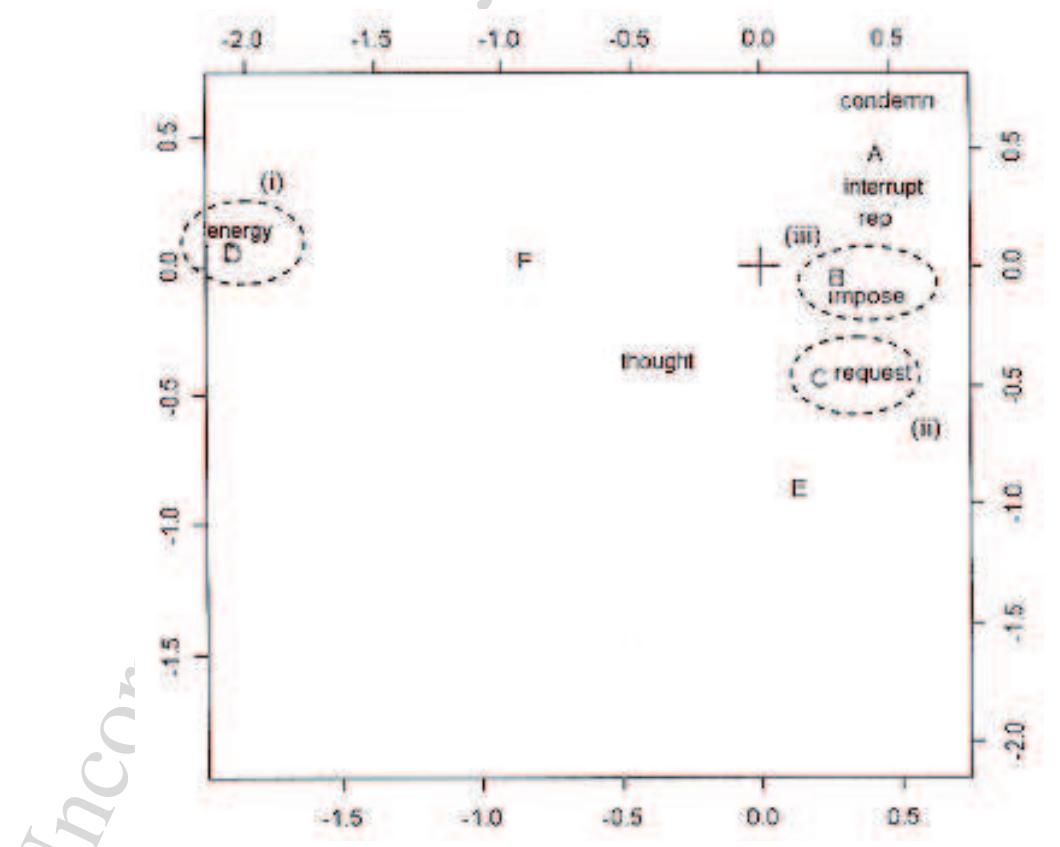
Figure 3. Construction-stimulus correlation in American English - i ~ il = tructional variation, once again using Correspondence Analysis. Again, we see the grouping (i) that is a result of the association between the featur energy” and Patient-Oblique construction (D). This further verifies the association wit 1essed for the British data, especially since the data are less sparse for this construction i he American dataset. Similarly, although less common in American, the semantic featur request” is again highly associated with the resultative construction (ii). Lastly, and als similar to the British data, we have the rough grouping of the more common semanti eatures and more “basic” grammatical constructions (iii). That is to say, relative to th eature “energy” and the Patient-Oblique construction, as well certain other outliers, thes nore general semantic features and constructions are clustered. The principal differenc yetween the British and American results here is the outliers. The Intransitive Construc ion (F) and perhaps also Instrumental-Oblique Transitive construction (E) seem to lac
Figure source:



Abstract: A case study in multivariate corpus-driven Cognitive Semantics. The study seeks to show how 'senses' can be understood as clusters of usage features, relative to social context, rather than discrete semantic categories. The study employs multiple correspondence analysis.


