Books by Florian Scheding
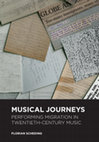
Winner of the RMA/CUP Monograph Prize 2020
Read online at https://www.jstor.org/stable/j.ctvkt... more Winner of the RMA/CUP Monograph Prize 2020
Read online at https://www.jstor.org/stable/j.ctvktrz8q
The displacement of European musics and musicians is a defining feature of twentieth-century music history. Musical Journeys uses vignettes of migratory moments in the works of Hanns Eisler in Paris, Mátyás Seiber in London, and István Anhalt in Montreal to investigate concepts of identity construction and musical aesthetics in the light of migratory experiences.
Moving between the Austro-Hungarian Empire, proto-fascist Hungary, fascist Germany, war-time Britain, post-war Canada, and socialist East Germany, the book explores aspects of musical migrant culture including creative responses to nationalist ideas and politics, the role of cultural institutions in promoting (or censoring) the works of immigrant composers, and the complex interaction between Jewish identity and memory. It contends that an approach to music through the lens of migration can challenge and enrich socio-cultural understandings of music as well as conceptions of music historiography.
Drawing on exile, diaspora, migration and mobilities studies, critical theory, and post-colonial and cultural studies, Musical Journeys weaves detailed biographical and contextual historical knowledge and analytical insights into music into an intricate fabric that does justice to the complexity of the musical migratory experience.
Voted as “Outstanding Academic Title 2010” by Choice Magazine
includes contributions by Michae... more Voted as “Outstanding Academic Title 2010” by Choice Magazine
includes contributions by Michael BECKERMAN, Philip V. BOHLMAN, Sean CAMPBELL, Ruth DAVIS, Björn HEILE, Jehoash HIRSHBERG, Sydney HUTCHINSON, Max PADDISON, Peter PETERSEN, Jim SAMSON, and myself
Reviews in CAML Review/Revue de l’ACBM, Choice Magazine, Music & Letters, Notes, and Yearbook for Traditional Music
Articles by Florian Scheding
Special Issue 'Migratory Musics', Arts 10:3/4 (2022)
Twentieth-Century Music 15:3, 439-92, 2018
The 20th Century has been called the era of displacement, exile, and mass migration. Bringing the... more The 20th Century has been called the era of displacement, exile, and mass migration. Bringing their music with them, migrants arrived in Britain throughout the century from all over the world. To this day, however, there has been no holistic discussion of their impact on British musical life. While excellent scholarly investigations of migrations and mobility as crucial factors for music in Britain have been undertaken, the field is fragmented, with insufficient collaboration across discussions of specific musical genres and diasporic communities. More broadly, musicology has long neglected migrations and migrants in its historicisation of a national cultural history.
This forum places the migrant within discourses on national identity. The authors embrace a multi-faceted approach to the history of Britain’s diverse musical immigrants across a wide range of musical styles and genres that span the entirety of the 20th century, reaching into the late 19th and the early 21st centuries. We reveal the impact of immigrant composers and second-generation migrants and diasporic communities with global backgrounds on popular music, musical comedy, jazz, concert music, folk music, and film music. The forum highlights the connections across genres, the time period, and diverse migrant backgrounds, thus revealing a multi-faceted narrative in which debates concerning ‘the national’ form a current in British musical life and open up questions regarding constructions of a national music history and historiography. The forum thus highlights the contributions of immigrants to British musical life; the extent to which immigrants are, or are not, narrated as part of British music history and the extent to which their musics have been marginalised or otherwise; and what opportunities this poses for an understanding of British music. In combination, the contributions challenge the notion that the migrant and the nation are incompatible, highlighting instead a narrative of (musical) diversity.
Discussing the impact of migration as a sonically enriching experience seems urgent given how current debates frame immigration as a crisis at the heart of national socio-cultural discourses more broadly. Putting music centre stage, this colloquy widens the debate on migration as it encourages a discourse that is not restricted solely to economic, legal, and narrow political contexts. The focus on music allows for an exploration of the impact of highly skilled creative migrants on British cultural history. In turn, it sets it against questions of national belonging and the sonic-cultural narratisation of the nation.
The forum includes contributions by Florian Scheding, Justin Williams (University of Bristol), Catherine Tackley (University of Liverpool), Derek B. Scott (University of Leeds), Erik Levi (Royal Holloway University of London), and Tom Western (University of Edinburgh).
Music & Letters, 2015
Begun on a train from Svendborg in Denmark to Prague in 1937 and developed until his forced depar... more Begun on a train from Svendborg in Denmark to Prague in 1937 and developed until his forced departure from the United States in 1948, Hanns Eisler’s Reisesonate (Travel Sonata) is inextricably linked with the composer’s displacements. This article positions the Reisesonate in several contexts—its material, performance, stylistic, and political histories—that challenge the directional simplicity of emigration as the move from home to exile, from nation to nationless-ness. We situate the sonata’s genesis against the background of Eisler’s travels and discuss strategies in Eisler scholarship vis-à-vis his places.
Mobility emerges in an analytical reading of the work that destabilizes static notions of musical modernism. Performance history and further documentary evidence, including the surveillance files of the British SecretSecurity Service, provide portraits of the composer on the move. We suggest that the Reisesonate provides musical counterpoint to Eisler’s biography, like a travel companion, and sheds light on the journeying that defined his life at mid-century.
Book Chapters by Florian Scheding
(Im-)Mobilität und Exil, ed. Dörte Bischoff, Kristina Schulz, Moritz Wagner., 2025
In the ‘age of the refugee, the displaced person, mass immigration’, to use Edward Said’s descrip... more In the ‘age of the refugee, the displaced person, mass immigration’, to use Edward Said’s descriptor, art song of the 20th century is permeated by its engagement with mobility. In my paper, I focus on two songs, Hanns Eisler’s ‘An den kleinen Radioapparat’ and ‘Berjoskele’ by Viktor Ullmann. Both were written against the background of catastrophe. Ullmann composed his as part of the collection ‘Brezulinka (Drei jiddische Lieder)’ in the Terezín concentration camp in 1944, only months before he was killed in Auschwitz. ‘An den kleinen Radioapparat’, later included in the ‘Hollywooder Liederbuch’, was composed in 1942, during Eisler’s time as a refugee in California. In this sense, both songs charter the displacements and human tragedies caused by political catastrophe. Beyond that, however, they both open up a number of dialectical engagements. I trace the extent to which mobility and stasis intersect in the songs and offer a reading that detects both nationalist as well as internationalist commitments. Against the backdrop of the Shoah, both songs bear witness to the fact that the displaced person, the refugee, and the migrant are simultaneously marginalised, but also located at the centre of history and human narrative. Neither song quotes the other, either implicitly or explicitly, and it is unlikely that either composer knew the other’s song when writing theirs. Nonetheless, both songs contribute towards an emerging nexus of migratory culture and a wider migratory aesthetic of music history.
Rethinking Migration Challenging Borders, Citizenship and Race, ed. Bridget Anderson. Bristol: Bristol University Press, 2025
This text introduces the section on Transformative Representations in Rethinking Migration: Chall... more This text introduces the section on Transformative Representations in Rethinking Migration: Challenging Borders, Citizenship and Race (ed. B. Anderson, 2025). The section concerns two principal areas, both broadly defined. The first is the dialectics of envoicement and unvoicement. Who shapes discourses on migration? Who has access to participating in these debates, and who is excluded from them? Who has the terminological power to label someone a ‘migrant’? We draw on existing debates in migration studies across disciplines and connect these with frequent use of the term ‘voice’ in humanitarian and refugee campaigns. We highlight the importance of access to debates and discourses surrounding migration, mobility and citizenship, and we interrogate the extent to which these enable or disempower the multiple (and often cacophonic) migrant voices. Second, we are concerned with representation. How are migratory voices mediated? Who does the representing, who listens to the representations, and how are they framed? What is the role of media in framing and labelling migration? Our chapters consider traditional and social media, film and music, among other sources, and we seek to remind readers that media representations are not mere commentary from the sidelines. Rather, they are crucial and transformative, central to shaping discourses and creating our imaginary of what migration is.
free access to the entire volume is here: https://bristoluniversitypress.co.uk/rethinking-migration
Rethinking Migration Challenging Borders, Citizenship and Race, ed. Bridget Anderson. Bristol: Bristol University Press, 2025
This text explores musical responses to the Russia– Ukraine war, focusing on three key events: th... more This text explores musical responses to the Russia– Ukraine war, focusing on three key events: the Eurovision 2022 winning song ‘Stefania’ by Kalush Orchestra, Pink Floyd’s collaboration with Andriy Khlyvnyuk, ‘Hey hey rise up’, and the Concert for Ukraine organized by British broadcaster ITV. These case studies raise questions about sonic access and migratory representations, examining the envoicement and silencing of migrant voices. Despite their intentions to support refugees and anti- war causes, the musical examples inadvertently contribute to the exceptionalization of migration and reinforce nationalist narratives. All three case studies are prestigious and well funded, and they reached millions of audience members. They demonstrate music’s ability to build communities and protest border restrictions, yet they also strengthen nationalist ideologies. By shifting the focus to sound and music, I challenge methodological nationalisms, offering a rich perspective on migration and mobility. The text argues that migration is inherently sonic, though this is often overshadowed by visually and textually dominant media. In an era of border closures and refugee debates, this approach provides a valuable alternative to crisis- driven narratives.
Free access to the entire volume is here: https://bristoluniversitypress.co.uk/rethinking-migration
Music and Exile: From 1933 to the Present Day. (Yearbook of the Research Centre for German and Austrian Exile Studies 22.) Ed. Malcolm Miller and Jutta Raab Hansen. Leiden: Brill, 2023, 94-112., 2023
The article deals with the musical activities of the exile organisation Free German League of Cul... more The article deals with the musical activities of the exile organisation Free German League of Culture that was active in the UK during the time of the Second World War, focusing in particular on Ernst Hermann Meyer's role in these activities. The history of the League (especially its musical dimension) has received rather scant attention from scholars, in part because of the lack of access to the materials that were transferred to East Germany after the war. I offer several explanations for the focus of the musical events of the League on the Austro-German canonical music at the expense of modernist music, much of which was written by (Jewish) composers who were forced into exile. Particularly significant was the communist core of the League in advancing ideological positions that foreshadowed debates about nationalism and race in postwar Germany.
Wartime Cabaret: The Laughter of the Hiding Exiled
Their Safe Haven: Hungarian Artists in Britain from the 1930s, Ed. Robert Waterhouse, Manchester: Baquis Press, 2018, 130-5., 2018
This is an abridged version of my chapter ‘“I Only Need the Good, Old Budapest”: Hungarian Cabare... more This is an abridged version of my chapter ‘“I Only Need the Good, Old Budapest”: Hungarian Cabaret in Wartime London’, the full text of which is on my academia.edu page.
Confronting the National in the Musical Past. Ed. Elaine Kelly, Markus Mantere and Derek B. Scott, Abingdon: Routledge, 2018, 49-63.
My chapter focuses on the migratory journey of Hanns Eisler. I discuss how shifts in his composit... more My chapter focuses on the migratory journey of Hanns Eisler. I discuss how shifts in his compositional approaches reveal a musical turning away from nationalism in search of more internationalist idioms on the one hand, and a recourse to traditional Austro-German forms on the other. I argue that this seemingly paradoxical confrontation with the national manifests itself as a dialectical engagement. For example, as a migrant, Eisler re-focused his employment of certain compositional avant-garde idioms, notably that of the Schoenberg School.
Unlike most of his contemporaries, Eisler was displaced twice, falling victim to McCarthyism in the immediate postwar era. This second migratory journey saw Eisler re-emerge into the limelight of music history as composer of the national anthem of the GDR. He now confronted the national very directly, composing a national anthem and actively participating in the creation of new German folksongs for a new Germany. And yet, the socialist promise of the new nation, which resounds in Eisler’s music, ultimately disappointed his search for utopia. Even in East Berlin, Eisler thus confronted the national from a place of heterotopia.
In observing Eisler’s compositional strategies in the heterotopia of mobility, I highlight how, paradoxically, migration acted as a catalyst for a dialectic engagement with nationalism and, in the process, undermines nationalist historiographical approaches to understanding his musics fixated on place.
Partituren der Erinnerung: Der Holocaust in der Musik—Scores of Commemoration: The Holocaust in Music. Ed. Verena Pawlowsky and Béla Rásky, Vienna: New Academic Press, 2015, 261–76
Dislocated Memories: Jews, Music, and Postwar German Culture. Ed. Tina Frühauf and Lily E. Hirsch. New York: Oxford University Press, 2014, 205–21.
Discusses the complex relationship between composer and work through exploration of the reception... more Discusses the complex relationship between composer and work through exploration of the reception of György Ligeti. He does so by questioning the dialectic nexus of Ligeti’s wartime experience and compositional oeuvre. While Schoenberg famously responded to the Holocaust with A survivor from Warsaw, many Jewish composers, albeit deeply affected by the Nazi era, chose to avoid the topic altogether in their work. As a prominent example of this latter path, Ligeti serves here as a case in point—raising serious questions about any one-dimensional explorations of the link between biography and compositional output.
The Impact of Nazism on Twentieth-Century Music. Ed. Erik Levi. (exil.arte 3) Vienna: Böhlau, 2014, 247–71
Migration of musicians between 1933 and 1945 included a number of prominent composers that were a... more Migration of musicians between 1933 and 1945 included a number of prominent composers that were at the forefront of musical developments of their time. Arriving in places virtually everywhere in the world as refugees, these musicians affected the musical lives of their adopted countries, some more so than others. Of the 400 musicians from Austria and Germany that came to Britian during the Hitler years, the activities of several refugee composers are focused on, who came to London in the years following 1933. A common feature of the work catalogues of numerous émigré composers is that they turned to lighter musical idioms after their migrations to England.
Twentieth-century Music and Politics. Ed. Pauline Fairclough. Farnham: Ashgate, 2012, 211–30.
This description of Hungarian cabaret (and other music-related emigré activities) in London – bot... more This description of Hungarian cabaret (and other music-related emigré activities) in London – both during and after the war – unpacks crucial aspects of the emigré experience: political readjustment within a new cultural framework; definitions of ‘Self and Other’, and the tangible impact of a newly transplanted cultural community on the British art scene.
Centre and Periphery, Roots and Exile: Interpreting the Music of István Anhalt, György Kurtág and Sándor Veress. Ed. Friedemann Sallis, Robin Elliott and Kenneth DeLong. Waterloo: Wilfried Laurier University Press, 2011, 111–28.
A composer's biography and work history constitute different and often very distinct narratives. ... more A composer's biography and work history constitute different and often very distinct narratives. This chapter compares those of Mátyás Seiber and István Anhalt, both of them Kódaly students who were displaced as a result of Antisemitism. The argument focuses on the turn both composers made towards serialism following the Second World War and how this change in compositional technique can be related to their displacement.
Music and Displacement: Diasporas, Mobilities and Dislocations in Europe and Beyond. Ed. Erik Levi and Florian Scheding. Lanham, Md.: Scarecrow Press, 2010, 119–34.
Examines the theorization of displacement in the field of Exilforschung (exile studies) in German... more Examines the theorization of displacement in the field of Exilforschung (exile studies) in Germany since 1945 using a historiographic approach that situates exile studies within Germany's wider political history. The promotion of Exilforschung highlights the particular ways in which the two postwar Germanys dealt with the Nazi past. It was also a political act played out against the background of the Cold War in which both East and West Germany aimed to justify and bolster their existence. Rather than viewing the displacement of creative figures (and other elite intellectuals) as tales of passivity, the author describes the displacement as a contextual phenomenon that provided an opportunity for these figures to rebuild their lives outside Germany.
Music and Displacement: Diasporas, Mobilities and Dislocations in Europe and Beyond. Ed. Erik Levi and Florian Scheding. (Europea: Ethnomusicologies and Modernities 10.) Lanham, Md.: Scarecrow Press, 2010, 1–11.
Destination London: German-Speaking Émigrés and British Cinema, 1925–1950. Ed. Tim Bergfelder and Christian Cargnelli. (Film Europa 6.) Oxford/New York: Berghahn, 2008, 230–42.
Book Reviews by Florian Scheding
Yearbook of the Research Centre for German and Austrian Exile Studies 43, 2025



Uploads
Books by Florian Scheding
Read online at https://www.jstor.org/stable/j.ctvktrz8q
The displacement of European musics and musicians is a defining feature of twentieth-century music history. Musical Journeys uses vignettes of migratory moments in the works of Hanns Eisler in Paris, Mátyás Seiber in London, and István Anhalt in Montreal to investigate concepts of identity construction and musical aesthetics in the light of migratory experiences.
Moving between the Austro-Hungarian Empire, proto-fascist Hungary, fascist Germany, war-time Britain, post-war Canada, and socialist East Germany, the book explores aspects of musical migrant culture including creative responses to nationalist ideas and politics, the role of cultural institutions in promoting (or censoring) the works of immigrant composers, and the complex interaction between Jewish identity and memory. It contends that an approach to music through the lens of migration can challenge and enrich socio-cultural understandings of music as well as conceptions of music historiography.
Drawing on exile, diaspora, migration and mobilities studies, critical theory, and post-colonial and cultural studies, Musical Journeys weaves detailed biographical and contextual historical knowledge and analytical insights into music into an intricate fabric that does justice to the complexity of the musical migratory experience.
includes contributions by Michael BECKERMAN, Philip V. BOHLMAN, Sean CAMPBELL, Ruth DAVIS, Björn HEILE, Jehoash HIRSHBERG, Sydney HUTCHINSON, Max PADDISON, Peter PETERSEN, Jim SAMSON, and myself
Reviews in CAML Review/Revue de l’ACBM, Choice Magazine, Music & Letters, Notes, and Yearbook for Traditional Music
Articles by Florian Scheding
This forum places the migrant within discourses on national identity. The authors embrace a multi-faceted approach to the history of Britain’s diverse musical immigrants across a wide range of musical styles and genres that span the entirety of the 20th century, reaching into the late 19th and the early 21st centuries. We reveal the impact of immigrant composers and second-generation migrants and diasporic communities with global backgrounds on popular music, musical comedy, jazz, concert music, folk music, and film music. The forum highlights the connections across genres, the time period, and diverse migrant backgrounds, thus revealing a multi-faceted narrative in which debates concerning ‘the national’ form a current in British musical life and open up questions regarding constructions of a national music history and historiography. The forum thus highlights the contributions of immigrants to British musical life; the extent to which immigrants are, or are not, narrated as part of British music history and the extent to which their musics have been marginalised or otherwise; and what opportunities this poses for an understanding of British music. In combination, the contributions challenge the notion that the migrant and the nation are incompatible, highlighting instead a narrative of (musical) diversity.
Discussing the impact of migration as a sonically enriching experience seems urgent given how current debates frame immigration as a crisis at the heart of national socio-cultural discourses more broadly. Putting music centre stage, this colloquy widens the debate on migration as it encourages a discourse that is not restricted solely to economic, legal, and narrow political contexts. The focus on music allows for an exploration of the impact of highly skilled creative migrants on British cultural history. In turn, it sets it against questions of national belonging and the sonic-cultural narratisation of the nation.
The forum includes contributions by Florian Scheding, Justin Williams (University of Bristol), Catherine Tackley (University of Liverpool), Derek B. Scott (University of Leeds), Erik Levi (Royal Holloway University of London), and Tom Western (University of Edinburgh).
Mobility emerges in an analytical reading of the work that destabilizes static notions of musical modernism. Performance history and further documentary evidence, including the surveillance files of the British SecretSecurity Service, provide portraits of the composer on the move. We suggest that the Reisesonate provides musical counterpoint to Eisler’s biography, like a travel companion, and sheds light on the journeying that defined his life at mid-century.
Book Chapters by Florian Scheding
free access to the entire volume is here: https://bristoluniversitypress.co.uk/rethinking-migration
Free access to the entire volume is here: https://bristoluniversitypress.co.uk/rethinking-migration
Unlike most of his contemporaries, Eisler was displaced twice, falling victim to McCarthyism in the immediate postwar era. This second migratory journey saw Eisler re-emerge into the limelight of music history as composer of the national anthem of the GDR. He now confronted the national very directly, composing a national anthem and actively participating in the creation of new German folksongs for a new Germany. And yet, the socialist promise of the new nation, which resounds in Eisler’s music, ultimately disappointed his search for utopia. Even in East Berlin, Eisler thus confronted the national from a place of heterotopia.
In observing Eisler’s compositional strategies in the heterotopia of mobility, I highlight how, paradoxically, migration acted as a catalyst for a dialectic engagement with nationalism and, in the process, undermines nationalist historiographical approaches to understanding his musics fixated on place.
Book Reviews by Florian Scheding