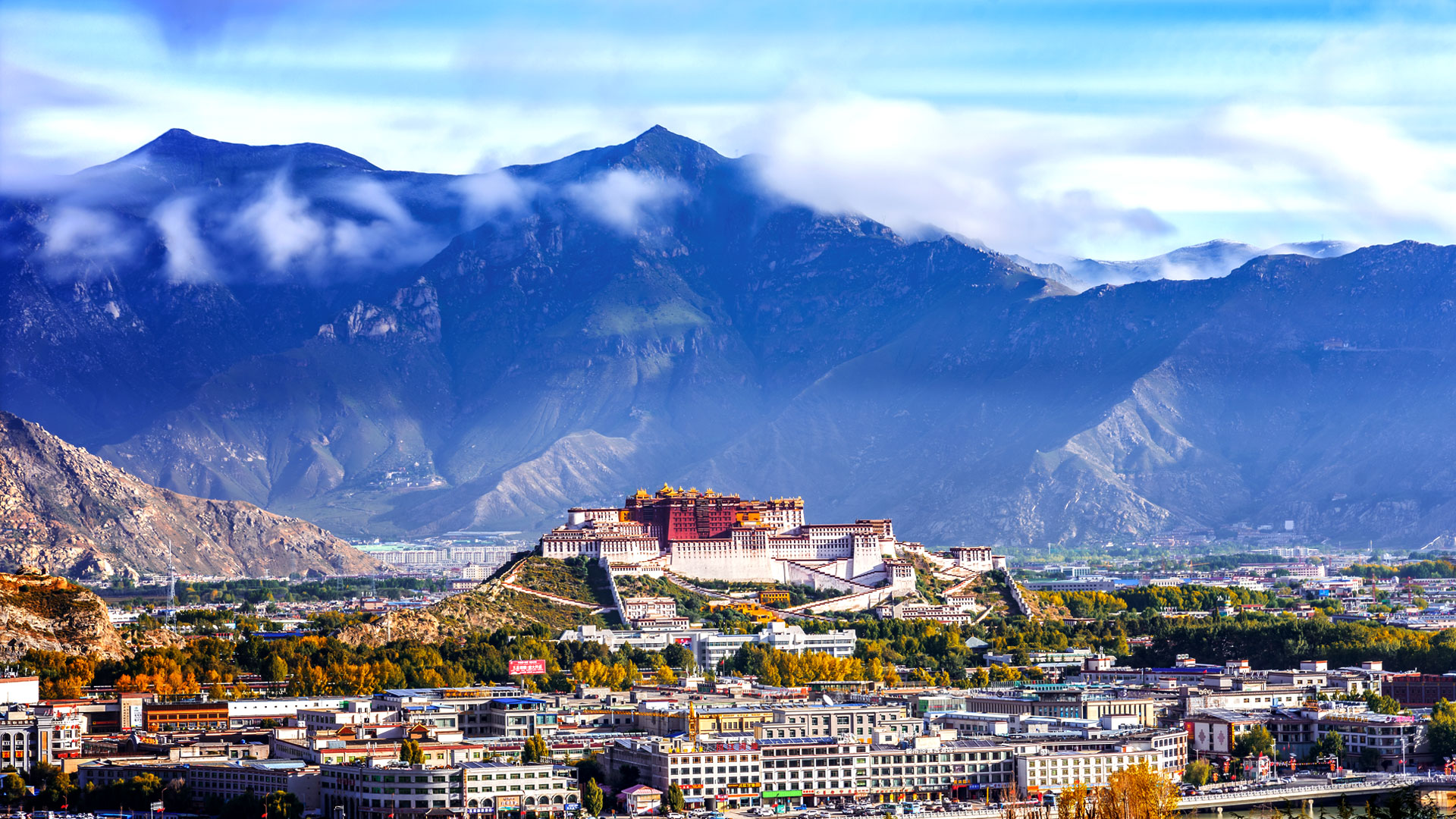
Potala Palace
Synopsis
The Potala Palace in Lhasa stands at 3,700m elevation as the world's highest palace, a UNESCO World Heritage Site and the most iconic symbol of Tibetan culture.
Overview
The Potala Palace (བུ་དྷ་ལ་ག, Bùdálā Gōng) stands atop Marpo Ri (Red Mountain) in the center of Lhasa, the capital of the Tibet Autonomous Region, China. At an altitude of approximately 3,700 meters (12,100 ft), it is the highest-elevation palace in the world and the most iconic architectural landmark of Tibet. The Potala Palace was inscribed as a UNESCO World Cultural Heritage Site in 1994.
The palace's origins trace back to the 7th century when Songtsen Gampo, the Tibetan king of the Yarlung Dynasty, reportedly built the first palace on this site around 637 AD to welcome his bride, Princess Wencheng of the Tang Dynasty. The present structure was begun in 1645 under the order of the 5th Dalai Lama, Ngawang Lozang Gyatso, and took nearly 50 years to complete. From 1649 until 1959, the Potala Palace served as the winter residence of the Dalai Lamas and the seat of Tibet's theocratic government.
The palace takes its name from Mount Potalaka, the mythical abode of Avalokiteśvara (the Bodhisattva of Compassion) in Buddhist tradition. Measuring approximately 400 meters east-west and 350 meters north-south, the complex rises 119 meters above the mountain with over 1,000 rooms, 10,000 shrines, and approximately 200,000 statues.
Architecture
The Potala Palace blends Tibetan dzong-style architecture with Han Chinese, Nepalese, and Indian influences, representing the pinnacle of Tibetan architectural achievement.
The White Palace (Potrang Karpo) is one of the main sections of the complex, constructed beginning in 1645 and completed in 1649. It served as the Dalai Lama's residential and administrative quarters, including the East Great Hall (Tsonkhang), the Sunlight Halls, and other important structures. The East Great Hall is the largest hall in the White Palace, covering 717 square meters, and was the venue for major religious and political ceremonies.
The Red Palace (Potrang Marpo) was built between 1690 and 1694, primarily for religious purposes and housing the stupas of past Dalai Lamas. The Red Palace contains the stupa tomb of the 5th Dalai Lama (Sishi Phuntsog), standing 14.85 meters tall, covered in gold leaf, and inlaid with tens of thousands of precious gems — one of the Potala's most treasured artifacts. The Red Palace also houses the stupas of the 7th through 13th Dalai Lamas.
The Potala's walls feature a distinctive inward-sloping design — the base is 5 meters thick, averaging 3 meters throughout, with copper poured into the foundations for earthquake protection. The complex rises 13 stories, utilizing over 60,000 tons of stone along with timber, earth, and other traditional building materials.
History
The Potala's history extends to the 7th-century Tibetan Empire. After unifying Tibet, Songtsen Gampo moved the capital to Lhasa and built the first palace on Red Hill. Legend holds that this palace had 999 rooms, plus a royal meditation chamber at the summit, totaling 1,000 — built to welcome Princess Wencheng of the Tang Dynasty and Princess Bhrikuti of Nepal.
In 1642, the 5th Dalai Lama, with military support from Mongol leader Gushi Khan, assumed political control of Tibet. In 1645, following the advice of his spiritual tutor Konchog Chophel, the 35th Ganden Tripa, he decided to rebuild the palace on Red Hill as the new political and religious center. The external structure was completed in just 3 years, but the interior and furnishings took 45 years. In 1690, Desi Sangye Gyatso initiated construction of the Red Palace, which was completed in 1694 — 12 years after the 5th Dalai Lama's death.
During the 1959 Tibetan uprising, the Potala sustained moderate damage from shelling. During the Cultural Revolution, Premier Zhou Enlai personally intervened to protect the palace from wider destruction. However, according to Tibetan historian Tsering Woeser, the palace — which harbored "over 100,000 volumes of scriptures and historical documents" and "many store rooms for housing precious objects, handicrafts, paintings, wall hangings, statues, and ancient armour" — was "almost robbed empty."
Conservation & Restoration
The Potala Palace was inscribed on the UNESCO World Heritage List in 1994. In 2000 and 2001, Jokhang Temple and Norbulingka were added as extensions to the heritage site.
Between 1989 and 1994, the Chinese government invested 55 million yuan (US$6.875 million) in the first major restoration of the Potala. In 2002, a second phase of renovation was launched at a cost of 180 million yuan (approximately US$22.5 million), strictly using traditional materials and craftsmanship.
To protect the palace, daily visitor numbers were capped at 1,600 starting in May 2003, later raised to 2,300 following the opening of the Qingzang Railway to Lhasa in 2006. After restoration was completed in 2006, roof visits were banned to prevent further structural damage.
Practical Information
| Item | Details |
|---|---|
| Location | 35 Beijing Middle Road, Chengguan District, Lhasa, Tibet Autonomous Region |
| Opening Hours | Peak season (May-Oct): 9:00-18:00; Off-season (Nov-Apr): 9:30-17:00 |
| Admission | Peak: 200 yuan/person; Off-season: 100 yuan/person |
| Best Season | May-October (mild weather) |
| Transport | ~1 hour from Lhasa Gonggar Airport to city center; ~20 minutes from Lhasa Railway Station |
| Visit Duration | Recommended 2-3 hours |
| Notes | Daily quota of 2,300 visitors; advance booking required; no photography inside the palace |
Cultural Significance
The Potala Palace is not only the pinnacle of Tibetan architecture but also a vital symbol of Tibetan Buddhist culture and Tibetan history. It bears witness to over a millennium of political and religious change in Tibet and serves as the most important window into Tibetan history, culture, and religion.
The image of the Potala Palace appears on the reverse of the 50-yuan note of the fifth series of the Chinese Renminbi, making it one of the iconic representatives of China's national image. Together with Jokhang Temple and Norbulingka, the Potala Palace forms the Historic Ensemble of Lhasa, hailed as "the Pearl on the Roof of the World."
References
- Wikipedia - Potala Palace
- UNESCO World Heritage - Historic Ensemble of the Potala Palace, Lhasa
- Baidu Baike - 布达拉宫
- Potala Palace Official Website
- The New York Times - Potala Palace travel guide
Stills & Gallery
Comments (0)