Books by Francesca Brancaccio
Le mura urbiche. Il cantiere di restauro, 2017
Saggi in onore di Giovanni Carbonara, 2021
Proceedings for the Seventh International Conference Kerpiç’19 Earthen Heritage, New Technology, Management, 2019
The analysis of the structural behavior of the archeological walls involved historical knowledge, geometric survey, analysis of discontinuities, the evaluation of the causes of the disruption and the identification of the interventions. Each technical sheet has been structured by identifying the failure and the causes and providing intervention proposals in compliance with operational practices adopted in the Site, aimed at safeguarding the archaeological asset. The design also includes the work on re-profiling earth excavation fronts, excluding the archeological excavations envisaged.
The detailed survey gives the opportunity to establish a chart of risk, by considering different elements (geometries, presence of elements of values, structural problems). Some devices were adopted to improve the accessibility and the quality of the touristic visit in places considered “at risk” for accessibility. Fruition and valorization are conceived in a modern way: the places that cannot be visited by tourists can be seen from a suspended pathway, in order to allow visitors to understand more, and without any risk. A special attention has been given also to planned maintenance for the future.
Keywords: evaluation of risk, prevention techniques, Pompeii archaeological heritage, earth front of excavation.
RESTAURANDO POMPEI Riflessioni a margine del Grande Progetto, 2018
The so-called 'Gym' is located between the porch on the east and the boundary wall on the west, while on the north it borders the series of thermal rooms of the Male sector. The female thermal sector is inserted in the northwest corner of the block.
The project aims to arrest degradation, secure the site, removing the causes that threaten the preservation of items and that makes some areas impossible to use. The site has been object of extensive scientific study, considering the set of values, from all historical, archaeological, geological, material, architectural and structural points of views, with particular attention to the use and to planned maintenance. The in-depth and wide-ranging allowed to lead to a conscious design, based on the initial "recognition" of the values, and aimed at preservation and transmission of these values recognized.
RESTAURANDO POMPEI Riflessioni a margine del Grande Progetto, 2018
Inquadramento storico-urbanistico
Breve introduzione dell'insula dei Casti amanti (il contesto della Regio IX; lo scavo archeologico; le unità edilizie presenti nell'insula).
Descrizione dell'area
Descrizione delle strutture archeologiche, con breve riferimento alla storia edilizia dell'insula, alle condizioni di conservazione ed agli interventi precedenti.
Descrizione degli interventi
Quadro generale delle principali tematiche che compongono l'intervento e breve introduzione alle soluzioni di progetto per ogni specifico aspetto (copertura, fronti di scavo, scavo archeologico, restauro, messa in sicurezza elevati murari, fruizione e valorizzazione).
2 INTERVENTI
Copertura
Considerazione sul rapporto tra aree archeologiche e contesto. Considerazioni riferite ad aspetti archeologici. Considerazioni riferite ad aspetti architettonici, anche in rapporto con il contesto. Soluzione adottata.
Geologia, fronti di scavo e sistemazione idraulica ed idrologica
Breve inquadramento geologico anche in riferimento alle precedenti attività ispettive eseguite (Patti). Brevi cenni sulla caratterizzazione geotecnica dei terreni. Analisi e soluzioni di progetto. Brevi cenni sull'analisi idrologica e conseguenti interventi di progetto.
Scavo archeologico
L'interpretazione della storia edilizia dell'insula dei Casti Amanti. Analisi delle problematiche legate alla presenza di aree ancora non scavate (aree interne all'insula; peristilio insula IX 11). Le soluzioni di progetto (scavo funzionale alla realizzazione della nuova copertura; scavo per la comprensione e la fruizione dell'insula; scavo per il miglioramento delle condizioni di conservazione dei manufatti archeologici).
Restauro
Considerazioni sullo stato di conservazione con cenni alle attività ispettive condotte in sede di progettazione (mappature, rilievi, indagini strumentali in situ, indagini di laboratorio). Schematizzazione delle principali problematiche. Interventi e soluzioni di progetto. Piano di monitoraggio continuo. Le indicazioni fornite alla progettazione architettonica.
Messa in sicurezza degli elevati murari
Introduzione dell'analisi del comportamento strutturale degli elevati murari. Descrizione delle problematiche riscontrate (opere di presidio presenti). Descrizione della campagna diagnostica condotta in fase di progettazione. Soluzioni adottate (telaio a cavalletto, telaio a contrasto, telaio a portale). Rimando ai puntuali intervento di restauro della muratura.
Fruizione e valorizzazione dell'insula dei Casti Amanti
Considerazioni sulla fruizione del bene archeologico con riferimento a differenti approcci. Il caso dei Casti Amanti con il cantiere evento del 2010 e la realizzazione della passerella sospesa. L'idea di un percorso integrato ed il controllo - e contingentamento - dei flussi alla quota pavimentale, con riferimento all'analisi sulle vulnerabilità e gli elementi funzionali alla narrazione. Brevi cenni sulla comprensione degli spazi (realizzazione di controsoffittature in rete elettrosaldata, es. artista Eduardo Tresoldi, basilica di Siponto).
Il cantiere
Un approccio valutato sul caso specifico all'interno di un delicato contesto come Pompei. La valutazione dell'impatto di ogni lavorazioni sulle aree archeologiche e sulla integrazione delle lavorazioni.
The priorities:
- Respect the ancient building
- Employ traditional techniques and materials.
The goals:
- Natural lighting (passive solar design)
- Water recovery (underground rainwater storage)
- Thermal mass consideration
- Reduction of consumptions in lighting, heating and cooling systems (high performance technologies)
- Natural ventilation (manual devices)
- Integration of renewable energies (rebuilding the roof with semi-transparent PV modules)
The project was considered by the UNESCO delegation as “best practice”.
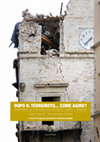
An architecture is a recognized place, because people live there, and can populate and modify it. It is made up of structures and images inherited from history. When the collective identity, structured in a place, is related to earthquakes and catastrophes, it is necessary to find ways to deal with the physical consequences, but also the symbolic and cultural ones. Almost all the Italian regions today present one or more stories of disasters, abandonment, reconstruction, and some of these can be useful to grasp the meaning of the current debate: there is a "before" and a "after", and there are so many changes, that nothing can ever be like before. Spaces move, change, and die; ruin is the tangible sign, material of abandonment. The choice between rebuilding on site or elsewhere - "where it was as it was" - or "where it was not and how it was not", sees numerous hypotheses and different stakeholders in the field. The reconstruction - however realized - will never restore the traditional community, but will follow the divisions and conflicts of new life. In the decisions on where and how to reconstruct, it is necessary to put the problem of the future of communities at the center of the technical discussion: investing in knowledge, study, understanding, physical and symbolic recovery of a collective memory, which otherwise disappears or risks being irremediably falsified. Here are some case studies of restoration and seismic improvement of some heritage buildings in Italy

Papers by Francesca Brancaccio
Diagnosis for the Conservation and Valorization of Cultural Heritage, 2025
Set up in a sequence marked by five courtyards, the “machine for hosting” tran-slates each function into a clear layout, embodying social and hygienic rules in a typological organization. The central forepart is home to the administration, the central courtyard hosts the church, and the volumes around the courtyards are designated for the poor, separated by gender and age. A hierarchy establishes precise relationships between serving spaces and served spaces, between rooms and corridors, between levels and stairs; movements are regulated to prevent promiscuity: large staircases for the poor, smaller staircases for the ministers, and pathways used only by the priests. Ultimately, only three of the five cour-tyards were completed; the posterior and lateral factory structures remain unfi-nished, and the church was never completed. The immense container, modified and divided, intended for various functions, will experience alternating fortunes that record an overlapping of phases, contaminations, destinies, and modifica-tions that have altered its reading and perceptions.
The knowledge, acquired through historical-archival research, analyses, and direct observations, has been supplemented with surveys, non-destructive in-vestigations, and analyses on the nature and conservation of materials, provi-ding adequate dimensions and profiles, verifying events, and allowing for the formulation of a picture of the state of the places. The correspondence between the measurement system adopted in the construction – Neapolitan palm and current canne – and the dimensions and compositional rules has been verified; comparisons with similar designs by Fuga, both prior and subsequent, Roman and Neapolitan, along with recent instruments used to verify data and measurements, have contributed to reestablishing a logic in the reading and organization and use of the planned spaces. The utopian machine of the Real Albergo dei Poveri, hospice, reformatory, laboratory, factory, its stories of suffering, pover-ty, but also of absolute autarky, even thanatological, hope and education, await today further urgent interventions and an immediate reuse, based on minimal intervention and integration, with a view to the opportunity to finally become a civitas.
Atti del XVI Convegno Internazionale Diagnosis for the Conservation and Valorization of Cultural Heritage, 2025
of the restoration of the southern facade of Palazzo Donn’Anna in Naples, starting from the in-depth knowledge gained from the material characterisation of masonry and the stratigraphic examination of the upper floors, as well as from on-site and laboratory investigations. It also discusses the methodological issues raised by the need to eliminate some recent interventions that are incompatible with the historicised consistency of the building and cause obvious material degradation.
Finally, it illustrates the adoption of materials and technologies that are physically and chemically compatible with the monumental context, characterised by particularly difficult environmental conditions.
CITTÀ CHE SI ADATTANO? ADAPTIVE CITIES - Tome 1?, 2024
A+ ARCHITECTURE / URBANISME / DESIGN / ARTS PLASTIQUES, 2000
Intervenir sur le bâti. : Andrea Bruno, l'observatoire de l'architecture
Il nuovo edificio per l'Ospizio di carita' di Torino (1876-1896): rappresentazioni, conflitti e strategie in un cantiere di fine Ottocento