Books by Ian L . J . Tian
Asian Canada Is Burning: Theories, Methods, Pedagogies, and Praxes
Brill , 2025
Asian Canada is Burning is an invitation to trouble the mobilization of “anti-Asian hate” in the ... more Asian Canada is Burning is an invitation to trouble the mobilization of “anti-Asian hate” in the aftermath of the COVID-19 pandemic. Bringing together activists, organizers, academics, and artists, this book explores the historical and contemporary conditions that make theorizing “Asian Canadian” feasible. Grounded in a transnational queer and feminist lens, this book also aims to envision possible futures and solidarities. Ultimately, this collection is concerned with moments and places of tension, confrontations, relations, and solidarity. We offer stories of insurgent encounters as people who identify as “Asian” navigate and implicate settler colonial nation-states to make new dreams, histories, and intimacies.
Papers by Ian L . J . Tian
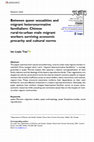
Sexualities , 2026
This paper examines how sexual nonconforming, rural-to-urban male migrant workers in mainland Chi... more This paper examines how sexual nonconforming, rural-to-urban male migrant workers in mainland China navigate what I term "migrant heteronormative familialism," a concept grounded in queer Marxist analysis that captures a distinct conceptualization of natal family relations and the ideology of the hetero-reproductive family. Their negotiations are shaped not only by sociocultural norms but also by material concerns specific to migrant workers that include insufficient access to social welfare, hukou restrictions, and transient migrant lives. These structural constraints reinforce their dependence on their natal families for care and affective investment in a hetero-reproductive future. Ultimately, the paper explores how workers navigate heterosexual familistic norms to access socioeconomic resources while sustaining non-normative sexual lives on the margins of ruralto-urban migrant communities.
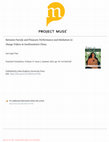
Feminist Formations, 2025
In recent decades, extensive research has explored gender and sexual performances, though much of... more In recent decades, extensive research has explored gender and sexual performances, though much of it has focused on urban Western contexts. This essay redirects scholarly attention to rural Yunnan, a province in Southwestern China, specifically examining commercialized shange (mountain songs) VCDs produced in the early 2000s. These videos feature parodic performances of gender and sexual transgressions and have gained a cult following in China and across East Asia. Using a scavenging methodology, I argue that representations of femininity in these videos, either by cis women or bian zhuang (cross-dressing) performers, can be interpreted as performative commentaries on the shifting gender and sexual propriety amidst rural-urban inequality intensified by China’s economic reform. These parodic perfor- mances portray the perceived sexual and gender improprieties as dangerous symptoms of capitalist expansion into rural Yunnan villages. At the same time, they reveal a performative excess: a liminal pleasure in embodying the perverse.
Communication and Critical/Cultural Studies , 2025
This paper approaches queer digital culture through social reproduction. It argues that queer peo... more This paper approaches queer digital culture through social reproduction. It argues that queer people's communicative acts on digital platforms are socially reproductive, yet the "hidden abode" subsumed by contemporary capitalist expansions. However, this subsumption creates remaindering opportunities for alternative relationality. Using four Chinese gay couples' vlogging on Bilibili, I analyze vlogs and danmu textsto show, first performances of social reproduction are raw materials for communicative production. Second, communicative acts that reproduce the social are captured and reorganized by the platforms' interaction protocols. I highlight how danmu can be understood as a communicative means of reproducing a virtual reparativity.
Made in China Journal, 2025
This essay tells stories of gender and sexually nonconforming rural-to-urban migrant workers in t... more This essay tells stories of gender and sexually nonconforming rural-to-urban migrant workers in two urban villages in Southern China. Based on an ethnography of their community-making through ‘cruising’—a pratice of seeking non-heterosexual sexual encounters in semi-public spaces—I argue that ‘queer life’ in China is divided by a spatialised structure of class. While LGBTQ+ individuals who are urban middle-class residents have gained visibility in tier one and tier two cities, migrant workers in these same cities face precarious conditions. This should compel the LGBTQ+ movement to ask different questions and confront its own economic and spatial exclusions.
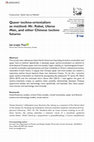
Media, Culture & Society, 2025
This article inter-references Asian North American theorizing of techno-orientalism and queer Asi... more This article inter-references Asian North American theorizing of techno-orientalism and queer Asia as method. Specifically, it develops queer techno-orientalism as method to think beyond Chinese queer and trans bodies' hyper visibility as "technologized threats" in techno-orientalist representations and their invisibility in China's cisheteronormative, nationalist hi-tech future. It argues that Chinese queer and trans bodies can reclaim a reparative techno future beyond these two dominant frames. To do this, I practice queer techno-orientalism as method by juxtaposing the cyberpunk TV series Mr. Robot (2016-2019) and the animated short Uterus Man (2013). I read against the grain of techno-orientalist tropes to explore other possible relationships between Chinese queer/trans bodies and technology more specifically, and between East Asian queer/ trans futures and technology more broadly.
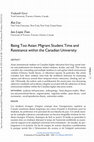
TOPIA, 2023
As an nternat onal students n Canad an h gher educat on have long caused anxety and pred cament f... more As an nternat onal students n Canad an h gher educat on have long caused anxety and pred cament for domest c (wh te) students, faculty, and staff. Th s art cle cons ders the contend ng and mult ple t mel nes n and aga nst wh ch nternat onal students (Ch nese, South As ans, or otherw se) operate. In part cular, th s art cle cons ders how these students t me-tr ck the neol beral un vers ty by exam n ng reports and advocacy around three temporal events: extens ons, cheat ng and su-119 c de. Ult mately, the authors seek to problemat ze the moral pan c over decreas ng adm ss on standards and academ c ntegr ty assoc ated w th the adm ss on of As an nternat onal students w th n the Canad an h gher educat on system. KEYWORDS: academ c nfrastructures, anthropology, As an d aspora stud es, Marxsm and postcolon al theory, m grant just ce, m grat on stud es, queer theory, soc al movements, soc al reproduct on theory, un vers t es stud es RÉSUMÉ Les étud ants étrangers d'or g ne as at que dans l'ense gnement supér eur au Canada const tuent depu s longtemps une source d'anx été et d'embarras pour les étud ants, les professeurs et le personnel de race blanche du pays. Cet art cle examne les mult ples échéances contrad cto res en fonct on desquelles évoluent les étud ants étrangers (Ch no s, As at ques du Sud ou autres). Il étud e en part cul er la man ère dont ces étud ants déjouent le temps de l'un vers té néol bérale en examnant les rapports et les pla doyers entourant tro s événements : les su c des, les prolongat ons et la tr cher e. En f n de compte, les auteurs cherchent à problémat ser la pan que morale l ée à l'aba ssement des normes et de l' ntégr té un vers ta re TOPIA 47
International Journal for Equity in Health , 2023
Objective Epidemics impact individuals unevenly across race, gender, and sexuality. In addition t... more Objective Epidemics impact individuals unevenly across race, gender, and sexuality. In addition to being more vulnerable to COVID-19 infection, evidence suggests racialized gender and sexual minorities experienced disproportionate levels of discrimination and stigma during the COVID-19 epidemic. Drawing on Critical Race Theory (CRT), we examined the experiences of gay, bisexual, queer, and other men who have sex with men (GBQM) of colour facing discrimination during COVID-19. Design Engage-COVID-19 is a mixed methods study examining the impact of COVID-19 on GBQM living in Vancouver, Toronto, and Montréal, Canada. We conducted two rounds of qualitative interviews (November 2020 to February 2021, and June to October 2021) with 93 GBQM to explore the evolving impact of COVID-19 on their lives. Transcripts were coded using inductive thematic analysis. Data analysis was conducted using Nvivo software.
TOPIA: Canadian Journal of Cultural Studies , 2023
This article focuses on the culture and politics of apology for injustice against LGBTQ+ people i... more This article focuses on the culture and politics of apology for injustice against LGBTQ+ people in the context of Anglo-European, liberal democratic nationstates. I examine the circumstances and limits of Justin Trudeau's apology for the gay purge and related initiatives since November 2017. I contend that while the normative affective structure of liberal apology mandates a move from mythical homo sorrow to mythical reparation, jettisoned affects, experiences and activism from below exceed the state's directive for reparation and forgetting. I name such excesses divine queer sorrow. More specifically, I trace the remaindered and peripheral affect of testimonies and activism to think about not only a queer affective structure of forgiveness but also a transformative future stemming from activist sensibilities.
Rethinking Marxism , 2022
Recent publicity of Chinese feminist activism highlights the urgency for scholarly attention to h... more Recent publicity of Chinese feminist activism highlights the urgency for scholarly attention to historically and contextually grounded knowledge about socialism and feminism. This essay explores current Chinese feminism as a contentious and geopolitically mediated subject, introducing critical socialist feminism within the Chinese feminist theorizing that has emerged in the last decade. Specifically, the essay discusses how several scholars reexamine gender, socialist legacy, and community-based socialism and argues that this new terrain of Chinese feminist theory should be read critically while paying attention to recent theoretical developments in East Asia. Grounded in the context of Chinese state capitalism, critical socialist feminism holds potential to challenge certain Eurocentric tendencies in the transnational flow of socialist feminism.
Upping the Anti, 2021
Written against the grain of Cold War Orientalism, this paper brings ‘socialism’ from the hegemon... more Written against the grain of Cold War Orientalism, this paper brings ‘socialism’ from the hegemonic and centralized state back to the everyday struggle in workspaces, sweatshops, and communities. I will first give a brief but historically grounded understanding of the so-called transition to capitalism. Second, although the integration of global capitalism helps to stabilize the hegemonic political elite who have deployed socialism as a discourse for the past 20 years or so, theories and organizing, largely underground, have been developing and providing the possibility for critical socialism, a type of socialism that sometimes converges and diverges with the state socialist discourse mobilized by the CCP, which some Left activists call ‘Huang ma 皇馬 (Marxism of the Emperor).’
Journal of Canadian Studies (Queer Canada Special Issue), 2021
This article questions the political branding of settler Canada as a place of sanctuary. I examin... more This article questions the political branding of settler Canada as a place of sanctuary. I examine two seemingly paradoxical processes: "private-public partnership" in queer refugee settlement programs and migrant detention centres in Canada. This article argues that rescue and capture are not contradictory, but dialectical features of human bioeconomy. Such an economy renders the reproduction of life, vitality, and time bioavailable for extraction. In this sense, the queer refugee as rescuable and the detained as expendable are both the subject of value extraction. Although human bioeconomic processes do not promise life vitality, queer refugees and migrants do find ways to assemble a liveable life. Taking cues from Saidiya Hartman's "innovators of life genre," I discuss community building as processes of queer reproduction of liveability, countering bioeconomic violence.
Résumé : Cet article examine l'image politique du Canada colonial en tant que sanctuaire. J'examine deux processus en apparence paradoxaux : les « partenariats privés-publics » dans les programmes d'établissement de réfugiés queers et les centres de détention des migrants au Canada. Je soutiens que sauver et capturer ne sont pas contradictoire, mais des aspects dialectiques de la bioéconomie humaine. Une telle économie rend la reproduction de la vie, la vitalité et le temps biodisponibles pour extraction. Dans ce sens, le réfugié queer en tant que sauvable et le détenu en tant que sacrificiable sont tous deux le sujet d'une extraction de valeur. Bien que les processus de bioéconomie humane ne promettent pas une vitalité de vie, les réfugiés queers et les migrants trouvent tout de même des moyens de créer une qualité de vie. En m'inspirant des « innovateurs du genre de vie » de Saidiya Hartman, je discute de la création de communautés et j'examine les processus de la reproduction queer de qualité de la vie, contrant la violence bioéconomique.
QED: a journal of GLBTQ Worldmaking , 2020
This article offers a queer postsocialist lens to theoretical contestations around neoliberalism,... more This article offers a queer postsocialist lens to theoretical contestations around neoliberalism, socialist legacies, capitalist reform, and the Chinese state. I fore- ground a queer Marxist position by situating Chinese capitalist developmentalism in global racial capitalism. I examine a recent GLBTQ hiring event in Shanghai alongside publications and personal involvement with the socialist organization “Queer Workers.” Based on this analysis, I contend that, rather than taking the Chinese state’s leftist legacies for granted, queer Marxism should be read as critical Marxism in the global postsocialist present. In the Marxist perspective, the sexual politics of queer liberation is inherently anti-statist and anti-capitalist. Further, queer Marxism in China, while remaining tied to postsocialism and the afterlife of the Cold War, should be situated within the broader struggle against racial capitalism. Groups like Queer Workers should be taken seriously as they are actively making space for historically and geographically grounded postsocialist radicality on their own terms.
Invert , 2020
Our project is an intervention of, by and for queers in Asia specifically and the Global Sout... more Our project is an intervention of, by and for queers in Asia specifically and the Global South more generally. We foreground that a decolonial queer Marxist critique has to be grounded and contextualized. To countenance this argument, we critique two publications on queer Marxism; Warped and The Politics of Everybody. We argue that some streams of queer Marxism do not consider the coloniality of power; thus continue to disregard violence deployed on the bodies living in the South through the global cheapening and exploitation of the peripheral population. Further, it seems to set the tone for what is a ‘proper’ queer Marxist critique so the rest of the world can follow. Our relative work in China, Iran and India bring lived experiences of activists and demonstrate that queer liberation in these localities inevitably addresses issues of state-form (nation-state), capitalism, post-coloniality and post-sociality. Queer Marxism that only centres white urban workers in the North does not liberate but further disadvantage queers in the South. Anti-capitalist sexuality in the ‘peripheral’ innovates and decolonizes resistance to navigate multiple layers of power. What we call ‘decolonized queer Marxism’, then, has to engage with the uneven development, dialectics and the nation-state system that are intertwined with the praxis of global racial capitalism, heteropatriarchy of various forms and the construction of gender binary.
QED:A Journal in GLBTQ Worldmaking, 2019
Grounded in my activist labour over the past few years, this article delineates the current stat... more Grounded in my activist labour over the past few years, this article delineates the current state of Ku’er (queer) politics in (post)socialist China. I contribute to the discussion of GLBTQ politics in a non-Western context by asking questions about the ways in which the power of the state is negotiated by activists. I join a conversation with Shirinian about the possibility and the consequences of being seen. I begin my reflections with an overview of GLBTQ activism in China, Hong Kong, and Taiwan, focusing on China where my activist and scholarly work is based. Following a discussion of specific socialist and authoritarian legacies, I argue that queer activism in China has adopted a framework I call “graduated in/ visibility” in order to organize and navigate repressive policies. This scheme of visibility affords queer people the ability to mobilize, but it is not without drawbacks. Indeed, in the final section, I consider the purpose and the politics of visibility in relation to what has been called “global neoliberal queering.” Further, I ask what the desire for visibility, acceptance, and assimilation mean in the context of an authoritarian capitalist regime. My intention is not to brand China as “bad capitalism” or a “backward society,” nor am I embarking on a detailed political analysis of the Chinese Communist Party and its sexual politics after the opening the country. Rather, I attempt to highlight the importance of activist knowledge in the context of emerging studies of Third World sexuality, which is unfortunately shaped by the coloniality of power, global capitalism, and imperialism.
Intersectional Apocalypse, 2018
I focus on online posts and hashtags circulated after the news that two lesbians were caned in Ma... more I focus on online posts and hashtags circulated after the news that two lesbians were caned in Malaysia. I unpack some perhaps unintended consequences of speaking from the diaspora in relation to settler/orientalist homonationalism and imperialism. I ask what are the assumptions behind 'diasporic blaming'; in what ways does such blaming exceed or conform to the discursive limits of the transnational white settler nationalism; how do people like me who are from these 'backward' places think through and criticize such blaming and how can we critically engage with the imagined 'non-West' from the location of a settler colonial and anti-immigrant (especially queer refugees) nation-state known as Canada. Content warning: the q word will be used as an act of reclaiming
Book Reviews by Ian L . J . Tian
Sexualities , 2026
When cruising emerged as a distinct sexual culture amongst gay men and down low trades (masculine... more When cruising emerged as a distinct sexual culture amongst gay men and down low trades (masculine presenting men who have sex with men but identify as straights), writers emphasized how such practices challenge the regimented private/public divide of bourgeois family and personhood. What counts as acceptable sex and where it must take place are key questions posed by a wide range of scholars of cruising trained in literature, sociology, anthropology, and geography. Queer theorists like the late José Esteban Muñoz have used cruising as a methodology for thinking about the future as ephemeral, just as the sexual pleasure experienced through cruising is equally fleeting. With the advent of digital platforms, the gathering of people in semi-public spaces seems to be disappearing. Replaced by digital cruising on apps such as Grindr, new forms of pleasure and personhood emerge, to the point that many claim cruising in postmodern urban space has largely fallen away from the contemporary gay male sex culture of Gen Z and Millennial men. Crossings: Creative Ecologies of Cruising intervenes in this critical juncture by rethinking cruising as more than casual sexual encounters between (white) macho bodies. Co-authored by a genderqueer artist and a queer academic, the book treats cruising and sexuality not as individualized experiences but as forms of relationality and sociality that connect bodies of all shapes and genders, while holding on to the political potentials of cruising in an era of global surveillance and digital economies. What remains of cruising, the authors ask, if not the "affect, desire, erotic kinship, and pleasure" that "carry us away from all the ways we told ourselves that certain things fit in certain places, that certain bodies belong here, and others belong there." (p.4) To explore these possible connections
Critical Sociology , 2026
Nellie Chu's Precarious Accumulation offers a compelling account of migrant bosses who joined Gua... more Nellie Chu's Precarious Accumulation offers a compelling account of migrant bosses who joined Guangzhou's booming global fast fashion industry by opening small workshops, storefronts or export companies. This book draws on long-term ethnographic research among urban migrant entrepreneurs and transnational migrants from West Africa and South Korea in Guangzhou, a city in southern China that serves as a key node in the global fast-fashion supply chain -home, for instance, to the supply headquarters of SHEIN. Yet Chu's focus lies elsewhere: on the small "fish" folded into this chain through outsourcing and subcontracting. These bosses play crucial roles in producing, circulating, and selling just-in-time fashion worldwide, but their stories are often absent from supply-chain discussions centered on logistics, circulation, and economic data. Core to Chu's argument is that bosshood represents a transitional form of personhood that both internal and transnational migrants adopt to navigate the highly volatile markets in pursuit of class mobility and fortune. These "entreprecariats" embody the "spirits of entrepreneurship" and "selfemployment" (p. 17), yet their status remains precariously tied to capital accumulation, social hierarchies, and shifting political conditions. By examining how vulnerable populations turn to risky ventures in fast fashion, Chu disrupts the binary between sweatshop worker and globe-trotting entrepreneur, revealing how migrants envision new possibilities through innovative practices that nonetheless "leave them in conditions of precarity" (p. 5). To explore these contradictory processes, the book is organized in two ways. First, Chapters 1 to 3 focus on small workshop production and the regulation of space, while Chapters 4 and 5 examine product distribution in wholesale markets and through transnational export companies. The book also centers on two distinct yet interconnected groups: internal migrants within China and transnational migrants from South Korea and West Africa. Chapter 4 foregrounds internal migrant workers who become bosses in wholesale markets, whereas Chapter 5 is devoted to transnational migration, bosshood, and religion. Chapters 1 to 3 link both groups within the broader history of China's postsocialist transition in labor, land, identity, and global capitalism. Chapter 1 serves as the "historical" chapter of the ethnography. It situates rural-to-urban migrant workers within China's postsocialist economic transition, which disavowed the peasant subject and dismantled the collective land-tenure system. With market liberalization, rural peasants migrated to cities, while those living near major urban centers found their villages absorbed by urban expansion and became landlords by asserting their land-use rights. These processes have been widely documented by scholars such as Alexander F. Day, Eli Friedman, Pun Ngai amongst others; Chu 1434640C RS0010.1177/08969205261434640Critical SociologyBook review book-review2026 Book review
Sexualities , 2024
Miller's work underscores how local communities navigate and negotiate globalized identitarian fr... more Miller's work underscores how local communities navigate and negotiate globalized identitarian frameworks within specific socio-cultural contexts. The focus on space, time, and locality in Miller's book not only aligns with previous anthropological inquiries but also expands the scope of Chinese queer/trans studies, particularly beyond the conventional focal points of Southern and Eastern China. As indicated by the subtitle, Miller's ethnographic exploration is grounded in a decade-long engagement with gay men-led local HIV/AIDS prevention NGOs and a queer women's NGO in Xi'an. Central to Miller's intervention is the concept of "the circle," or quanzi, which represents a uniquely Sinophone mode of relationality distinct from Western notions of "community" and "tribe." As he writes, quanzi is relational, dividual, flexible, and transitory (p. 27). One needs to be in contact with other queer people to become a part of the circle. There might be multiple circles simultaneously shaping one's life. Chapter 2 and 3 unpacks the circle through Miller's ethnographical accounts of several key informants' understandings of relationships, family dynamics, and decisions to "exit" the circle. Miller argues that for many gay men in China, the circle serves as a vital mode of association, offering a space for negotiation between familial obligations and the pursuit of romantic love. Contrary to the archetype of the "sexual revolutionary subject," Miller's interlocutors grapple with deeply ingrained cultural expectations surrounding filial piety and the transmission of family lineage. While previous scholarships have identified how the market reform dilutes filial piety, Miller suggests that in Northwestern China, the impact might be overestimated. Miller attributes the differences to the spatial and temporal dynamics of queer identity/ community formations in China that privilege the richer and more developed areas. What I am wondering is the role of class dynamics within Chinese LGBTQ+ communitiesa dimension that warrants further exploration. What strikes me is how much his informants echo with my research on sexual/gender non-conforming internal migrant workers in Southern China. I also find, despite an awareness of global "LGBTQ+" framework, that the economic reform has differentially shaped my interlocuters' understanding of individuality and personhood.
Dialogues in Human Geography, 2025
What is left of subsumption Petrus Liu's book comes as a welcoming intervention in the field and ... more What is left of subsumption Petrus Liu's book comes as a welcoming intervention in the field and at least makes two significant advancements. First, this book makes material concerns central to the theorizing and researching of Book Review Forum Dialogues in Human Geography 1-4



Uploads
Books by Ian L . J . Tian
Papers by Ian L . J . Tian
Résumé : Cet article examine l'image politique du Canada colonial en tant que sanctuaire. J'examine deux processus en apparence paradoxaux : les « partenariats privés-publics » dans les programmes d'établissement de réfugiés queers et les centres de détention des migrants au Canada. Je soutiens que sauver et capturer ne sont pas contradictoire, mais des aspects dialectiques de la bioéconomie humaine. Une telle économie rend la reproduction de la vie, la vitalité et le temps biodisponibles pour extraction. Dans ce sens, le réfugié queer en tant que sauvable et le détenu en tant que sacrificiable sont tous deux le sujet d'une extraction de valeur. Bien que les processus de bioéconomie humane ne promettent pas une vitalité de vie, les réfugiés queers et les migrants trouvent tout de même des moyens de créer une qualité de vie. En m'inspirant des « innovateurs du genre de vie » de Saidiya Hartman, je discute de la création de communautés et j'examine les processus de la reproduction queer de qualité de la vie, contrant la violence bioéconomique.
Book Reviews by Ian L . J . Tian