- Thermodynamics = study of the transformation of energy from one form to another, and from one system to another.
- Thermal energy = sum of energy associated with motion of atoms and molecules in a substance.
- Kinetic energy = energy associated with bulk velocity of a substance.
- Chemical energy = energy associated with chemical and nuclear bonds of molecules and atoms.
- Potential energy = energy associated with gravity and the relative height or vertical distance of a substance.
- System = definite quantity of mass bounded by a real or imaginary closed surface.
- Surrounding = any systems that can interchange E. with a given system.
- A system exchange energy with surroundings by doing mechanical work or by heat flow.
- If no energy interchange takes place, then the system is isolated.
They are the values that determine the state of a system (e.g. P, T , V, mass and density).
   Definition:
   Macroscopic properties
Gross quantities of the system, measured by lab operations. (e.g. P, V, T, m).
   Definition:
   Microscopic properties
Quantities that describe the atoms and molecules of the system and their properties (e.g. m and v of molecules).
Process = change in the thermodynamics coordinates.
Reversible process
Process in which the system is always in equilibrium with its surrounding.
Irreversible process
Process in which the system is not in equilibrium with its surroundings.
Occurs when the change in thermodynamic coordinates is large and sudden.
- It is a relation between P, V and T of a substance.
- It exists for every homogenous substance.
- E.g. P may be considered as a function of V and T: P = f (V,T).
- A perfect or ideal gas is one in which intermolecular forces between gas particles are considered negligible.
Common forms of the equation of state of an ideal gas:


Where n is the number of moles, Ru is the universal gas constant, and R is the specific gas constant. The universal and specific gas constants are related as follows: R=Ru/M, where M is the molecular weight of the gas. Using this relation and the fact that n=m/M, the two equations above can be derived from each other. The value of the universal gas constant is:
Ru=8314J/(kg*mole*K)=4.97*104(ft*lb)/(slug*mole*R)
Note: Some textbooks do a poor job of specifying whether to use the universal or specific gas constant. Remember that if the equation contains mass (or density) use the specific gas constant. If the equation contains the number of moles, use the universal gas constant. If you still aren't certain, make sure the units check out.
- State function = function that depends only on the state of the system and does not vary as long as the system has definite and fixed state variables.
Consider a force being applied to a gas in a cylindrical piston.

F is the force exerted on the piston, A is the area of the piston over which the force is distributed, and P is the pressure. Work can be taken as the first derivative of the distance over which a force is exerted.

Via substitution of F into the work equation the following equation can be obtained:

If A can be considered to be constant, then the A * dx terms can be combined into a volume term:

Completing the integration of work results in:

Where the work done is the area of the P-V curve.
The two following situations can now be considered, where work goes either into the system or is performed by the system:
Work done by the gas
The gas expands.
Work is +ve.
Work done on the gas
The gas contracts.
Work is –ve.
- From initial state a to final state c, a system may take any of the following paths:
- a b c, doing greatest work.
- a d c, doing minimal work.
- a c, doing intermediate work.

- Work thus depends not only on final and initial states but also on intermediate ones. Work is thus not a property of a system.
- Same result follows by computing flow of heat during the process. Thus, both work and heat depend on path and neither can be conserved alone.
Work = E. transmitted from one system to another so that a difference in T is not directly involved.
The values of specific heat for different substances are found under specific conditions:
At constant volume (isometric)

- Cv = molar specific heat at constant V
At constant pressure (isobaric)

- Cp = molar specific heat at constant P
However take note that Cv and Cp can only be used for different processes not necessarily dependent on isometric or isobaric conditions. The Robert Mayer formation provides the following equations which can be useful:

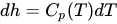


Note that
cp = cv + R , Qv + p∆V = Qp, but ∆T = ∆T.
Note that only for condensed matter, can du, dh and ds can be found or determined by one of three methods:
- Models,
- Graphs, or
- Tables
Power formulation:

Energy formulation:

Practice problems:
Thermodynamics/The First Law Of Thermodynamics/Example Problem 1
Q: Which of the following would increase the Internal Energy of a System by 5(J)?
A. Heat the System, 20(J), and have it do 15(J) of work.
B. Heat the System, 20(J), and do 15(J) of work on it.
C. Cool the System, 20(J), and have it do 15(J) of work.
D. Cool the System, 20(J), and do 15(J) of work on it.
Solution
Answer: A.
Explanation: Answer A is for calculating sensible load, while C is for calculating total load.
B. (False, ΔU = +35J)
C. (False, ΔU = -35J)
D. (False, ΔU = -5J)
1) Isometric process:
- It occurs at constant V. Thus, W = 0.
- From the 1st rule of thermodynamics,

- Quantity of heat supplied to a system at constant V is thus equal to the increase in the internal E. of the system.
2) Isobaric process:
- It occurs at constant P. e.g. water boiled and vaporized in a steam engine

- From the 1st Law of thermodynamics,

Where Vf = volume of vapor, Vi = volume of liquid.

3) Cyclic process:
- In which final state and initial state are the same. Since internal E. is a state function, internal E. doesn’t change during cyclic process. Thus, ∆U = 0.
- From the 1st rule of thermodynamics,
Q = W
- Thus, in a cyclic process, the amount of heat gained or lost through the cycle is equal to the amount of work done = area enclosed by the cycle.
4) Isothermal process:
- It occurs at constant T. e.g. in thermostats. Thus dT = 0.

- Since T is constant, Pi Vi = Pf Vf

WT = n R T ln (Vf / Vi) = n R T ln (pi / pf)

5) Adiabatic process :
- It occurs so that no heat flows into or out of the system. E.g. by sealing the system off from its surroundings with insulating material or by performing the process quickly (because flow of heat is slow). Thus Q = 0.
- From 1st rule of thermodynamics,
∆U = Uf – Ui = – W
- Thus, if work is done on the system, internal E. increases by exactly the amount of work done on the system.
- If work is done by the system (gas expand), internal E. decreases by exactly the amount of external work it does.


But H = U + pV ; where H = enthalpy = state function depending only on the state of the system and not on the path taken. Thus,

- Thus, heat gained or lost in any isobaric process = change in enthalpy of the system.
- In endothermic reaction, heat is gained by system, so Qp > 0 and enthalpy increases.
- In exothermic reaction, heat is lost by system, so Qp < 0 and enthalpy decreases.
- Gas can be heated to a temperature T, one of two paths:
- isometrically, or
- isobarically.
- In an isometric process,

• In isobaric process, dUp = n cp dT – p dV.
• From ideal gas equation, p V = n R T p dV = n R dT.
• Thus, for isobaric process, dUp = n cp dT – n R dT.
• Internal E. depends only on T change in internal E. is the same in both process.
• Thus, dUv = dUp n cv dT = n cp dT – n R dT cp – cv = R.
• For ideal gas, U = (3/2) n R T. Thus,
cv = (1 / n) ( dU / dT) = (1 / n) d / dT[(3 / 2) ( n R T)] = (3 / 2) R And cp = cv + R = (5 / 2) R.
• γ = cp / cv. (constant). cv, cp and γ vary according to type of gas:


cp = (5 / 2) R
γ = 5 / 3 = 1.67


γ = 7 / 5 = 1.40


γ = 9 / 7 = 1.29

Adiabatic ---> Q = 0 ; W = p dV ---> dU = n cv dT = - p dV ---> dT = - p dV / n cv.
Since p V = n R T ---> p dV + V dp = n R dT = – (R / cv) p dV. Since R = cp – cv,
p dV + V dp = - [(cp – cv) / cv] p dV = (1 – γ) p dV. Dividing by (p V),
dV / V + dp / p = (1 – γ) dV / V ---> (dp / p) + (γ dV / V) = 0. Integrating the eqn,
ln p + γ ln V = constant ----> p (V) ^ γ = constant. Thus,
pi (Vi) ^ γ = pf (Vf) ^ γ
But p = n R T / V. Thus,
Ti (Vi) ^ (γ – 1) = Tf (Vf) ^ (γ – 1)
For isothermal process, p V = constant ----> p dV + V dp = 0.
Slopeisothermal = dp / dV ---> Slopeisothermal = – p / V.
For adiabatic process, p V ^ γ = constant ---> γ p (V) ^ (γ – 1) + (V ^ γ) dp = 0
Slopeadiabatic = dp / dV ---> Slopeadiabatic = – γ (p / V). Thus,
Slopeisothermal / Slopeadiabatic = γ
Note:
Wadiabatic = (pi Vi – pf Vf) / γ – 1
UC Davis Thermal Energy Wiki - http://chemwiki.ucdavis.edu/Physical_Chemistry/Thermodynamics/State_Functions/THERMAL_ENERGY
Energy/Watt Calculator - http://www.mhi-inc.com/Converter/watt_calculator.htm