Books by Ivan Malara
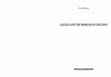
Morellini editore, 2025
“Galileo and the Problem of Creation” uncovers a side of Galileo that few readers know: the think... more “Galileo and the Problem of Creation” uncovers a side of Galileo that few readers know: the thinker who set out to explain how God shaped the architecture of the cosmos. Through careful historical contextualisation — ranging from Renaissance debates on gravity to philosophical readings of Genesis — this book reveals how Galileo’s scientific imagination was forged within a rich and contested intellectual world.
Tracing Galileo’s ideas from his early writings on motion to the “Dialogue” and the “Two New Sciences,” this study shows that he developed multiple cosmogonies — first geocentric, then heliocentric — as part of a bold attempt to unite terrestrial and celestial physics. Rather than grounding his science in metaphysics or theology, Galileo treated the structure of the cosmos as a problem of natural philosophy, to be solved through demonstration, mathematics, and experience.
Far from abstract speculation, Galileo’s engagement with the problem of creation illuminates a distinctive dimension of his thought — one that enriches our understanding of his approach to nature and its laws.
Papers by Ivan Malara
Seicento & Settecento, 2025
I termini telescopio e cannocchiale sono il prodotto di un complesso intreccio di dinamiche cultu... more I termini telescopio e cannocchiale sono il prodotto di un complesso intreccio di dinamiche culturali e strategie retoriche, molte delle quali sorte in seguito alla pubblicazione del Sidereus Nuncius (Venezia, 1610) di Galileo Galilei. La loro affermazione nel vocabolario del primo Seicento testimonia il passaggio da un oggetto di curiosità, una «castronaria», a uno strumento scientifico, destinato a ridefinire non solo l’osservazione del cielo, ma anche il linguaggio e l’immaginario della modernità.
Rivista di Storia della Filosofia, 2025
Ludovico delle Colombe was among the most tenacious adversaries of Galileo Galilei. A staunch def... more Ludovico delle Colombe was among the most tenacious adversaries of Galileo Galilei. A staunch defender of Aristotelian natural philosophy, he sought by every means – even invoking the authority of Scripture – to oppose Copernicanism, which Galileo openly endorsed with the publication of the Sidereus nuncius in 1610. This article aims to investigate the distinctive features of delle Colombe’s Aristotelianism prior to 1610, when he had not yet defined himself as «an Anti-Galileo». To this end, the analysis focuses on his two works on the nova of 1604, the Discorso of 1606 against Raffaello Gualterotti’s thesis, and the Risposte piacevoli e curiose of 1608, addressed to Alimberto Mauri, probably a pseudonym used by Galileo. It has
therefore been established that, contrary to what was previously assumed, his shift to an anti-Galilean form of Aristotelianism cannot be attributed to the existence of a Florentine circle opposing Galileo before the publication of the Sidereus nuncius.
Notes and Records, 2026
The Austrian National Library houses a heavily annotated copy of the 1515 printed edition of the ... more The Austrian National Library houses a heavily annotated copy of the 1515 printed edition of the Almagest (shelfmark: 80.O.11 Alt Rara), once part of Georg Wilhelm von Hohendorff's (1670-1719) library. The marginalia, including illustrations and diagrams, can be traced to sixteenth-century editions, translations, and commentaries on the Almagest. This article presents the first study of these annotations, highlighting two key aspects: (1) a comparative approach to the Latin editions, constructing a kind of synoptic Almagest, and (2) the reformulation of Ptolemy's procedure for calculating chords into verbally expressed arithmetical rules. Although the annotator remains unidentified, evidence suggests a late sixteenth-century origin. If so, these notes provide a rare glimpse into the early post-Copernican assimilation of the Almagest, offering insights into evolving mathematical practices in early modern astronomy. An Appendix details the main marginalia of the first book and their sources.
Galilaeana , 2025
The National Library of Turin holds a copy of Ludovico delle Colombe's Risposte piacevoli e curio... more The National Library of Turin holds a copy of Ludovico delle Colombe's Risposte piacevoli e curiose (1608), notable for its Italian handwritten marginal annotations, which may date to the 1660s (Coll. CIACC 256). This paper summarizes the key arguments of the Risposte, analyzes the annotations in five thematic areas, and explores the history of the annotated copy. A table at the end provides transcriptions of the notes.
Rivista di Filosofia Neoscolastica, 2025
In relation to the character «dottor Bozio», a fictional figure within Iacopo Soldani's satirical... more In relation to the character «dottor Bozio», a fictional figure within Iacopo Soldani's satirical composition Against the Peripatetics, the article proposes interpreting Galileo's The Assayer through an anti-Bozian lens. This suggests viewing it as a text that adeptly captured common aspirations for the renewal of knowledge, infused with ethical and political significance. While The Assayer undoubtedly emerged from a controversy involving individuals with varied dispositions, each more or less cognizant of the dynamics of power and patronage prevalent in their milieu, it would be reductionist to attribute the genesis and aims of the work solely to these factors. Importantly, The Assayer also stands as a scientific endeavor whose significance warrants reevaluation, particularly in its potential impact on subsequent discussions on comets involving Copernican astronomers.
Galilaeana, 2025
In 1607, Benedetto Castelli sent a letter to Galileo Galilei from Cava de' Tirreni. This correspo... more In 1607, Benedetto Castelli sent a letter to Galileo Galilei from Cava de' Tirreni. This correspondence provides valuable insights into Castelli's mathematical training and is significant for two main reasons. First, it demonstrates that by 1607, Galileo had already articulated key principles of his scientific work, such as the relativity of motion and a concept resembling inertia. Thus, the letter serves as an important source on Galileo's advanced thinking prior to the publication of Sidereus Nuncius (1610). Second, it explores the relationship between Galileo's ideas on motion, the eternity of the world, and the existence of God. Castelli refutes Aristotelian errors and underscores the limitations of Galilean science regarding theological matters, aiming to prevent conflicts between scientific inquiry and religious truths. This letter thus highlights the early debates sparked by Galileo's new "doctrine" of motion, occurring before any of his major findings were published.
Intersezioni, 2025
Galileo’s understanding of nature remains a relatively underexplored subject.
While a significant... more Galileo’s understanding of nature remains a relatively underexplored subject.
While a significant portion of the historiographical debate has revolved around whether Galileo adhered to a philosophical framework rooted in mathematical realism – famously articulated by Alexandre Koyré’s assertion that le réel incarne le mathématique – this contribution aims to shift scholarly focus towards an aspect of Galileo’s conception of nature that, despite some recognition, has not received adequate attention in existing literature. Regardless of its mathematical foundations, Galileo argued that nature transcends complete and absolute human understanding. This perspective, linked to a distinct conception of God as a geometer and deeply motivated by an anti-anthropocentric view, finds its most explicit elucidation in Galileo’s letter sent to Gallanzone Gallanzoni on July 16, 1611.
“Galileo as a Reader of Ptolemy: Notes on the Occasion of the 400th Anniversary of Il Saggiatore (1623).” Rivista di Storia della Filosofia, 3(2023), pp. 465-473, 2023
The controversy between the Jesuit Orazio Grassi and Galileo Galilei flared up in just under a ye... more The controversy between the Jesuit Orazio Grassi and Galileo Galilei flared up in just under a year, but lasted almost ten. Eventually, the initial question about comets grew increasingly thorny and complicated. By taking this complex story as a starting point, this short paper intends to shed more light on Ptolemy’s role in Galileo’s work. At times, it appears that Galileo employs a Ptolemaic rhetoric, structured to function in a pro-Copernican as well as anti-Tychonic manner.
History and Philosophy of Science by Ivan Malara
Starting from the fourteenth century, "intension" (intensio) and "remission" (remissio) became te... more Starting from the fourteenth century, "intension" (intensio) and "remission" (remissio) became terms linked to the philosophical attempt at quantifying qualitative changes…
NB This is a first version erroneously modified by Indian typesetters (see "Di Liscia and A. Daniel"!!!)
Marco Sgarbi (ed.), Encyclopedia of Renaissance Philosophy, 2020
Traditionally, gravitas denotes the inner source of movement towards the centre of the universe. ... more Traditionally, gravitas denotes the inner source of movement towards the centre of the universe. In the mediaeval Latin tradition, the chief problem was to fit this notion within a coherent Aristotelian framework. As philosophers in the Renaissance begin to breach the constraints of Aristotelian natural philosophy, we see diverse attempts to conceive gravitas as a force also responsible for natural phenomena such as tides and free fall acceleration. The coexistence in the Renaissance of different Aristotelian and non-Aristotelian concepts of gravitas makes the latter a polysemic scientific term, whose meaning can be determined only after careful examination of the context in which it was employed.
Thesis Chapters by Ivan Malara
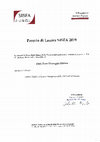
Il Consiglio Direttivo della SISFA (Società Italiana degli Storici della Fisica e dell'Astronomia... more Il Consiglio Direttivo della SISFA (Società Italiana degli Storici della Fisica e dell'Astronomia) e la Commissione giudicatrice per il Premio di Laurea SISFA 2019 hanno deciso di premiare la mia tesi di laurea magistrale. Di seguito la valutazione complessiva:
«La Commissione valuta la tesi di Malara come meritevole del Premio SISFA 2019. Rispetto ai punti che la Commissione ha preso in considerazione la tesi presenta elementi di completezza, di originalità, di argomentazione, di collegamento tra temi specifici e temi generali che la rendono estremamente interessante. Il tema affrontato – quello della Cosmogonia in Galilei – è complesso se non altro per l’esiguità della sua trattazione nei pur ampi studi storici su Galilei. Per la sua collocazione temporale anche in manoscritti e opere giovanili il tema si prestava all’individuazione di elementi di continuità e discontinuità con la tradizione medievale, un problema storiografico del quale Malara, facendo riferimento all’ampia letteratura, cerca di sollevare quesiti e risposte originali. Interessante dal punto di vista fisico la trattazione del rapporto tra legge di caduta dei gravi e l’ipotesi cosmogonica, sostenuta da Galilei nelle opere maggiori, secondo la quale Dio avrebbe fatto cadere in caduta libera i pianeti (dalla stessa altezza) e avrebbe poi inferto ad essi una deviazione che li avrebbe costretti a percorrere un’orbita circolare con la stessa velocità orbitale che essi avevano raggiunto al momento della deviazione. La terminologia è quella galileiana che si accorda con difficoltà a quella successiva. L’argomento permetterebbe di capire se Galilei abbia usato la prima formulazione (errata) della legge di caduta dei gravi oppure se sia pervenuto alla legge corretta sulla base dei suoi calcoli cosmogonici. L’Autore riporta le contrapposte tesi sostenute da due storici introducendo utili considerazioni al riguardo. Dal punto di vista filosofico l’Autore individua la persistenza dell’aristotelismo laddove egli, come molti storici, partiva dall’ipotesi dell’influenza della filosofia platonica nello sviluppo del pensiero galileiano. Viene mostrato in definitiva come il tema cosmogonico, lungi dall’essere trattato da Galilei essenzialmente nelle sue opere mature, sia invece presente anche nelle opere giovanili e che non sia affatto un argomento collaterale e secondario rispetto a quello della Meccanica».
Master Thesis in Philosophy, State University of Milan, a.a. 2015/2016.
ERRATA CORRIGE
• pp. 88... more Master Thesis in Philosophy, State University of Milan, a.a. 2015/2016.
ERRATA CORRIGE
• pp. 88-89: La copia de "Le Transformazioni" consultabile online sul sito del Museo Galileo non è quella posseduta da Galileo. Dunque, anche le annotazioni a mano marginali, che io ingenuamente attribuisco al Pisano, non sono di quest'ultimo (ringrazio il Prof. Michele Camerota per avermelo fatto gentilmemte notare);
• p. 93: «la scoperta che tutti i corpi, se lasciati cadere, si muovono con velocità proporzionali al quadrato dei tempi di caduta, ossia la cosiddetta legge di caduta dei gravi». La legge di caduta dei gravi corretta vuole che gli spazi percorsi, non la velocità, siano proporzionali al quadrato dei tempi. Il mio lapsus è forse dovuto al fatto che, quando scrivevo, avevo in mente la prima formulazione di Galileo, secondo cui la velocità di caduta aumenta all'aumentare degli spazi percorsi, a loro volta proporzionali al quadrato dei tempi. Come ricordo anche nella tesi, fu solo in un secondo momento che Galileo si rese conto dell'errore, capendo che la velocità di caduta incrementa in maniera direttamente proporzionale al tempo. Mi consolo notando che non sono stato l'unico a commettere questo errore. Anche al Galileo più maturo, ormai avvedutosi da tempo dell'errore, capita di fare la seguente osservazione: «le innate velocità da tutti i mobili dovere essere nel vacuo tra di loro tutte simili ed eguali, crescenti però continuamente in duplicata proporzione de' tempi» (OG, VII, pp. 742-743).
La prima sezione dell'elaborato offre l'analisi accurata delle principali allocuzioni con cui la ... more La prima sezione dell'elaborato offre l'analisi accurata delle principali allocuzioni con cui la Chiesa, per volere di Giovanni Paolo II, nel 1992 tentò di riabilitare l'immagine di Galileo Galilei a distanza di poco più di tre secoli dalla condanna del 22 giugno 1633.
Nelle altre due sezioni, invece, vengono presi in esame alcuni concetti fondamentali che aiutano a comprendere la legittimità storica o meno di alcune delle tesi sostenute dal cardinale Poupard e da Giovani Paolo II.
Tesi triennale in Filosofia discussa l'11 aprile 2014; Università degli Studi di Milano; Relatore: Elio Nenci.
Conference Presentations by Ivan Malara
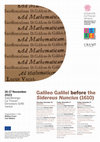
Galileo Galilei before the Sidereus Nuncius (1610), 2023
From numerous perspectives, the Sidereus Nuncius represents a pivotal work—a symbolic turning poi... more From numerous perspectives, the Sidereus Nuncius represents a pivotal work—a symbolic turning point signaling the dawn of a new epoch while concurrently marking the conclusion of an ancient worldview. In 1610 the publication of this work (“one’s man battle cry against ignorance” according to the suggestive definition by John W. Hessler) did also mark a turning point in its author’s life. Up until then, Galileo Galilei (1564-1642) had scant publications to his name, due in large part to his academic obligations as a mathematics professor at the Universities of Pisa (from 1589 to 1592) and Padua (from 1592 to 1610). But thanks also to the political slant he gave to some of the telescopic discoveries described in the Sidereus Nuncius, in 1610 he managed to transition to the Medici court, free from teaching duties and now revered as the Grand Duke of Tuscany’s mathematician and philosopher.
Galileo’s most renowned works, including The Assayer (1623), the Dialogue Concerning the Two Chief World Systems (1632), and the Discourses and Mathematical Demonstrations Relating to Two New Sciences (1638), were all published after the Sidereus Nuncius. This period, defined by Galileo’s relentless pursuit to validate his “sensible experiences and certain demonstrations”, saw notable challenges, including the 1616 Congregation of the Index decree opposing the Copernican model and Galileo’s subsequent trial and abjuration on June 22, 1633.
Even though these crucial events and Galileo’s most noteworthy publications unfolded during and after 1610, Galilean scholars have consistently underlined the importance of the years before the Sidereus Nuncius was published. This emphasis on Galileo’s earlier period can be traced back to, at least, Antonio Favaro’s Galileo Galilei e lo Studio di Padova (1888) and its preparatory studies.
It is in this early period, indeed, that Galileo formulated a new “doctrine” of motion (as termed by Benedetto Castelli in a 1607 letter), became convinced of the truth of the Copernican view (with the first pieces of evidence dating back to 1597), established connections with leading scientific figures of his time (e.g., Christoph Clavius, Guidobaldo del Monte, Michel Coignet, Jacopo Mazzoni, Paolo Sarpi, Gian Vincenzo Pinelli, Kepler, and many others), and began to shape the first students of his ‘school’, such as Benedetto Castelli and Girolamo Spinelli. With their assistance, he also participated in substantial scientific and technical discussions, such as that on the nova of 1604, or the one on the instrumental power of his geometric and military compass.
Recognizing the crucial role this period plays in interpreting the subsequent developments of Galileo’s natural philosophy, the conference seeks to reflect anew on specific aspects of Galileo’s life and work before the Sidereus Nuncius. The goal is twofold: first, to deliver a comprehensive assessment of the studies on Galileo’s Pisan and Paduan period (also in relation to the ‘official’ Artistotelianism of the universities and the higher intellectual freedom permitted by local academies), thus setting a benchmark for future investigations; second, to present fresh research that illuminates this seminal period for Galileo’s scientific and philosophical thought. This kind of exploration may enhance our understanding of Galileo’s later work, and by extension, our perception of this important figure in the history of early modern science.
Sleep and wakefulness, alongside the closely related phenomena of dreams and divination through d... more Sleep and wakefulness, alongside the closely related phenomena of dreams and divination through dreams, have since long been objects of analysis in the philosophical and in the medical tradition. We are interested in discussing the themes of sleep and wakefulness in different philosophical traditions.



Uploads
Books by Ivan Malara
Tracing Galileo’s ideas from his early writings on motion to the “Dialogue” and the “Two New Sciences,” this study shows that he developed multiple cosmogonies — first geocentric, then heliocentric — as part of a bold attempt to unite terrestrial and celestial physics. Rather than grounding his science in metaphysics or theology, Galileo treated the structure of the cosmos as a problem of natural philosophy, to be solved through demonstration, mathematics, and experience.
Far from abstract speculation, Galileo’s engagement with the problem of creation illuminates a distinctive dimension of his thought — one that enriches our understanding of his approach to nature and its laws.
Papers by Ivan Malara
therefore been established that, contrary to what was previously assumed, his shift to an anti-Galilean form of Aristotelianism cannot be attributed to the existence of a Florentine circle opposing Galileo before the publication of the Sidereus nuncius.
While a significant portion of the historiographical debate has revolved around whether Galileo adhered to a philosophical framework rooted in mathematical realism – famously articulated by Alexandre Koyré’s assertion that le réel incarne le mathématique – this contribution aims to shift scholarly focus towards an aspect of Galileo’s conception of nature that, despite some recognition, has not received adequate attention in existing literature. Regardless of its mathematical foundations, Galileo argued that nature transcends complete and absolute human understanding. This perspective, linked to a distinct conception of God as a geometer and deeply motivated by an anti-anthropocentric view, finds its most explicit elucidation in Galileo’s letter sent to Gallanzone Gallanzoni on July 16, 1611.
History and Philosophy of Science by Ivan Malara
NB This is a first version erroneously modified by Indian typesetters (see "Di Liscia and A. Daniel"!!!)
Thesis Chapters by Ivan Malara
«La Commissione valuta la tesi di Malara come meritevole del Premio SISFA 2019. Rispetto ai punti che la Commissione ha preso in considerazione la tesi presenta elementi di completezza, di originalità, di argomentazione, di collegamento tra temi specifici e temi generali che la rendono estremamente interessante. Il tema affrontato – quello della Cosmogonia in Galilei – è complesso se non altro per l’esiguità della sua trattazione nei pur ampi studi storici su Galilei. Per la sua collocazione temporale anche in manoscritti e opere giovanili il tema si prestava all’individuazione di elementi di continuità e discontinuità con la tradizione medievale, un problema storiografico del quale Malara, facendo riferimento all’ampia letteratura, cerca di sollevare quesiti e risposte originali. Interessante dal punto di vista fisico la trattazione del rapporto tra legge di caduta dei gravi e l’ipotesi cosmogonica, sostenuta da Galilei nelle opere maggiori, secondo la quale Dio avrebbe fatto cadere in caduta libera i pianeti (dalla stessa altezza) e avrebbe poi inferto ad essi una deviazione che li avrebbe costretti a percorrere un’orbita circolare con la stessa velocità orbitale che essi avevano raggiunto al momento della deviazione. La terminologia è quella galileiana che si accorda con difficoltà a quella successiva. L’argomento permetterebbe di capire se Galilei abbia usato la prima formulazione (errata) della legge di caduta dei gravi oppure se sia pervenuto alla legge corretta sulla base dei suoi calcoli cosmogonici. L’Autore riporta le contrapposte tesi sostenute da due storici introducendo utili considerazioni al riguardo. Dal punto di vista filosofico l’Autore individua la persistenza dell’aristotelismo laddove egli, come molti storici, partiva dall’ipotesi dell’influenza della filosofia platonica nello sviluppo del pensiero galileiano. Viene mostrato in definitiva come il tema cosmogonico, lungi dall’essere trattato da Galilei essenzialmente nelle sue opere mature, sia invece presente anche nelle opere giovanili e che non sia affatto un argomento collaterale e secondario rispetto a quello della Meccanica».
ERRATA CORRIGE
• pp. 88-89: La copia de "Le Transformazioni" consultabile online sul sito del Museo Galileo non è quella posseduta da Galileo. Dunque, anche le annotazioni a mano marginali, che io ingenuamente attribuisco al Pisano, non sono di quest'ultimo (ringrazio il Prof. Michele Camerota per avermelo fatto gentilmemte notare);
• p. 93: «la scoperta che tutti i corpi, se lasciati cadere, si muovono con velocità proporzionali al quadrato dei tempi di caduta, ossia la cosiddetta legge di caduta dei gravi». La legge di caduta dei gravi corretta vuole che gli spazi percorsi, non la velocità, siano proporzionali al quadrato dei tempi. Il mio lapsus è forse dovuto al fatto che, quando scrivevo, avevo in mente la prima formulazione di Galileo, secondo cui la velocità di caduta aumenta all'aumentare degli spazi percorsi, a loro volta proporzionali al quadrato dei tempi. Come ricordo anche nella tesi, fu solo in un secondo momento che Galileo si rese conto dell'errore, capendo che la velocità di caduta incrementa in maniera direttamente proporzionale al tempo. Mi consolo notando che non sono stato l'unico a commettere questo errore. Anche al Galileo più maturo, ormai avvedutosi da tempo dell'errore, capita di fare la seguente osservazione: «le innate velocità da tutti i mobili dovere essere nel vacuo tra di loro tutte simili ed eguali, crescenti però continuamente in duplicata proporzione de' tempi» (OG, VII, pp. 742-743).
Nelle altre due sezioni, invece, vengono presi in esame alcuni concetti fondamentali che aiutano a comprendere la legittimità storica o meno di alcune delle tesi sostenute dal cardinale Poupard e da Giovani Paolo II.
Tesi triennale in Filosofia discussa l'11 aprile 2014; Università degli Studi di Milano; Relatore: Elio Nenci.
Conference Presentations by Ivan Malara
Galileo’s most renowned works, including The Assayer (1623), the Dialogue Concerning the Two Chief World Systems (1632), and the Discourses and Mathematical Demonstrations Relating to Two New Sciences (1638), were all published after the Sidereus Nuncius. This period, defined by Galileo’s relentless pursuit to validate his “sensible experiences and certain demonstrations”, saw notable challenges, including the 1616 Congregation of the Index decree opposing the Copernican model and Galileo’s subsequent trial and abjuration on June 22, 1633.
Even though these crucial events and Galileo’s most noteworthy publications unfolded during and after 1610, Galilean scholars have consistently underlined the importance of the years before the Sidereus Nuncius was published. This emphasis on Galileo’s earlier period can be traced back to, at least, Antonio Favaro’s Galileo Galilei e lo Studio di Padova (1888) and its preparatory studies.
It is in this early period, indeed, that Galileo formulated a new “doctrine” of motion (as termed by Benedetto Castelli in a 1607 letter), became convinced of the truth of the Copernican view (with the first pieces of evidence dating back to 1597), established connections with leading scientific figures of his time (e.g., Christoph Clavius, Guidobaldo del Monte, Michel Coignet, Jacopo Mazzoni, Paolo Sarpi, Gian Vincenzo Pinelli, Kepler, and many others), and began to shape the first students of his ‘school’, such as Benedetto Castelli and Girolamo Spinelli. With their assistance, he also participated in substantial scientific and technical discussions, such as that on the nova of 1604, or the one on the instrumental power of his geometric and military compass.
Recognizing the crucial role this period plays in interpreting the subsequent developments of Galileo’s natural philosophy, the conference seeks to reflect anew on specific aspects of Galileo’s life and work before the Sidereus Nuncius. The goal is twofold: first, to deliver a comprehensive assessment of the studies on Galileo’s Pisan and Paduan period (also in relation to the ‘official’ Artistotelianism of the universities and the higher intellectual freedom permitted by local academies), thus setting a benchmark for future investigations; second, to present fresh research that illuminates this seminal period for Galileo’s scientific and philosophical thought. This kind of exploration may enhance our understanding of Galileo’s later work, and by extension, our perception of this important figure in the history of early modern science.