Synopsis
The Silk Road was the most important ancient trade network connecting East and West — over 6,400 km of cultural exchange, inscribed by UNESCO in 2014.
Overview
The Silk Road (丝绸之路, Sīchóu zhī lù) was the most important network of trade routes and cultural exchange connecting the East and West in ancient times. Rather than a single road, it was a vast web of land and sea routes spanning over 6,400 km (4,000 mi) across Asia, Africa, and Europe. Active from the 2nd century BCE to the 15th century CE, the Silk Road profoundly shaped economic, cultural, political, and religious interactions between the Eastern and Western worlds.
The name "Silk Road" derives from the central role of Chinese silk textiles in the trade network. The term was coined in 1877 by the German geographer Ferdinand von Richthofen. In 2014, UNESCO inscribed "Silk Roads: the Routes Network of Chang'an-Tianshan Corridor" on the World Heritage List, encompassing 33 sites across China, Kazakhstan, and Kyrgyzstan.
The Silk Road was far more than a trade route — it was a great bridge for the exchange and mutual learning of human civilizations. Religions such as Buddhism and Islam spread along the Silk Road, while China's Four Great Inventions — papermaking, gunpowder, the compass, and printing — traveled westward, profoundly transforming the course of world history.
Historical Development
Han Dynasty Opening (138 BC – 220 AD): The formal opening of the Silk Road is closely tied to Emperor Wu of Han's dispatch of Zhang Qian as an envoy to the Western Regions. In 138 BC, Zhang Qian was sent on a mission to the Da Yuezhi. Although he failed to establish a military alliance, he brought back invaluable intelligence about the states of Central Asia. In 119 BC, Zhang Qian's second mission formally opened the passage from the Central Plains to Central Asia. Emperor Wu subsequently established four commanderies along the Hexi Corridor — Wuwei, Zhangye, Jiuquan, and Dunhuang — and set up the Protectorate of the Western Regions to secure the Silk Road.
Wei, Jin, and Northern-Southern Dynasties (220–589 AD): Despite political turmoil in the Central Plains, Silk Road trade did not cease. Buddhism spread massively into China along the Silk Road. The excavation of the Mogao Caves at Dunhuang (beginning in 366 AD) stands as a testament to Buddhism's transmission along these routes.
Tang Dynasty Golden Age (618–907 AD): The Tang Dynasty represented the golden age of the Silk Road. The Tang government established the Anxi and Beiting Protectorates to strengthen administration of the Western Regions. Chang'an (modern Xi'an) became the world's largest international metropolis, attracting envoys, merchants, and monks from Persia, Arabia, India, Japan, and beyond. Trade goods flowed along the Silk Road — silk, porcelain, and tea moved westward, while spices, gemstones, glassware, and horses traveled eastward.
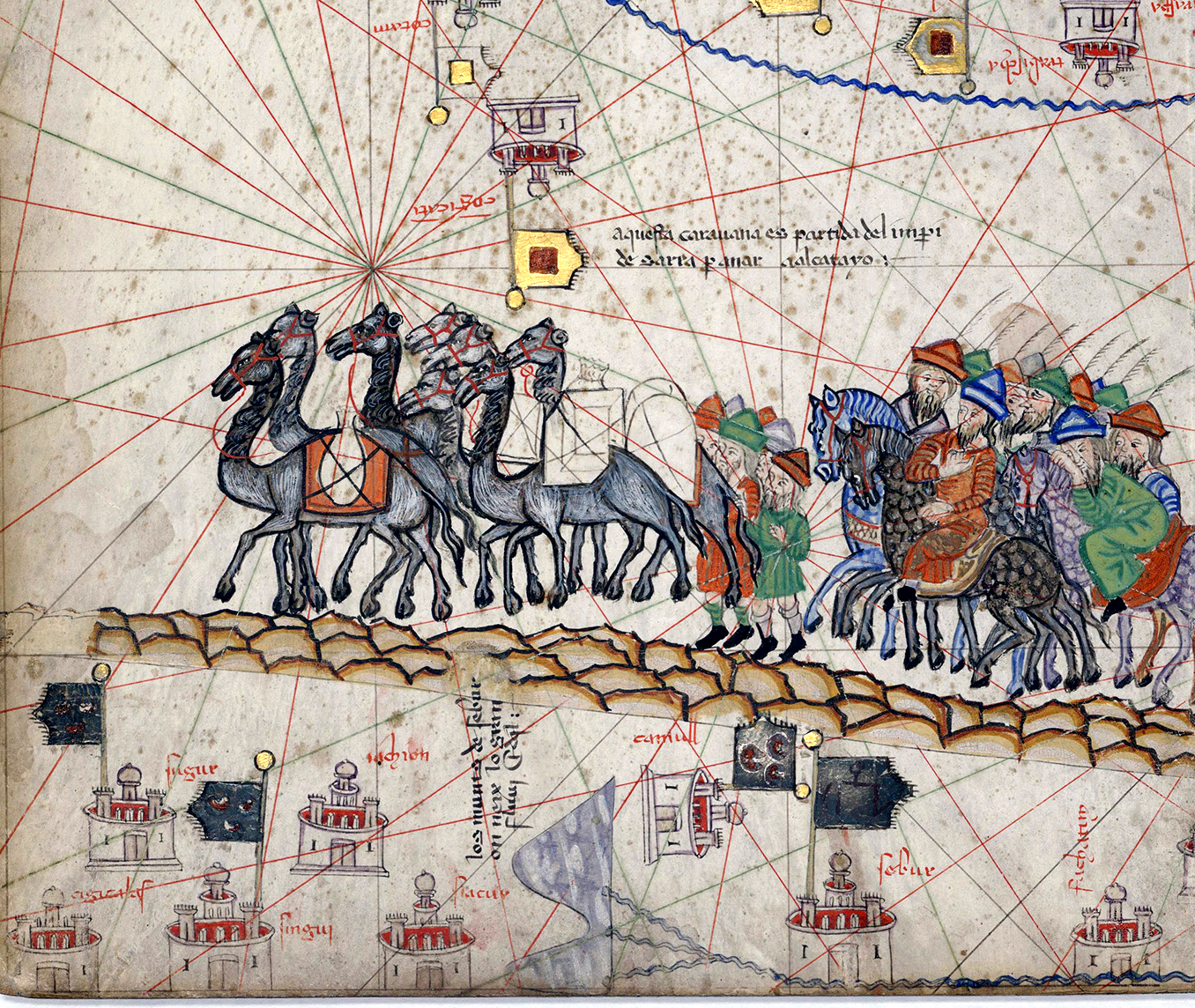
Song and Yuan Dynasties (960–1368 AD): During the Song Dynasty, conflict in northern China disrupted overland routes, leading to unprecedented development of the Maritime Silk Road (also known as the "Ceramic Route"). Under the Mongol Empire, which unified most of Eurasia, the Silk Road experienced its last great flourishing. The Italian traveler Marco Polo journeyed along the Silk Road to China during this period, introducing the wealth and civilization of the East to the West through his travel accounts.
Ming Dynasty Decline (1368–1644 AD): The Ming Dynasty's maritime restrictions, combined with the Ottoman Empire's capture of Constantinople in 1453 — which gave it control over the overland trade route between East and West — led to the gradual decline of the traditional Silk Road. European nations began searching for maritime routes to the East, inaugurating the Age of Discovery.
Major Routes
The Overland Silk Road consisted of three main routes — northern, central, and southern:
Northern Route: Departing from Chang'an, passing through Lanzhou, Wuwei, Zhangye, Jiuquan, and Dunhuang, then exiting through the Jade Gate (Yumen Pass) and following the northern foothills of the Tianshan Mountains through Ili and Suyab (modern Tokmok, Kyrgyzstan), reaching the Caspian and Black Sea coasts.
Central Route: From Chang'an through the Hexi Corridor, exiting via Yumen Pass or Yang Pass, following the northern edge of the Taklamakan Desert through Loulan, Kucha, and Kashgar, crossing the Pamir Mountains, and reaching Central and West Asia.
Southern Route: From Chang'an through the Hexi Corridor, exiting via Yang Pass, following the southern edge of the Taklamakan Desert through Ruoqiang, Khotan, and Yarkand, crossing the Pamir Mountains, and reaching India and Pakistan.
The Maritime Silk Road: Departing from port cities such as Guangzhou, Quanzhou, and Ningbo, traversing the South China Sea and Indian Ocean to Southeast Asia, South Asia, the Arabian Peninsula, and the East African coast. The Maritime Silk Road reached its zenith during the Song and Yuan dynasties and was the longest maritime trade route in the world at the time.
Trade Goods
Eastern Exports: Silk (the core commodity), porcelain, tea, lacquerware, ironware, paper, gunpowder
Western Imports: Ferghana horses (heavenly horses), camels, spices (pepper, frankincense, myrrh), gemstones (glass, amber), glassware, gold and silverware, woolen textiles
Cultural Exchange
The Silk Road's most significant contribution lies not in trade itself, but in the deep intercultural exchange it facilitated:
Religious Transmission: Buddhism traveled from India through the Silk Road into China, and subsequently to the Korean Peninsula and Japan. Islam, Zoroastrianism, and Nestorian Christianity also entered China along these routes.
Technological Diffusion: China's Four Great Inventions — papermaking (reaching the Arab world in the 8th century and Europe in the 12th), gunpowder, the compass, and printing — spread westward via the Silk Road, greatly accelerating the progress of world civilization.
Artistic Synthesis: Buddhist artistic treasures such as the Mogao Caves at Dunhuang, the Yungang Grottoes, and the Longmen Grottoes blend Chinese, Indian, Greek, and Persian artistic styles, standing as outstanding examples of cultural exchange along the Silk Road.
World Heritage Site
In 2014, UNESCO inscribed "Silk Roads: the Routes Network of Chang'an-Tianshan Corridor" as a World Heritage Site. This heritage project encompasses 33 sites across China, Kazakhstan, and Kyrgyzstan, including:
- Ancient city ruins, palace sites, cave temples, and passes in Henan, Shaanxi, Gansu, and Xinjiang provinces, China
- Aktepe site and Kel-Ata Pass in Kazakhstan
- Suyab (Ak-Beshim) and Burana sites in Kyrgyzstan
Modern Significance
In the 21st century, the "New Silk Road" has become the name for several large-scale infrastructure projects. China's Belt and Road Initiative (BRI) aims to revive the trade spirit of the ancient Silk Road by building highways, railways, ports, and energy pipelines to promote economic cooperation and connectivity among nations along the historic routes.
The Silk Road is not merely a glorious chapter of history — it is an enduring symbol of the exchange and mutual learning of human civilizations. It reminds us that different cultures, faiths, and peoples can create prosperity and progress through dialogue and cooperation.
References
- Wikipedia - Silk Road
- UNESCO - Silk Roads: the Routes Network of Chang'an-Tianshan Corridor (2014)
- Baidu Baike - 丝绸之路
- Valerie Hansen - The Silk Road: A New History
- Peter Frankopan - The Silk Roads: A New History of the World
Stills & Gallery
Comments (0)