Papers by Jenny Bergenmar
This paper summarizes the project Queerlit: Metadata and Searchability for LGBTQ+ Literary Herita... more This paper summarizes the project Queerlit: Metadata and Searchability for LGBTQ+ Literary Heritage 2020-2023 and discusses some challenges in the development of this resource. The Queerlit project consist of four parts: 1. Creating a bibliography of Swedish fiction with LGBTQI themes 2. Creating a Swedish thesaurus (QLIT), adapted from the of the linked open data thesaurus Homosaurus 3. Assigning all material in the bibliography with subject headings from QLIT. 4. A web user interface for searching the material All four parts are integrated with the Swedish union catalog, Libris, making the results of the project available for all under a CC0 license. QLIT is the first external thesaurus integrated in the linked open data framework used in the technical platform of Libris, XL. The bibliography spans from rune stones from the 7th century to recently published fiction. When applying subject headings for the material both general aspects of the work and specific LGBTQI topics are described, making this the most comprehensive retrospective indexing project of Swedish literature to date. The underlying knowledge organization is made a prominent method of interacting with the search interface, which is empirically designed around the needs of various user groups.
Sweden and Algeria in the Travel Writing of Anna Maria Roos, 1905–1909
BRILL eBooks, Jun 29, 2021
Johanna Akujärvi [email protected] Lund University Women in the early history of trans... more Johanna Akujärvi [email protected] Lund University Women in the early history of translations of ancient literature in Sweden The dead languages are ingrossed by men; these are their peculiar privileges, and they are up in arms when we invade their provinces. (Elizabeth Griffith, quoted in J.C. Hayes, Translation, Subjectivity and culture in France and England, 1600–1800.) The number of women who have translated ancient literature into Swedish is small. Until the end of the 20th century, there are less than 50 individual women translators, which is a low figure in comparison with the more than 600 known male translators. The nearly 200 translations of varying length made by anonymous and wholly unidentifiable translators are left out of the count. Moreover, their output is low. Most translated excerpts that are published in anthologies or journals. Only a few of the 50 women published complete translations in monographs. Even fewer made more than one translation of an anc...

Translation and untellability. Autistic subjects in autobiographical discourse
This article discusses the conditions for and reception of autobiographies by autistic persons fr... more This article discusses the conditions for and reception of autobiographies by autistic persons from a critical disability perspective. Taking as a point of departure theories of narra- tivity where storytelling is seen as an essential human trait and narrative as a prerequisite for the construction of a self, the article discusses different modes of representing autistic subjectivity, in some cases contradicting these assumptions. In some of the »canonized« autistic autobiographies, the narrative script of overcoming autism is strongly present. The article shows how this is not merely an adaptation to the expectations of the audience, but also a method strategically employed as a means to avoid objectification and to gain agency. Although some autobiographical representations of autistic personhood resist having to translate their experience or language to fit the narrative script of disability, audiences tend to appropriate them into the expected narrative trajectory of overcoming,...
Selma Lagerlöf, Fredrika Bremer and Women as Nation Builders
Women Telling Nations, 2014
Selma Lagerlöf: Körkarlen. Berättelse
Bästa författarinna, Högtärade Dr. Lagerlöf, Kära sagotant! Om allmänhetens läsning av Selma Lagerlöf
Receptionshistoria riktar ofta av praktiska skal in sig pa professionella lasare, framforallt kri... more Receptionshistoria riktar ofta av praktiska skal in sig pa professionella lasare, framforallt kritiker som vittnar om sin lasning i tillganglig, tryckt form. Men intresset for andra lasarter och lasargrupper i historisk tid vaxer stadigt. Problemet ar bara att uppgifter om den bredare publikens lasning ar mer svara att fa tag pa. De finns till exempel i dagbocker och i brev − kallor som sallan bevarats. I RJ-projektet ”Lasarnas Lagerlof. Allmanhetens brev till Selma Lagerlof” har vi dock tillgang till over 40 000 brev till Selma Lagerlof. Breven harror delvis fran kolleger, slakt och vanner och denna del av materialet har ofta varit foremal for forskningens intresse. Men merparten av breven ar fran en svensk och utlandsk allmanhet. For lasforskningen ger darfor brevsamlingen mycket goda mojligheter att belysa fragor om hur manniskor anvande litteraturen; vad den betydde och nar, hur, varfor och var den lastes. Materialet ar inte bara stort, det ar ocksa anmarkningsvart heterogent. Man och kvinnor fran olika landsandar, stad och land, av olika klasser och alder skrev till Selma Lagerlof. Artikeln ger exempel visa pa olika lasarter som gor sig gallande i breven och i fragan om lasning i olika lasargemenskaper diskuteras.
Gender and Vernaculars in Digital Humanities and World Literature
Routledge eBooks, Feb 17, 2021
The Writing of Transcultural Literary History
Travelling Ideas in the Long Nineteenth Century
De Gruyter eBooks, Nov 21, 2022
Introduction: Swedish Women’s Writing on Export: Tracing Transnational Reception in the Nineteenth Century
European Journal of Scandinavian Studies, 2018
When Selma Lagerlöf became a Nobel laureate in 1909, her works were translated into new languages... more When Selma Lagerlöf became a Nobel laureate in 1909, her works were translated into new languages and introduced to countries, including Spain, where she had previously been unknown. This article traces the image of Sweden and Scandinavia reflected in Selma Lagerlöf’s reception in Spanish newspapers and periodicals around 1910. The idea of a distinctive Nordic or Scandinavian identity is discernible in the critics’ characterizations of Lagerlöf’s works; however, there is tension between their presentations of Lagerlöf as a representative of the region of Scandinavia or the North in general versus just one nation (Sweden) or province (Värmland). Building on research in imagology and literary transfer, this article investigates how and which regional, national, and provincial identities, geographies, and stereotypes of North and South were activated in support of a particular idea of the author.
Tracing the Jerusalem Code, 2021
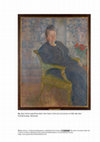
's novel Jerusalem (1901-1902) was one of her most successful ones, and it is reflecting the nati... more 's novel Jerusalem (1901-1902) was one of her most successful ones, and it is reflecting the national project circa 1900. However, she also wrote other, lesser known short prose texts about Jerusalem. These texts introduce Jerusalem to a Swedish public, and in them Jerusalem also serves as an exotic place that can be juxtaposed with a Swedish national identity; thus promoting a notion of Swedishness. The Jerusalem constructed in these texts also functions as a code to Christian cultures. The main questions posed in this chapter concern how the Jerusalem code plays out in these texts, more precisely how the concept of the "Holy Land" can be interpreted in them. Moreover, the question of how religious faith plays into the national discourse is explored. At the peak of the Swedish migration to the West (North America), Selma Lagerlöf (1858-1940) wrote a novel about migration in the opposite direction, to the East (Fig. 22.1). 1 In her novel Jerusalem (1901-1902), a group of farmers from the region of Dalarna is motivated not by the economic reasons common to migrants to the West, but by another shared reason: the longing for freedom, in this case religious freedom, more precisely, a longing for the heavenly Jerusalem. Jerusalem was written in two volumes. The first, In Dalarne (1901), narrates the religious revival of a group of villagers in Dalarna and the conflicts arising from it; ending with their departure to Jerusalem. The second, In the Holy Land (1902) describes the lives and the subsequent return to Sweden of the main characters, Ingmar and Gertrud, and others from Dalarna in the American Colony in Jerusalem. Lagerlöf's novel is known to have relied on factual sources. The migration of about 40 people, including children, from the village of Nås in Dalarna to Jerusalem in 1896 was reported in newspapers. This probably did not arouse much interest, since reports
Journal of Documentation
PurposeThe purpose of this study is to investigate the needs of potential end-users of a database... more PurposeThe purpose of this study is to investigate the needs of potential end-users of a database dedicated to Swedish lesbian, gay, bisexual, transgender, queer, and intersex (LGBTQI) literature (e.g. prose, poetry, drama, graphic novels/comics, and illustrated books), in order to inform the development of a database, search interface functionalities, and an LGBTQI thesaurus for fiction.Design/methodology/approachA web questionnaire was distributed in autumn 2021 to potential end-users. The questions covered people's reasons for reading LGBTQI fiction, ways of finding LGBTQI fiction, experience of searching for LGBTQI fiction, usual search elements applied, latest search for LGBTQI fiction, desired subjects to search for, and ideal search functionalities.FindingsThe 101 completed questionnaires showed that most respondents found relevant literature through social media or friends and that most obtained copies of literature from a library. Regarding desirable search functionalit...
Despite a growing number of digital LGBTQI (lesbian, gay, bisexual, transsexual, queer, intersex)... more Despite a growing number of digital LGBTQI (lesbian, gay, bisexual, transsexual, queer, intersex) history archives, and research-driven digital LGBTQI initiatives, queer perspectives have not been prominent in the digital humanities. Furthermore, investigations of LGBTQI in literary history is hampered by the fact that, to date, there are no broad scholarly inventories of such literature. Due to the absence of exhaustive bibliographies, scholars need to perform time-consuming, human reading of individual works and imprecise searches in order to locate LGBTQI motifs and themes. Research on subject indexing has also revealed that controlled vocabularies in use are too general to describe LGBTQI themes, motifs, and characters in a relevant manner. The purpose of this paper is to discuss how LGBTQI literature can be made more searchable, and more visible through the development of a quality-controlled subject specific database (QUEERLIT database) in which specialized subject indexing is...
Nordic Digital Resources and Practices: Guest Editorial in Human IT: Journal for Information Technology Studies as a Human Science
With the rapid expansion of digital humanities initiatives in the Nordic countries, it is easy to... more With the rapid expansion of digital humanities initiatives in the Nordic countries, it is easy to forget that Nordic digital resources and practices have a long history. Rather than a relatively new phenomenon first consolidated in an Anglo-American context, digital humanities may be regarded as strategic label to bring together ongoing research activities in a variety of fields in different parts of the world. Digital humanities activities in the Nordic countries have a history dating back to the computational humanities and language technology of the 1980s, and as Mats Dahlstrom points out in this issue, ‘each of these Nordic countries of course also has a DH history and infrastructure of its own, adding their dialects to the collective DH thesaurus’ ... Read the full guest editorial >
Vulnerability in Scandinavian Art and Culture, 2020



Uploads
Papers by Jenny Bergenmar