Books and Monographs by Johannes Hackl
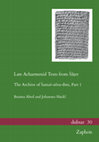
dubsar 30 (Münster 2024), together with Basima Abed
The present volume begins with an introduction, providing necessary background information on the... more The present volume begins with an introduction, providing necessary background information on the extant Late Achaemenid texts from Šāṭer. This includes an overview of what is known about the city in general, a discussion of the protagonists of the archive reconstructed from these texts, and a section on abbreviations and conventions. As detailed in the introduction, these remarks are not intended to be exhaustive but serve as a preliminary summary of the Late Achaemenid record from Šāṭer. The book is organized into two main parts. Part I (chapters 2 and 3, along with the appendix to chapter 3) presents a catalog and editions of 67 legal documents from Šamaš-zēru-ibni's archive in Šāṭer. Part II (chapter 4) provides a prosopography, including the person files compiled from the Šāṭer texts featured in this volume, as well as those published elsewhere (excluding those found in Abraham & Zilberg 2024). Reproductions of the texts in the form of photo collages as well as 57 autographed copies, prepared by Basima Abed for the original manuscript and digitally enhanced by Taichuan Tang for publication (see preface), are included in chapter 3 to enhance the usability of this book. (Art I 10 = 454 BCE). For references, see the prosopography. 9 See § 1.2. 10 They are thought to be "negative witnesses," that is, witnesses whose presence is to signal acquiescence in the transaction, not so much to observe it (Koschaker 1911: 201-209 and San Nicolò 1947: 293-294; for the term, see Westbrook 2006: 145). The fact that Šamaš-zēru-ibni's supposed brothers usually occur as first named witnesses strengthens this assumption. For references, see the prosopography.
with the collaboration of J. Wende, N. J. C. Kouwenberg, N. Rudik, J. Hackl, , F. Simons and E. Zomer: Supplement to the Akkadian Dictionaries, Volume D, T, Tet = Leipziger Altorientalistische Studien 7,2 (2019). lxviii, 120 pp.
Spätbabylonische Briefe Band 1 (SbB 1). AOAT 414/1 (2014)
In this volume – the first of a series that will publish a full (re-)edition of the Late Babyloni... more In this volume – the first of a series that will publish a full (re-)edition of the Late Babylonian letter corpus – 243 letters from private archives are edited. Eighty of these letters have not been published before, and an additional 58 have never been edited and are not included in Ebeling’s now quite dated edition of the corpus. Almost all of the tablets have been collated, and the editions are preceded by an analysis of the letters’ formal structure and content. Accompanying commentary contextualizes the letters and establishes their archival background. The book includes a glossary and numerous indices.
"The present study investigates the diplomatics of the Late Achaemenid and Hellenistic archival t... more "The present study investigates the diplomatics of the Late Achaemenid and Hellenistic archival texts from Northern Babylonia as well as the socio-economic background of the archives that can be reconstructed on the basis of this textual material. It is supplemented by c. 420 text editions and transcriptions.
The corpus comprises some 1250 tablets, of which less than 700 are currently available in publication. They were either recovered by illicit diggers or excavated by early archaeologists (especially by H. Rassam on behalf of the British Museum) during the second half of the 19th and first decades of the 20th centuries and are now housed in the British Museum, the Vorderasiatische Museum, the Louvre, the Yale Babylonian Collection and other minor collections in the western world. The temporal range of our corpus extends from the second year of Xerxes until the eventual disappearance of cuneiform legal and economic texts during the first decade of the first century BCE (484–93 BC). Its beginning is thus set by the watershed formed by the revolts of the Babylonian elite against Xerxes and the following social upheavals. The particular focus on textual material drafted in Northern Babylonia is warranted by the current state of research, as no comprehensive study of the available textual material has ever been undertaken.
The first section of this study focuses on the intrinsic (textual) and extrinsic (physical) aspects of the tablets resulting from certain conventions as well as techniques that have been employed by the Babylonian scribes when drafting legal or administrative records. The most important results of the research carried out in this section can be summarized as follows. Overall, the formulae and clauses employed in Late Achaemenid and Hellenistic archival texts from Northern Babylonia display a pronounced resemblance to those that one encounters in the pertinent text types from the long sixth century (~ 626–484 BCE). These strong links of continuity notwithstanding, there are also some areas in which innovations can be observed in the course of the fifth and fourth centuries BC. As for the intrinsic aspects, marriage contracts and slave sales deserve particular attention in this respect, since the formulae of both contract types exhibit major changes that seem to have occurred during the reign of Artaxerxes I. Also, some contract types evolved for the first time in the period under consideration (e.g., records of deposit with added clauses and ‘genuine’ service contracts). As far as the extrinsic aspects are concerned, we see a clear development in sealing practices which were accompanied by the emergence of new tablet formats. The latter were necessary to accommodate the gradually increasing number of seals that were applied to each tablet. In sum, the methodological refinement that was reached in this study can thus be used to help date undated or imprecisely dated tablets, especially when dating from the reign of an Artaxerxes.
The second section focuses on archival studies. Numerous institutional and private archives, including hitherto unknown smaller archives and dossiers from Babylon, have been reconstructed and described, both in terms of textual composition and socio-economic background. Especially, the in-depth studies of the two largest institutional archives (i.e., the Late Achaemenid and Early Hellenistic Esangila archive and the brewer’s archive) have yielded substantial new insights in the organization of the temple households in Northern Babylonia in this period. As was demonstrated, there is strong reason to believe that the prebendary system as it is known from the long sixth century had been abolished. Likewise, our sources point to a complete restructuring of the temple administration, as the highest temple officials of the long sixth century are almost absent from our sources. The evidence presented here thus makes it difficult to escape the conclusion that these fundamental changes were prompted by royal intervention, presumably instigated by the Babylonian revolts against Persian rule in the second year of Xerxes.
"
Articles and Shorter Notices by Johannes Hackl
Published in IRAQ (2025), pp. 1-20.
https://doi.org/10.1017/irq.2025.10033
This article revisits the editorial history of the Babylo... more https://doi.org/10.1017/irq.2025.10033
This article revisits the editorial history of the Babylonian (Akkadian) version of the Bīsotūn (Behistun) Inscription (DB) to establish the extent of the surviving text in light of a re-examination of the inscription at Mount Bīsotūn (Behistun). Questions arising about the reliability of the standard edition presented in Von Voigtlander (1978) prompted a critical review of her new readings, which significantly expand the text by approximately two-thirds compared to what previous commentators recorded and what is visible on the rock face today. The article focuses on the results of this scrutiny, supported by information from Von Voigtlander's correspondence with George G. Cameron and Matthew W. Stolper, highlighting the implications of their discussions.
Published in Altorientalische Forschungen 51/2 (2024), pp. 149-169.
This article complements my earlier article on the history of the Hilprecht Collection at the Fri... more This article complements my earlier article on the history of the Hilprecht Collection at the Friedrich Schiller University Jena, previously published in this journal (Hackl 2024). It provides editions of Neo-Babylonian texts from the collection that were either not included or only partially covered by Oluf Krückmann in TMH 2/3 in 1933.
Published in Altorientalische Forschungen 51/1 (2024), pp. 64-83.
The article provides an overview of the history of the Hilprecht Collection at the Friedrich Schi... more The article provides an overview of the history of the Hilprecht Collection at the Friedrich Schiller University Jena, with a particular focus on the period after 1926, i.e., the year when Hilprecht's objects arrived in Jena. Special attention is given to the Neo-Babylonian texts of the collection, most of which were published in copy by Oluf Krückmann in TMH 2/3 in 1933.
Published in Orientalia 92/2 (2023), pp. 1-16.
Published in Wiener Zeitschrift für die Kunde des Morgenlandes (2021), pp. 81-98.
This article presents an edition of seven unpublished Ur III administrative documents, housed in ... more This article presents an edition of seven unpublished Ur III administrative documents, housed in the Egyptian and Near Eastern Collection of the Kunsthistorisches Museum (Vienna). They fall into two groups. The texts of group A come from the "Central Bureau" at Puzriš-Dagān, dated in the reigns of Šulgi, Amar-Suen and Šu-Suen. The concerns of those of group B make it likely that they belonged to the Provincial Archive from Umma. An appendix contains a transliteration and translation of the most common Gudea inscription (RIME 3/1, 1.7.37), found on a foundation peg (clay nail), also in the collection of the Kunsthistorisches Museum.
Published in Archiv für Orientforschung (2021), pp. 2-45.
Taxes and Tributes, in: B. Jacobs, R. Rollinger (eds.), A Companion to the Achaemenid Empire Vol. 1, Hoboken 2021, 967-979 (mit J. Hackl).
Published in Journal of Ancient Near Eastern History (2021), pp. 39-71.
It is by now well established that authors and copyists of scholarly works also drafted legal doc... more It is by now well established that authors and copyists of scholarly works also drafted legal documents, if only occasionally. This article examines newly available prosopographical information concerning the scribal activities of the Sîn-lēqi-unnīnī during the mid to late fourth century BCE. It offers new datings of learned texts that have been known to academic circles for a long time and argues that the extant archival texts from Early Hellenistic Uruk mainly belonged to the archives of the Aḫûtu and Ekur-zakir families. In addition, it presents cases of transference of linguistic items peculiar to one or the other genre, giving rise to some general remarks on cross-genre imprints.
Published in: J.-P. Vita (ed.), History of the Akkadian Language. Vol. 1: Linguistic Background and Early Periods. Vol. 2: The Second and First Millennia BCE. Afterlife. Handbook of Oriental Studies vol. 152. Leiden-Chicago: Brill: 1459-1477., 2021
This chapter surveys the language death (or rather extinction) of Akkadian.
Published in: J.-P. Vita (ed.), History of the Akkadian Language. Vol. 1: Linguistic Background and Early Periods. Vol. 2: The Second and First Millennia BCE. Afterlife. Handbook of Oriental Studies vol. 152. Leiden-Chicago: Brill: 1431-1458., 2021
This chapter offers a description of Late Babylonian, the latest variety of Akkadian, including t... more This chapter offers a description of Late Babylonian, the latest variety of Akkadian, including the language of the Babylonian version of the Behistun inscription.
Publishedin Zeitschrift für Assyriologie 111 (2021), pp. 88-99 [Ahead of Print in Zeitschrift für Assyriologie (2020)], 2020
This article revisits the question of whether the sanctuary named é ud.1.kam and the New Year Fes... more This article revisits the question of whether the sanctuary named é ud.1.kam and the New Year Festival house (bīt akīti) are one and the same or whether they are separate entities. It presents new evidence that suggests reading the logographic name as bīt ūmakkal, and argues that the latter refers to a sanctuary which was situated in the juniper garden surrounding Marduk’s temple Esangila. In addition, it calls into question P. J. Kosmin’s assumption that the é ud.1.kam may have been founded or repurposed to commemorate in cult the “idealized” Seleucid Era epoch.
Published in Klio 102/2 (2020), pp. 560-578.
This article presents a hitherto unpublished cuneiform document from the Liagre Böhl Collection (... more This article presents a hitherto unpublished cuneiform document from the Liagre Böhl Collection (Leiden) that sheds new light on the length of the coregency of Seleucos I Nicator and his son Antiochos (I Soter). Judging by the date mentioned in this document (LB 863), it is plausible to suppose that Antiochos was made coregent at least two years earlier than generally assumed. Furthermore, this discovery accords well with the peculiar date of another cuneiform document (D.T. 189) that has so far defied explanation.
Published in Xerxes and Babylonia. The Cuneiform Evidence. Edited by C. Waerzeggers and M. Seire. Orientalia Lovaniensia Analecta 277 (2018), pp. 165-187.
Published in Klio 100/3 (2018), pp. 688-708.
A number of Babylonian archival, astronomical and other texts show that the Achaemenid ruler know... more A number of Babylonian archival, astronomical and other texts show that the Achaemenid ruler known as Arses (338–336 BCE) bore the throne name Artaxerxes (IV). The Babylonian sources thus present a picture that fits well with the evidence offered by other sources, including the Xanthos trilingual inscription. This contribution explores the criteria for assigning Babylonian texts to Artaxerxes IV.
In collaboration with J. Oelsner, published in Orientalia 86/1 (2017), pp. 42-96 and tab. I-IV



Uploads
Books and Monographs by Johannes Hackl
The corpus comprises some 1250 tablets, of which less than 700 are currently available in publication. They were either recovered by illicit diggers or excavated by early archaeologists (especially by H. Rassam on behalf of the British Museum) during the second half of the 19th and first decades of the 20th centuries and are now housed in the British Museum, the Vorderasiatische Museum, the Louvre, the Yale Babylonian Collection and other minor collections in the western world. The temporal range of our corpus extends from the second year of Xerxes until the eventual disappearance of cuneiform legal and economic texts during the first decade of the first century BCE (484–93 BC). Its beginning is thus set by the watershed formed by the revolts of the Babylonian elite against Xerxes and the following social upheavals. The particular focus on textual material drafted in Northern Babylonia is warranted by the current state of research, as no comprehensive study of the available textual material has ever been undertaken.
The first section of this study focuses on the intrinsic (textual) and extrinsic (physical) aspects of the tablets resulting from certain conventions as well as techniques that have been employed by the Babylonian scribes when drafting legal or administrative records. The most important results of the research carried out in this section can be summarized as follows. Overall, the formulae and clauses employed in Late Achaemenid and Hellenistic archival texts from Northern Babylonia display a pronounced resemblance to those that one encounters in the pertinent text types from the long sixth century (~ 626–484 BCE). These strong links of continuity notwithstanding, there are also some areas in which innovations can be observed in the course of the fifth and fourth centuries BC. As for the intrinsic aspects, marriage contracts and slave sales deserve particular attention in this respect, since the formulae of both contract types exhibit major changes that seem to have occurred during the reign of Artaxerxes I. Also, some contract types evolved for the first time in the period under consideration (e.g., records of deposit with added clauses and ‘genuine’ service contracts). As far as the extrinsic aspects are concerned, we see a clear development in sealing practices which were accompanied by the emergence of new tablet formats. The latter were necessary to accommodate the gradually increasing number of seals that were applied to each tablet. In sum, the methodological refinement that was reached in this study can thus be used to help date undated or imprecisely dated tablets, especially when dating from the reign of an Artaxerxes.
The second section focuses on archival studies. Numerous institutional and private archives, including hitherto unknown smaller archives and dossiers from Babylon, have been reconstructed and described, both in terms of textual composition and socio-economic background. Especially, the in-depth studies of the two largest institutional archives (i.e., the Late Achaemenid and Early Hellenistic Esangila archive and the brewer’s archive) have yielded substantial new insights in the organization of the temple households in Northern Babylonia in this period. As was demonstrated, there is strong reason to believe that the prebendary system as it is known from the long sixth century had been abolished. Likewise, our sources point to a complete restructuring of the temple administration, as the highest temple officials of the long sixth century are almost absent from our sources. The evidence presented here thus makes it difficult to escape the conclusion that these fundamental changes were prompted by royal intervention, presumably instigated by the Babylonian revolts against Persian rule in the second year of Xerxes.
"
Articles and Shorter Notices by Johannes Hackl
This article revisits the editorial history of the Babylonian (Akkadian) version of the Bīsotūn (Behistun) Inscription (DB) to establish the extent of the surviving text in light of a re-examination of the inscription at Mount Bīsotūn (Behistun). Questions arising about the reliability of the standard edition presented in Von Voigtlander (1978) prompted a critical review of her new readings, which significantly expand the text by approximately two-thirds compared to what previous commentators recorded and what is visible on the rock face today. The article focuses on the results of this scrutiny, supported by information from Von Voigtlander's correspondence with George G. Cameron and Matthew W. Stolper, highlighting the implications of their discussions.