Articles and Chapters by Jonathan Worthington, Ph.D.

While considering my role and activity as Lecturer / Assistant Professor in higher education (HE)... more While considering my role and activity as Lecturer / Assistant Professor in higher education (HE), I highlighted the stimulation of student motivation for focused research, experimentation, and critical reflection. According to HE researchers as well as to university students themselves, motivation is one element of effective teaching that is indicative of student achievement. So it is worth exploring more deeply. My focus on motivation also accords with a growing global movement in higher education called by some “transformational education”. Motivation is at the heart of transformation, and transformation is at the heart of higher education. But different types of motivation aid in different types and even depths of achievement in learning. To critically analyze how I help stimulate motivation in my university students (or not), I selected some teaching/learning experiments and educational approaches to research and analyze. First, I analyze aspects of my teaching, student learning, and some basics of motivation-theory through a short portfolio from my course on Study Skills. Second, through a look at my assignments for Introduction to the Bible I analyze how assessment can be used to increase motivation to learn deeply. Third, I focus on equipping students to critically think, and I use Action Research to explore more complex aspects of motivation in learning such a skill/art. And fourth, I use insights from a colleague via Peer-Review to analyze further complexities of motivation as I focus on stimulating curiosity in students in a class on Jesus and the Gospels.

In Romans 5:12–21, Paul seems to have realized that his own interpretation of Genesis 3 – of Adam... more In Romans 5:12–21, Paul seems to have realized that his own interpretation of Genesis 3 – of Adam’s death for disobedience and, perhaps especially, of Adam’s affect on subsequent humans – was not a universally accepted interpretation. He anticipates a view “out there,” either among his readers or those around them, which assumes or argues that Adam’s action in Eden did not end in death and/or did not affect or could not have affected subsequent humans, at least not in quite the extremity that Paul suggests. How can “death” actually be for “all” even when subsequent people did not transgress like Adam? Is everyone’s death because of Adam’s choice? Did Adam himself even die for his disobedience? Arresting ideas and intriguing ambiguities occur within Romans 5:12–21. This chapter focuses on a very particular question: When Paul introduces Adam and Genesis 3, why does he interrupt himself in verse 12? He seems to realize that people may disagree with him about Adam. We do not need to speculate about this. He is right. This becomes much more clear and concrete (and consequently so too does Paul’s own view) when we listen carefully to another Jewish interpreter of Adam in Genesis 3: Philo of Alexandria.
Rom 4.17d is often read as referring to creation, perhaps even creatio ex nihilo. Others argue th... more Rom 4.17d is often read as referring to creation, perhaps even creatio ex nihilo. Others argue that this doctrine was not yet conceptually available. After exploring what ‘nothing’ means in similar phrases in Paul’s ancient context (2 Macc 7.28 and Philo), my first conclusion is that if Rom 4.17d refers to creation then Paul’s ‘nothings’ most likely do not refer to an absolute nihil. However, after exploring Rom 4.17 in the context of Paul’s argument, my final conclusion is that in Rom 4.17d Paul does present absolute ‘nothings’, though in God’s speech to Abraham, not at creation. Paul’s theology encompasses God’s authority and causation ex nihilo.
Books by Jonathan Worthington, Ph.D.
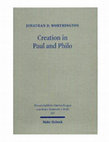
God’s creative activity “in the beginning” is important to many aspects of Paul’s theology. In th... more God’s creative activity “in the beginning” is important to many aspects of Paul’s theology. In this academic monograph I explore Paul’s protology by analyzing his interpretation of scripture concerning creation, mainly the beginning of Genesis. By examining Paul’s exegetical manoeuvres within 1–2 Corinthians and Romans, and by comparing these with the contemporary but more detailed treatments of the same texts by Philo of Alexandria in his formal commentary on Genesis 1–2, De Opificio Mundi, I uncover an approach to creation that is fundamental to both ancient interpreters. Paul’s interpretation of creation, like Philo’s in his commentary, contains three interwoven aspects: the beginning of the world, the beginning of humanity, and God’s intentions before the beginning. Recognizing this basic hermeneutical interplay between “the Beginning” and “the Before” facilitates a more appropriate comparison between Paul and Philo as well as a more adequate treatment of difficult and debated passages in both interpreters regarding creation.



Uploads
Articles and Chapters by Jonathan Worthington, Ph.D.
Books by Jonathan Worthington, Ph.D.