Papers by Jonneke Koomen
Research paper thumbnail of Suriname Land of Diversity Lespiki Mi Respect Me,  Carla Bakboord and Jonneke Koomen

Lespiki Mi Respect for Lesbian, Gay, Bisexual and Transgender People in Suriname , 2024

ABSTRACT There is a dearth of research on the ways lesbian, gay, bisexual and transgender (LGBT)... more ABSTRACT
There is a dearth of research on the ways lesbian, gay, bisexual and transgender (LGBT) people in Suriname experience stigma and discrimination in public life. This study draws on an extensive 2017 qualitative survey of representatives of eleven community-based organizations (CBOs), non-governmental organizations (NGOs), and government organizations (GOs), as well as 45 interviews (focus groups, workshops and individual interviews) with representatives of the private and public sectors and organizations supporting key populations. We find that LGBT individuals regularly experience stigma and discrimination based on their sexuality or gender non-conformity from (prospective) employers, educational institutions, police and healthcare providers. Moreover, we find that stigma and discrimination undermine LGBT people's access to health care, education, employment, nutrition, shelter and financial resources which, in turn, can compound health problems and other forms of marginalization. We recommend interdisciplinary training using a theory of change with inclusive gender equality and human rights perspectives for all relevant service providers and employers to strengthen their capacity to serve LGBT people.

Keywords: Suriname, LGBT, stigma, discrimination, service providers, employment, access

‘Unspeakable Suffering’: Sexualized Violence, Survivor Testimony, and International Justice

Research paper thumbnail of WPS and the International Criminal Court

WPS and the International Criminal Court

The International Criminal Court began its work in 2003. The Court’s founding treaty, the Rome St... more The International Criminal Court began its work in 2003. The Court’s founding treaty, the Rome Statute (1998), offers an unprecedented legal framework dedicated to ending impunity for sexual and gender-based violence in armed conflict. This chapter examines how the Rome Statute contributes to the Women, Peace, and Security agenda, paying particular attention to the Statute’s definitions of crimes, gender-sensitive rules, commitment to gender expertise, provisions for victim participation and reparations, and its framework for national implementation. Next, the chapter examines the difficulties faced by the Court in institutionalizing the Statute’s gender justice commitments during the first decade of its work, including challenges surrounding the prosecutor’s investigations, charging decisions, and the ICC’s first trials. The chapter points to efforts to strengthen the Court’s gender justice framework and notes the key role of advocates and NGOs in monitoring the Court’s gender just...

Female Genital Cutting: Cultural Rights and Rites of Defiance in

This article reviews campaigns against female genital cutting (FGC) direct ed at Maasai communiti... more This article reviews campaigns against female genital cutting (FGC) direct ed at Maasai communities in northern Tanzania. The authors argue that campaigns against FGC using educational, health, legal, and human rights?based approaches are at times ineffective and counterproductive when they frame the practice as a "tradition" rooted in a "primitive" and unchanging culture. We suggest that de velopment interventions that do not address local contexts of FGC, including the complex politics and history of interventions designed to eradicate it, can in fact reify and reinscribe the practice as central to Maasai cultural identity.

Reflections from the forum organizers

International Politics Reviews

Alternatives: Global, Local, Political

Is it possible to write a publishable, peer-reviewed academic paper in a day? We attempted this t... more Is it possible to write a publishable, peer-reviewed academic paper in a day? We attempted this task in 2016, motivated by a desire to find new ways of doing academic work in the face of our growing sense of alienation within the neoliberal academy. This article provides our analysis of academic alienation and an auto-ethnography of our experiment. We discuss four lessons learned: (1) knowledge as a social relation, (2) time and the academy, (3) gender and collaborative writing, and (4) the contradictions and possibilities of anarchy and authorship. We also offer practical advice for scholars looking to engage in similar collaborations.

Research paper thumbnail of International Relations/Black Internationalism: Reimagining Teaching and Learning about Global Politics

International Relations/Black Internationalism: Reimagining Teaching and Learning about Global Politics

International Studies Perspectives

A growing body of critical scholarship interrogates racism in international relations. Yet many i... more A growing body of critical scholarship interrogates racism in international relations. Yet many introductory undergraduate courses reproduce the colonial and racist foundations and practices of the discipline for new students of global politics. This article argues that, to engage seriously racism in international relations, scholars must rethink undergraduate curriculum and pedagogy. To this end, I offer an alternative model of teaching introductory international relations courses. I propose reading the disciplinary canon alongside, through, and against the texts of Black internationalists. This diverse intellectual and political tradition provides ways to (re)claim the study of race, racism, and Black liberation struggles as international politics. In doing so, Black internationalism allows international relations scholars to radically rethink our curricula, our classrooms, our pedagogy, and the politics of knowledge-making more broadly.

Alternatives, 2020

Is it possible to write a publishable, peer-reviewed academic paper in a day? We attempted this t... more Is it possible to write a publishable, peer-reviewed academic paper in a day? We attempted this task in 2016, motivated by a desire to find new ways of doing academic work in the face of our growing sense of alienation within the neoliberal academy. This article provides our analysis of academic alienation and an auto-ethnography of our experiment. We discuss four lessons learned: (1) knowledge as a social relation, (2) time and the academy, (3) gender and collaborative writing, and (4) the contradictions and possibilities of anarchy and authorship. We also offer practical advice for scholars looking to engage in similar collaborations.

Cultural rights and rites of defiance: FGC in Northern Tanzania

African Studies Review, Jan 1, 2009
This article reviews campaigns against female genital cutting (FGC) directed at Maasai communitie... more This article reviews campaigns against female genital cutting (FGC) directed at Maasai communities in northern Tanzania. The authors argue that campaigns against FGC using educational, health, legal, and human rights–based approaches are at times ineffective and counterproductive when they frame the practice as a “tradition” rooted in a “primitive” and unchanging culture. We suggest that development interventions that do not address local contexts of FGC, including the complex politics and history of interventions designed to eradicate it, can in fact reify and reinscribe the practice as central to Maasai cultural identity.

Research paper thumbnail of Language Work at International Criminal Courts

International Feminist Journal of Politics, 2014

This article seeks to bring the often-invisible labor of interpreters and language assistants at ... more This article seeks to bring the often-invisible labor of interpreters and language assistants at the International Criminal Court and the ad hoc International Criminal Tribunals for Rwanda and the former Yugoslavia into sharper focus. I highlight the far-reaching and extensive tasks of language workers, paying particular attention to their efforts to negotiate and mediate witnesses’ accounts of atrocity, including sexualized violence, inside and outside international courtrooms. In doing so, I illustrate how language work is central to the life of an international court and the vision of international criminal accountability. I argue that attention to the dynamics of language work provides opportunities to consider the project of international criminal justice in new and important ways, focusing on its practical work, its social encounters and its complex engagement with relations of difference.

Research paper thumbnail of “Without These Women, the Tribunal Cannot Do Anything”: The Politics of Witness Testimony on Sexual Violence at the International Criminal Tribunal for Rwanda

Signs: Journal of Women in Culture and Society, Jan 1, 2013

he International Criminal Tribunal for Rwanda (ICTR) was established by the UN Security Council t... more he International Criminal Tribunal for Rwanda (ICTR) was established by the UN Security Council to prosecute high-profile organizers of the 1994 Rwandan genocide, including those responsible for systematic sexual violence against Rwandan women. Focusing on tribunal cases involving mass rape, I examine how global justice for Rwandan women is produced through the politics of translation and negotiation. Through in-depth interviews and ethnographic fieldwork, I investigate how unspeakable suffering is articulated through witness testimony, translated into the language of international law, and mediated through the tribunal bureaucracy. I examine encounters between international tribunal workers and Rwandan witnesses, specifically how ICTR staff investigate sexual violence, gather witness statements, and render individuals’ stories fit for public appearance at the tribunal. I also explore the conditions under which witnesses tell their stories in ICTR courtrooms. I argue that international justice at the ICTR depends on Rwandan victims and witnesses. At the same time, however, the project of international justice for women depends on routine social practices that at times marginalize Rwandan women as objects of justice. I contend that these practices may, counterintuitively, reinforce the distance between “local victims” and the expansive ambitions of international justice.

African Studies Review, Jan 1, 2009

This article reviews campaigns against female genital cutting (FGC) directed at Maasai communitie... more This article reviews campaigns against female genital cutting (FGC) directed at Maasai communities in northern Tanzania. The authors argue that campaigns against FGC using educational, health, legal, and human rights–based approaches are at times ineffective and counterproductive when they frame the practice as a “tradition” rooted in a “primitive” and unchanging culture. We suggest that development interventions that do not address local contexts of FGC, including the complex politics and history of interventions designed to eradicate it, can in fact reify and reinscribe the practice as central to Maasai cultural identity.

Teaching Documents by Jonneke Koomen

Research paper thumbnail of Intro to International Politics Syllabus
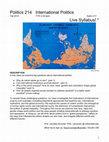
DESCRIPTION In this class we examine big questions about international politics: ● Why do nation-... more DESCRIPTION In this class we examine big questions about international politics: ● Why do nation-states go to war? (part 1) ● Can international institutions promote peace? (part 2) ● Why is the world unequal? How do race, class, gender and colonialism shape global inequality? (part 3) ● How do people organize across borders to address injustice? Is a better world possible? (cross-cutting) To answer these challenging questions, our class investigates the implications of international anarchy and evaluates competing theoretical approaches that examine war, international institutions, and the global economy. We explore the causes of violent conflict, the emergence of human rights norms and international courts, the dilemmas of humanitarian intervention, the politics of global inequality. Throughout the course we examine how race, class and gender shape world politics and the ways people mobilize transnationally to address injustice and oppression. In doing so, we will think about politics from a " global perspective, " reflect on the ways that international politics shapes our own lives, and imagine different worlds and different futures. Prof. Jonneke Koomen, PhD | jkoomen @ willamette.edu office hours sign up: ​ tinyurl.com/profkoomen​ | Smullin 206

Book Chapters by Jonneke Koomen

Sara E. Davies and Jacqui True (eds), The Oxford Handbook of Women, Peace, and Security, 2019

Gordon DiGiacomo and Susan Kang (Eds), The Institutions of Human Rights: Developments and Practices, University of Toronto Press, 2019

Review articles by Jonneke Koomen

A Deeper Silence

Women's Review of Books, 2013

Review of Genocide Lives in Us: Women, Memory and Silence in Rwanda, By Jennie E. Burnet, Madison... more Review of Genocide Lives in Us: Women, Memory and Silence in Rwanda, By Jennie E. Burnet, Madison: University of Wisconsin Press, 2012

Conflict-Related Sexual Violence: International Law, Local Responses . Edited by Tonia St. Germain and Susan Dewey . Sterling, VA: Kumarian Press, 2012. Contesting the Politics of Genocidal Rape: Affirming the Dignity of the Vulnerable Body . By Debra B. Bergoffen . New York: Routledge, 2012

Signs, 2014

Conference Papers by Jonneke Koomen

Human Rights Investigations on Trial: Human Rights Reports and the International Criminal Tribunal for Rwanda

Human rights reports serve multiple purposes: they document atrocities and they construct narrati... more Human rights reports serve multiple purposes: they document atrocities and they construct narratives about the causes and consequences of human rights abuses in order to mobilize publics, shame governments, and promote changes in human rights policy. Research by human rights ...