Papers by Julita Vassileva
Conflict emerging from collaboration in wiki can be helpful to achieve a better quality of collab... more Conflict emerging from collaboration in wiki can be helpful to achieve a better quality of collaborative learning. However, few studies have utilized conflict to support collaborative learning and wiki systems themselves have limitations. This paper proposes to provide visual feedback about conflict in wiki based on the "page history" to create a sense of audience, psychological ownership and support information seeking. Theoretical model is built upon literature, and the Partial Least Squares (PLS) results from a survey study (208 responses) indicate that conflict awareness can motivate students to participate, achieve better conflict resolution and improve the quality of learning. The results also show that the new design is well accepted by students and can significantly enhance the influence of conflict awareness on participation and conflict resolution.

SBC Journal on Interactive Systems, Dec 22, 2017
In human-computer interaction, aesthetics, usability and credibility are key factors in the desig... more In human-computer interaction, aesthetics, usability and credibility are key factors in the design of a successful website. Specifically, aesthetics has been identified as one of the main drivers of web credibility. However, in the mobile domain, large-scale research, cutting across cultures and continents, which is key to the generalizability of findings, is scarce. To bridge this gap, we conducted a multicultural study among 526 participants from 5 continents: Africa, Asia, North America, South America and Europe. Using four systematically designed mobile websites, we investigated: (1) the interrelationships among aesthetics, usability and credibility; and (2) the moderating effect of gender. Our results, based on partial least square path modeling, reveal that: (1) perceived aesthetics is stronger than perceived usability in predicting the perceived credibility of mobile websites; and (2) gender moderates the effect of perceived aesthetics on perceived usability, with this effect...

Frontiers in computer science, Mar 25, 2020
The number of fitness applications on the market is increasing annually, driven by the increasing... more The number of fitness applications on the market is increasing annually, driven by the increasing awareness of the need to support and motivate physical activity to reduce the incidence of non-communicable diseases worldwide. However, there is limited research on the user-experience (UX) design attributes that drive their adoption and the moderating role culture plays. Consequently, we conducted a study on the Persuasive Technology Acceptance Model (PTAM) for a fitness application aimed at motivating physical activity at home. Using Canada (an individualist culture, n = 189) and Nigeria (a collectivist culture, n = 67) as a case study, we investigated: (1) which of the commonly researched UX design attributes (perceived aesthetics, perceived usability, perceived credibility and perceived usefulness) have the strongest influence on users’ intention to use a fitness application; (2) the moderating effect of culture; and (3) how perceived persuasiveness mediates the direct effect of pe...
International Conference on Human-Computer Interaction, 2001
The use of animated pedagogical agents with emotional capabilities in an interactive learning env... more The use of animated pedagogical agents with emotional capabilities in an interactive learning environment has been found to have a positive impact on learners. The Greek philosopher Aristotle contended that three elements; emotion, logic, and character are crucial for successful persuasion, i.e. in winning others over to one's way of thinking. We have designed a pedagogical agent, which acts in an interactive learning environment, using the Cognitive Structure of Emotion model and the five-factor model of personality thus taking into consideration Aristotel's elements of a good persuader. In this paper we investigate the persuasive impact of this emotional pedagogical agent on a group of learners. The results show that while not contributing any significant performance gain in learning, the incorporation of emotion changes the way students perceive the learning process, and makes it more engaging. We also found out that there are some gender-based and individual differences in the user perception of an emotional agent, which need to be taken into account when designing a more adaptive and "intelligent" emotional pedagogical agents.
Springer eBooks, 2004
We have implemented a novel peer-to-peer based environment called Comtella, which allows students... more We have implemented a novel peer-to-peer based environment called Comtella, which allows students to contribute and share class-related resources. This system has been implemented successfully in a fourth year undergraduate course on Ethics and IT. The intermediate results of the ongoing experiment show a significant increase in participation and contribution in the test version in comparison with a previous offering of the class where students contributed class-related resources via their own personal web-sites. Our ongoing and future work focuses on motivating higher levels of participation and getting students involved in the quality control of the contributions aiming at a selforganizing virtual learning community.
Springer eBooks, Aug 29, 2007
The paper describes a further development of the design of a motivational visualization encouragi... more The paper describes a further development of the design of a motivational visualization encouraging participation in an online community. The new design overcomes shortcomings in previous designs, by using more attractive appearance of the graphic elements in the visualization, by giving up the largely unused in the previous design user customization options. The visualization integrates more information in one view, and uses an improved user clustering approach for representing graphically their different levels of contribution. A case study of the new design with a group of 32 students taking a class on Ethics and Computer Science is presented. The results show that the visualization had a significantly effect participation and with respect to two activities (logging into the community and rating resources).
International Conference on User Modeling, Adaptation, and Personalization, 2013
Nowadays, there are growing number of devices and applications that assist user in her day-to-day... more Nowadays, there are growing number of devices and applications that assist user in her day-to-day activities. These devices and applications collect and store enormous amount of information about user's daily lives -clickstreams, events, interests, etc. These life-logs are valuable data source for enriching user modeling when shared and reused across applications and devices. While many frameworks and solutions have been proposed for user model sharing and reuse, most existing solutions follow centralized architectural approach where the data is collected from the various sources and stored on a central server before it is shared with the user-adaptive application. However, centralized server can become a single point of failure and can be a ready target for hackers. In this paper, we describe a decentralized approach for multi-application life-logs sharing and reuse. We outline the essential components of a decentralized user life-logs sharing across applications and services on the web.
Online communities thrive on their members' participation and contributions. There are numerous w... more Online communities thrive on their members' participation and contributions. There are numerous ways to visually represent information, current status, power, and acceptance of members in an online community. In this paper we present a design of a visualization representing reciprocal and non-reciprocal relationships among users, which emphasizes and hopefully triggers common bond in the community. Our future goal is to see whether the visualization triggers higher participation in an online community called "WISEtales", which currently is mostly based on common identity. If our hypothesis is confirmed, it will present one of the few examples of successful community whose members associate both by common identity and common bond.
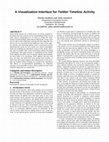
Social media streams are a useful source of current, targeted information, but such a stream can ... more Social media streams are a useful source of current, targeted information, but such a stream can be overwhelming if there are too many sources contributing to it. In order to combat this information overload problem, rather than by filtering the stream, users may be able to more efficiently consume the most impactful content by way of a visualization that emphasizes more recent, popular, relevant, and interesting updates. Such a visualization system should provide means for user control over stream consumption while not excluding any information sources in the stream, allowing users to broaden their source networking without becoming overwhelmed. This paper presents a visualization for the Twitter home timeline that allows users to quickly identify which updates are most likely to be interesting, which updates they have and have not read, and which have been posted most recently. A small-scale pilot study suggests that improvements to the prototype are required before carrying out a larger-scale experiment. The effects of recommendation presentation on subjective measures of recommender accuracy will be studied as future work using this application as a framework.
Frontiers in Artificial Intelligence
Student characteristics affect their willingness and ability to acquire new knowledge. Assessing ... more Student characteristics affect their willingness and ability to acquire new knowledge. Assessing and identifying the effects of student characteristics is important for online educational systems. Machine learning (ML) is becoming significant in utilizing learning data for student modeling, decision support systems, adaptive systems, and evaluation systems. The growing need for dynamic assessment of student characteristics in online educational systems has led to application of machine learning methods in modeling the characteristics. Being able to automatically model student characteristics during learning processes is essential for dynamic and continuous adaptation of teaching and learning to each student's needs. This paper provides a review of 8 years (from 2015 to 2022) of literature on the application of machine learning methods for automatic modeling of various student characteristics. The review found six student characteristics that can be modeled automatically and high...

Proceedings of the 15th Brazilian Symposium on Human Factors in Computing Systems, 2016
In human-computer interaction, aesthetics, usability and credibility are key factors in the desig... more In human-computer interaction, aesthetics, usability and credibility are key factors in the design of a successful website. Specifically, aesthetics has been identified as one of the main drivers of web credibility. However, in the mobile domain, large-scale research, cutting across cultures and continents, which is key to the generalizability of findings, is scarce. To bridge this gap, we conducted a multicultural study among 526 participants from 5 continents: Africa, Asia, North America, South America and Europe. Using four systematically designed mobile websites, we investigated: (1) the interrelationships among aesthetics, usability and credibility; and (2) the moderating effect of gender. Our results, based on partial least square path modeling, reveal that: (1) perceived aesthetics is stronger than perceived usability in predicting the perceived credibility of mobile websites; and (2) gender moderates the effect of perceived aesthetics on perceived usability, with this effect being stronger for males than for females. Our findings underscore the need for designers to pay closer attention to aesthetics in designing successful mobile websites, as their visual appeal, irrespective of gender, enhances their perceived ease of use and credibility. These findings are noteworthy because, given the usability challenges posed by the relatively small-screen size of the mobile device, designers may be tempted to focus on designing easy-to-use websites only, while downplaying their visual appeal. Such a decision may adversely impact the overall credibility of their websites going by users' first impression.
2019 IEEE 10th Annual Information Technology, Electronics and Mobile Communication Conference (IEMCON), 2019
Currently, there is no universal method to track who shared what, with whom, when and for what pu... more Currently, there is no universal method to track who shared what, with whom, when and for what purposes in a verifiable way to create an individual incentive for data owners. A platform that allows data owners to control, delete, and get rewards from sharing their data would be an important enabler of user data-sharing. We propose a usable blockchain-and smart contracts-based framework that allows users to store research data locally and share without losing control and ownership of it. We have created smart contracts for building automatic verification of the conditions for data access that also naturally supports building up a verifiable record of the provenance, incentives for users to share their data and accountability of access. The paper presents a review of the existing work of research data sharing, the proposed blockchain-based framework and an evaluation of the framework by measuring the transaction cost for smart contracts deployment. The results show that nodes responded quickly in all tested cases with a befitting transaction cost.
Persuasive Technology: Development and Implementation of Personalized Technologies to Change Attitudes and Behaviors, 2017
The use of persuasive strategies has been identified as one means through which e-businesses can ... more The use of persuasive strategies has been identified as one means through which e-businesses can engage their existing clients and make new ones. To contribute to ongoing research in this area, we extend our previous study where Amazon was evaluated as a persuasive system using the Persuasive System's Design (PSD) framework. In the current study, we further investigate the factors that affect the perceived effectiveness, credibility and continuance intention for use of e-commerce systems through the prism of the PSD framework. Using Amazon as a case study and a sample size of 324 Amazon shoppers, we develop and test a research model using partial least-squares structural equation modelling (PLS-SEM) analysis. Our results show that perceived effectiveness of an e-commerce company like Amazon is a great predictor of continuance intention. In addition, social support and primary task support are strong predictors of perceived effectiveness. Furthermore, dialogue support significantly influences perceived product credibility and perceived review credibility and both constructs are strong predictors of system credibility. These findings suggest possible design guidelines in the development of successful e-commerce sites.
The Persuasive Systems Design (PSD) is a framework for developing and evaluating persuasive syste... more The Persuasive Systems Design (PSD) is a framework for developing and evaluating persuasive systems. Despite its extensive use as a guide for developing persuasive systems, its use as an evaluation tool for persuasive systems is yet to be exploited. In this paper, we review the PSD framework and use it to evaluate the persuasiveness of Netflix. We were able to identify at least one implementation of all the persuasive principles of the PSD framework.
The use of personalization and persuasion has been shown to optimize customers’ shopping experien... more The use of personalization and persuasion has been shown to optimize customers’ shopping experience in e-commerce. This study aims to identify the personalization methods and persuasive principles that make an ecommerce company successful. Using Amazon as a case study, we evaluated the personalization methods implemented using an existing process framework. We also applied the PSD model to Amazon to evaluate the persuasive principles it uses. Our results show that all the principles of the PSD model were implemented in Amazon. This study can serve as a guide to e-commerce businesses and software developers for building or improving existing e-commerce platforms.
In recent years, behavior modeling in fitness apps has become popular. However, there is little w... more In recent years, behavior modeling in fitness apps has become popular. However, there is little work on the implication of tailoring behavior models to their target users in fitness apps. Using the Social Cognitive Theory as a theoretical framework, we conducted a study on the efficacy of tailoring behavior models based on gender and exercise-type preference. Specifically, we investigated the social-cognitive-beliefs profile of participants when observing behavior models performing Push Up and Squat bodyweight exercises and the moderating effect of gender and exercise-type preference. Our results show that, regardless of exercise type, males’ perceived self-efficacy and projected exercise performance level are higher than females’, with males preferring Push Up and females preferring Squat the most. Thus, males are more likely to engage in Push Up than females. However, there is no significant difference between both genders with respect to Squat. Our findings underscore the need fo...
Different classifications of Wiki editor have been proposed. However, so far there has been no ma... more Different classifications of Wiki editor have been proposed. However, so far there has been no mapping between user classes based on their contributions and their motivations, which can be useful to design persuasive functions in wiki systems to increase participation. In this study, we attempt to bridge this gap by developing a customized MediaWiki system, used by 10 senior undergraduate students for their coursework. The participants were classified into three editors' classes and mapped to their motivation factors, using the system data and the results from the exit questionnaire.
Information, 2021
Research shows that a well-designed user interface is more likely to be persuasive than a poorly ... more Research shows that a well-designed user interface is more likely to be persuasive than a poorly designed one. However, there is a limited understanding of the relationship between user-experience (UX) design attributes and users’ receptiveness to the persuasive features of a persuasive technology aimed at motivating behavior change. To bridge this gap, we carried out an online case study among 228 participants from Canada and the United States to investigate the relationship between perceived UX design attributes and users’ receptiveness to persuasive features. The study serves as exploratory work by focusing on a single prototype (homepage of a fitness app); four commonly researched UX design attributes (perceived aesthetics, perceived usability, perceived credibility, and perceived usefulness); and six commonly employed persuasive features (Goal-Setting/Self-Monitoring, Reward, Cooperation, Competition, Social Comparison, and Social Learning) illustrated on storyboards. The resul...
Frontiers in Artificial Intelligence, 2020
Persuasive strategies are used to influence the behavior or attitude of people without coercion a... more Persuasive strategies are used to influence the behavior or attitude of people without coercion and are commonly used in online systems such as e-commerce systems. However, in order to make persuasive strategies more effective, research suggests that they should be tailored to groups of similar individuals. Research in the traits that are effective in tailoring or personalizing persuasive strategies is an ongoing research area. In the present study, we propose the use of shoppers' online shopping motivation in tailoring six commonly used influence strategies:scarcity, authority, consensus, liking, reciprocity, andcommitment. We aim to identify how these influence strategies can be tailored or personalized to e-commerce shoppers based on the online consumers' motivation when shopping. To achieve this, a research model was developed using Partial Least Squares-Structural Equation Modeling (PLS-SEM) and tested by conducting a study of 226 online shoppers. The result of our stru...
Information, 2019
Persuasive technologies have been identified as a potential motivational tool to tackle the risin... more Persuasive technologies have been identified as a potential motivational tool to tackle the rising problem of physical inactivity worldwide, with research showing they are more likely to be successful if tailored to the target audience. However, in the physical activity domain, there is limited research on how culture moderates users’ susceptibility to the various persuasive features employed in mobile health applications aimed to motivate behavior change. To bridge this gap, we conducted an empirical study among 256 participants from collectivist (n = 67) and individualist (n = 189) cultures to determine their culture-specific persuasion profiles with respect to six persuasive features commonly employed in fitness applications on the market. The persuasive features include two personal features (goal-setting/self-monitoring and reward) and four social features (competition, cooperation, social learning and social comparison). We based our study on the rating of storyboards (on whic...