Books by Karl-Stéphan Bouthillette

Springer, 2025
This book examines the significance of metaphysical list-making as a determining feature of ‘spir... more This book examines the significance of metaphysical list-making as a determining feature of ‘spiritual exercises’ in South Asian gnostic yogas. It examines how these ancient traditions sought spiritual transformation through the dialectical practice of taxonomy. It highlights the gnostic thread that intersects ‘spiritual exercises’ and ‘ways of life’ in Hindu, Buddhist, and Jaina circles. It fills a gap in yoga studies by proposing a new understanding of jñāna-yoga (yoga of knowledge). Departing from mainstream Anglophone philosophical traditions, it articulates an original meta-theory of philosophical practice, explaining how philosophy can be 'therapeutic' in concrete terms. The book theorizes yogic Gnosticism, as a South Asian religious undercurrent and as a distinctive form of philosophical practice and ascetic way of life internalizing a sacrificial worldview. Finally, the book analyzes four literary case studies, presenting therapeutic methods in competing gnostic traditions, namely, the Verses on Sāṃkhya of Īśvarakṛṣṇa; the Advaita Instructions on the Doctrine of Gauḍapāda; the Buddhist Heart Sūtra; and the Twelve Contemplations of the Jaina Kundakunda. The groundbreaking multidisciplinary and trans-sectarian book offers a must-read for scholars across the fields of world philosophy and religious studies.
Routledge, 2020
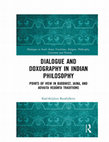
This is the first book fully dedicated to Indian philosophical doxography. It examines the functi... more This is the first book fully dedicated to Indian philosophical doxography. It examines the function such dialectical texts were intended to serve in the intellectual and religious life of their public. It looks at Indian doxography both as a witness of inter- and intra-sectarian dialogues and as a religious phenomenon. It argues that doxographies represent dialectical exercises, indicative of a peculiar religious attitude to plurality, and locate these ‘exercises’ within a known form of ‘yoga’ dedicated to the cultivation of ‘knowledge’ or ‘gnosis’ (jñāna).
Concretely, the book presents a critical examination of three Sanskrit doxographies: the Madhyamakahṛdayakārikā of the Buddhist Bhāviveka, the Ṣaḍdarśanasamuccaya of the Jain Haribhadra, and the Sarvasiddhāntasaṅgraha attributed to the Advaitin Śaṅkara, focusing on each of their respective presentation of the Mīmāṃsā view.
It is the first time that the genre of doxography is considered beyond its literary format to ponder its performative dimension, as a spiritual exercise. Theoretically broad, the book reaches out to academics in religious studies, Indian philosophy, Indology, and classical studies.
https://www.taylorfrancis.com/books/9780429275982
Qui s’éveille à la pensée indienne sait rarement se diriger seul. La présente introduction s’adre... more Qui s’éveille à la pensée indienne sait rarement se diriger seul. La présente introduction s’adresse à ce non-initié intéressé à découvrir différents courants philosophiques indiens, tout en évitant, autant que possible, l’écueil de l’écriture académique formelle. À travers sept tableaux, incluant le Yoga, le Védanta et le bouddhisme, apparaissent autant de développements idéologiques qui ont façonné la culture indienne, auxquels s’ajoutent des éléments biographiques inspirés d’aventures personnelles de l’auteur en Inde, qui enracinent le récit dans une expérience d’apprentissage concrète. En somme, ce carnet de route philosophique et poétique esquisse une tradition intellectuelle et religieuse que l’auteur qualifie de « yoga de la raison ».
Until today, the many specialists who criticized Rampa‟s work were unanimous in describing it as ... more Until today, the many specialists who criticized Rampa‟s work were unanimous in describing it as a pure make up, a web of lies and half-truths. In general, this depreciation has been supported by considerations proper to the field of Tibetology. Is it possible to take on another point of view when approaching this most controversial author, a view that would not be that of Tibetology but that of Religious Studies in general and of Mythology in particular? From this perspective, looking beyond the usual ideologically biased condemnations, can‟t we perceive in Rampa‟s work the genesis o f myths foretelling a new approach to spirituality?
Book Chapters by Karl-Stéphan Bouthillette
Indian and Western Philosophical Concepts in Religion, 2023
Philosophical concepts are influential in the theories and methods to study the world religions. ... more Philosophical concepts are influential in the theories and methods to study the world religions. Even though the disciplines of anthropology and religious studies now encompass communities and cultures across the world, the theories and methods used to study world religions and cultures continue to be rooted in Western philosophies. For instance, one of the most widely used textbooks used in introductory courses on religious studies, introduces major theoreticians such as
The Routledge Handbook of Indian Buddhist Philosophy, 2022
Appearing in : The Routledge Handbook of Indian Buddhist Philosophy, edited by Pierre-Julien Hart... more Appearing in : The Routledge Handbook of Indian Buddhist Philosophy, edited by Pierre-Julien Harter William Edelglass, and Sara McClintock
Puṣpikā V: Tracing Ancient India, through Texts and Traditions: Contributions to Current Research in Indology, 2019
The first and only critical edition of the Sarvasiddhāntasaṅgraha (SSS) was produced over a centu... more The first and only critical edition of the Sarvasiddhāntasaṅgraha (SSS) was produced over a century ago, in 1909, by Professor M. Raṅgācārya. Since then, besides being mentioned as one of the many spurious literary attributions of the famous theologian Śaṅkara, the text received little attention. My purpose here will be to summarise what has been said concerning both the authorship and the possible dates of the SSS, and to contribute my own observations on the subject in tune with what we know so far in regard to Śaṅkara’s work in particular and the genre of doxography in general. I begin by aligning the several arguments in favour of and against the authorship of Śaṅkara, so as to identify and localise the problematic passages. I argue that these passages are found within precise locations of the text that could potentially be later additions. I explain how doxographies are, by nature, composite texts, and that new content can easily be added onto them without breaking their continuity. I then explain that doxography is in tune with Śaṅkara’s pedagogy and is a logical development of his work as an embattled religious teacher. In this regard, the SSS even appears to support a form of spiritual exercise essential for the soteriological project of the Advaita. Taking all these matters into consideration, I suggest that the core of the SSS might have been assembled between the eighth and tenth centuries, still allowing for later additions until the 14th century.
Papers by Karl-Stéphan Bouthillette
India Foundation Journal, 2026
This paper reconsiders the meaning of karma in classical Jain and Buddhist philosophy and its imp... more This paper reconsiders the meaning of karma in classical Jain and Buddhist philosophy and its implications for ethics and politics. Against modern popular and activist appropriations that recast karma as a principle of justice, responsibility, and worldly repair, I argue that Buddhist and Jaina sources understood karma primarily as a contaminant: the binding force that traps beings in saṃsāra, the cycle of birth and death marked by suffering and delusion. The task was not to perfect karma but to exhaust, transcend, or dissolve it, a project inseparable from the renunciatory ideal.
Part One traces this negative valuation of karma in Jaina and Buddhist sources, from Jain metaphysics of karmic matter to the Buddha’s definition of karma as intention, Abhidharma theories of continuity, and Nāgārjuna’s radical deconstruction of karmic causality as empty. In each case, karma emerges not as cosmic justice but as the very machinery of bondage, demanding renunciation as its practical corollary.
Part Two turns to the broader implications of this view. I develop the notion of renunciation as a form of ascetic resistance: an apolitics that resists the karmic economy itself, neither reforming nor fleeing the world but refusing its logic of action and accumulation. This perspective is then contrasted with modern activist reinterpretations, which transform karma into a resource for social justice, ecological responsibility, or political resistance. While powerful in their own right, these activist reuses risk reinscribing the very economy of action that renunciation sought to overcome.
Finally, I suggest that the renunciatory critique of karma retains philosophical force in the Anthropocene. In an age of ecological collapse and political exhaustion, the lesson of these traditions is not that we must “make saṃsāra great again,” but that some problems cannot be redeemed within the frameworks that generate them. Their refusal of the karmic economy discloses another mode of resistance—ascetic rather than activist, apolitical rather than political—in which life is revalued as the possibility of peace beyond accumulation, identity, and striving.
Journal of Vaishnava Studies, 2025
Among the eighteen Mahāpurāṇas, the Śrīmad Bhāgavatam (Bhāgavata Purāṇa) occupies a unique theolo... more Among the eighteen Mahāpurāṇas, the Śrīmad Bhāgavatam (Bhāgavata Purāṇa) occupies a unique theological stature across Hindu traditions, especially within the bhakti movements. 1 Composed, according to its own narrative, after the compilation of the Vedas, the Mahābhārata, and the other Purāṇas by Veda Vyāsa, the Bhāgavata is portrayed not merely as another Purāṇa, but as the culmination of Vyāsa's literary and spiritual work. In Canto 1, Chapter 5, Vyāsa's transformative encounter with Nārada reveals that his earlier writings had failed to evoke exclusive devotion (bhakti) to the Supreme Being, which was the cause of his lingering dissatisfaction even after composing monumental works like the Mahābhārata and the Brahmasūtras. This episode is significant for how it marks the Bhāgavata as a theologically distinct text, one that prioritizes personalist theism and bhakti over impersonal metaphysics or ritualism. As the text insists, even imperfect devotional speech is superior to flawlessly constructed, yet Godless, philosophical discourse. The very second verse declares its salvific purpose, tāpatrayonmūlanam, to uproot the threefold miseries (ādhyātmika, ādhibhautika, ādidaivika), 2 thus identifying its target audience: those afflicted by existential suffering, for whom bhakti becomes the best means of liberation. The text's chronological placement is also of theological significance. Though composed after the Mahābhārata and Brahmasūtras, Madhvācārya cites a Garuḍa Purāṇa verse that praises the Bhāgavata as the essence of all Purāṇas, the culmination of Vedic meaning, and a fifth Veda in itself: artho'yaṃ brahmasūtrāṇāṃ bhāratārthavinirṇayaḥ gāyatrībhāṣyarūpo'sau vedārthaparibṛṃhitaḥ
Journal of Yoga Studies, 2025
In this paper I gather core definitional components of yogic Gnosticism (aka jñāna-yoga/ the yo... more In this paper I gather core definitional components of yogic Gnosticism (aka jñāna-yoga/ the yoga of knowledge), which I produced for a forthcoming monograph (Metaphysics as Therapy, Springer, April 2025) on the use of taxonomy in the spiritual exercises of gnostic yogas. I highlight the historical significance of this elite form of yogic cultivation and its general neglect within the emerging field of Yoga Studies. I explore the reasons for this neglect and suggest that, since we have not yet come close to any thorough understanding of the variform manifestations of gnostic yogas, it leaves a serious gap in the field to disregard this rather contemplative, intellectual, and scholastic form of yoga in favour of the more spectacular ones in fashion today. I present textual evidence for the usage of the term jñāna-yoga and the development of its meaning. I propose a minimal list of ten features, which I argue are shared among the various gnostic currents of yoga. In a fourth step, I briefly discuss the doctrinal antagonism of the ritual-oriented forms of yoga (karma-yoga) and the knowledge-oriented jñāna-yoga, to highlight how Hindu, Buddhist, and Jaina Gnostics have variously insisted on the cultivation of knowledge as the sole means of liberation. I then critically engage with Vivekananda’s perception of jñāna-yoga to highlight some elements of his thought that correspond with my research findings on yogic Gnosticism, before concluding with remarks on the challenging elitism of this trans-sectarian South Asian current.
Distant Worlds Journal Special Issues, 2021
Doxographical writings appeared early on in the Graeco-Roman world. The genre of doxography never... more Doxographical writings appeared early on in the Graeco-Roman world. The genre of doxography never disappeared ever since. It can be found in Islamic and Christian literature, and even, in some ways, in some modern writings on the history of philosophy. My doctoral dissertation explored the genre in the Asian context, through three early Indian models. In Asia, doxographies are found pretty much anywhere philosophy developed, in Tibet and China in particular. Despite the widespread use of doxographical formats of writing in various cultures, modern philosophers tend to look down on the genre, which they perceive as an unreflective and by times even misleading presentation of philosophical ideas. Recent research in classical doxography, however, has shown that there is more to be found under their covers than a mere listing of opinions. My own contribution to the discussion shows that early Indian models can even be seen as 'spiritual exercises' in their own rights. This paper challenges the pejorative connotations some may entertain towards doxography and calls for a renewed appreciation of the genre.
Studia Religiologica, 2017
Could the presuppositions behind the distinction between theory and practice in the realm of yoga... more Could the presuppositions behind the distinction between theory and practice in the realm of yoga be misguided, if not misleading? To approach this question, this paper drafts a meta-perspective gleaned from the thought of three thinkers credited with the earliest Indian doxographies, namely the sixth-century philosopher of Madhyamaka Buddhism, Bhāviveka, the seventh-century Jaina logician Haribhadra Sūri, and the eighth-century Advaita-Vedānta philosopher Śaṅkarācārya. The paper examines the notion of " view " entertained in Indian thought, and suggests that yoga is particularly interested in shaping views. It draws a distinction between the notions of " practice " and " praxis, " arguing that the latter best captures the " yoga " of our authors. The paper then discusses the transformative role of hermeneutics and how, when combined with dialectic, it captures the essence of " scholastic praxis. " Finally, it presents a traditional framework to elucidate the interplay of hermeneutic praxis and soteriology within Buddhism, with brief references to similar patterns in the work of our two non-Buddhist authors. The self-transformative aspect of hermeneutics has so far received little attention and requires further research. This paper is an attempt in that direction.
Distant Worlds Journal, 2017
In a tumultuous socio-historical context, the Buddhist Madhyamaka philosopher Bhāviveka d... more In a tumultuous socio-historical context, the Buddhist Madhyamaka philosopher Bhāviveka designed a coherent battle strategy that was to set the tone for the development of later philosophical compendia in India and beyond. Bhāviveka’s writings, especially his magnum opus, the Madhyamaka-hṛdaya-kārikā (MHK), his only text preserved in Sanskrit, is not only a rare window into the complex intellectual panorama of sixth century India, but it offers a vivid picture of an engaged Buddhist philosopher ascertaining various dialectical and exegetical strategies suited to the
challenges at hand. The first part of this paper is a briefing on the sociohistorical context in which Bhāviveka intervened. The second section borrows from ‘social-ecological coexistence theory’ to examine that context as a dynamic ecosystem. Finally, the mission assigned by the author to his bodhisattvas is presented in his own words, from the MHK’s opening section, the bodhicitta-aparityāgaḥ.
Religious Inquiries, 2015
This article discusses the function of dialectic in religious history, focusing on the works of t... more This article discusses the function of dialectic in religious history, focusing on the works of two major sixth century Indian intellectuals and doxographers Bhāviveka and Haribhadra Sūri, who belonged to the competing Madhyamaka Buddhist and Jaina traditions respectively. The article studies how these two figures used medical metaphors for their dialectic purposes.
Centre de ressources et d'observation de l'innovation religieuse, Apr 15, 2010
Karl-Stéphan Bouthillette a consacré un mémoire de maîtrise à plusieurs livres de Lobsang Rampa (... more Karl-Stéphan Bouthillette a consacré un mémoire de maîtrise à plusieurs livres de Lobsang Rampa (Le troisième œil, L’histoire de Rampa, etc.). Il situe brièvement ce qu’il appelle le mythe de Rampa dans le cadre des spiritualités contemporaines.
Book Review by Karl-Stéphan Bouthillette
Religion, 2025
Buddhist Ethics and the Bodhisattva Path: Śāntideva on Virtue and Well-Being,by Stephen E. Harris... more Buddhist Ethics and the Bodhisattva Path: Śāntideva on Virtue and Well-Being,by Stephen E. Harris, London, Bloomsbury Academic, 2023, x +264pp., US$90.00(hardback), ISBN 978 135 037955 8
Religion, 2024
Bouthillette, Karl-Stéphan. 2024. “A Social Cognition Perspective of the Psychology of Religion: ... more Bouthillette, Karl-Stéphan. 2024. “A Social Cognition Perspective of the Psychology of Religion: ‘Why God Thinks Like You’: By Luke Galen, London, Bloomsbury, 2023, Ix + 298 Pp., US$115.00 (Hardback), ISBN 978 135 029390 8.” Religion, November, 1–4. doi:10.1080/0048721X.2025.2425578.
Religion, 2023
This concise yet wide-ranging work is the sixth monograph penned by Ankur Barua. According to the... more This concise yet wide-ranging work is the sixth monograph penned by Ankur Barua. According to the author, it is meant for advanced graduate and postgraduate students. Its purpose is to explore the mythic narratives, logical disputations, moral visions, and spiritual practices relating to the texts, themes, thinkers, and traditions that would be accepted, more or less readily, as vital markers of present-day 'Hindu' self-understanding. At the same time, it seeks to present a critical contribution to contemporary conversations about the concept of philosophy across European and Indian intellectual landscapes. To accomplish this, Barua abandons the doxographical approach often used in framing discussions on Indian philosophy. Instead of devoting separate chapters to every single Hindu philosophical school, or darśana, as they are commonly called in Sanskrit, the book foregrounds specific motifs relating to major philosophical themes of contemporary relevance, reflecting on how each school grapples with them individually, but also in debate with one another, and especially in opposition to Buddhism. I will briefly list each theme as it unfolds, chapter by chapter, keeping the subtitles' terminology as far as possible, and reflect on the work in general by articulating a critique of the dominant analytical trend in the study of Indian philosophies: an Anglo-American positivistic outlook to which the current book is solely committed. Chapter One, on 'unity and its concrete multitudes,' discusses what is a thing, working with words to understand the world, mapping the multitudes in the world, what is the criterion of reality, comprehending the form of unity, and what is the most economical inventory of the world, the best attempt at list making. The chapter is chiefly preoccupied with the discussions and arguments of the Nyāya-Vaiśeṣ ika schools, presented as embattled with the Buddhists over fundamental issues regarding the relation between language and the world. It also begins to spell out the worldview of Advaita, although it acknowledges that the fundamental cement that holds it together cannot be apprehended through human thought. Chapter Two asks what the correct analysis of cognitive processes is, assessing the reality of reasoning. It ponders whether universals are reality-rooted or mind-constructed, leading to discussions on the mind's cognitions and the world's textures, before ending on an assessment of the power of reasoning in relation to the root of reality. Therein, we find an example from Shakespeare's Macbeth drawn to illustrate an argument about mind-dependence (47). Barua assumes that his readers are more familiar with the classical English poet than with authors closer to the Hindu traditions he is introducing and leaves the situation unchallenged. The example, not being an isolated case, illustrates how having the good intention of being accessible to undergrads comes to serve as an excuse to acculturate Indian philosophy to the dominant paradigm in contemporary philosophical scholarship: the Anglo-American model. Precisely here, any aspiration to challenge the colonial legacy in philosophical scholarship goes down the drain. In sum, the chapter is mainly given to Nyāya rhetoric-the child prodigy of Indian philosophy for scholars espousing Bimal Krishna Matilal's (a British-Indian philosopher himself) inspired positivism-and its engagement with Buddhist arguments, with minor exceptions, i.e., a discussion on Śaiva siddhāṇ ta (70). Chapter Three boasts an ambitious title: 'Therapies for Liberation.' It promises a philosophical perspective which could finally add a contrasting interpretative dimension to the RELIGION
Religion, 2023
A Global History of Buddhism and Medicine, by C. Pierce Salguero, ColumbiaUniversity Press, New Y... more A Global History of Buddhism and Medicine, by C. Pierce Salguero, ColumbiaUniversity Press, New York, 2022, vii + 244, US$140.00 (hardback) ISBN 978 023118526 4



Uploads
Books by Karl-Stéphan Bouthillette
Concretely, the book presents a critical examination of three Sanskrit doxographies: the Madhyamakahṛdayakārikā of the Buddhist Bhāviveka, the Ṣaḍdarśanasamuccaya of the Jain Haribhadra, and the Sarvasiddhāntasaṅgraha attributed to the Advaitin Śaṅkara, focusing on each of their respective presentation of the Mīmāṃsā view.
It is the first time that the genre of doxography is considered beyond its literary format to ponder its performative dimension, as a spiritual exercise. Theoretically broad, the book reaches out to academics in religious studies, Indian philosophy, Indology, and classical studies.
https://www.taylorfrancis.com/books/9780429275982
Book Chapters by Karl-Stéphan Bouthillette
Papers by Karl-Stéphan Bouthillette
Part One traces this negative valuation of karma in Jaina and Buddhist sources, from Jain metaphysics of karmic matter to the Buddha’s definition of karma as intention, Abhidharma theories of continuity, and Nāgārjuna’s radical deconstruction of karmic causality as empty. In each case, karma emerges not as cosmic justice but as the very machinery of bondage, demanding renunciation as its practical corollary.
Part Two turns to the broader implications of this view. I develop the notion of renunciation as a form of ascetic resistance: an apolitics that resists the karmic economy itself, neither reforming nor fleeing the world but refusing its logic of action and accumulation. This perspective is then contrasted with modern activist reinterpretations, which transform karma into a resource for social justice, ecological responsibility, or political resistance. While powerful in their own right, these activist reuses risk reinscribing the very economy of action that renunciation sought to overcome.
Finally, I suggest that the renunciatory critique of karma retains philosophical force in the Anthropocene. In an age of ecological collapse and political exhaustion, the lesson of these traditions is not that we must “make saṃsāra great again,” but that some problems cannot be redeemed within the frameworks that generate them. Their refusal of the karmic economy discloses another mode of resistance—ascetic rather than activist, apolitical rather than political—in which life is revalued as the possibility of peace beyond accumulation, identity, and striving.
challenges at hand. The first part of this paper is a briefing on the sociohistorical context in which Bhāviveka intervened. The second section borrows from ‘social-ecological coexistence theory’ to examine that context as a dynamic ecosystem. Finally, the mission assigned by the author to his bodhisattvas is presented in his own words, from the MHK’s opening section, the bodhicitta-aparityāgaḥ.
Book Review by Karl-Stéphan Bouthillette