Synopsis
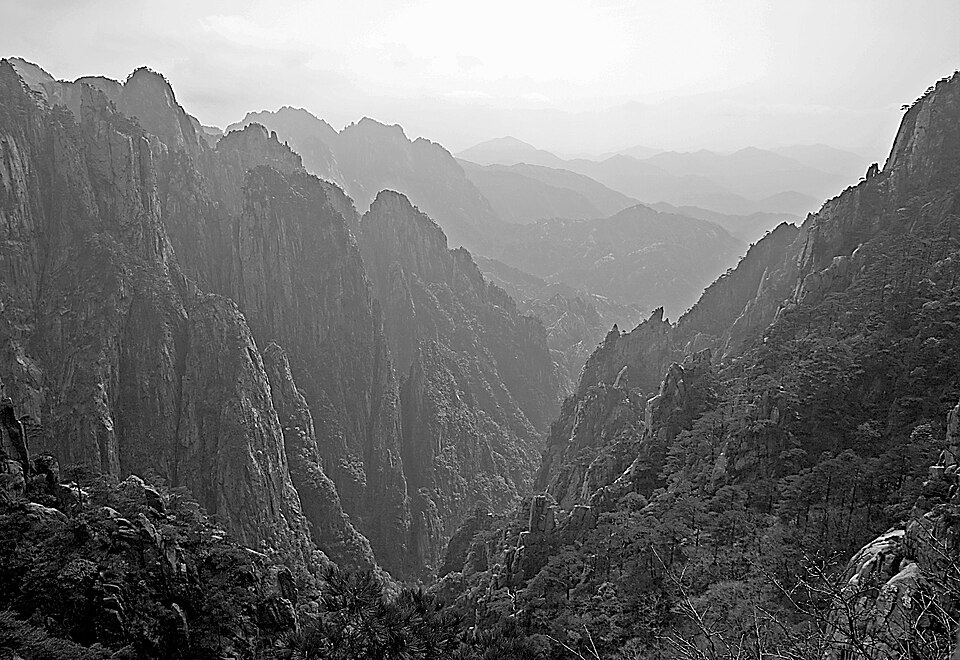
Huangshan in southern Anhui Province is famous for its Four Wonders: odd pines, grotesque rocks, sea of clouds, and hot springs. A UNESCO World Cultural and Natural Heritage Site since 1990.
Overview
Mount Huangshan (Yellow Mountain), located in southern Anhui Province, is one of China's most famous mountain scenic areas. Huangshan is renowned for its "Four Wonders": odd pines, grotesque rocks, sea of clouds, and hot springs. It enjoys the reputation that "After returning from the Five Great Mountains, one need not see other mountains; after returning from Huangshan, one need not see the Five Great Mountains."
The Huangshan scenic area covers approximately 160 square kilometers, with a core area of about 154 square kilometers. Huangshan has 72 peaks, among which Lotus Peak (Lianhua Feng) rises to 1,864.8 meters — the highest peak of Huangshan and of Anhui Province. Two other famous peaks are Bright Summit Peak (Guangming Ding, 1,860m) and Celestial Capital Peak (Tiandu Feng, 1,810m).
In December 1990, Huangshan was inscribed on UNESCO's World Cultural and Natural Heritage List — one of the few scenic areas in the world to hold dual World Heritage status for both culture and nature.
The Four Wonders of Huangshan
| Wonder | Features | Representative Sights |
|---|---|---|
| Odd Pines | Huangshan pines are famous for their tenacious vitality, growing in rock crevices | Guest-Greeting Pine, Farewell Pine, Black Tiger Pine, Connected Pines |
| Grotesque Rocks | Rocks of various shapes that present different images from different angles | Flying-Over Rock, Monkey Watching the Sea, Immortal Pointing the Way, Dreaming Brush Producing Flowers |
| Sea of Clouds | Clouds and mist enveloping the peaks, creating spectacular cloud seas | East Sea, West Sea, South Sea, North Sea, Heavenly Sea |
| Hot Springs | Year-round water temperature of approximately 42°C, containing various minerals | Huangshan Hot Spring (anciently called Tangquan), legend says the Yellow Emperor once bathed here |
Main Attractions
The Huangshan scenic area is divided into six scenic zones: Hot Spring, Yuping, Beihai, Xihai, Baiyun, and Songgu:
- Yuping Scenic Area: Centered on Yuping Pavilion, includes the Guest-Greeting Pine and Celestial Capital Peak. The Guest-Greeting Pine (Yingkesong) is the iconic symbol of Huangshan and one of the symbols of Anhui Province
- Beihai Scenic Area: Shixin Peak is the best place to view Huangshan pines — "Without reaching Shixin Peak, one has not seen Huangshan pines"
- Xihai Grand Canyon: One of Huangshan's most spectacular areas, with deep, dramatic valleys and breathtaking views — a paradise for hikers
- Bright Summit Peak: Huangshan's second-highest peak, the best position for watching sunrise, sunset, and cloud seas
- Celestial Capital Peak: Huangshan's third-highest peak, famous for its steepness — the "Carp's Back" section is the most thrilling
- Lotus Peak: Huangshan's highest peak (1,864.8m), named for its lotus-like shape at the summit
- Flying-Over Rock: A giant boulder standing on a rock platform, approximately 12 meters high and weighing about 360 tons — a filming location for the 1987 TV series Dream of the Red Chamber
- Monkey Watching the Sea: A rock resembling a monkey, perched on a peak and gazing out at the sea of clouds
History and Culture
Huangshan was originally called Yishan (Black Mountain) due to its dark-colored peaks and rocks. In the sixth year of the Tianbao era of the Tang Dynasty (747 AD), Emperor Xuanzong of Tang renamed it Huangshan (Yellow Mountain) based on the legend that the Yellow Emperor (Huangdi) practiced alchemy and achieved immortality here.
Throughout history, Huangshan has attracted countless literati and artists. Tang Dynasty poet Li Bai visited Huangshan and wrote: "Huangshan rises four thousand ren, with thirty-two lotus peaks." Ming Dynasty traveler Xu Xiake ascended Huangshan twice and exclaimed: "Among all the famous mountains within and beyond the seas, none compares to Huangshan in Huizhou. After climbing Huangshan, there is no mountain left to see — perfection has been reached!" From this, later generations distilled the famous saying: "After returning from the Five Great Mountains, one need not see other mountains; after returning from Huangshan, one need not see the Five Great Mountains."
Huangshan is also a source of inspiration for Chinese landscape painting. The "Huangshan School of Painting" is an important tradition in Chinese art history, with representative artists including Jian Jiang, Shi Tao, and Mei Qing.
Practical Information
| Item | Details |
|---|---|
| Location | Huangshan District, Huangshan City, Anhui Province |
| Best Season | Year-round: Spring (Apr-May) for flowers, Summer (Jun-Aug) to escape heat, Autumn (Sep-Nov) for red leaves, Winter (Dec-Feb) for snow scenes and rime ice |
| Recommended Duration | 2-3 days |
| Admission | Peak season (Mar-Nov) ~190 RMB, Off-season (Dec-Feb) ~150 RMB |
| Cable Cars | Yungu Cableway, Yuping Cableway, Taiping Cableway, Xihai Grand Canyon sightseeing cable car |
| Accommodation | Several hotels on the mountaintop (Baiyun Hotel, Beihai Hotel, Xihai Hotel, etc.) — staying overnight is recommended for sunrise |
| Transportation | Huangshan North Station (high-speed rail), Tunxi International Airport |
| Hiking Routes | Front mountain (Yuping route) is steeper but concentrated in scenery; back mountain (Yungu route) is gentler |
World Heritage
In 1990, Huangshan was inscribed by UNESCO as a World Cultural and Natural Heritage Site for:
- Natural Value: Unique granite landforms, rich biodiversity (over 2,000 plant species, 1,500 animal species), and spectacular natural phenomena such as cloud seas and sunrise
- Cultural Value: Huangshan holds an important place in Chinese literary, artistic, and religious history — it is the birthplace of the "Huangshan School of Painting" and a significant sacred site for both Daoism and Buddhism
Huangshan and Mount Tai are the only two World Cultural and Natural Heritage Sites in China (dual designation).
References
- Wikipedia: https://zh.wikipedia.org/wiki/黄山
- Baidu Baike: https://baike.baidu.com/item/黄山
- UNESCO: https://whc.unesco.org/en/list/547/
Stills & Gallery
Comments (0)