Papers by Lidar Sapir-Hen

Tel Aviv, 2025
The Greek inscriptions discovered on Delos ascribed to (former) inhabitants of Ashkelon and Yavne... more The Greek inscriptions discovered on Delos ascribed to (former) inhabitants of Ashkelon and Yavneh may offer insight into the ritual customs practiced in these regions. Noteworthy instances of such inscriptions, dating back to the 2nd and early 1st centuries BCE, explicitly prohibit the sacrifice of either goats or both goats and pigs. In this paper, we endeavour to elucidate both the meaning of these inscriptions and the ritual practices associated with them. To achieve this goal, we delve into the zooarchaeological data found at these sites, draw comparisons between the findings of this and earlier periods, and explore literary sources referring to Levantine societies. Both types of evidence, zooarchaeology and textual, suggest that these prohibitions on the sacrifice of pigs and/or goats can be attributed to a specific ritual belief or taboo associated with these animals, which reflects the origins of the inscriptions' dedicators.

New Studies in the Archaeology of Jerusalem and its Region 18 , 2025
Pigs have attracted more attention than perhaps any other animal in the archaeological research o... more Pigs have attracted more attention than perhaps any other animal in the archaeological research of the southern Levantine Iron Age. Two main factors account for this focus. First, a long-standing assumption in the archaeological scholarship associated the consumption or avoidance of pork with cultural identity: “Israelite” settlements were identified by the absence of pig bones, and “Philistine” settlements by their presence. Recent archaeozoological studies have challenged this view, demonstrating that the Iron Age evidence demands a more nuanced interpretation, and that pig remains cannot serve as definitive markers of identity. Second, the pig’s distinctive status as an impure animal in later Jewish tradition has shaped interpretations of the archaeological record. This interpretive approach, however, relies on a monolithic reading of biblical and Jewish attitudes toward pigs. This paper traces the development of attitudes towards pigs over time, showing that a significant shift occurred during the Hellenistic and Roman periods. It also examines perceptions of pigs among other groups in the Hellenistic East, offering a comparative model for understanding the changes that took place within the Jewish world in these periods.
Tel Aviv, 52:2, 256-273, 2025
The Greek inscriptions discovered on Delos ascribed to (former) inhabitants of Ashkelon and Yavne... more The Greek inscriptions discovered on Delos ascribed to (former) inhabitants of Ashkelon and Yavneh may offer insight into the ritual customs practiced in these regions. Noteworthy instances of such inscriptions, dating back to the 2nd and early 1st centuries BCE, explicitly prohibit the sacrifice of either goats or both goats and pigs. In this paper, we endeavour to elucidate both the meaning of these inscriptions and the ritual practices associated with them. To achieve this goal, we delve into the zooarchaeological data found at these sites, draw comparisons between the findings of this and earlier periods, and explore literary sources referring to Levantine societies. Both types of evidence, zooarchaeology and textual, suggest that these prohibitions on the sacrifice of pigs and/or goats can be attributed to a specific ritual belief or taboo associated with these animals, which reflects the origins of the inscriptions' dedicators.
Scientific Reports, 2024
This study explores changes in pastoral practices in the Jerusalem region (Iron Age II-Late Helle... more This study explores changes in pastoral practices in the Jerusalem region (Iron Age II-Late Hellenistic) through a multi-isotope approach (strontium, carbon, oxygen, and nitrogen). Based on the analysis of 135 sheep, goat, and cattle teeth and bone samples from Givati Parking Lot we demonstrate the value of this method in reconstructing past animal husbandry, revealing adaptation and resilience of pastoral communities amidst environmental and socio-political changes. Isotopic analysis indicates local sourcing for most animals, with intriguing outliers from distant regions up to 150 km away, suggesting regional exchange networks. Notably, the Persian period (5th century BCE) exhibits a wider isotope range, implying increased flexibility and exploitation of diverse grazing lands, potentially driven by climate shifts and political upheavals. Conversely, Late Hellenistic (2nd century BCE) livestock display restricted movement, while showcasing a rise in desert caprines, indicative of increased import compared to the Persian era. These findings highlight the dynamism and adaptability of past pastoral communities, adjusting their strategies in response to various pressures. This study opens new avenues for understanding human-environment interactions in the Levant and underscores the power of multiisotope approaches in unraveling intricate socioeconomic and ecological dynamics of the past.
ZDPV, 2023
The animal economy of Jerusalem in the wake of the Neo-Babylonian destruction and reestablishment... more The animal economy of Jerusalem in the wake of the Neo-Babylonian destruction and reestablishment of the city in the 6 th through the 2 nd cent. B.C.E. is relatively unknown. This paper presents the first diachronic perspective of Jerusalem and its hinterland's animal economy in the latter half of the 1 st mill. B.C.E., against the backdrop of geopolitical, environmental, and cultural changes. To accomplish this aim, we carried out a synchronic and diachronic study of the faunal assemblages from two sites dated to this time frame: Giv ati Parking Lot (Area 10) in Jerusalem and Nebi Samuel in the hinterland. Further, we studied these sites in the context of previously published contemporary sites. We demonstrate that Jerusalem continued to butcher locally and consume livestock acquired through direct and indirect channels in both periods. At the same time, those in the hinterland continued to produce meat and agropastoral products for themselves and external consumers. Additional conclusions of this research indicate that while there is continuity in the herd management practices of sheep and goats in Jerusalem and its hinterland, there is a change in the exploitation of cattle and chicken. We suggest that these changes relate to social, cultural, and religious developments in the latter half of the 1 st mill. B.C.E.

Environmental Archaeology, 2024
Significant changes to subsistence economy and hunting habits have occurred in huntergatherer soc... more Significant changes to subsistence economy and hunting habits have occurred in huntergatherer societies in the Levant, starting as early as the late Epi-Palaeolithic. Among the observed changes were the increase in the frequencies of gazelles and small sized animals, including small carnivore species, primarily foxes and felids. The role of the red fox in Late Natufian and early Neolithic economies in the southern Lavant has been examined in previous studies, though rarely in detail, while the role of wildcats has been largely neglected. We studied fox and wildcat remains from EPPNB Ah. ihud (Israel), in order to elucidate their role in the economy of the site. We found relatively high frequencies of fox and wildcat remains and an abundance of burn signs and cut marks, which enabled us to conduct a detailed study of these small carnivore remains in their archaeological context. Our study demonstrates that foxes and wildcats were hunted and exploited intensively, both for their fur and for their meat. Hence, we suggest that they should be considered as game animals in future studies of animal exploitation in the Early Neolithic.
International Journal of Osteoarchaeology, 2024
Animal domestication led to changes in the interaction between animals and humans, including new ... more Animal domestication led to changes in the interaction between animals and humans, including new ways of exploitation, which could potentially leave lesions on the animals' bones. This study aims to examine changes in the prevalence of pathological manifestation following changes in human-animal interactions as a result their domestication. For this purpose, we studied 19,565 animal remains recovered from archaeological excavations, dated from the Pre-Pottery Neolithic period to historical periods and assigned the pathologies into types. Of these, 60 animal remains presented pathological lesions. The suspected pathological cases were validated using a microscope, X-ray, and/or micro-CT scan. Lesions were divided into four categories: trauma, aging/musculoskeletal stress marks (MSM), periodontal diseases, and inflammatory processes. Then, our database was combined with previously published data to a total of 26,596 animal remains, out of which 128 demonstrated pathological lesions. We found that the prevalence of lesions in animals was higher in the historical periods compared with prehistoric periods. Moreover, based on a comparison between recent gazelles living in captivity and those living in the wild, we found that captivity resulted in the deterioration of the animals' health. We concluded that pathologies were more frequent in livestock in historic periods, in comparison with wild species and livestock from earlier periods. Such lesions were common not only in working livestock (cattle and donkeys) but also in non-working domesticates (caprines and chickens) and companion animals (dogs and cats). Variations in the pathological frequencies between these three categories may be attributed to differences in exploitation, including the intensification of farming and herding. Finally, this study provides a unique reference dataset for zooarchaeologists when studying ancient animal assemblages.
Archaeological and Anthropological Sciences, 2024
This study aims at establishing a historically based model of animal husbandry in urban and rural... more This study aims at establishing a historically based model of animal husbandry in urban and rural settlements, in the Southern Levant. This type of model is required in the field of zooarchaeology, to better analyze and study ancient faunal remains. It also applies a non-traditional method to study and differentiate between urban and rural economies. For this
aim, we used British Mandate tax files and village statistics. These are the best available historical documents for this period, that recorded herds management statistics in all settlements of Palestine. We selected only settlements inhabited by the indigenous population and divided the data into four environmental regions. We analyzed the livestock abundance
and herd demography in each region. Each urban center was considered independently, while the rural villages were classified into three groups, based on the most common livestock (cattle, sheep, or goats). Results show economic variations between urban and rural settlements as well as regional trends, such as in pastoralism and agricultural management. In
addition, meat industries were common in most urban centers, being the primary difference from rural economies. We applied this model to two large zooarchaeological case studies, dating from the Early Islamic to the Ottoman period; Mount Zion, located in the urban city of Jerusalem, and Tel Beth Shemesh (East), whose size and nature were not historically
recorded. We found that the economic variations reflected in the model were also present in the faunal assemblages.
Pelorient, 2024
The recent excavations at the site of Aḥihud uncovered the remains of an Early Pre-Pottery Neolit... more The recent excavations at the site of Aḥihud uncovered the remains of an Early Pre-Pottery Neolithic B village on the bank of Nahal Ḥilazon (Acre valley, Israel) tributary channel. The site is in an ecotone between the western Galilee hills and the northern coastal plain. The lithic assemblage from the site includes typical PPNB arrowheads (about a third are El-Khiam and Helwan types) as well as hundreds of sickle blades. The fauna include evidence to the hunting of large and small game as well as small predators. The flora from the site shows evidence for an intensive legume crop agriculture. Thousands of legume seeds were concentrated in two silos. The vast majority are broad beans (Vicia faba) that predate the earliest evidence for an established cultivation of legumes in the Southern Levant. Other finds attest to the acquisition of exotic goods such as various green stones and obsidian from the Northern Levant or shells from the Red Sea.
Koch, I., Lipschits, O., and Sergi, O. 2023. From Nomadism to Monarchy? Revisiting the Early Iron Age Southern Levant (Mosaic 3). Tel Aviv and University Park, PA
'Atiqot, 2023
This paper presents a cache of 31 astragali from the site of Tel Nagila, dating to the Middle Bro... more This paper presents a cache of 31 astragali from the site of Tel Nagila, dating to the Middle Bronze Age. This is the earliest known cache of astragali from the Southern Levant outside tombs, and may be the forebearer of the later caches found in cultic contexts in the Late Bronze and Iron Ages. This paper presents the context in which the cache was found, adjacent to a tower that functioned as part of the site's fortifications; the social mechanisms behind the use of astragali; their deposition in a cache; and how the cache may have related to the function of the context in which it was found.
Oxford Journal of Archaeology, 2023
Studies of dog remains focused on the Iron Age southern Levant generally highlight their unique n... more Studies of dog remains focused on the Iron Age southern Levant generally highlight their unique nature in the archaeological context, specifically in relation to their post-mortem exploitation. Here we review the published archaeological and textual data to evaluate the current understanding of dogs' roles in their Iron Age settings. The analysis reveals that dogs are relatively common in the archaeological record, having been reported at 66% of sites. This study further contextualizes this presence in light of their co-occurrence with caprine and wild taxa. The significant number of dog remains indicates that they were part of the social matrix of a village. While dogs have been viewed as 'unclean' or pariah, based on certain textual references in the Hebrew Bible, we assert, on the basis of the archaeological record, that they were part of the life of the village, functioning as herders, guards and occasionally hunters.
Strategies of Animal Exploitation in Late Iron Age IIA H orvat Tevet (the Jezreel Valley) Reveal Patterns of Royal Economy in Early Monarchic Israel, 2023
Faunal remains from H orvat Tevet, a site located in the rural hinterlands of the Jezreel Valle... more Faunal remains from H orvat Tevet, a site located in the rural hinterlands of the Jezreel Valley, reveal patterns of a complex redistributive apparatus during the Late Iron IIA. This paper assesses a large assemblage of animal bones within inter-and intra-site comparative analyses. Inter-site comparisons to contemporary sites in the northern valleys of Israel demonstrate that the agricultural production of grain and animal by-products at H orvat Tevet is unprecedented and went far beyond the site's local needs. Further, an intra-site comparison reveals a hierarchical distinction in the consumption patterns between elites and the labour force. These results further reinforce the conclusion that the late Iron IIA H orvat Tevet was an administrative centre of a royal Israelite estate in the Jezreel Valley.

Emory University, 2022
We present here the faunal remains from Tell Halif, attributed to the Iron Age I (Phase post-VII)... more We present here the faunal remains from Tell Halif, attributed to the Iron Age I (Phase post-VII), Iron Age II (Phases VIC2, post–VIC2, VIC1, VIC, pre-VIB, VIB, VIB or later, post-VIB and VIA), Persian/Hellenistic period (Phase V/IV), Hellenistic period (Phase pre-IV), Roman/Byzantine period (Phases pre-III, IIIa, III), Early Islamic/Crusader period (Phase post-III), and Modern Arab (Phase I). The database and analysis for this paper include faunal remains that were collected in seasons 2007-9 and published in Sapir-Hen (2015), and newly recorded material from excavation seasons 2014-2016 (Table 1, Analysis by phases and years provided in Appendix 1). The faunal remains were collected by hand picking as well as dry sieving. All phases were dated by the architectural and ceramic finds. Bones from mixed or disturbed loci were excluded from the analysis. This report will provide a summary of the fauna and discuss the economy in each period.
Near Eastern Archaeology, 2022
The studies in this volume display the complexity of human and animal bonds, contributing to the ... more The studies in this volume display the complexity of human and animal bonds, contributing to the deconstruction of the dichotomy expressed in Western academic traditions between humans and nature. With the goal of contributing to current interdisciplinary debates about the interactions between humans and other animals through the lens of the ancient Near East, this issue opens a space for interdisciplinary collaboration between scholars who explore how ancient societies interacted with their environs, how they experienced and perceived other animals, and how we can grasp a better understanding of the impact other animals had on human societies.
Let me know if you would like to have the full text.
Near Eastern Archaeology, 2022
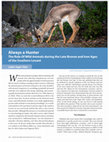
By the Late Bronze and Iron Ages in the southern Levant, livestock animals were the dominant meat... more By the Late Bronze and Iron Ages in the southern Levant, livestock animals were the dominant meat source, and wild animals constituted a very small supplementary proportion of economy. As a result, wild animals often receive limited attention in studies of these periods. This article aims to examine the role of wild animals based on a large body of published zooarchaeological data. By studying temporal changes in species presence and frequencies, the study tracks the local diminution in several wild species; reveals a clear preference for hunting deer in sites of the
Iron Ages, regardless of changes in local landscape; and shows
that various other wild animals can be correlated to assemblages
that are identified with Egyptian presence. Based on these observations and with correlation to historic events and cultural changes, wild animals’ roles in the economic and symbolic world of past societies are discussed.
Near Eastern Archaeology, 2022
https://www.journals.uchicago.edu/toc/nea/2022/85/4
![Research paper thumbnail of The emergence of a nomadic desert polity: an archaeozoological perspective [Archaeological and Anthropological Sciences 14 (2022): 232]](https://attachments.academia-assets.com/95108736/thumbnails/1.jpg)
Recent research has provided valuable insights into the identity and social structure of the loca... more Recent research has provided valuable insights into the identity and social structure of the local nomadic tribes operating the two main copper production centers in Wadi Arabah, Timna, and Faynan, between the thirteenth and the ninth century BCE. This was a time of major changes in the political and economic settings of Wadi Arabah and the entire southern Levant. Our study adds the archaeozoological perspective. It focuses on animal remains, specifically access to animals and their products, as a proxy for social processes. We analyze materials from four smelting camps in Timna, dated to the twelfth to tenth century BCE, and discuss the results in the context of previous studies. Our results show that there is continuity in the ways livestock animals were exploited. However, a shift in the economic basis occurred in the late eleventh century, when cattle and sheep, which are expensive, especially in desert conditions, became part of the local economy. We argue that this change is regional and that it implies an economic flourishing of the entire region during the late eleventh to ninth century BCE. Our observations corroborate others that point to the rise of an early nomadic state-the early Edomite kingdom-during this period. They also contribute to our understanding of nomadic societies, including their ability to achieve a greater level of social complexity than the one typically attributed to them in research on the region under study.
The emergence of a nomadic desert polity: an archaeozoological perspective. Sapir-Hen and Ben-Yosef 2022. Archaeological and Anthropological Sciences
Archaeological and Anthropological Sciences, 2022
Free View :https://rdcu.be/c0PXT
. For the PDF email me
PLoS One, 2022
The average body size of human prey animals in archaeological sites is influenced by myriad envir... more The average body size of human prey animals in archaeological sites is influenced by myriad environmental, physiological and anthropogenic variables. When combined with supporting evidence, body size has the potential to provide a proxy for several variables of fundamental interest to archaeologists including climatic change, food availability and hunting impacts, among other things. In the southern Levant changes in mountain gazelle (Gazella gazella) body size in the Late Pleistocene were initially interpreted as evidence for a climatic downturn, but the picture has become increasingly murky as data has grown. Here we reconsider trends in gazelle body size using an updated dataset from the Mediterranean zone that spans the Early Epipaleolithic to the Middle Pre-Pottery Neolithic B period (ca. 24,000-9,500 cal BP). Our results reveal that gazelle were smallest in the Early and Middle Epipaleolithic (Kebaran and Geometric Kebaran), reached their largest size in the early Late Epipaleolithic (Early Natufian) and then shrunk slightly before stabilizing in size through the Middle Pre-Pottery Neolithic. We see no evidence that sex ratio, or climatic factors influenced this trend. Instead, we explore the role of human impacts on gazelle populations and their habitats as they grew in earnest at the beginning of the Late Epipaleolithic when people first began to settle into more permanent communities. Initially, in the Early and Late Natufian, anthropogenic impacts related to more intensive hunting and the increased footprint of more permanent settlements on the landscape. This may have pushed gazelle numbers below what could be supported by the environment, thus increasing the amount of food available for each animal and hence average body size. Later, as humans began to cultivate plants, manage animals and establish permanent villages, avoidance of humans and livestock by gazelle, and greater stability in food and water availability provided by agriculture, may have similarly reduced gazelle population size and intraspecific competition, thus allowing individual animals to grow larger on average.



Uploads
Papers by Lidar Sapir-Hen
aim, we used British Mandate tax files and village statistics. These are the best available historical documents for this period, that recorded herds management statistics in all settlements of Palestine. We selected only settlements inhabited by the indigenous population and divided the data into four environmental regions. We analyzed the livestock abundance
and herd demography in each region. Each urban center was considered independently, while the rural villages were classified into three groups, based on the most common livestock (cattle, sheep, or goats). Results show economic variations between urban and rural settlements as well as regional trends, such as in pastoralism and agricultural management. In
addition, meat industries were common in most urban centers, being the primary difference from rural economies. We applied this model to two large zooarchaeological case studies, dating from the Early Islamic to the Ottoman period; Mount Zion, located in the urban city of Jerusalem, and Tel Beth Shemesh (East), whose size and nature were not historically
recorded. We found that the economic variations reflected in the model were also present in the faunal assemblages.
Let me know if you would like to have the full text.
Iron Ages, regardless of changes in local landscape; and shows
that various other wild animals can be correlated to assemblages
that are identified with Egyptian presence. Based on these observations and with correlation to historic events and cultural changes, wild animals’ roles in the economic and symbolic world of past societies are discussed.