Books by Linda Zampol D'Ortia
A Failing Mission? Salvation in the Jesuit Mission in Japan Under Francisco Cabral, 2024
The Jesuit textual production from the sixteenth century leaves no doubt that the Japanese evange... more The Jesuit textual production from the sixteenth century leaves no doubt that the Japanese evangelising enterprise was publicised as the epitome of success. Francisco Cabral, third superior of the mission, who had initially shared this judgement, in time began fearing that the mission was, instead, doomed to failure. As he perceived the loosening of the internal ties of the Society of Jesus, and the salvation of the catechumens as more and more independent of that of the Jesuits, Cabral concluded that God had abandoned the mission. This study, using little-known manuscript sources, examines Cabral’s attitudes towards his confreres and the Japanese people, to illuminate how particular salvation mechanics could define early modern Catholic missions.
Journal Articles by Linda Zampol D'Ortia
Journal of Religious History, 2025
This article analyses the references to local practices of abortion and infanticide by the Japane... more This article analyses the references to local practices of abortion and infanticide by the Japanese mission of the Society of Jesus between the sixteenth and the seventeenth centuries, as a case study of Jesuit knowledge production on the country. Albeit described as common, allusions to such condemned practices in Jesuit literature were scant. This article dissects them to understand how the missionaries perceived these practices, and how and why they identified different causes in the narratives they sent to Europe, of socio-economic and religious natures. It then illustrates the European-Catholic background and practical reasons why such Jesuit narratives coalesced, first, in a depiction of Japanese mothers as unable to love, and then as embodying wrong practices of love for their children.
Studi Tanatologici, 2023
This paper examines the practices of good death in the Catholic mission of Japan of the sixteenth... more This paper examines the practices of good death in the Catholic mission of Japan of the sixteenth/seventeenth century using as a case study the death of a young woman living in Miyako (Kyoto), Paula. In competition for proselytes with the Japanese Buddhist sects, especially the Pure Land ones, the Jesuit missionaries spent considerable effort to make the rituals that surrounded the passing of the converts as attractive and efficient as possible. This paper focuses on the religious and emotional practices that characterised Paula’s death to analyse how European traditions were adapted to the Japanese context, the influence of Buddhism on them, and how the missionaries strove to create new models of martyrs in an epoch before the start of the persecutions by the Tokugawa regime.
Published in Studi Tanatologici 1-2, nuova serie, 2022-2023 (Fondazione Fabretti): https://www.fondazionefabretti.it/pubblicazioni/studi-tanatologici/
Entangled Religions, 2020
Open Access: https://er.ceres.rub.de/index.php/ER/article/view/8438/8220
The present article ana... more Open Access: https://er.ceres.rub.de/index.php/ER/article/view/8438/8220
The present article analyses the use of clothing in the Jesuit sixteenth-century mission in Japan by applying dress theory. It investigates Jesuit garments and other perceptible elements of dress by understanding them as nonverbal communication. Texts by missionaries such as Francis Xavier (1506–52), Francisco Cabral (1533–1609), Luís Fróis(1532–1597), and Alessandro Valignano (1539–1606) are scrutinised to establish the content of the messages they meant to convey through Jesuit dress. The range of modifications that dress imposed on the bodies of the missionaries is examined to determine the limits within which the missionaries operated and how these boundaries came to be. Through an historical overview, the missionaries’ strategies are examined to show how such messages were fine-tuned through the manipulation of dress, and to what extent they represented responses to the specific context of Japan. Anti-Christian polemical texts supply information on the Japanese’s reception of these messages. The article explores Jesuit assumptions about the dress policies’ impact on their souls through the senses and on their work of evangelization as well.
Estudios, 2016
Già nelle sue prime descrizioni del Giappone, il missionario gesuita Francesco Saverio pose l’att... more Già nelle sue prime descrizioni del Giappone, il missionario gesuita Francesco Saverio pose l’attenzione su certe istituzioni che egli identificava come “università,” e che gli era stato impossibile trovare in India. Con questo termine egli voleva indicare in realtà strutture di vario genere, che andavano dai templi Zen della capital Miyako, ai grandi complessi monastici dei monti Hiei o Kōya, fino alla famosa accademia confuciana di Ashikaga, nel nord del paese. Dal punto di vista di Saverio, la caratteristica saliente ed unificante di queste università era che avrebbero potuto garantire status ed autorità alla religione cristiana, nel paese politicamente frammentato dalle guerre civili, se i gesuiti avessero potuto sostenere delle dispute e convertire i loro studenti. Nelle sue intenzioni dunque, il Giappone avrebbe dovuto essere evangelizzato da un gruppo di gesuiti scelti, istruiti nella lingua e nelle dottrine locali allo scopo di dimostrarsi l’esistenza di Dio ai letterati nipponici.
Dossier Los misioneros cristianos como intelectuales interculturales, 1500-1800, Jun 2016
Entre finales del siglo XV y principios del XVI, los portugueses ylos españoles expan... more Entre finales del siglo XV y principios del XVI, los portugueses ylos españoles expandieron sus influencias en los actuales continentes africano, americano y asiático. Para el siglo XVII, los holandeses y otros europeos empezaron a llevar a cabo sus propias aventuras imperialistas. Junto con los intereses de conquista ycomercio, los misioneros viajaron miles de kilómetros para intentar evangelizar las “nuevas” tierras. Exactamente en el año 1500, los francisanos realizaron la primera misa en suelo brasileño, y en 1524, los primeros frailes de dicha orden llegaron a México. En 1542, el jesuita Francisco Javier llegó a Goa. Este momento, gracias al protagonismo de la Misión cristiana, significó el inicio de siglos de contactos, intercambios y encuentros entre Asia, América y Europa. Ampliar en el PDF...
Book chapters by Linda Zampol D'Ortia
This volume presents comprehensive research on how southern European Catholics and the Japanese c... more This volume presents comprehensive research on how southern European Catholics and the Japanese confronted each other, interacted and mutually experienced religious otherness in early modern times.
In their highly variable and asymmetric relations, during which the politi¬cal-military elites of Japan at times not only favoured, but also opposed and strictly controlled the European presence, missionaries – particularly the Jesuits – tried to negotiate this power balance with their interlocutors.
This collection of essays analyses religious and cultural interactions between the Christian missions and the Buddhist sects through processes of coopera¬tion, acceptance, confrontation and rejection, dialogue and imposition, which led to the creation of new relational spaces and identities.
This book is available in open access: https://www.peterlang.com/document/1190560
Her main areas of research are the reception of Western art in Japan during the sixteenth to seve... more Her main areas of research are the reception of Western art in Japan during the sixteenth to seventeenth centuries, and the Romanesque and Gothic art of Northern Italy� Her publications Abbreviations abb� -abbreviation act. -active aka -also known as ARMSTA
East and West Entangled (17th-21st Centuries), 2023
This chapter considers the long shadow of failure on the 1716-1721 mission to Tibet by Italian Je... more This chapter considers the long shadow of failure on the 1716-1721 mission to Tibet by Italian Jesuit Ippolito Desideri (1684-1733). Analysing Desideri's letters, his missionary manual, and his Notizie historiche del Thibet, it focuses on the historical actors' perceptions of missionary failure, and on the expectations and biases these perceptions created, to expose otherwise neglected aspects of this intercultural encounter. It investigates the impact that these perceptions had on the tensions extant in the Jesuit Province of Goa, on Desideri's description of the populations of the so-called "Three Tibets" (Baltistan, Ladakh and Tibet), and on the missionary policy he proposed for creating a Catholic Christendom that could spread globally.
https://books.fupress.com/catalogue/representations-of-tibet-and-responses-to-missionary-failure-in-ippolito-desideris-italian-writings/14112
Narratives and Representations of Suffering, Failure, and Martyrdom. Early Modern Catholicism Confronting the Adversities of History / ed. Leonardo Cohen. Lisboa : Centro de Estudos de História Religiosa da Universidade Católica Portuguesa, 2020
"And would that God had willed that the Father Visitor, when he left Japan, had not allowed [the ... more "And would that God had willed that the Father Visitor, when he left Japan, had not allowed [the use of] the honours and pomp that he did..."
This article will consider the attempt of a long-time antagonist of Valignano, his fellow Jesuit Francisco Cabral, to propose a competing vision for the evangelization of Japan to the General of the Order, Claudio Acquaviva. It will analyse Cabral's rhetoric by looking at his use of the textual canon and of lived experience to support his interpretation of the Japanese mission as a failure, and his bid for the change of missionary policy to overcome the occurring crisis.
Exploring Jesuit Distinctiveness. Interdisciplinary Perspectives on Ways of Proceeding within the Society of Jesus, edited by Robert Aleksander Maryks, 137-155. Leiden, Boston: BRILL,, 2016
This chapter will examine Francisco Cabral’s attempts at policing Jesuit identity in
Japan throu... more This chapter will examine Francisco Cabral’s attempts at policing Jesuit identity in
Japan through the imposition of specific garments upon the missionaries. It
will consider the importance assumed by dress in sixteenth-century Europe,
and its relation to the attitude of Ignatius of Loyola regarding the
body and its modifications in the form of garments. It will consider how the
use of silk garments by some Jesuits caused an internal division in the Japanese
mission, highlighting Cabral’s central role as he attempted to implement the
orders of the visitor, who requested the end of the use and ownership of silk by
the missionaries.
Conference Presentations by Linda Zampol D'Ortia
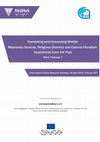
International Online Research Seminar, 16 April 2021, 3:00 pm CET [2:00 pm LONDON; 10:00 pm TOKYO... more International Online Research Seminar, 16 April 2021, 3:00 pm CET [2:00 pm LONDON; 10:00 pm TOKYO; 8:00 am NEW YORK]
Contact and Registration
[email protected]
Once registered, shortly before the event, participants will receive an invitation for the Zoom link at the email address provided.
EVENT PROGRAM
Friday, 16 April 2021, 3:00 pm CET
Gaetano Sabatini (Director, CNR ISEM)
Welcome Note
Marcello Verga (Università degli Studi di Firenze, CNR ISEM - ReIReS WP7 Leader)
Presentation
Angelo Cattaneo (CNR ISEM)
Convenor
3:15 pm Alexandra Curvelo (IHA - NOVA FCSH, Lisbon)
The Christian Mission in Early Modern Japan through the lens of an Art Historian
3:40 pm Linda Zampol D’Ortia (Ca’ Foscari University of Venice)
Tracing Feelings on Paper: Emotions in early modern Jesuit missions in Asia
4:10 pm Ana Carolina Hosne (National Council for Scientific Research - CONICET, Argentina)
The question of "barbarism" in the Jesuit missions, from Asia to Spanish America (16th-18th centuries)
4:30 pm Angelo Cattaneo (CNR ISEM)
Early Modern Missions and the Creation of the First Global System of Connected Languages. The case of the Portuguese Padroado
5:00 pm Sabrina Corbellini (University of Groningen)
Discussant
5:20 pm General discussion and conclusions
The webinar “Translating and Connecting Worlds” will be recorded in view to be broadcasted through the CNR ISEM YouTube channel shortly after the event.
EVENT DESCRIPTION
The online international research seminar “Translating and Connecting Worlds” aims to highlight and analyze the paramount importance of religious archives and sources connected to the activities of religious orders (in particular of the orders engaged in early modern and modern missions), for the study of several branches of modern cultural history.
“Translating and Connecting Worlds” was specifically conceived and designed in accomplishment with the general goals of ReIReS (Research Infrastructure on Religious Studies) to mobilize “the widest range of expertise, sources, resources and facilities of the domain of historical religious studies, by opening up to users a plurality of both documents and sources and research tools and instruments.”
Over the past three decades, a complex and highly articulated set of research projects, doctoral theses and publications, has unequivocally highlighted that both religious archives and documentation prove to be essential for the history of linguistics, the history of books and reading, the history of geography, the history of the European expansion and empires and orientalism, ethnography, art history, the history of cultural encounters, translations and clashes. Altogether, these compsite fields of enquiry have demostrated the great potential of religious archives, libraries and sources beyond more traditional and “internal” religious research perspectives, such as the History of Religion(s) or of Religious Orders.
Religious archives and libraries are aggregators of knowledge that preserve and mediate fundamental sources for the study of several social and cultural processes. At the same time, these processes allow us to understand the persistent pervasiveness of religious phenomena or phenomena connected or mediated by religious practices, in the history of early modern and modern cultures, well beyond the institutional History of the Church or Religious History, and the simplistic claims of the “secularization” tout court.
Religious archives are also fundamental to promote reflections on situations where cross-cultural communication worked or broke down in early modern and modern missions.
They are of particular value for understanding the processes of learning each other’s languages, sharing and negotiating systems of beliefs, world views, values and histories, by exchanging languages, visuality and oral traditions.
Call for Papers by Linda Zampol D'Ortia
Organised at the Gender and Women's History Research Centre (ACU), in Melbourne and online.
This... more Organised at the Gender and Women's History Research Centre (ACU), in Melbourne and online.
This workshop aims to further the study of intercultural encounters in the pre-modern world through the lens of gender. More specifically, we mean to foster a discussion on how masculinities could affect the processes of cultural encounter and their outcomes, but also how masculinities emerged changed in turn from such processes.
Deadline for abstracts: 3 June 2024.
This online conference aims to question how the religious lives of Catholic people in the Asia-Pa... more This online conference aims to question how the religious lives of Catholic people in the Asia-Pacific region are informed by socially and temporally specific understandings of emotions and affects, and normative ideas about gender. It thus seeks to further our understanding of perceptions, experiences, practices, beliefs of Asia-Pacific Catholic women, men, and non-binary people by using both lenses of gender and emotion.
Prof. Haruko Nawata Ward: “Deciphering Kirishitan women, emotions, and persecution”
7th February ... more Prof. Haruko Nawata Ward: “Deciphering Kirishitan women, emotions, and persecution”
7th February 2023, 9-10am AEDT
Keynote address of the international workshop "Gender and Emotion in Japanese Christianity (1549-1638)," presented by the Gender and Women's History Research Centre, Australian Catholic University
Book Reviews by Linda Zampol D'Ortia
[Open Access] Review of Nuns’ Priests’ Tales: Men and Salvation in Medieval Women’s Monastic Life, by Fiona J. Griffiths
Parergon, vol.37, no.1, 2020
Griffiths, Fiona J., Nuns’ Priests’ Tales: Men and Salvation in Medieval Women’s Monastic Life (M... more Griffiths, Fiona J., Nuns’ Priests’ Tales: Men and Salvation in Medieval Women’s Monastic Life (Middle Ages Series), Philadelphia, University of Pennsylvania Press, 2018; cloth; pp. 424; 29 b/w illustrations; R.R.P. US$69.95, £58.00; ISBN 9780812249750.
https://parergon.org/files/37_1_reviews.pdf
[Open Access] Review of Rewriting Holiness: Reconfiguring Vitae, Re-signifying Cults, edited by Madeleine Gray
Parergon, vol.37, no.1, 2020
Gray, Madeleine, ed., Rewriting Holiness: Reconfiguring Vitae, Re-signifying Cults (King’s Colleg... more Gray, Madeleine, ed., Rewriting Holiness: Reconfiguring Vitae, Re-signifying Cults (King’s College London Medieval Studies, 25), London, King’s College London, Centre for Late Antique and Medieval Studies, 2017; hardback; pp. 338; 9 colour illustrations; R.R.P. £60.00; ISBN 9780953983896.
https://parergon.org/files/37_1_reviews.pdf
[Open Access] Review of The Hebrew Bible in Fifteenth-Century Spain: Exegesis, Literature, Philosophy, and the Arts, edited by Jonathan Decter and Arturo Prats



Uploads
Books by Linda Zampol D'Ortia
Journal Articles by Linda Zampol D'Ortia
Published in Studi Tanatologici 1-2, nuova serie, 2022-2023 (Fondazione Fabretti): https://www.fondazionefabretti.it/pubblicazioni/studi-tanatologici/
The present article analyses the use of clothing in the Jesuit sixteenth-century mission in Japan by applying dress theory. It investigates Jesuit garments and other perceptible elements of dress by understanding them as nonverbal communication. Texts by missionaries such as Francis Xavier (1506–52), Francisco Cabral (1533–1609), Luís Fróis(1532–1597), and Alessandro Valignano (1539–1606) are scrutinised to establish the content of the messages they meant to convey through Jesuit dress. The range of modifications that dress imposed on the bodies of the missionaries is examined to determine the limits within which the missionaries operated and how these boundaries came to be. Through an historical overview, the missionaries’ strategies are examined to show how such messages were fine-tuned through the manipulation of dress, and to what extent they represented responses to the specific context of Japan. Anti-Christian polemical texts supply information on the Japanese’s reception of these messages. The article explores Jesuit assumptions about the dress policies’ impact on their souls through the senses and on their work of evangelization as well.
Book chapters by Linda Zampol D'Ortia
In their highly variable and asymmetric relations, during which the politi¬cal-military elites of Japan at times not only favoured, but also opposed and strictly controlled the European presence, missionaries – particularly the Jesuits – tried to negotiate this power balance with their interlocutors.
This collection of essays analyses religious and cultural interactions between the Christian missions and the Buddhist sects through processes of coopera¬tion, acceptance, confrontation and rejection, dialogue and imposition, which led to the creation of new relational spaces and identities.
This book is available in open access: https://www.peterlang.com/document/1190560
https://books.fupress.com/catalogue/representations-of-tibet-and-responses-to-missionary-failure-in-ippolito-desideris-italian-writings/14112
This article will consider the attempt of a long-time antagonist of Valignano, his fellow Jesuit Francisco Cabral, to propose a competing vision for the evangelization of Japan to the General of the Order, Claudio Acquaviva. It will analyse Cabral's rhetoric by looking at his use of the textual canon and of lived experience to support his interpretation of the Japanese mission as a failure, and his bid for the change of missionary policy to overcome the occurring crisis.
Japan through the imposition of specific garments upon the missionaries. It
will consider the importance assumed by dress in sixteenth-century Europe,
and its relation to the attitude of Ignatius of Loyola regarding the
body and its modifications in the form of garments. It will consider how the
use of silk garments by some Jesuits caused an internal division in the Japanese
mission, highlighting Cabral’s central role as he attempted to implement the
orders of the visitor, who requested the end of the use and ownership of silk by
the missionaries.
Conference Presentations by Linda Zampol D'Ortia
Contact and Registration
[email protected]
Once registered, shortly before the event, participants will receive an invitation for the Zoom link at the email address provided.
EVENT PROGRAM
Friday, 16 April 2021, 3:00 pm CET
Gaetano Sabatini (Director, CNR ISEM)
Welcome Note
Marcello Verga (Università degli Studi di Firenze, CNR ISEM - ReIReS WP7 Leader)
Presentation
Angelo Cattaneo (CNR ISEM)
Convenor
3:15 pm Alexandra Curvelo (IHA - NOVA FCSH, Lisbon)
The Christian Mission in Early Modern Japan through the lens of an Art Historian
3:40 pm Linda Zampol D’Ortia (Ca’ Foscari University of Venice)
Tracing Feelings on Paper: Emotions in early modern Jesuit missions in Asia
4:10 pm Ana Carolina Hosne (National Council for Scientific Research - CONICET, Argentina)
The question of "barbarism" in the Jesuit missions, from Asia to Spanish America (16th-18th centuries)
4:30 pm Angelo Cattaneo (CNR ISEM)
Early Modern Missions and the Creation of the First Global System of Connected Languages. The case of the Portuguese Padroado
5:00 pm Sabrina Corbellini (University of Groningen)
Discussant
5:20 pm General discussion and conclusions
The webinar “Translating and Connecting Worlds” will be recorded in view to be broadcasted through the CNR ISEM YouTube channel shortly after the event.
EVENT DESCRIPTION
The online international research seminar “Translating and Connecting Worlds” aims to highlight and analyze the paramount importance of religious archives and sources connected to the activities of religious orders (in particular of the orders engaged in early modern and modern missions), for the study of several branches of modern cultural history.
“Translating and Connecting Worlds” was specifically conceived and designed in accomplishment with the general goals of ReIReS (Research Infrastructure on Religious Studies) to mobilize “the widest range of expertise, sources, resources and facilities of the domain of historical religious studies, by opening up to users a plurality of both documents and sources and research tools and instruments.”
Over the past three decades, a complex and highly articulated set of research projects, doctoral theses and publications, has unequivocally highlighted that both religious archives and documentation prove to be essential for the history of linguistics, the history of books and reading, the history of geography, the history of the European expansion and empires and orientalism, ethnography, art history, the history of cultural encounters, translations and clashes. Altogether, these compsite fields of enquiry have demostrated the great potential of religious archives, libraries and sources beyond more traditional and “internal” religious research perspectives, such as the History of Religion(s) or of Religious Orders.
Religious archives and libraries are aggregators of knowledge that preserve and mediate fundamental sources for the study of several social and cultural processes. At the same time, these processes allow us to understand the persistent pervasiveness of religious phenomena or phenomena connected or mediated by religious practices, in the history of early modern and modern cultures, well beyond the institutional History of the Church or Religious History, and the simplistic claims of the “secularization” tout court.
Religious archives are also fundamental to promote reflections on situations where cross-cultural communication worked or broke down in early modern and modern missions.
They are of particular value for understanding the processes of learning each other’s languages, sharing and negotiating systems of beliefs, world views, values and histories, by exchanging languages, visuality and oral traditions.
Call for Papers by Linda Zampol D'Ortia
This workshop aims to further the study of intercultural encounters in the pre-modern world through the lens of gender. More specifically, we mean to foster a discussion on how masculinities could affect the processes of cultural encounter and their outcomes, but also how masculinities emerged changed in turn from such processes.
Deadline for abstracts: 3 June 2024.
7th February 2023, 9-10am AEDT
Keynote address of the international workshop "Gender and Emotion in Japanese Christianity (1549-1638)," presented by the Gender and Women's History Research Centre, Australian Catholic University
Book Reviews by Linda Zampol D'Ortia
https://parergon.org/files/37_1_reviews.pdf
https://parergon.org/files/37_1_reviews.pdf