Videos by M. Javad Khajavi
The main goal of this initiative was to improve students’ learning experience and to increase the... more The main goal of this initiative was to improve students’ learning experience and to increase their motivation and engagement by making a change in the teaching approach and including Virtual Reality (VR) technology in teaching and in particular for prototyping in one of the modules on the digital media strand of the Media Program.
This initiative was generously supported by the Center for Teaching and Learning at the National University of Ireland in Maynooth, and T&L National Forum for the Enhancement of Teaching and Learning in Higher Education. 309 views
KEYNOTE SPEECHES by M. Javad Khajavi
International Conference on Advanced Imagery, 2023
Within the dynamic landscape of animation, the convergence of Artificial Intelligence, Spatial Co... more Within the dynamic landscape of animation, the convergence of Artificial Intelligence, Spatial Computing, and the Metaverse stands at a potentially pivotal juncture. Recent developments in these domains hold the promise of reshaping established paradigms in animation creation. In this presentation, Associate Professor Javad Khajavi embarks on a scholarly exploration of this transformative era. His forthcoming book delves deep into the synergistic relationship between AI, Spatial Computing, and the emerging Metaverse, analyzing their far-reaching impact on the art of animation-making. This presentation offers a glimpse into the implications and possibilities that unfold within this rapidly evolving landscape.
33rd Annual Conference of the Society for Animation Studies (SAS), 2022
Today, Virtual Reality applications such as Quill by Smoothstep and AnimVR provide users with imm... more Today, Virtual Reality applications such as Quill by Smoothstep and AnimVR provide users with immersive spaces of creation, generating unprecedented workflows, styles, and aesthetics. Allowing users to animate inside immersive three-dimensional spaces using intuitive techniques that are unique to the medium of VR, these applications stimulate novelty and new forms of collaborative animation-making. Based on a book in progress, this talk looks at some of the unique features of these techniques of animating in VR. Thereby, current and future trends and possibilities of this new medium of animation-making are explored.
BOOKS by M. Javad Khajavi
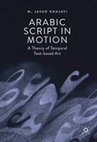
Palgrave Macmillan, 2019
Arabic Script in Motion is a pioneering study of animated typography and time-based calligraphic ... more Arabic Script in Motion is a pioneering study of animated typography and time-based calligraphic art written in the Arabic system of writing. Arabic script is the system of writing used to write many languages including Arabic, Persian (Farsi), Urdu, Ottoman Turkish, etc. Inspired by the innate qualities of Arabic script as well as certain practices in Islamic calligraphy and contemporary calligraphic art, the book devises five broad categories of temporal behaviors for Arabic characters in time-based media. It goes onto expand the vocabulary used to describe Arabic script’s appearance in time-based media and proposes a theory to help artists, practitioners, and theoreticians push the boundaries of temporal text-based art. Furthermore, it tackles questions of legibility and readability, and seeks to understand how temporality of Arabic text influences the creation of meaning. This book will therefore appeal not only to animators, designers, and artists, but also to commentators and scholars who deal with temporal text-based art written in Arabic script.
For more information, visit: www.animatedcalligraphy.com
BOOK CHAPTERS by M. Javad Khajavi
Animating the Spirited: Journeys and Transformations, 2020
PEER REVIEWED PAPERS by M. Javad Khajavi
Animation Practice, Process & Production, 2026
This study examines the use of enhanced trackable markings in semi-automatic animation rotoscopin... more This study examines the use of enhanced trackable markings in semi-automatic animation rotoscoping with EbSynth, an open-source free software, to uncover new efficiencies and streamline the animation workflow. Unlike generative artificial intelligence (AI) applications such as Runway, Stable Diffusion and Sora, which use machine learning (ML) and neural network (NN) techniques, EbSynth uses example-based synthesis (EBS) algorithms to create images for animation sequences based on one or more keyframe inputs. This research examines how distinctive facial markings – dotted markers, contour lines and character-specific markings – affect the manual labour involved in frame-by-frame editing in semi-automatic rotoscoping, particularly in scenarios where the animated character’s design significantly deviates from the live-action actor’s facial features. Through a series of controlled experiments with an actress portraying various facial movements and expressions, we analysed the effectiveness of these markings in improving the accuracy and reducing the need for subsequent adjustments in rotoscoped sequences. This research addresses a gap in empirical studies regarding the practical application of semi-automatic tools in animation, particularly in optimizing the rotoscoping process. By detailing the impact of character-specific trackable markings, this study contributes to the academic field while also providing practical guidelines for animators seeking to integrate semi-automation technologies such as EbSynth into their creative processes.
Exploring the Viewer’s Role in Narrative-Based Animated Virtual Reality Experiences: Strategies for Role Activation and Immersive Storytelling, 2024
Virtual reality (VR) storytelling offers immersive experiences that engage viewers in unique and ... more Virtual reality (VR) storytelling offers immersive experiences that engage viewers in unique and interactive ways. This study investigates the viewer’s role within animated narrative-based VR and explores strategies and techniques employed to facilitate this engagement. Using thematic analysis, the authors examined 22 animated VR experiences and identified six key themes: viewer interaction, virtual body, viewer’s spatial perspective, voice of the narrator, directed viewing and providing options. These themes encompass various strategies used to activate the viewer’s role and enhance their immersion in the narrative. The findings reveal that interactive elements, such as viewer interactions and decision-making opportunities, contribute to a heightened sense of agency and immersion. Additionally, the incorporation of a visible and functional virtual body, strategic placement of the viewer and guidance from a narrator potentially shape the viewer’s experience and understanding of the narrative. However, it is essential to strike a balance between directed viewing and viewer agency to ensure a satisfying and engaging storytelling encounter. The implications of these findings provide valuable insights for VR creators, highlighting the importance of considering these strategies when designing narrative-based VR experiences. By utilizing these techniques effectively, creators can craft immersive and engaging VR narratives that captivate and involve viewers in dynamic and meaningful ways.
The International Journal of Visual Design, 2018
Extensive studies have been conducted to test ideas about logos in branding and communication. Wh... more Extensive studies have been conducted to test ideas about logos in branding and communication. While many of these studies have concentrated on static logos and on what constitutes a logo, there is an overwhelming lack of academic research on an important aspect of branding practices: animated logos. Previous research on logo animation has concentrated on the effectiveness of agent animation; that is animation in which objects seem to have life-like movement in creating brand personality. This research adds to the emerging literature on the topic by conducting an empirical study. In this research, an experiment was conducted and quantitative data were collected using a questionnaire. The goal was to test if the animated logos differ from the static ones in terms of generating positive affect and providing clues to understand the services provided by the company. Such results could be of interest not only to
motion graphics designers and animators, who develop static or animated logos, but also to scholars of such diverse fields as art and design, psychology, and marketing. The outcomes of this research could also be useful for improving companies’ branding strategies.

This paper traces how the design of a new media cultural heritage project was inspired by the tra... more This paper traces how the design of a new media cultural heritage project was inspired by the transformative qualities found in many specimens of Islamic calligraphy. As certain scholars have pointed out, Islamic art is filled with examples of letters and words that appear to transform into things other than text. Indeed, such transformative qualities can be seen across the Islamic world and on a diverse range of artefacts, including the epigraphs on the walls of the Alhambra palace and the religious texts on Ottoman Turkish scrolls written in ghubār (which literary means "dust" in Arabic) script. In this paper, the author outlines two broad types of transformative qualities that can be distinguished in many specimens of Islamic calligraphic art, namely, the metamorphosis of the form and the transformation of the function of the letters and words. The paper then demonstrates how, inspired by such transformative qualities, the designers of a cultural heritage project created a calligraphic installation for museums and galleries in which letters are transformed from text to image and vice versa. Using a projection mapping system, words are transformed into images devoid of any semantic meaning, and then revert back into readable text again. Finally, the paper investigates how the transformation of the function of calligraphy renders readability a transitory process in this artwork, and how the technique used in the creation of this artwork can be applied to cultural heritage sites as an educational and entertainment tool.
Cinema: Journal of Philosophy and the Moving Image, 2017
In this article, the author traces the genealogy of calligraphic animations (here defined as anim... more In this article, the author traces the genealogy of calligraphic animations (here defined as animations in which Islamic calligraphic elements are the only or one of the main visual components of the film) that establish a correlation between Islamic calligraphy and music. Within the past few decades a number of time-based artworks that establish such a correlation have been created. These artworks — in the form of films, animations, interactive art pieces and performances — can be considered visual music, following a broad definition of the term. While Visual music calligraphic animations may be considered a direct continuation of earlier European visual music films (such as the works of Oskar Fischinger, Viking Eggeling, Hans Richter, and others), a detailed study of their historic-cultural context reveals a different genealogy line that goes back to the earlier centuries of Islamic civilization. It is argued in this paper that these visual music calligraphic animations and time-based artworks seem to be inspired by the putative comparisons between various aspects of Islamic calligraphy and those of music (or aural arts). The author begins the article by exploring different modes of musical analogies that were used to describe Islamic calligraphy throughout the history of Islamic civilization. He continues to review the influences of such analogies on calligraphic art, especially in the contemporary context. Then, he studies the influence of musical analogies on calligraphic time-based artworks, and contextualizes visual music calligraphic animations within such a historic-cultural background.
Animation Studies Journal, 2011
Using a vast spectrum of highly hybridized forms of contemporary filmmaking, animated documentary... more Using a vast spectrum of highly hybridized forms of contemporary filmmaking, animated documentary – an increasingly ubiquitous mode of representation – examines different aspects of representing reality. Likewise in academia, it keeps receiving scholarly attention from the side of different disciplines and fields of study. In spite of all these interests and attentions, this mode of filmmaking inquires more in-depth scrutiny not only because studies on animated documentary may result in more conscious utilization of the mode, but also as Ward suggests it may “potentially provide answers to some of the more troubling questions asked of documentary as a field.” (2005, p. 99). One of the obstacles which slows down in-depth studies of animated documentary is the complexity of reality representation processes in such films. Therefore, it would be a helpful practice to set up (a) framework(s) that make(s) it possible to discuss the intricate processes in animated documentary. The present study is the first stage to propose such a model. To this end, drawing on the principles of Kress and van Leeuwen’s visual grammar (Kress & van Leeuwen, 2006), the study embarks on an initial framework for analyzing animated documentary. As a work-in-progress, the proposed framework will then be adopted for studying animated documentaries based on Paul Wells’ typology (Wells, 1997).
GRANTS by M. Javad Khajavi
Design and Development of the Companion Website for a forthcoming book on "Animating in the Age of Spatial Computing"
ASIFA-HOLLYWOOD’S AEF FACULTY GRANT, 2024
ASIFA-Hollywood’s Animation Educators Forum, USA ($ 5,000)
Grant for Design and Development of th... more ASIFA-Hollywood’s Animation Educators Forum, USA ($ 5,000)
Grant for Design and Development of the Companion Website for the book, "Animating in the Age of Spatial Computing, AI, and Metaverses: Immersive Animation-making inside Virtual Reality
Continuation of Empowering Animation Education and Healthcare Communication through Innovative XR Interaction
DEVELOPMENT FUNDS, 2024
Læringsverkstaden Center, Norway (19995 NOK)
Continuation of Empowering Animation Education and H... more Læringsverkstaden Center, Norway (19995 NOK)
Continuation of Empowering Animation Education and Healthcare Communication through Innovative XR Interaction

The Nordic Animation Symposium: Sharing research and art across Nordic animation communities
Nordic Culture Fund. Project support (180,000 DKK), 2024
To enhance the impact and quality of the Nordic Animation Symposium (NAS), the Animated Arts and ... more To enhance the impact and quality of the Nordic Animation Symposium (NAS), the Animated Arts and Media Research group (AAM) at Volda University College in collaboration with Uppsala University and VIA University College received support from the Nordic Culture Fund. The goal of this project is to establish NAS as the premier convergence point for animation researchers, industry professionals, and enthusiasts. This initiative will not only elevate the symposium's standard but also create a lasting organizational structure to support its activities. The long-term vision includes translating the insights and discussions at NAS into further research, events, and a range of publications, thereby extending its influence and reach within the field of animation.
the Society for Animation Studies Event Fund, 2023
The "Animated Horror: Unveiling the Potential of Animation as a Medium for Horror" symposium is a... more The "Animated Horror: Unveiling the Potential of Animation as a Medium for Horror" symposium is an event organized by the Animated Arts and Media research group at Volda University College. We are seeking support from the SAS Event Funds to bring together a diverse community of scholars, artists, and aficionados in Norway. Our goal is to explore the captivating intersection of animation and horror, delving into the artistic, cultural, and psychological dimensions of this enthralling genre combination. This symposium will serve as a platform for rigorous academic discourse, artistic exploration, and audience engagement, shedding light on the unique and transformative qualities of animated horror.
The Expansion of the Nordic Animation Research Network (NARN)
NORDIC CULTURE FUND, 2023
Empowering Animation Education and Healthcare Communication through Innovative XR Integration
Læringsverkstaden Center, 2023
This project seeks to harness the transformative potential of cutting-edge technologies like Arti... more This project seeks to harness the transformative potential of cutting-edge technologies like Artificial Intelligence (AI) and Extended Reality (XR) to enrich animation education and bridge the gap between academia and real-world applications. This endeavor is inspired by my ongoing research into immersive animation within Virtual Reality (VR), which I am documenting in the upcoming book "Animating in the Age of the Metaverse," slated for publication by CRC Press.
SAS Event Fund 2022, 2022
While Animation Studies as a field of research is a relatively young discipline, it is a rapidly ... more While Animation Studies as a field of research is a relatively young discipline, it is a rapidly growing area of investigation as the practice of animation is expanding into other fields such as video games, scientific and medical visualizations, web and interaction design, extended and mixed realities (e.g. VR and AR), etc. Historically speaking, academics and practitioners in some countries and regions of the world (such as the United States and the United Kingdom) have traditionally been more active in researching on the field of animation in comparison to other parts of the world such as the Nordic region. This is despite the fact that within the Nordic countries there were and there are individual scholars who proved to be influential in the field of Animation Studies. Unlike the US and the UK, these scholars and researchers have been working mostly in isolation and usually have not been much informed about the scholarly work that their colleagues have been producing in the same region. Now, given the expansion of the field of Animation Studies and the growing popularity of this area of research within the Nordic region, it seemed essential to bring all these isolated research activities together and establish a network of scholars who are interested in researching the field of Animation Studies.

Spark Initiative, 2020
The main goal of this initiative is to improve students’ learning experience and increase their m... more The main goal of this initiative is to improve students’ learning experience and increase their motivation and engagement by making a small change in the teaching approach and including Virtual Reality (VR) technology in teaching and in particular for prototyping in the Human-Computer Interaction module (and potentially other modules in the Interactive thread of the Media Studies program).
The Human-computer interaction (HCI) module focuses on information design technology, particularly the interaction between the user and computers in any form. In other words, students in this module, learn how to understand users’ needs and how to design user experiences (UX) and user interfaces (UI) for computer applications. So, the main goal of this module is to teach students the foundations and the processes of UX and UI design.
UX/UI design is a rapidly changing field, and so the pedagogies in this field require to adapt to these fast shifts in the industry. One of the recent developments in the field is the increasing popularity of Virtual Reality technology and tools. Aside from designing the user experience and interface of applications on computers and smartphones, now UX/UI designers are sometimes required to design for virtual environments. Since 2015 when consumer VR started to become widely available to the general public, VR has increasingly become an important aspect of the Human-Computer Interaction discipline. An increasing number of companies around the world, in Europe and Ireland are now investing in Virtual Reality technologies and thus looking to hire experts with the knowledge and skills of developing for VR. Having recognized such a need in the industry, the department of Media Studies have included designing for VR in the syllabus for the HCI module. Currently, Students develop simple VR applications and experiences using Unity (which is one of the standard programs used for developing VR experiences).
The UX/UI Design process includes various steps such as User Research, Visual Research, Ideate, Design, Prototype, Test and Evaluate. In the HCI module, students learn about all these various steps with activities and hands-on exercises. One of the most important steps in the UX/UI Design process is the Prototyping phase. In this phase, the designer creates a non-functional visual representation of the User Interface so s/he can test and evaluate how users may interact with the final product. Currently, students use conventional applications such as Adobe XD and Figma for prototyping. The problem with these applications is that they are designed for prototyping in 2-dimensional space and do not have appropriate tools for prototyping 3D spatial environments (as is the case in VR). The result is that students with low spatial abilities face many difficulties in understanding and adjusting to the 3-dimensional field, which they are working with.
In the past few years, new VR tools and technologies have been developed that can be helpful for such a shortcoming in current tools. There are now a handful of VR applications that can be used for 3D design and prototyping. These include applications such as Gravity Sketch, Oculus Medium, MasterpieceVR, Google Tilt Brush, etc. While wearing a 6DoF VR headset the students can use these tools and by means of hand controllers they can prototype directly in the 3D virtual space. The benefit of such a prototyping method is that students with lower spatial abilities will better understand and adjust to the requirements of the 3-dimensional space (Ho et al., 2019)
While such tools and technologies are relatively new, companies and industries have already started to use them in their UX/UI design pipelines. Educational programs around the world are also gradually including these and similar approaches in their curriculum and teaching. For example, the MA program in Virtual Reality at the University of the Arts London which initiated in 2018 includes some of these VR prototyping tools in its curriculum (MA Virtual Reality, n.d.). Similarly, the University College London organizes short courses on Virtual Reality that uses prototyping tools such as Tvori (Milligan, 2019).
Figure 1. A user prototyping in VR using Gravity Sketch
Supported by the National Forum for the Enhancement of Teaching and Learning in Higher Education, Researchers at The Institute of Technology Carlow have also started an initiative for developing Virtual Reality-based Learning Experiences (Virtual Reality-Based Learning Experience, n.d.). IT Carlow’s VR Learning initiative is focused on designing a VR platform for the creation, delivery, and assessment of university courses in virtual reality. While IT Carlow’s VR Learning initiative has a different approach from the proposed initiative, it shows the growing interest in the application of immersive technologies such as VR in higher education teaching. The proposed initiative can be a starting point for further including Mixed Reality technologies in Maynooth University’s teaching culture.
Ho, L., Sun, H., & Tsai, T. (2019). Research on 3D Painting in Virtual Reality to Improve Students ’ Motivation of 3D Animation Learning. Sustainability, 11(1605), 1–17. https://doi.org/10.3390/su11061605
MA Virtual Reality. (n.d.). Retrieved June 18, 2020, from https://www.arts.ac.uk/subjects/animation-interactive-film-and-sound/postgraduate/ma-virtual-reality-lcc#
Milligan, M. (2019). UCL, Open City Docs Introduce VR Animation Short Course to UK. AnimationMagazine. https://www.animationmagazine.net/schools/ucl-open-city-docs-introduce-vr-animation-short-course-to-uk/
Sattar, M. U., Palaniappan, S., Lokman, A., Hassan, A., Shah, N., & Riaz, Z. (2019). Effects of Virtual Reality training on medical students’ learning motivation and competency. Pak J Med Sci, 35(3), 852–857. https://doi.org/10.12669/pjms.35.3.44
Virtual Reality-based Learning Experience. (n.d.). National Forum for the Enhancement of Teaching and Learning in Higher Education. Retrieved June 20, 2018, from https://www.teachingandlearning.ie/project/virtual-reality-based-learning-experience/
AWARDS AND RECOGNITIONS by M. Javad Khajavi
The Society for Animation Studies, 2021
Inaugurated in 1995, this award, administered by the Society for Animation Studies, seeks to cele... more Inaugurated in 1995, this award, administered by the Society for Animation Studies, seeks to celebrate exceptional scholarship, published in book form, in the field of animation studies. In recognition of the growing critical mass of animation scholarship, the judging process was expanded to include Runners-Up in 2009. The award was bestowed on an ad-hoc basis between 1995 and 2009. At present, the Society is eager to mark the upcoming 30th anniversary of the Book Award’s inauguration (in 2025) by retrospectively bestowing the award for those years, in the awarding sequence, where no judging was administered. The retrospective awards will be decided by SAS member ballot conducted via the SAS mailing list.
CONFERENCE PRESENTATIONS by M. Javad Khajavi
From Prompts to Expressions: Teaching Creative Coding to Art and Design Students with AI-Assisted Tools
Twentieth International Conference on Design Principles & Practices, 2026
This paper explores the integration of Artificial Intelligence (AI) tools into the teaching of cr... more This paper explores the integration of Artificial Intelligence (AI) tools into the teaching of creative coding and computer programming for art and design students. While coding has become an essential skill in contemporary animation and design workflows, many students with strong visual and artistic backgrounds are reluctant to engage with programming due to its perceived complexity. To address this gap, I developed a pedagogical approach that leverages AI-assisted tools such as Claude, ChatGPT, and MidJourney to make coding more accessible, intuitive, and directly connected to students’ creative practices. The paper presents insights from two animation courses at Volda University College, where students used AI systems to translate natural language prompts into functional expressions in Adobe After Effects, generate visual assets, and troubleshoot code within their projects. The outcomes demonstrate how AI can reduce entry barriers, and enhance student engagement with coding tasks that were previously avoided. By positioning AI as a collaborative teaching partner rather than a replacement for creative practice, this approach highlights new possibilities for integrating technical skills into art and design education while responding to the rapid transformation of creative industries.



Uploads
Videos by M. Javad Khajavi
This initiative was generously supported by the Center for Teaching and Learning at the National University of Ireland in Maynooth, and T&L National Forum for the Enhancement of Teaching and Learning in Higher Education.
KEYNOTE SPEECHES by M. Javad Khajavi
BOOKS by M. Javad Khajavi
For more information, visit: www.animatedcalligraphy.com
BOOK CHAPTERS by M. Javad Khajavi
PEER REVIEWED PAPERS by M. Javad Khajavi
motion graphics designers and animators, who develop static or animated logos, but also to scholars of such diverse fields as art and design, psychology, and marketing. The outcomes of this research could also be useful for improving companies’ branding strategies.
GRANTS by M. Javad Khajavi
Grant for Design and Development of the Companion Website for the book, "Animating in the Age of Spatial Computing, AI, and Metaverses: Immersive Animation-making inside Virtual Reality
Continuation of Empowering Animation Education and Healthcare Communication through Innovative XR Interaction
The Human-computer interaction (HCI) module focuses on information design technology, particularly the interaction between the user and computers in any form. In other words, students in this module, learn how to understand users’ needs and how to design user experiences (UX) and user interfaces (UI) for computer applications. So, the main goal of this module is to teach students the foundations and the processes of UX and UI design.
UX/UI design is a rapidly changing field, and so the pedagogies in this field require to adapt to these fast shifts in the industry. One of the recent developments in the field is the increasing popularity of Virtual Reality technology and tools. Aside from designing the user experience and interface of applications on computers and smartphones, now UX/UI designers are sometimes required to design for virtual environments. Since 2015 when consumer VR started to become widely available to the general public, VR has increasingly become an important aspect of the Human-Computer Interaction discipline. An increasing number of companies around the world, in Europe and Ireland are now investing in Virtual Reality technologies and thus looking to hire experts with the knowledge and skills of developing for VR. Having recognized such a need in the industry, the department of Media Studies have included designing for VR in the syllabus for the HCI module. Currently, Students develop simple VR applications and experiences using Unity (which is one of the standard programs used for developing VR experiences).
The UX/UI Design process includes various steps such as User Research, Visual Research, Ideate, Design, Prototype, Test and Evaluate. In the HCI module, students learn about all these various steps with activities and hands-on exercises. One of the most important steps in the UX/UI Design process is the Prototyping phase. In this phase, the designer creates a non-functional visual representation of the User Interface so s/he can test and evaluate how users may interact with the final product. Currently, students use conventional applications such as Adobe XD and Figma for prototyping. The problem with these applications is that they are designed for prototyping in 2-dimensional space and do not have appropriate tools for prototyping 3D spatial environments (as is the case in VR). The result is that students with low spatial abilities face many difficulties in understanding and adjusting to the 3-dimensional field, which they are working with.
In the past few years, new VR tools and technologies have been developed that can be helpful for such a shortcoming in current tools. There are now a handful of VR applications that can be used for 3D design and prototyping. These include applications such as Gravity Sketch, Oculus Medium, MasterpieceVR, Google Tilt Brush, etc. While wearing a 6DoF VR headset the students can use these tools and by means of hand controllers they can prototype directly in the 3D virtual space. The benefit of such a prototyping method is that students with lower spatial abilities will better understand and adjust to the requirements of the 3-dimensional space (Ho et al., 2019)
While such tools and technologies are relatively new, companies and industries have already started to use them in their UX/UI design pipelines. Educational programs around the world are also gradually including these and similar approaches in their curriculum and teaching. For example, the MA program in Virtual Reality at the University of the Arts London which initiated in 2018 includes some of these VR prototyping tools in its curriculum (MA Virtual Reality, n.d.). Similarly, the University College London organizes short courses on Virtual Reality that uses prototyping tools such as Tvori (Milligan, 2019).
Figure 1. A user prototyping in VR using Gravity Sketch
Supported by the National Forum for the Enhancement of Teaching and Learning in Higher Education, Researchers at The Institute of Technology Carlow have also started an initiative for developing Virtual Reality-based Learning Experiences (Virtual Reality-Based Learning Experience, n.d.). IT Carlow’s VR Learning initiative is focused on designing a VR platform for the creation, delivery, and assessment of university courses in virtual reality. While IT Carlow’s VR Learning initiative has a different approach from the proposed initiative, it shows the growing interest in the application of immersive technologies such as VR in higher education teaching. The proposed initiative can be a starting point for further including Mixed Reality technologies in Maynooth University’s teaching culture.
Ho, L., Sun, H., & Tsai, T. (2019). Research on 3D Painting in Virtual Reality to Improve Students ’ Motivation of 3D Animation Learning. Sustainability, 11(1605), 1–17. https://doi.org/10.3390/su11061605
MA Virtual Reality. (n.d.). Retrieved June 18, 2020, from https://www.arts.ac.uk/subjects/animation-interactive-film-and-sound/postgraduate/ma-virtual-reality-lcc#
Milligan, M. (2019). UCL, Open City Docs Introduce VR Animation Short Course to UK. AnimationMagazine. https://www.animationmagazine.net/schools/ucl-open-city-docs-introduce-vr-animation-short-course-to-uk/
Sattar, M. U., Palaniappan, S., Lokman, A., Hassan, A., Shah, N., & Riaz, Z. (2019). Effects of Virtual Reality training on medical students’ learning motivation and competency. Pak J Med Sci, 35(3), 852–857. https://doi.org/10.12669/pjms.35.3.44
Virtual Reality-based Learning Experience. (n.d.). National Forum for the Enhancement of Teaching and Learning in Higher Education. Retrieved June 20, 2018, from https://www.teachingandlearning.ie/project/virtual-reality-based-learning-experience/
AWARDS AND RECOGNITIONS by M. Javad Khajavi
CONFERENCE PRESENTATIONS by M. Javad Khajavi