Books by Marco Cavallaro
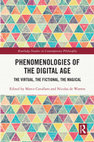
Routledge Studies in Contemporary Philosophy, 2025
It contends that the impact of digital technologies on the lifeworld involves both the emergence of novel fields of lived experience in need of phenomenological analysis and the transformation of the method and attitude of phenomenologically oriented philosophers towards the world. The chapters cover topics including immersion in virtual environments, the impact of digital cognitive devices on our perception of time, the invisibility of digital technologies in the lifeworld, the new extension of reality rendered possible by the employment of digital devices, how new technologies affect our intimacy and sexual body, the new methodological paradigm for phenomenological research prompted by digital technologies, the additive upshot of virtual imaginary, the intersection of the real and the virtual in augmented reality experiences, the structures of perception in the regime of digitally generated environments, how it feels like to empathize with others in a regime of virtual reality, process of en-rolling in the constitution of a virtual subject, the transformation of virtual reality into conspiratorial reality by means of on-line media platforms, and the problem of the extent to which technological environments impact human cognitive and perceptual experience.
Phenomenologies of the Digital Age will be of interest to scholars and advanced students working in phenomenology, philosophy of technology, science & technology studies, and media studies.

Schriften zur Phänomenologie und Anthropologie , 2022

Contributions to Phenomenology, 2022
Schriften zur Phänomenologie und Anthropologie 1, 2022
Papers by Marco Cavallaro

Das Ich als Erlebniskomplexion: Husserls Bündeltheorie in den ,Logischen Untersuchungen‘ im Vergleich mit Hume
Erfahrungslogiken: Festschrift für Dieter Lohmar, 2025
Logical lnvestigations, arguing that his early theory shows surprising affinities with David
Hume's bundle theory. Both philosophers reject the idea of a substantial ego and develop an
account of the seif as a bundle of experiences constituted through inner relations and laws
of association. Methodologically, the comparison reveals a shared commitment to grounding philosophical concepts in experience, whether through Hume's principle of impressions or Husserl's reduction to the »real content« of consciousness. The paper demonstrates that Husserl's early phenomenology exhibits empiricist tendencies that align him more closely with Hume than is generally recognised. lt also shows how Husserl's notion of the seif as an Erlebniskomplexion provides a phenomenological counterpart to Hume's non-substantialist conception of personal identity.
Seeing Beyond the Image: Husserlian Reflections on the Empathetic Experience of Photographs
Husserl on Depiction, 2025
The Vanishing Point: Digital Technologies and the Quest for a Phenomenology of Technological Invisibility
Phenomenologies of the Digital Age: the Virtual, the Fictional, the Magical, 2025
Habits in Exile: A Genetic Phenomenology of Exile Displacement
Phenomenology of Broken Habits: Philosophical and Psychological Perspectives on Habitual Action, 2024
The Existential Husserl , 2022
Perspektivität und Horizontalität: Situation, Feld, Welt
Handbuch Phänomenologie, 2023
Rezeptionen der Phänomenologie
Handbuch Phänomenologie, 2023
Hanne Jacobs (ed.), The Husserlian Mind. London: Routledge, 2021

Iulian Apostolescu (ed.), "The Subject(s) of Phenomenology. Rereading Husserl", 2020
Fausto Fraisopi (ed.), Mathesis, Grund, Vernunft Die philosophische Identität Europas zwischen Deutschem Idealismus und Phänomenologie, 2019

Horizon. Studies in Phenomenology, 2019
Phainomenon. Journal of Phenomenological Philosophy, 2019
Phänomenologische Forschungen, 2018


Husserl Studies, 2016

Investigaciones Fenomenológicas, 2015
its correlate, the natural world (Umwelt) —as they emerge in various lectures during the 1910s and especially in Ideen I with respect to the phenomenological reduction— stem from an early confrontation with Avenarius’ “empiriocriticist” standpoint as laid out in his book Der menschliche Weltbegriff. In order to uphold this claim, I will discuss in my paper Husserl's gradual approach to the theories of the Swiss-German philosopher as well as his late critique of the same. Although Husserl in fact conceived of Avenarius’ standpoint as a valuable beginning, he was decisively prompted in his late reflections to call into question some of the premises of the “empirio-criticist” philosophy.