Papers by Margaret E Walker
Musicultures, Feb 6, 2010
Although Euro-American musical revivals are usually connected to folk music, the postcolonial Ind... more Although Euro-American musical revivals are usually connected to folk music, the postcolonial Indian revival privileged "classical" music and dance as objects of priceless national heritage. Yet, the revival in India was not a straightforward process of cultural recovery in the wake of occupation. Issues of authority, authenticity and appropriation are woven into the process of reclamation. Through a comparison of this period in Indian dance history with themes in current theories of revival, this article moves towards a model of "revival" as a global phenomenon seeking to broaden our understanding of cultural continuity and change.
Intersections: Canadian Journal of Music/Revue Canadienne de musique Vol. 39 no.1, 2019
This article is the co-written introduction (editorial) to a special theme issue of the Journal I... more This article is the co-written introduction (editorial) to a special theme issue of the Journal Intersections entitled "Decolonizing Music Pedagogies." The entire issue is available on www.muscan.org ,https://www.muscan.org/en/publications/intersections/1357-intersections-vol-39-no-1>
The introduction explores theoretical concepts of decolonizing, the Canadian context and the application of decolonial ideas to university music teaching. As we write in the article, "we hope amongst our many aspirations for this publication that the articles presented here will invite many more voices to engage in further dialogue about pedagogy , scholarship, and decolonial teaching. Our sincere thanks to Beverley Diamond and Alan Dodson for their comments on this introduction. We are also very grateful to the eighteen anonymous peer reviewers, the Intersections editorial team, and the MusCan Board for their assistance with and support of this special issue."
Journal of Music History Pedagogy Vol.10 No.1, 2020
Although musicological scholarship has expanded in recent decades to include critical theories an... more Although musicological scholarship has expanded in recent decades to include critical theories and diverse repertoire, post-secondary music history curricula largely continue to disseminate a Eurocentric canon of composers and works presented within an evolutionary historical narrative. This article places questions of curricular revision in the current context of calls for educational reform through decolonization initiatives. Beginning with an exploration of what decolonizing education might mean, I then investigate the impact that the European colonial project might have had on the standard music history curriculum, uncovering an embedded teleological progression that supports European exceptionalism and culture superiority. A first step in decolonizing music history teaching, therefore, must be to make the historiographical foundations of what we are teaching transparent through contextualizing Western art music history within a critical, global framework.
Dance Matters: Performing India. Eds. Pallabi Chakravorty and Nilanjana Gupta , 2010
Asian Music, 2007
A brief article about the life and accomplishments of Indian intellectual and freedom fighter, Go... more A brief article about the life and accomplishments of Indian intellectual and freedom fighter, Govind Vidyarthi.
MUSICultures, 2010
Although Euro-American musical revivals are usually connected to folk music, the postcolonial Ind... more Although Euro-American musical revivals are usually connected to folk music, the postcolonial Indian revival privileged “classical” music and dance as objects of priceless national heritage. Yet, the revival in India was not a straightforward process of cultural recovery in the wake of occupation. Issues of authority, authenticity and appropriation are woven into the process of reclamation. Through a comparison of this period in Indian dance history with themes in current theories of revival, this article moves towards a model of “revival” as a global phenomenon seeking to broaden our understanding of cultural continuity and change.
Journal of the Indian Musicological Society, 2009
A careful search through historical sources for either a dance called kathak or people called Kat... more A careful search through historical sources for either a dance called kathak or people called Kathaks, with a goal of understanding the roots of the 20th-century dance called kathak.
CRME Bulletin, 2000
Theories of music cognition and hermeneutics are out of step with scholarship in other fields bec... more Theories of music cognition and hermeneutics are out of step with scholarship in other fields because they continue to separate the cognitive roles of mind and body. Through an examination of the spatiomotorpatterns used in performance, the prevalence of physical metaphor in written and verbal musical discourse and the connections between music and structured movement such as dance. This paper proposes an "embodied" approach to the study of musical knowing and meaning. Such an approach is not only in keeping with current research and theories in fields of philosophy, anthropology, and ethnomusicology, it provides a paradigm that is applicable cross-culturally and includes the processes of both listeners and performers.
ICTM Study Group Symposium on Global History of Music, 2021
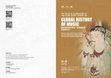
ICTM Study Group on Global History of Music
Reflecting a new interest in global histories outsi... more ICTM Study Group on Global History of Music
Reflecting a new interest in global histories outside music, the ICTM topic-based Study Group on Global History of Music would focus on the global interaction of regional musical cultures. Historical studies of music have almost always restricted themselves to specific geographically or culturally defined areas, but music is pursued in relation to the music of other areas and cultures, resulting in a global network of cross-cultural relationships largely neglected by conventional musical historiography. The Study Group on Global History of Music aims to continue this work, bringing together musicologists and ethnomusicologists in an attempt to add value to work currently underway in both disciplines to get out of Euro- and America-centric approaches.
The mission of the ICTM Study Group on Global History of Music is to encourage, promote and support scholars and performers investigating music history in a global context. We are concerned not only with previously neglected musical traditions but also with how music and related sound genres have intersected cross-culturally and become entangled with each other. Furthermore, different research practices and views of history are also regarded. Acting as an information exchange and providing workshops, symposia, performances, publication opportunities, and pedagogical resources, the ICTM Study Group on Global History of Music brings together researchers from around the world to share and develop their research.
Papers / Articles / Chapitres by Margaret E Walker

Les Cahiers de la Société québécoise de recherche en musique, 2024
Abstract (résumé en français ci-dessous)
As decolonization of knowledge and teaching becomes incr... more Abstract (résumé en français ci-dessous)
As decolonization of knowledge and teaching becomes increasingly prominent within universities, post-secondary music programs in Canada and elsewhere must revaluate their relationship to Eurocentric musical traditions. Currently, most undergraduate programs focus on Western classical music and a limited number of works and composers. These works are generally presented in a teleological manner consisting of a series of stylistic periods, ignoring external influences such as local music, non-Western music, oral or popular music. As these programs influence the representation of genres, repertoires, and musical tastes of future performers, teachers and music professionals, our institutions have the responsibility of considering ways to move beyond the dominant, Eurocentric, and colonial narrative of the “history of music.” This article offers a theoretical and practical approach to transforming the teaching of music history in Canadian universities and conservatories, drawing of recent examples of course redesign. After briefly examining the nature of the historical narrative usually taught in post-secondary programs, it also provides theoretical tools and pedagogical methods that can concretely support the possible emancipation of this narrative in the context of Western classical music history courses.
Résumé
Dans un contexte de sensibilisation grandissante aux enjeux de décolonisation des savoirs et de l’enseignement au sein des universités, un nombre croissant de professeures et professeurs, au Canada comme ailleurs, cherchent à repenser leur rapport à une histoire de la musique centrée sur la tradition européenne. En musicologie, une discipline enracinée dans les épistémologies de l’Europe du xixe siècle, les voix sont variées et les idées, qu’elles soient radicales, modérées ou conservatrices, se croisent et s’influencent mutuellement. Ces débats incitent à réfléchir sur la manière de conceptualiser l’histoire de la musique occidentale et à en revisiter les approches pédagogiques, pour ainsi en approfondir et en élargir la compréhension dans sa dimension globale. En s’appuyant sur une variété de sources théoriques et pratiques et à partir des expériences de refonte des cours d’histoire de la musique dans trois universités canadiennes (Université Laval, Mount Allison University et Queen’s University), cet article met l’accent sur l’importance d’examiner les fondements du récit prédominant, d’effectuer un travail historiographique critique, de faire place à la démarche réflexive et d’avoir recours à un éventail de ressources pédagogiques adaptées.
Books by Margaret E Walker
Through an analysis both broad and deep of primary and secondary sources, ethnography, iconograph... more Through an analysis both broad and deep of primary and secondary sources, ethnography, iconography and current performance practice, I undertake a critical approach to the history of kathak dance and present new data about hereditary performing artists, gendered contexts and practices, and postcolonial cultural reclamation. The account that emerges places kathak and the Kathaks firmly into the living context of North Indian performing arts.
Dissertation by Margaret E Walker
My PhD Dissertation, University of Toronto, 2004.



Uploads
Papers by Margaret E Walker
The introduction explores theoretical concepts of decolonizing, the Canadian context and the application of decolonial ideas to university music teaching. As we write in the article, "we hope amongst our many aspirations for this publication that the articles presented here will invite many more voices to engage in further dialogue about pedagogy , scholarship, and decolonial teaching. Our sincere thanks to Beverley Diamond and Alan Dodson for their comments on this introduction. We are also very grateful to the eighteen anonymous peer reviewers, the Intersections editorial team, and the MusCan Board for their assistance with and support of this special issue."
Reflecting a new interest in global histories outside music, the ICTM topic-based Study Group on Global History of Music would focus on the global interaction of regional musical cultures. Historical studies of music have almost always restricted themselves to specific geographically or culturally defined areas, but music is pursued in relation to the music of other areas and cultures, resulting in a global network of cross-cultural relationships largely neglected by conventional musical historiography. The Study Group on Global History of Music aims to continue this work, bringing together musicologists and ethnomusicologists in an attempt to add value to work currently underway in both disciplines to get out of Euro- and America-centric approaches.
The mission of the ICTM Study Group on Global History of Music is to encourage, promote and support scholars and performers investigating music history in a global context. We are concerned not only with previously neglected musical traditions but also with how music and related sound genres have intersected cross-culturally and become entangled with each other. Furthermore, different research practices and views of history are also regarded. Acting as an information exchange and providing workshops, symposia, performances, publication opportunities, and pedagogical resources, the ICTM Study Group on Global History of Music brings together researchers from around the world to share and develop their research.
Papers / Articles / Chapitres by Margaret E Walker
As decolonization of knowledge and teaching becomes increasingly prominent within universities, post-secondary music programs in Canada and elsewhere must revaluate their relationship to Eurocentric musical traditions. Currently, most undergraduate programs focus on Western classical music and a limited number of works and composers. These works are generally presented in a teleological manner consisting of a series of stylistic periods, ignoring external influences such as local music, non-Western music, oral or popular music. As these programs influence the representation of genres, repertoires, and musical tastes of future performers, teachers and music professionals, our institutions have the responsibility of considering ways to move beyond the dominant, Eurocentric, and colonial narrative of the “history of music.” This article offers a theoretical and practical approach to transforming the teaching of music history in Canadian universities and conservatories, drawing of recent examples of course redesign. After briefly examining the nature of the historical narrative usually taught in post-secondary programs, it also provides theoretical tools and pedagogical methods that can concretely support the possible emancipation of this narrative in the context of Western classical music history courses.
Résumé
Dans un contexte de sensibilisation grandissante aux enjeux de décolonisation des savoirs et de l’enseignement au sein des universités, un nombre croissant de professeures et professeurs, au Canada comme ailleurs, cherchent à repenser leur rapport à une histoire de la musique centrée sur la tradition européenne. En musicologie, une discipline enracinée dans les épistémologies de l’Europe du xixe siècle, les voix sont variées et les idées, qu’elles soient radicales, modérées ou conservatrices, se croisent et s’influencent mutuellement. Ces débats incitent à réfléchir sur la manière de conceptualiser l’histoire de la musique occidentale et à en revisiter les approches pédagogiques, pour ainsi en approfondir et en élargir la compréhension dans sa dimension globale. En s’appuyant sur une variété de sources théoriques et pratiques et à partir des expériences de refonte des cours d’histoire de la musique dans trois universités canadiennes (Université Laval, Mount Allison University et Queen’s University), cet article met l’accent sur l’importance d’examiner les fondements du récit prédominant, d’effectuer un travail historiographique critique, de faire place à la démarche réflexive et d’avoir recours à un éventail de ressources pédagogiques adaptées.
Books by Margaret E Walker
Dissertation by Margaret E Walker