Papers by Maurizio Vivarelli
"AIB Studi", 2025
and bunko. Considering the methodological features of comparative librarianship, the reflection adopts the concept of transduction to describe knowledge as a metastable process, in which libraries emerge as relational thresholds oscillating between continuity and transformation. The resulting cartography delineates an evolving geography, in which the library is understood as a temporal form of knowledge.
Biblioteche Oggi, 2010
«Culture del testo e del documento», 2025
DigitCult. Scientific Journal on Digital Cultures, 2023
Biblioteche oggi, 2024
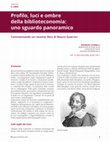
transdisciplinary foundation of this disciplinary field, necessary to face the many challenges of contemporary complexity.
JLIS.it, 2024
AgCult - Letture lente, 2023
AIB studi, 2022
del settore disciplinare M-STO/08, sulla sua collocazione nella gerarchia della organizzazione accademica, e sulle linee di sviluppo della cultura bibliografica e biblioteconomica che il «testo breve» di una declaratoria può riuscire a prefigurare.
The paper proposes some considerations on the configuration of the disciplinary sector M-STO/08, which, in the Italian juridical-academic lexicon, is described in a concise declaration, published with the Ministerial Decree of 4 October 2000, which briefly delineates its boundaries. Mission 4 “Istruzione e ricerca” of the PNRR (Piano nazionale di ripresa e resilienza) envisages a reform of the degree classes
and binds the relevant scientific communities, such as the SISBB (Società italiana di Scienze bibliografiche e biblioteconomiche), to adaptations, which concern both the concrete organizational and procedural dynamics, and, at the same time, the theoretical and methodological implications
referred to them, and which therefore affect the profile of the disciplinary field of bibliography and library science. The specific objective proposed is primarily based on the analysis of the contents of the current declaration of the disciplinary sector M-STO/08, on its position in the hierarchy of the
academic organization, and on the lines of development of the bibliographic culture, that the «short text» of a declaration may succeed in prefiguring.
DigitCult. Scientific Journal on Digital Cultures, 2022
Department of Historical Studies of the University of Turin, and Turin Civic Libraries. Reading(&)Machine is based on the processing of information content of data produced by the libraries, and of other types of data,
coming from the social reading platform aNobii and generated directly by users, used to promote and enrich the reading experience, in specificity of the symbolic and informative ecosystem of the public library; the
recommendations produced will be made available in an immersive Virtual Reality environment. The article examines two particular aspects of these contexts. The first refers to the relationship between the digital
space of the project and the configuration of the physical space of the library, within which the prototype will be placed. The second specifically concerns the methods and phases of the choice of reading, in which
suggestions produced by the machines and signs communicated by the library space are integrated.
Atti della Rassegna Tecnica degli ingegneri e degli architetti in Torino, 2022
Cases on Developing Effective Research Plans for Communications and Information Science, María-Victoria Carrillo-Durán (University of Extremadura, Spain) and Margarita Pérez Pulido (University of Extremadura, Spain), 2022
Culture e funzione sociale della biblioteca: memoria, organizzazione, futuro. Studi in onore di Giovanni Di Domenico, Roma, AIB, 2022
Enciclopedia italiana, 2022
Reimmaginare la Grande Galleria. Forme del sapere tra età moderna e culture digitali, Torino, Academia University Press, 2022
AIB studi, 2021
Biblioteche oggi Trends, 7, n. 2, 2021
can be traced back to the concept of ‘utopia’, in its articulated polysemy. The proposed reasoning will develop according
to the following steps. First of all, a rapid exploration of the meaning of the word ‘utopia’ will be carried out, differentiating
it from that of other words or expressions closely related (‘concrete utopia’, ‘dystopia’, ‘estropia’, ‘heterotopia’, ‘ucronia’).
Subsequently the article describes and evaluates from this point of view some projects of public libraries in which the
utopian program seems particularly evident (Seattle Central Library; Tianjin Library; Helsinki Central Library Oodi), linking
their profile and relevant elements in the definition of identity. of the contemporary public library (order / disorder, visibility,
‘public’ and ‘social’ model). Finally, inspired by the reflection of the French philosopher Paul Ricoeur, we will discuss a
method for evaluating the relationships between ideal and concrete symbolic contents, trying to show their intimate and
circular connection, exemplified through the apparent contrast between real and imaginary libraries.
Bibliothecae.it, 10, 2, p. 15-46, 2021
of the organization and communication of knowledge in contemporary reality make it necessary to reflect on the principles on which models and methods of the bibliographic tradition are based. This paper examines these topics: a) the elementary entities that constitute the “objects” of the representation of knowledge, from “books” to “data”; b) the description of some of the essential characteristics of the models of representation of these “objects”; c) the ways in which the perception of representations is carried out and communicated, through the recordings, giving rise to the different interfaces of bibliographic
mediation, in the classic frame of the Bibliographic universe; d) the relational and holistic nature that characterizes the empirical phenomena referred to knowledge of objects, bibliographic and extra-bibliographic; e) the model profile of a possible Bibliographic multiverse; e) the general lines of a “point of view” with which to hypothesize the integration, following Michel Foucault, of “words” and “things”.