Papers by Nassima Sahraoui
The following article deconstructs certain figures of Benjamin’s thoughts on history and on epist... more The following article deconstructs certain figures of Benjamin’s thoughts on history and on epistemology – such as image, trace, crystal, standstill, the ‘Now’, and the ‘subject of historical knowledge’ – and relates them to the political dimension of his “Critique of Violence”, and to his remarks on the linguistic structure of political writing. Thereby it centres on the following questions: in what way could Benjamin’s characterisation of the singular moment, as well as his analysis of temporality provide insights into historical dynamics? Furthermore, it aims at investigating if and to what extent historico-political action is related to a certain understanding of time and power: can such action be seen as a crystallised emanation of the ‘Now’, of Jetztzeit?
Als Wissenschaftlerin ist "Neugier" sicher für Sie eine Eigenschaft, die Sie auszeichnet?
Neugie... more Als Wissenschaftlerin ist "Neugier" sicher für Sie eine Eigenschaft, die Sie auszeichnet?
Neugier ist sicherlich eine vorteilhafte Eigenschaft für jeden Wissenschaftler. Ein gewisses Maß an Neugierde ist vielleicht sogar notwendig, um die Suche nach einem Zugewinn an Wissen anzustoßen...
Neugier ist sicherlich eine vorteilhafte Eigenschaft für jeden Wissenschaftler. Ein gewisses Maß an Neugierde ist vielleicht sogar notwendig, um die Suche nach einem Zugewinn an Wissen anzustoßen...
Ein InDepth-longread auf "Philosophie InDebate" zum Thema Müßiggang und der Frage, ob die philoso... more Ein InDepth-longread auf "Philosophie InDebate" zum Thema Müßiggang und der Frage, ob die philosophischen Figuren des Müßiggangs aus dem 19. Jahrhundert für heutige Diskurse und Krisen angebracht sind.
Der Artikel diskutiert einige Aspekte aus Schlegels "Lucinde", Benjamins Flaneur und Schildkröten.
https://philosophie-indebate.de/3690/indepth-longread/
Der Artikel diskutiert einige Aspekte aus Schlegels "Lucinde", Benjamins Flaneur und Schildkröten.
https://philosophie-indebate.de/3690/indepth-longread/
"Generations of Water Mourning in the Sea of Life. Loose thoughts on the Power of Rain, Acqua Alt... more "Generations of Water Mourning in the Sea of Life. Loose thoughts on the Power of Rain, Acqua Alta, and the Question of Survival", published in the Zine "Living under Water", ed. by Andi Arnovitz and Shaul Bassi (2020)
This article examines the elliptical turns that Walter Benjamin takes around Martin Heidegger's p... more This article examines the elliptical turns that Walter Benjamin takes around Martin Heidegger's philosophy of history.
Love and loss, two of the most fundamental and vehement human emotional experiences, can both onl... more Love and loss, two of the most fundamental and vehement human emotional experiences, can both only operate on the verge of expression:
human language, this extraordinarily powerful tool of shaping and building our world, seems to fail whenever one attempts to capture the reality of love or loss in words...
human language, this extraordinarily powerful tool of shaping and building our world, seems to fail whenever one attempts to capture the reality of love or loss in words...
In: Anthropology and Materialism. A Journal of Social Research, Special Issue: "Discontinuous In... more In: Anthropology and Materialism. A Journal of Social Research, Special Issue: "Discontinuous Infinities. Walter Benjamin and Philosophy", ed. Jan Sieber and Sebastian Truskolaski, March 2017
This two-day workshop will be devoted to a discussion of the appearance of violence and disruptio... more This two-day workshop will be devoted to a discussion of the appearance of violence and disruption as themes with which philosophy and literature deal, as well as to a contemplation of the difficult relationship between violence and writing in both perspectives: that of disruptive philosophical thinking as well as disruptive literary writing. International scholars from both fields will discuss the ways in which both realms disrupt and shed light on each other, hence tracing the space of disruption.
The panel "Hannah Arendt / Jacques Derrida: Politics, Language, Writing" address the intersection... more The panel "Hannah Arendt / Jacques Derrida: Politics, Language, Writing" address the intersections among the theoretical insights of two of the most influential intellectuals of the 20 th Century...
"Throughout his entire text corpus, Benjamin develops an original concept of experience: from the... more "Throughout his entire text corpus, Benjamin develops an original concept of experience: from the early essay On the Program of the Coming Philosophy (1917-18) to his last writings – especially his essay on Baudelaire (1939) and the Theses on the Concept of History – he attempts to outline a philosophy of experience in the age of its unrelenting decline...."
During the two days of our workshop, we will hence closely read and discuss the central aspects o... more During the two days of our workshop, we will hence closely read and discuss the central aspects of Benjamin’s idiosyncratic concept of experience.
"This editorial necessarily begins with a paradox—a paradox which stems from our own claim to que... more "This editorial necessarily begins with a paradox—a paradox which stems from our own claim to question the present of deconstruction, at a conference that took place at the University of Frankfurt in March 2012. Whilst the question arose out of an awareness of a certain urgency to ‘actualise’ and ‘advance’ deconstruction with and against economic, institutional and academic interventions, at its centre this practice already bears an undeniable inconsistency in itself..."
(Nassima Sahraoui, Felix Trautmann, Thomas Telios)
(Nassima Sahraoui, Felix Trautmann, Thomas Telios)
Talks by Nassima Sahraoui
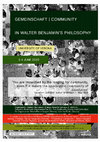
UNIVERSITY OF VERONA 3-4 JUNE 2022
"You are imperilled by the longing for community, even if it... more UNIVERSITY OF VERONA 3-4 JUNE 2022
"You are imperilled by the longing for community, even if it means the apocalyptic community of revolution" (Gershom Scholem, Letter to Benjamin, May 1931)
The concept of 'community' (Gemeinschaft) runs like a thread through many of Benjamin's writings: from his earliest reflections on the German Student Movement, including his 1911 essay on 'The Free School Community', to his ill-fated Habilitation on the Origin of the Mourning Play (1925); and from his early language-philosophical tract 'On Language as Such and on the Language of Man' (1916) to his later, more pointedly materialist city portrait, 'Moscow' (1927). For Benjamin, the term entails not only a critique of 'national community' (Volksgemeinschaft), but equally an effort to delineate a form of 'ethical community' (sittliche Gemeinschaft) and a 'community of language' (Sprachgemeinschaft). In each case, these figures of community are articulated in response to shifting historical circumstances, including two World Wars, and through an engagement with a wide range of interlocutors-Friedrich Hölderlin and Gustav Landauer, among them. Although Benjamin never systematically expounds the concept of community per se, his frequent use of the word is consistent with his wider effort to recast the sense in which alternative forms of sociality might be conceivedbe it in terms of 'The Storyteller's 'community of listeners' or in terms of the city as 'the first communio', as noted in The Arcades Project. In other words, there is a sense in which Benjamin's concept of community, alongside its cognate terms, marks a nodal point: an opportunity to rethink the interplay of language, history, and politics in the register of what is common.
"You are imperilled by the longing for community, even if it means the apocalyptic community of revolution" (Gershom Scholem, Letter to Benjamin, May 1931)
The concept of 'community' (Gemeinschaft) runs like a thread through many of Benjamin's writings: from his earliest reflections on the German Student Movement, including his 1911 essay on 'The Free School Community', to his ill-fated Habilitation on the Origin of the Mourning Play (1925); and from his early language-philosophical tract 'On Language as Such and on the Language of Man' (1916) to his later, more pointedly materialist city portrait, 'Moscow' (1927). For Benjamin, the term entails not only a critique of 'national community' (Volksgemeinschaft), but equally an effort to delineate a form of 'ethical community' (sittliche Gemeinschaft) and a 'community of language' (Sprachgemeinschaft). In each case, these figures of community are articulated in response to shifting historical circumstances, including two World Wars, and through an engagement with a wide range of interlocutors-Friedrich Hölderlin and Gustav Landauer, among them. Although Benjamin never systematically expounds the concept of community per se, his frequent use of the word is consistent with his wider effort to recast the sense in which alternative forms of sociality might be conceivedbe it in terms of 'The Storyteller's 'community of listeners' or in terms of the city as 'the first communio', as noted in The Arcades Project. In other words, there is a sense in which Benjamin's concept of community, alongside its cognate terms, marks a nodal point: an opportunity to rethink the interplay of language, history, and politics in the register of what is common.
Conferences by Nassima Sahraoui
One of the most striking features of Benjamin’s thinking is his extreme attention to material det... more One of the most striking features of Benjamin’s thinking is his extreme attention to material details, which, although they constitute the main texture of our everyday experience, are mostly overlooked. Thanks to this particular awareness, his ideas always develop “in bodily contact with the materials”, as Adorno pointed out, thereby subverting the metaphysical dualism between form and matter. One might even argue that the topic of matter (not only Materie but also Stoff or Stofflichkeit) could be seen as a thread that runs through his entire oeuvre. [...]
This two-day workshop aims at re-reading Benjamin’s writings by following these various material traces.
If you would like to participate, please send a message and a brief biographical note to the organisers by 10 March, 2023.
Organisation: Stefano Marchesoni (Paris), Nassima Sahraoui (Frankfurt), Sebastian Truskolaski (Manchester)
Contact: marchesoni.stefano[at]gmail.com, nassima.sahraoui[at]gmx.org, sebastian.truskolaski[at]manchester.ac.uk
In collaboration with the Walter Benjamin Archiv, Akademie der Künste, Berlin, the Frankfurt Benjamin Lectures (Thomas Regehly), and the Ernst Bloch Centre for German Thought, School of Advanced Study, University of London.
This two-day workshop aims at re-reading Benjamin’s writings by following these various material traces.
If you would like to participate, please send a message and a brief biographical note to the organisers by 10 March, 2023.
Organisation: Stefano Marchesoni (Paris), Nassima Sahraoui (Frankfurt), Sebastian Truskolaski (Manchester)
Contact: marchesoni.stefano[at]gmail.com, nassima.sahraoui[at]gmx.org, sebastian.truskolaski[at]manchester.ac.uk
In collaboration with the Walter Benjamin Archiv, Akademie der Künste, Berlin, the Frankfurt Benjamin Lectures (Thomas Regehly), and the Ernst Bloch Centre for German Thought, School of Advanced Study, University of London.
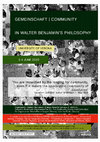
The concept of 'community' (Gemeinschaft) runs like a thread through many of Benjamin's writings.... more The concept of 'community' (Gemeinschaft) runs like a thread through many of Benjamin's writings... Although Benjamin never systematically expounds the concept of community per se, his frequent use of the word is consistent with his wider effort to recast the sense in which alternative forms of sociality might be conceived-be it in terms of 'The Storyteller's 'community of listeners' or in terms of the city as 'the first communio', as noted in The Arcades Project. In other words, there is a sense in which Benjamin's concept of community, alongside its cognate terms, marks a nodal point: an opportunity to rethink the interplay of language, history, and politics in the register of what is common. This two-day workshop will take the concept of 'community' as it appears in a selection of texts, including (but not limited to) the ones noted above, as a starting point for a broader exploration of the 'actuality' of Benjamin's thought-its Aktualität. As in previous years, the workshop will be organised around close readings of short, selected text passages in which these matters will be traced over the course of Benjamin's earlier writings, as well as his later thought, probing the currency of his reflections for the present moment. In short: we intend to focus on the question what Benjamin's concept of community means for us today-and how we might understand its continuing or renewed currency.
For this workshop we will be joined by HOWARD CAYGILL (Kingston University London).
Since the event revolves around intensive reading sessions, some prior knowledge of Benjamin's philosophical writings is strongly encouraged. Bilingual, German-English copies of the texts will be made available. To facilitate the discussion, the number of participants for this workshop is limited. If you are interested in participating, please send a message and a brief biographical note to the organisers before 1 May, 2022.
For this workshop we will be joined by HOWARD CAYGILL (Kingston University London).
Since the event revolves around intensive reading sessions, some prior knowledge of Benjamin's philosophical writings is strongly encouraged. Bilingual, German-English copies of the texts will be made available. To facilitate the discussion, the number of participants for this workshop is limited. If you are interested in participating, please send a message and a brief biographical note to the organisers before 1 May, 2022.

Violence in Philosophy and Literature VII International Online Workshop, 2021
For more than a year now we have been all globally isolated. Assuming that the seriousness of the... more For more than a year now we have been all globally isolated. Assuming that the seriousness of the crisis demands some further, more focused reflections, this workshop proposes to address the question of isolation in philosophy and literature and in connection to the notion of violence. Following our annual tradition, we will devote ample time for discussion after each talk and for one reading sessions.
This workshop is the seventh event in a series of gatherings that fall under the epigraph of “Violence in Philosophy and Literature”. It has taken place previously on “Language and Violence” (Tel Aviv University), “Space and Violence” (Polish Academy of Sciences, Warsaw), “Thinking and Writing – Disruption” (ZfL Berlin), “Violence Incorporated” (University of Chicago), “Sound and Violence” (Collège International Paris), and on “Time and Violence” (Goethe University, Frankfurt).
This workshop is the seventh event in a series of gatherings that fall under the epigraph of “Violence in Philosophy and Literature”. It has taken place previously on “Language and Violence” (Tel Aviv University), “Space and Violence” (Polish Academy of Sciences, Warsaw), “Thinking and Writing – Disruption” (ZfL Berlin), “Violence Incorporated” (University of Chicago), “Sound and Violence” (Collège International Paris), and on “Time and Violence” (Goethe University, Frankfurt).
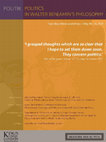
"I grasped thoughts which are so clear that I hope to set them down soon. They concern politics."... more "I grasped thoughts which are so clear that I hope to set them down soon. They concern politics."
(Walter Benjamin, Letter to Schoen, September 1919)
This two-day virtual workshop focusses on the fragments and studies written in the orbit of Benjamin’s seminal essay “Towards the Critique of Violence,” stemming mainly from the period between 1918 and 1921. The workshop will be organised around collective readings and discussions of selected text passages, each introduced by a brief presentation. The constellation of problems and concepts presented in these texts will serve as a starting point for a broader exploration of Benjamin’s political thought: we will ask what it means to read these texts today – and how we might understand their actuality. To facilitate the discussion, the number of participants for this workshop is limited. If you are interested to participate, please send a message and a brief biographical note to the organisers before 31 March, 2021.
(Walter Benjamin, Letter to Schoen, September 1919)
This two-day virtual workshop focusses on the fragments and studies written in the orbit of Benjamin’s seminal essay “Towards the Critique of Violence,” stemming mainly from the period between 1918 and 1921. The workshop will be organised around collective readings and discussions of selected text passages, each introduced by a brief presentation. The constellation of problems and concepts presented in these texts will serve as a starting point for a broader exploration of Benjamin’s political thought: we will ask what it means to read these texts today – and how we might understand their actuality. To facilitate the discussion, the number of participants for this workshop is limited. If you are interested to participate, please send a message and a brief biographical note to the organisers before 31 March, 2021.
This two-day virtual workshop focusses on the fragments and studies written in the orbit of Benja... more This two-day virtual workshop focusses on the fragments and studies written in the orbit of Benjamin’s seminal essay “Towards the Critique of Violence,” stemming mainly from the period between 1918 and 1921. The workshop will be organised around collective readings and discussions of selected text passages, each introduced by a brief presentation. The constellation of problems and concepts presented in these texts will serve as a starting point for a broader exploration of
Benjamin’s political thought: we will ask what it means to read these texts today – and how we might understand their actuality.
To facilitate the discussion, the number of participants for this workshop is limited. If you are interested to participate, please send a message and a brief biographical note to the organisers before 31 March, 2021.
Benjamin’s political thought: we will ask what it means to read these texts today – and how we might understand their actuality.
To facilitate the discussion, the number of participants for this workshop is limited. If you are interested to participate, please send a message and a brief biographical note to the organisers before 31 March, 2021.
Like many of his other works, Walter Benjamin’s reflections on the concept of politics have a fra... more Like many of his other works, Walter Benjamin’s reflections on the concept of politics have a fragmentary character. In the early 1920s, Walter Benjamin worked intensively on a project that he came to refer to simply as his Politics; but even though this study appears to have been largely completed, most of the resulting texts have been lost or survived only in the form of outlines, notes, drafts, and fragments. [...] This two-day workshop will take the constellation of problems and concepts presented in these texts as a starting point for a broader exploration of Benjamin’s political thought, especially with a view to its “actuality” (Aktualität). Taking the fragmentary remainders of Benjamin’s reflections from the early 1920s as a starting point, we will focus on the central preoccupations of this project, ranging from his planned essays on “The True Politician” and the “Dismantling of Violence” to his extended treatment of Paul Scheerbart’s asteroid novel, Lesabéndio. The workshop will be organised around close readings of selected text passages in which these preoccupations will be traced through Benjamin’s earlier writings, as well as his later thought, probing the currency of these reflections for contemporary political struggles. We intend to focus on the question what it means to read these texts today – and how we might understand their renewed actuality.
For this workshop we will be joined by AGATA BIELIK-ROBSON (Nottingham) and IRVING WOHLFARTH (Paris/Bremen).
For this workshop we will be joined by AGATA BIELIK-ROBSON (Nottingham) and IRVING WOHLFARTH (Paris/Bremen).
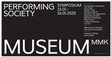
Societies are not givens, but take shape in a process of negotiation, regulation, governance and ... more Societies are not givens, but take shape in a process of negotiation, regulation, governance and resistance. The symposium Performing Society is devoted to the question of how we can conceive of societies in their current dynamics as well as their future formations. Do we need new terminology or are we called upon to rethink that already at our disposal?
The imagination and construction of the social, the relationship between immigration and class, the performativity of power, and faith in progress, will be among the topics discussed, but also the political as a concept, as an act of speech or as epistemological and social justice.
Within the framework of the exhibition Museum, in which art offers scope for the Other and its visualization, for freedom, transgression and resistance, the symposium is intended as an invitation to contemplate the societies in which we live–and want to live.
SATURDAY, 25 JANUARY
11am–1pm
Kristina Hasenpflug: Welcome
Susanne Pfeffer: Introduction
Aria Dean: Bad Infinity
Lea Ypi: Immigration and Social Class
2:30–4:30pm
Geoffroy de Lagasnerie: Is Democracy a Relevant Concept for Thinking about Politics?
Rainer Forst: The Performativity of Power
5–6pm
Gurminder K Bhambra: Performing Society, Reforming Society: From Progress to Reparations
SUNDAY, 26 JANUARY
11am–1pm
Natasha Lennard: Liberatory Language Games and Anti-Fascist Speech Acts: Why We Need a Better Understanding of Truth and Meaning-Making in the Fight for Social Justice
Nina Power: We Live in a Society: Ironic Belonging and Meme-Being in a Post-Public Age
2:30–4:30pm
Tiziana Terranova: Hypersocial Planetarization
Matteo Pasquinelli: Tools, Numbers, Machines and Algorithms: A Social History of Artificial Intelligence
5–6pm
Markus Gabriel: Fiction, Imagination, and Social Facts - The Dialectical Glue of Society
Moderation
Martin Saar, Nassima Sahraoui, Anna Sailer
Concept
Susanne Pfeffer, Anna Sailer
The imagination and construction of the social, the relationship between immigration and class, the performativity of power, and faith in progress, will be among the topics discussed, but also the political as a concept, as an act of speech or as epistemological and social justice.
Within the framework of the exhibition Museum, in which art offers scope for the Other and its visualization, for freedom, transgression and resistance, the symposium is intended as an invitation to contemplate the societies in which we live–and want to live.
SATURDAY, 25 JANUARY
11am–1pm
Kristina Hasenpflug: Welcome
Susanne Pfeffer: Introduction
Aria Dean: Bad Infinity
Lea Ypi: Immigration and Social Class
2:30–4:30pm
Geoffroy de Lagasnerie: Is Democracy a Relevant Concept for Thinking about Politics?
Rainer Forst: The Performativity of Power
5–6pm
Gurminder K Bhambra: Performing Society, Reforming Society: From Progress to Reparations
SUNDAY, 26 JANUARY
11am–1pm
Natasha Lennard: Liberatory Language Games and Anti-Fascist Speech Acts: Why We Need a Better Understanding of Truth and Meaning-Making in the Fight for Social Justice
Nina Power: We Live in a Society: Ironic Belonging and Meme-Being in a Post-Public Age
2:30–4:30pm
Tiziana Terranova: Hypersocial Planetarization
Matteo Pasquinelli: Tools, Numbers, Machines and Algorithms: A Social History of Artificial Intelligence
5–6pm
Markus Gabriel: Fiction, Imagination, and Social Facts - The Dialectical Glue of Society
Moderation
Martin Saar, Nassima Sahraoui, Anna Sailer
Concept
Susanne Pfeffer, Anna Sailer