Books by Noga Ayali-Darshan
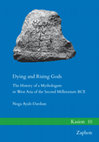
(chapters 1 and 7)
The present book is a contribution to the study of the origins and development of the dying and r... more The present book is a contribution to the study of the origins and development of the dying and rising god mythologem in the second millennium BCE. As outlined in the Introduction, since the publication of James G. Frazer’s research towards the end of the nineteenth century, the scholarship has dealt extensively and continuously with the influential mythologem of the dying and rising god. The study follows this mythologem in its narrow definition (as adapted twenty years ago, particularly by Tryggve N.D. Mettinger), aiming to fill a lacuna in previous studies on this topic. Its objective is to trace the mythologem’s origins and its dissemination route amongst the ancient Near Eastern cultures.
To this end, the study examines the earliest texts attesting to the mythologem in question, all from West Asia of the second millennium BCE, including Mesopotamia, Mari, Ugarit and another Northwest Semitic culture reflected in a Hittite text. As it turns out, along with the few early texts that describe the return from the netherworld of a god who had been killed, many others attest to a different sort of a mythologem; namely, the death of a god without his revival. The scholarship of the late nineteenth and early twentieth centuries led many scholars through the present day to consider this variant as a part of the complex mythologem of a god dying and being resurrected. However, the extant evidence presented in this study demonstrates that the distribution of the revival concept in its early years was in fact limited...
Preface This volume is a revised and expanded version of my Hebrew book (published in 2016 by the... more Preface This volume is a revised and expanded version of my Hebrew book (published in 2016 by the Bialik Institute), based on my doctoral dissertation. First and foremost, I would like to thank my supervisors, Prof. Edward L. Greenstein of Bar-Ilan University and Prof. Wayne Horowitz of the Hebrew University of Jerusalem, who unstintingly gave of their time, bountifully shared their scholarly acumen and insights, and enthusiastically gave their support not only during the project but also now as I continue my academic career. My gratitude also goes to Prof. Dennis Pardee of the University of Chicago, who aided me and contributed to my knowledge and understanding of the ancient Near East during my postdoctoral studies. During the writing of the dissertation and its revisions, numerous other scholars contributed advice, pointed me in fruitful directions, introduced me to sources, and read drafts and chapters:
Sixty-six colleagues, friends, and former students of Edward L. Greenstein present essays honorin... more Sixty-six colleagues, friends, and former students of Edward L. Greenstein present essays honoring him upon his retirement. Volume 1 includes essays on ancient Near Eastern studies, Biblical Hebrew and Northwest Semitic languages, and biblical law and narrative. Volume 2 includes essays on biblical wisdom and poetry, biblical reception and exegesis, and postmodern readings of the Bible.
Papers by Noga Ayali-Darshan
On Scribes and Scholars: Fs. Wayne Horowitz, 2025
One of the duplicates of Inana's Descent exclusively contains a significant parablepsis,
which i... more One of the duplicates of Inana's Descent exclusively contains a significant parablepsis,
which is repeated in Ištar's Descent, and this may suggest that the text reflected in this duplicate served as the basis for the Akkadian Ištar's Descent. After a brief introduction highlighting the importance of errors, such as parablepsis, as valuable tools for this research, the subsequent sections present evidence from both Inana's Descent and Ištar's Descent, followed by a summary of the findings and their implications.
Journal of Northwest Semitic Languages, 2025
This study explores various aspects of the socio-historical landscape of the Chaldean region of B... more This study explores various aspects of the socio-historical landscape of the Chaldean region of Bīt-Amukānu in 5th century BCE Southern Babylonia, through the lens of two previously unpublished texts from the town of Šāṭir. The study offers an editio princeps of these texts, with a detailed analysis that provides new insights into the town’s human landscape. Particular attention is given to the interactions between the Babylonian and West-Semitic inhabitants of Šāṭir, as well as their involvement with local institutions, especially the town’s local temple.
JNES 84.2, pp. 241-252, 2025
The combat myth between the storm god and the Sea is among the most renowned narratives of the an... more The combat myth between the storm god and the Sea is among the most renowned narratives of the ancient Near East during the second and first half of the first millennium BC. Yet, evidence of its presence in Phoenician cities appears only in late, fragmentary texts from the Hellenistic and Roman periods, such as the account preserved by Philo of Byblos, which serves as the focus of this paper. A striking feature of Philo’s version is its depiction of the storm god—called Demarous (Ugaritic Dmrn)—not as a victor but as defeated in his battle against Pontos (literally “Sea” in Greek). Scholarship on the storm god’s combat with the Sea has predominantly focused on earlier, well-preserved sources. Similarly, studies of Philo of Byblos tend to offer only limited consideration of his role in preserving this tradition. This paper thus seeks to address these gaps by examining Philo’s writings in conjunction with texts from his contemporaries and earlier sources, including Hurro-Hittite. Ugaritic and Greek texts. Through this analysis, we aim to reconstruct the myth’s prevailing form in Phoenician cities during the Hellenistic and Roman periods, illuminating its continuities and divergences from earlier versions.
Vetus Testamentum, 2025
The paper explores the doxologies in the book of Amos, arguing that they articulate
a polemical ... more The paper explores the doxologies in the book of Amos, arguing that they articulate
a polemical viewpoint distinct from prevailing biblical and ancient Near Eastern
notions about the formation of the sea, mountains, wind, and God’s abode. Central
to the comprehension of this cosmogony is the recurring phrase in Amos 5:8d and
6:9c, “(He) who summons the waters of the sea and pours them on the surface of the
earth.” While previous scholars have understood this phrase as referring to the primeval
Flood, a tsunami event, or Levantine torrential rain, the present paper suggests
a cosmogonic interpretation, in line with its context. Subsequent elements in the
same series of texts are interlinked with this portrayal, emphasizing the unified—and
polemical—perspective of the doxologies. This new explanation also has ramifications
for the dating and composition of the doxologies in the book of Amos.
This is an open access article distributed under the terms of the CC BY 4.0 license.
Antiguo Oriente, 2022
Lines 282-306 in the work Inana's Descent to the Netherworld are the opening lines of the section... more Lines 282-306 in the work Inana's Descent to the Netherworld are the opening lines of the section situated between two literary units: the recounting of Inana's journey to the netherworld and the recounting of Dumuzi's descent to the netherworld. These lines are characterized by various textual differences, as well as multiple repetitions of the phrase "Inana ascended from the netherworld," in both the temporal and indicative clauses. By examining each one of the repetitive phrases and its adjacent paragraph, the article traces the gradual development of that passage from one sentence into a paragraph of ca. 30 lines.
The Cambridge Companion to Biblical Wisdom Literature, 2022
Part I The Context of Wisdom Literature 1 Introduction 3 katharine j. dell, suzanna r. millar and... more Part I The Context of Wisdom Literature 1 Introduction 3 katharine j. dell, suzanna r. millar and arthur jan keefer 2 The Scope of Wisdom Literature 13 tremper longman iii 3 The Multiple Genres of Wisdom 34 suzanna r. millar 4 The Literary Context(s) and Development of Wisdom Literature in Ancient Israel (with Special Reference to Proverbs) 57 knut m. heim 5 The Scribal World 76 mark sneed 6 Theological Themes in the 'Wisdom Literature': Proverbs, Job and Ecclesiastes 96 katharine j. dell 7 The Solomonic Connection: Solomon and Wisdom in Kings and Chronicles 116 david firth Part II Wisdom Literature in the Hebrew Bible 8 Proverbs 137 christopher b. ansberry 9 Job 162 will kynes vii Published online by Cambridge University Press 10 Ecclesiastes 184 mette bundvad 11 The Song of Songs 200 jennifer l. andruska 12 Wisdom Psalms 219 simon chi-chung cheung 13 Wisdom's Wider Resonance 239 michael c. legaspi Part III Wisdom Literature beyond the Hebrew Bible 14 Ben Sira 261 seth a. bledsoe 15 The Book of Wisdom 283 joachim schaper 16 Wisdom at Qumran 303 david a. skelton 17 Egyptian Wisdom 323 michael v. fox and suzanna r. millar 18 The Syro-Palestinian Wisdom of the Late Bronze Age 344 noga ayali-darshan 19 Mesopotamian Wisdom 366 paul-alain beaulieu Part IV Themes in the Wisdom Literature 20 Creation in the Wisdom Literature 391 zoltá n schwá b 21 Reward and Retribution 414 peter t. h. hatton 22 From Rebuke to Testimony to Proverb: Wisdom's Many Pedagogies 433 william p. brown 23 The Wisdom Literature and Virtue Ethics 455 arthur jan keefer Bibliography 475 Index 511 viii c o n t e n t s
NABU, 2022
(ISRAEL) 17) A cognate for Akk. ḫabāqu?-In a recently published paper, 1) Yigal Bloch proposed th... more (ISRAEL) 17) A cognate for Akk. ḫabāqu?-In a recently published paper, 1) Yigal Bloch proposed that Middle Assyrian ḫabiqtu is a spelling of *ḫawiqtu, "turning, going", from the verb ḫuāqu/ḫâqu (root ḫwq) and likewise, that the verb ḫabāqu means "to go, turn". His proposal is based on the lexical equations ge₄ = ḫu
Rituale und Magie in Ugarit Praxis: Kontexte und Bedeutung, 2022
IOS 21, 2021
The paper surveys two repetitions that frame the sections of the cosmogony and the anthropogony i... more The paper surveys two repetitions that frame the sections of the cosmogony and the anthropogony in Enūma Eliš (iv 105-134 and v 67-84; v 113-130 and vi 39-58). In light of the duplications and inconsistencies that are caused by these repetitions, as well as the distinct content present in the cosmogony and the anthropogony in comparison to other parts of Enūma Eliš, this paper suggests that these resumptive repetitions serve the author as an editorial technique to integrate secondary material into an existing continuum at a relatively-later stage of the formation of Enūma Eliš.
Fest. Ed Greenstein, vol. 1, 2021
KTU 1.2 in its Context and in Relation to Extra-Ugaritic Parallels: A Reevaluation (2015/2021), 31-47
Literaturkontakte Ugarits: Wurzeln und Entfaltungen, 2021
WdO 50, 2020
The closing hymn of the Ugaritic Baal Cycle, which praises the Sun goddess-a minor character in t... more The closing hymn of the Ugaritic Baal Cycle, which praises the Sun goddess-a minor character in the Cycle-has raised literary questions since its publication, due to its exceptional content. While some have suggested resolving these questions by interpreting the hymn as devoted to Baal despite Baal's absence therein, others have correctly focused on its independent origin, leaving the question of its relation to the preceding myth unanswered. Following a close examination of the hymn, its addressee, and its origin, this paper suggests looking at the hymn from a wider perspective by studying the literary structure of the common Mesopotamian Belle-lettres compositions, with a special focus on the Sumerian and Akkadian disputation poems. The conclusions illustrate the formal role of the closing hymns in the ancient West Asian texts in general and in the Baal Cycle in particular. * This study was supported by the Israel Science Foundation (1393/18). I am grateful to Ed Greenstein, Yoram Cohen and Uri Gabbay for their careful reading and constructive comments on the text. 1 Cf. KTU 1.2 III. This fragment is not directly connected to any of the tablets of the Baal Cycle,
UF 48, 2019
The Ugaritic account of Mot's death and resurrection in the Baal Cycle (KTU 3 1.6 II, V) neither ... more The Ugaritic account of Mot's death and resurrection in the Baal Cycle (KTU 3 1.6 II, V) neither suits its immediate context nor reflects other West Asian traditions. This article suggests that it can fruitfully be studied in the light of the Osirian traditions prevalent in contemporaneous Egypt. Since the full plot of the Osirian myth was committed to writing only at a late date, the paper examines Egyptian spells and cultic texts containing motifs of this myth, which were written up until the New Kingdom period. The findings provide a literary parallel to the clear and evident impact of Egyptian visual art upon Ugaritic art.
Teaching Morality in Antiquity, 2018
ZAW 130, 2018
שבלת לפני תעמוד ואל (b) מעון לשוב תבוש אל (a) (4:26) מושלים לפני תמאן ואל... more שבלת לפני תעמוד ואל (b) מעון לשוב תבוש אל (a) (4:26) מושלים לפני תמאן ואל (b) נפשך לנבל תצע אל (a) (4:27)



Uploads
Books by Noga Ayali-Darshan
To this end, the study examines the earliest texts attesting to the mythologem in question, all from West Asia of the second millennium BCE, including Mesopotamia, Mari, Ugarit and another Northwest Semitic culture reflected in a Hittite text. As it turns out, along with the few early texts that describe the return from the netherworld of a god who had been killed, many others attest to a different sort of a mythologem; namely, the death of a god without his revival. The scholarship of the late nineteenth and early twentieth centuries led many scholars through the present day to consider this variant as a part of the complex mythologem of a god dying and being resurrected. However, the extant evidence presented in this study demonstrates that the distribution of the revival concept in its early years was in fact limited...
Papers by Noga Ayali-Darshan
which is repeated in Ištar's Descent, and this may suggest that the text reflected in this duplicate served as the basis for the Akkadian Ištar's Descent. After a brief introduction highlighting the importance of errors, such as parablepsis, as valuable tools for this research, the subsequent sections present evidence from both Inana's Descent and Ištar's Descent, followed by a summary of the findings and their implications.
a polemical viewpoint distinct from prevailing biblical and ancient Near Eastern
notions about the formation of the sea, mountains, wind, and God’s abode. Central
to the comprehension of this cosmogony is the recurring phrase in Amos 5:8d and
6:9c, “(He) who summons the waters of the sea and pours them on the surface of the
earth.” While previous scholars have understood this phrase as referring to the primeval
Flood, a tsunami event, or Levantine torrential rain, the present paper suggests
a cosmogonic interpretation, in line with its context. Subsequent elements in the
same series of texts are interlinked with this portrayal, emphasizing the unified—and
polemical—perspective of the doxologies. This new explanation also has ramifications
for the dating and composition of the doxologies in the book of Amos.
This is an open access article distributed under the terms of the CC BY 4.0 license.