Oil Tankers In Canadian Waters
#tankers101
About this microsite
The expansion of oil handling facilities and an additional pipeline in Western Canada has increased the number of oil tankers and also the proportion of oil transiting through the Pacific region compared to other Canadian waters.
This development, along with the continued use of tankers to transport fossil fuels around the world, has raised questions about the opportunities and risks for coastal and Indigenous communities, the environment, and the economy from oil transported by ship.
This site was created by Clear Seas, a Canadian not-for-profit organization that provides independent fact-based information to enable governments, industry, and the public to make informed decisions on marine shipping issues.
The site’s purpose is to share fact-based information about oil tankers in Canadian waters and to encourage informed conversations about marine shipping issues.
Oil Tankers 101
Since the late 19th century, oil tankers have been used to transport large amounts of oil across oceans and through waterways. In 2023, oil tankers accounted for about 29% of global seaborne trade by deadweight tonnes (DWT), with approximately 1.95 billion metric tonnes of crude oil transported by sea.1,2 This is a reduction from 1980, when tankers made up 50% of the world’s shipping fleet by DWT capacity.
Tanker Sizes and Capacities


Aframax
245m | Max DWT 120,000
Up to 750,000 barrels of crude oil

Suezmax
285m | Max DWT 200,000
Up to 1 million barrels of crude oil

Very Large Crude Carrier (VLCC)
330m | Max DWT 320,000
Up to 2.2 million barrels of crude oil

An oil tanker’s capacity is measured based on its size in deadweight tonnes (DWT), which is the total weight a ship can safely carry (including the cargo, fuel, crew, provisions, etc.) not including the weight of the ship itself. Tanker capacities can range from a few thousand DWT to 550,000 DWT.5 Aframax and Suezmax tankers regularly call in Canadian waters. VLCC are rare and ULCC are unknown.
How to Spot a Tanker
Tankers are easily identifiable

Oil Tanker
- Transports refined or crude oil
- Piping visible on deck
- No large cranes visible

Container Ship
- Transports thousands of standard-sized multi-coloured shipping containers
- Containers stacked visibly above deck

Roll-on/Roll-off (RORO) Ship
- Transports wheeled cargo, such as cars, trucks and railway cars
- Sits high above the water
- Multiple enclosed vehicle decks

Bulk Carrier
- Transports unpackaged cargo, such as coal, grain, fertilizers and minerals
- Large hatches visible on deck
- Large cranes may be visible
Tankers in Canadian Waters
While tankers play an important role in transporting crude oil along Canadian waterways, they carry a small fraction of Canada’s total crude oil exports. In 2023, 92% of crude oil exports from Canada were transported by pipeline. About 5% were exported by marine vessel and 3% were exported by rail.6
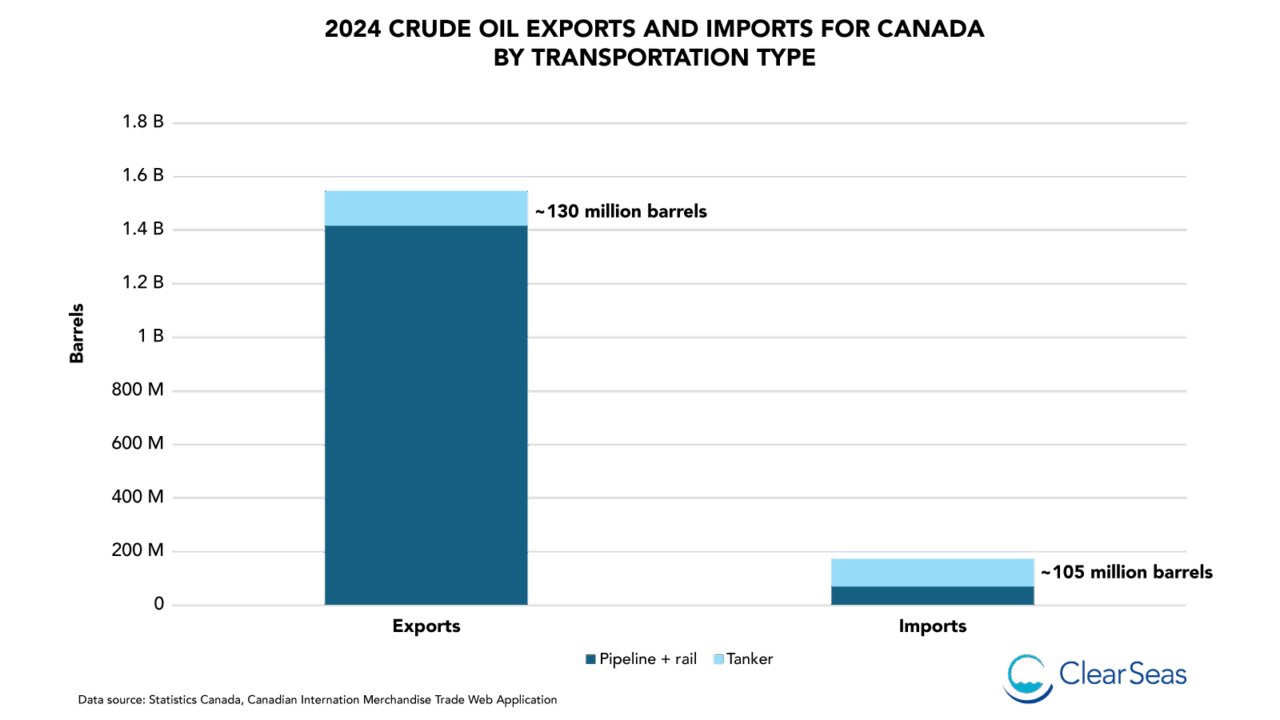
Canada exports a much larger volume of crude oil than it imports. In 2024, Canada exported over 1.55 billion barrels, of which 130 million barrels (8%) were transported by tanker, and imported just over 175 million barrels of oil, of which 105 million barrels (60%) were transported by tanker.7
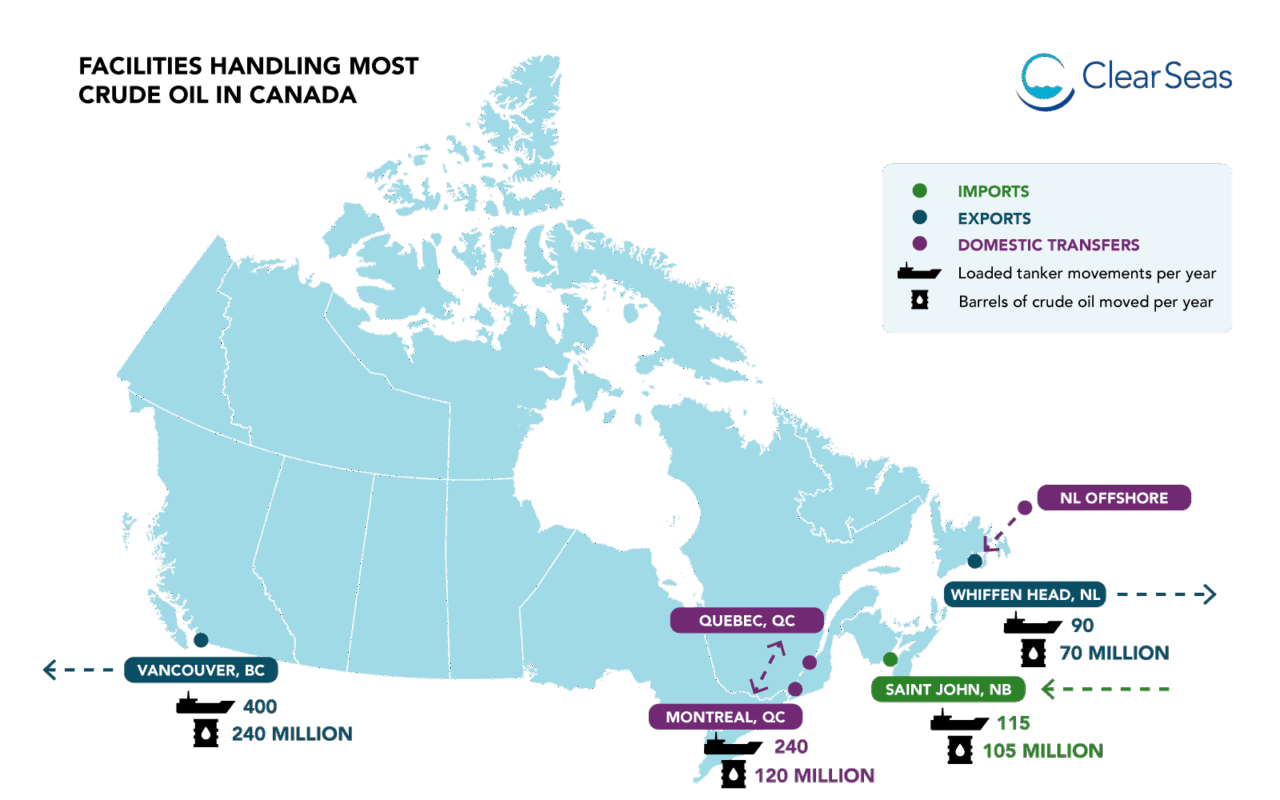
Canadian Ports and Facilities that Handle Most Oil Tankers
Most of the oil tanker activity in Canada takes place at six facilities8: Vancouver, Montreal, Quebec City, Saint John, Whiffen Head, and Newfoundland Offshore.9
Oil Transported as Cargo in Canadian Waters by Region
Pacific Canada
Most crude oil transported by tanker on the West Coast moves through the Port of Vancouver. The vast majority of this oil arrives from Alberta via the Trans Mountain pipelines.
The largest vessels used to ship oil out of the Port of Vancouver are Aframax tankers (80,000 – 120,000 DWT), which can carry approximately 550,000 barrels of oil. Due to Port of Vancouver depth restrictions, these tankers are generally loaded to about 80 percent of their full capacity to allow sufficient clearance through constrained waterways.10
Until 2024, tankers represented about 2% of total ship traffic per year visiting the Port of Vancouver (out of 250 total vessels per month, about 5 were tankers). In May 2024, the Trans Mountain Expansion Project (TMX) became operational, significantly increasing the amount of oil transported via pipeline from Alberta to the Westridge Marine Terminal in the Port of Vancouver. The expanded terminal can hold 395,000 barrels and has a maximum capacity of 34 tankers per month at three berths. 11,12 As of July 2024, the terminal was averaging around 20 tankers per month.13
Previously, most crude oil leaving Vancouver was transported to United States refineries. However, the increased capacity in 2024 allowed Canada to expand to Asian markets, with around 50% of oil exports from Vancouver going to China in 2024.14
In 2019, the federal government enacted a ban on oil tankers off the North Coast of British Columbia, including the ecologically sensitive Great Bear Rainforest, as part of Bill C-48, the Oil Tanker Moratorium Act.15
Atlantic Canada
Port Saint John in New Brunswick is a significant hub for processing, refining, and shipping crude oil. The Irving Oil refinery in Saint John is the largest refinery in Canada with a capacity of 320,000 barrels per day.16 Irving Oil imports crude oil via tankers from many different countries, including Saudia Arabia, Nigeria, and Norway.17 Over half of the refined petroleum products (such as gasoline, diesel, heating oil, jet fuel, propane, and asphalt) produced at the Irving Oil refinery are then exported via marine vessel to the Northeast United States.18
There are no pipelines from western Canada to the Atlantic provinces so most of the oil processed in Atlantic refineries comes from abroad (or to a lesser extent from Offshore Newfoundland). However, there has been renewed interest in extending pipelines to the Atlantic region to increase Canada’s capacity to refine its own oil. 19,20
In Newfoundland and Labrador, domestic crude oil from offshore projects is transported by tankers to international markets, including the United States and Europe, and less frequently to domestic refineries.21 Production occurs from five offshore fields: Hibernia, Terra Nova, White Rose, North Amethyst, and Hebron.22 From there, crude oil is transported via shuttle tanker to Newfoundland Transshipment Limited’s terminal in Whiffen Head, NL, located in Placentia Bay, where it is loaded onto ships for export.23

Great Lakes–St. Lawrence Seaway
Tankers account for about 7 percent of all shipments on the Great Lakes-St. Lawrence Seaway.24 Heavy crude oil is not currently transported by ship in this region.
Quebec has the second largest refining capacity in Canada after Alberta, but only 5% of crude oil entering the province comes from abroad via tanker.25 Most crude oil is transported from Western Canada via the Enbridge 9 pipeline to Montreal. Since 2015, Valero has operated two Panamax tankers to shuttle light crude oil from its storage terminal in Montreal to its refinery in Lévis, near Quebec City.26 The finished products travel back to Montreal via Valero’s pipeline where they are distributed to various other terminals throughout Eastern Canada by rail, ships, trucks, and third-party pipelines.27
Arctic
Crude oil is not currently transported as shipping cargo in the Arctic. Refined oil cargo is carried to supply Canada’s Arctic communities with vital fuel for heating, generators and transport. A domestic ban in the Arctic on the use and carriage of heavy fuel oil (HFO), a common engine fuel for commercial ships, came into effect on July 1, 2024; however, all double-hulled ships will be exempt from the HFO ban until July 1, 2029, and ships involved in Arctic community resupply can apply for a waiver until July 1, 2026.28 This ban is intended to reduce the risk of oil spills in Arctic waters and reduce black carbon emissions from ships.
Incidents, Accidents and Spills
While tankers carry unrefined crude oil and refined petroleum products that we benefit from using every day, they also carry risks – including the potential for spills.
According to a 2024 Angus Reid Institute Opinion Poll commissioned by Clear Seas, 60% of Canadians are concerned about the potential for oil spills from tankers in Canadian waters, while ship fuel oil spills are an impact of concern for 50% of Canadians.29
Major marine oil spills are most likely to occur when vessels are involved in accidents. The most common types of accidents and incidents that lead to major ship-source oil spills include groundings, collisions, allisions (when a ship strikes a stationary object), and hull and equipment failures.30
The risks associated with marine oil spills are not limited to oil tankers – all vessels that use oil-based fuels pose risk of an oil spill. When oil-based products are discharged from any type of commercial vessel it is known as a ship-source oil spill.
The consequences of large-scale oil spills can be devastating on wildlife, ecosystems, coastal and Indigenous communities, and local economies such as fisheries and tourism.
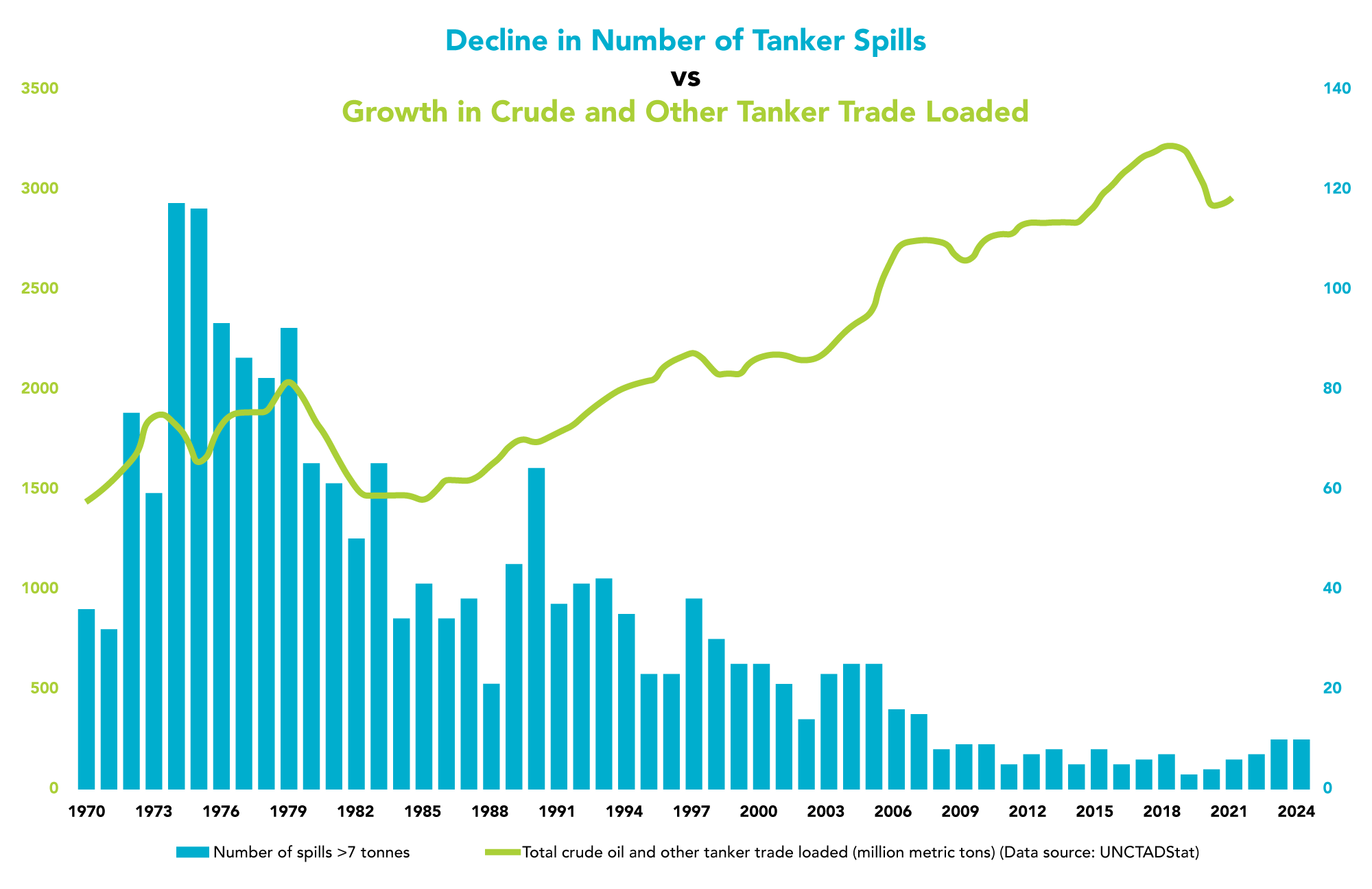
While there is justifiable concern for the potential of an oil spill, the volume and frequency of ship-source oil spills has decreased by 95% since the 1970s, due to a range of marine safety improvements.31
Incidence of Spills Worldwide 1970 – 2024
Tanker safety has improved with new regulations, more robust ship design codes, enhanced emergency preparedness and response systems, and better regulations and procedures.32
History of large* (>10,000 L) Ship-source Oil Spills in Canada
| Spill Size in Litres** | Year | Ship, Ship Type, Location, Incident Type |
|---|---|---|
| 10,000,000 | 1970 | SS Arrow, Tanker, Nova Scotia, Grounding |
| 464,000 | 1974 | Golden Robin, Tanker, Quebec, Bunkering Spill |
| 9,280,000 | 1979 | Kurdistan, Tanker, Nova Scotia, Allision |
| 874,430 | 1988 | Nestucca, Fuel Barge, Washington U.S. & British Columbia, Collision |
| 290,000 | 1989 | Nancy Orr Gaucher, Tanker, Ontario, Bunkering Spill |
| 232,000 | 1990 | Rio Orinoco, Tanker, Quebec, Grounding |
| 23,000 | 1998 | MV Saraband, Tanker, Quebec, Leak |
| 170,000 | 2004 | Terra Nova, Floating Production Storage and Offloading (FPSO), Newfoundland, Mechanical Failure |
| 230,000 | 2006 | Queen of the North, RORO Ferry, British Columbia, Grounding |
| 110,000 | 2016 | Nathan E. Stewart, Tug Boat, British Columbia, Grounding |
| 20,000 | 2018 | HMCS Calgary, Naval Vessel, British Columbia, Refueling Spill |
| 250,000 | 2018 | SeaRose, Floating Production Storage and Offloading (FPSO), Newfoundland, Mechanical Failure |
| 61,000 | 2020 | MV Schiedyk, Cargo Vessel, British Columbia, Leak from Historical Shipwreck |
*For comparison, the size of the Exxon Valdez oil spill was ~40,882,450 litres
**Spill sizes have been estimated to the best of responders’ abilities
Spill Prevention and Response
Canada has the longest coastline in the world and Canadians are rightly concerned about protecting it.
Spill Prevention
Preventing shipping accidents, incidents and oil spills is a shared responsibility among international, national, provincial and local bodies, and ship owners and operators. Working together, the following measures are aimed at preventing accidents and spills in Canadian waters.
Marine Pilots
These licensed Canadian navigational experts conduct tankers and other ships in harbours and busy waterways.
Learn more
Mandatory Double Hulls
All tankers must have two watertight layers on the bottom and sides of ships. The double layer construction helps in reducing the risks of marine pollution if the ship’s hull is damaged.
Learn more
Navigational Aids
Navigating Canadian waters is made safer using visual, auditory and electronic aids that warn of obstructions and hazards along shipping routes.
Learn more
Marine Inspections
Transport Canada regularly deploys marine inspectors to ensure tankers transiting Canadian waters are in safe operating condition and that every tanker operating in Canada has a double hull. The Government of Canada conducts inspections after assessing the risk of all vessels calling in Canadian waters, in cooperation with inspectors in other nations where the ships travel.
Learn more
Tug Escorts
In designated areas, tugs escort loaded tankers and are ready to aid both incoming and outgoing vessels – tugs can slow, stop or steer a tanker if it loses power or its steering system.
Learn more
Spill Response
While minimizing risks through prevention measures is critical – what happens if a spill does occur?
The response to an oil spill influences the spill’s impact – and can avoid or reduce negative environmental, social, economic and health impacts.
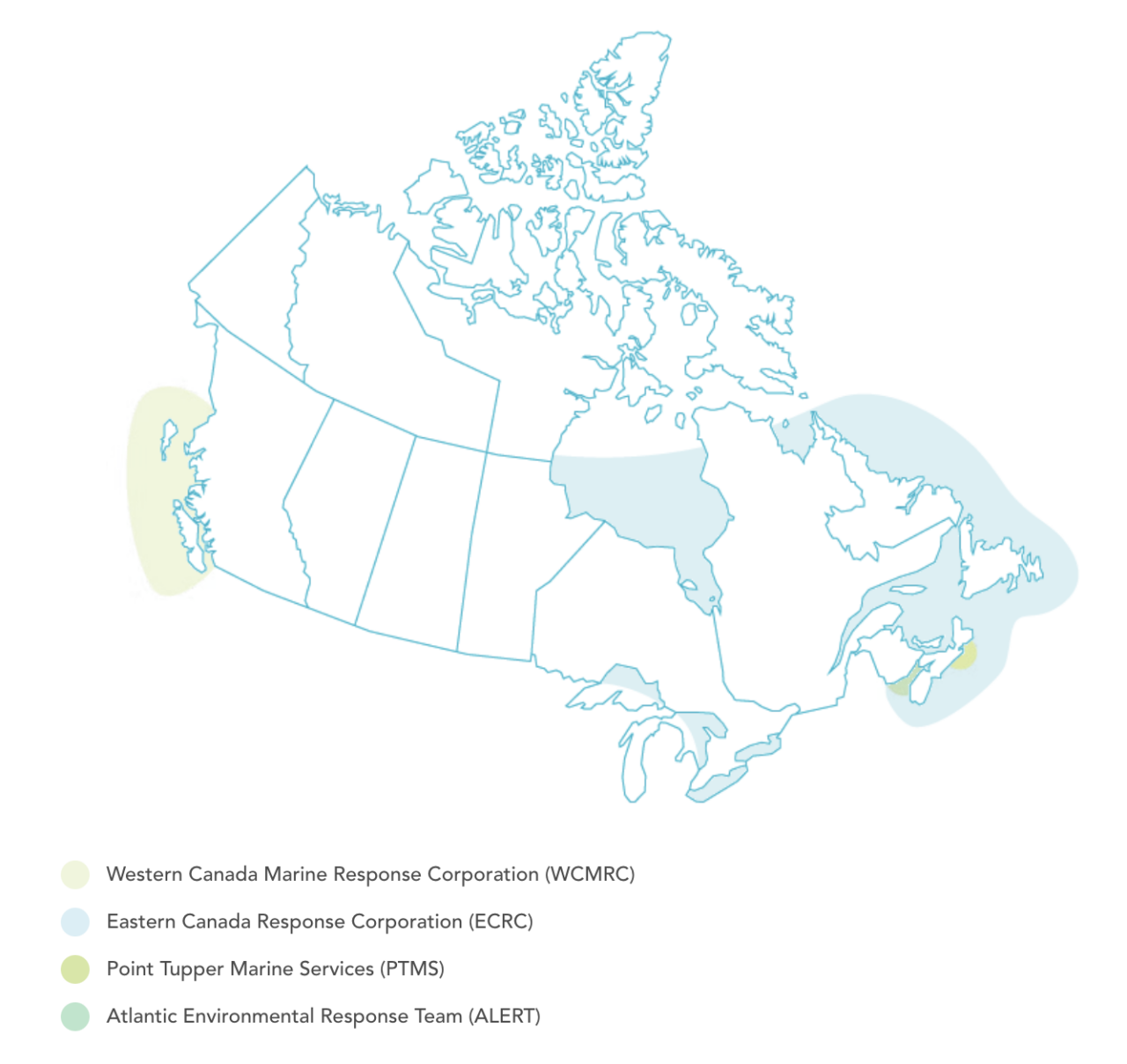
Canada’s response to a spill involves a combination of industry-led initiatives and government regulation and oversight.36 Industry – whose activities create the risk – bears financial responsibility to prepare for and respond to spills. In Canada, industry is required to contract with one of four industry-funded and government-certified regional response organizations, which are prepared to respond to spills.
Simply stated – if a tanker is headed to a Canadian port, the shipowner must have an agreement with a response organization before entering Canadian waters. In the event of a spill, the polluter is, by law, required to pay for the cost of clean-up.
Unlike in southern Canadian waters, there are no certified response organizations for Arctic spills. Preparedness in the Arctic requires ship and oil handling facility owners to identify – in their respective spill response plans – the resources they would employ to respond to a spill.
Canada’s Marine Oil Spill Response Organizations
The Canadian government delivers the legislation and regulation for the spill response regime and oversees industry’s preparedness and actions during a spill. Transport Canada provides the government’s legislative and regulatory mandate while the Canadian Coast Guard is tasked with overseeing the response to the spill as the “on-scene commander.”
Liability and Compensation – “The Polluter Pays”
Who pays for spill clean-up?
When a spill from a tanker occurs in Canada, there are different sources of compensation from international and domestic funds.37 Domestic funds set up under Canadian law are combined with international schemes, such as the International Oil Pollution Compensation Funds, so that in the event of a major tanker spill, the combined sources could provide more than $1.55 billion in compensation.38
Shipowners’ Liability for Spills
International conventions make shipowners liable for oil spills from tankers. Liability depends on the size of the ship, and must be backed by the shipowners’ mandatory insurance.
Learn more
The Ship Fund
This Canadian fund was created from levies collected from oil cargo companies in the 1970s. It addresses spills of any type of oil from any type of ship – not just tankers. Changes made to the Ship Fund in December 2018 removed the per-incident limit of liability; there is effectively no limit to compensation available from the Ship Fund.
Learn more
International Oil Pollution Compensation Funds
Canada is a member of the International Oil Pollution Compensation Funds which administers two international funds created from levies collected from oil cargo companies.
Learn more
Learn more about Who Pays for An Oil Spill.
Oceans Protection Plan
In November 2016, the Government of Canada launched the $1.5 billion Oceans Protection Plan (OPP) aimed at strengthening the protection of Canada’s coasts and waterways through improved marine safety measures.39 Since 2016, there have been over 300 OPP initiatives in collaboration with Indigenous and coastal communities, stakeholders, and researchers.40
Among relevant measures, the plan has supported:
- Investments in oil spill response.
- A moratorium on crude oil tankers on British Columbia’s north coast since 2019.
- Enhanced resources and authority for the Canadian Coast Guard to respond to ship-source pollution incidents.
- An independent review and updates to the Pilotage Act to strengthen the pilotage system, through which marine pilots take control of a vessel and navigate it safely through certain coastal areas across Canada.41
About Clear Seas
Clear Seas is a Canadian not-for-profit organization that provides independent fact-based information to enable governments, industry, and the public to make informed decisions on marine shipping issues. We work to build awareness and trust so that all people can feel a part of the marine sector. Our vision is a sustainable marine shipping sector that is safe, vibrant, and inclusive, both now and for future generations.
As an independent research centre, Clear Seas operates at arm’s length from our funders. Our research agenda is defined internally in response to current issues, reviewed by our research advisory committee, and approved by our board of directors.
Our board of directors is composed of mariners, scientists, community leaders, engineers and industry executives with decades of experience investigating human, environmental and economic issues related to our oceans, coastlines and waterways.
Our reports and findings are available to the public at clearseas.org