Books by Owen Hodkinson

Ancient Love Letters: Form, Themes, Approaches. Ed. Anna Tiziana Drago & Owen Hodkinson, 2023
This volume investigates the form of love letters and erotic letters in Greek and Latin up to the... more This volume investigates the form of love letters and erotic letters in Greek and Latin up to the 7th Century CE, encompassing both literary and documentary letters (the latter inscribed and on papyrus), and prose and poetry. The potential for, and utility of treating this large and diverse corpus as a ‘genre’ is examined. To this end, approaches from ancient literary criticism and modern theory of genre are made; mutual influences between the documentary and the literary form are sought; and origins in proto-epistolary poetic texts are examined. In order to examine the boundaries of a form, limit cases, which might have less claim to the label ‘love letter’, are compared with more clear-cut examples. A series of case studies focuses on individual letters and letter-collections. Some case studies situate their subjects within the history and literary evolution of the love letter, using both intertextuality and comparative approaches; others placing them in their cultural and historical contexts, particularly uncovering the contribution of epistolarity to erotic discourse, and to the history of sexuality and gender in diverse eras and locations within Classical to Late Antiquity.
* Documents origins and development of the Love Letter in European literature up to the early Middle Ages.
* First systematic approach to Love Letters/Erotic Letters in antiquity (Greek and Latin, prose and poetry, literary and documentary letters).
Blurb:
Ancient Greek hymns traditionally include a narrative section describing episodes from th... more Blurb:
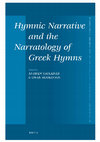
Ancient Greek hymns traditionally include a narrative section describing episodes from the hymned deity’s life. These narratives developed in parallel with epic and other narrative genres, and their study provides a different perspective on ancient Greek narrative. Within the hymn genre, the place and function of the narrative section changed over time and with different kinds
of hymn (literary or cultic; religious, philosophical or magical). Hymnic Narrative and the Narratology of Greek Hymns traces developments in narrative in the hymn genre from the Homeric Hymns via Hellenistic and Imperial hymns to those in the Orphic tradition and in magical papyri, analysing them in narratological terms in order to place them in the wider context of ancient Greek narrative literature.
Contributors are: Ewen Bowie, Michael Brumbaugh, Nicola Devlin, William D. Furley, Miguel Herrero de Jáuregi, Anne-France Morand, Ivana Petrovic, Nicholas Richardson, Susan A. Stephens, and Athanassios Vergados.
----
"Extract from the book proposal:
The basic premise for this volume is a simple one: the editors and contributors feel that a collective and comparative focus on the narrative techniques and on the narrative sections of ancient Greek hymns (across the centuries and of various kinds) can yield extremely fruitful results, both for the reading of individual texts and authors and for the study of the hymnic genre as a whole; and that there is a marked gap in scholarship in this regard, in comparison with the study of other ancient Greek genres containing narrative. We recognise, of course, that discussions of the narrative aspects of hymns have not been absent from scholarly readings, especially of the major ‘literary’ hymns; but it is also the case that the analysis of narrative within classics has become far more sophisticated (especially in the last two decades), so that far more can now usefully be said than, e.g., categorising hymns as Du- or Er-Stil. Studies of the hymn genre have lagged behind those of some other major genres, on the whole, in exploiting the full potential of recent studies of narrative. Among the approaches employed by the volume’s contributors are, naturally, the kinds of narratological analysis first popularised within classics by Irene de Jong, but also other kinds of analysis of narrative literature and of narrative techniques, including more traditional approaches—especially in the case of the less studied texts featured in the volume, which unlike Callimachus’ or the Homeric Hymns have not already had the benefit of countless scholarly ‘readings’ and interpretations. That is to say, the volume is not intended to be a theory-heavy contribution to narratological scholarship within classics (nor to prescribe a particular narratological orthodoxy to its contributors); rather, it aims to be an accessible introduction to some of the possibilities raised by narrative- and narratology-focused approaches to the hymnic genre, and as such a valuable contribution to both the fields of ancient Greek hymn scholarship and of narratology within classics. The individual contributions often focus on examples and case studies, unlike the chapters on hymns in narratology collections as, for example, the ones edited by de Jong et al., which, by the nature of those volumes, aim to survey their respective corpora of hymns more evenly.
Since the focus of the volume is one particular aspect of hymnic texts and their interpretation, the editors have assembled contributions on a large variety of texts of that genre—wide-ranging in several ways: in terms of chronology; of means of transmission (from the very well-known corpora transmitted in literary MSS, to those preserved epigraphically or on papyrus); of the identity of the hymned gods and other entities; of formal features (e.g. different metres and prose); and including both ‘literary’ and ‘cult’ hymns. Because of the sufficiently narrow focus of the volume, we believe that this wider casting of the net is not out of place, but is rather very revealing, in that it shows the diversity and the development of narrative techniques in Greek hymns over a great many texts, authors, and traditions (including less clearly ‘literary’ hymns), and enables the contributors to demonstrate precisely what is unique, and what more conventional, in their chosen texts. "
Angus Bowie, Silvio Bär, Deborah Gera, Pamela Gordon, Dimitri Kasprzyk, Jason König, Jane McClarty, John Morgan, Andrew Morrison, Ryan Olson, Orlando Poltera, Ian Repath, Niall Slater, Tim Whitmarsh , 2013
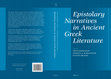
""Recent scholarship in Classics and related fields has shown great interest in letters and epist... more ""Recent scholarship in Classics and related fields has shown great interest in letters and epistolary literature of all forms (e.g. Morello and Morrison 2007; Trapp 2003; Rosenmeyer 2001). The use of embedded letters to advance the narrative in genres such as historiography and the novel, and the potential for real or pseudonymous letters to function as biography (real or fictionalized), autobiography, or historical fiction, mean that letters in antiquity play a crucial role in the development of narrative literature of many kinds. The apparent popularity of letters as reading matter rather than merely tools for communication, especially in the Imperial period, makes it essential that we pay attention to this genre, as we assess the reading practices and literary preferences of antiquity. The literary qualities of Greek letters are often overlooked, despite the fact that they display the same kind of awareness of generic conventions and self-consciousness of their literary nature as other narrative genres.
Letters are always about narrative, among other things, whether directly – narrating events to absent correspondents - or indirectly – presenting fragments of an underlying narrative that the reader attempts to reconstruct. This collection of essays explores the inherent narrative quality of letters and its use by Greek authors in a variety of genres and time periods, as well as the limited and sometimes even willfully obscure nature of epistolary narratives that omit vital information in the name of verisimilitude. A series of case studies, with topics ranging from Classical poetry and historiography through to Philostratus and Christian martyrs, asks why particular authors choose the letter form; how an embedded letter relates to its narrative environment, and, conversely, the effect of the epistolary form on the narrative it contains; and how each author manipulates the epistolary tradition. It explores various types of epistolary forms: individual letters (embedded or free-standing); collections of continuous epistolary narrative; and letters presenting fragmented or discontinuous narrative. It pays close attention to the self-consciously literary or fictional qualities in Greek letters, including intertextuality with other literary texts and particularly allusions to earlier letters as literature. A chronological organization of the volume encourages the reader to consider epistolary narrative as a kind of literature that develops over time, growing in popularity and in the variety of forms it takes. ""
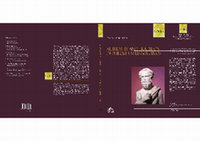
"The book constitutes a close reading of Philostratus’ dialogue Heroikos, especially its opening,... more "The book constitutes a close reading of Philostratus’ dialogue Heroikos, especially its opening, scene-setting chapters, and its central section concerning the myth of Odysseus and Palamedes. It points out a systematic and programmatic intertextuality with Plato’s Phaedrus, especially in that text’s famous scene-setting. Details of the setting and the dialogue are altered in a way that is very similar to the ‘correction’ of Homer found later in the Heroikos and throughout Second Sophistic literature, thus setting out Philostratus’ aim as being both to recall and to challenge Plato’s method of dealing with mythical subjects (especially in the Phaedrus). It argues that Philostratus’ text emulates that of Plato, and that this includes emulation of Plato’s deliberate ambiguities, ironies, and polyvalency—thus the interlocutors and characters in Heroikos each take on characteristics of Socrates at various times, deliberately misleading the reader if he is expecting one character to take on the (more authoritative?) Socratic role. The Heroikos does not end any less aporetically than the Phaedrus with respect to the status of myths or the written word or any of its other themes; however, this monograph argues that the Heroikos does have something more certain to say when it comes to Philostratus’ ‘Second Sophistic’. The emulation of and rivalry with Plato, including ‘capping’ allusions and ‘correcting’ attitudes to myths seen in Phaedrus especially, is part of a strategy of valorising Philostratus’ sophists and their work by favourable comparison with philosophers (attacking the chief representative in the Greek tradition, just as the Homeric criticism parts of the text go for the chief poet). In this respect, the Heroikos can be seen as echoing Philostratus’ other texts in their promotion of his sophistic, especially the Lives of the Sophists, though in a different genre and through more allusive means.
[Table of contents and cover only available to download below.]"

Brief Encounters: Studies in the Letters of Alciphron, Aelian, and Philostratus
DPhil thesis (doctoral dissertation), Oxford, 2009
This thesis presents a series of studies on three 2nd-3rd century CE books of literary and fictio... more This thesis presents a series of studies on three 2nd-3rd century CE books of literary and fictional letters, by Alciphron, Aelian (Claudius Aelianus), and Flavius Philostratus. The three are connected by their similar uses of the letter book as a literary form within which to mimic or include a wide range of genres, and to exploit the varied potential of epistolary literature. Tracing the development of Greek epistolary literature and epistolary theory from their beginnings until these authors, the thesis argues that these three books are both deliberately positioned within a popular tradition of epistolary literature and are innovative in creating a sub-genre (unique among extant works in the Classical and Imperial periods) within it, that of the non-novelistic fictional letter book in prose. These books are also contextualised within the literary trends of Imperial Greek literature and the Second Sophistic. Individual studies explore the use of traditional epistolary themes and formal devices by these authors, and their intertextuality with and combination of other genres (especially Hellenistic pastoral poetry and mime, Greek New Comedy, and Latin elegy); they also examine the structure and style of each book, and contextualise these works within others by the same authors (where applicable). Principal arguments of individual studies: Alciphron’s and Aelian’s occasional inclusion of correspondences is a strategy for metaliterary comment on the advantages and disadvantages of epistolary communication. Alciphron uses pastoral’s concerns with hierarchies among ‘low’ characters as inspiration for an exploration of similar characters. Aelian’s priorities in other works—entertainment and moral comment—are equally the letters’ focus. Philostratus’ epistolary persona—an obsessive, often rejected lover—exploits distance as a major epistolary motivation; his submissive, masochistic traits most resemble Latin elegists’ personae; he may allude to Latin elegy.
Bibliographies by Owen Hodkinson
Philostratus, Lucius Flavius (Oxford Bibliographies Online)
1st update published 30th October 2019
Introduction
L. Flavius Philostratus (c. 170 CE–c. 240s), Philostratus II or “the younger,” is o... more Introduction
L. Flavius Philostratus (c. 170 CE–c. 240s), Philostratus II or “the younger,” is one of several related Philostrati; the division of works in the corpus among them is a vexed question (see the Question of the Philostrati). Philostratus was a sophist or rhetor, who may have received patronage from the imperial family, including Julia Domna. Probably beginning his education in Athens, where he held local offices (including hoplite general and prytanis), he was later active as a sophist, performing display oratory and teaching, in Athens, Rome, and Ionia; he has some connection with Lemnos (Life of Apollonius of Tyana (Vita Apollonii) 6.27.4), and was perhaps born there. He coined the phrase Second Sophistic to define a literary and cultural movement, in his Lives of the Sophists, a collection of short biographies of those he considered as representative of the “Second” style of Greek oratory. Its subjects are largely contemporary with his own era but begin with Aeschines in the 4th century BCE; its style is contrasted with that of the “First Sophistic,” including Gorgias. He was especially influenced by Herodes Atticus, whose biography is the most important in Lives of the Sophists (VS), and whose oratory he witnessed personally. But his literary output is large and varied in both theme and genre. It encompasses more biography in the Life of Apollonius of Tyana (VA), the perhaps heavily fictionalized life of a “holy man” and “wonder worker” of the Neronian age; Platonic dialogue mixed with revision of the Homeric version of the Trojan war and cult worship of Greek heroes in the Heroikos; a collection of miniature descriptions of paintings (ekphrases) in the Imagines; a collection of literary Letters including epigram- and elegy-influenced Erotic Epistles as well as letters addressed to historical persons and other authors; and a treatise on Greek athletic history and practice, the Gymnastikos. He wrote at least one extant epigram (Planudean Anthology 110), and may also have been the author of the Pseudo-Lucianic dialogue Nero, and one of the short treatises or Dialexeis transmitted in the Philostratean corpus (these minor and doubtful works are not treated in this bibliography). In addition, he wrote many lost works, including sophistic declamations, discussions and introductions (meletai, dialexeis, prolaliae) to be performed in public. Philostratus wrote in an Atticizing Greek that is, however, stylistically florid and quite idiosyncratic; in style, literary and narrative technique, and choice of subjects, he is one of the most original Greek literary artists of the imperial or perhaps any era, reworking the themes of the classical era in a manner far more creative than simply imitative.
Papers by Owen Hodkinson
‘The Moral Madness of the Modern Herakles’: Collage and Fragments in Tony Harrison’s The Labourers of Herakles and the Harrison Archive
Hercules Performed: The Hero on Stage from the Enlightenment to the Early Twenty-First Century , 2024
Philostratus’ Erotic Epistles and Latin Elegy Revisited
Ancient Love Letters: Form, Themes, Approaches, 2023
This chapter re-examines the question of Imperial Greek authors alluding to earlier Latin literat... more This chapter re-examines the question of Imperial Greek authors alluding to earlier Latin literature, in the specific case of Philostratus' Erotic Epistles and Latin elegiac poetry. In light of much recent work that undermines long-held prejudices against entertaining the possiblity of sophistic Greek authors alluding to Latin literature (e.g. Daniel Jolowicz's recent OUP book on the Greek novel), each possible case of allusion in this direction must be examined on its own merits.
This chapter does that, starting with Philostratus' family connections (Roman wife) and career, which mean that he inevitably spoke Latin and likely read its literature.
It then focuses on examples in which a detailed correspondence between his letters and earlier Latin texts can be traced, and in one case when writing about the Floralia festival, a thematic connection with Rome makes Roman literary sources most likely. It further argues that, even where "lost common sources" can be posited to explain away any similarities between later Greek and earlier Latin texts, this is a simple-minded solution that does not allow for the complexities of classical intertextuality. This is supported by a case in which the common source is known and partly extant: Ovid and Philostratus both alluding to the same themes from the same play of Menander. This does not in any way prevent Philostratus from alluding both to Ovid and Menander, while recognising and responding to how the intervening poet has reconfigured the dramatist in different ways and to fit a different genre.
‘Icarus’ fall as suicide: The Icarus myth exploring bullying and mental health in children’s and YA fiction’
Political Changes and Transformations in Twentieth and Twenty-first Century Children’s Literature, 2023
‘Poor, Foreign, and Desperate: Philostratus’ Fictional Letter-writer Persona in the Erotic Letters’
Epistolary Fiction in Ancient Greek Literature, 2023
Insights from the Tony Harrison Archive
Tony Harrison and the Classics, 2022
How poetic are Philostratus’ Erotic Epistles?
Studia Hellenistica Gaditana II: De Calímaco a Nono de Panópolis. Estudios de crítica textual y exégesis literaria, 2021
This chapter reexamines the often mentioned, but rarely precisely defined,
‘poetic’ qualities of ... more This chapter reexamines the often mentioned, but rarely precisely defined,
‘poetic’ qualities of Philostratus’ Erotic Epistles. It uses several new approaches to ask what it means for such a prose text to count as poetic (such as comparisons of vocabulary density and percentage of text hapax legomena with statistical samples of poetic, classical prose, and other imperial prose works) combined with traditional factors (‘poetic vocabulary’, prose rhythm, and dense accumulation of several kinds of poetic device). While labels like ‘prose epigram’ certainly have merit for some Epistles and passages, others are determinedly prosaic (e.g. cases excluding all Homeric and poetic vocabulary while alluding directly to Homeric passages)—an effect I term ‘prosaism’, as the inverse of the Epistles’ better-known ‘poeticisms’.
'Orphic Resonances of Love and Loss in David Almond’s A Song for Ella Grey’
Our Mythical Hope: The Ancient Myths as Medicine for the Hardships of Life in Children’s and Young Adults’ Culture, 2021
‘Hercules in children's literature: a ‘warts and all’ model of masculinity?’
The Modern Hercules: Images of the Hero from the Nineteenth to the Early Twenty-First Century, 2020
“She’s not deadly. She’s beautiful.” Reclaiming Medusa for Millenial Tween and Teen Girls?
Chasing Mythical Beasts: The Reception of Ancient Monsters in Children’s and Young Adults’ Culture, 2020
‘Les lettres dangereuses’: epistolary narrative as metafiction in the Epistles of Chion of Heraclea
Some Organic Readings in Narrative, Ancient and Modern (Festschrift for John Morgan), 2019
This chapter presents a reading of the pseudonymous Epistles attributed to the tyrannicide and pu... more This chapter presents a reading of the pseudonymous Epistles attributed to the tyrannicide and pupil of Plato Chion of Heraclea. Agreeing with scholars who see them as a coherent narrative and as a piece of deliberate fiction – an epistolary novel – rather than as ‘forgeries’, it argues that in many respects it is a highly self- conscious fiction, containing several devices and features that might be labelled metafictional. While some of these are familiar from other forms of narrative, this chapter argues that the peculiarities of the epistolary form lend themselves to the creation of such a self-conscious fictional narrative, and that the author exploited the full potential of epistolary narrative in writing one of the most metafictional extant novels of antiquity.
Typecast? Speaking names in Alciphron
The Letters of Alciphron: A Unified Literary Work? (ed. M. Biraud and A. Zucker), 2018
The characters of Alciphron’s fictional letters are almost all given ‘speaking names’, which refl... more The characters of Alciphron’s fictional letters are almost all given ‘speaking names’, which reflect their status, their occupation, or their role in the miniature narratives or vignettes which they relate. At first sight, these are self-conscious signals of the text’s fictionality, being so clearly artificial. But in fact they are not so implausible as they seem : it is rather the accumulation of so many of them in correspondence that makes them ‘unrealistic’ character names. This is shown by a detailed investigation of the prior attestations of the names (in life, using the Lexicon of Greek Personal Names, and in literature) of all Alciphron’s characters in Book 2, as a case study. The results are surprising, and demonstrate that the face-value assumptions in previous studies of Alciphron’s strategies of naming need to be revised.
The second part of the chapter investigates some of the several functions of speaking names in Alciphron, building on the results of the previous section. Alciphron’s naming techniques are compared with those of New Comedy and pastoral poetry, showing that beside evident debts to both genres, there is development and innovation in the epistolographer’s approach. The various games with names employed in different letters signal generic affiliations and sometimes blend together the genres of Alciphron’s intertexts; they are also a crucial part of his technique for creating fiction. Also investigated is the ironic distance that speaking names can create between the expectations of the reader regard-ing the character’s status (based on the speaking name, which constitutes a sort of textual ‘mask’ in the letter’s miniature drama) and what actually happens to him. The chapter shows that characters’ names are not only speaking names but also dramatic constructions in a kind of metafiction that draws on comic metatheatre and pastoral irony alike.
Michael Cadnum's Metamorphoses of Ovid
Classical Reception and Children’s Literature: Greece, Rome and Childhood Transformation, 2018
Classical Reception and Children’s Literature: Greece, Rome and Childhood Transformation, 2018


Uploads
Books by Owen Hodkinson
* Documents origins and development of the Love Letter in European literature up to the early Middle Ages.
* First systematic approach to Love Letters/Erotic Letters in antiquity (Greek and Latin, prose and poetry, literary and documentary letters).
Ancient Greek hymns traditionally include a narrative section describing episodes from the hymned deity’s life. These narratives developed in parallel with epic and other narrative genres, and their study provides a different perspective on ancient Greek narrative. Within the hymn genre, the place and function of the narrative section changed over time and with different kinds
of hymn (literary or cultic; religious, philosophical or magical). Hymnic Narrative and the Narratology of Greek Hymns traces developments in narrative in the hymn genre from the Homeric Hymns via Hellenistic and Imperial hymns to those in the Orphic tradition and in magical papyri, analysing them in narratological terms in order to place them in the wider context of ancient Greek narrative literature.
Contributors are: Ewen Bowie, Michael Brumbaugh, Nicola Devlin, William D. Furley, Miguel Herrero de Jáuregi, Anne-France Morand, Ivana Petrovic, Nicholas Richardson, Susan A. Stephens, and Athanassios Vergados.
----
"Extract from the book proposal:
The basic premise for this volume is a simple one: the editors and contributors feel that a collective and comparative focus on the narrative techniques and on the narrative sections of ancient Greek hymns (across the centuries and of various kinds) can yield extremely fruitful results, both for the reading of individual texts and authors and for the study of the hymnic genre as a whole; and that there is a marked gap in scholarship in this regard, in comparison with the study of other ancient Greek genres containing narrative. We recognise, of course, that discussions of the narrative aspects of hymns have not been absent from scholarly readings, especially of the major ‘literary’ hymns; but it is also the case that the analysis of narrative within classics has become far more sophisticated (especially in the last two decades), so that far more can now usefully be said than, e.g., categorising hymns as Du- or Er-Stil. Studies of the hymn genre have lagged behind those of some other major genres, on the whole, in exploiting the full potential of recent studies of narrative. Among the approaches employed by the volume’s contributors are, naturally, the kinds of narratological analysis first popularised within classics by Irene de Jong, but also other kinds of analysis of narrative literature and of narrative techniques, including more traditional approaches—especially in the case of the less studied texts featured in the volume, which unlike Callimachus’ or the Homeric Hymns have not already had the benefit of countless scholarly ‘readings’ and interpretations. That is to say, the volume is not intended to be a theory-heavy contribution to narratological scholarship within classics (nor to prescribe a particular narratological orthodoxy to its contributors); rather, it aims to be an accessible introduction to some of the possibilities raised by narrative- and narratology-focused approaches to the hymnic genre, and as such a valuable contribution to both the fields of ancient Greek hymn scholarship and of narratology within classics. The individual contributions often focus on examples and case studies, unlike the chapters on hymns in narratology collections as, for example, the ones edited by de Jong et al., which, by the nature of those volumes, aim to survey their respective corpora of hymns more evenly.
Since the focus of the volume is one particular aspect of hymnic texts and their interpretation, the editors have assembled contributions on a large variety of texts of that genre—wide-ranging in several ways: in terms of chronology; of means of transmission (from the very well-known corpora transmitted in literary MSS, to those preserved epigraphically or on papyrus); of the identity of the hymned gods and other entities; of formal features (e.g. different metres and prose); and including both ‘literary’ and ‘cult’ hymns. Because of the sufficiently narrow focus of the volume, we believe that this wider casting of the net is not out of place, but is rather very revealing, in that it shows the diversity and the development of narrative techniques in Greek hymns over a great many texts, authors, and traditions (including less clearly ‘literary’ hymns), and enables the contributors to demonstrate precisely what is unique, and what more conventional, in their chosen texts. "
Letters are always about narrative, among other things, whether directly – narrating events to absent correspondents - or indirectly – presenting fragments of an underlying narrative that the reader attempts to reconstruct. This collection of essays explores the inherent narrative quality of letters and its use by Greek authors in a variety of genres and time periods, as well as the limited and sometimes even willfully obscure nature of epistolary narratives that omit vital information in the name of verisimilitude. A series of case studies, with topics ranging from Classical poetry and historiography through to Philostratus and Christian martyrs, asks why particular authors choose the letter form; how an embedded letter relates to its narrative environment, and, conversely, the effect of the epistolary form on the narrative it contains; and how each author manipulates the epistolary tradition. It explores various types of epistolary forms: individual letters (embedded or free-standing); collections of continuous epistolary narrative; and letters presenting fragmented or discontinuous narrative. It pays close attention to the self-consciously literary or fictional qualities in Greek letters, including intertextuality with other literary texts and particularly allusions to earlier letters as literature. A chronological organization of the volume encourages the reader to consider epistolary narrative as a kind of literature that develops over time, growing in popularity and in the variety of forms it takes. ""
[Table of contents and cover only available to download below.]"
Bibliographies by Owen Hodkinson
L. Flavius Philostratus (c. 170 CE–c. 240s), Philostratus II or “the younger,” is one of several related Philostrati; the division of works in the corpus among them is a vexed question (see the Question of the Philostrati). Philostratus was a sophist or rhetor, who may have received patronage from the imperial family, including Julia Domna. Probably beginning his education in Athens, where he held local offices (including hoplite general and prytanis), he was later active as a sophist, performing display oratory and teaching, in Athens, Rome, and Ionia; he has some connection with Lemnos (Life of Apollonius of Tyana (Vita Apollonii) 6.27.4), and was perhaps born there. He coined the phrase Second Sophistic to define a literary and cultural movement, in his Lives of the Sophists, a collection of short biographies of those he considered as representative of the “Second” style of Greek oratory. Its subjects are largely contemporary with his own era but begin with Aeschines in the 4th century BCE; its style is contrasted with that of the “First Sophistic,” including Gorgias. He was especially influenced by Herodes Atticus, whose biography is the most important in Lives of the Sophists (VS), and whose oratory he witnessed personally. But his literary output is large and varied in both theme and genre. It encompasses more biography in the Life of Apollonius of Tyana (VA), the perhaps heavily fictionalized life of a “holy man” and “wonder worker” of the Neronian age; Platonic dialogue mixed with revision of the Homeric version of the Trojan war and cult worship of Greek heroes in the Heroikos; a collection of miniature descriptions of paintings (ekphrases) in the Imagines; a collection of literary Letters including epigram- and elegy-influenced Erotic Epistles as well as letters addressed to historical persons and other authors; and a treatise on Greek athletic history and practice, the Gymnastikos. He wrote at least one extant epigram (Planudean Anthology 110), and may also have been the author of the Pseudo-Lucianic dialogue Nero, and one of the short treatises or Dialexeis transmitted in the Philostratean corpus (these minor and doubtful works are not treated in this bibliography). In addition, he wrote many lost works, including sophistic declamations, discussions and introductions (meletai, dialexeis, prolaliae) to be performed in public. Philostratus wrote in an Atticizing Greek that is, however, stylistically florid and quite idiosyncratic; in style, literary and narrative technique, and choice of subjects, he is one of the most original Greek literary artists of the imperial or perhaps any era, reworking the themes of the classical era in a manner far more creative than simply imitative.
Papers by Owen Hodkinson
This chapter does that, starting with Philostratus' family connections (Roman wife) and career, which mean that he inevitably spoke Latin and likely read its literature.
It then focuses on examples in which a detailed correspondence between his letters and earlier Latin texts can be traced, and in one case when writing about the Floralia festival, a thematic connection with Rome makes Roman literary sources most likely. It further argues that, even where "lost common sources" can be posited to explain away any similarities between later Greek and earlier Latin texts, this is a simple-minded solution that does not allow for the complexities of classical intertextuality. This is supported by a case in which the common source is known and partly extant: Ovid and Philostratus both alluding to the same themes from the same play of Menander. This does not in any way prevent Philostratus from alluding both to Ovid and Menander, while recognising and responding to how the intervening poet has reconfigured the dramatist in different ways and to fit a different genre.
‘poetic’ qualities of Philostratus’ Erotic Epistles. It uses several new approaches to ask what it means for such a prose text to count as poetic (such as comparisons of vocabulary density and percentage of text hapax legomena with statistical samples of poetic, classical prose, and other imperial prose works) combined with traditional factors (‘poetic vocabulary’, prose rhythm, and dense accumulation of several kinds of poetic device). While labels like ‘prose epigram’ certainly have merit for some Epistles and passages, others are determinedly prosaic (e.g. cases excluding all Homeric and poetic vocabulary while alluding directly to Homeric passages)—an effect I term ‘prosaism’, as the inverse of the Epistles’ better-known ‘poeticisms’.
The second part of the chapter investigates some of the several functions of speaking names in Alciphron, building on the results of the previous section. Alciphron’s naming techniques are compared with those of New Comedy and pastoral poetry, showing that beside evident debts to both genres, there is development and innovation in the epistolographer’s approach. The various games with names employed in different letters signal generic affiliations and sometimes blend together the genres of Alciphron’s intertexts; they are also a crucial part of his technique for creating fiction. Also investigated is the ironic distance that speaking names can create between the expectations of the reader regard-ing the character’s status (based on the speaking name, which constitutes a sort of textual ‘mask’ in the letter’s miniature drama) and what actually happens to him. The chapter shows that characters’ names are not only speaking names but also dramatic constructions in a kind of metafiction that draws on comic metatheatre and pastoral irony alike.