Review by Luz Vanasco
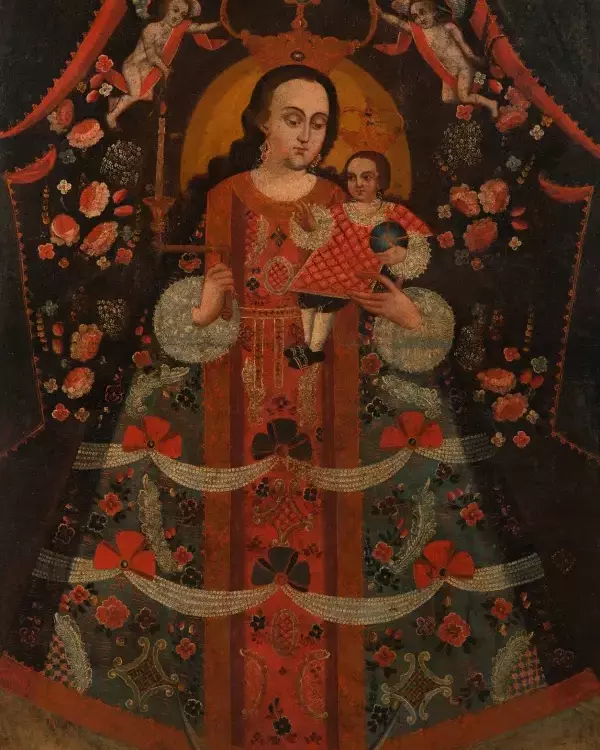
Virgen de la Candelaria (‘Virgin of the Candlelight’) is an anonymous 18th century painting from Peru. It belongs to The Phoebus Foundation, in Antwerp, which houses a varied collection, including Latin American and Spanish colonial artworks. The conservation treatment and research conducted to this oil painting on canvas (159 x 106.5 cm) was presented by paintings conservator Carlos Gonzalez Juste on 18th April 2023. He covered the context in which the painting was produced, the conservation treatment, and its technical aspects. He also discussed the iconography and symbolism of both the Virgen de la Candelaria and of an underlying painting of Mary Magdalene which had been discovered through technical examination.
Carlos addressed how, following the conquest of Mesoamerica and Mexico, the Spanish were drawn southward by South America's abundant resources. For this expansion, leaded by Francisco Pizarro, they took advantage of a civil war within the Inca Empire between Atahualpa and Huascar, which allowed the Spanish to gain control over the territory in the 1530s, which was then organised in viceroyalties. The Viceroyalty of Peru (covering from the actual Panama until Chile and Argentina) was established in 1542 with Lima as its capital. While Cuzco initially served as the capital of the Inca empire, it was deemed too distant, leading to the establishment of Lima as the new capital in 1542.
Within the Viceroyalty of Peru, there emerged a distinct artistic tradition known as the Cuzco School. While the Lima School embraced more European influences, the artists in Cuzco remained rooted in their indigenous heritage. The Cuzco School rapidly developed during the 18th century. It is characterized by the use of gold leaf in garments, known as brocateado, stereotyped facial features, hieratic frontality of the main figures, and simple distorted backgrounds. Artists often used prints as references for their work, and as the 18th century progressed, the production of artworks in workshops grew exponentially. Masters would oversee a team of assistants, enabling mass production of paintings.
Paintings from Cuzco used to be considered ‘popular’ paintings due to their planimetry, schematic forms, and their simple palette, probably by being compared with European paintings. However, in order to fully appreciate and understand these works it is important to consider that they are actual representations of sculptures present in churches. These vera effigies or painted sculptures had a sacred value and were quite popular in Cuzco, were they could be found in churches, private oratories and homes. As the popularity of these images grew, copies were made, and eventually copies of the copies, leading to the evolution and alteration of the original iconography over time.
The iconography of the Virgen de la Candelaria is based on a vision of two inhabitants from Tenerife, known as Guanche shepherds, who saw the virgin in a cliff with a candlelight, baby Jesus, and a basket of doves. It reflects the story present in the Gospel of Luke, which combines the Presentation of the Temple and the Purification of the Virgin. Moreover, the fusion of Inca beliefs in the Pachamama (mountains and hills) with Christian imagery resulted in unique representations where the triangular shape of the Virgin itself resembled mountains.
In terms of the technique, the painting is executed on a reused canvas. This was common practice in the Viceroyalty, as the production of linen and hemp was banned so there was scarcity of canvases for painting. It was painted with no ground, directly onto another composition. The background layers were applied thinly, while the figures and details were painted more thickly. This technique resulted in transparent layers and visible traces of the underlying artwork. Hands and faces were given special attention and left reserved for the master artist, while stencils were used for certain elements like the ropes. The palette is simple, and its pigments are consistent with a painting from this period and context: smalt, vermilion (probably from mines of Huancavelica in Peru), lead tin yellow, orpiment, and a copper-based pigment.
The painting had been wax lined and had a discoloured varnish, layers of grime, spots, and dirt. The uneven surface and small paint losses were related with folding marks. To address these issues, the restoration process began with surface cleaning and addressing some minor canvas deformations.
The varnish removal proved to be a delicate process due to the sensitivity of the paint. It required swelling the varnish and subsequent mechanical work, which proved to be a delicate and time-consuming process. Underneath the varnish, a layer of grime was found, requiring further cleaning with the use of buffer solutions for its removal and to diminish the dark spots. Afterwards, a first layer of dammar varnish was applied. Paint losses were then filled and textured with a Tylose and Mowiol putty commonly used at the Phoebes Foundation, which was then toned with watercolours. This was followed by another varnish layer, further retouching and a final varnish.
For the technical examination of the painting, ultraviolet fluorescence, infrared photography, infrared false colour, and X-radiography were carried out. The underlying composition depicted an angel and another figure in the centre, along with a table decorated with flowerpots and a carpet at the bottom. Further examination using macro XRF provided a clearer image of the hidden composition, revealing a fully finished representation of Mary Magdalene.
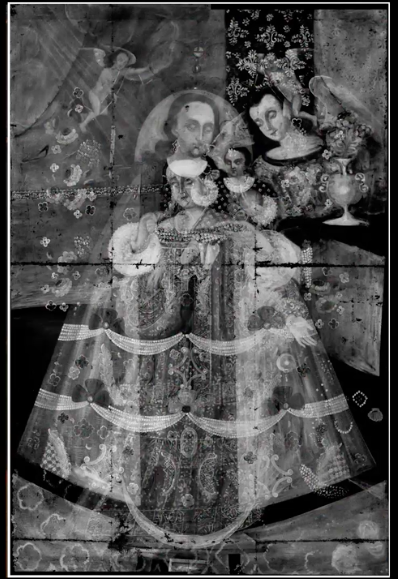
Similar representations of Mary Magdalene were found in South America, albeit with slight variations, suggesting the influence of a common source, possibly a print. However, this one in particular is quite uncommon, due to the representation of the angel and a very rich background.
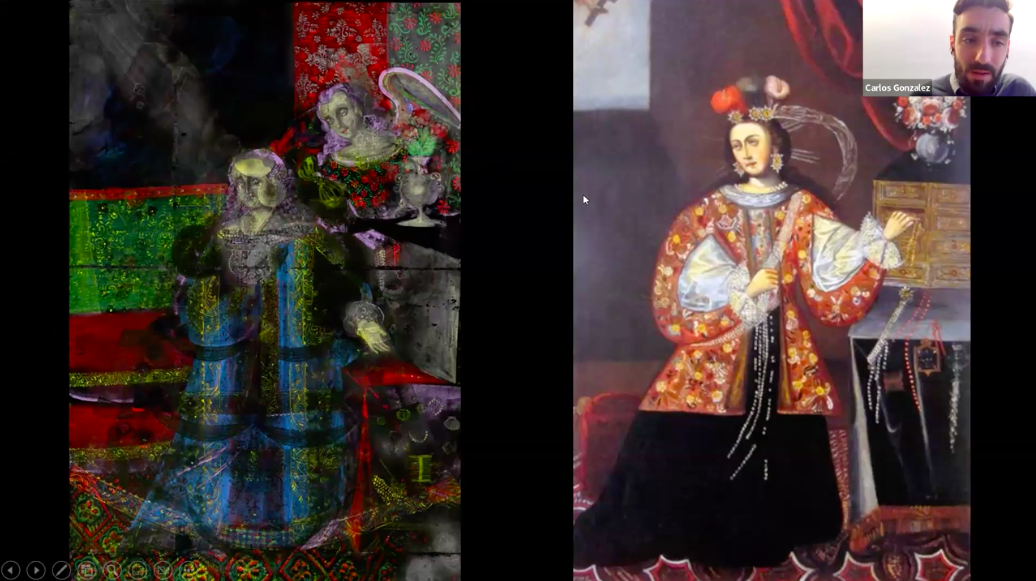
The influences in the Viceroyalty of Peru extended beyond Spain. The region was also impacted by trade and cultural exchanges with Europe and Asia, particularly through the Manila-Acapulco trade route. China and Japan, in particular, played a role in providing goods to the Philippines, and then making their way to South America. These influences manifested in various ways, such as the adoption of lacas, furniture styles, and the enconchados technique in Mexico. In the underlaying painting of Mary Magdalene, the jewellery and presence of the rich comb made with ivory is a clear example of this influence as it was made in China.
Another interesting aspect is the representation of Mary Magdalene in a Spanish estrado, a small room richly decorated with Arab influences. This private space for women often had estrado or raton furnitures like the one represented with Mary Magdalene. The composition also features a tupu or ttipqui, a pin commonly used during the Inca period, highlighting the incorporation of indigenous elements.
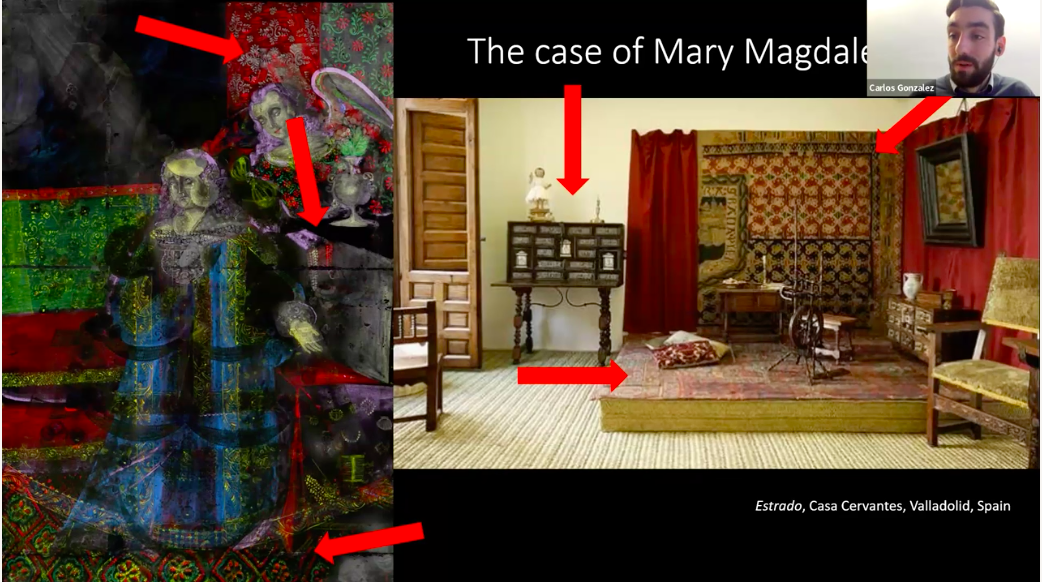
Carlos presentation provided an insightful overview of the context and techniques of the paintings produced in 18th century Peru. These artworks transcend mere religious imagery and provide insights into the lives of the society in which they were created. The also defy simplistic comparisons with European paintings and highlight the fusion of local and external influences. The case study also shows the importance of conducting technical studies as they have proven invaluable in understanding commercial, iconographic, and societal aspects of the Viceroyalty of Peru.
Luz Vanasco
Luz Vanasco is a paintings conservator from Argentina currently working at Tate, London. She has worked in leading institutions in Latin America, Spain, and the UK. She holds both a BA and Master’s degree in conservation of cultural heritage from UMSA and IIPC-TAREA (Argentina), and the Postgraduate Diploma in the Conservation of Easel Paintings from The Courtauld Institute of Art (UK).