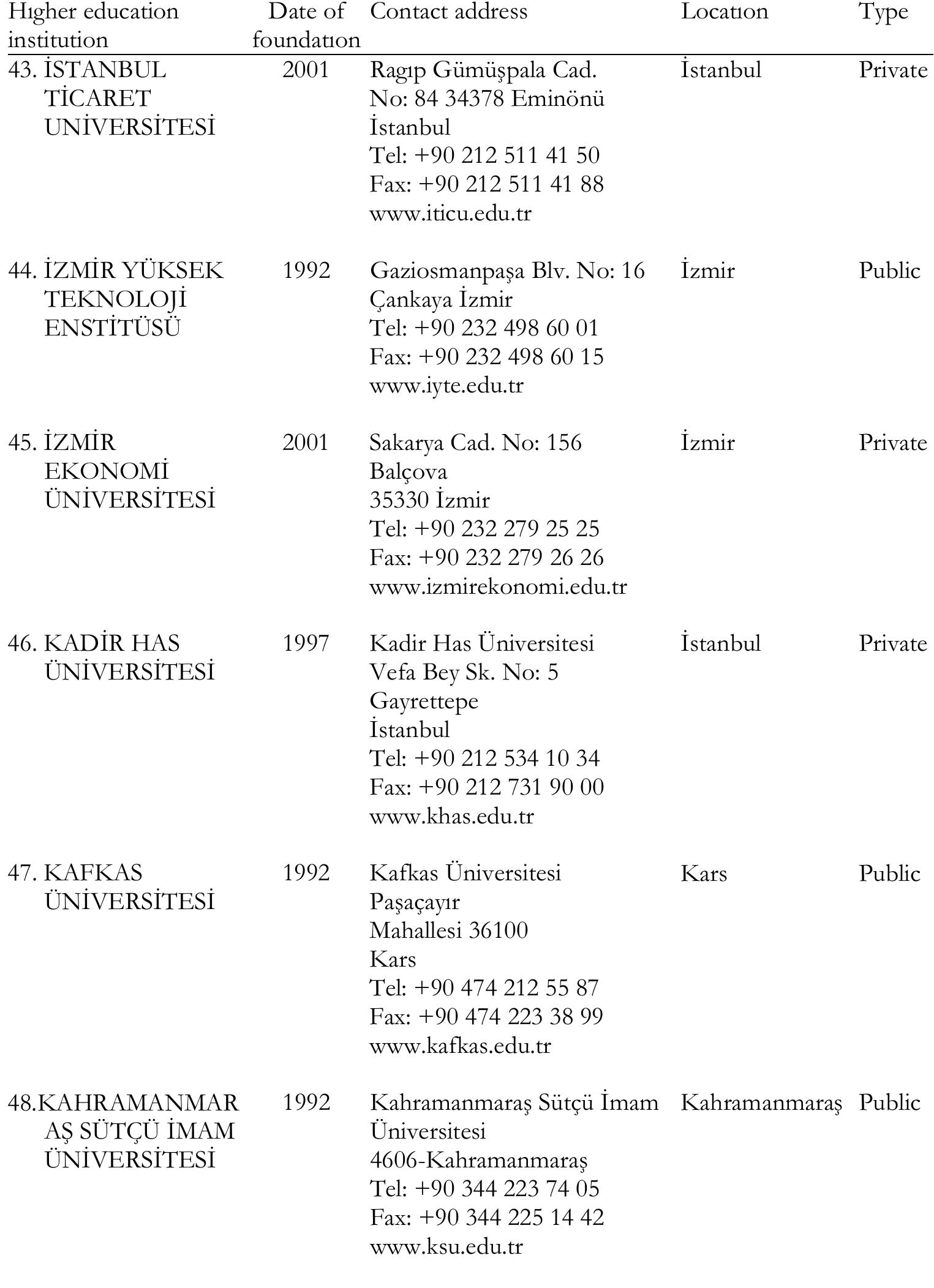
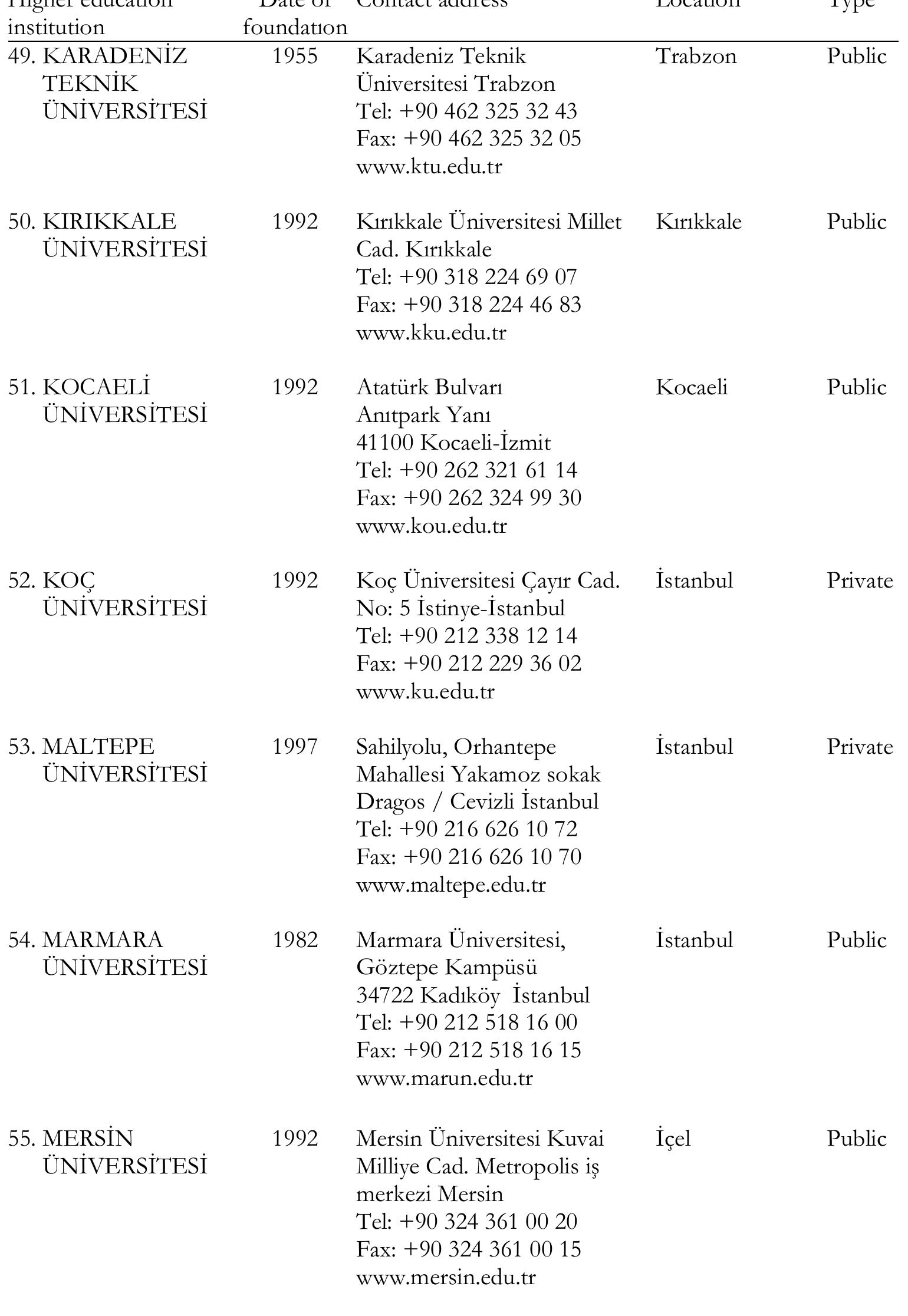
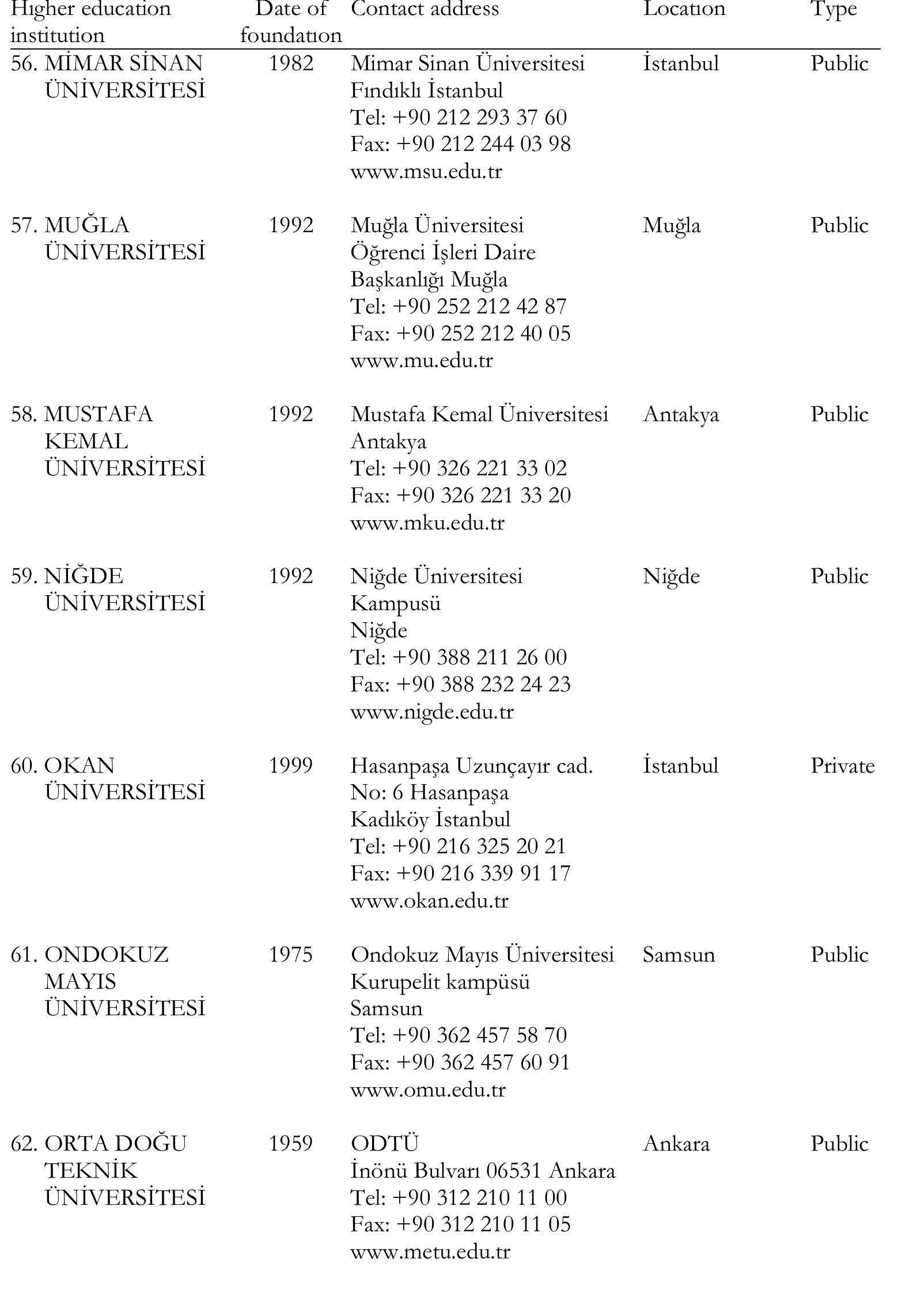
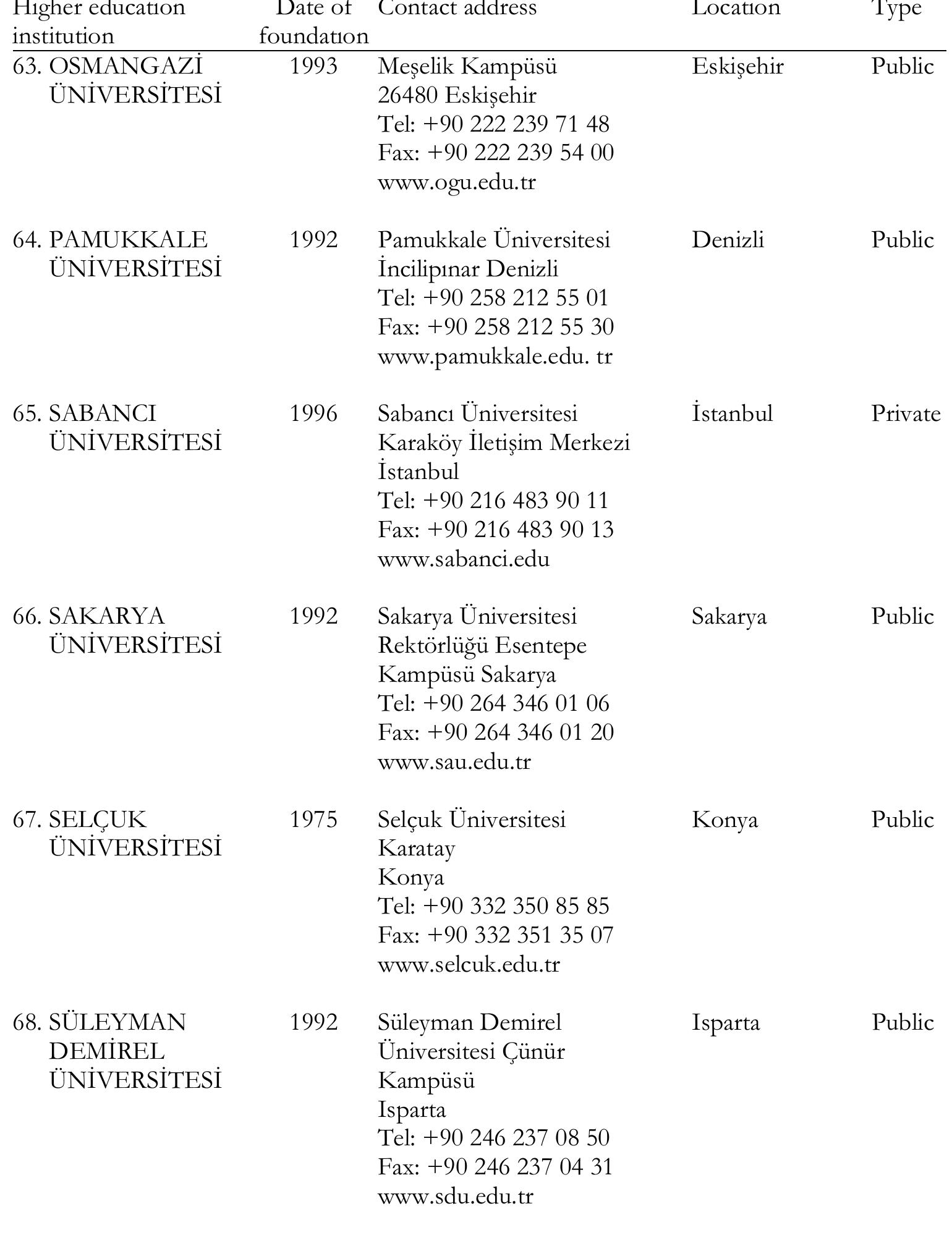
Higher Education in Turkey (Monograph) - Series Editor, P. J. Wells

2005

Abstract
sparkles

AI

This monograph provides a comprehensive analysis of the Turkish higher education system, highlighting its historical evolution from the Ottoman Empire to the present day. It discusses three significant turning points: the establishment of universities in the 17th century, the modernization reforms by Kemal Ataturk in 1923, and the 1981 Law on Higher Education. The study emphasizes the impact of the Bologna Process on Turkish higher education, aiming to integrate quality and diversity while navigating current challenges and maintaining traditional values.
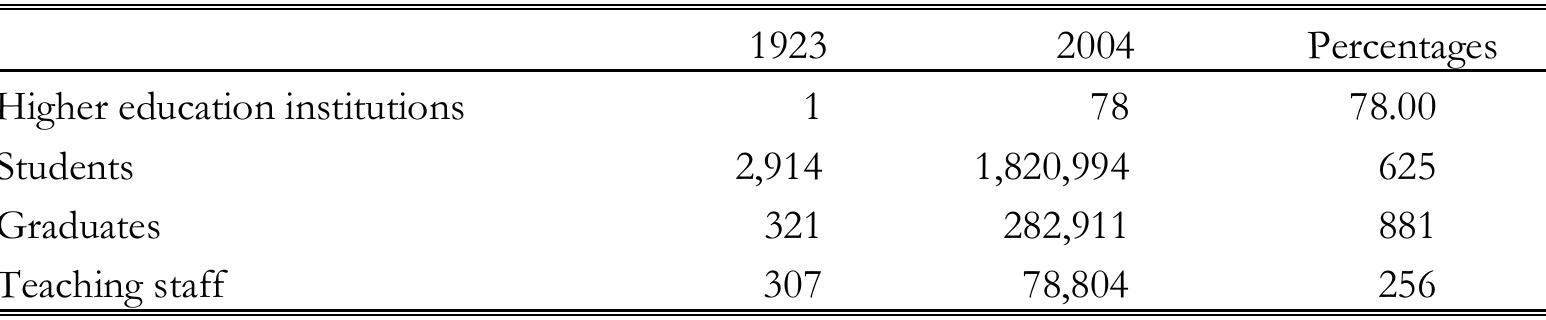
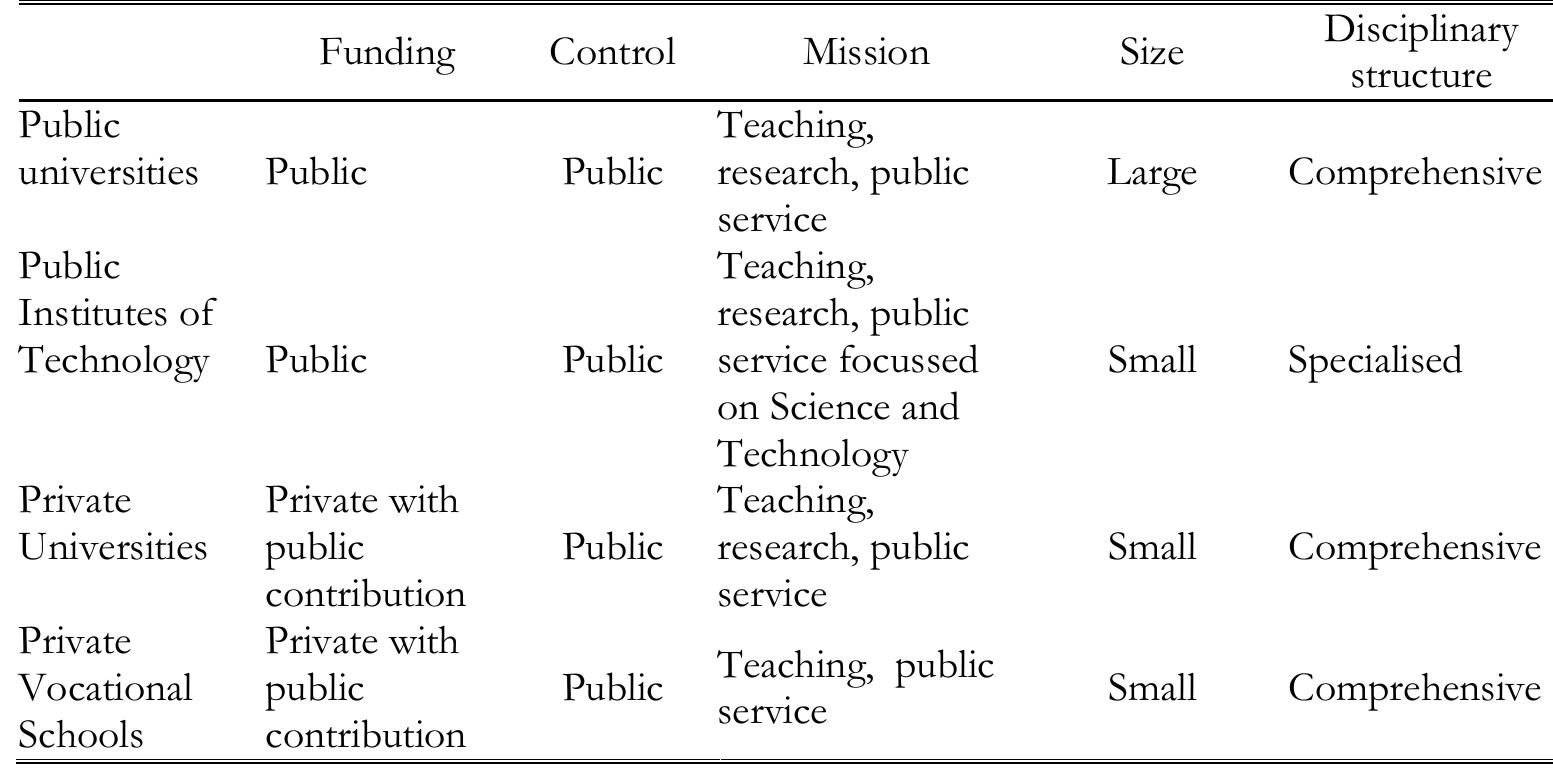
Monographs on Higher Education HIGHER EDUCATION IN TURKEY by Fatma Mizikaci Bucharest 2006 UNESCO-CEPES Monographs on Higher Education Editor of the Series a. i. Peter J. Wells Assistants to the Editor Maria-Ana Dumitrescu Viorica Popa Valentina Pîslaru ISBN 92-9069-83-2 © UNESCO 2006 Table of Contents PREFACE ............................................................................................................. 11 THE AUTHOR.................................................................................................... 13 CHAPTER 1. THE HISTORY OF TURKISH HIGHER EDUCATION AND RECENT CHALLENGES.............................. 15 1.1. The Historical Foundations of Higher Education in Turkey ...... 15 1.1.1 The First Higher Education Institutions ................................. 15 1.1.2. From Medresses to Secular Universities.................................... 16 1.1.3. The Foundations of Contemporary Turkish Higher Education.................................................................................... 17 1.1.4. The Structure of Turkish Higher Education.......................... 19 1.2. Recent Challenges to Higher Education in Turkey....................... 20 1.2.1. Funding ....................................................................................... 20 1.2.2. Access to Higher Education and Participation Rates........... 21 1.2.3. Discrepancies among Higher Education Institutions........... 23 1.2.4. Designing and Implementing a National Quality Assurance System ...................................................................... 25 1.2.5. Private Higher Education ......................................................... 26 CHAPTER 2. THE GOVERNANCE OF HIGHER EDUCATION IN TURKEY.............................................................................................. 29 2.1. National Level Governance .............................................................. 29 2.1.1. The 1981 Constitution: A Moment of Reform in the Reconstruction of Higher Education .................................... 29 2.1.2. The Council of Higher Education (YÖK) ............................. 30 2.1.3. The Higher Education Supervisory Board (YDK) ............... 31 2.1.4. The Student Selection and Placement Centre (ÖSYM) ....... 31 2.1.5. The Inter-University Board (ÜAK)......................................... 32 2.2. Administration and Funding............................................................. 32 2.2.1. Sources of Income ..................................................................... 33 2.2.2. State Subsidy for Private Universities ..................................... 34 2.2.3. Financial Supervision................................................................. 35 2.2.4. Revolving Fund and Research Fund ....................................... 35 2.2.5. Public Expenditure for Higher Education ............................. 36 2.3. Institutional Governance and Management ................................... 37 2.3.1. Institutional Autonomy and Academic Freedom.................. 40 2.4. Institutional Management Bodies .................................................... 42 2.4.1. The Rector .................................................................................. 42 2.4.2. The Senate................................................................................... 42 2.4.3. The University Administrative Board ..................................... 43 2.4.4. The Dean..................................................................................... 43 2.4.5. The Faculty Board...................................................................... 43 2.4.6. The Faculty Administrative Board .......................................... 43 2.4.7. The Department......................................................................... 44 2.4.8. Graduate Schools ....................................................................... 44 2.4.9. Vocational Schools of Higher Education............................... 44 2.4.10. The Managerial Bodies of Private Higher Education......... 44 CHAPTER 3. INSTITUTIONAL PATTERNS AND QUANTITATIVE DEVELOPMENTS............................................... 47 3.1. Number and Types of Higher Education Institutions.................... 47 3.1.1. Universities.................................................................................. 48 3.1.2. Private Universities .................................................................... 51 3.1.3. Institutes of Technology ........................................................... 52 3.1.4. Non-University Forms of Higher Education ........................ 52 3.2. Access and Admission to Higher Education.................................. 53 3.2.1. Access to Higher Education..................................................... 53 3.2.2. Access Patterns........................................................................... 54 3.3. ICT–Integration in Turkish Higher Education.............................. 55 3.3.1. The Challenges of Incorporating New Information Technology in Higher Education............................................ 55 3.3.2. Measures Taken at National Level for ICT-Promotion....... 57 3.3.3. Measures Taken at Institutional Level .................................... 58 3.4. Internationalization and Mobility Issues......................................... 58 3.4.1. National Policy for Internationalization in Turkish Higher Education ...................................................................... 58 3.4.2. Student and Staff Mobility........................................................ 59 3.4.3. Institutional Responsiveness to Internationalization............ 61 3.5. The Bologna Process and Structural Changes in Turkish Higher Education .............................................................................. 62 3.5.1. European Models....................................................................... 62 3.5.2. Structural Changes in Turkish Higher Education following the Bologna Declaration ......................................... 63 3.5.3. The Bologna Process and Study Programmes....................... 65 3.5.4. Academic Mobility in the Framework of the Bologna Process......................................................................................... 65 3.6. Quality Assurance and Accreditation......................................... 66 3.6.1. Adopting a National-Level Accreditation System for Turkey......................................................................................... 66 3.6.2. Quality Movements at the Institutional Level ....................... 67 3.7. Research and Development......................................................... 68 3.7.1 National-Level Improvements.................................................. 68 3.7.2. International Agreements and Co-operation ......................... 69 3.7.3. National Research Institution (TÜBİTAK)........................... 70 CHAPTER 4. DEGREES AND PROGRAMMES ...................................... 73 4.1. Structure of Study Programmes in Turkey ..................................... 73 4.1.1. Undergraduate Programmes..................................................... 73 4.1.1.1. Associate’s Degree Programmes ..................................... 73 4.1.1.2. Bachelor’s Degree Programmes ...................................... 74 4.1.2. Graduate Programmes: Master’s and Doctor’s Degrees...... 76 4.1.3. Specialisation in Medicine......................................................... 77 4.1.4. Proficiency in Art ....................................................................... 78 4.2. Vocational Higher Education ........................................................... 78 4.3. Teacher Education ............................................................................. 80 4.4. Distance Education ............................................................................ 82 4.5. Language of Instruction .................................................................... 83 CHAPTER 5. FACULTY STRUCTURE AND ACADEMIC WORK..... 85 5.1. Academic Staff: Employment and Career Development ............. 85 5.1.1. Numbers of Teaching Staff ...................................................... 86 5.1.2. Teaching ...................................................................................... 87 5.1.3. Promotion and Career Development...................................... 88 5.1.4. Faculty Performance Evaluations............................................ 88 5.1.5. Teaching Staff Development Programmes ............................ 89 5.2. The Role of Higher Education in Research and Development in Turkey ............................................................................................. 90 CHAPTER 6. STUDENTS AND GRADUATES ........................................ 93 6.1. Trends in Student Enrolments ......................................................... 93 6.2. Student Social Backgrounds.............................................................. 94 6.2.1. Student Financial Support ........................................................ 94 6.3. Trends in Numbers of Graduates............................................... 95 6.4. Transition to Employment................................................................ 96 CHAPTER 7. THE FUTURE OF HIGHER EDUCATION IN TURKEY .................................................................................................... 99 7.1. Future Policies and Planning of Higher Education....................... 99 7.1.1. Overall Evaluation from Berlin to Bergen ............................. 99 7.1.2. Future Progress in Implementing the Bologna Process.....100 7.1.2.1. Degree System Changes..................................................100 7.1.2.2. National Quality Assurance System Reform ...............100 7.1.2.3. Academic Mobility...........................................................101 7.1.2.4. Doctoral Studies and Research......................................101 7.1.2.5. Diploma Supplement ......................................................101 7.1.2.6. Recognition of Professional Qualifications .................101 7.1.2.7. Lifelong Learning ............................................................102 7.1.2.8. Student Involvement and Social Dimension...............102 7.2. National Plans for Future Development ...................................... 102 7.2.1. National Legislation................................................................. 103 7.2.2. Governance of Higher Education......................................... 103 7.2.3. National Policies of Science and Education ........................ 103 7.2.4. Human Resource Development ............................................ 103 7.2.5. Institutional Autonomy and the Delegation of Responsabilities........................................................................ 104 7.2.6. Teaching and Learning Environment Update ..................... 104 7.2.7. Access to Higher Education................................................... 104 7.2.8. Teacher Education................................................................... 105 7.2.9. Financing of Higher Education ............................................. 105 7.2.10. Five Years of Development: From 2000 to 2005 ............. 105 APPENDICES ................................................................................................... 107 REFERENCES .................................................................................................. 183 LIST OF TABLES TABLE 1. Turkish higher education in 1923 and in 2004................................ 18 TABLE 2. The typology of Turkish higher education institutions.................. 19 TABLE 3. Teaching staff/student ratio in ‘developing universities’ in founding years.................................................................................................. 24 TABLE 4. Distribution of functions by governing bodies............................... 30 TABLE 5. Sources of income of higher education from 1995 to 2004 ........ 33 TABLE 6. State subsidies to private universities versus funds allocated to public universities, by year ........................................................................ 35 TABLE 7. Public expenditures on education: Total and as percentage of GNP......................................................................................... 38 TABLE 8. State budget allocation for higher education, by years................... 38 TABLE 9. Institutional autonomy of public and private higher education institutions...................................................................................... 41 TABLE 10. Increases in higher education provision in 1923, 1983 and 2004............................................................................................................ 48 TABLE 11. Size of universities ranked by student numbers (Undergraduate enrolment 2003-2004)........................................................ 50 TABLE 12. Size of universities ranked by numbers of teaching staff (2003-2004).............................................................................................. 50 TABLE 13. The numbers of units in private higher education institutions ........................................................................................................ 51 TABLE 14. Student and teaching staff numbers in Institutes of Technology....................................................................................................... 52 TABLE 15. Number of student applicants and placement, by years.............. 54 TABLE 16. Placement rate, by years ................................................................... 55 TABLE 17. Internet users in 2001 ....................................................................... 56 TABLE 18. Turkish students studying abroad in tertiary education, by country of destination (OECD countries only) ................. 60 TABLE 19. Foreign students studying in Turkish tertiary education, by country of origin (2002) ............................................................................ 60 TABLE 20. Percentage of GNP allocated for research and development..................................................................................................... 68 TABLE 21. Student enrolment in two-year Associate’s programmes, by type of school ............................................................................................. 74 TABLE 22. The number of students in Associate’s programmes (public and private), by field of study (2004) .............................................. 74 TABLE 23. Number of students in Bachelor’s programmes public and private, by field of study (2004)............................................................ 76 TABLE 24. The percentage of students in graduate programmes, by field of study (2003-2004)........................................................................ 77 TABLE 25. Student and teacher numbers and teacher/student ratio (2000-2001) ...................................................................................................... 81 TABLE 26. The number of academic staff in universities, by year ................ 86 TABLE 27. The five largest and smallest universities, by number of teaching staff (2003-2004)........................................................................ 86 TABLE 28. Comparison of number of teaching staff in public and private universities (2004)....................................................................... 87 TABLE 29. Funds for academemic research...................................................... 90 TABLE 30. Proportion of sectors in scientific publications ............................ 92 TABLE 31. Number of students granted contribution fee loans (2000-2005) ...................................................................................................... 94 TABLE 32. Number of students granted education subsidy loans (2000-2005) ...................................................................................................... 94 TABLE 33. Number of graduates in the 2002/2003 academic year, by type of institution....................................................................................... 95 TABLE 34. Number of graduates in the 2003/2004 academic year (Master’s and Doctor’s levels) ....................................................................... 96 Preface This monograph comes at an opportune moment when there is a growing interest about Turkey, in particular in the context of the country’s progress in transforming its institutions as part of crucial developments on the way to joining the European Union. In this regard the role of education, in particular that of higher education is evident. Therefore, it is both timely and relevant for a detailed review of the Turkish higher education system, past, present and future. The cultural origins which led to the emergence of higher education can be traced back to the period of the Ottoman Empire which made the country at the time one of the most important centres of learning and culture in the region. The country’s history as well as its unique position, bridging Europe with Asia, contributed to intellectual cross-fertilization which is has been reflected in the country’s education system generally and specifically its higher education institutions. There have been arguably three major turning points in Turkish higher education, the first in the Seventeenth Century with the establishment of the first universities in the Ottoman State. The second one, even more important for present day Turkish higher education, took place in 1923, with the birth of the Turkish Republic and as part of modernization reforms by Kemal Ataturk, the conversion of the Darulfunun to Istanbul University followed by the reform of higher education which was initiated in 1931. The third one was the adoption in 1981 of the Law on Higher Education which continues today provides the legal framework for functioning of tertiary education in Turkey. Since the late 1990s, as in so many other European countries, Turkish higher education development policy is guided by the objectives embraced in the Bologna Process, while at the same time preserving traditional values and qualities. The European Higher Education Area (EHEA), which should be a natural outcome of the Bologna Process, can only become a reality by a careful combination of quality and diversity. It is the rich diversity and long traditions of the Turkish experience that not only will strengthen the national structures of higher education and research, but also the attractiveness, quality and competitiveness of European higher education generally. This monograph, published by the UNESCO European Centre for Higher Education under its Monographs on Higher Education series provides a comprehensive analysis of the structure of the higher education system in 11 12 HIGHER EDUCATION IN TURKEY Turkey, the governance and management of its institutions, describes recent developments and changes and gives a realistic diagnosis of the challenges that lie ahead. As with previous monographs published by UNESCO- CEPES, the text follows a set format that should facilitate comparison among the higher education systems of the region that, so far, have been the subjects of monographs. In recent years, the series has added monographs on Hungary (1997), Germany (1999), Bulgaria (2002), the Republic of Moldova (2003), and Ukraine (2006). We are very grateful to Dr. Fatma Mizikaci, Lecturer at the University of Ufuk in Anakara, for undertaking research, which was carried out during her time as a Visiting Scholar to UNESCO-CEPES, and for writing this comprehensive analysis of Turkish higher education. Jan Sadlak Director of UNESCO-CEPES The author Fatma Mizikaci has been a researcher and lecturer for eighteen years in the area of Educational Sciences. Her Doctoral research was on quality assurance in higher education and she has published work on accreditation, quality systems, and program evaluation in higher education, with specific emphasis on the Turkish higher education system. In 2004, she was a visiting scholar at UNESCO-CEPES and undertook the writing of a monograph on Turkish higher education. She currently teaches at Ufuk and Middle East Technical Universities in Ankara. 13 Chapter 1 The History of Turkish Higher Education and Recent Challenges 1.1. THE HISTORICAL FOUNDATIONS OF HIGHER EDUCATION IN TURKEY 1.1.1 The First Higher Education Institutions In the Middle Ages (before the Turks were in today’s Arabian and Persian territories) the Medresse (lit. ‘place to study’) was a college for the professional study of the Islamic sciences and ancillary fields, such as Arabic grammar and philology, the knowledge of which helped students in understanding sacred and legal texts. The so-called ‘foreign sciences’ (such as Philosophy and Medicine, which were considered part of a learned education), were most often studied in teachers’ homes, was literature (when it was conceived as a field distinct from the Islamic sciences). In the period of the Seljuk State (1071-1299), Medresses grew in number, as they were the main schools of Muslim theology, being established at Sırçalı, Karatay, Ince Minareli, Atabekkiye, Gökmedrese, Buruciye, Çifte Minareli, and the Çaçoğlu. During the same period, the Medical Sciences were recognised and several medical training centres and hospitals were established as a result. Darüş-Şifa, Darül- Afiye, and Darüş-Sihna came to host medical training schools, while Gevher Nesibe, Izzettin I Keykavus, Torumtay, Muinuddin Pervane and Pervaneoğlu Ali became medical treatment centres. Following the Seljuk Period, Medresses remained as the prominent higher education institutions in Turkey and thus grew in number and variety in the Ottoman State period (1299-1920). The first Ottoman Medresses were Baghdad Nizamiye, Iznik Orhaniyesi, Fatih, Hagia Sophia and Süleymaniye. Theology, Philosophy, Logic, Mathematics, History, Law and Languages continued to be the main taught subjects. Until the late Nineteenth Century, this general structure had remained unchanged. 15 16 HIGHER EDUCATION IN TURKEY 1.1.2. From Medresses to Secular Universities From the Ottoman State period onward, the actual higher education system has changed considerably, moving towards increasing secularisation and modernisation. The first attempt to institute a secular university resulted in the Darulfünun,1 founded in 1863 as the first and only University of the Ottoman State, with a modern structure, curriculum and teaching methods. Because of these features, it drew reactionary responses from teachers at the Medresses. The Darulfünun was thus reorganised and reopened under the name of Dar’ulfünu-i Osmani (the Ottoman House of Sciences) in 1900, comprising the fields of medicine, law, literature, science, and theology. In 1912, twenty German professors, fleeing from the First World War, joined its Faculty. Several research institutes were established in 1915, marking the beginnings of modern academic research. In 1933, the Darulfünun was later converted into Istanbul University. The declaration of the Tanzimat2 in 1839 was a major transition to modernisation, which had continued, in abated forms, since the beginning of the 17th century. The principles inherent in the Tanzimat Reform Decree thereby laid the basis for the constitutional regime of modern Turkey and the full realisation of secularism. In the same period, other higher education institutions were established, most of which were specialised in vocational and technical education. Mühendishane-I Bahri-i Hümayun (The Imperial Naval Engineering College) in 1773; Tıbbiye (Imperial Medical College) in 1827; Harbiye (Imperial Military College) in 1834; Mülkiye (School of Administration) in 1877 and a Faculty of Law in 1878 were founded, modelled after French grandes écoles. Following the foundation of the Turkish Republic, all these institutions were converted into universities and faculties of the new nation. Another major development of this period was the active role played by foreign schools and scholars in the new era of education. In the late Nineteenth Century, a number of foreign schools were founded (most established by foreign missionary boards) in the Ottoman territory. American 1 The House of Sciences: the first modern higher education institution in the Ottoman State. 2 [English=reorganization], the name referring to a period of modernizing reforms instituted under the Ottoman Empire from 1839 to 1876. In 1839, under the rule of Sultan Abdülmecid I, the edict entitled Hattı-i Sharif of Gülhane laid out the fundamental principles of the Tanzimat reform. Foremost among the laws was security of honor, life, and property for all Ottoman subjects, regardless of race or religion. Other reforms, which sought to reduce theological dominance, included the lifting of monopolies, fairer taxation, secularized schools, a changed judicial system, and new rules regarding the military service. Tanzimat ended (1876) under Abdülhamid II's reign, when the ideas for a Turkish constitution and parliament promoted by the vizier Midhat Pasha were rejected by the sultan. THE HISTORY 17 and French higher education institutions (such as the American College, the American University and the French St. Joseph’s University) opened in Istanbul and Beirut before the foundation of the Turkish Republic. Scholars from America, France and Germany taught in these institutions and contributed to the improvement of modern teaching methods and the new additional study areas in the same period. 1.1.3. The Foundations of Contemporary Turkish Higher Education With the proclamation of the Turkish Republic in 19233, all Medresses and religious schools were closed. Following upon this action in 1931, the government invited Professor Albert Malche of the University of Geneva to make an evaluation and prepare a report on the Darulfünun (in which the modernisation drive had stagnated over the years), and an overall proposal for higher education system reform. Mustafa Kemal Atatürk, the founder and the first President of the Turkish Republic, read the report himself and added what he saw as necessary changes to the university. Atatürk’s notes were fascinating in that they addressed a number of issues which even today are the topic of much debate; academic freedom and accountability, criteria for academic promotions, the leadership role of the Rector, a common core- curriculum for various disciplines, the key role of libraries and part-time jobs for students, and so on. Following this report, the Grand National Assembly passed Law No. 2253 in 1933, converting the Darulfünun to Istanbul University, which was duly inaugurated on November 18, 1933. The University Senate stated its main purpose was to maintain a Western-style higher education institution playing a key role in social and economic development and promoting a secular state. The philosophy underlying the policies was Atatürk’s reforms, which were aimed at aiding Western modernization and secularism. Istanbul University was thus a project of the nation-state and its cultural identity followed its contemporary counterparts elsewhere. As a secular university maintaining laity, it became a governing model for its successors. Critically, the regulatory system set up was a national one, paralleling the establishment of a secular national culture. Reinforced by many Jewish professors fleeing from Nazi persecution, Istanbul University soon became one of the leading centres of education and research in Turkey. As the first modern higher education institution, Istanbul University also provided the first teaching staff members for subsequently established universities in the country. 3 At the end of the war of independence, and abolishment of the Ottoman State, the official foundation of the Turkish Republic was declared in the Turkish National Assembly in 1923. 18 HIGHER EDUCATION IN TURKEY Besides its assigned roles promoting economic, social, cultural, ideological, educational and scientific-development reform, Turkish higher education institutions typified the generation and transmission of Atatürk’s ideology of the nation-state, as laid down by the founding legislation. The ideological- maintenance role of education, established through primary through secondary education, was amplified in the universities via a compulsory (irrespective of field of study) two-year course called Atatürk’s Principles and Reforms. This national secularism and a combination of Anglo-American and Continental European university models followed the basis of the modern higher education system in Turkey. There have been several periods which have affected development of the modern Turkish higher education system. The first critical change came under the governance of the Democratic Party in the 1950s with the establishment of Anglo-American styled universities, such as Karadeniz Technical University in Trabzon, and Ege University in İzmir in 1955; Middle East Technical University in Ankara in 1956, and Atatürk University in Erzurum in 1957. In 1967, Hacettepe University was created following a merger between Hacettepe Faculty of Medicine with Ankara University. In 1971, Robert College was converted into an English-language state university and renamed Boğaziçi University. In many respects, Hacettepe University represented a hybrid model situated between the Anglo-American model and the Continental European model of the other public universities (YÖK, 2004b). Until 1981, there were four types of higher education institutions: universities; academies, vocational schools and teacher training institutes. While universities had institutional autonomy but were financially state governed, the academies, vocational schools and teacher training institutions were, in all respects, under the control of the Ministry of Education Since the foundation of the Turkish Republic in 1923, expansion in the higher education sector has been considerable. The increase in the numbers of institutions, students, graduates, and teaching staff can be summarised as follows: TABLE 1. Turkish higher education in 1923 and in 2004 1923 2004 Percentages Higher education institutions 1 78 78.00 Students 2,914 1,820,994 625 Graduates 321 282,911 881 Teaching staff 307 78,804 256 Source: YÖK (2004b). THE HISTORY 19 1.1.4. The Structure of Turkish Higher Education In 1981, with the passage of the basic Law on Higher Education (Law No. 2547) (YÖK, 1981), higher education in Turkey was comprehensively reorganised. The system thereby has gained a centralised structure, with all higher education institutions tied to the Yüksek Ögretim Kurumu (YÖK) [Council of Higher Education]. By this restructuring movement, all institutions of higher education were designated as universities. Expansion of higher education throughout the country was consolidated, access to higher education was centralised, and a central university entrance exam introduced. Student contribution fees at public universities were also introduced, and non-profit foundations were allowed to establish private higher education institutions. Since then, both public and private universities have been controlled and supervised, with the Council of Higher Education regularly checking their programmes. Currently there are eighty-two higher education institutions, of which fifty-four are public and twenty-four are private universities; as well as two public Institutes of Technology and two private Vocational Schools of Higher Education. The dominance of the traditional state university is prominent, holding a much larger share of the student enrolment. Even so, the portion of the private sector in higher education total enrolment in 2005 was 5.7 percent and is planned to be expanded to 10 percent by the year 2010 (YÖK, 2004a). Having taken its basic characteristics from both the Anglo-American and Continental European models, Turkish higher education institutions are mainly public foundations under the control of the state. They focus on teaching, research and public service as their general mission, and represent overall national development goals in their curricula. The typology of Turkish higher education (in terms of financial sources, controlling systems, mission statements, institutional size and discipline intensification) suggests a relatively homogeneous structure, as seen in Table 2. Other higher education institutions, such as the Military and Police Academies (See, 3.1.4),4 are not included in the typology since they are field- specific institutions and thus possess different goals and structures from general public and private higher education institutions. Therefore, they are only partly subject to the Higher Education Law (YÖK, 1981). 4 Details at <www.pa.edu.tr> or <www.kho.edu.tr>. 20 HIGHER EDUCATION IN TURKEY TABLE 2. The typology of Turkish higher education institutions Disciplinary Funding Control Mission Size structure Public Teaching, universities Public Public research, public Large Comprehensive service Public Teaching, Institutes of research, public Technology Public Public service focussed Small Specialised on Science and Technology Private Private with Teaching, Universities public Public research, public Small Comprehensive contribution service Private Private with Teaching, public Vocational public Public Small Comprehensive service Schools contribution Source: The author. 1.2. RECENT CHALLENGES TO HIGHER EDUCATION IN TURKEY 1.2.1. Funding Public higher education institutions in the Turkish Republic are funded by the government budget, based on a detailed itemising of their expenditures. The major difficulty the higher education sector has encountered in the last decade has been the limited subsidies from the government budget, with the existing line-item budgeting system (essentially prepared by negotiations based on the previous year’s allocations), leaving insufficient discretionary spending powers to individual public higher education institutions. Furthermore, each year, there has been a relative decrease in the subsidy allocated to higher education, although there has been a concurrent expansion in the number of universities and students. In the 2004 fiscal year, the share of GNP allotted to higher education was 0.93 percent. Average annual expenditure per student in public higher education institutions was USD1,311, while in the OECD countries the mean average was USD7,023 in 2003 (YÖK, 2004b; OECD, 2004). It is obvious that the funding allocated to higher education is far behind the needs of the institutions. This systematic under-funding of higher education has hindered its development, noted as follows: THE HISTORY 21 − Restoration expenditures for the historical buildings of the universities: TL135,400 trillion was projected, but only TL77,103 billion was granted5. – Maintenance of improvements and modernisation in schooling: this is planned to be increased from 28.3 percent to 37.3 percent, but without extra-budgetary resources being taken. – Insufficient physical area for instruction: 12.14 m² per student in Turkey; 25 m² per student in European countries. – Insufficient funding for Internet and other information technology, teaching and learning materials and equipment. – Insufficient grants for research and development projects: the projected budget for education investment was TL637,757 trillion; TL430,182 billion was granted in 2004. − Insufficient funding for establishing new higher education institutions and staff development programmes (YÖK, 2004b) This chronic under-funding in public institutions has affected quality, especially given the concurrent rise of private sector investment in Turkey since 1984. Insufficient subsidies and a high control of expenditures have led the public universities to slow adaptation to changing demographic conditions and competitiveness, both in the internal and external labour markets. Dependence upon public resources and state control over institutional budgets are essential issues to overcome. Therefore, state universities must be equipped with the same financial decision-making powers as those of their private competitors (YÖK, 2004b). 1.2.2. Access to Higher Education and Participation Rates The discrepancy existing between the numbers of potential degree candidates and the actual number of student placements in an academic programme is enormous. In 2003, only 554,316 of 1,593,831 exam-takers were enrolled in a higher education programme (YÖK, 2004b). In general, during the last ten years, only about one-third of the candidates have been placed in a university programme, leaving two-thirds without higher learning. With a growing young population of nearly 71 million, 36 percent of whom are under 14 years old,6 Turkey is confronted by the future challenges of access and participation in higher education. The population of 20 to 29 year-olds is expected to increase by 7 to 16 percent over the next decade, imposing an increasing demand upon the tertiary education system. 5 TL conversion rate is 1,351,499.97= 1 USD (29 October, 2005). 6 Please, visit <http://www.dtm.gov.tr>. 22 HIGHER EDUCATION IN TURKEY Turkey is among the least favourably positioned OECD countries with 56 percent of 20-to 24-year olds having only a lower secondary education (or less). In tertiary education, the participation and graduation rates, in general, are less than the OECD average (OECD, 2004). The total percentage ratio of school-leavers’ gross enrolment in tertiary education was 24.8 percent in 2001 (UNESCO, 2005). With the expansion of young cohorts, the number of high- school leavers (who make up the majority of university students) grew from 220,941 in the 1985/1986 academic year to 518,104 in the 2002/2003 academic year. The twenty-year increase was gradual, except for a dramatic expansion in 1996/1997, when the number of high-schools leavers reached 663,612. According to projections by the Ministry of Education, enrolment in secondary education will reach 79.4 percent by 2005. In the five-year plans, expansion in higher education is projected to be 40 percent (YÖK, 2004b). This means that the already increasing pressure for access to higher education in the future will continue to grow. There are several reasons for the increasing numbers of students who want to enrol in higher education over the years. First, there has been a steady rise in the number of high-school graduates, and this increased either after the introduction of eight-year compulsory primary education in 1997. Secondly, there is a cumulatively increasing candidate group, including previous years’ under-scorers (who did not perform satisfactorily on the initial entrance exam). Finally, a considerable number of students who succeeded in being placed into an academic programme, re-took the entrance exam several times in order to enter their desired academic programme. These three groups of candidates constitute a significant ‘snowball effect’ each year. The population of the young cohort (aged 18-25, which stood at 5,210,000 in 2004), is also among the influencing factors in increasing the snowball effect. Although there has been a rapid increase in the number of universities (especially private institutions opened during the last ten years) equal access to higher education remains a challenge. Another concern is that the demographic pressure on higher education is caused, to some extent, by shortcomings of secondary-school education which does not provide student competencies for the labour market (YÖK, 2004b). Those students who are unable to get into a university programme also lack the basic knowledge and skills necessary to earn a living and are thus ‘left in the dark’. The curriculum of the Turkish secondary education system does not provide pupils with professional, academic, or life skills, making the only alternative to gain these core skills is to enrol in any higher education programme. THE HISTORY 23 This setback is defined in European Union educational development reports as one of the major reasons why Turkish high-school education must move towards a vocational focus, providing critical skills for securing jobs. Therefore, programmes were launched in 2001 aimed at improving and enlarging vocational education options, as well as providing for a straightforward transition from high-school to higher vocational training without an admission exam. 1.2.3. Discrepancies among Higher Education Institutions While equal access to higher education is a quantity issue for Turkish higher education, discrepancies can also be considered a quality issue. The historical demand for higher education corresponding with the population growth occurring in the aftermath of the Turkish War of Independence led the way towards a rapid increase in the number of universities, often ignoring long-term preparation and planning processes. Rapid, unplanned expansion made some universities’ educational and academic quality vulnerable. Today, the institutions most recently opened by the elected provincial authorities (with the purposes of enhancing provincial status and fulfilling pre-election promises) are still suffering from a lack of academic staff, physical plant, etc., leading to a loss of academic reputation and competitiveness, thus remaining only local institutions. For example, when established, these institutions’ teaching staff/student ratios were enormous (Table 3). Twenty-three public universities established in 1992 have slowed the pace, but this enlargement in higher education all in one year brought about a vast pressure to the budget. Thus, the new universities failed to hire a sufficient number of teaching staff, or provide adequate physical conditions, and therefore could not maintain a high standard of education. Once these discrepancies became obvious, YÖK launched some institutional development programmes. One of these was the academic staff-development programme, which provides ‘developing university’ (YÖK, 2004) graduates with post-graduate education opportunities in established, ‘developed’ universities. The programme has been effective, with the teaching staff/student ratio at the undergraduate level having recently increased on average by 45 percent (but still lagging behind the desired level). 24 HIGHER EDUCATION IN TURKEY TABLE 3. Teaching staff/student ratio in ‘developing universities’ in founding years University Year of foundation Teaching staff/student ratio* Abant İzzet Baysal 1992 1/221.0 Adnan Menderes 1992 1/121.9 Afyon Kocatepe 1992 1/80.1 Balıkesir 1992 1/70.0 Celal Bayar 1992 1/174.5 Çanakkale 18 Mart 1992 1/602.5 Dumlupınar 1992 1/59.0 Mustafa Kemal 1992 1/400.0 Niğde 1992 1/190.4 Pamukkale 1992 1/225.3 Zonguldak Karaelmas 1992 1/59.1 *Figures are from the year of foundation, 1992 Source: Gürüz et al. (1994). With regard to Doctorate student enrolment, the numerical discrepancy is critical, but in the other direction: while the public universities enrolling the smallest number of Doctorate students are Mustafa Kemal University and Muğla University (enrolling seven and fourteen Doctorate students respectively), the largest ones, Ankara and Marmara, enrol 2,859 and 1,959 Doctorate students, respectively. Similar setbacks in quality are found among private universities. There are private universities functioning in poor conditions (such as one operating in the old corridors of a hospital with eighty-five students, eight teaching staff, and without any graduate programmes and scientific research), while others competently compete in the international arena, from well-developed campuses, employing highly qualified academic staff and promoting impressive student achievements (YÖK, 2004b). Allocation of state subsidies for library holdings is another indicator of the quantity/quality discrepancy. In 1993, Dicle and Fırat Universities were granted only TL1,200 million and TL2,300 million respectively for their libraries, while the figures were TL14,000 and TL13,000 million for Boğaziçi and Middle East Technical Universities, respectively. Research expenditures for 1992 also illustrate a considerable difference between the universities: Research disbursement for Yüzüncü Yil University was TL1 million, while that of Istanbul Technical University was TL12,548 million (Gürüz et al., 1994). THE HISTORY 25 Turning to scientific publication indicators – Science Citation Index (SCI), Social Sciences Citation Index (SSCI), and Art and Humanities Citation Index AHCI), academic staff/publication rankings in developed universities such as Bilkent University (1.21) and Gebze Institute of Technology (1.19) were ranked highest in Turkey, while Okan University (0.00) and Yaşar University (0.00) failed to publish in the referred indices.7 These discrepancies among the higher education institutions create unfavourable conditions for ‘developing’ university graduates by reducing their employability, in that their studies do not give them the current knowledge and skills necessary to compete in the labour market. Top-level employers thus seek future employees from among the ‘developed’ university graduates, even going so far as to even name their top three university preferences in their advertising. Finally, as concerns the economic rate of return of higher education in Turkey, several studies have showed that regional differences are important factors in gaining the highest returns from higher education in industrialised districts (where the three metropolises, Ankara, İstanbul and İzmir serve as centres of attraction) (Aysıt and Güngör, 2002). 1.2.4. Designing and Implementing a National Quality Assurance System At present, there is no national accreditation and quality assurance system for higher education in Turkey. In the existing system, the Council of Higher Education and the Inter-University Board are the bodies responsible for setting criteria for the overall recognition of academic programmes. Owing to the implementation of the Bologna Process, there is a national push to create a national quality assurance system within the limits of the current legislation. Thus, in 2003, the Inter-University Board set up the commission of Academic Assessment and Quality Control, which promotes self-assessment of academic programmes. In the long term, it is planned that the national evaluation procedures will be transformed into a national accreditation system. It is reported that academic assessment and evaluation mechanisms, eventually leading to a full accreditation system, must be established so that funding can be linked to performance, and potential student ‘consumers’ can be properly informed about available higher education alternatives (YÖK, 2004a). In 1998, a national quality assurance system (but only for teacher training programmes) was launched in collaboration with the World Bank. This programme implementation lasted only nine months, however, and ended its 7 More details at <http://www.yok.gov.tr>. 26 HIGHER EDUCATION IN TURKEY pilot stage without having reported any results. Any successful establishment and maintenance of a national quality assurance system will require consistent investment and long-term training programmes to educate assessors and programme coordinators. Several universities with high quality and competitiveness objectives have adopted institutional quality assurance programmes in collaboration with American and British assessment institutions and/or agencies. As a widespread implementation, quality assurance has been welcomed by both public and private universities, but the centralised system of higher education in the country makes further establishment dependent upon the financial and governance policies of one decision-making mechanism and parliamentary act (Mizikaci, 2003). Thus, the timely establishment of a national quality assurance and accreditation system needs also to be done by central authorities. At the national level, the lack of a national quality assurance system causes quantity/quality discrepancies among the institutions, and at the international level lessens their overall competitive effectiveness on behalf of the country. A national quality assurance system is thereby crucial for the better understanding of human resources development for knowledge-based investment; for improving Turkey’s international profile and higher education reputation; for fostering student and staff development; for improving income generation; for promoting strategic alliances; and for encouraging research and knowledge production. 1.2.5. Private Higher Education In the present system of Turkish higher education, private universities offer the same mono-disciplinary academic programmes with traditional teaching methods as do the state institutions. They are not encouraged to develop or explain the specific, unique value of what they produce, either for learners or society, remaining largely insulated within the framework of national education objectives and its uniform vernacular (Mizikaci, 2005a). The majority of universities therefore produce graduates who lack the entrepreneurship and skills to present themselves well in the local and global labour markets. Turkish public universities are suffering from over-regulation with nationally defined courses for students and strict employment rules for academic staff, which tend to inhibit curricular reform and inter-disciplinarity. Private universities were anticipated to overcome all these problems with their more international and innovative development objectives and autonomous organisational structures. However, to a large extent, this expectation has not been realised. They are not meeting the demands caused by vast higher THE HISTORY 27 education enrolment, which rests at approximately two million students at present. Due to high tuition fees, they cannot fill their allotted quotas, while candidates are simultaneously seeking a place at public universities. Private universities charge tuition fees generally much higher than the income range of an average Turkish family; thus, they attract only a small number of students. (Gross domestic product per capita in Turkey is USD2,500, while the yearly fees of a private university are between USD5,000 and USD12,000). In spite of the scholarships available to exceptional students, the enrolment rates are still low. On the other hand, well off students are no longer going abroad to pursue a quality education. A critical report states that private higher education institutions do not meet the needs for quality education; that the expected participation (enrolment) rate has not reduced demand; nor are they providing blooming labour market employability; nor are they increasing market-university relations and competitiveness (Yaşar, 2002). Private universities are also stagnant in their competitive-ranking in international ranking systems. (Two Turkish public universities ranked among the top 500 Asian/Pacific Universities in Academic Ranking of the World Universities – 20048 by Shanghai Jiao Tong University, while no private university has yet gained a place in the international rankings.) Consequently, the future enlargement of private higher education faces obstacles and the future remains uncertain. In a report by YÖK, it is indicated that the 5.7 percent student enrolment share of private universities is unlikely to get close to the public university share in the future (YÖK, 2004a). The present and future of the private sector in higher education is thereby limited to its current share in the market, restricted by the problem of social acceptance, as well as starkly marking existing socio-economic divides within the country (Mizikaci, 2005a). 8 Available at <http://ed.sjtu.edu.ch/ranking.html>. Chapter 2 The Governance of Higher Education in Turkey 2.1. NATIONAL LEVEL GOVERNANCE With the enactment of Higher Education Law No. 2547 (YÖK, 1981), higher education in Turkey underwent considerable reform, in terms of governance and organisation of the higher education institutions. The Turkish Higher Education system possesses a centralised structure, allowing for central planning and control of the organisation of institutional governance, thus fostering knowledge creation, and the reforming of teaching and learning activities. In the same law, higher education is defined as encompassing all post-secondary education of at least four semesters in length within the national education system. 2.1.1. The 1981 Constitution: A Moment of Reform in the Reconstruction of Higher Education The Law on Higher Education (YÖK, 1981)1 brought about three fundamental transformations in the Turkish higher education system. The most important part of the legislation is the part allowing for the foundation of the National Council of Higher Education (YÖK). Second, provisions allowing private non-profit foundations to establish universities were made. Third, the previously existing higher education institutions were reorganised and roles and responsibilities of higher education institutions were redefined. The 1981 Higher Education Law is thus the first and most comprehensive legislation to be enacted in the Republic. Attached to YÖK, the Higher Education Supervisory Board (YDK), the Student Selection and Placement Centre (ÖSYM),2 and the Inter-University 1 Some of the articles and chapters in the Law on Higher Education have been modified with over thirty amendments since it was enacted in 1981. The information provided in this monograph was quoted from the original version, with only very recent amendments being footnoted. 2 Please, visit <www.osym.gov.tr> (in Turkish) for detais and a condensed English version. 29 30 HIGHER EDUCATION IN TURKEY Board (ÜAK) were founded. The functions of these subsidiary bodies can be summarised as follows: TABLE 4. Distribution of functions, by governing bodies Council of Higher Higher Education Inter-University Student Selection and Education Supervisory Board Board Placement Centre (YÖK) (YDK) (ÜAK) (ÖSYM) Govern and direct Supervise and control Establish and ensure Determine examination activities of attached activities of higher co-ordination among principles; prepare, bodies and higher education institutions the higher education administer and evaluate education institutions and related units; carry institutions the centralised out investigative examinations procedures Source: The author. The former three governing bodies, YDK, ÖSYM, and ÜAK, are integrated into YÖK and carry out their duties with the knowledge and/or request of YÖK (as well as other relevant units responsible for planning, research, development, evaluation, budget, investment and co-ordination). 2.1.2. The Council of Higher Education (YÖK) The Council of Higher Education [Yüksek Öğretim Kurumu (YÖK)] is an autonomous public juridical body with the authority and responsibility to administer the activities of all institutions of higher education. It is a corporate public body of twenty-two members responsible for the planning, co-ordination and supervision of higher education within the provisions set forth in Higher Education Law. More specifically, the function of YÖK is defined as: The Council of Higher Education is an autonomous body with a legal personality which governs all higher education, directs the activities of the institutions of higher education, within the context of duties and powers given by the Higher Education Law (YÖK, 1988, Art. 6). Seven of its members are selected by the President of the Republic from among former rectors and professors. Seven members are selected by the Council of Ministers from among distinguished, high-ranking civil servants. One member is selected by the Chief of the Military General GOVERNANCE 31 Staff.3 Seven professors are selected by the Inter-University Board from among non-members. Each member is appointed for a renewable term of four years, except for the member selected by the Chief of the Military General Staff. The President of the Council is directly appointed by the President of the Republic from among the Council members. Day-to-day functions of the Council are carried out by a nine-member executive board, elected from among its own members. The Minister of Education can chair the meetings of YÖK, but has no right to vote. The Minister is also the representative of YÖK and higher education in the Parliament. Neither the decisions of the Council nor those of the universities are subject to ratification by the Ministry. 2.1.3. The Higher Education Supervisory Board (YDK) The Higher Education Supervisory Board [Yüksek Öğretim Danışma Kurulu (YDK)] is formed, on behalf of YÖK, to supervise and control the universities in educational and other activities to insure their conformity to the national objectives as determined by the law and principles laid down by YÖK, and in harmony within the enumerated units, teaching staff and activities. The membership comprises five university professors appointed by YÖK; three members of whom are nominated and selected from members of the Supreme Court, Council of State, and Court of Accounts; one member appointed by the Chief of the Military General Staff and another by the Minister of Education. The Chairperson is appointed from among the members by the president of YÖK. The term of service is six years, except for the member from the Council of Military General Staff,4 who serves as an outside member for one year in each appointment cycle. 2.1.4. The Student Selection and Placement Centre (ÖSYM) The Student Selection and Placement Centre [Öğrenci Seçme ve Yerleştirme Merkezi (ÖSYM)]5 was established in 1974 and affiliated with YÖK in 1981 to cover matters of administration, management, and supervision under its regulation. It functions in three stages related to the centralised student examinations: it is the only responsible body, in the context of fundamentals 3 On 22 May 2004, the member appointed by the Chief of the Military General Staff was removed by legislation. 4 The 1982 Constitution allowed a Military General Staff member in civic councils, but, as mentioned above, such military membership in YÖK was dismissed in 2004, by law. 5 See footnote 10. 32 HIGHER EDUCATION IN TURKEY established by YÖK, for both determining the entry standards and to carry out centralised examinations (preparing, administering and evaluating such exam results in the light of student rankings and preferences). It then places student candidates in higher education institutions, and carries out research related to these activities and performing other services. As the demand for higher education far exceeds places available, ÖSYM focuses its strategies on two main areas: 1) to assure a balance between the demand for higher education in general and individual higher education programmes and the places available in higher education institutions; and, 2) to select and place students with the highest probability of success in the available higher education programmes, taking into consideration their preferences and performance on the selection and placement examination. 2.1.5. The Inter-University Board (ÜAK) The Inter-University Board [Üniversitelerarası Kurul (ÜAK)] consists of university Rectors, a professor selected by the Chief of the Military General Staff from the Armed Forces, and one professor from each university selected by their university Senates. Each member is appointed for four years. Each Rector acts as the Chairperson of the Board for a term of one year (in the order of the date of each university’s founding). The main duties are to establish regulations, co-ordinate and evaluate teaching, research and publication activities; to propose measures for the needs and improvement of academic staff; and to establish principles regarding doctoral work and granting of academic staff positions and degrees. The Board also forms permanent and ad hoc commissions and committees in order to facilitate its activities and secure co-operation among universities and with international institutions of higher education. 2.2. ADMINISTRATION AND FUNDING Public higher education institutions are required to follow the organisational and administrative structure as defined by law, with the administration and funding being subject to central governing bodies. An appointed Secretary- General is responsible for the central administration of governing bodies of higher education. The main funding is subject to the state-provided budget and the additional three funding sources are regulated and controlled by appropriate legislation. GOVERNANCE 33 2.2.1. Sources of Income The Law on Higher Education (YÖK, 1981) defines what kind of income sources universities can have. These are annual budgetary allocations; contribution aids from institutions; student fees and payments received; income from sales of publications and from movable and immovable property; profits from the enterprises of the revolving fund and donations; bequests and other sources. Overall, the actual budget of a public higher education institution is made up of three main sources of income: the state subsidy, self-generated income sources (research fund), and student fees (the annual fees paid by each student, which can be no higher than 25 percent of the total expenditure per student). The allocation rate of these funding sources is given in Table 5. As can be seen in the table, the state subsidy has been reduced while the self-generated income rate has increased in the last ten years. TABLE 5. Sources of income of higher education from 1995 to 2004 (in percentages) Year State budget Self-generated Student contributions 1995 69 27 4 1996 65 28 7 1997 57 38 5 1998 61 34 5 1999 60 35 5 2000 57 38 5 2001 52 44 4 2002 58 37 5 2003 55 41 4 2004 n/a n/a n/a n/a: not available Source: YÖK (2004b). The report Present Situation of the Turkish Higher Education System (YÖK, 2004b), defines the budgetary system of higher education as follows: The annual budget of each public university is negotiated jointly by the Council of Higher Education and the university concerned with the Ministry of Finance and, in the case of the investment budget, with the State Planning Organisation. The Council transmits these budgets, together with its own budget, to the Ministry of National Education, and the Minister defends them in the Parliament. The president of the 34 HIGHER EDUCATION IN TURKEY Council is also given the floor at the beginning and the end of the discussion in the parliamentary commission. The result is a line-item budget with very specific earmarked budget figures (YÖK, 2004b, p. 7). In addition to the budget from the state, public universities have additional sources of income. By law, they charge each student a mandatory annual fee. This fee, however, is much lower than the fees charged in private universities and defined by programme base. (The fee for each programme is determined by law upon recommendation of YÖK, the average annual contribution fee being USD100-200 per student in a public university.) Second, there is a revolving fund contributed by the services provided by the university, such as patient care in university hospitals and research contracts. Third, each university has a research fund made up of a lump-sum grant from the state- provided budget plus a portion of the income from the revolving fund and from projects given by the State Planning Organisation. Use of these three income sources are subject to specific laws, rules and regulations, which leave little room to manoeuvre. However, in the 2003 fiscal year (with the adaptation of an ‘analytical budget classification’), these different income sources were combined under the same overall budget allocation. This implementation is intended to leave room for some institutional flexibility, provided the Ministry of Finance policies are positive (YÖK, 2004a). 2.2.2. State Subsidy for Private Universities Private universities are fully able to create their own income sources independently, the largest amount being earned from student fees. Additionally, however, they can also receive state subsidies upon application, under Law No. 4689 article 3 (Ministry of Justice, 2001), fulfilling the criteria set by the Inter-University Board and ratification by the YÖK. The procedures for so doing are defined by law by the Ministry of Finance. Once application is made for financial support, the application undergoes the endorsement of YÖK via an evaluation board, and then recommendation of the Ministry of Education. The amount of any state subsidy granted to private universities is defined on the basis of criteria and standards, not to exceed the subsidies granted to the public universities, i.e., − Ratio of scientific publications to academic staff – Student/teacher ratio – Foreign languages as medium of instruction – Expenditure for and number of books and periodicals GOVERNANCE 35 – Number of students enrolled scoring within the top 250 in the university entrance exam – Student scholarship and grants − Support services and social and cultural activities Accordingly, the following amounts have been granted to private universities and public universities: In exceptional cases, private institutions that do not meet the above- mentioned criteria and fall into the bottom five places in the ranking tables can still be granted a maximum subsidy of twenty percent of their budget annually. In addition, under provisions of the same law, public lands can be allocated to private universities. 2.2.3. Financial Supervision The budgets of public higher education institutions are supervised in accordance with the provisions, which apply to general and subsidiary budgets, by the Ita Amiri (the president of governing bodies and Rectors in universities). This authority of supervision can then be delegated to vice- presidents, deans, directors of graduate schools and schools of higher education, chairpersons of the units attached to governing bodies, and to secretary-generals of governing bodies and universities. As for private universities, the only authority to prepare, direct, supervise, and evaluate the budgetary facilities, and delegate the authority, is the Board of Trustees. 2.2.4. Revolving Fund and Research Fund Besides the annual State subsidy, which provides the total budget of major infrastructure investments and recurrent expenditures, the universities can create extra-budgetary sources of incomes, which in general are contracts, research projects, consulting and health services and semi-industrial operations such as dairy farms, fisheries, agricultural products, printing and computer services. All the income from these sources is collected in the revolving funds budget. Revolving funds are defined as the sources of income universities can create, in line with the principles established and with the approval of YÖK, within their own facilities, e.g., hospitals, research centre and conservatories. The revenues acquired from the revolving fund and each year’s unspent funds are transferred to the revolving funds account of the following fiscal year, and are submitted to the Government Accounting Bureau, with copies sent to the Ministry of Finance. From the income of revolving fund, at least 30 percent is 36 HIGHER EDUCATION IN TURKEY to be spent for the provision of materials, equipment and research projects, etc., with the remaining amount to be allocated to the teaching staff and administrative staff of the related unit. TABLE 6. State subsidies to private universities versus funds allocated to public universities, by year State subsidy/Private higher education Funding/Public higher Year institutions education institutions (USD) (USD) 1993 9,582 12,353,320 1994 13,069,932 23,072,751 1995 25,786 33,468,615 1996 42,175 68,200,420 1997 114,613 149,724,417 1998 129,486 312,731,937 1999 290,048 500,851,129 2000 508,176 780,326,660 2001 536,959 1,009,916,766 2002 678,062 1,846,814,315 2003 363,522 2,476,264,503 TOTAL 15,768,343 7,213,724,834 Note:: Conversion Rate: 1 USD = TL 1,351,499 (6 October 2005) Sources: Turkish Ministry of Finance (2005); YÖK (2004b). Research funds can only be established upon the decision of YÖK being then delegated to the Rector of the university. All research income, any remaining funds from the previous fiscal year, donations, consultancy service funds, and other incomes of the university are accumulated in the research fund. Provisions regarding the use and administration of the fund are determined by YÖK. 2.2.5. Public Expenditure for Higher Education The State is the major source of funding for higher education, thus, the largest amount of higher education expenditures is allocated from public sources (See 2.2.1). Yet, in the annual budget meetings in the Parliament, the low share allotted to the education budget is an indicator of the stagnant role of the state as a source of funding for universities. In spite of the emphasis on the importance of educational economic policies in achieving development strategies, each year the higher education allocation turns out far from GOVERNANCE 37 meeting the needs and expectations, even if there has been an observed actual increase in the annual GNP share for education by years. In the 2003 and 2004 fiscal years, the share of education’s allocation increased from 9.2 percent to 11.1 percent in the consolidated budget; and from 3.81 percent to 3.99 percent in the GNP (Table 7) (The balance of state subsidy shares is closely related to the economic picture of the country at the time, specifically during economic crises). There were periods when the higher education subsidy has increased greatly (such as between 1991 and 1993 when the new universities were established). However, in general public expenditure on higher education has been limited, i.e., in the last two years higher education share increased 2.6 percent in the consolidated budget, but saw a decline of 0.93 percent in terms of GNP (Table 8). The proportion of self-generated funds (revolving fund and research fund) of the total income of universities is 41 percent, 4 percent of which are student fees (‘contribution fees’) (YÖK, 2004b). From a comparative point of view, public expenditure on education as a percentage of GDP in OECD countries is 5.3 percent, while in Turkey it is 3.7 percent. In spite of an observed increase in the educational budget by years, public expenditure in higher education has remained at 1.2 percent in Turkey while increasing 1.3 percent in OECD countries in 2001. The public expenditure per student in higher education, between 1999 and 2003, increased from USD 1,924 to USD 2,059 respectively, but is still far from meeting the expectations set by the OECD countries. The European Commission development report for Turkey indicates that the public expenditure for higher education in the country is, in general, lower than other European countries. Being an important indicator of development, the Commission recommended these educational expenditures be quickly reviewed at the policy-making level. 2.3. INSTITUTIONAL GOVERNANCE AND MANAGEMENT Public higher education institutions in Turkey are state institutions and governed in line with the regulations defined by the relevant legislation. The main duty of a higher education institution is to carry out post-secondary education at various levels, undertake scholarly research, create publications, and act in the capacity of a consultant (YÖK, 1981, Art. 12). 38 HIGHER EDUCATION IN TURKEY TABLE 7. Public expenditures on education: Total and as percentage of GNP Actual budget expenses (USD) Total education budget Year Ministry of YÖK Total GDP share GNP share Education (%) (%) 1981 108,990 34,406 143,396 12.9 2.42 1982 138,513 40,548 179,060 13.8 2.28 1983 212,875 70,662 283,537 15.2 2.75 1984 252,756 87,458 340,215 14.2 2.07 1985 48,835 112,246 161,080 12.3 1.74 1986 457,640 164,632 622,272 11.6 1.64 1987 687,089 237,218 924,307 11.3 1.67 1988 1,327,711 458,676 1,786,387 11.6 1.87 1989 2,195,414 777,433 2,972,847 12.2 1.74 1990 6,294,122 1,853,793 8,147,916 17.1 2.77 1991 10,248,028 3,474,660 13,722,689 17.9 2.90 1992 22,461,874 6,750,208 29,212,082 18.9 3.57 1993 42,579,684 12,353,320 54,933,004 22.0 3.72 1994 69,242,005 23,072,751 92,314,756 15.1 3.21 1995 100,312,616 33,468,615 133,781,231 13.5 2.30 1996 190,603,989 68,200,420 258,804,409 9.8 2.37 1997 377,405,829 149,724,417 527,130,246 11.2 2.81 1998 919,799,423 312,731,937 1,232,531,360 11.3 3.39 1999 1,576,256,068 500,851,129 2,077,107,197 11.7 3.50 2000 2.478.973.347 780.326.660 3.259.300.007 9.3 3.52 2001 2.993.939.026 1.009.916.766 4.003.855.793 11.2 3.53 2002 5.520.530.167 1.846.814.315 7.367.344.482 10.1 3.54 2003 7.532.374.793 2.476.264.503 10.008.639.296 9.2 3.81 2004 9.511.395.865 2.881.297.433 12.392.693.298 11.1 3.99 Source: YÖK (2004b). GOVERNANCE 39 TABLE 8. State budget allocation for higher education, by years Share of YÖK (%) Total of Year educational in GDP in GNP expenditures 1981 24.0 3.1 0.58 1982 22.6 3.1 0.52 1983 24.9 3.8 0.69 1984 25.7 3.7 0.53 1985 24.4 3.0 0.42 1986 26.3 3.0 0.42 1987 25.7 2.9 0.42 1988 25.5 2.9 0.47 1989 26.2 3.2 0.45 1990 22.8 3.9 0.56 1991 23.7 4.2 0.69 1992 22.9 4.3 0.84 1993 22.5 4.1 0.90 1994 25.0 3.8 1.10 1995 25.1 3.2 0.90 1996 26.4 2.6 0.80 1997 28.4 3.1 0.80 1998 25.4 2.9 0.86 1999 22.9 2.8 0.84 2000 23.9 2.2 0.84 2001 25.2 2.8 0.89 2002 25.0 2.5 0.89 2003 24.7 2.3 0.94 2004 23.2 2.6 0.93 Source: YÖK (2004b). The present organisational structure of the Turkish university presents a ‘top-to-bottom’ style of governance. In public universities, the Rector is appointed by the President of the Republic from among candidates holding the academic title of Professor, selected by the teaching staff members of the university. The Rector, the Senate, and the university administrative board are the upper-level governance bodies within the university, while Deans, Faculty 40 HIGHER EDUCATION IN TURKEY administrative boards, and unit Directorates are the governing bodies at the unit level. All teaching and administrative staff members in public universities are subject to the Civil Servants Law No. 657 (Ministry of Justice, 1965) as concerns their rights and duties, thus the provisions of this Law are applied in matters concerning the official records of teaching Faculty members, administrative and other personnel. The private universities are also governed by the rules laid down in the Higher Education Law. Under its provisions, they can establish their own principles in matters of institutional administration and income generation. 2.3.1. Institutional Autonomy and Academic Freedom Institutional autonomy has long been a subject of internal debate, but has recently gained an external dimension as well. The highly centralised system of higher education leaves little room for institutional autonomy for public universities, with structures leading to the central planning of knowledge creation and teaching/learning activities. Therefore, public universities enjoy only a limited degree of autonomy due to the following specific restrictions: − Public universities are state-governed institutions. – The state owns their assets and employs their staff. – The basic structure of the university management, faculties, staff, and student numbers, salaries, tuition fees is determined by government legislative and budgetary instruments. – The responsible body for implementing government legislation is YÖK. – Universities do not own their buildings and equipment. – They do not have access to independent funding sources. – They partly set academic structure and course content: they have to get the approval of YÖK and set it according to the established structure. – They only partly employ and dismiss academic staff, who are subject to the National Public Civil Servant Law (Ministry of Justice, 1965), which has some specific references to higher education within its provisions. For example, salaries are decided by the government. – The universities only partly decide the size of student enrolment: while they are asked to inform the government of their enrolment quota each year before the selection exam, modifications in this quota can be made by YÖK as needs dictate. GOVERNANCE 41 − They cannot set tuition rates charged to students, as ‘contribution fees’ are set by the government (OECD, 2003). On the other hand, universities are free to design their curricula, course contents, grading systems and degree requirements. Teaching methods and grading are decided by individual instructors within the provisions adapted by the related university or unit. Related to this, a development report of the European Commission on Turkish higher education states that institutional autonomy is one of the most emphasised issues. Except for the establishment of a new university (or a new Faculty within an existing university), the decisions of YÖK and the universities are not subject to ratification by the government. Nevertheless, indirect governance stemming from the public finance laws (which stipulate in minute detail the procedures of the annual budget and the auditing of expenditures) creates an inevitable dependence of public universities upon the government. This dependency is also seen in personnel matters, by which universities are subject to the National Public Civil Servant Law (Ministry of Justice, 1965). Unlike public universities, private universities are free to operate their administration structures according to their own governing principles adopted by their Boards of Trustees. It can thus be said that they enjoy relative autonomy. Nonetheless, they function under the supervision of the Council of Higher Education and their academic programmes are regularly accredited, and are subject to the basic academic requirements and structures defined by law. In summation, the terms of finance, governance, management, and curriculum autonomy of Turkish higher education are as follows: TABLE 9. Institutional autonomy of public and private higher education institutions Public Private Autonomous: Not autonomous: Finance Own source + tuition fees + Allocated and controlled by the State state subsidy Not autonomous: Not autonomous: Governance Governed by law Governed by law Not autonomous: Autonomous: Management Appointed and approved by Board of Trustees the higher authority YÖK Curriculum Partly autonomous Partly autonomous Source: The author. 42 HIGHER EDUCATION IN TURKEY 2.4. INSTITUTIONAL MANAGEMENT BODIES Under the present system of Turkish higher education, the main superior institutions are the universities, the institutes of technology and vocational schools of higher education. The institutional management bodies of each of these institutions are presented in the following sections. 2.4.1. The Rector In public universities, the Rector is appointed by the President of the Republic from among candidates holding the academic title of Professor, selected by the teaching staff members of the university, by secret ballot. Upon election, the Rector is appointed for a four-year period of work that can be extended for two additional four-year terms. Upon the completion of such elections, the president of YÖK proposes the three candidates having the most votes to the President of Republic, who then makes the final selection. In private universities, the selection of candidates and appointment of the Rector are carried out by the respective Board of Trustees. The Rector is the authority who takes the Chair in university boards, implements the resolutions, reviews and decides on the proposals of the university board and ensures co-ordination among subsidiary organisations attached to the university. The Rector holds the final responsibility for the use and development of the educational, research capacity and other assets of the university such as the planning and implementation of curriculum and research activities; supervision and delegation of duties within the university and related units. In private universities, the duties of the Rector are subject to the principles and provisions drawn by the Board of Trustees. Both public and private university Rectors have a seat in the Inter-University Board. 2.4.2. The Senate The Senate is the governing body of a university, consisting of the Rector, the vice-rectors, the Deans, the Directors of the Graduate Schools and the Schools of Higher Education, as well as a teaching staff member, elected for a three-year term. The Senate holds meetings at least twice a year and is the deciding body on the principles relating to the university’s educational programmes, research, and publication activities; forming drafts of regulations and the laws concerning the university as a whole or to express its views thereof. In sum, the Senate performs the duties assigned by the Law on Higher Education (YÖK, 1981). GOVERNANCE 43 2.4.3. The University Administrative Board The University Administrative Board is chaired by the Rector and consists of the Deans and three professors appointed by the Senate for four years. The main duty of this board is to assist the Rector in administrative duties, specifically by implementing decisions of the Senate and governing bodies. The board is also responsible for ensuring the success of plans and programmes created, for discussing the administrative proposals of the units, for examining the budgetary drafts and investment programmes of the university, and for making decisions about the university administration and related units and bodies of the university. 2.4.4. The Dean The Faculty Dean is the representative of the Faculty and appointed by YÖK from among three candidate professors nominated by the Rector. The Dean is directly responsible to the Rector for the rational utilisation and improvement of the educational potential of the Faculty and its units. Among his/her duties are to chair the Faculty boards, implement the decisions made by the Rector and the University Administrative Board, ensure effective co- ordination, report results back to the Rector, present budgetary and staff needs of the Faculty, and supervise and control the related units and their personnel. 2.4.5. The Faculty Board The Faculty Board is an academic body consisting of three full professors and one assistant professor elected by the entire Faculty’s members from their respective ranks and department chairpersons in the Faculty. The Board is responsible for making decisions on the educational programme, the research and publication activities of the Faculty (and the main principles thereof), setting the related plans and programmes, such as the academic calendar, as well as electing members of the Faculty Administrative Board. 2.4.6. The Faculty Administrative Board The Faculty Administrative Board is chaired by the Dean and consists of three professors, two associate professors, and two assistant professors, all of which are selected by the Faculty Board. Its functions are similar to those of the University Administrative Board, such as assisting the Dean in implementing the decisions of the Faculty Board and preparing drafts of budgets and investments. This Board is also responsible for decisions regarding questions of admission of students, the determination of the 44 HIGHER EDUCATION IN TURKEY equivalence of courses, academic dismissal, and other education and examination related matters. 2.4.7. The Department The Department is a unit of a Faculty or a school of higher education offering academic programmes and carrying out research. It embraces related areas of science and art in a defined scope and character. A department operates directly under the Faculty Dean, administered by a Head of the Department appointed by the Dean for a three-year period from among full professors. (If no full professors are available in a specific Department, then the Dean can appoint the Chair from among associate or assistant professors.) 2.4.8. Graduate Schools The Graduate School is a university unit concerned with graduate education, scholarly research and applied studies in more than one related academic field. Graduate-level programmes are designed as either Master’s or Doctoral degree programmes. In medical faculties, graduate-level studies are designed within the Faculty in co-operation with the university hospitals and training hospitals owned by the Ministry of Health and the Social Insurance Organisation. The Graduate School Director, the Graduate School Board and the Graduate School Administrative Board are the relevant administrative units of a Graduate School. They perform the duties assigned by the Faculty Dean (if not directly attached to the Rector’s office), in addition to operation and maintenance of educational programmes and research. 2.4.9. Vocational Schools of Higher Education This institution is concerned with providing instruction for specific career vocations or job training. There are two types of schools of vocational higher education: four-year schools offering Bachelor’s level programmes with a vocational emphasis, and two-year vocational schools offering Associate- degree programmes of a strictly job-based training nature. These schools can be founded either under a university administrative structure or independently. 2.4.10. The Managerial Bodies of Private Higher Education The administrative structure of the higher education system is the same both for public and private universities, that is, a unitary system consisting only of GOVERNANCE 45 ‘universities’. As noted above, private universities have only to conform to the basic requirements and structure set forth in the Law, and have their appointed Deans and Rectors confirmed by YÖK. Otherwise, they are autonomous to manage administrative matters according to the rules and regulations adopted by their Boards of Trustees. Chapter 3 Institutional Patterns and Quantitative Developments 3.1. NUMBER AND TYPES OF HIGHER EDUCATION INSTITUTIONS The Turkish higher education institutional network consists of Universities, Institutes of Technology and non-university higher education institutions namely the Vocational Schools of Higher Education. Universities embrace Faculties, Graduate Schools, Schools of Higher Education, Conservatories, Vocational Schools and Research Centres. Institutes of Technology, having the identity of research bodies, function as graduate institutions of research and technology. Non-university forms of higher education institutions are Police and Military Academies. The Universities and the Higher Institutes of Technology offer four- to five-years Bachelor’s degrees and two-year Associate’s degree programmes leading to Master’s and/or Doctorate degrees. (In Faculties of Medicine, Veterinary Medicine, and Dentistry, the Bachelor’s degree is six years in length and graduate studies are formed by medical speciality training programmes equivalent to a Doctorate degree.) In 2005, the total number of higher education institutions was eighty-two. Of these, seventy-eight are universities (fifty-four public and twenty-four private); two institutes of technology and two vocational schools of higher education. Geographically, higher education institutions cover forty-two cities. The higher education provision is intensified in large cities such as Ankara, İstanbul, and İzmir, each having more than one university. Private universities are more concentrated in urban areas, in that twenty-three of the twenty-four private-sector universities are located in Ankara, Istanbul, and İzmir, with the remaining one being in Mersin. Since the foundation of the Turkish Republic in 1923, the quantitative expansion in higher education has been considerable (Table 4). 47 48 HIGHER EDUCATION IN TURKEY TABLE 10. Increases in higher education provision in 1923, 1983 and 2004 1923 1983* 2004 Increase 1923-2004 (%) Higher education institutions 1 27 78 78 Students 2,914 322,320 1,820,994 625 Graduates 321 39,855 282,911 881 Teaching staff 307 19,757 78,804 56 *Data for 1983 show the development after the enactment of the Law on Higher Education (YÖK, 1981). Sources: YÖK (2004b); Gürüz et al. (1994). Of the thirty-nine universities founded after 1991, twenty-four are private. Following the 1990s, in more stable economic and social conditions, there had been a flourishing in the number of universities (both private and public) but with public institutions showing the most growth. Even so, the private sector grew impressively. The real growth of private universities took place after 1996, only after their increasing public legitimacy (i.e., the worth of their degrees on the market) had been observed from the experiences of the two private universities established earlier (one established in 1984, and another in 1992). The growth in private universities dropped off in 2003. 3.1.1. Universities By law, the defined function of Turkish universities is two-fold: performing teaching and research. Specifically, the university is an institution possessing academic autonomy and legal personality, conducting advanced-level education, scholarly research, publication, and consultancy. (Despite this remit, advanced-level education is carried out by the Faculties, Graduate Schools, Vocational Schools and Schools of Higher Education, while research is mainly, but not exclusively, carried out in Research Centres.) The purpose of teaching is defined as educating students to be loyal to Founder Atatürk’s reforms and principles, embracing the national, ethical, human, spiritual and cultural values central to the modern Turkish Nation. Students are to become conscious of the privilege of being a Turk, as well as of having universal physical, mental, psychological, moral and emotional values. The ongoing purpose is stated as to enhance the welfare of the Turkish State as a whole, conducive to national and territorial indivisibility; to implement programmes contributing to and accelerating the economic, social and cultural development of the country (YÖK, 1981, Art. 4). In terms of research, higher INSTITUTIONAL PATTERNS 49 education institutions are charged with the responsibility to carry out studies and research of a high academic level, to promote knowledge and technology, to disseminate scientific findings, to assist progress and development at the national level, and (through co-operation with national and international institutions) to become recognised members of the international academic community, and thereby contribute to universal, contemporary progress. Specific diversification is not specified in the general functions of universities in carrying out such research or teaching activities. Although research is carried out to a certain extent at universities, its most emphasised function is to carry out education and training. Basic research is carried out by the institutes of technology and the national research institution, the Scientific and Technical Research Council of Turkey (TÜBİTAK) (3.7.3 or <http://www.tubitak.gov.tr>). Recently, however, a few universities have intensified their research focus, granting more resources to research centres, and national and international contract projects. Specifically in line with recent EU-research programmes, universities are motivated to take part in co- operative European research projects. Study programmes are primarily discipline-based, with inter-disciplinary programmes being found in the more developed curricula of selected public and private universities, e.g., Middle East Technical University, Sabancı University, and Koç University. For example, at Sabancı University, students are enrolled in the Faculty for the first two years to attend a university course programme which offers an inter-disciplinary curriculum. In the beginning of their third year they select the diploma programme in which to specialise.1 In other universities, more approaches that are inter-disciplinary have been adopted, such as offering major and minor fields of study and optional choices in other compulsory courses.2 The size of universities varies: in terms of student enrolment, the public Selçuk University (in Konya) is the largest institution, and the private Okan University (in Istanbul) is the smallest. The largest five universities are public while four of the smallest five universities are private (Table 11). Turning to teaching staff size, the largest five universities are public while the smallest five are private (Table 12). 1 More details at <www.sabanciuniv.edu.tr>. 2 More details, at <www.metu.edu.tr>. 50 HIGHER EDUCATION IN TURKEY TABLE 11. Size of universities ranked by numbers of students (Undergraduate enrolment 2003-2004) University Total number of student enrolment Largest Selçuk 58,729 Gazi 57,584 Istanbul 50,239 Marmara 43,545 Uludağ 37,975 Smallest Okan 85 Ufuk 194 Yaşar 202 Gebze Institute of Technology* 336 Çağ 771 * Public Source: YÖK (2004b). TABLE 12. Size of universities ranked by numbers of teaching staff (2003-2004) University Teaching staff Largest İstanbul 2,118 Ankara 1,622 Gazi 1,531 Hacettepe 1,308 Ege 1,244 Smallest Okan 8 Yaşar 10 Çağ 19 Ufuk 22 İzmir Ekonomi 23 Source: YÖK (2004b). INSTITUTIONAL PATTERNS 51 3.1.2. Private Universities The number of private universities is twenty-four, having a total number of 183 units, 105 faculties, forty-four graduate schools, eight schools of higher education and twenty-six vocational schools of higher education (Table 13). TABLE 13. Units of private higher-education institutions (in numbers) Schools of Graduate Vocational University Faculty higher Total school schools education Atılım 4 2 - 1 6 Bahçeşehir 6 2 - 3 9 Başkent 9 5 1 1 18 Beykent 4 1 3 6 Bilkent 9 5 2 1 19 Çağ 3 1 - 1 5 Çankaya 4 2 - 1 7 Doğuş 3 2 - 3 6 Fatih 3 2 - - 8 Haliç 3 2 2 - 7 Işık 3 2 - - 5 İstanbul Bilgi 4 1 - 1 6 İstanbul Kultur 5 2 - 2 9 İstanbul Ticaret 5 2 - 1 8 İzmir Ekonomi 5 1 - 1 7 Kadir Has 5 2 - 3 10 Koç 4 3 1 - 8 Maltepe 6 1 - 1 8 Okan 2 - 1 - 3 Sabancı 2 2 - - 4 TOBB Ekonomi - - - - - Ufuk 4 - - - 4 Yasar 3 1 - 1 5 Yeditepe 9 3 1 1 14 Total 105 44 8 25 182 Source: MEB (2004a). 52 HIGHER EDUCATION IN TURKEY 3.1.3. Institutes of Technology An Institute of Technology is a higher education institution possessing academic autonomy and a specific legal personality, carrying out high-level research, education, production, publication, and consultancy, particularly in the areas of technology. Currently, there are two institutes of technology, both established in 1992 – Gebze Institute of Technology (GYTE) and İzmir Institute of Technology (IYTE). These two institutes are devoted to research and development within the programmes of sciences, engineering, architecture, and business. Within an integrated teaching and research curriculum, they offer Master’s and Doctorate programmes as well as undergraduate programmes. The language of instruction is (partly) English. The numbers of students and teaching staff in these two institutions are given in Table 14. TABLE 14. The numbers of students and teaching staff in the Institutes of Technology Students Undergraduate Graduate Teaching staff IYTE 913 506 500 GYTE 337 1,478 303 TOTAL 1,250 1,984 803 Source: IYTE and GYTE web pages. 3.1.4. Non-University Forms of Higher Education The non-University institutions of higher education are the Military and Police academies. Given the special nature of their instructional missions, they are subject to different laws, rather than to the Law on Higher Education (YÖK, 1981). The Police Academy [Polis Akademisi] was given University status in 2001 by Law no. 4652. It consists of one Faculty of Security Sciences, one Graduate School of Security Sciences, twenty High Schools of Police Training, and other related units. The administrative structure of the Academy is similar to that of universities. The Police Academy offers undergraduate and postgraduate degree programmes to produce chief constables and police officers. The institution is involved in research and publication as well as training and education. The Military Academy [Kara Harp Okulu], The Naval Academy [Deniz Harp Okulu], and The Air Force Academy [Hava Harp Okulu] are also comprised of similar organisational structures to those of universities, each offering INSTITUTIONAL PATTERNS 53 programmes to produce commissioned officers who possess necessary military qualities with developed leadership qualities and efficient physical competence. The academies also run graduate programmes related to the specific service needs. Gülhane Military Academy of Medicine is another non-university form of higher education which functions in Medical Sciences and training to produce surgeons, doctors, and health service personnel for Military institutions. 3.2. ACCESS AND ADMISSION TO HIGHER EDUCATION 3.2.1. Access to Higher Education The only way for prospective students to enter a higher education programme in Turkey is to perform adequately in the centralised Student Selection Exam (ÖSS).3 The examination is administered annually by the Student Selection and Placement Centre (ÖSYM) (See 2.1.4). − Any school leaver or graduate who wants to be admitted to a higher education institution has to sit for this exam. The examination is a selective ‘steering ’ device by nature, designed with the following criteria in mind: – The quota, i.e., the maximum number of students to be admitted to each higher education programme. – The rank of the scores of candidates wishing to enter the same higher education programmes. – The candidates’ list and ranking of higher education programmes. − Special requirements of the higher education programmes, if any (e.g., females only; foreign language test must have been taken in a specific foreign language, etc.) (ÖSYM web page). Upon the recommendation of related universities, YÖK determines the number of students to be admitted to each undergraduate programme. Following this, the admission requirements for each programme are determined by YÖK upon the recommendation of the Inter-University Board. Subject ‘steering’ of the candidates is tied to several provisions: 1) the personal preferences of the candidate (done according to the percentages of the previous-year enrolments in the study programmes); 2) the added score of high-school grade-point averages; 3) the admission quota provided by each 3 With the exception of access to the two year Associate’s vocational programme without exam for the graduates of vocational high schools since 2002. 54 HIGHER EDUCATION IN TURKEY university. The central placement procedure in the higher education programmes admitting students on the results of the examination is carried out through an interactive computerized evaluation process. Each candidate can be placed in one programme only. (Some academic programmes specialised in the Arts, Sports, Physical Education, and institutions of military academies and police academies separately apply other admission procedures based on aptitude tests prepared by the respective programme units. In this case, they also have to refer to the ÖSS results regarding the first stage of the admission exam, for the ÖSS exam defines not only the conditions for selection and placement but also the rankings of the programmes regarding the registration scores.) Each year before the entrance exam the booklet of the programmes and scores is published and distributed by the ÖSYM to prospective students. Students can move from one university to another provided the provisions of horizontal transfer [Yatay Geçiş Yönetmeliği] are followed. 3.2.2. Access Patterns In 2005, 1,851,618 candidates took the centralised selection exam, yet only 32.8 percent were placed in a higher education programme. Of these, 27.9 percent were high-school graduates in the same year, 29.1 percent were students already enrolled in an academic programme, but wishing to change study programmes, 38.4 percent were those who could not been placed in an academic study programme in previous years, 29.9 percent were graduates of a higher education programme, and 8.2 percent had not mention made of their education levels. The number of applicants and placements by five-year intervals since 1980 are shown in Table 15. TABLE 15. Number of student applicants and placements, by years Year Number of applicants Number of placements* 1980 466,963 41,574 1985 480,633 156,065 1990 892,975 196,253 1995 1,265,103 383,974 2000 1,414,823 440,028 2004 1,902,082 575,867 *Including distance education placements Source: ÖSYM web page. INSTITUTIONAL PATTERNS 55 TABLE 16. Placement rate, by years Year Placement rate 1990 22.0 1991 22.8 1992 26.6 1993 28.1 1994 27.7 1995 27.9 1996 29.5 1997 31.8 1998 30.9 1999 30.3 2000 31.2 2001 31.0 2002 36.4 2003 34.7 Source: YÖK (2004b). The gap between the demand for education and the actual placement rate has been overwhelming during the last two decades. This is partly due to the large increase in the youth cohort and partly due to a persistent overall under- schooling rate. 3.3. ICT– NTEGRATION IN TURKISH HIGHER EDUCATION 3.3.1. The Challenges of Incorporating New Information Technology in Higher Education As a developing country, Turkey is moving towards the effective use of Information and Computer Technologies (ICT) in higher education as in other sectors. New programmes have been launched in this context to catch up with world-level developments. The E-transformation Turkey Project is one of the initiatives launched to foster and co-ordinate information-society activities using information technologies. Yet, as of June 2003, the number of development projects focused on ICT integration in Turkey was only seven, and the amount of internal support by the Technology Development Foundation of Turkey was only USD1.623.646 (OECD, 2003). Since the first activities to establish an IP-based network in 1989, and the Middle East Technical University (METU)-TÜBİTAK co-operation to establish an Internet connection between METU and NSF (US National Science 56 HIGHER EDUCATION IN TURKEY Foundation) in 1993, substantial improvement has, nonetheless, been attained. Even so, in terms of Internet use (which is a useful indicator for the general human development level), Turkey falls far behind both OECD countries, and other countries in the region, except Romania. TABLE 17. Internet users (2001) Country Internet ssers (per 1,000 people)* Romania 44.7 Turkey 60.4 Bulgaria 74.6 Poland 98.4 Slovakia 125.3 Greece 132.1 Czech Republic 146.7 Hungary 148.4 Cyprus 217.5 Estonia 300.5 OECD 332.0 * People with access to the world wide network Source: UNDP (2003). Turkey (at the moment) is ranked 30th in the use of the Internet. An ULAKBİM (Turkish Academic Network and Information Centre) project to expand Internet facilities in higher education institutions is providing a great improvement in Internet services to both researchers and students. Since the 1980s, there has been an effort to employ computers in education as both an instructional and administrative tool. Nevertheless, the level of computerisation in schools remains low, because the necessary human resources are inadequate. Therefore, in a 2003 report by the State Planning Organisation, the future objectives of the new IT technologies and E- Transformation project were stated as follows: − Policies, laws, and regulations regarding ICT will be re-examined and changed if necessary, with respect to EU accession policies. For example, the E-Europe+Action Plan, initiated for the candidate countries, will be adapted to Turkey. – Mechanisms that facilitate participation of citizens in decision-making processes in the public domain by using ICT will be developed. INSTITUTIONAL PATTERNS 57 – Transparency and accountability for public management will be enhanced by the use of ICT. – Good governance principles will be put in place in government services through increased usage of ICT. – ICT diffusion will be promoted at all levels of activity. – Public IT projects will be co-ordinated, monitored, evaluated and consolidated if necessary in order to avoid duplicating or overlapping investments. − The private sector use of ICT will be also guided according to the above-mentioned principles. This scheme (prepared in response to EU-integration programmes in the area of ICT) provides refurbishment of the ICT sector in Turkey, but still remains below the EU average. 3.3.2. Measures Taken at National Level for ICT Promotion The diffusion of Internet access to universities at the national level is being implemented through a programme launched by ULAKNET (The Turkish Academic Backbone) which has been connected with all state universities, several public institutions, and armed forces R&D departments since 1997. All university units are covered in the programme and the number of current users is 300,000. With the extension systems initiated in 2002 and afterwards, universities and R&D institutions are now connecting four to seventy-five times faster than before. However, as a response to these reports and criteria, action plans and modifications in the university and training ICT programmes remain insufficient. The report of the State Planning Organisation (OECD, 2003) states that: According to the 8th Five Year Development Plan, there will be a significant gap between supply and demand of IT professionals by 2005, and the need for new ICT-related education programmes is highlighted as a priority. Electric-Electronics, Computer, Mathematics, Physics and Industrial Engineering Departments and 2-year vocational training programmes need additional quotas for closing the IT professional gap in the years to come (p. 29). However, conventions meeting the need of educated human resources stated in the report have not yet been reflected in the higher education policies and quotas. 58 HIGHER EDUCATION IN TURKEY 3.3.3. Measures Taken at Institutional Level The legislative feature of the university makes the higher education institutions subject to centralised provisions and co-operation in ICT-related matters. The national research centre TÜBİTAK is the main supplier of Internet technologies to public universities. All public universities (and a majority of private universities) are using the TR-NET networking system formed by METU and TÜBİTAK in 1993 to promote the use of Internet technology among organisations and universities throughout the country. All universities are connected to the Internet, each having web sites actively updated. However, the availability of peripheral devices and skilled teaching and technical staff highly depends on the financial conditions at each institution and can be said to be scarce in public universities in general, as compared to private universities (almost all of which are equipped with the necessary equipment). In general, in terms of access to printers, scanners, CD-ROM devices, CD-writers, more specialised educational peripheral and computer software, and the ratio of teaching staff to student/computer (PC), private universities are no doubt better furnished than most public universities, with the exception of the few public universities which actually founded a computer network system (such as METU). An increasing dependence on technological knowledge and skills in the labour force makes individual institutions more alert in the creation of knowledge sources. This is usually done through co-operation projects with national and international, and governmental and non-governmental institutions. A great reliance on EU research projects, however, needs to be reversed in favour of self-created and self-funded projects. In this regard, the EU Evaluation Report emphasises that Turkey will need to create the necessary implementing capacities in the field of research and technological development, including an increase in personnel related to Framework Programmes’ activities (COM, 2004). 3.4. INTERNATIONALIZATION AND MOBILITY ISSUES 3.4.1. National Policy for Internationalization in Turkish Higher Education Many of the policies of academic internationalisation and mobility are enacted in consultation with YÖK and the Parliament. Given its very nature, the main implementation processes in national and international mobility are undertaken within YÖK’s dissemination, corroboration, and consultancy policies. As a higher authority to universities, YÖK’s response to globalisation INSTITUTIONAL PATTERNS 59 and mobility initiatives has been positive and supportive. Although not always in full agreement with parliamentary priorities, YÖK has had to work towards collaboration with Parliament in making policies. In order to undertake, for example, the Bologna Process implementations, YÖK disseminates reports and information via its webpage, holds meetings and initiates programmes, and consults universities and other higher education and research institutions. All national-level initiatives and programme launches are undertaken within the supervising role of YÖK to promote co-operation and co-ordination between international and Turkish higher education institutions. (Consequently, any initiative by individual public universities in terms of internationalisation and mobility programmes is under the supervision and knowledge of YÖK.) 3.4.2. Student and Staff Mobility In general, Turkey is a higher education ‘export’ country, sending students and academic staff abroad rather than ‘importing’ foreign students or staff (Mizikaci, 2005b). The number of outgoing students has been increasing, while incoming student numbers have been declining over the years. In recent times, there has been an expansion in the number of Turkish students studying in the USA. In a report of the Turkish University Rectors’ Committee, it is observed that the number of Turkish students studying in the USA tertiary education sector is 12,000, which ranks Turkey eighth in the world and first in Europe in the rankings of countries sending tertiary students abroad. Several American and European universities are attracting many of the best Turkish students, often via scholarships. (This one-way movement of Turkish students cannot be seen as simple mobility or internationalisation, however.) There is also an availability of a ‘study abroad’ period that enables students and researchers, registered in a ‘home’ university, to take a part of their programme abroad. A considerable number of Turkish students and researchers studying and working abroad fall into this. Hence, one must be cautious when calculating numbers strictly referring to mobility. In OECD countries, foreign enrolment increased by 34 percent between 1998 and 2000 and the share of foreign students from throughout the world increased more than 60 percent. Quite the opposite was the case of Turkey, in that the share of foreign enrolments dramatically declined by 26 percent in 2004 (OECD, 2004). In the European countries, less than 10 percent of the student population is mobile (Almqvist and et al., 2003). Turkey is among the twenty top countries sending students to Europe, mostly to Germany and Austria (EPDGR, 2003). Due to labour migration, these two countries host 60 HIGHER EDUCATION IN TURKEY second generations of Turkish migrants enrolled in tertiary education. Thus, especially in Germany, a distinction is made between resident students with foreign citizenship and non-resident students with foreign citizenship. Obviously, the majority of Turkish students fall into the permanent-resident group (20,201 students) while a minority (3,540 students) are non-resident foreign citizens. Therefore, it would be premature to suggest that the number of Turkish students in Germany and other European countries has risen due to the new European Education Programmes launched by the Bologna Process and other European agreements. TABLE 18. Turkish students studying abroad in tertiary education, by country of destination (OECD countries only) Country of destination Percentage Australia 0.6 Austria 3.2 Belgium 0.9 Denmark 0.3 Finland 0.1 France 4.6 Germany 57.3 Greece 0.1 Hungary 0.1 Italy 0.2 Japan 0.2 Netherlands 1.9 Norway 0.1 Sweden 0.3 Switzerland 1.3 United Kingdom 3.0 United States 25.5 Source: OECD (2004). Incoming and outgoing tertiary education proportions for Turkey vis-à-vis OECD countries are given in the following tables, with percentages given of all Turkish students enrolled in other countries, in 2002. As seen in Table 18, the majority of the Turkish tertiary students abroad are enrolled in Germany and in the USA, followed by France, Austria, and UK. Parallel to this, state and private scholarships are offered to students going to the above-mentioned countries. The number of official and private scholarships remunerable abroad is 29,196, of which 21,282 are for graduate studies, and 7,914 are for post- graduate degree studies. It is noteworthy that these state-scholarship programmes only cover state university students, because private university students are excluded from all official state-sponsored mobility programmes INSTITUTIONAL PATTERNS 61 (e.g., by TÜBİTAK). Therefore, these official figures include only state university students. Some students, however, do come to Turkey for higher education. Among the OECD countries, the foreign students studying in Turkey are mostly from Jordan and the Russian Federation, followed by Greece (Table 19). As can be seen in the data, the outgoing movement of Turkish students is more towards the European countries and the USA, while incoming students are mainly from Russia and Arabic countries. TABLE 19. Foreign students studying in Turkish tertiary education, by country of origin (2002) Country of origin Percentage Australia 0.4 Austria 0.1 Egypt 0.7 Germany 0.2 Greece 2.6 Israel 0.5 Jordan 3.4 Paraguay 0.1 Russian Federation 3.3 Tunisia 0.1 Zimbabwe 0.1 Source: OECD (2004). 3.4.3. Institutional Responsiveness to Internationalization At the institutional level, internationalisation has been an increasing concern of Turkish universities. Many universities have taken part in student and staff exchange programmes based on bilateral agreements with universities abroad. Yet, in practice, the picture is not a competitive one, if one compares present Turkish figures to the European-area level. One reason for this is the under- funding for exchange and co-operative programmes, which are often seen as having the least priority. Another reason is the lack of systematic internationalisation of institutional policies and goals. Even when well-established internationalisation programmes are launched, there can be impediments for individual students and researchers taking part in accessing mobility opportunities, for example, because of financial limitations, lack of information, language barriers, problems with credential 62 HIGHER EDUCATION IN TURKEY recognition, lack of opportunities for studying abroad and visa/residential problems. 3.5. THE BOLOGNA PROCESS AND STRUCTURAL CHANGES IN TURKISH HIGHER EDUCATION 3.5.1. European Models Due to the changing orientations in political and economic interests, the recent policies of Turkish higher education have been directed to European processes. Thus, a strong emphasis of Turkish higher education recently has been integration with the European Union. As a signatory country of the Bologna Declaration, Turkey is undertaking steps to enact various instruments: the European Credit Transfer System (ECTS), the European Higher Education Area (EHEA), and the Prague and Berlin Communiqué requirements. Actual student involvement in administration, quality improvement, academic mobility, changes and reforms in curriculum are some of the issues taken into consideration in the framework of this integration process. (Full participation in the programmes is planned to be fulfilled as of the 2004/2005 academic year.) This European drive has been welcomed by both national political elites and the individual institutions. The constant objectives of Turkish higher education to achieve westernisation are now materialised trends towards Europeanization. Therefore, it is expected that a real thriving will be observed in the increase of competitiveness, university attractiveness, foreign enrolment, and mobility (Mizikaci, 2005b). For the higher education sector, newly debated issues could be reflected in moves towards quality assurance, institutional competitiveness, decentralisation, privatisation, social inclusion, professional qualifications, labour market relations, and responsiveness to new audiences, global student choice and participatory forms of teaching and research. In structural terms, Europeanization is a familiar phenomenon, since the Turkish university model had been adapted from (largely) European examples. Being a part of EU programmes brings more opportunities for them to grow and compete. Finally, universities would enjoy the generation of both long and short-term income sources within such European education and research programmes (Mizikaci, 2005b). INSTITUTIONAL PATTERNS 63 3.5.2. Structural Changes in Turkish Higher Education following the Bologna Declaration Since the signing of the Bologna Declaration, besides welcoming its provisions and implementations, there have been a number of structural changes made in the Turkish higher education system. The main changes have been in two areas: 1) in the structure of the governing body (YÖK); and, 2) in the promotion of vocational education. One change related to the legislative structure is having the military’s Staff-General step down from the Council of Higher Education so that it becomes an all-civilian council. The second legislative change came with the establishment of technical and vocational education “zones” created in co-operation with the Ministry of Education. By this legislation, vocational high schools and two-year higher vocational education programmes were integrated, allowing graduates to enter the higher vocational schools without sitting an entrance exam. In addition, successful vocational school graduates will now be able to directly continue to Bachelor’s degree programmes. Turning to financial issues, state control continues, but, in the 2003 fiscal year, an analytic budget classification has been enacted, which allows for a more active allocating role to the individual institutions. In addition, different incomes and expenditures of the same institution will now be merged in the same financial statement. It is reported that this new budgetary discipline will lead to positive developments at the institutional level, if corresponding flexibility is given by the Ministry of Finance (YÖK, 2004a). Concerning matters of quality assessment, there is currently no national quality assurance and accreditation system in Turkish higher education. In line with the Bologna Declaration agreements, such a national quality assurance system is planned in the near future. In sum, the Report published by YÖK in 2004, Towards the European Higher Education Area: The Bologna Process, includes the following main points: − Regarding the establishment of ‘easily readable and comparable degrees’ and the reforming of the ‘two-tier system’, the existing Turkish higher education system already meets those first two action lines. – Regarding establishment of a system of transferable credits, work on the ECTS and Diploma Supplement has reached the final stage. – Regarding the promotion of mobility, the ERASMUS programme was started in 2003/2004 as a pilot study in a number of universities. In this pilot programme, the number of outgoing students was 124 and that of incoming students was only seventeen. The 2004/2005 academic year was the full implementation period for ERASMUS, and in the fall semester of that year, the number of incoming students was 183, and 64 HIGHER EDUCATION IN TURKEY that of outgoing Turkish students was 475; the number of incoming teaching staff was two and that of outgoing Turkey teaching staff was fifty-five. It was expected that the numbers of outgoing and incoming students would reach 1150 as of the spring semester of the 2004/2005 academic year. – The student loan system has been fully centralised; but the right of the university to decide and propose the student name for a scholarship generated by the university has been reserved. – Regarding the promotion of European co-operation in quality assurance practices, several assessment and accreditation exercises (domestic, European and international) have been performed by universities / programmes, progressing towards the establishment of a successful national quality assurance system. – Regarding the promotion of the European dimensions in higher education, new research centres and graduate programmes have been established in the higher education institutions and they are actively participating in teaching at the graduate level and performing research on different EU-related topics. – Regarding lifelong learning, almost all the universities have continuous education centres. These centres offer seminars, conferences, and refresher courses to those persons who wish to be kept up-to-date in their profession, or to those persons who would like to obtain additional skills and/or knowledge in a different field. Although the Turkish private sector is very keen on keeping its personnel fully equipped with state-of-the-art knowledge, the state does not yet have any compulsory measures for requiring professionals to follow developments to continue practising their profession. – Regarding participation of students and higher education institutions in the Bologna Process, progress on the establishment of national student representatives has been submitted to the Council of Higher Education. It is expected to become active before the end of the academic year, following rulings of the Inter-University Board and the Council of Higher Education on the issue. − Regarding the creation of a desired synergy between Doctorate studies and ERA and EHEA, within the Sixth Framework Programme, Turkey has fully joined the EU-framework programmes. Joint-degree programmes at Doctorate levels are thus being established by bilateral agreements for individual cases. INSTITUTIONAL PATTERNS 65 3.5.3. The Bologna Process and Study Programmes Participation in the European educational programmes takes place in two stages: 1) introduction and promotion of the programmes; and, 2) training and pilot projects. Turkish universities have, in a positive and flexible way, welcomed instruments for recognition and mobility (ECTS, Lisbon Convention, Diploma Supplement, NARIC/ENIC network), as stated in the Salamanca Convention (EUA, 2001). In 2002, a National Office under the State Planning Organisation was opened acting as a national agency for the administration, promotion, supervision, and evaluation of European education programmes. Upon signing of the work plan with the European Commission, full Turkish participation and integration in EU programmes would be achieved as of the end of 2005. Up to now, the ECTS credit system has been applied in the universities under the supervision of YÖK. For the pilot project of student mobility and ECTS/Diploma Supplement studies, fifteen universities were selected in April 2003 to participate in the programme. Selection was based on the criteria of equal representation of both the rural regions and the highly populated areas in the country. Representatives from each selected university have attended seminars by the ECTS experts from European Universities. The SOCRATES programme, with its training and promotional modules, is now on the Turkish University agenda. Sixty-three university representatives were appointed by the Turkish National Agency to promote the SOCRATES and the related LEONARDO programmes in all universities, and given a training seminar in May 2003. Additionally, a campaign was planned with eighty-four local meetings and seven regional conferences. The projected timeline for full participation in these mobility programmes for scientists and students is 2005. 3.5.4. Academic Mobility in the Framework of the Bologna Process As a signatory state of the Bologna Declaration, some special measures have been taken to improve mobility of students and academic staff. The measures are described as follows in the Bologna Report (YÖK, 2004a) published on the YÖK webpage, Section 7.2: − Establishment of administrative offices within universities dealing specifically with the ERASMUS Programme. – Promotion of the ERASMUS Programme within universities (such as organising information days for students and academic staff, encouraging students to learn/improve a second language, encouraging the Faculty to increase their European-wide activities by signing 66 HIGHER EDUCATION IN TURKEY ERASMUS agreements, participating in related networks, projects and the proposing of new projects) – Usage of ECTS as an additional credit transfer system – Increasing the visibility of Turkish universities in the ERASMUS Programme (via setting up web-pages for ERASMUS activities, publication of ECTS Information packages and course catalogues) – Increasing the number of course offerings in the English language – International marketing aimed towards increasing participation in European-wide conferences and fairs – Encouraging site visits to/from potential partnering institutions − Participating in related activities and organisations of the National Agency. 3.6. QUALITY ASSURANCE AND ACCREDITATION 3.6.1. Adopting a National-Level Accreditation System for Turkey Due to the private sector’s involvement and already existing differences in educational opportunities and resources among the country’s regions, the Turkish higher education system has acquired an extremely heterogeneous structure as regards the quality of education. Some universities are of very high quality with an excellent research and graduate reputation, while many others are little more than secondary schools. Therefore, the need for adapting quality assessment systems became obvious, and will increase with the realisation that standardisation and quality systems for improvement are also necessary. Thus, some of the initiatives in private universities are setting new patterns of reform-actions, while the others, mainly in the public system, are adaptations of existing quality-assessment systems (Mizikaci, 2003). While belated, the rise of quality assurance and accreditation systems at the national level was inevitable. So far, however, fresh initiatives are scarce. In the candidacy process of EU, the first initiative movement has been the creation of a Board of Accreditation Oversight, appointed by YÖK, to examine the existing quality management and accreditation systems in European countries. On this board of eight members specialised in education, two are European university professors. They submitted a report of evaluation and proposed an accreditation model for the Turkish higher education context. On the basis of this proposed model, YÖK introduced an accreditation system for teacher- education programmes, consisting of seven quality control areas: (1) planning, implementation and evaluation of education; (2) academic staff; (3) students; INSTITUTIONAL PATTERNS 67 (4) Faculty–school co-operation; (5) learning sources (materials, physical conditions); (6) management; and (7) a quality assurance system. After the pilot implementation in six education faculties, the plan was submitted to the YÖK to make a decision on its implementation (World Bank, 1999). While the project has been implemented successfully for nine months, and individual university level reports have been made public on the website of YÖK, a concise overall evaluation of the project has not yet been made, and the project has not been completed. 3.6.2. Quality Movements at the Institutional Level Particular institutional movements in initiating assessment systems are usually observed as an adaptation of a registered quality-improvement-standards system (such as ISO 9000 standardisation) and/or implementation of quality principles in administrative levels. One of the first university examples of such implementations is at the Marmara University Engineering Faculty. First, the board of the university agreed to apply Total Quality Management (TQM) principles for academic improvement (Külahçı, 1995). The focus of the action was determined as the defining of students, parents, YÖK, the government, labour market, community, and academic and administrative staff as ‘customers’. After a survey on these ‘customer’ needs was completed, the Faculty determined five key elements of successful teaching and learning: (1) communication, (2) leadership, (3) teamwork, (4) technical ability and (5) entrepreneurship, and innovation. Then, new Faculty development plans were designed and teams were formed focusing on these five important issues. Finally, the evaluation of these implementations were reported in a descriptive analytical document. Another application of quality-assessment systems within Turkish higher education is the Accreditation Board of Engineering Teaching (ABET), which includes a process of accrediting engineering programmes. It was founded as the Engineer’s Council for Professional Development in 1932, and monitors, evaluates, and certifies the quality of such programmes in colleges and universities. ABET is governed by twenty-one participating bodies, its board of directors consisting of representatives of each of these bodies. In evaluating a programme, ABET considers eight general areas: (1) students; (2) educational objectives of the programme; (3) programme outputs and evaluation; (4) professional components; (5) faculty; (6) infrastructure; (7) institutional support and financial resources; and (8) programme criteria. Middle East Technical University’s Faculty of Engineering, Marmara University’s Faculty of Engineering and Istanbul University’s Faculty of Engineering are currently implementing the ABET criteria in their 68 HIGHER EDUCATION IN TURKEY programmes. Assessment reports are disseminated and necessary modifications are recommended to decision-makers each year. Several universities practice quality-assessment principles at the departmental or unit level, sometimes defining any singular effort (such as gathering information about students’ demographic background and students’ evaluation of instructors; organising regular meetings with instructors; reporting student achievement rates by years and document data on what has been done to improve physical conditions) as ‘quality implementations’, although they do not represent systematic quality activities (Mizikaci, 2003). This result stems from a lack of knowledge on the concept of quality, but it also indicates that there is a deeply felt need for reform in higher education. In this sense, some of the above-noted activities are considered to be applicable, feasible, and practical to conduct, without systematic external and internal assessments necessarily being required. 3.7. RESEARCH AND DEVELOPMENT 3.7.1 National Level Improvements Previously, the Turkish science and technology policy was formulated without any guidance by comprehensive policy documents, but through a tacit consensus with the government (Kök, 2004). With the shifts in the national economy from state-controlled to a liberalised, market-oriented one, Turkey has targeted more focused investment in its infrastructure by reforming the training of researchers and establishing public R&D facilities. Co-operative research projects have seemed to have increased in number, with implementation of the new agreements of EU-research programmes. However, national funding policies for research and development are actually at a standstill. Compared to developed countries, the public expenditure for research and the development of Turkey is very low (Table 20). The expenditure per-capita for the research and development is USD 39.2 in Turkey, while it is an average of USD 460.9 in the European Union countries and USD 962.8 in the United States. Nowadays, however, Turkey is employing new funds emerging from the EU-research projects to build a base for future growth in the figure. INSTITUTIONAL PATTERNS 69 TABLE 20. Percentage of GNP allocated for research and development Country State fund for research and development (percentage) Japan 2.98 USA 2.70 France 2.13 EU 1.94 EU+CC 1.76 Turkey 0.64 Source: YÖK (2004b). 3.7.2. International Agreements and Co-operation Bilateral, multilateral and regional co-operation in the scientific and technological fields are undertaken within the framework of agreements and protocols signed between the relevant governments, or between TÜBİTAK on behalf of the Turkish Government and its equivalent foreign organisations. At the governmental level, agreements have been signed with the USA, the Russian Federation, Hungary, Kazakhstan, Pakistan, Azerbaijan and Albania. DGF of Germany, CNR of Italy, CNRS of France, CSIR of India and SSTCC of China are among the subsidiary organisations that undertake co-operation with TÜBİTAK. The Economic Co-operation Organisation (ECO) and the Black Sea Economic Co-operation Organisation (BSEC) are examples of regional level co-operating parties. Turkey also participates in activities in the field of science and technology with numerous international organisations such as NATO, OECD, and the Organisation for Islamic Conference (OIC), the European Science Foundation (ESF), and the International Council of Scientific Unions (ICSU). Turkey is a member of the Co-operation in Scientific and Technological Research in Europe (COST) and the European Research Co-ordination Association (EUREKA) programmes and has similar duties in some of the programmes of the European Union. In line with the EU-research projects, the national research institution TÜBİTAK has recently opened a Sixth Framework Programme (FP6) National Co-ordination Office, with national agents being appointed in different research areas. To date, Turkish researchers have submitted fifty coordinator/partner projects to the FP6 programme, of which only six partnerships have been supported, forming 14 percent of the total support of EU-research programmes in 2003. The FP National Co-ordination Office is introducing and promoting such FP6 programmes by the instruments of: 70 HIGHER EDUCATION IN TURKEY − Integrated Projects (IP) – Networks of Excellence (NoE) – Specific Targeted Research Projects (STREP) – Co-ordination Actions (CA) − Specific Support Actions (SSA) By launching the programmes and instruments of the European Higher Education Area, the Bologna Process, and European Credit Transfer System, balanced flows of co-operative research projects can soon be expected. The Leonardo da Vinci Programme, for example, enables universities to build up and strengthen co-operation with industry. Turkish Universities are still in the rounds of recognition and adaptation of the Leonardo da Vinci Programme. In order to undertake such international projects and integrate into the European programmes, universities have founded International Offices with well-established universities and have signed bilateral agreements with European and American universities. Mobility, although a new concept, is perceived as a higher education policy to be systematically fulfilled in more qualified universities, for it is believed that such European programmes lead to initiatives and innovations in mobility and international concepts. 3.7.3. National Research Institution (TÜBİTAK) The Scientific and Technical Research Council of Turkey (TÜBİTAK) was founded in 1963 as the national research institution charged with the organisation, co-ordination and promotion of basic and applied research at the national level. Additionally, for the last ten years TÜBİTAK has promoted basic research development in universities through grant schemes. (For instance, the Marmara Research Centre was established by TÜBİTAK for the purpose of industrial technological undertakings through research contracts.) TÜBİTAK undertakes an extensive scope of work in the area of research and development (Medisat, 1998): − As a funding agency, like the American National Science Foundation, it has competitive research grant programmes in eight disciplines, each with an Executive Director. – It owns and operates three Research Institutes: BİLTEN at METU, one in the defence sector (about 110 employees; NFI), and the Marmara Research Centre (MRC) near Istanbul. – TÜBİTAK is a human resource development organisation: It manages a programme of scholarships for elite students, starting at the high- INSTITUTIONAL PATTERNS 71 school level and extending through postgraduate work, to develop the most promising Science and Technology (S&T) talent. – It incorporates the National Science Policy Institute, which reports through a Secretariat (President and Vice-President of TÜBİTAK), to the Supreme Council of S&T, chaired by the Prime Minister and comprising all the Ministers. – It embodies an Informatics Institute, implementing the national Internet connection (through METU), which has now been privatised. Its current activity is to enhance the academic network. – It is an International institute responsible for bilateral and multi-lateral (e.g., with NATO, EC, and the UN) and S&T interactions and agreements. − It supports Industrial Research and Development (R&D). Given that R&D is the only permissible industrial incentive under GATT, TÜBİTAK thus encourages and supports market-oriented research in the area (Kök, 2004). Chapter 4 Degrees and Programmes 4.1. STRUCTURE OF STUDY PROGRAMMES IN TURKEY 4.1.1. Undergraduate Programmes 4.1.1.1. ASSOCIATE DEGREE PROGRAMMES The Associate’s degree is awarded after the completion of two-year study programme. Under the Law on Higher Education (YÖK, 1981), the Associate’s degree programme is called the pre-Baccalaureate Stage1 and defined as offering post-secondary higher education involving a programme of at least four semesters, aiming at training for a vocation or comprising the first level of the Baccalaureate degree. The degree is awarded in two-year vocational schools of higher education (being strictly vocational in nature) and including various professional training schemes. These programmes can exist, in public or private higher education institutions, associated with universities, as independent vocational schools of higher education in distance education institutions. Focusing on vocational training, they serve to meet the needs of the middle-level labour market. The four-semester vocational Associate’s programme also requires a period of on- the-job training. The total number of students in Associate’s degree programmes (including distance education and other Associate’s programmes) is 562,677 (Table 21), making the proportion of Associate’s programme enrolment 18.7 percent of the total higher education enrolment figure. The number of two-year vocational schools of higher education is 469. In the 2003-2004 academic year, 194,500 new students registered in Associate’s programmes, and the teaching staff/student ratio was 56/1 (YÖK, 2004b). 1 In other YÖK documents, it is referred to as a pre-Bachelor’s or Associate’s degree programme. 73 74 HIGHER EDUCATION IN TURKEY The fields of study offered in the vocational schools of higher education include language and literature, mathematics and sciences, health sciences, social sciences, applied social sciences, technical sciences, agriculture and forestry, and arts. Under these study programmes there are 267 sub-branches. The number of students enrolled in the conventional Associate’s degree programmes by fields of study is 344,984 (Table 22). TABLE 21. Student enrolment in two-year Associate’s programmes, by type of school Type of school Number of students Conventional two-year Vocational schools 199,604 Second education 145,380 Distance education 204,997 Other 12,696 TOTAL 562,677 Source: YÖK (2004b). TABLE 22. The number of students in Associate’s programmes (public and private) by field of study (2004) Field of study Number of students* Percent Language and Literature 111 - Mathematics and Science 2,664 .8 Health Sciences 12,147 3.5 Social Sciences 16 - Applied Social Sciences 133,839 38.8 Technical Sciences 175,389 50.8 Agriculture and Forestry 15,010 4.4 Arts 5,724 1.7 Other 84 - TOTAL 344,984 100.0 *Does not include distance education and other two-year programmes Source: YÖK (2004b). 4.1.1.2. BACHELOR’S DEGREE PROGRAMMES A Bachelor’s degree is normally awarded after the completion of at least four years of study, called the Baccalaureate Stage of a post-secondary academic programme of at least eight semesters under the Law on Higher Education DEGREES AND PROGRAMMES 75 (YÖK, 1981). The length of dentistry and veterinary medicine Bachelor’s programmes is five years and that of medicine is six years. In veterinary medicine, the professional qualification of a veterinary doctor degree is granted upon completion of studies, and, in dentistry, the dentist degree is awarded upon the completion of five years' study, with the professional qualification of medical doctor degree being awarded. These graduates of medicine, veterinary medicine and dentistry can directly apply to Doctorate programmes, after their basic studies are completed, with qualifications in these three fields of study being considered to be the equivalent of a Master’s degree. In Engineering, an engineering diploma is awarded after four years' study by universities or institutes of technology. There is a large quantity of fields of study in Bachelor’s programmes available in 570 faculties and 175 four-year vocational schools, in both public and private institutions. The study programmes are configured under the following fields of study: − Language and Literature: Turkish Language and Literature, Western Languages and Literatures, Eastern Languages and Literatures, Ancient Languages and Cultures, Foreign Languages, Linguistics, Contemporary Turkish Dialects and Literatures − Mathematics and Natural Sciences: Mathematics, Physics, Chemistry, Biology, Astronomy and Space Sciences Statistics − Health Sciences: Medicine, Pharmacy, Dentistry, Nursing, Home Economics, Health Technology, Hospital Administration, Social Work, and Veterinary Sciences − Social Sciences: Philosophy, History, Geography, Physiology, Behavioural Sciences, Sociology, Anthropology, Folklore, Archaeology and History of Art, Theology, Economics − Applied Social Sciences: Law, Politics and Public Administration, Management, Administrative Sciences, Mass Communications and Mass Media, Education, Home Management and Family Economics, Library Sciences, Archives − Technical Sciences: Engineering Sciences, Environmental Engineering, Aeronautics and Space Sciences, Geology, Geophysics, Mining Engineering, Hydrogeology, Geodesy and Photogrammetry, Petroleum and Natural Gas Engineering, Material Science and Metallurgical Engineering, Mechanical Engineering, Marine Sciences and Ship Building, Electrical and Electronics Engineering, Computer 76 HIGHER EDUCATION IN TURKEY Engineering, Civil Engineering, Architecture, Industrial Engineering, Textile Engineering, Food Engineering, Chemical Engineering, Woodworking Industry − Agriculture and Forestry: Agriculture, Forestry, Home Economics, Fish and Fisheries − Arts: Painting, Sculpture, Performing and Visual Arts, Music, Traditional Turkish Handicrafts, Applied Arts, Drama, Fine Arts, Interior Architecture. The total number of student enrolment in Bachelor’s programmes in 2003- 2004 was 1,275,869, including distance education figures. In Table 23, the number of student enrolments by specific field of study is shown (distance education numbers are not, however, included in this table). In the 2003/2004 academic year, the number of newly registered students in the Bachelor’s programmes was 286,928. In the same year teaching staff/ student ratio in this mode of study was 31/1. TABLE 23. Number of students in Bachelor’s programmes, public and private, by field of study (2004) Field of study Number of students* Percent Language and Literature 32,628 4.0 Mathematics and Science 79,928 9.7 Health Sciences 76,263 9.3 Social Sciences 80,828 9.8 Applied Social Sciences 370,180 44.9 Technical Sciences 143,387 17.4 Agriculture and Forestry 26,876 3.3 Arts 13,650 1.6 TOTAL 823,740 100.0 *Not including distance education Source: YÖK (2004b). 4.1.2. Graduate Programmes: Master’s and Doctor’s Degrees The Law on Higher Education (YÖK, 1981) refers to graduate study as post- graduate study, a term covering programmes leading to the Master’s and Doctorate degrees, specialisation in medicine or proficiency in arts. Master’s and Doctorate degree programmes are undertaken by the Graduate Schools within the universities and in other research institutions. DEGREES AND PROGRAMMES 77 A Master’s programme is a post-baccalaureate stage of higher education consisting of course work and research. There are two kinds of Master’s programmes: thesis and non-thesis. Thesis Master’s programmes consist of a minimum of seven courses with a minimum 21 credits followed by a submission of a thesis submitted within two years, whereas non-thesis programmes consist of the completion of ten graduate courses of minimum 30 credits and a term project submitted within one and a half year. Doctorate programmes consist of a minimum of seven courses, with a minimum of 21 credits, a qualifying exam, a dissertation proposal, and a dissertation. The duration of Doctorate programmes may differ depending on the field of study. Although a minimum of eight semesters is allocated to the Doctorate studies in Article 19 of the Regulation on Graduate Education, the Senate of each institution can specify the procedures and the time allocated. After the successful completion of the coursework and the qualifying exam, students have to submit and defend the dissertation orally before an examining committee. A recent change in the Regulations on Graduate Education (YÖK, 2003), allows Bachelor’s degree holders to enrol directly (without Master’s study) in a Doctorate programme provided that their performance in the Bachelor’s programme has been exceptionally high and the Doctorate application is approved by the relevant authorities (YÖK, 2004a). The total graduate-level student enrolment (during the 2003/2004 academic year) in the higher education institutions in Turkey was 131,116, of which 90,057 were Master’s and 24,835 were Doctorate students, with the rest having been enrolled in medical specialisations. In table 24, the overall proportion of graduate student enrolment by field of study is illustrated. As can be seen in the table, the highest enrolment in both types of study programmes is in the fields of applied social sciences and technical sciences, while the lowest enrolment is in the area of art studies. 4.1.3. Specialisation in Medicine Medical specialisation programmes are equivalent to Doctoral degree programmes and are carried out in Faculties of medicine, university hospitals and training hospitals owned by the Ministry of Health and Social Insurance Organisation, and private foundations. For the specialisation in medicine, there is a competitive selection examination in various branches of medicine for those holding the Doctor of Medicine (MD) degree. In the included areas of specialised training, student enrolment was 15,892 in the 2003- 2004 academic year. 78 HIGHER EDUCATION IN TURKEY TABLE 24. The percentage of students in graduate programmes, by field of study (2003- 2004) Field of study Master’s Doctorate (%) (%) Language and Literature 2.6 3.1 Mathematics and Science 7.8 11.4 Health Sciences 3.8 14.0 Social Sciences 11.3 13.5 Applied Social Sciences 47.5 26.9 Technical Sciences 21.5 23.3 Agriculture and Forestry 3.8 6.2 Arts 1.7 1.6 TOTAL 100.0 100.0 Source: YÖK (2004b). 4.1.4. Proficiency in Art Proficiency in Art is defined as a post-baccalaureate programme of at least six semesters, or a post-Master’s programme in the visual and performance art branches of at least four semesters, making it equivalent to a Doctorate degree under the Law on Higher Education (YÖK, 1981). It requires the presentation of an original work of art, or (in music and the performing arts) a superior, creative performance. 4.2. VOCATIONAL HIGHER EDUCATION Vocational higher education is undertaken in two modes: two-year Associate’s degree programmes and four-year Bachelor’s degree programmes within the vocational schools of higher education, established independently or as a unit in a university. In the majority of the universities, public or private, there are vocational schools and in addition, there are two private vocational schools of higher education. Currently, the number of actively operating vocational higher education institutions is 477, which are spread all over the country. The number of programmes is 258 under the following organisation of studies: marine, finance, business and administration, automation, computer and information technologies and health-related programmes. The proportion of vocational schools of higher education in the overall scheme of higher education is just 38 percent, representing a low figure compared to developed countries. DEGREES AND PROGRAMMES 79 The relatively high unemployment rate of vocational high-school graduates (of which only 50 percent are employed) is discouraging participation in vocational higher education. In order to make vocational higher education more attractive to graduates of related majors, several initiatives have been undertaken within the framework of Modernisation of Vocational Education and Training in Turkey, funded by European Union MEDA (Euro- Mediterranean Partnership) programme. Since 2001, access into two-year vocational programmes for graduates of related majors has been eased by eliminating the central university entrance exam requirement. With this amendment (Law No. 4702), the rate of enrolment in vocational higher education increased sharply in 2002, growing by 159.7 percent. Accordingly, in the same year, 85.9 percent of all vocational higher education enrolment was by graduates of related secondary-education majors (YÖK, 2004b). In 2002, 182,262 students graduated from secondary vocational and technical education schools. Of these 121,718 were subsequently enrolled in a related higher vocational education programme. Additionally, by legislation, high- achieving graduates of two-year vocational higher education were allowed to continue directly into Bachelor’s degree programmes. Within the same framework, the private sector has been permitted to establish vocational higher education institutions, and two such schools have been quickly opened. Further reform-actions, made with the aim of ‘upgrading’ the system and transforming vocational education into a tool for economic growth have been recently embarked upon as part of the process of integration into European education-level programmes, such as Socrates, Leonardo da Vinci, and Youth for Europe Programmes. The overall goal of the projects is to make vocational education more responsive to the socio-economic needs of the country; reinforce the relation between vocational and technical education and industry; generate a Law of National Vocational Standards; and propose the establishment of a Vocational Standards Institution. The MEDA project contributed to the improvement of vocational education considerably, especially in terms of legislative changes in the structure. However, in the official documents (YÖK, 2004b; YÖK, 2004a) it is emphasised that the main challenges facing Turkish higher education remain. Improvement in the quality of vocational higher education is required, as is the need to make two-year vocational schools more attractive to university candidates. It is hoped that these measures would boost the participation rate in such programmes from 35 percent to 65 percent. To achieve this end, the essential issues to be dealt with in detail are stated as 80 HIGHER EDUCATION IN TURKEY training provisions, building institutional capacity in vocational education, producing teaching staff, and continuing education (ETF, 1999). 4.3. TEACHER EDUCATION The teacher-education diploma is awarded after the completion of a four-year Bachelor’s programme conducted in specialised formats, namely, pre-school, primary or secondary education. A secondary-school teacher diploma is also awarded to the graduates of a Bachelor’s programme in a substantial subject area (e.g., Mathematics, Physics, and History), after the completion of a non- thesis Master’s programme in teacher education. The Bachelor’s and non- thesis Master’s programmes include courses on subject-matter specialities and the teaching profession itself, including school experience and general education. This non-thesis Master’s programme for teacher education operates in two modes: − A 3.5 + 1.5 years programme offers an integrated study of majors in the concerned field and teacher education courses in the faculties of education − A 4 + 1.5 years programme offers teacher education Master’s programme in the 1.5 year period to the graduates of concerned fields (that is determined by YÖK) In 2003, the total number of teacher-education units, all under the management of universities, was seventy-eight. Of these, sixty were Faculties of Education; thirteen were Faculties of Technical Education; two were Faculties of Vocational Education; one was a Faculty of Industrial Arts Education; one was a Faculty of Trade and Tourism Education, and one was a Faculty of Informal Vocational Education (YÖK, 2004b). The process of teacher education has undergone several modifications and reform-actions since the foundation of the Turkish Republic in 1923. Today, these are undertaken by the universities in the faculties of education under the supervision and control of YÖK, in that the Turkish education system was centralised. From that date onwards, all educational policies and implementations were placed under the control of the Ministry of Education (including policy and administrative decisions, the appointment of teachers and administrators, curriculum design procedures and the selection of textbooks and teaching materials.) Until the enactment of the 1981 Higher Education Law, teacher education had also been the responsibility of the Ministry of Education. Teacher education has always been one of the most challenging issues in the education system of Turkey. Quantity/quality problems, mostly consisting of a lack of teachers to work in schools which have grown overwhelmingly in DEGREES AND PROGRAMMES 81 number (the number of primary and secondary schools was over 58,000 in 2005), has led the Ministry of Education to employ graduates of any four-year undergraduate programmes, without them having any special preparation to teach. Similarly, to meet the lack of teachers for primary schools, secondary- school teachers have been appointed to these posts. In sum, specialisation in teaching has not been considered an important issue in the employment and appointment of teachers. Such kinds of solutions to meet the demand have (partially) resulted in a decline in the quality of education and of teachers in general. This imbalance between the demand and supply of teachers has reached dramatic proportions over the years. For example, in 1997, the number of students in the secondary-teacher education certificate programmes has exceeded 40,000, while the number of primary school teacher education students was only 1,000. (However, the actual need was just the opposite; the most needy area was primary education, while there is a surplus of secondary teachers.) Co-operative projects between the Ministry of Education and YÖK have thus been established and these inconsistencies have been, to some extent, overcome. Up to 1998, the total quota of Education Faculties’ graduates was 20,000, but with restructuring teacher education projects in accordance with the needs of the country, this quota has been increased to 36.000 (YÖK, 2004b). Teacher education is vital, since demographic shifts and a younger population of the country require more investment in schooling and human resources. The number of teachers and students and the teacher/student ratio in Turkey is given below (Table 25). TABLE 25. Student and teacher numbers and teacher/student ratio (2000-2001) Primary Education Secondary Education Students Teachers Ratio Students Teachers Ratio 10,3129,288 312,962 32/1 2,368,460 131,179 18/1 Source: MEB (2004a). Since 1994, YÖK and the Ministry of Education have taken on improvement programmes in teacher education. The “World Bank Pre- service Teacher Education Project” initiated in December 1994, was a four- year project funded by a 23.1 million USD loan from the World Bank to YÖK, aimed at improvement of all Faculties of Education in Turkey. In 1996, the curricula of teacher education undergraduate and graduate programmes were restructured, with the new programmes being implemented 82 HIGHER EDUCATION IN TURKEY during the fall semester of 1998. In addition, by the decision of the Turkish Council of Higher Education General Assembly, The National Committee of Teacher Education was set up to supervise, evaluate and develop the programmes implemented in the Faculties of Education. The committee consisted of representatives from YÖK, the Ministry of Education and Faculties of Education (YÖK, 2004b). This was the first national accreditation system (begun as a pilot project in teacher education); it was, however, discontinued during the pilot stage. It is also worth mentioning that the teacher-education programmes are the most preferred programmes for incoming students, taking first place among choices by candidates of ÖSS. 4.4. DISTANCE EDUCATION Distance education is offered in three faculties and one institute of Anadolu University: Open Faculty of Education, Faculty of Economics, Faculty of Business and Western European Programmes. In 1982, the Open Education Faculty of Anadolu University started to offer distance education delivering two-to-four-year undergraduate programmes via Turkish-language broadcasting television broadcasts in Turkey, Europe, and the Turkish Republic of Northern Cyprus. Following upon this success, distance programmes in the Faculties of Economics and Business were founded. These programmes are undertaken using various educational platforms and media (video, computer, radio and newspaper-printed materials, television programmes, video-conferencing, Internet and e-mail services, and face-to-face academic tutorials). The Educational Television and Radio Production Centre (ETV) of the Open Education Faculty produces approximately 300 television programmes and revises almost the same amount of printed teaching materials each academic year. There are presently thirteen Associate’s and seven Bachelor’s degree programmes offered, including business and economics, vocational education and teacher education. Access to distance education programmes is possible through the Student Selection Exam (ÖSS). Enrolment in the Open Faculty programmes in 2003 was 166,299, of which 102,538 were Bachelor’s and 63,646 were Associate’s degree students. The total number of distance education students was 930,000 in the Faculties of Open Education, Economics and Business,2 making the proportion of distance education students to total student enrolment 35.4 percent. 2 Visit <http://www.anadolu.edu.tr>. DEGREES AND PROGRAMMES 83 The heavy demand for higher education is eased considerably by distance education programmes. Since 1982, these programmes, consisting of both two-year Associate’s and four-year Bachelor’s programmes, have become an important means for absorbing some of the ever-increasing demand for higher education. This unique distance education programme has been called the ‘largest university on Earth’ in World Bank publications, since nearly a million students are enrolled in this programme from different parts of Turkey as well as from different countries (MacWilliams, 2000). The demand for distance education increased considerably after 1992. However, distance-education graduates are not considered equally qualified to those of conventional education programmes. Thus, in most cases, the graduates become the diploma-holding unemployed. Conversely, distance education provides an opportunity to employed civil servants working in the public sector to receive a university diploma, which allows them promotion in their careers. Thus, the majority of enrolment in distance-education programmes is composed of the civil servants and working people who did not score high enough on the ÖSS to enrol in a conventional academic programme. According to the results of a survey of graduates of distance education programmes, the main purpose in attending the programme was to receive a university degree (nearly 90 percent of them stated it as very important and an important goal). Similarly, 70 percent of the graduates received promotions in their career path after attending distance learning programmes. (About 70 percent of the students are in full time employment and 8 percent are employed part-time.) In order to expand the capacity of distance education provision, a co- project by YÖK and the State University of New York was launched in 2003- 2004, and, today (apart from the Open Faculty of Anadolu University), seventeen other higher education institutions are offering distance education. 4.5. LANGUAGE OF INSTRUCTION Article 49 of the Higher Education Law (YÖK, 1981) refers to foreign language instruction in higher education in Turkey as follows: Those higher education institutions which carry out education, partially or totally, in a foreign language, shall administer a proficiency examination in the medium of instruction. Students found inadequate in the foreign language examination are to be given preparatory courses of up to one year’s duration, according to principles to be established by YÖK. Students unsuccessful in this language course are to be dismissed. During the normal course of education, every effort will be 84 HIGHER EDUCATION IN TURKEY made to ensure that the students continue to improve their knowledge of foreign languages (YÖK, 1981, Art. 49). The main language of education at the institutions of higher education in Turkey is Turkish. However, at sixteen universities (Atılım, Bahçeşehir, Beykent, Bilkent, Boğaziçi, Çankaya, Doğuş, Fatih, Işık, İzmir Ekonomi, İzmir Yüksek Teknoloji, Koç, Sabancı, Yaşar, Yeditepe and Orta Doğu Teknik) the language of instruction is English while at one university (Galatasaray) instruction is in French. These universities have high prestige and graduates are readily hired in the public and private labour markets. Apart from this, in twenty-five universities (public and private), either some programmes or some courses are carried out in English, German or French languages. In order to accomplish such foreign language instruction, a majority of the universities offer one-year compulsory language programmes usually entitled Preparatory Classes. In the universities where the language of instruction is Turkish, following the English-language preparatory year, there are obligatory, intensive courses (most often English for Professional Purposes) in the first two or three years of study. For foreign students who do not have a sufficient knowledge of Turkish and are placed at institutions of higher education where the language of instruction is Turkish, there are also similarly compulsory Turkish language preparatory classes. Furthermore, these students can continue their education only if they can become proficient in Turkish within one year. Chapter 5 Faculty Structure and Academic Work 5.1. ACADEMIC STAFF: EMPLOYMENT AND CAREER DEVELOPMENT Academic personnel employed in Turkish higher education institutions (public or private) are subject to the definitions and job descriptions stated in the Law on Higher Education (YÖK, 1981). The two main qualification levels of teaching staff members are the following: “Teaching Staff Members” are those who do not hold an academic title such as instructor, lecturer, and ancillary staff, and “Teaching Faculty Members” are those who hold an academic title such as professor, associate professor, and assistant professor (YÖK, 1981).1 Both public and private higher education institutions recruit teaching faculty and staff (full-time or part-time) according to the definitions set in the Law. For public institutions, the basic structure of staff employment and salaries being determined by government legislative and budgetary instruments. They are subject to the National Public Civil Servant Law, Law No. 657 (Ministry of Justice, 1965), partly having some descriptions specific to higher education. Staff salaries are decided by the government, and full-time teaching staff members and faculty members are employed based on state employment contracts for unlimited periods. Members of teaching staff at other institutions can teach on a part-time basis while retaining their full-time position in their home institution. This is the way private universities function, i.e., by inviting part-time teaching staff members of public institutions to collaborate with them. Private universities can also recruit full- time teaching staff, subject to the Social Insurance Organisation employment system providing a different insurance mechanism, but keeping the same academic career development and job descriptions. 1Unless otherwise noted, the text and tables following include teaching personnel of both ranks under the general term, “staff”. 85 86 HIGHER EDUCATION IN TURKEY 5.1.1. Numbers of Teaching Staff Parallel to the expansion in the number of universities and students, there has been an increase in the total number of academic staff since the 1990s. In 2004, the number of affiliated teaching staff members in higher education institutions was 78,804. This increase in the numbers of teaching staff members over recent years is given in table 26. TABLE 26. The number of academic staff in universities, by year Year 2001 2002 2003 2004 Number of academic staff 66,750 70,012 74,134 78,804 Source: The author; IYTE web page. Higher education institutions vary in terms of academic staff numbers. Newly founded private universities employ a smaller amount of staff than the public universities do; public institutions usually recruit more than 2,000 academic staff members (Table 27). TABLE 27. The five largest and smallest universities, by number of teaching staff (2003- 2004) University Teaching staff Largest Istanbul 2,118 Ankara 1,622 Gazi 1,531 Hacettepe 1,308 Ege 1,244 Smallest Okan 8 Yasar 10 Cag 19 Ufuk 22 Izmir Ekonomi 23 Source: YÖK (2004b). In terms of staff recruitment, all the largest universities are public while the smallest ones are private universities. A comparison between the public and FACULTY STRUCTURE AND ACADEMIC WORK 87 private universities regarding the numbers of professors, associate professors, assistant professors and teaching staff members is given in table 28. TABLE 28. Comparison of number of teaching staff in public and private universities (2004) Institution Professors Associate Assistant. Teaching staff Total Professors Professors members Private 713 281 810 3,846 5,650 Public 9,975 4,840 12,465 44,144 71,415 TOTAL 10,688 5,121 13,266 47,990 77,065* *not including ancillary staff Source: YÖK (2004b). Between 2002 and 2004, the increase in the number of students was 4.5 percent while the increase in the number of teaching faculty members was 4 percent and teaching staff members was 5.2 percent. The number of foreign teaching staff members in 2004 was 2,427 in all public and private higher education institutions. Although there seems to be a parallel expansion in the numbers of students and academic staff, the average student/staff ratio is generally high: 31/1 in Bachelor’s programmes and 56/1 in Associate’s programmes. In two-year Associate’s programmes (especially in certain fields) the ratio is considerably higher, being as much as 381/1 in Mathematics and Sciences; and 140/1 in the applied Social Sciences (YÖK, 2004). 5.1.2. Teaching The teaching loads of teaching staff, the volume and the type of their teaching, their other responsibilities and the ways in which teaching is to be undertaken is specified by the internal regulations of higher education institutions. Teaching loads of staff members are determined by legal provisions and varies according to the academic degree held. The highest amount of classroom teaching hours is twelve-plus hours a week for those who do not hold academic titles. Those who hold an academic title teach relatively less, such as ten hours a week. However, due to the large student populations and course numbers in the public universities, there are always ‘plus’ hours (up to 30 hours a week) in addition. Furthermore, academic staff members are supposed to get involved in research, service, supervision, guidance and if appointed, administrative activities. 88 HIGHER EDUCATION IN TURKEY 5.1.3. Promotion and Career Development Associate professorship and professorship titles are awarded by the Inter- University Board (ÜAK) and YÖK, according to the provisions and criteria followed by a set of examinations and evaluation reports in the given discipline. In order to increase the quality of academic careers to the international level, the criteria for earning academic degrees and titles have recently been renewed and elevated by adding for example the prerequisite of international academic/scientific publication(s) in highly ranked journals and language proficiency in a centralised language test. The Inter-University Board (ÜAK) appoints a jury of three or five members from the major area of the study according to the regulations of the Promotion and Appointment of Academic Staff. The jury examines written reports and after a successful oral and/or practical examination, the candidate is awarded the title of Associate Professor or Professor. (Teaching staff members who do not hold an academic title is awarded promotions by the individual institutions according to the civil servant law.) Teaching faculty members are also protected by this law, and career development and salary increases are defined by it. Dismissal of teaching staff members is not a common practice in public universities. In cases of proven plagiarism of scientific/academic work, any dismissal from the occupied position requires a legislative procedure following an initial decision by YÖK. 5.1.4. Faculty Performance Evaluations Academic faculty and staff members must carry out their responsibilities according to the job descriptions and approved individual work plans. The University Senate creates job descriptions, and adopts regulations set out by the Law. It may also approve a system of evaluating and maintaining the teaching and learning facilities. Recently, several universities have adopted academic staff evaluations based on student opinion questionnaires. A few universities undertake teaching staff developmental evaluations on a more systematic basis within the framework of quality improvement. A growing number of private higher education institutions have raised competitiveness, with a majority of them undertaking Faculty performance evaluations, including assessment of scholarly publications, research and quality of teaching. Teaching staff members are supervised by Heads of Departments, Directors of Graduate Schools and Schools of Higher Education, Deans and Rectors; and this includes managing the evaluative activities related to education, i.e., research, publication, seminars, clinical and practical works of each member. Teaching faculty members submit self-reports of their FACULTY STRUCTURE AND ACADEMIC WORK 89 academic research, publication, courses taught, seminars organised, practical work and a copy of each paper presented at an academic conference. In line with this, in each university, faculty members are to submit Faculty Performance Reports at the end of each academic year, which contain similar records of academic performance and outreach. These individual reports are then collated into quantitative results as university-wide development indicators and submitted to YÖK. Afterwards, YÖK (through the evaluation boards that examine these reports) can make recommendations for each higher education institution to improve and/or promote their achievements. All this quality-assessment activity is done within the individual university framework and does not require national accreditation and evaluation (for the time being). At private universities, each institution sets their own criteria, mostly by adopting the existing standards: fulfilment of the teaching obligations (as adopted by the academic Senate), development of new seminars, and/or tutorials, textbooks, and teaching materials; production of scientific/academic publications; engagement in research and international scientific co-operation; and supervisory work with students. In general, discussions on the quality of academic staff (both in teaching and research), suggest that there is a need to improve the existing mechanism of employment of academic staff that is currently regulated by the civil servant law. It is widely believed that promotion and development of academic staff in higher education institutions has to have its own specific, appropriate grounding. The concern is that in the existing system, any evaluation reported by the given institution administration would not result in any career promotions or reductions. Academic staff members in public universities (as civil servants) enjoy the protection of regular career and salary increases irrespective of their individual professional performance. More effective regulations in staff career development and/or adaptation of a national-accreditation system (which can attest to professional development and quality in teaching and research activities) cannot be fully applied in the present context. 5.1.5. Teaching Staff Development Programmes YÖK and the Ministry of Education have launched a study-abroad programme for research assistants to better train prospective academic staff in higher education institutions. The programme involves awarding research assistants state scholarships to complete graduate studies in foreign countries. In return, the awardees are obliged to work in Turkish universities for a particular period after they return. From 1993 up to 2004, 3,694 research 90 HIGHER EDUCATION IN TURKEY assistants were granted scholarships: 50 percent in the USA, 38 percent in the UK, and 12 percent in other countries. Two-thirds of the grant-holding researchers have returned to Turkey as envisioned. In a countrywide collaboration among universities under YÖK asepses, research assistants of underdeveloped universities pursue graduate studies in more developed collaborating universities, under the condition of holding a teaching position at their ‘home’ university in return. Importantly, private university academic staff members are not eligible to be involved in any of these Faculty development programmes. 5.2. THE ROLE OF HIGHER EDUCATION IN RESEARCH AND DEVELOPMENT IN TURKEY By the law governing higher education, Turkish higher education institutions were given the status of academic organisations that produce research along with their teaching activities. No diversification is specified in such legislation dividing the research functions of universities from their teaching functions. Thus, research is carried out only to a certain extent at universities, with their most emphasised function remaining education and training. Even so, the higher education sector represents 60 percent of Turkey’s total research and development potential. Approximately 100 million USD of public funding is provided annually for academic research. There are three main sources for academic research carried out in the public higher education institutions (Table 29). TABLE 29. Funds for academic research Source Annual amount (%)* TUBITAK 10 SPO** 40 Ministry of Finance 40 *Percentages are rounded off; **State Planning Organization Source: Kök (2004). TÜBİTAK’s academic research support to the higher education institutions (which represents 10 percent of the total public funding for academic research) is the most prestigious grant in the national academic network today. Another funding source for the higher education institutions is the State Planning Organisation (SPO), which represents about 40 percent of the total public funding for research support in the higher education FACULTY STRUCTURE AND ACADEMIC WORK 91 institutions. Furthermore, the Ministry of Finance provides a research fund to each public university, which represents approximately 40 percent of the total public funding for research. Public universities also have their own mechanism for allocating this fund to several research projects. The remaining public funding for academic research comes from various ministries and state departments (Kök, 2004). Despite these financial possibilities, obstacles persist for researchers and institutions in performing research. The amounts of state funding for research and development are low, and research activities undertaken in higher education institutions are largely disorganised in nature. There are two reasons for this state of affairs. First, the professorial career development system favours individual research work over teamwork. Second, team work co-projects, most of the time, fail to receive financial, and other kind of supports, either from the given institution or the state. Yet, with the recent EU-research programmes, private universities have been motivated to take part in co-operative European research projects. (Traditionally, private universities focus upon teaching more than they do upon research, with only a few large institutions active in establishing research centres and co- operative, international projects.) From 2003 to 2004, there was a 17 percent decline in state funding for research allocated to the higher education institutions – from TL112,995 billion to TL94,310 billion, respectively. The total budget allocation for research and development was only 0.64 percent of GNP. In Turkey the scientist/per thousand people ratio is 1.1 while this ratio is 5.8 in EU countries and 8.6 in the USA (YÖK, 2004b). Despite this, Turkey saw an increase in the number of scientific publications indexed in Science Citation Index, Social Science Citation Index and Arts and Humanities Citation Index in the last few years. In 2003, the number of publications by Turkish scholars in the index is 12,751, ranked 22nd among the world’s research-publishing countries, an improvement over 1980-1990, when it ranked only the 41st (YÖK, 2004b). The number of academic publications has grown from only 390 in 1980 to 12,751 in 2003, with the number of scientific publications growing by 92 percent between 1995 and 1999. As can be seen in Table 30, the share of universities in research output is 98.2 percent. However, in Social Sciences, the rate of internationally indexed scientific publication markedly lags behind, being only 5 percent of the total number of publications. 92 HIGHER EDUCATION IN TURKEY TABLE 30. Proportion of sectors in scientific publications Sector Share (%) Public universities 92.0 Private universities 6. 2 Other public and private institutions 1. 8 Source: YÖK (2004b). Chapter 6 Students and Graduates 6.1. TRENDS IN STUDENT ENROLMENTS In the last two decades, the trends in student preferences in Turkey have changed from elite, liberal arts studies towards labour-market defined fields of study. Students first select desired professions in which to qualify rather than the university to be attended. Thus, student preferences in their study programmes represent preferences for their future profession. Based upon enrolment trend data, the most preferred fields of study in Turkish universities today are Business, Banking and Finance, Medicine, Electric and Electronics Engineering, Computer Technologies and Engineering, Industrial Engineering, Environment and International Relations. In the last five years, the best scorers of the student selection exam have preferred computer and electronics engineering programmes in either public or private universities. The availability of Foreign-Language instruction is another factor for selecting the desired study programme, for Foreign Language instruction is perceived as providing better education (as well as better future job opportunities and social status). Enrolment rates show that the applied Social Sciences and Technical Sciences at the Bachelor’s level are the largest enrolled study programmes. In the two-year Associate’s programmes, the Technical Sciences are the most preferred programmes, while Social Sciences are the least preferred. The percentages in the graduate study programmes are aligned with the Bachelor’s programme tendencies, enrolling the majority of the students in applied social sciences (s. Section 4.1.). According to the results of a study on student preferences of study programmes, the first preferences for Bachelor’s study among the university candidates are: Medicine (13.6 percent); Teacher Education (13.6 percent); Electric, Electronics, Computer and Industrial Engineering (16.1 percent); and Finance and Business (9.6 percent). Approximately 60 percent of the 93 94 HIGHER EDUCATION IN TURKEY candidates prefer one of these fields of studies as their first choice (YÖK, 1997). 6.2. STUDENT SOCIAL BACKGROUNDS 6.2.1. Student Financial Support Beginning in 1984, the Higher Education Law introduced tuition fees in public universities under the name of student ‘contribution fees’. Contribution fees, which cannot be higher than 25 percent of the total state expenditure per student, are subject to numerous laws, rules, and regulations. There is a Student Loan Scheme that targets students with economic hardships to be able to transfer this fee directly to the university. Upon application, the student can be exempted from fee payment, with a fixed repayment rate and loan term to the Higher Education Credit and Hostels Institution (YURTKUR)1 after graduation. At present, a total of 459,595 public university students at the undergraduate and graduate degree levels benefit from these contribution loans. The total amount of contribution fee loan funds transferred to the universities in 2004 is 93 trillion 976 billion TL. The number of students who have benefited from this loan by years is as follows: TABLE 31. Number of students granted contribution fee loans (2000-2005) Year Students 2000 314,430 2001 360,042 2002 405,791 2003 428,270 2004 459,595 2005 486,006 Source: YURTKUR web page. Students of public higher education institutions can also benefit from education subsidy loans (granting a monthly payment of TL110 million) under the same scheme. The number of students granted such additional education loans is given in Table 32. Students of private universities have no access to the contribution and education-subsidy loans offered by YURTKUR. Neither do they have any exemptions from tuition fees, unless they are awarded scholarships by the 1 The public institution established to provide accommodation and loans to higher education students. STUDENTS AND GRADUATES 95 university in which they are enrolled, if they fall into the 5 percent (of enrolled students) quota allowed (this figure may differ depending on the university’s policies). One of the state provisions granted to private institutions is a subsidy allowing them to exempt at least 15 percent of their students from paying the tuition fee. TABLE 32. Number of students granted education subsidy loans (2000-2005) Year Students 2000 345,311 2001 392,577 2002 451,550 2003 494,070 2004 522,670 2005 557,760 Source: YURTKUR web page. Scholarships for studying abroad for the students of public universities are administered by YÖK and the Ministry of Education. (As mentioned before, this type of scholarship is granted for graduate studies to research assistants in public universities. Between 1987 and 2003, 3,694 students were given grants to study abroad, of whom 50 percent went to the USA; 38 percent to the UK; and 12 percent to other countries.) With the recent launching of the Bologna Process implementations at national level, both public and private universities are included in the exchange and mobility programmes that provide their students with scholarship and exchange programme opportunities. 6.3. TRENDS IN NUMBERS OF GRADUATES The total number of university graduates in the 2002-2003 academic year was 282,911. A high percentage of graduates were from Bachelor’s programmes (50.2 percent). The percentages of graduates from vocational education and distance education were 29.2 percent and 20.6 percent respectively, making the overall increase from 2002 to 2003, 10.6 percent (Table 33). Regarding graduate study programmes, the number of graduates is given in table 34. According to this data, the total number of graduates from graduate programmes was 19,172. Of these, 16,367 students graduated from Master’s programmes, while 2,805 students graduated from Doctorate programmes. 96 HIGHER EDUCATION IN TURKEY TABLE 33. Number of graduates in the 2002-2003 academic year, by type of institution Programme Students Percent Faculties 131,327 46.4 High Schools 10,779 3.8 Vocational high schools 82,621 29.2 Distance education 58,184 20.6 TOTAL 282,911 100.0 Source: MEB (2004a). TABLE 34. Number of graduates in the 2003-2004 academic year (Master’s and Doctor’s level) Graduate level programme Number of graduates Master’s programme 16,367 Doctorate programme 2,805 TOTAL 19,172 Source: MEB (2004a). 6.4. TRANSITION TO EMPLOYMENT There are serious problems in the transition from schooling to work in all educational levels in Turkey. For graduates of higher education, unemployment rates suggest that a high proportion of graduates face severe difficulties in entering the labour market. The ever-strong demand of Turkey’s young population for the limited number of higher education programmes is reflected in the transition to employment. Only one third— the lucky ones—of the young population can obtain a place in tertiary education and thus manage to acquire a university diploma, yet, even they have to face another, and more challenging, obstacle in successfully transitioning to employment upon completion of studies. Unemployment among educated people is widespread: In 2002, about 25 per cent of the 20-24 age group and 10 percent of the 25-29 age group were not in tertiary education and unemployed, while the OECD country averages were 3.9 percent and 4.7 percent respectively (OECD, 2004). Likewise, in 2003 among the 15-24 aged group, 27.8 percent of the unemployed population held either secondary or upper-secondary level diplomas. In the first period of 2004, the unemployment rate among the same group was 33.4 percent (DIE, 2004). STUDENTS AND GRADUATES 97 Sound cultivation of the vocational education system is believed to reduce youth unemployment and limit the demand for higher education. However, only 50 percent of the vocational school graduates have made successful transitions to the labour market (YÖK, 2004b). Inadequate participation of all graduates in the coming knowledge society and poorly prepared workforce problems have forced reform of the educational system to the front-burner of policy-makers. In the government’s eighth five-year development plan, pressing quality and governance issues have engendered new actions in the higher education system, seeking to raise learning standards and outcomes through improvements in curriculum, instruction, standards and delivery, the use of ICTs being among the prioritised objectives. Nevertheless, at the moment, there is neither a national- level labour market higher education relations programme, nor systematic data collection, or market analysis on the success of graduates’ accomplishments. Chapter 7 The Future of Higher Education in Turkey 7.1. FUTURE POLICIES AND PLANNING OF HIGHER EDUCATION The future policies and planning of Turkish higher education are now defined by European integration programmes and agreements. The Europeanization process has been causing considerable structural changes in the national system, as well as in policy and planning for the last five years. The main drives in the structural changes are stemming from the commitment to the Bologna Process objectives, and the recently recognised Lisbon Qualification Convention. In this regard, Turkish higher education has a commitment to building capacity at both governmental and institutional levels to achieve the goals of the Bologna Process. In order to become compatible with the European Higher Education Area, structural changes are required in curricula leading to the introduction of innovative teaching and learning processes as well as changes in legislation. 7.1.1. Overall Evaluation from Berlin to Bergen The overall evaluation of the Bologna implementations in the Turkish higher education system was reported in the Bologna Process National Report (YÖK, 2004a) and The Bologna Process Stocktaking Report (2005). According to the result of the evaluation, Turkey made many reforms while having reservations in some of the areas. In implementing the two-cycle degree system (initiating the two-cycle system and establishing levels of student enrolment in the two-cycle system and student access from first to second levels) Turkey has performed excellently. Easing student access from the first cycle to the second cycle went well. In terms of recognition of degrees and periods of study (e.g. implementation of the diploma supplement and ECTS) Turkey’s performance is also compatible. However, ratification of the Lisbon’s Recognition of degrees and adopting new arrangements for professional qualifications are areas that need to be improved. Reforms required to establish a national quality assurance system lag behind the desired level, even though there are 99 100 HIGHER EDUCATION IN TURKEY initiatives for academic evaluation and internal control systems currently within the universities. 7.1.2. Future Progress in Implementing the Bologna Process 7.1.2.1. DEGREE SYSTEM CHANGES Further implementations in degree/qualifications standardisation are necessary by 2010, as stipulated in the Bergen Ministers of Education Meeting. They held that the compatibility of the Turkish degree system with the Bologna Process could be improved by − Increasing the employability of graduates with Bachelor’s qualifications; – Adopting the framework for degree qualifications into a national context, that is, making the generic descriptors of three cycles based on learning outcomes and competencies, and establishing credit ranges in the first and second cycles; – Creating a national framework for qualifications compatible with the overall framework for qualifications within the EHEA; – Establishing systematic and intensified co-operation with the labour market, and, − Improving business and social partnerships. 7.1.2.2. NATIONAL QUALITY ASSURANCE SYSTEM REFORM In terms of developing a quality assurance system by 2010, Turkey will introduce a national quality assurance mechanism adopting the standards and guidelines for quality assurance proposed by ENQA as agreed on in Bergen; also adopting the proposed model for peer review of quality assurance agencies on a national basis and in co-operation with EUA, EURASHE, and ESIB. In 2003, preliminary planning introduced the Regulations on Academic Assessment and Quality Control (YÖK website), which is considered to lead to further moves towards a national quality assurance system, with a number of evaluations being completed by the 2007 Ministers’ Meeting. Furthermore, by 2010, drawing on all these initiatives, new legislative and structural arrangements will be undertaken. One can say that the initial debate and consultations to establish a national quality assurance agency have certainly begun. THE FUTURE 101 7.1.2.3. ACADEMIC MOBILITY For the improvement of mobility − Programmes will be extended to the whole country and the number of students in the framework of ERASMUS-Student mobility programme will be increased ; – Portability of grants and loans will be facilitated ; − Present obstacles to mobility (visas, work permits, etc.) will be lifted. 7.1.2.4. DOCTORAL STUDIES AND RESEARCH For the expansion and improvement of doctoral joint programmes and research within the EHEA, the following measures will be taken: − Expansion of active involvement in international co-operation research; – Further enhancing of research for the economic and cultural development of the society and to enhance the competitiveness and attractiveness of EHEA; – Full alignment of Doctoral programmes with the unified framework for European qualifications using an outcomes-based approach; – Promotion of interdisciplinary training and the development of transferable skills to meet the needs of the wider employment market; – Increasing the numbers of doctoral candidates taking up research careers within the EHEA; − Expansion of joint degree programmes at doctoral level to all fields of study. 7.1.2.5. DIPLOMA SUPPLEMENT1 The diploma supplement, which has already been introduced in some programmes, will be issued to all students, free of charge, in both English and Turkish, beginning from 2005. 7.1.2.6. RECOGNITION OF PROFESSIONAL QUALIFICATIONS After the ratification of the Lisbon Recognition Convention by the Parliament, requirements for the recognition of degrees will be introduced. The already existing national recognition system for the quality of the process 1 Details on the Diploma Supplement developed by the European Commission, Council of Europe, and UNESCO-CEPES are available at <http://europa.eu.int/comm/education/ policies/rec_qual/recognition/ds_en.pdf>. 102 HIGHER EDUCATION IN TURKEY associated with the recognition of foreign qualifications will also be improved. The present draft law for the recognition of professional qualifications partially covers doctors, dental practitioners, pharmacists, general care nurses, midwives, veterinary surgeons and architects. 7.1.2.7. LIFELONG LEARNING Regulated requirements will be established to systematise lifelong learning programmes within universities and public training centres. 7.1.2.8. STUDENT INVOLVEMENT AND SOCIAL DIMENSION Work on establishing a national student-representative system regarding student involvement in academic life is in progress and a national student union is to be founded. Following upon these steps, the level of students’ participation should be improved at four levels: − In the governance of national bodies for quality assurance (i.e., the prospective national quality assurance commission); – In external review teams; – In consultation or involvement during external reviews; − Involvement in internal evaluations. Specifics covering student involvement mechanisms are now being debated. The Regulations of Universities Student Councils (YÖK website) will also be expanded to attain the objectives spelled out by the Bologna Process. More generally, within the participating countries there is a need for more data related to challenges of achieving improvements in the ‘social dimension’, i.e., encompassing community stakeholders. Working together with organisations representing university leaders, staff and students, business and social partners will be mandated for participants’ future development. 7.2. NATIONAL PLANS FOR FUTURE DEVELOPMENT The present system of Turkish higher education creates a number of challenges that can create obstacles for future developments. In the Report of the Eighth Five-Year Development Plan by the Higher Education Expertise Commission (YÖK, 2000), it is stated that the Turkish higher education system needs a re-engineering process to obtain international achievement levels in science and education. Emphasised areas of the Report are presented in the following section. THE FUTURE 103 7.2.1. National Legislation It is emphasised that the present national legislation is not keeping up with the rapid developments and changes in higher education. For example, the 1981 Higher Education Law (YÖK, 1981) has been changed twenty-five times with permanent amendments; altered in eighty-six clauses; with twenty-three additional permanent articles, and even several temporary articles. With these changes, the Law is no longer functioning as a founding legislative act. Thus, a new foundation law is necessary. 7.2.2. Governance of Higher Education The current centralised system makes the higher education system run slowly, and bureaucratically. The president of YÖK and the Rectors are too powerful, while academic staff members have no power in decision-making. Faculties and other academic units have no autonomy to decide upon their own internal matters. Therefore, adaptation of effective decentralisation policies in governance and delegation of powers are crucial events required to take place in the eighth five-year period. 7.2.3. National Policies of Science and Education By legislation, the main institutions charged to undertake scientific research activities are the institutions of higher education, with the private sector’s involvement in research not being encouraged by present law and science policies. Delegation of research and development activities to the private sector, diminishing the load upon higher education institutions (e.g., by opening private research institutions/organisations) is essential. The goal of improving Research and Development co-ordination between government, education and the labour market (by enhancing information access to labour- market demand and fostering communication between the world of work and education) are essential elements in the future planning of Turkish higher education. 7.2.4. Human Resource Development Establishing a knowledge-based economy and building a knowledge society is possible only by empowering the role of higher education in society. With new human resources programmes, the prestige of academic staff and scholars must be raised from the low position that they are presently in. Politicisation in career development should be erased and objective assessment criteria should be adopted. The issues of motivational and promotional incentives and social and economic status must be discussed in 104 HIGHER EDUCATION IN TURKEY the eighth five-year period. The present civil servant career-ladder system for academic staff must be reorganised according to the provisions of science and research career development, i.e., by computing measures of professional competencies. In some scientific areas (such as physics and mathematics), there is a lack of teaching and research staff. The human resources development programmes should thus be improved according to the data gathered systematically in higher education settings. Enhancing the competitiveness of various enterprises in higher education (i.e., through quality assurance and accreditation systems) also needs to be envisaged. Establishing systematic and efficient statistical data networks, and establishing a structure of studies to monitor the results of the transformative actions in higher education must be among the plans of the sector. 7.2.5. Institutional Autonomy and the Delegation of Powers Increasing the policy-making capacities of the main actors of higher education is the major concern in the Eighth Five-Year Report (YÖK, 2000). It holds that flexibility and a delegation of power in the decision-making process in higher education institutions must be provided, with academics taking an active role. Appropriate legal regulation must be adopted for increasing institutional autonomy in governance and financial matters. 7.2.6. Teaching and Learning Environment Update According to the Eighth Five-Year Plan (YÖK, 2000), new strategies to make higher education more responsive to the needs of the country should be adopted, i.e., updating the teaching-learning environment to make it conducive to the acquisition of dynamic professional know-how; also adopting a problem-based approach in education and science is envisaged as one of the priorities in the eighth five-year plan. To achieve these goals, an improvement of resources and operations in the areas of instruction and research must be taken into consideration. 7.2.7. Access to Higher Education The main concerns spelled out in the Report to The Eighth Five-Year Development Plan (YÖK, 2000) regarding access to higher education are the Student Selection Exam (ÖSS) exam and the legal status of the Student Selection and Placement Centre (ÖSYM). For the ÖSS exam, the key considerations are the deep social and psychological effects upon failing exam-takers and their families. To obtain these objectives better, ÖSYM is envisaged to have an THE FUTURE 105 autonomous legal status independent of YÖK. To reduce applicant-testing failures, it is necessary to lessen the social imbalances due to poverty and income inequality in access to higher education (mainly caused by private universities). 7.2.8. Teacher Education The main issues in the Eighth Five-Year Report (YÖK, 2000) centre upon the quality of teacher education, namely the training of teachers and the competency of teacher trainers. Stricter teaching professional qualifications are envisaged to be launched soon. 7.2.9. Financing of Higher Education Financial autonomy of the higher education institutions and academic staff salaries are also a main concern of the Eighth Five-Year Report. In its spirit, legal provisions for the improvement of teaching staff salaries and new legislation for institutional financial autonomy are recommended. 7.2.10. Five Years of Development: From 2000 to 2005 The Eighth Five-Year Report (YÖK, 2000) was written in 2000. Since then, some of the envisaged provisions have been debated and put into action. A majority of the recommendations overlap with the Bologna Process implementations (such as establishing a framework for teaching professional qualifications, easing access to higher education for the graduates of vocational education, and the adaptation of an analytical budgetary system), all of which should ease, to some extent, the financial demands of higher education provision. In conclusion it can be pointed out that Turkey is adapting its principles with corresponding legislative changes. The unifying vision of Bologna has been welcomed. Under the supervision of YÖK, higher education institutions are committed to implementing the Bologna principles. To ensure future reforms, a permanent mechanism for the continuation of implementations is, nonetheless, necessary. Priority in general terms should be given to the continuation of the Bologna implementations and to the establishment of a national quality assurance system. By taking these steps, Turkey will solidify its role as an active participant country in transforming the idealised vision of the European Higher Education Area into an accomplished reality. APPENDICES APPENDIX 1 109 APPENDIX 1. HIGHER EDUCATION INSTITUTIONS IN TURKEY Hıgher education Date of Contact address Locatıon Type institution foundatıon 1. ABANT İZZET 1992 Gölköy Kampüsü Bolu Public BAYSAL 14280 Bolu ÜNİVERSİTESİ Tel: +90 374 253 45 03 Fax: +90 374 253 45 06 www.ibu.edu.tr 2. ADNAN 1992 Kepez Mevkii Aydın Public MENDERES Aydın ÜNİVERSİTESİ Tel:+90 256 214 66 80 Fax: +90 256 214 66 87 www.adu.edu.tr 3. AFYON 1992 Ordu Bulvarı Afyon Public KOCATEPE Afyon ÜNİVERSİTESİ Tel: +90 272 444 03 03 Fax: +90 272 228 14 01 www.aku.edu.tr 4. AKDENİZ 1982 Dumlupınar Bulvarı Antalya Public ÜNİVERSİTESİ Kampüs Antalya Tel: +90 242 227 59 83 Fax: +90 242 227 55 40 www.akdeniz.edu.tr 5. ANADOLU 1973 Anadolu Üniversitesi Eskişehir Public ÜNİVERSİTESİ Yunusemre Kampüsü 26470 Eskişehir Tel: +90 222 335 05 81 Fax: +90 222 335 36 16 www.anadolu.edu.tr 6. ANKARA 1946 Ankara Üniversitesi Ankara Public ÜNİVERSİTESİ 06100 Tandoğan Ankara Tel: +90 312 223 43 61 Fax: +90 312 212 60 49 www.ankara.edu.tr 7. ATATÜRK 1957 Atatürk Üniversitesi Erzurum Public ÜNİVERSİTESİ Rektörlüğü 25170 Erzurum Tel: +90 442 218 12 90 Fax: +90 442 236 10 14 www.atauni.edu.tr 110 HIGHER EDUCATION IN TURKEY Hıgher education Date of Contact address Locatıon Type institution foundatıon 8. ATILIM 1997 Kızılcaşar Köyü Ankara Private ÜNİVERSİTESİ 06836 İncek Gölbaşı Ankara Tel: +90 312 586 82 00 Fax: +90 312 586 80 91 www.atilim.edu.tr 9. BAHÇEŞEHİR 1998 Bahçeşehir Üniversiyesi İstanbul Private ÜNİVERSİTESİ Merkez Kampusü Bahçeşehir İstanbul Tel: +90 212 669 65 23 Fax:+90 212 669 43 98 www.bahcesehir.edu.tr 10. BALIKESİR 1992 Soma Cd. Balıkesir Balıkesir Public ÜNİVERSİTESİ Tel: +90 266 245 96 50 Fax: +90 266 96 54 www.balikesir.edu.tr 11. BAŞKENT 1994 Bağlıca Kampüsü Eskişehir Ankara Private ÜNİVERSİTESİ Yolu 20. Km. 06530 Ankara Tel: +90 312 234 10 10 Fax: +90 312 234 12 16 www.baskent.edu.tr 12. BEYKENT 1997 Tel: +90 212 872 64 32 İstanbul Private ÜNİVERSİTESİ Fax: +90 212 872 24 89 www.beykent.edu.tr 13. BİLKENT 1984 Bilkent Üniversitesi Ankara Private ÜNİVERSİTESİ 06800 Bilkent Ankara Tel: +90 312 266 41 20 Fax: +90 312 266 41 27 www.bilkent.edu.tr 14. BOĞAZİÇİ 1971 Boğaziçi Üniversitesi İstanbul Public ÜNİVERSİTESİ Bebek- İstanbul Tel: +90 212 287 17 53 Fax: +90 212 265 06 08 www.boun.edu.tr APPENDIX 1 111 Hıgher education Date of Contact address Locatıon Type institution foundatıon 15. CELAL BAYAR 1992 İstasyon mevkii Manisa Manisa Public ÜNİVERSİTESİ Tel: +90 236 231 88 16 Fax: +90 236 237 24 42 www.bayar.edu.tr 16. CUMHURİYET 1974 Cumhuriyet Üniversitesi Sivas Public ÜNİVERSİTESİ Kampüsü Sivas Tel: +90 346 219 11 58 Fax: +90 346 219 11 10 www.cumhuriyet.edu.tr 17. ÇAĞ 1997 Adana Mersin karayolu Tarsus Private ÜNİVERSİTESİ üzeri Yenice Tel: +90 324 651 48 00 Fax: +90 324 651 48 11 www.cag.edu.tr 18. ÇANAKKALE 18 1992 İskele meydanı Çanakkale Public MART Çanakkale ÜNİVERSİTESİ Tel: +90 286 212 88 16 Fax: +90 286 212 88 15 www.cau.edu.tr 19. ÇANKAYA 1997 Öğretmenler cd. Ankara Private ÜNİVERSİTESİ 112/2 Yüzüncüyıl Balgat Ankara Tel: +90 312 284 45 00 Fax: +90 312 286 40 78 www.cankaya.edu.tr 20. ÇUKUROVA 1973 Çukurova Üniversitesi Adana Public ÜNİVERSİTESİ Rektörlüğü Balcalı Adana Tel: +90 322 338 64 23 Fax: +90 322 338 69 45 www.cu.edu.tr 21. DİCLE 1973 Dicle Üniversitesi Diyarbakır Public ÜNİVERSİTESİ 21280 Diyarbakır Tel: +90 412 248 80 02 Fax: +90 412 248 82 16 www.dicle.edu.tr 112 HIGHER EDUCATION IN TURKEY Hıgher education Date of Contact address Locatıon Type institution foundatıon 22. DOĞUŞ 1997 Acıbadem cad. İstanbul Private ÜNİVERSİTESİ Zeamet Sk. Acıbadem İstanbul Tel: +90 216 327 96 31 Fax: +90 216 327 96 31 www.dogus.edu.tr 23. DOKUZ EYLÜL 1982 Cumhuriyet Bulvarı İzmir Public ÜNİVERSİTESİ No: 144 Alsancak İzmir Tel: +90 232 464 80 47 Fax: +90 232 464 81 35 www.deu.edu.tr 24. DUMLUPINAR 1992 Çamlıbahçe Kütahya Kütahya Public ÜNİVERSİTESİ Tel: +90 274 265 20 02 Fax: +90 274 265 20 14 www.dpu.edu.tr 25. EGE 1955 Ege Üniversitesi Gençlik İzmir Public ÜNİVERSİTESİ Cad. 35100 Bornova İzmir Tel: +90 232 339 02 04 Fax: +90 232 339 90 90 www.ege.edu.tr 26. ERCİYES 1978 Erciyes Üniversitesi Kayseri Public ÜNİVERSİTESİ 38039 Kayseri Tel: +90 352 437 49 22 Fax: +90 352 437 49 31 www.erciyes.edu.tr 27. FATİH 1996 Fatih Üniversitesi İstanbul Private ÜNİVERSİTESİ Beylikdüzü Büyükçekmece İstanbul Tel: +90 212 889 09 04 Fax: +90 212 889 09 12 www.fatihun.edu.tr 28. FIRAT 1975 Fırat Üniversitesi Elazığ Public ÜNİVERSİTESİ 23119 Elazığ Tel: +90 424 212 85 10 Fax: +90 424 212 27 17 www.firat.edu.tr APPENDIX 1 113 Hıgher education Date of Contact address Locatıon Type institution foundatıon 29. GALATASARAY 1994 GSÜ Çırağan Caddesi İstanbul Public ÜNİVERSİTESİ No: 102 Ortaköy İstanbul Tel: +90 212 287 44 96 Fax: +90 212 259 20 85 www.gsu.edu.tr 30. GAZİ 1982 Gazi Üniversitesi Ankara Public ÜNİVERSİTESİ Rektörlüğü 06500 Teknikokullar Ankara Tel: +90 312 213 42 44 Fax: +90 312 22132 02 www.gazi.edu.tr 31. GAZİANTEP 1987 P.K 27319 Şehitkamil Gaziantep Public ÜNİVERSİTESİ Gaziantep Tel: +90 342 360 10 10 Fax: +90 342 360 10 13 www.gantep.edu.tr 32. GAZİOSMANPAŞA 1992 Gaziantep Üniversitesi Tokat Public ÜNİVERSİTESİ 60200 Tokat Tel: +90 356 252 16 27 Fax: +90 356 252 16 26 www.gop.edu.tr 33. GEBZE YÜKSEK 1992 GYTE Kampusü Gebze Kocaeli Public TEKNOLOJİ Tel: +90 262 653 84 92 ENSTİTÜSÜ Fax: +90 262 653 84 90 www.gyte.edu.tr 34. HACETTEPE 1967 Hacettepe Üniversitesi Ankara Public ÜNİVERSİTESİ Sıhhiye Ankara Tel: +90 312 305 30 01 Fax: +90 312 311 02 32 www.hun.edu.tr 35. HALİÇ 1998 Molla Gürani İstanbul Private ÜNİVERSİTESİ Cd. No: 16/18 Fındıkzade- İstanbul Tel: +90 212 621 37 03 Fax: +90 212 621 37 03 www.halic.edu.tr 114 HIGHER EDUCATION IN TURKEY Hıgher education Date of Contact address Locatıon Type institution foundatıon 36. HARRAN 1992 Harran Üniversitesi Şanlıurfa Public ÜNİVERSİTESİ Yenişehir Yerleşkesi Şanlıurfa Tel: +90 414 312 81 43 Fax: +90 414 314 69 89 www.harran.edu.tr 37. IŞIK 1996 Büyükdere Cad. İstanbul Private ÜNİVERSİTESİ Maslak Ayazağa İstanbul Tel: +90 212 285 28 70 Fax: +90 212 285 28 75 www.isikun.edu.tr 38. İNÖNÜ 1975 İnönü Üniversitesi Malatya Public ÜNİVERSİTESİ Malatya Tel: +90 422 341 00 27 Fax: +90 422 341 00 34 www.inonu.edu.tr 39. İSTANBUL 1933 İstanbul Üniversitesi İstanbul Public ÜNİVERSİTESİ Beyazıt İstanbul Tel: +90 212 513 41 87 Fax: +90 212 520 54 73 www.istanbul.edu.tr 40. İSTANBUL BİLGİ 1996 Büyükdere cad. İstanbul Private ÜNİVERSİTESİ Maslak Meydanı No. 39 İstanbul Tel: +90 212 216 24 14 Fax: +90 212 216 24 24 www.ibun.edu.tr 41. İSTANBUL 1997 E-5 karayolu üzeri no: 22 İstanbul Private KÜLTÜR Şirinevler İstanbul ÜNİVERSİTESİ Tel: +90 212 639 30 24 Fax: +90 212 551 11 89 www.kultur.edu.tr 42. İSTANBUL 1944 Ayazağa Kampüsü İstanbul Public TEKNİK Maslakİstanbul ÜNİVERSİTESİ Tel: +90 212 285 29 00 Fax: +90 212 285 39 77 www.itu.edu.tr APPENDIX 1 115 Hıgher education Date of Contact address Locatıon Type institution foundatıon 43. İSTANBUL 2001 Ragıp Gümüşpala Cad. İstanbul Private TİCARET No: 84 34378 Eminönü UNİVERSİTESİ İstanbul Tel: +90 212 511 41 50 Fax: +90 212 511 41 88 www.iticu.edu.tr 44. İZMİR YÜKSEK 1992 Gaziosmanpaşa Blv. No: 16 İzmir Public TEKNOLOJİ Çankaya İzmir ENSTİTÜSÜ Tel: +90 232 498 60 01 Fax: +90 232 498 60 15 www.iyte.edu.tr 45. İZMİR 2001 Sakarya Cad. No: 156 İzmir Private EKONOMİ Balçova ÜNİVERSİTESİ 35330 İzmir Tel: +90 232 279 25 25 Fax: +90 232 279 26 26 www.izmirekonomi.edu.tr 46. KADİR HAS 1997 Kadir Has Üniversitesi İstanbul Private ÜNİVERSİTESİ Vefa Bey Sk. No: 5 Gayrettepe İstanbul Tel: +90 212 534 10 34 Fax: +90 212 731 90 00 www.khas.edu.tr 47. KAFKAS 1992 Kafkas Üniversitesi Kars Public ÜNİVERSİTESİ Paşaçayır Mahallesi 36100 Kars Tel: +90 474 212 55 87 Fax: +90 474 223 38 99 www.kafkas.edu.tr 48.KAHRAMANMAR 1992 Kahramanmaraş Sütçü İmam Kahramanmaraş Public AŞ SÜTÇÜ İMAM Üniversitesi ÜNİVERSİTESİ 4606-Kahramanmaraş Tel: +90 344 223 74 05 Fax: +90 344 225 14 42 www.ksu.edu.tr 116 HIGHER EDUCATION IN TURKEY Hıgher education Date of Contact address Locatıon Type institution foundatıon 49. KARADENİZ 1955 Karadeniz Teknik Trabzon Public TEKNİK Üniversitesi Trabzon ÜNİVERSİTESİ Tel: +90 462 325 32 43 Fax: +90 462 325 32 05 www.ktu.edu.tr 50. KIRIKKALE 1992 Kırıkkale Üniversitesi Millet Kırıkkale Public ÜNİVERSİTESİ Cad. Kırıkkale Tel: +90 318 224 69 07 Fax: +90 318 224 46 83 www.kku.edu.tr 51. KOCAELİ 1992 Atatürk Bulvarı Kocaeli Public ÜNİVERSİTESİ Anıtpark Yanı 41100 Kocaeli-İzmit Tel: +90 262 321 61 14 Fax: +90 262 324 99 30 www.kou.edu.tr 52. KOÇ 1992 Koç Üniversitesi Çayır Cad. İstanbul Private ÜNİVERSİTESİ No: 5 İstinye-İstanbul Tel: +90 212 338 12 14 Fax: +90 212 229 36 02 www.ku.edu.tr 53. MALTEPE 1997 Sahilyolu, Orhantepe İstanbul Private ÜNİVERSİTESİ Mahallesi Yakamoz sokak Dragos / Cevizli İstanbul Tel: +90 216 626 10 72 Fax: +90 216 626 10 70 www.maltepe.edu.tr 54. MARMARA 1982 Marmara Üniversitesi, İstanbul Public ÜNİVERSİTESİ Göztepe Kampüsü 34722 Kadıköy İstanbul Tel: +90 212 518 16 00 Fax: +90 212 518 16 15 www.marun.edu.tr 55. MERSİN 1992 Mersin Üniversitesi Kuvai İçel Public ÜNİVERSİTESİ Milliye Cad. Metropolis iş merkezi Mersin Tel: +90 324 361 00 20 Fax: +90 324 361 00 15 www.mersin.edu.tr APPENDIX 1 117 Hıgher education Date of Contact address Locatıon Type institution foundatıon 56. MİMAR SİNAN 1982 Mimar Sinan Üniversitesi İstanbul Public ÜNİVERSİTESİ Fındıklı İstanbul Tel: +90 212 293 37 60 Fax: +90 212 244 03 98 www.msu.edu.tr 57. MUĞLA 1992 Muğla Üniversitesi Muğla Public ÜNİVERSİTESİ Öğrenci İşleri Daire Başkanlığı Muğla Tel: +90 252 212 42 87 Fax: +90 252 212 40 05 www.mu.edu.tr 58. MUSTAFA 1992 Mustafa Kemal Üniversitesi Antakya Public KEMAL Antakya ÜNİVERSİTESİ Tel: +90 326 221 33 02 Fax: +90 326 221 33 20 www.mku.edu.tr 59. NİĞDE 1992 Niğde Üniversitesi Niğde Public ÜNİVERSİTESİ Kampusü Niğde Tel: +90 388 211 26 00 Fax: +90 388 232 24 23 www.nigde.edu.tr 60. OKAN 1999 Hasanpaşa Uzunçayır cad. İstanbul Private ÜNİVERSİTESİ No: 6 Hasanpaşa Kadıköy İstanbul Tel: +90 216 325 20 21 Fax: +90 216 339 91 17 www.okan.edu.tr 61. ONDOKUZ 1975 Ondokuz Mayıs Üniversitesi Samsun Public MAYIS Kurupelit kampüsü ÜNİVERSİTESİ Samsun Tel: +90 362 457 58 70 Fax: +90 362 457 60 91 www.omu.edu.tr 62. ORTA DOĞU 1959 ODTÜ Ankara Public TEKNİK İnönü Bulvarı 06531 Ankara ÜNİVERSİTESİ Tel: +90 312 210 11 00 Fax: +90 312 210 11 05 www.metu.edu.tr 118 HIGHER EDUCATION IN TURKEY Hıgher education Date of Contact address Locatıon Type institution foundatıon 63. OSMANGAZİ 1993 Meşelik Kampüsü Eskişehir Public ÜNİVERSİTESİ 26480 Eskişehir Tel: +90 222 239 71 48 Fax: +90 222 239 54 00 www.ogu.edu.tr 64. PAMUKKALE 1992 Pamukkale Üniversitesi Denizli Public ÜNİVERSİTESİ İncilipınar Denizli Tel: +90 258 212 55 01 Fax: +90 258 212 55 30 www.pamukkale.edu. tr 65. SABANCI 1996 Sabancı Üniversitesi İstanbul Private ÜNİVERSİTESİ Karaköy İletişim Merkezi İstanbul Tel: +90 216 483 90 11 Fax: +90 216 483 90 13 www.sabanci.edu 66. SAKARYA 1992 Sakarya Üniversitesi Sakarya Public ÜNİVERSİTESİ Rektörlüğü Esentepe Kampüsü Sakarya Tel: +90 264 346 01 06 Fax: +90 264 346 01 20 www.sau.edu.tr 67. SELÇUK 1975 Selçuk Üniversitesi Konya Public ÜNİVERSİTESİ Karatay Konya Tel: +90 332 350 85 85 Fax: +90 332 351 35 07 www.selcuk.edu.tr 68. SÜLEYMAN 1992 Süleyman Demirel Isparta Public DEMİREL Üniversitesi Çünür ÜNİVERSİTESİ Kampüsü Isparta Tel: +90 246 237 08 50 Fax: +90 246 237 04 31 www.sdu.edu.tr APPENDIX 1 119 Hıgher education Date of Contact address Locatıon Type institution foundatıon 69. TOBB EKONOMİ 2003 Söğütüzü Cad. Ankara Private VE TEKNOLOJİ No: 43 06560 ÜNİVERSİTESİ Söğütözü Ankara Tel: +90 312 292 40 00 Fax: +90 312 266 37 26 www.etu.edu.tr 70. TRAKYA 1982 Trakya Üniversitesi Edirne Edirne Public ÜNİVERSİTESİ Tel: +90 284 214 40 04 Fax: +90 284 214 42 09 www.trakya.edu.tr 71. UFUK 1999 Mevlana Bulvarı No: 86-88 Ankara Private ÜNİVERSİTESİ 06520 Balgat Ankara Tel: +90 312 284 77 77 Fax: +90 312 287 23 90 72. ULUDAĞ 1975 Uludağ Üniversitesi Bursa Public ÜNİVERSİTESİ Bursa Tel: +90 224 442 80 01 Fax: +90 224 442 80 95 www.uludag.edu.tr 73. YAŞAR 2001 Alsancak Kampusü İzmir Private ÜNİVERSİTESİ Şehitler cad. No: 1522 35 230 İzmir Tel: +90 232 464 55 15 Fax: +90 232 463 07 80 www.yasar.edu.tr 74. YEDİTEPE 1996 Yeditepe Üniversitesi İstanbul Private ÜNİVERSİTESİ Maltepe İstanbul Tel: +90 216 578 02 00 Fax: +90 216 428 19 49 www.yeditepe.edu.tr 75. YILDIZ TEKNİK 1982 YTÜ Merkez Kampusü İstanbul Public ÜNİVERSİTESİ Barbaros Bulvarı Yıldız İstanbul Tel: +90 212 227 71 19 Fax: +90 212 261 43 60 www.yildiz.edu.tr 120 HIGHER EDUCATION IN TURKEY Hıgher education Date of Contact address Locatıon Type institution foundatıon 76. YÜZÜNCÜ YIL 1982 Yüzüncü Yıl Üniversitesi Van Public ÜNİVERSİTESİ Van Erciş Karayolu 65080 Van Tel: +90 432 225 10 01 Fax: +90 432 225 11 19 www.yyu.edu.tr 77. ZONGULDAK 1992 Zonguldak Karaelmas Zonguldak Public KARAELMAS Üniversitesi İncivez ÜNİVERSİTESİ Zonguldak Tel: +90 372 257 40 14 Fax: +90 372 257 21 40 www.karaelmas.edu.tr 78. ANADOLU BİL 2003 Tel: +90 212 442 61 60 İstanbul Private VOCATIONAL www.anadolubil.edu.tr SCHOOL OF HIGHER EDUCATION 79. MERSİN 2003 Tel: +90 324 329 50 37 İçel Private MARINE www.medet.edu.tr SCIENCES VOCATIONAL SCHOOL OF HIGHER EDUCATION APPENDIX 2 121 APPENDIX 2. THE LAW ON HIGHER EDUCATION THE LAW ON HIGHER EDUCATION Law Number: 2547 Date of enactment: November 4, 1981 Published in the Official Gazette No 17506; Date: November 6, 1981 PART ONE AIM AND SCOPE OF THE LAW AND DEFINITIONS Aim Article 1 The aim of this law is to define the goals and principles pertaining to higher education and to establish principles, related to the functioning, duties, authority, and responsibilities in connection with education, research, publication, teaching staff, students and other personnel of institutions of higher education and their governing bodies. Scope Article 2 This law covers the activities and principles of governing bodies of higher education, all institutions of higher education, and their sub-divisions. Matters concerning institutions of higher education of the Turkish Armed Forces and Security Organization are subject to other separate laws. Definitions Article 3 The concepts and terms used in this law are defined as follows: a) Higher Education: All post-secondary education consisting of at least four semesters, within the national education system, at every stage. b) Governing Bodies: The Council of Higher Education and the Inter- university Board. 122 HIGHER EDUCATION IN TURKEY c) Institutions of Higher Education: Universities, Higher Institutes of Technology, Faculties, Graduate Schools, Schools of Higher Education, Conservatories, Vocational Schools and Research Centers. A Higher Institute of Technology is an institution of higher education possessing academic autonomy and juristic personality, carrying out high- level research, education, production, publication, and consultancy specifically in the areas of technology. d) University: An institution of higher education possessing academic autonomy and juristic personality, conducting advanced-level education, scholarly research, publication and consultancy; it is composed of faculties, graduate schools, schools of higher education and similar institutions and units. e) Faculty: An institution of higher education conducting high-level education, scholarly research and publication; sub-divisions may be attached to it. f) Graduate School: An institution in universities and in faculties which is concerned with graduate education, scholarly research and applied studies in more than one related academic area. g) School of Higher Education: An institution of higher education mainly concerned with providing instruction for a specific vocation. h) Conservatory: An institution of higher education in music and the performing arts. i) Higher Vocational School: An institution of higher education carrying out four-semester education aimed at training manpower in specific areas. j) Research and Applied Studies Center: An institution of higher education carrying out research and applied studies to meet the applied study needs of various areas and to provide preparatory and support activities for various professional areas, with the aim of supporting education in institutions of higher education. k) Department: A unit of a Faculty or of a School of Higher Education giving instruction and carrying out research; it embraces similar or related areas of the sciences or arts, forming a whole in aim, scope and character. It is sub-divided into departmental sections. Departments directly attached to the office of the Rector can also be established for the purpose of offering courses common to various departments. l) Teaching Faculty Members: Teaching staff members as well as instructors, lecturers, and ancillary staff. APPENDIX 2 123 m) Teaching Staff Members: Professors, Associate Professors, and Assistant Professors at institutions of higher education. 1. Professor: A teaching staff member holding the highest academic title. 2. Associate Professor: A teaching staff member who has successfully fulfilled the requirements of the Inter-university Board and been granted the title of Associate Professor. 3. Assistant Professor: A teaching staff member at the first stage, who has received a doctorate, or qualified as a specialist in a medical field, or received a certificate of competence in one of the areas of the fine arts. a. Instructor: A teaching faculty member responsible for teaching courses and conducting applied study sessions. b. Lecturer: A teaching faculty member responsible for teaching certain compulsory subjects common to students in various programmes. c. Ancillary Staff: These include research assistants, specialists, translators, and educational planners. Ancillary staff are appointed for a specific period of time. n) Pre-Baccalaureate Stage: Post-secondary higher education involving a programme of at least four semesters, aiming at training for a vocation or comprising the first level of the baccalaureate. o) Baccalaureate Stage: A post-secondary programme of at least eight semesters. p) Post-graduate Study: A term covering programmes for the master’s and doctorate degrees, Specialist training in medicine or competency in the Arts; it includes: a) Master’s Degree Programme: A post-baccalaureate stage of higher education consisting of course work and research. b) Doctorate Programme: A programme of higher education of at least six semesters (post-baccalaureate) or at least four semesters (post-master’s, or post-specialization in a laboratory field approved by the Ministry of Health for graduates of Faculties of Pharmacy or Science) culminating in the presentation of an original work of scholarly research. c) Specialization in Medicine: A programme of higher education conducted in accordance with the regulations established by the Ministry of Health and leading to specialization in one of the fields of medical science. d) Competency in the Arts: A post-baccalaureate programme (of at least six semesters) or post-master’s programme (of at least four semesters) equivalent to doctorate-level programmes. It requires the presentation 124 HIGHER EDUCATION IN TURKEY of an original work of art, or, in music and the performing arts, a superior, creative performance. u) Types of Higher Education: 1. Formal Education: Programmes requiring attendance during the entire course of education. 2. Distance Education: Education conducted by means of radio, television, and educational materials. 3. External Education: Programmes offering courses outside of working hours. Class attendance is not compulsory, but students are required to take midterm and final examinations. 4. Non-Formal Education: Programmes offered to the general public with the aim of disseminating knowledge and enabling the acquisition of skills in various areas. PART TWO GENERAL PROVISIONS Aims Article 4 The aims of higher education: a) To educate students so that they: 1. will be loyal to Atatürk nationalism and to Atatürk’s reforms and principles, 2. will be in accord with the national, ethical, human, spiritual and cultural values of the Turkish Nation and conscious of the privilege of being a Turk, 3. will put the common good above their own personal interests and have full devotion to family, country and nation, 4. will be fully conscious of their duties and responsibilities towards their country and will act accordingly, 5. will be objective, broad-minded, and respectful of human rights, 6. will develop in a balanced way, physically, mentally, psychologically, morally, and emotionally, APPENDIX 2 125 7. will prove to be good citizens contributing to the country’s development and welfare and at the same time acquire the necessary knowledge and skills for their future vocations. b) To enhance the welfare of the Turkish State as a whole, conducive to national and territorial indivisibility; to implement programmes contributing to and accelerating the economic, social and cultural development of the country; and to ensure that students are constructive, creative and outstanding participants in contemporary civilization. c) As higher educational institutions, to carry out studies and research of high academic level, to promote knowledge and technology, to disseminate scientific findings to assist progress and development at the national level, and, through cooperation with national and international institutions, to become recognized members of the academic world and contribute to universal, contemporary progress. Basic Principles Article 5 Higher education is organized, planned, and programmed in accordance with the following basic principles: a. To ensure that students develop a sense of duty in line with Atatürk’s reforms and principles, loyal to Atatürk nationalism. b. National culture integrated with universal culture, will be developed and fostered in keeping with Turkish mores and traditions so that the students develop a strong sense of national unity and solidarity. c. The principle of basic unity within the educational system is to be achieved with due regard to the aims and goals, and particular characteristics of various higher educational institutions and fields of study. d. Short and long term plans and programmes are to be devised on the basis of scientific and technological principles, in accordance with national and regional needs, and will be regularly up-dated. e. Measures are to be taken to secure equality of opportunity in higher education. f. New universities and higher institutes of technology as well as new faculties, graduate schools, and schools of higher education within universities are established by law upon the recommendation or proposal of the Council of Higher Education in accordance with the principles and 126 HIGHER EDUCATION IN TURKEY goals of national development plans and within the context of higher education planning. g. Vocational schools of higher education attached to ministries are founded by a decision of the Council of Ministers on the basis of principles set forth by the Council of Higher Education. h. Developing institutions of higher education, improving their efficiency, increasing their numbers so as to cover the whole country, training teaching staff in-country and abroad, and their proper assignment; securing a balance between manpower needs and education; distribution of resources and specialized manpower and education; meeting the national and local needs and specific requirements of the fields of practice in accordance with the principles and aims of the national education policy and the national development plans, are planned and achieved in a manner to cover formal and non-formal, continuing, and distance education. i. In the course of education in the institutions of higher education, Atatürk’s Principles and the History of the Turkish Reforms, the Turkish language and a foreign language are all compulsory courses. In addition, a non- compulsory course in physical education or in one of the fine arts shall be included in the curriculum. All of these courses are to be planned and implemented for a minimum of two semesters. PART THREE GOVERNING BODIES The Council of Higher Education Article 6 a. The Council of Higher Education is an autonomous body with juristic personality which governs all higher education, directs the activities of the institutions of higher education, within the context of duties and powers given by this law. To the Council of Higher Education are attached the Higher Education Supervisory Board and the Student Selection and Placement Center together with the relevant units responsible for planning, research, development, evaluation, budget, investment and coordination. b. The Council of Higher Education consists of: APPENDIX 2 127 1. Seven members selected by the President of the Republic, preferably from among former Rectors and distinguished professors, 2. Seven members selected by the Council of Ministers, from among distinguished, high-ranking civil servants, either active or retired (with the approval of the Ministry of Justice and their personal consent in the case of judges or prosecutors), 3. One member selected by the Chief of the General Staff, 4. Seven professors selected by the Inter-university Board from among non-members of the Board. The memberships of those selected and nominated according to paragraphs (2), (3), and (4) become final upon the approval of the President of the Republic. The nomination of members specified in the above paragraphs is to be made within one month; in case of membership not being approved by the President of the Republic, nomination of new candidates shall be made within two weeks, otherwise the appointment is to be made directly by the President of the Republic. Members selected from those holding positions in public institutions will maintain their relationship with the institution concerned. The term of office of Council members is four years. New elections are held to replace those who leave for any reason and on completion of a term of office. Those whose term expires are eligible for re-election.. c. The organs of the Council of Higher Education are the General Assembly, the President and the Executive Board. The members of the General Assembly are specified in section (b) above. The General Assembly meets at least three times each semester. Meetings can also be called by the President of the Council or upon written application by at least one-third of the members. The President of the Republic selects the President from among the Council members for four years. The President of the Council is responsible for implementation of laws, regulations, as well as decisions of the General Assembly and the Executive Board; the President represents the Council and appoints academic personnel and other persons whose selection falls within the authority of the Council. The Minister of National Education, when (s)he deems necessary, participates and chairs the meetings. The Executive Board is composed of nine members, including the President. Two Vice-Presidents are selected from among the members of 128 HIGHER EDUCATION IN TURKEY the General Assembly as members of the Board, one by the President of the Board and the other by the General Assembly. The remaining members of the Board are selected by the General Assembly as follows: two members from among those specified in Article 6, section b, sub- section 1; two from those specified in Article 6, section b, sub-sections 2 and 3; two from those specified in Article 6, section b, sub-section 4. A member of the General Assembly selected from among judges or prosecutors cannot be elected to the Executive Board. The President chairs meetings of the General Assembly and the Executive Board. In the absence of the President, one of the Vice-Presidents represents the President. The General Assembly may delegate to the Executive Board authority and responsibility vested in it by the Law on Higher Education, as it deems appropriate, with the exception of: planning, organization, direction and supervision of higher education, preparation of regulations, examination and approval of budgets prepared by governing bodies of higher education and by universities, and nomination of candidates for university rector. The quorum for meetings of the General Assembly is 14, while that for the Executive Board is 6. Decisions in both bodies are taken by majority of votes cast. In the event of a tie, the President’s vote counts as two. d. The salaries of the President and members of the Executive Board are determined by the Council of Ministers with the proviso that this amount is no more than two times the salary paid to the highest-ranking civil servant (including supplementary indicator, auxiliary payment, and compensation) in accordance with Law No. 657, the Civil Service Law. Members of the Executive Board receive no further salary from public institutions. Those receiving a retirement pension continue to receive that pension. Civil servants who serve as members of the Executive Board are considered to be on leave without pay from the institution at which they are employed and retain all of their accumulated rights as personnel. The sum to be paid to members of the General Assembly other than Executive Board members as an honorarium for attendance at meetings shall be calculated by multiplying the monthly salary coefficient for civil servants by 4,000. However, a maximum of twelve such participation honoraria can be paid in one year. e. Members of the Executive Board are appointed on a full-time basis. The President of the Council and Executive Board Members are not permitted to have any employment in a public or private institution except for associations founded for the public interest, foundations, and affiliated APPENDIX 2 129 institutions where they receive no remuneration for their services and in the case of temporary assignments given them by the Council of Ministers. Members of the Executive Board who are absent for a total of one month in a year for any reason other than assignments by the Council of Ministers shall be presumed to have forfeited their membership. f. Apart from those members who have not resigned from their primary employment, members of the Council of Higher Education shall not be subject to the legally stipulated maximum age limit, as long as they continue to be elected and serve as members. The Functions of the Council of Higher Education Article 7 The functions of the Council of Higher Education are as follows: a. To prepare short and long-term plans for the establishment, development, and realization of educational activities of the higher educational institutions; to see to the training of the teaching staff, in-country and abroad, according to the aims, goals and principles set forth in this law; to supervise efficiently the resources allocated to universities within the framework of these plans and programmes. b. To promote continual and harmonious cooperation and coordination among the institutions of higher education, aiming at unification and integration, in accordance with the aims, principles and targets specified in this law. c. To determine the extent of growth compatible with the running of the universities at maximum efficiency and the taking of such measures as summer courses, night courses and two-shift education. d. In accordance with the principles and targets of the national development plans and in the context of higher education planning: 1. To present to the Ministry of National Education proposals or views on the establishment, and, if necessary, unification of newly established universities, 2. To make decisions directly or on the basis of proposals made by universities concerning the opening, unification, or closing down of faculties, graduate schools and schools of higher education within a university and to convey the above decisions to the Ministry of National Education for appropriate action in due course, 130 HIGHER EDUCATION IN TURKEY To make decisions and to have them implemented directly or on the basis of proposals made by universities, regarding the opening, unification, or closing down of departments, sections, research and applied studies centers, as well as the opening of conservatories, higher vocational schools, preparatory schools or units, In the event of circumstances causing a breakdown in education, to make decisions directly or on the basis of proposals made by universities regarding a temporary close-down or a recommencement of education and to put them into effect, 3. To study the aims and rationale of higher educational institutions to be established by ministries and to present opinions to the competent authorities. e. To specify, taking into consideration the views of the Inter-university Board, the principles related to minimum number of contact hours and minimum period of study in educational curricula, conditions for passing to the subsequent year of study, intra- and inter-mural transfer of students in the institutions of higher education and the principles whereby graduates of schools of higher education continue their studies at a higher level. f. To fix, in a balanced ratio, the positions of professors, associate professors, and assistant professors in universities on the basis of needs, education programmes, characteristics of the branches of learning, research activities, fields of application, buildings, materials and equipment and similar facilities and the number of students of the universities and other related matters. g. To examine and evaluate the annual activity reports submitted by the universities; to pinpoint the highly successful and those considered to be inadequate and to take necessary measures. h. To decide on the maximum yearly student intake into each academic programme after examining the proposals of the universities on this question and further to determine the principles whereby the selection and admission of students be carried out with a view to manpower planning, the capacity of the institutions and the students’ interests and skills, taking into account on the orientation principles of secondary education. i. To take measures to realize equality of opportunity and possibility in the institutions of higher education and during admission. j. To arrive at a decision concerning the proposals of higher education institutions concerning the fees to be charged to the students in each academic year. APPENDIX 2 131 k. To submit to the Ministry of National Education the budgets prepared by the governing bodies and universities after examining and approving them. l. To conduct and decide upon disciplinary proceedings concerning rectors, to initiate the regular proceedings for the dismissal or transfer on a probationary status to another institution of higher education of those faculty members who fail to carry out in a satisfactory manner their duties as specified in this law or who act in a manner incompatible with the aims, fundamental principles and prescribed order as indicated in this law, upon the proposal of the rector or directly. m. To establish national scholarly committees and working groups in various fields of the arts and sciences. n. To devise the principles related to the contribution to be made by developed universities to newly-established or developing universities with regard to education and staff development and, when necessary, to assign developed universities to provide such services. o. To present to the Ministry of National Education opinions and proposals concerning the institutions of higher education to be established by foundations within the provisions of this law, to take the necessary measures concerning such institutions and to supervise them. p. To determine the equivalency of pre-baccalaureate, baccalaureate, and graduate degrees received at institutions of higher education abroad. q. To fulfill other obligations assigned by this law. The Higher Education Supervisory Board Article 8 a. The Higher Education Supervisory Board is a body, which, on behalf of the Council of Higher Education, supervises and controls the universities together with the units attached to them and teaching staff and their activities. b. The Higher Education Supervisory Board consists of: 1. Five members holding the rank of professor, proposed by the Council of Higher Education, 2. Three members to be selected and nominated by the Council of Higher Education from among nine candidates; of these the Supreme Court proposes three as do the Council of State and the Court of Accounts, 3. Two further members, one to be selected by the Chief of the General Staff and the other by the Ministry of National Education. 132 HIGHER EDUCATION IN TURKEY The appointment of the members thus defined to the Higher Education Supervisory Board will be carried out according to current procedures. The Chairperson of the Higher Education Supervisory Board is appointed from among board members by the President of the Council of Higher Education. The term of the member selected by the Chief of the General Staff is two years; that of the other members is six years. The member selected by the Chief of the General Staff will be assumed to be on unpaid leave but all his/her other rights arising from personnel legislation are reserved. All other members’ relations with their institutions are discontinued. The age limit (for retirement) of board members is the same as that of teaching staff members. One third of the members are renewed every two years, with the exception of the member selected by the Chief of the General Staff. Members whose term expires can be re-elected. Upon termination (irrespective of reason) of membership before the completion of the normal term, a new member with the same status is selected to complete the remaining term. The salaries of the board members are fixed by the Council of Ministers so as not to exceed those of the members of the Council of Higher Education. Retired persons selected continue to receive their pensions. The members of the Higher Education Supervisory Board are not allowed to work for any public or private organization, with or without pay, except in the case of exceptional temporary duties assigned by the Council of Ministers and by the Council of Higher Education. Any member who is absent from duty for a period of three months within a year for any reason other than temporary assignment and annual leave will be assumed to have left the Board. Duties of the Higher Education Supervisory Board Article 9 The duties of the Higher Education Supervisory Board are as follows: To supervise, on behalf of the Council of Higher Education, the educational and other activities in universities as regards their conformity with the aims and main principles specified in this law and with the principles to be laid down by the Council of Higher Education. To carry out investigative procedures in accordance with Article 53 of this law, upon the request of the President of the Council of Higher Education. APPENDIX 2 133 To fulfill other obligations assigned by this law. The Student Selection and Placement Center Article 10 The Student Selection and Placement Center determines, in the context of fundamentals established by the Council of Higher Education, the examination principles of the students to be admitted to the institutions of higher education, it prepares, administers and evaluates the examinations on the basis of their results and the principles determined by the Council of Higher Education, and in the light of student preferences, places student candidates in universities and other higher educational institutions, as well as carrying out research related to these activities and performing other services. The Student Selection and Placement Center, upon the request of institutions of higher education, carries out questionnaire-based research, examinations and evaluation at all levels, including the Associate Professorship examinations, student registration procedures, and other duties assigned by the Council of Higher Education. Candidates pay a fee for these services. These fees are to be collected in the Council of Higher Education Student Selection and Placement Fund. The President of the Council of Higher Education is responsible for the fund. This fund is to be used for selection and placement services. In expenditures to be made from the fund and in other financial matters, the principles of a revolving fund are applied. The fundamentals relating to its administration, management and supervision are determined by the Council of Higher Education. At the end of each year, the money remaining in the fund is transferred to the following year’s fund. Inter-university Board Article 11 The Inter-university Board consists of the university rectors, a professor selected by the Chief of the General Staff from the Armed Forces, appointed for a period of four years and one professor from each university selected by their senates for a period of four years. The rectors act as the Chairperson of the Inter-university Board in turn and consecutively for a term of one year, in the order of the date of foundation of their universities since the establishment of the Turkish Republic. 134 HIGHER EDUCATION IN TURKEY The Board may form permanent and temporary units and commissions in order to facilitate its activities and secure cooperation among the universities and with international institutions of higher education. The organization and working procedures of these units and commissions are specified by the Inter-university Board. The Board meets at least twice a year in the city where the Chairperson’s university is located unless otherwise specified, and the Board’s agenda is sent beforehand to the Ministry of National Education, the Council of Higher Education and the Board members. The Minister of National Education and the President of the Council of Higher Education may participate in the Board’s meetings if they deem it necessary. The Inter-university Board is an academic organ with the following duties: To coordinate, within the scope of higher education planning, the universities’ teaching, research, and publication activities, to evaluate implementations and to make recommendations to the Council of Higher Education and to universities, To propose measures to meet the needs of universities for teaching staff members, bearing in mind organization and academic staff positions and in line with the decisions of the Council of Higher Education, To prepare regulations on education, research, and publication activities concerning all universities or to express views on these matters, To ensure coordination in terms of principles and periods of education in faculties of the same or similar characteristics or in other institutions of higher education attached to the universities or faculties, To establish the principles regarding doctoral work and to evaluate the doctoral degrees and the academic titles of Associate Professor and Professor received abroad, To organize the Associate Professorship examinations and determine the principles for the evaluation of the publications and research work of Associate Professorship candidates, according to the relevant regulations, and to select the juries, To fulfill other obligations assigned by this law. APPENDIX 2 135 PART FOUR INSTITUTIONS OF HIGHER EDUCATION Duties of the Institutions of Higher Education Article 12 In accordance with the aims and basic principles of this law, the duties of the institutions of higher education are as follows: a. To carry out post-secondary education at various levels, undertake scholarly research, engage in publication, and act in the capacity of consultant, in accordance with the principles and objectives of the development plans and the needs of society, with regard to the conditions of modern societies and contemporary education. b. Utilizing its own specialist abilities and material resources in a rational, productive and economic way, to train sufficient manpower in the required fields to meet the needs of the country; in line with the national education policy and principles and objectives of development plans and programmes as prepared by the Council of Higher Education. c. To disseminate, in oral, written, or other forms, scientific data and scholarly findings such as might be expected to raise the standard of living of Turkish society and enlighten the public in general. d. To train people, especially in the fields of industrialization, and the modernization of agriculture, through formal, informal, continuous and adult education. e. To carry out research and educational activities pertaining to the country’s scientific, cultural, social and economic progress and development, and through cooperation with other organizations to encourage public organizations to contribute to such activities; to make research results available to the public, to carry out studies requested by public institutions, and to offer relevant proposals. f. To take measures that will contribute to the institutions responsible for formal, informal, continuous, widespread, constant and adult education in mobilizing literacy campaigns. g. To contribute to the training and development of agricultural and industrial workers, to modernize services in the fields of industry, agriculture and health, to prepare and implement programmes that will encourage productivity, and to participate in such activities as the solution of environmental problems. 136 HIGHER EDUCATION IN TURKEY h. To develop, apply and disseminate educational technology. i. To develop the principles of education with a view to a more practical approach to higher education, to set up revolving funds and operate them productively and to take necessary measures for the development of these activities. UNIVERSITY ORGANS Rector Article 13 a. In state universities, the Rector is appointed by the President of the Republic from among candidates holding the academic title of professor, selected by the teaching staff members of the university upon the announcement of the currently-serving rector. The term of office is four years, at the end of which a Rector may be re-appointed by the same means, for a maximum of two terms of office. The Rector is the representative of the juristic personality of the institution of higher education. Selection of candidates is carried out by secret ballot. Each teaching staff member may write the name of only one candidate on the ballot. A minimum of one half of the teaching staff members must be present in order for the ballot to take place. In the absence of this number, the selection is postponed for 48 hours with no quorum specified. The Council of Higher Education proposes to the President of the Republic three candidates which it selects from among the six candidates receiving the highest number of votes in the afore-mentioned balloting. In private universities established by foundations, the selection of candidates and appointment of the Rector are carried out by the board of trustees concerned. In order to be appointed as a rector, a candidate must be less than 67 years of age. However, rectors who reach the age of 67 while in office are permitted to continue until the end of their term of office without regard to the age limit. The Rector may select up to three of the university’s salaried professors to act as Vice-Rectors. However, in the case of universities responsible for centralized distance education, a Rector may select five Vice-Rectors, when deemed necessary. The Vice-Rectors are appointed by the Rector for a period of five years. APPENDIX 2 137 In his/her absence, the Rector appoints one of the Vice-Rectors to act as acting rector. The Rector informs the Council of Higher Education if (s)he is to be away from his/her office for more than two weeks. If the acting rectorship lasts for more than six months, a new Rector is appointed. b. Duties, powers and responsibilities: 1. To preside over university boards, implement the resolutions of the governing bodies of higher education, review and decide on the proposals of university boards, and ensure coordination among organizations attached to universities, 2. At the end of each academic year, and whenever necessary, to report to the Inter-university Board on the university’s academic activities as regards education, research and publication, 3. After having received the proposals of the attached bodies and having consulted the Senate and the Administrative Board of the university, to prepare the investment programmes, budget and personnel requirements of the university and to submit them to the Council of Higher Education, 4. To change, when deemed necessary, the service location of the teaching staff and other personnel in organizations and units comprising the university or to delegate new duties to them, 5. To supervise the constituent units of the university and personnel at every level, 6. To carry out other duties assigned by this law. The Rector is invested with final authority and responsibility for the rational use and development of the educational capacity of a university and its attached organizations, for providing the students with essential social services, for taking security measures whenever necessary, for the planning and implementation of instruction, research and publications in accordance with the principles and objectives of the national development plans, for the supervision of academic and administrative duties, for the devolution of these duties to the bodies below, and for the supervision and review of the results of this policy. The Senate Article 14 a. Under the chairmanship of the Rector, the Senate consists of the Vice- Rectors, the Deans of each faculty, a teaching staff member elected for a 138 HIGHER EDUCATION IN TURKEY term of three years by the respective faculty board and Directors of the Graduate Schools and Schools of Higher Education attached to the office of the Rector. The Senate meets at least twice a year, once at the beginning and once at the end of each academic year. When (s)he deems necessary, the Rector calls for a meeting of the Senate. b. The Senate is the university’s academic organ with the following functions: 1. To decide on the principles relating to the university’s educational programmes, research, and publication activities, 2. To prepare drafts of laws and regulations concerning the university as a whole or to express its views thereof, 3. To prepare regulations concerning the university or its attached units to take effect upon publication in the Official Gazette following approval by the Rector, 4. To examine and decide on the university’s annual academic programme and calendar, 5. To award honorary academic titles (no examination being required) on the recommendations of the Faculty Board, 6. To intervene in the case of objections raised against decisions of the Faculty Boards and the Boards of the Graduate Schools and Schools of Higher Education attached to the office of the Rector, 7. To elect the members of the University Administrative Board, 8. To perform other duties assigned by this law. The University Administrative Board Article 15 a. Under the chairmanship of the Rector, the University Administrative Board consists of the Deans and three professors to be selected by the Senate for a period of four years. The professors shall represent various fields in the university. The Rector calls for a meeting of the University Administrative Board when necessary. The Vice-Rectors may participate in the meetings of the Administrative Board as ex officio members. b. The University Administrative Board is an organ that assists the Rector in his/her administrative duties and has the following responsibilities: APPENDIX 2 139 1. To assist the Rector in the implementation of decisions of the Senate and governing bodies of higher education in line with specified plans and programmes, 2. To ensure that plans and programmes are put into effect, and, taking into consideration the proposals of the constituent units of the university, to examine the investment programme and budgetary draft proposals and submit to the office of the Rector its opinions and suggestions thereto relating, 3. To decide on matters brought up by the Rector related to university administration, 4. To examine and reach a final decision concerning objections raised against the decisions of the Faculty Administrative Boards and those of graduate schools and schools of higher education, 5. To perform other duties assigned by this law. FACULTY ORGANS Dean Article 16 a. The Dean, who is the representative of a Faculty and its units, is selected by the Council of Higher Education from among three professors (regardless of whether they are staff members of the university concerned) nominated by the Rector, and is appointed by normal procedure. When his/her term of office expires a Dean may be re-appointed. From among the Faculty’s regular staff members, the Dean appoints at the most two Assistant Deans to help him/her in his/her work. In the case of universities responsible for centralized distance education, four Assistant Deans may be selected. The Assistant Deans are appointed by the Dean for a period not to exceed three years. One of the Assistant Deans acts as acting dean in his/her absence. Should this continue for more than six months, a new Dean shall be appointed. b. Duties, powers and responsibilities: 1. To chair the Faculty boards, implement their decisions and ensure the coordination of Faculty units, 2. To report to the Rector on the general situation and functioning of the Faculty at the end of each academic year and when requested, 140 HIGHER EDUCATION IN TURKEY 3. To present to the office of the Rector the rationale for the budgetary and staff requirements of the Faculty, taking into consideration the views of the Faculty Administrative Board concerning the budget, 4. To generally supervise and control the constituent units and personnel at every level of the faculty, 5. To perform other duties assigned by this law. 6. The Dean is directly responsible to the Rector for the rational utilization and improvement of the educational potential of the Faculty and its units, for taking security measures when necessary, for the provision of needed social services to the students, for the orderly implementation of educational programmes, research and publication activities and for the supervision of all of these activities. Faculty Board Article 17 a. Under the chairmanship of the Dean, the Faculty Board is composed of the heads of departments, the directors of any graduate schools and schools of higher education attached to the faculty, three professors to be selected from among the professors of the faculty for three years, two associate professors and one assistant professor selected in the same manner and for the same term. The Faculty Board normally meets at the beginning and end of each semester. The Dean, when (s)he deems necessary, calls a for a meeting of the Faculty Board. b. The Faculty Board is an academic organ with the following duties: 1. To decide on the educational programme, research and publication activities of the faculty and the main principles thereof, the plans and programmes thereto related, and the academic calendar, 2. To elect members of the Faculty Administrative Board, 3. To perform other duties assigned by this law. APPENDIX 2 141 Faculty Administrative Board Article 18 a. Under the chairmanship of the Dean, the Faculty Administrative Board consists of three professors, two associate professors and two assistant professors, all of whom are chosen by the Faculty Board for a period of three years. The Faculty Administrative Board meets when called by the Dean. When necessary, the Administrative Board may organize temporary working groups, or appoint coordinators for educational programmes and regulate their functions. b. The Faculty Administrative Board, an organ which assists the Dean in administrative activities, has the following duties: 1. To assist the Dean in the implementation of essential matters specified in the decisions of the Faculty Board, 2. To ensure the implementation of academic plans and programmes as well as the academic calendar, 3. To draft proposals for the investment schemes, programmes and budget of the Faculty, 4. To decide on all matters brought up by the Dean concerning faculty administration, 5. To decide on questions regarding the admission of students, equivalency of courses, dismissal and other matters related to education and examinations, 6. To perform other duties assigned by this law. GRADUATE SCHOOLS Organs Article 19 a. The organs of the graduate schools are the Graduate School Director, the Graduate School Board and the Graduate School Administrative Board. b. Upon the nomination of the Faculty Dean, the Graduate School Director is appointed by the Rector for three years. Where graduate schools are directly attached to the office of the Rector, the appointment is made directly by the Rector. A Director whose term of office has expired may be re-appointed. 142 HIGHER EDUCATION IN TURKEY The Director will have at most two assistants, whom (s)he appoints from among the full-time teaching staff of the graduate school for a period of three years. In case of the absence of the Director or his/her post being vacant, the procedure is the same as in the case of Deans. Within the framework of the graduate school, the Graduate School Director performs the duties assigned to Deans by this law. c. The Graduate School Board meets under the chairmanship of the Director and consists of the Assistant Directors and the heads of the departments of the graduate school. d. The Graduate School Administrative Board meets under the chairmanship of the Director and is composed of the Assistant Directors and three teaching staff members to be selected for a period of three years by the Graduate School Board from among six candidates nominated by the Director. e. Within the framework of the graduate school, the Graduate School Board and the Graduate School Administrative Board perform the duties assigned by this law to the Faculty Board and the Faculty Administrative Board. SCHOOLS OF HIGHER EDUCATION Organs Article 20 a. The organs of the schools of higher education are the Directors of schools of higher education, their Boards and Administrative Boards. b. The Director of a school of higher education is appointed by the Rector for a period of three years upon nomination by the respective faculty dean. In schools of higher education, attached to the office of the Rector, appointment is made directly by the Rector. A Director whose term of office has expired may be re-appointed. The Director has at most two assistant directors whom (s)he appoints for three years from among the full-time teaching staff of the school of higher education. In case of the absence of the Director, or his/her place being vacant, the procedure is the same as in the case of Deans. Within the framework of the schools of higher education, the Director performs the duties assigned to the Deans by this law. APPENDIX 2 143 c. The Board of a school of higher education meets under the chairmanship of the Director and consists of the Assistant Directors and the heads of the departments or sections of the school of higher education. d. The Administrative Board meets under the chairmanship of the Director and consists of the Assistant Directors and three teaching staff members to be selected for a period of three years by the Board of the school of higher education from among six candidates nominated by the Director. e. Within the framework of the school of higher education, the Board and the Administrative Board of the school of higher education perform the duties assigned by this law to the Faculty Board and the Faculty Administrative Board. Department Article 21 In a faculty or in a school of higher education, there cannot be more than one department engaged in the same or similar education. The Department is administered by the Head of the Department. The Head of the Department is appointed for three years from among full- time professors in the Department; if none, from among the associate professors; if none, from among the assistant professors. The appointment is made by the Dean in the case of faculties, in the case of schools of higher education attached to the faculty, by the Dean upon the nomination of the Director, and by the Rector upon the nomination of the Director in schools of higher education attached to the office of the Rector. The Head of the Department may be re-appointed, at the end of his/her term of office. The Head of the Department appoints one of the teaching staff members as his/her deputy during his/her absence. In case of an absence lasting, for any reason whatsoever, for more than six months, a new Head is appointed following the procedures outlined above, to complete the remaining part of the term. The Head of the Department is responsible for education and research at every level in the Department and for the orderly and productive functioning of all activities within the Department. 144 HIGHER EDUCATION IN TURKEY PART FIVE TEACHING FACULTY MEMBERS The Duties of the Teaching Staff Members Article 22 a. To carry out and have carried out education and practical studies at the pre-baccalaureate, baccalaureate and post-graduate (post-baccalaureate) levels in the institutions of higher education in line with the purpose and objectives of this law, and to direct project preparations and seminars. b. To undertake scientific and scholarly research for publication in the institutions of higher education. c. In accordance with a programme arranged by the head of the related unit, to set aside certain days for the advising and guidance of students, helping them as needed and directing them in line with the aims and basic principles of this law. d. To carry out the duties assigned by authorized organs. e. To perform other duties assigned by this law. Appointment to Assistant Professorship Article 23 a. A vacancy for an Assistant Professor position in a unit of the university is advertised by the rectorate and applications are invited. In faculties and organizations attached to the faculties, the Dean, in graduate schools and schools of higher education attached to the rectorate, the Director assigns three Professors or Associate Professors (one of whom shall be from outside the university in question, and one an administrator of that unit) to give written statements upon each of the candidates. The Dean or the Director upon receipt of the opinion of the Administrative Board concerned submits his/her nominations to the Rector. The appointment is made by the Rector. The Assistant Professor(s) may be appointed to any one university for no longer than 12 years, each time for a term of two or three years. Appointment is not automatically renewable. APPENDIX 2 145 b. Prerequisites for the appointment of Assistant Professors: 1. To have acquired a doctorate, or specialist status in medicine, or proficiency in certain branches of the fine arts to be determined by the Council of Higher Education upon the recommendation of the Inter- university Board, 2. To pass the foreign language examination, which will cover a translation in the candidate’s major field of about 150-200 words from Turkish into a foreign language and from the foreign language into Turkish to the satisfaction of a jury of three members, one of them a teaching staff member in the relevant language. The jury shall be selected by the Administrative Board of the Faculty, Graduate School or School of Higher Education. Associate Professorship Examinations Article 24 a. The Associate Professorship examinations are held once a year by the Inter-university Board. Candidates possessing the following qualifications may apply to the Inter- university Board by the date which it decides upon, with the necessary documents and publications, also stating their major area of study, specialization and research. The Inter-university Board appoints a jury of three or five members according to the regulations concerning the Promotion and Appointment of Academic Staff, taking into consideration their major area. This jury examines the work, gives the candidates an oral or, if necessary, a practical and applied examination and awards the successful candidates the title of Associate Professorship in the relevant subject. b. In order to take the Associate Professorship examinations, the following conditions are necessary: 1. After receiving a bachelor’s degree, to have received a doctorate degree, specialization in medicine, or proficiency in certain branches of the fine arts to be determined by the Council of Higher Education upon the proposal of the Inter-university Board, 2. To have produced original research and publications, 3. To have passed a centralized foreign language examination to be prepared by the Inter-university Board. 146 HIGHER EDUCATION IN TURKEY It is not necessary for the foreign language examination referred to in paragraph (3) above to be related to the major branch of the candidate. If the candidate’s major area is a foreign language, the examination is to be taken in another foreign language. Appointment to Associate Professorship Article 25 a. When there is a vacancy for an Associate Professorship in a university unit, this is advertised by the office of the Rector, specifying whether the position is full-time or part-time. The Rector assigns three professors, one of them from outside the university and one of them the administrator of the related unit if there is one, to examine the candidates. These professors relay their views to the Rector on each candidate separately. Based on these views and those of the University Administrative Board, the Rector makes the appointment. b. Requirements for appointment to Associate Professorship: To have received the title of Associate Professor. Article 26 a) To be promoted to professorship, it is necessary: 1. To have worked in the relevant field of study for five years after receiving the title of Associate Professor, 2. To have done work of practical application and to have published original research of an international standard, 3. To have been appointed to a staff position of professorship. One of the publications referred to in paragraph (2) above is designated as the main research work. b) Appointment to a Professorship Staff Position: 1. Associate Professors having the above qualifications and professors having at least two years of service in another university may be appointed to a vacant professorship position, 2. Upon the vacancy of a professorship post in universities, the Rectors advertise vacant posts of the universities, with details of the areas of study and the special qualifications that are required, 3. At least five professors, including at least three from outside the university, are appointed by the Rector to evaluate the applicants. The Rector submits to the University Administrative Board each of the separate assessments of APPENDIX 2 147 the professors on the candidates including their preferences in the case of more than one candidate. The appointment is made by the Rector upon the decision of the administrative board of the institution of higher education, taking these reports into consideration. The Title of Associate Professor Obtained in Foreign Countries Article 27 Those who have been granted an Associate Professorship title in a foreign country after they have received a doctorate degree or qualified as a specialist in a medical field may apply to the Inter-university Board for confirmation of the validity of this title provided they have worked under this title in a higher education institution or at a research center for at least two years in foreign countries. In order for the title to be granted equivalency, the Inter-university Board must recognize the foreign institution of higher education at which the candidate has worked as being of a standard equal to that of such institutions in Turkey. The Title of Professorship Obtained in Foreign Countries Article 28 Those who have obtained the title of Professor in a foreign country after receiving the doctorate degree, or specialization in medicine, or have worked in the fine arts for a specified period, and have worked for at least two years with this title in institutions of higher education and research in foreign countries, may apply to the Inter-university Board for confirmation of the validity of this title. In order for the title to be granted equivalency, the Inter- university Board must recognize the foreign institution of higher education at which the candidate has worked as being of a standard equal to that of such institutions in Turkey. The Maintaining of Titles Article 29 Teaching staff members may not be deprived of the academic titles they have earned except under the provisions of this law. Those leaving the teaching profession consequent on changing their jobs, retiring or resigning or being considered to have done so, may keep their academic titles. The titles of Professor, Associate Professor and Assistant 148 HIGHER EDUCATION IN TURKEY Professor may only be used in places of work other than institutions of higher education if the bearer has completed at least two years in an institution of higher education after being granted the title. Retirement Age Article 30 Teaching staff members will retire, at the latest, at the age of 67. Instructors Article 31 Instructors may be appointed on a full-time or hourly basis in universities and attached units to teach courses or conduct applied practical studies for which a teaching staff member has not been appointed in accordance with this law, or courses requiring particular specialization, from among individuals recognized as specialists in their field on the basis of their experience and works. Instructors may be appointed to positions designated for teaching staff members, ancillary staff or instructors, by a rector, upon the proposal of the Faculty Administrative Board and the Dean in the case of faculties, or the head of department in the case of departments attached to the office of the Rector. They may also be appointed on a part-time (hourly) basis or on a contract basis. Instructors may be appointed to a position designated for a teaching staff member for a maximum two-year period. If, at the end of this period, no teaching staff member has applied for the said position, and the institution deems it appropriate, they may be re-appointed in the same manner. Such appointments are not automatically renewed. Conservatories and schools of higher education may appoint instructors on a regular basis, when necessary. Lecturers Article 32 Lecturers can be appointed by the Rector upon the proposal of Deans, in the case of faculties and units attached to faculties, or of Directors, in the case of graduate schools or schools of higher education attached to the office of the Rector. They may be appointed on a part-time or full-time basis. Re- appointment is possible, but not automatic. In the case of re-appointment, the procedures originally followed are to be repeated. APPENDIX 2 149 ANCILLARY STAFF Research Assistants, Specialists, Translators, and Educational Planners Article 33 a. Research assistants are members of the ancillary staff who assist with research, studies, and experiments in higher education institutions, as well as carrying out other duties assigned by authorized bodies. Upon the proposal of the section head concerned and the approval of the Department Head, Dean, Graduate School, School of Higher Education or Conservatory Director, they are appointed by the Rector for a maximum period of three years, at the end of which their appointment automatically comes to an end. The Council of Higher Education sets the criteria concerning those research assistants who are to be sent abroad for graduate study, as well as those appointed for the first time with this aim in view. The stipulation stated above with regard to the period of appointment is not applied in the case of research assistants sent abroad for graduate study. Tuition fees, travel expenses and other relevant expenditures of such research assistants are paid for out of special funds within the personnel expenditures of the universities concerned. During the period of their graduate study abroad the appointments of such research assistants remain in force and they are paid 60 % of their net monthly salaries by the institution concerned [with the exception of those who receive scholarships (for the period after one year) and those who secure scholarships on their own and have been granted leave of absence without pay]. Those who are sent by their institutions are also paid a sum stipulated by Law No. 1416 on Students to be Sent to Foreign Countries, equivalent to that paid to students in the same country. In the case of scholarship holders, if the amount of their scholarship is less than this amount, the difference is paid by their institution. Tuition fees and fees for courses which are prerequisite to begin their studies are also paid by their institutions. Each year, in the months of March and September, they are also paid two equal supplementary payments (each equivalent to their monthly remuneration) to cover textbook, stationery, and other educational expenses). b. Specialists are ancillary staff who are required, for a specific period, to carry out duties directly or indirectly related to instruction or to assist in 150 HIGHER EDUCATION IN TURKEY laboratory work or in libraries where special skills or specialized knowledge is required. c. Translators are ancillary staff employed for specific periods to carry out oral or written translation. d. Educational Planners are ancillary staff responsible for the planning of instruction and education at institutions of higher education. e. The appointment of Specialists, Translators and Educational Planners is made by the Rector of the university, upon the proposal of the respective Deans of Faculties or Directors of Graduate Schools or Schools of Higher Education. The Deans and the Rectors have to consult the respective Administrative Boards, before making their proposals. Such appointments are made for a maximum of two years, and automatically expire at the end of this period. Re-appointments can be made following the same procedures. After the third appointment, full-time appointment can be made. Foreign National Teaching Staff Members Article 34 Teaching staff of foreign nationality, who are to be employed on a temporary basis at higher education institutions, are appointed by the Rector in accordance with the recommendations of the University Administrative Board following the proposals of the Administrative Board of the relevant Faculty or Graduate School or School of Higher Education. The provisions as set down in this law regarding teaching duties for the permanent teaching staff also apply for these foreign appointees. The appointment of such foreign nationals is made upon the approval of the Ministry of the Interior, without being subject to the provisions of Law No. 657 on Civil Servants, which require a decision on the part of the Cabinet. The Ministry of the Interior is to reply within two months, and such foreign nationals are hired on a contract basis. Training of Teaching Faculty Members Article 35 To meet their own needs and those of other higher education institutions either newly established or yet to be established, higher education institutions are responsible for the training of their faculty members, at home or abroad, and in accordance with the principles and objectives of development plans APPENDIX 2 151 and also in accordance with the needs and principles set down by the Council of Higher Education. The positions allocated to research assistants may be transferred on a temporary basis by the Council of Higher Education to other universities for the purpose of training faculty members in order for them to carry out research or doctoral studies. Those who obtain their doctorate, specialization in medicine, or proficiency in the arts in this manner are to return to their own universities upon the completion of their studies. In this event the staff position is re-allocated to the research assistant’s university. Faculty members trained in Turkey or abroad are required to carry out compulsory service to their institutions in accordance with general provisions in force. Those who do not carry out this requirement are not appointed to higher education institutions. Forms of compulsory service stipulated by special laws are not covered by this provision. PART SIX ACTIVITIES AND SUPERVISION Working Principles Article 36 a. Professors and Associate Professors fall into two groups, those employed on a full-time, permanent basis and those on a part-time one: 1. Those employed on a permanent basis at the university Professors and Associate Professors of this category devote all their working time to activities relating to the university. Except in the case of special duties set down in special laws, they may not take on any work of any kind, paid or unpaid, official or private, outside the higher education institutions, with the exception of royalty payments and duties stipulated by special laws. Their work in public institutions, and in such organizations as aim to serve the public interest, and with which the University Administrative Board has agreed to cooperate, is counted as work carried out within the university. 152 HIGHER EDUCATION IN TURKEY All payments due from work of this kind are entered as income in the Revolving Fund of the organization at which the Professor or Associate Professor is employed. 2. Those employed on a part-time basis at the university Those Professors and Associate Professors, who are appointed for a period of two years at a time, are obliged to be present for at least twenty hours a week at the university. They are to undertake teaching duties, practical work and research under the direction of the Head of the Department. They: • receive no supplementary salary nor any increment of any kind; nor may they benefit from the revenue of the Revolving Fund. • cannot serve as Rector, Dean, Director of Graduate Schools and Schools of Higher Education, or Head of Department; nor can they become their deputies. However, they may serve as Graduate School Director, Department Head, or Section Head within the working hours and period stipulated for civil servants. • may go abroad to further their knowledge, to carry out research work and to take part in any academic activity, but their expenses are not to be paid for out of the budget or out of university funds. The appointment of those whose services are still required after two years is reserved according to the same procedure as of the original appointment. The appointment of those who wish to be employed on a permanent basis can be made in accordance with the provisions of this law if there is an opening in the relevant department, for such an appointment. b. Assistant Professors may only be employed on a permanent basis in the university and in the units attached to it. c. Teaching staff members, employed on a permanent basis, and the salaried ancillary staff, are to carry out such duties as those of teaching, research, practical and administrative work and whatever is assigned to them by the university organs. Their minimum working hours will correspond to those of civil servants. d. The decision as to how much of the practical work, seminars and doctorate work either carried out or supervised by teaching staff members is to be counted towards the minimum total of ten hours of teaching per week rests with the Council of Higher Education. APPENDIX 2 153 e. The weekly load of teaching work for instructors and lecturers employed at a university and at its attached organizations is to be determined by the Council of Higher Education, with a minimum of 12 hours per week. f. The work of teaching faculty members will be supervised by Heads of Departments, Directors of Graduate Schools and Schools of Higher Education, Deans and Rectors. g. Rectors, Deans, Directors of Graduate Schools and Schools of Higher Education are exempted from the requirement of the weekly teaching load. The weekly teaching load for Vice-Rectors, Assistant Deans, and Assistant Directors of Graduate Schools and Schools of Higher Education, and for Heads of Departments is half the term specified above. Practical Contributions of Universities Article 37 The requests of individuals or organizations outside the institutions of higher education for scientific and academic expertise, projects, research and similar services along with the medical examination and treatment of patients, and also laboratory tests and the research related to them, either at the university or at the place of service, may be performed in accordance with the principles laid down by the University Executive Board. All payments due from such services are entered as income into the Revolving Fund of the relevant higher education institution or of its attached organization. Assignment to Public Organization Article 38 Upon the request of the concerned institution and the willingness of the person concerned, and with the agreement of the relevant University Executive Board and the approval of the Rector, and of the Council of Higher Education, teaching faculty members, without loss of their acquired rights, and still benefiting from them at their own institutions, can temporarily be assigned to any such institutions or organizations as the Ministries, the Armed Forces, the Scientific and Technical Research Council of Turkey, The Center for Forensic Medicine, The Atomic Energy Commission, the Foundation for the Development of the Turkish Armed Forces, institutions working for the public benefit, foundations, and research and development centers, and other public institutions. Those assigned in such a manner (with the exception of the Center for Forensic Medicine, foundation hospitals, 154 HIGHER EDUCATION IN TURKEY health centers, and mobile health facilities) cannot benefit from the Revolving Fund, but continue to receive their monthly salaries and other payments from the institution of higher education to which they are attached, as well as retaining all relevant rights. Upon the request of the judicial authorities concerned, the approval of the Council of Higher Education, and within the framework of the regulations concerning forensic medicine, the academic staff of higher educational institutions or of their attached units can be required to act as expert witnesses in forensic medicine cases as well as in other legal matters. Assignment at Home and Abroad Article 39 For those faculty members who, without requesting any traveling expenses from their institutions, wish to attend congresses, conferences, seminars or similar academic meetings, in Turkey or abroad, or to undertake and carry out a research project involving traveling, leave of absence up to one week is given by the Dean or the Director of the Graduate School or School of Higher Education, and for up to fifteen days by the Rector of the relevant university. When a period of more than 15 days is involved, and when travel expenses, or the expenses incurred by the research project, are to be paid out of the budget of the university or of its attached units, or out of the Revolving Fund, the resolution of the concerned Administrative Board and the approval of the Rector must be sought. Apart from the conditions stipulated in Article 33 of this law and in the first paragraph of the present article, teaching faculty members may be sent abroad for professional training, or to increase their knowledge. Upon the proposal of the Council of Higher Education, the Council of Ministers shall determine quotas and time periods each year with regard to the universities, concerning those to be sent abroad for a maximum of one year. Similarly, teaching faculty members who receive grants from foreign sources may also be sent abroad. The quotas shall be distributed among the units of the universities by the decision of the University Administrative Board and the approval of the Rector, as shall also be the case for the selection of those to be sent abroad. When deemed necessary, the period spent abroad may be extended by 50 % upon the decision of the Administrative Board concerned and the approval of the Rector. Those sent abroad accordingly are subject to the provisions of Law No. 657 on Civil Servants with regard to those sent abroad for the same purpose. However, the University Administrative Board may decide to pay them an amount which does not exceed that paid to civil servants. Those who APPENDIX 2 155 receive scholarships, grants, or salaries from sources abroad, may be granted leave with or without pay, for the period that they are assigned, according to provisions determined by the institution concerned and upon the decision of the University Administrative Board. Traveling expenses shall be determined in accordance with general provisions, equivalent to that paid to civil servants of an equivalent status. This applies both to those referred to in the first paragraph, sent on a short-term basis, and those referred to in the second paragraph. Traveling expenses of those sent on a short-term basis are to be met by the institution concerned, be it their own institution or another institution. Upon the decision of the University Administrative Board and the approval of the Ministry of National Education, teaching faculty members may be granted leave with pay, when officially invited by institutions of higher education in the Turkic Republics or related communities for a period not to exceed 3 years, in which case they will retain all rights. Interinstitutional Co-operation Article 40 Should the teaching staff members or the ancillary staff of an institution of higher education have a teaching load of less than is prescribed, the Rector can assign them to teaching duties either in other departments of their own universities or in other higher education institutions in the same city. They are eligible for extra payment by the institution to which they are assigned only if the weekly teaching load is then exceeded. A teaching staff member may be asked to take up teaching duties at a university which has asked for such help. Following the approval of the Rector (s)he will be assigned by the Council of Higher Education for a minimum period of one academic year if both (s)he and the respective Administrative Board agree. The staff position of the teaching staff member thus assigned shall be kept open for him/her for a period of five years. When a vacancy is being filled, priority will be given to the candidate who, all else being equal, has served for at least 5 years at a higher education institution in one of the developing regions of the country. The needs for teaching staff members of the higher education institutions of the Turkish Armed Forces and the Security Forces – which are not covered by this law – shall be met from among the chosen staff preferably in higher education institutions of the same city. Assignment procedures are the same 156 HIGHER EDUCATION IN TURKEY as those described in paragraph (a) above. Such teaching staff members are to be requested by name. Procedures for Meeting the Needs for Teaching Staff Members Article 41 The Council of Higher Education shall determine the needs for teaching staff members in various disciplines at state institutions of higher education which fall within the provisions of this law, as well as determining which institutions are to meet these needs, and shall communicate this decision to the universities concerned with the aim of their meeting these needs. Within two weeks of receipt of these lists, the rectors of the universities concerned shall inform the Council of Higher Education of the teaching staff members who have been assigned for this purpose. Such assignments are made for a minimum of one and a maximum of four semesters, in which case the teaching staff positions of the staff members concerned are retained by them at their own institutions. Assignments made in accordance with this article or paragraph (b) of Article 40 come within the provisions regarding civil servants with regard to notification, separation from post, period of assignment and starting date. Assignments made in accordance with this article or paragraph (b) of Article 40 shall state the period of assignment as part of the written decision concerned. Salaries, supplementary payments, and traveling expenses are to be paid for by the university to which they have been assigned, in accordance with Law No. 6245 on Travel Allowances. Those assigned within the provisions of this article or paragraph (b) of Article 40, and who do not take up their new posts within the period specified by law, following official notification, will be considered to have resigned, and will not be permitted to be re-appointed to a higher education institution or work in a public institution as long as they fail to carry out this assignment. Intramural Academic Supervision Article 42 a. Academic supervision of teaching faculty members includes their activities pertaining to education, research, publication, seminars, clinical and practical work. b. At the end of each academic year the Head of Department submits a report to the respective Dean on the educational and research activities of APPENDIX 2 157 the department for the previous year, together with a work plan for the coming year. The Dean adds his/her comments and sends the report to the Rector. The Rector evaluates the report itself as well as the views of the Dean, takes the necessary measures and notifies the Council of Higher Education of his/her decision on inadequacy. The Director of a Graduate School or a School of Higher Education sends his/her report to the Rector or Dean to whom (s)he is responsible. c. Each teaching faculty member shall submit to the Rectorate, through the administrator of his/her own unit, a list showing his/her academic research, publications, courses taught, seminars organized, practical work and a copy of each paper presented at an academic congress whether in the country or abroad. If papers have not been published, a type-written copy should be presented to the Rectorate. The rights granted by Law No. 5846 on Copyright are reserved. d. The academic publications of the faculty members will be kept in special archives by the universities and by the Council of Higher Education. PART SEVEN EDUCATION AND STUDENTS Education at Bachelor’s Level Article 43 Higher education for which a fee is charged, is organized as follows in accordance with the aims and basic principles specified by this law: a. Guidelines for education conducted according to the special objectives of individual units, within the higher education institutions, as well as diplomas granted based on these educational programmes, shall be specified in the regulations regarding education and examination to be prepared by each university. b. In universities where education is given in the same fields or branches of a discipline, the Council of Higher Education, upon the recommendations of the Inter-university Board will regulate the education, methods, scope, teaching duration and the principles of evaluation within each academic year in order to establish a uniformity of expected standards and degrees granted as well as of rights and privileges. In the case of teacher-training 158 HIGHER EDUCATION IN TURKEY units, this procedure will be carried out in cooperation with the Ministry of National Education. c. Institutions of higher education may use any kind of educational method: formal, informal, and open. Duration of Education Article 44 A maximum of 4 years is to be granted to students for the completion of 2- year pre-baccalaureate programmes, and of 7 years for 4-year bachelor’s degree programmes. As for programmes normally taking 5 and 6 years, the maximum periods shall be 8 and 9 years, respectively. However, at the end of this period, those final-year students shall be given the right to take two additional examinations for all courses which they have failed, one of them being a make-up examination, in order that they might graduate. Those, who after these examinations are still failing in a maximum of 5 courses, will be allowed to take examinations for these 5 courses for a period of 3 semesters. Those students who fail up to 5 courses without taking additional examinations will be granted 4 additional semesters to pass the examinations (or two academic years for those institutions operating on a yearly rather than a semester basis). With the exception of the Gülhane Military Academy of Medicine, students failing 3 or fewer courses will be granted the right to take an unlimited number of examinations. Those students who have passed all courses required for graduation, but whose grade point average is below the minimum required for them not to be dismissed, and are in their last semester of study (or last year, in the case of institutions operating on a yearly basis) will be given the right to take an unlimited number of examinations in any two courses in the last two years of the curriculum in order to raise their grade point average. Apart from courses requiring practical sessions and such courses as they have not already taken, attendance shall not be a pre- condition for passing. Students who do not take any additional examinations for three consecutive or non-consecutive academic years, shall be considered to have forfeited their right to take an unlimited number of examinations and may not benefit from it. Those students who do benefit from this right are required to continue to pay tuition fees, but do not benefit from any rights granted to students, other than the right of examination. Students enrolled in open education programmes are not subject to these time limitations and do not benefit from student rights. In the case of those students who met attendance requirements but who failed to carry out their responsibilities with regard to midterm and final APPENDIX 2 159 examinations as stipulated by this article and who have consequently been dismissed, preparatory year and first year students, for a maximum of one course, second and third year students, for a maximum of three courses, are to be given three additional examinations. In the case of those students who have lost a year due to an insufficient grade point average, including those in the preparatory year and those in the second and third years, one additional examination in each of 3 courses of their own choice is to be given. Those who have been granted the right to take such examinations shall be permitted to do so, at the beginning of each academic year, upon application to the institution concerned, without regard to whether the examination is a midterm or a final examination. Those who pass all the courses, for which they are responsible, as a result of these examinations, continue with their education from the point at which they were. The period during which they were taking examinations is not taken into account in calculating their maximum period of study. Students taking such examinations do not benefit from any student rights. The Senate of each university determines requirements concerning pre- baccalaureate and bachelor’s level education, and prepares regulations concerning attendance, number and weight of midterm examinations, practice, examinations, and make-up conditions. The granting of pre-baccalaureate degrees to those who have or have not completed bachelor’s degree programmes, or their transfer to higher schools of vocational education is to be carried out in accordance with the provisions of regulations to be prepared by the Council of Higher Education. Admission to Higher Education Article 45 a. Students are admitted to institutions of higher education by means of an examination prepared in accordance with provisions specified by the Council of Higher Education. In the evaluation of examination results, the performance of students during their secondary education is taken into account. Quotas are allocated for the placement of top-ranking graduates of secondary schools, placement being carried out taking into account their preferences and entrance examination scores. In the selection of students for higher education institutions, supplementary points are calculated based on performance during secondary education, in a manner to be determined by the Student 160 HIGHER EDUCATION IN TURKEY Selection and Placement Center, and added to their entrance examination scores. Those students who are graduates of professionally- or vocationally- oriented secondary schools (lycees) and who apply for an undergraduate programme in the same area, will also have their entrance examination scores supplemented by a coefficient to be determined. b. Students demonstrating outstanding talent in certain branches of the arts, may be admitted to undergraduate programmes in those same branches on the basis of selection procedures to be determined by the Council of Higher Education. Fees Article 46 The fees to be paid each year per student to the institutions of higher education are fixed and announced by the Council of Higher Education, taking into consideration the character and duration of the period of study in various disciplines and also the nature of the individual higher education institutions. The portion of these fees to be paid by the State is determined each year by the Council of Ministers and allocated to the budget of the institution concerned on a per-student basis. The remaining portion of the fees is paid by the student. The portion paid by the State is to be a minimum of 50 %. By the month of July of each year, at the latest, the Council of Ministers decides upon the amount to be paid by the State and by the students themselves, taking into consideration different geographical regions, as well as the fees to be charged to foreign students, and determines provisions concerning payment of such fees. Loans may be granted by the Higher Education Loan and Dormitory Board to students who have financial difficulties to cover the student-paid portion of the tuition fees. With the exception of preparatory and foreign language development programmes, state support continues to be paid to students who are unable to complete pre-baccalaureate programmes in two years, or bachelor’s level programmes in the time stipulated, be it 4, 5, or 6 years. For the first such additional year the student portion is increased by 50 %, for subsequent years, by 100 %. Those students enrolled in a second bachelor’s level programme pay twice the normal student portion. APPENDIX 2 161 Registration procedures are not completed or renewed for those who do not pay the student portion of fees. Funds collected from student-paid fees, student facilities and activities as well as income from textbooks and educational materials produced by the institutions of higher education are to be deposited in an account opened in a national bank. The Budgetary Office and the Ministry of Finance are to be advised of this income. Funds collected in this manner are to be used primarily for subsidizing student meals, health, sports, cultural and other social services, as well as for the operating expenses of the university, investments related to development plans and programmes, currency transfers, and payment to students employed on a temporary, part-time basis. Provisions governing the use and expenditure of such funds are determined by the Council of Higher Education, taking into consideration the recommendations of the Ministry of Finance. The expenditure of such funds, as well as accounting and supervisory activities thereto related, are subject to revolving fund regulations and carried out by an accountant appointed by the university. Funds not spent in a given year are transferred to the budget of the subsequent year. Debts resulting from loans not repaid when due are collected in accordance with the provisions of Law No. 6183 on Money Owed to the State, and paid to the Higher Education Loan and Dormitory Board. Social Services Article 47 THE ORGANIZATION OF ACTIVITIES a. The institutions of higher education, in accordance with the plans and programmes of the Council of Higher Education, are to take necessary measures for the mental and physical well-being of students; to provide their social needs regarding nutrition, studies, relaxation, use of leisure time and the like; and with this aim in mind and within the limits of the budget, to open reading rooms, health centers with in-patient facilities, medico-social centers, student canteens and restaurants; to provide cinema and theatre halls, outdoor camping sites, gymnasiums and sports grounds. b. Higher education institutions, with the cooperation of public and private organizations, are to assist their graduates in finding jobs. 162 HIGHER EDUCATION IN TURKEY c. The universities are to establish centers for guidance and psychological counseling and try to solve the personal and family problems of the students. d. The number and distribution among disciplines of the students who shall study in the universities, sponsored by public institutions and receiving scholarships from them shall be determined taking into consideration manpower requirements and the need to train teaching faculty member. The fees of the scholarship students and also their laboratory, examination and diploma fees are all included in the scholarships. The Printing of Textbooks and other Educational Materials Article 48 In universities, textbooks and educational materials are printed by the universities themselves and sold to the students at a price not to exceed the printing costs. The teaching staff may not print textbooks and educational materials on their own initiative. In the event of their being informed in writing by the institution’s Administrative Board that the books accepted for printing cannot be printed by the university within that academic year, then they have the right to have them printed themselves. The regulations to be implemented and the royalties to be paid for the publication of textbooks and educational materials are determined by the Council of Higher Education. Foreign Language Preparatory Instruction Article 49 Those higher education institutions which carry out education, partially or totally, in a foreign language, administer a proficiency examination in the medium of instruction. Students found inadequate in the foreign language examination are given preparatory courses of up to one year’s duration, according to principles to be established by the Council of Higher Education. Students unsuccessful in this language course are dismissed. During the normal course of education, every effort will be made to ensure that the students continue to improve their knowledge of the foreign language. APPENDIX 2 163 Post-Graduate Education Article 50 PROCEDURES AND REQUIREMENTS a. Higher education institutions shall conduct examinations to select those university graduates who wish to study for a master’s or doctorate degree, or specialization in a field of medicine, according to principles determined by the Inter-university Board. b. The institutions of higher education prepare the necessary plans and take the necessary measures in order to meet demands concerning post- graduate study. c. Students in post-graduate education may receive scholarships, they may also be appointed for a period of one year at a time to an ancillary staff position. d. In the determination of salaries or remunerations to be given to those engaged in specialization in medicine, the salaries and remunerations of personnel of the same status, at the Ministry of Health, will be taken into consideration. PART EIGHT ADMINISTRATIVE STAFF AND OTHER EMPLOYEES Administrative Organizations Article 51 a. A Secretary General is appointed to be in charge of central administration and (s)he is responsible, in governing bodies of higher education, to the President and in universities to the Rector. In addition, there will be the necessary number of office heads, directors, consultants, legal advisors, experts, clerical staff and service personnel who are subject to Law No. 657 on Civil Servants. Departmental directorates and directorates are established in compliance with general provisions, by the decision of the Board in governing bodies of higher education and by the Administrative Board in universities. 164 HIGHER EDUCATION IN TURKEY b. In each Faculty, there is to be a Faculty Secretary, the head of the faculty administration, responsible to the Dean. Similarly, in Graduate Schools and Schools of Higher Education there are to be a Graduate School and a School of Higher Education Secretary responsible to the Graduate School or School of Higher Education Director. The necessary number of administrative and office staff will also be employed. Division of labor among them is to be made by the Secretary, upon the approval of the Dean or the Director. c. The Secretary General and Secretaries act ex officio in the capacity of rapporteurs. Appointment Procedures Article 52 a. The Director of the Student Selection and Placement Center, the Secretary- General, section heads, directors, legal advisors and experts are appointed by the President of the Council of Higher Education, upon the recommendation of the relevant board of the governing bodies of higher education; in universities the appointment is made by the Rector on the recommendation of the University Administrative Board. Similarly, the appointment of Faculty, Graduate School and School of Higher Education secretaries is made upon the recommendation of the relevant Dean and Director by the Rector. b. Secretary-Generals of governing bodies and universities must be university graduates and the Faculty, Graduate School and School of Higher Education secretaries must have a higher education diploma. c. The appointment of office staff is made by the Dean in faculties and their related units, by the directors in institutions directly attached to the office of the Rector, and by the President or the Rector in governing bodies of higher education and in the university central administration upon the recommendation of the Secretary- General and with attention to suitable vacancies. d. The appointment of service personnel in governing bodies of higher education, in the office of the Rector, and in the units attached to the Rector, is made by the President or by the Rector, upon the recommendation of the Secretary-General; in faculties and in their attached units, by the Dean upon the recommendation of the Faculty Secretary; and in Graduate Schools and in Schools of Higher Education, by the Director upon the recommendation of the Secretary. APPENDIX 2 165 e. The posts, whether permanent or temporary, for the administrative personnel of governing bodies of higher education and of universities are determined by the President in governing bodies of higher education and by the Rector in universities, and are then proposed to the relevant authorities. f. The administrative and other staff, in governing bodies of higher education and in universities, can be appointed or transferred by the President of the Council of Higher Education to other public organizations, or to other units of the governing bodies of higher education and to the higher education institutions, upon the recommendation of the Secretaries-General in governing bodies of higher education and of Rectors in universities. PART NINE DISCIPLINARY AND PENAL PROCEDURES General Principles Article 53 a. The President of the Council of Higher Education is the disciplinary superintendent of the Council of Higher Education and of university rectors; similarly rectors, of universities; deans, of faculties; graduate school and school of higher education directors, of graduate schools and schools of higher education; secretaries-general or secretaries, of the office of the relevant units. The administrative boards of the universities as well as of their attached units function, at the same time, as disciplinary committees. Associate and assistant professors are not admitted to the meetings of disciplinary committees when the case of a professor is in question; nor are assistant professors admitted when the case of an associate professor is under discussion. b. Disciplinary procedures, concerning teaching faculty members and the administrative and other personnel and also responsibilities of the disciplinary superintendents, are determined by the Council of Higher Education in accordance with the procedures and principles applied to civil servants. c. Penal Investigation Procedures 166 HIGHER EDUCATION IN TURKEY In the case of the allegation of criminal behavior on the part of the President or members of governing bodies of higher education, the administrators of higher education institutions, full-time or part-time faculty members and personnel subject to Law No. 657 on Civil Servants, alleged to have been committed as a consequence of their duties, or while carrying out their duties, the following provisions shall apply: 1. Preliminary Investigation The investigation is carried out by a commission composed of at least three members of the Council of Higher Education at a meeting chaired by the Minister of National Education and not attended by the President of the Council of Higher Education, when (s)he himself/herself is the subject of the said investigation. In the case of others, the investigation is carried out by the President of the Council of Higher Education or other disciplinary superiors, either directly or by delegation to investigators whose number is to be determined by them. Faculty members appointed to investigate the case of another faculty member must be equal in rank to, or of higher rank than, the subject under investigation. 2. The decision as to whether a final investigation is to be conducted, is made: a. by the 2nd Bureau of the Council of State, in the case of the President or members of the Council of Higher Education, or members of the Higher Education Supervisory Board, b. by a three-member commission composed of members of the Council of Higher Education, in the case of university rectors, vice-rectors, or secretaries-general of governing bodies, c. by a three-member commission composed of vice-rectors, chaired and appointed by the Rector, in the case of administrative board members of a university, faculty, graduate school or school of higher education, as well as in the case of deans and assistant deans of faculties, directors and assistant directors of graduate schools or schools of higher education, or university secretaries-general, d. by a three-member commission composed of members of the University Administrative Board, in the case of teaching faculty members, and of faculty, graduate school, or school of higher education secretaries, APPENDIX 2 167 e. by the local, provincial administrative board, in the case of other staff subject to the provisions of Law No. 657 on Civil Servants. f. Regular and alternate members of investigatory commissions established by the Council of Higher Education or university administrative boards are appointed for a period of one year. Appointments are renewable. 1. Presence of full membership of the body which is to decide upon the opening of a final investigation is necessary for a meeting to take place. Members concerning whom a preliminary investigation has been conducted or concerning whom a decision is to be reached do not participate in such meetings. Missing members are replaced by alternates. The provisions of Article 61 of this law apply with regard to other matters. 2. With regard to members of the Council of Higher Education and the Higher Education Supervisory Board, objections to a decision by the 2nd Bureau of the Council of State authorizing the commencement of a criminal action as well as decision concerning dismissal of charges are automatically reviewed by the Administrative Affairs Board of the Council of State and decided upon. Objections by those concerned to decisions by other bodies authorizing the commencement of a criminal action as well as decisions concerning dismissal of charges are automatically reviewed and decided upon by the 2nd Bureau of the Council of State. In the event that the decision to initiate a criminal action is upheld, the trial is to be conducted by the relevant criminal division of the Supreme Court and appeal proceedings to be dealt with by the General Penal Board, in the case of the President and members of the Council of Higher Education and the Higher Education Supervisory Board. For all others, the trial is to be conducted by the local courts in the place where the crime was committed. 3. In the case of a crime jointly committed by those of different status, the investigatory procedures as well as authority conducting the trial are to be determined with respect to the suspect occupying the highest status. 4. In the case of penal investigations concerning the President of the Council of Higher Education and rectors, with regard to crimes covered by Law No. 1609 on Procedures Governing Prosecution and Trial of Civil Servants and their Co-Defendants 168 HIGHER EDUCATION IN TURKEY with Regard to Certain Felonies, the penal investigation is to be carried out in accordance with the procedures indicated above. All others shall be dealt with in according with the afore- mentioned Law No. 1609. Permission for legal proceedings to be initiated concerning members of the Council of Higher Education and the President and members of the Higher Education Supervisory Board and administrative personnel of these institutions (including those of the Inter-university Board) is granted by the President of the Council of Higher Education, while that concerning university administrators, teaching faculty members, and civil servants is granted by university rectors. 5. In the event of the following, the procedures stated above are not to be applied, but the investigation is to be carried out by the Public Prosecutor: Ideologically-motivated crimes aimed at abolishing basic rights and freedoms stated in the Constitution, abolishing the indivisible unity of the state with its country and people, abolishing the Republic, whose characteristics are indicated in the Constitution, for reasons based on discrimination according to language, race, class, religion, or sect, as well as related crimes; crimes directly or indirectly involving restriction of the freedom of learning and teaching; crimes interfering with the peace and order of institutions; boycotts, occupation, obstruction, as well as encouragement or provocation of the same; as well as being caught in flagrante delicto with regard to major crimes requiring severe penalties. 6. Matters not covered by this law shall be dealt with in accordance with the Law on the Trial of Civil Servants, dated 4 February 1923. Student Disciplinary Procedures Article 54 INVESTIGATION, POWERS AND PENALTIES a. To those students whose behavior on the premises or otherwise is incompatible with the character and dignity of higher education students; who directly or indirectly restrict the freedom of learning and teaching; who violate the peace and order of institutions; who participate in actions APPENDIX 2 169 such as boycotts, occupations and obstructions; who encourage and provoke such actions; who assault the person, the honor and the dignity of the personnel of higher education institutions; who behave disrespectfully; and who participate in anarchic or ideological actions or encourage and provoke such actions, penalties will be given including warning, reprimand, suspension for a period between one week and one month, or for one or two semesters or expulsion from higher education institutions, even though such conduct involves another offence. b. The Faculty Dean, the Graduate School or School of Higher Education Director is authorized to investigate disciplinary violations by students on or off the premises of a Faculty, or of a Graduate School, or of a School of Higher Education, and directly to mete out the appropriate punishment or to refer the case to the disciplinary committee. c. The procedure for disciplinary investigation is to be commenced as soon as the incident is made known, and the investigation is to be concluded within fifteen days at most. d. A student who is under investigation has the right of oral or written defense. A student who does not make his/her defense within the allocated period is assumed to have renounced this right. e. A student is notified of disciplinary action in writing. The case is reported both to the organization from which (s)he receives a scholarship or grant and also to the Council of Higher Education. The student has the right to appeal to the University Administrative Board within 15 days for reconsideration of the decision concerning expulsion from a higher education institution. Penalties are entered into a student’s official records. f. During the procedures to be carried out in accordance with this Article, notification can, if deemed necessary, be made to the student by public notice at his/her own higher education institution. g. A decision to expel a student from a higher education institution is reported to all higher education institutions, to the Council of Higher Education, to Security Authorities and to the relevant draft office. Students who have been expelled from a higher education institution for disciplinary reasons are not eligible for admission to any higher education institution. 170 HIGHER EDUCATION IN TURKEY PART TEN FINANCIAL PROVISIONS Sources of Income Article 55 Sources of income of governing bodies of higher education, higher education institutions and the units attached to them are: a. Annual budgetary allocations, b. Aids from institutions, c. Fees and payments received, d. Income from publications and sales, e. Income from movable and immovable property, f. Profits from the enterprises of the revolving fund, g. Donations, bequests and sundry. Financial Facilities Article 56 PROCEDURES AND METHODS a. All donations and bequests, which are made to governing bodies of higher education, to higher education institutions and to the units attached to them, are exempt from taxation, duties, stamp duties and fees. Donations and bequests shall be utilized in full conformity with the conditions and the restrictions laid down by the donors and general legal provisions shall be observed. b. Universities and higher institutes of technology benefit from the same exemptions, exceptions and other financial facilities granted to other public institutions subject to the general budget. The donations made in cash by real or juristic persons liable for income taxes and corporate taxes to the institutions of higher education shall be deducted from their respective proceeds. c. Machines, tools and instruments, equipment, pharmaceuticals, materials and publications which are imported for educational and research APPENDIX 2 171 purposes by governing bodies of higher education, higher education institutions and the units attached to them are exempt from stamps, customs duty and excise on the condition that these goods are not available or manufactured within the country; similarly, goods of the same kind which are given as donations are also exempt from the same taxes and duties. d. The Rector in the university and the President in the governing bodies, is entitled to waive claims on the part of the respective institution up to and including one million Turkish Liras, if, according to his/her judgment, prosecution would not be in the best interests of the institution; for amounts above one million Turkish Liras, authorization has to be obtained from the Ministry of Finance, upon the application of the President, in the case of governing bodies, or the Rector in the case of universities, taking into consideration the advice of the Government Accounting Bureau. e. Expenditures necessitated by scholarly, scientific, technical research and publication conducted by universities, faculties, graduate schools, schools of higher education, conservatories, vocational schools of higher education and institutions and units thereto related are not subject to Law No. 2490 on Auctions, Bids, and Award of Contracts. f. The universities shall not be liable to the provisions of the Public Law No. 1050 Article 135 governing Public Accounting as well as Public Law No. 2490 on Auction, Bids, and Award of Contracts with regard to the construction of buildings, purchase of machinery as well as all kinds of equipment and their maintenance. g. Allocations in the budget of a given university may be transferred to the budget of another university by the Ministry of Finance, based upon the advice of the Rector and the proposal of the Council of Higher Education. Financial Supervision of the İta Amiri* Article 57 The budgets of governing bodies of higher education and higher education institutions are prepared, put into effect and supervised in accordance with the provisions which apply to general and subsidiary budgets. Presidents in governing bodies of higher education and rectors in universities are the İta Amiri(s). This authority can, when deemed necessary and appropriate, be delegated to Vice-Presidents, Deans, Directors of Graduate Schools and Schools of Higher Education, Chairperson of the units attached 172 HIGHER EDUCATION IN TURKEY to governing bodies, and to Secretaries-General of governing bodies and universities. Revolving Fund and Research Fund Article 58 a. Revolving Fund Revolving fund enterprises can be set up in governing bodies upon the proposal of boards concerned and with the approval of the Council of Higher Education; in universities and in their attached faculties, graduate schools, schools of higher education, conservatories, research centers, upon the proposal of administrative boards concerned and the recommendation of the Rector and with the approval of the Council of Higher Education. The amount of the initial fund is indicated in the budget. This amount can be increased by the addition of its own incomes and also by the decision of the Council of Higher Education in governing bodies of higher education. In universities this is to be done with the approval of the Rector upon the proposal of the relevant administrative board. Fields of activities for revolving fund enterprises, their capital limits, the principles governing the administrative procedures related to management, and accounting procedures are set down in the revolving fund regulations, in accordance with principles established by the Council of Higher Education and the recommendation of the Ministry of Finance. Enterprises of a revolving fund are not subject to the provisions of Law No. 1050 on General Accounting and Auditing of the State, or of Law No. 2490 on Auction, Bids and Award of Contracts. The revenues acquired from the revolving fund and also each year’s unspent funds are added to the revolving fund of the following fiscal year. The balance sheets and their supplements together with all income-expenditure documents, prepared within four months from the end of the fiscal year, are submitted to the Government Accounting Bureau, and copies sent to the Ministry of Finance within the same period. At least 30 % of the income accruing to the revolving fund, which is established by the contributions of the teaching faculty members of all the individual units (teaching, research, practice), is allocated to the provision of the various needs of that particular unit, including materials, equipment, research projects, etc. The remaining portion is divided among the relevant teaching faculty members and administrative personnel subject to Law No. APPENDIX 2 173 657 on Civil Servants in accordance with proportions established by the University Administrative Board. Teaching staff members and faculty members in units proposed by the Inter-university Board and approved by the Council of Higher Education may, in one year, receive a total payment from the revolving fund not to exceed twice the total income they receive from the university including their salary (including supplementary coefficient and all other supplementary payments). Other faculty members’ total payment from the revolving fund shall not exceed an amount equal to the total income they receive from the university (all-inclusive). This is not to exceed 50 % in the case of administrative personnel subject to Law No. 657 on Civil Servants. However, the share that teaching staff members receive for contributions to the revolving fund outside of regular working hours shall not be taken into account with regard to the limit of a maximum payment of double their all-inclusive income. b. Research Fund Upon the decision of the Council of Higher Education, research funds attached to the office of the Rector can be established in universities, making use of the income of all revolving funds in the university concerned. The income of such funds consists of: PART ELEVEN MISCELLANEOUS PROVISIONS Membership and Office-holding in Political Parties Article 59 Teaching faculty members in higher education institutions may be members of political parties. On condition that they carry out their responsibilities at their institution, and that they notify the institution within one month, they may hold office in the central organs of political parties and their research and advisory units. However, such teaching faculty members cannot serve as members of the Council of Higher Education or of the Higher Education Supervisory Board, as rectors, deans, graduate school and school of higher education directors, or as department heads, or as their deputies. Students in institutions of higher education may be members of political parties. 174 HIGHER EDUCATION IN TURKEY Teaching faculty members and students who are members of political parties shall not engage in party activities or party propaganda within institutions of higher education. Re-Appointment to Institutions of Higher Education Article 60 a. Those teaching staff members who have left institutions of higher education upon their being appointed to the Council of Ministers or elected to the Legislature, may, in accordance with the provisions of this law, be re-appointed to institutions of higher education. The period thus spent shall be considered to have been spent at the university, with regard to salary and promotion, and their re-appointment shall not require a vacant staff position. b. Those teaching members who have, with their own consent, left higher education institutions, can, unless they have been expelled by court order or on disciplinary procedure, be re-appointed in accordance with the provisions of this law and not requiring a vacant staff position. c. Those selected as President or members of the Council of Higher Education, as well as those selected as Rector or Dean while employed in an institution of higher education or a public institution may, upon completion of their term of appointment, and not being re-appointed, be re-appointed to their institution. The period thus spent shall be considered to have been spent at their institution with regard to salary and promotion, and their re-appointment shall not require a vacant staff position. Voting Article 61 In all juries and boards referred to in this law, each member will vote either for or against the motion; no one may abstain. For meetings of any boards, excluding the Council of Higher Education, the quorum is an absolute majority. All decisions are made by the absolute majority of votes of the participants. When the absolute majority cannot be obtained by the third round, the principle of the majority of votes is put into practice in the fourth round. APPENDIX 2 175 Personal Rights Article 62 As regards the personal rights of teaching faculty members in universities and also of administrative and other staff in governing bodies as well as in universities, the provisions of this law are applied. For matters not defined in this law, the University Personnel Law is applicable; if that law does not cover the matter either, general provisions are applied. Personnel Records Article 63 The personnel records of teaching faculty members, administrative and other personnel working in higher education institutions and in governing bodies, and also records of students, are kept in accordance with general provisions and with statutory provisions to be drawn up by the Council of Higher Education. With regard to appointments, promotions, academic titles and other personnel matters, these records are considered valid. Leave of Absence Article 64 Teaching faculty members usually take their annual leave when the higher education institution is not in session. Other leaves of absence for teaching faculty members and also for the personnel in governing bodies and administrative staff in higher education institutions are subject to the provisions of the Law No. 657 on Civil Servants. Rectors take their leaves of absence from the President of the Council of Higher Education, and other administrators from the authority they are immediately responsible to. All the personnel working in higher education institutions and governing bodies may absent themselves with the permission of their immediate disciplinary superior. 176 HIGHER EDUCATION IN TURKEY Regulations Article 65 a. The following matters shall be determined in the regulations to be prepared by the Council of Higher Education: 1. Matters concerning the organization, and the working procedures of the Council of Higher Education, and the selection of its members and procedures regarding elections and appointments within its jurisdiction, 2. Matters concerning the formation, functioning, supervision procedures and principles of the Higher Education Supervisory Board, 3. Principles relating to the organization, functioning and duties, of the Student Selection and Placement Center to procedures of student selection and placement, and to the registration and examination fees to be received from the candidates and the utilization of the fund thus resulting, 4. Procedures regarding promotion and appointment of Assistant Professors, Associate Professors, and Professors in higher education institutions covered by this law, 5. Principles concerning the training of teaching faculty members, 6. Principles regarding the weekly teaching load, 7. Principles of procedure as regards tuition fees, including those of foreign students, 8. Principles governing printing of textbooks and educational materials, and also royalties, 9. Principles governing disciplinary procedures regarding teaching faculty members, administrative and other personnel, and students, as well as principles concerning the powers of disciplinary superiors and the formation and functioning of disciplinary committees, 10. Principles and procedures concerning all types of expenditure arising from scientific and technical studies; research and publications to be carried out by higher education institutions and their attached units; and also concerning construction, machinery and equipment, and their maintenance and repair, 11. Matters concerning the official records of teaching faculty members, administrative and other personnel, and students, APPENDIX 2 177 12. Taking into account the educational fields dealt with by institutions of higher education to be established by foundations, matters related to buildings, facilities, equipment, education, administrators, and other academic matters, 13. Principles related to appointment, transfer, and other matters related to the implementation of this law. b. The following matters are determined in the regulations to be drafted by the Inter-university Board: 1. Principles of post-graduate education, 2. Other academic matters related to the implementation of this law. AMENDMENTS 1. Foundations may establish institutions of higher education, or one or more units attached thereto. on condition that they be non-profit in nature and that they abide by the principles and procedures stipulated by this law with regard to academic matters, hiring of teaching faculty members. and security, but excluding financial and administrative matters. 2. In the event that one or more foundations intend to establish an institution of higher education, the relevant written decision of the authorized administrative organ(s) of the foundation(s), accompanied by the written approval of the General Directorate of Foundations, are to be submitted to the Council of Higher Education, along with the following documents: • a document indicating that the buildings. equipment, supplies, and other reguisites are available for the institution to be established, or that suffıcient funds have been allocated for this purpose, • a document indicating that funds, property, shares having economic value, or an income are available, that they are sufficient to meet a minimum of 20 % of one year's operating expenses of the institution to be established, and all other current expenditures, and that they have been allocated for this purpose, • a document specifying the name of the institution to be established, as well as the names of the units of that institution, accompanied by a document, contractural in nature, stipulating the educational, financial, and administrative regulations of the said institution, 178 HIGHER EDUCATION IN TURKEY • a document indicating the provisions taken for the disposal of funds and property allocated to the said institution within the provisions of this article, in the event that it becomes evident that institution of higher education established by a foundation is unable to carry out its educational functions, The General Assembly of Higher Education, after having carried out the necessary inquiry with regard to the said documents, reaches a decision concerning the establishment of the institution, and informs the Ministry of National Education of this decision. 3. Foundations are not permitted to establish educational institutions or units involved with military or security (police) matters. 4. Institutions of higher education to be established by foundations.* are reguired to have a board of trustees with a minimum of seven members, constituting a body separate from the administrative organ of the foundation. The members of the board of trustees are selected by the administrative organ of the foundation for a period of four years. with membership being renewable upon expiration, With the exception of the maximum age restriction, members of the board of trustees are to meet the requirements for the civil service and at least 2/3 of the members are to hold a bachelor's degree. The board of truslees elects one of its members as chairperson. Henceforth these institutions shell be referred to as private universities. The board of trustees is the representative of the juristic personality of the private university. The administrators of the insitution are appointed by the board of trustees upon the consent of the Council of Higher Education. The board of trustees may delegate its authority to the administrators of the university, to the extent that it deems appropriate. The board of trustees enters into a contractual agreement with the administrators, faculty members, and other personnel, and approves their appointment and dismissal: it approves the budget of the institution, oversees its operation, and carries out other duties assigned to it by the regulations prepared by the foundation. Matters concerning quorum and decision-making of the board of trustees are governed by Article 61 of this law. 5. The juristic personality of the instution to be established constitutes a legal entity distinct from that of the foundation concerned. The income of the institution shall not, under any circumstances whatsoever, be transferred, even on a temporary basis, to the assets or accounts of the APPENDIX 2 179 foundation. Direct donations and assistance can be made to the institution. 6. Private universities shall benefit from the financial provisions and exemptions specifıed in Article 56 of this law in the same manner as public institutions, and are exempted from real estate tax. 7. The academic organs of the said institutions are to be constituted in the same manner as those in public institutions of higher education and to be responsible for carrying out the same duties. The qualifıcations of faculty members are to be the same as those in public institutions. Those individuals who are prohibited from working in public institutions of higher education, or who have been dismissed from such institutions for disciplinary reasons. cannot be employed by private universities. 8. Matters concerning educational regulations, periods of study, and student rights are subject to the provisions of this law. Fees to be paid by students are to be determined by the board of trustees. 9. Such institutions shall submit a comprehensive account of their activities to the Council of Higher Education at the end of each academic year, in the same manner as public institutions. These institutions are subject to the supervision and control of the Council of Higher Education with regard to financial, administrative, and economic matters. 10. If the Council of Higher Education determines that the level of education at such institutions has fallen below the expected Standard, and the situation is not remedied in spite of warnings and proposals, the Council of Higher Education shall terminate the operations of the institution concerned. 11. The highest academic body in private universities has the authority and duties of the Senate; the Administrative Board has those of the University Administrative Board, and the highest-ranking administrator has that of the Rector as specifıed in the relevant articles of this law. 12. Taking into account the areas of education in which these institutions are involved, buildings. facilities, equipment, teaching and administrative staff and other academic matters are to be determined by the Council of Higher Education. 13. In the event that the juristic personality of the foundation concerned should cease to exist, that of the private university shall contunue to be valid. in this case, all movable and immovable property, equipment, monies, and shares possessing economic value, which 180 HIGHER EDUCATION IN TURKEY have been allocated by the foundation to the educational institution, will become the property of the said institution. • in such an event, the authority to select the members of the board of trustees and the administrators of the educational institution shall be delegated to another foundation by the General Directorate of Foundations, with the approval of the Council of Higher Education. • in the event that the activities of a private university are temporarily suspended. or permanently terminated, the administration of the institution shall be transferred by the Council of Higher Education to an appropriate public institution for continuation or completion of educational activities, on a temporary basis (in the case of suspension) or a permanent basis (in the case of termination). 14. In order for private universities to carry out their educational activities, the Ministry of Finance may lease immovable property belonging to the Treasury or to other public legal entities to such institutions, with the consent of the owner(s), for a period not to exceed 49 years, for a fee to be determined by the Council of Ministers. in order for this to take place, the educational institution concerned must: • have provided formal education for a minimum of two academic years, • have a publication/teaching staff member ratio equivalent to that of those public universities occupying a position in the upper half of a ranking of public universities in terms of average number of articles per teaching staff member in prominent scholarly journals specifıed by an evaluation committee appointed by the Inter-university Board, • grant full-tuition scholarships to a minimum of 15 % of its students. Such institutions are responsible, within fıve years, for the forestation of an area twice that of the area allocated to the institution, in a location to be specified by the Minisry of Forestry, and to pay maintenance expenses for the forested area for the first fıve years. • in addition to the educational activities referred to above, land which has been allocated cannot be used for residential areas; housing will be provided only for full-time faculty members and those administrative staff who are required for the provision of uninterrupted service, and in no case whatsoever for any other individuals or juristic persons; buildings and facilities shall only be used for educational, social, cultural, or sporting activities; buildings and facilities cannot be constructed or provided in return for any form APPENDIX 2 181 of recompense whatsoever: dormitory facilities cannot be provided for students of other institutions. immovable property leased to private universities is to be used for the purposes and in the manner intended, and the institutions concerned are required to carry out the responsibilities which have been stipulated. in the event that this is not the case, the ownership of the land concerned, along with the buildings and facilities located thereon, shall revert to the Treasury or the public institution concerned with no further procedures being required. With the aim of partially defraying the expenditures of such educational institutions, the Ministry of Finance may provide state assistance upon the written application of the institution concerned, the endorsement of the Council of Higher Education, and the recommendation of the Ministry of National Education. The amount of such assistance per student enrolled in such an institution shall not exceed one-half of the amount per-student at public institutions of higher education as calculated by dividing the total amount allocated to public institutions from the national budget that year by the total number of students enrolled in formal education programmes at public institutions. The amount of state assistance shall not exceed 45 % of the total budgetary expenditures of the institution concerned. In order for such an institution to qualify for the maximum amount of assistance indicated above, the institution must: • have provided formal education for two years, • have a publication/teaching staff member ratio equivalent to that of those public universities occupying a position in the upper half of a ranking of public universities in terms of average number of articles published per teaching staff member in a prominent academic journals recognized by an evaluation committee appointed by the Inter-university Board; • be in a position equivalent to those public universities in the upper half of a ranking based on the number of students placed there who ranked among the top two thousand in terms of science and mathematics scores on the Student Placement Examination, • grant full-tuition scholarships to a minimum of 10 % of its students. Those private universities which are in a position equivalent to the public universities occupying the five lowest places in the ranking referred to above may be granted assistance equal to a maximum of 20 % of their budgets. The amount of assistance to be made to such 182 HIGHER EDUCATION IN TURKEY institutions falling between the minimum and maximum limits stated in this article shall be determined by the Ministry of Finance, taking into account the ranking determined by the Council of Higher Education. Financial assistance to private universities is to be paid in two equal installments during the first half of each year. Such institutions receiving such assistance are to inform the Ministry of Finance, the Ministry of National Education. and the Council of Higher Education, of their income and expenditures for the previous year, by the end of April. With regard to the implementation of this article, the Ministry of Finance is authorized to obtain all necessary documents and information from the educational institutions concerned and to have its auditors carry out investigations. when deemed necessary. References ALMQVIST, J., BAUMANN, B., PONTES, P., LAO, B, NEETENS, S., and PUSKÁS, P. European Student Surveys on the Bologna Process. Brussels: ESIB, 2003. ARAŞTIRMA PLANLAMA VE KOORDINASYON KURULU BAŞKANLIĞI (MEB) [Ministry of National Education Research Planning and Coordination Directorate]. Milli Eğitim Sayısal Veriler 2004 [Statistical Indicators 2004] Ankara: MEB, 2004a. AYSIT, T. and GÜNGÖR, N.D. “Brain Drain from Turkey: Survey Evidence of Student Non-Return”. Working paper 0307. Economic Research Forum. Cairo, 2002. Retrieved on 1 February 2005 from <www.erf.org.eg/ uploadpath/pdf/0307>. Bologna Process Stocktaking. Report 2005. Report from a working group appointed by the Bologna Follow-up Group to the Conference of European Ministers Responsible for Higher Education, Bergen: 2005. COMMISSION OF THE EUROPEAN COMMUNITIES. Communication from the Commission to the Council and the European Parliament. Recommendation of the European Commission on Turkey’s Progress Towards Accession. COM (2004) 656 Final. Brussels, 2004. EUROPEAN PARLIAMENT DIRECTORATE-GENERAL FOR RESEARCH (EPDGR). Statistics on Student Mobility within the European Union (Working Paper). Brussels: EPDGR, 2003. EUROPEAN TRAINING FOUNDATION (ETF). An Overview of Vocational Education and Training in Turkey. Produced with the involvement of Dr. Xavier Matheu. Turin, Italy: ETF, 1999. Retrieved on 26 Apr 2005 from <http://www.etf.eu.int/etfweb.nandf/pages>. EUROPEAN UNIVERSITY ASSOCIATION (EUA). Salamanca Convention 2001 – The Bologna Process and the European Higher Education Area. Downloadable from <http://www.eua.be/eua/jsp/en/upload/SALAMANCA_final.10693 42668187.pdf>. GEBZE INSTITUTE OF TECHNOLOGY (GYTE). Retrieved on 20 April 2005 from <http://www.gyte.edu.tr>. 183 184 HIGHER EDUCATION IN TURKEY GÜRÜZ, K., ŞUHUBI, E., SENGÖR, A.M.C., TÜRKER, K, and YURTSEVER, E. Türkiye’de ve Dünyada Yükseköğretim, Bilim ve Teknoloji [Higher Education, Science and Technology in Turkey and the World]. İstanbul: Tüsiad, 1994. HIGHER EDUCATION COUNCIL. Selection and Placement of Students in Higher Education Institutions in Turkey. Student Selection and Placement Center (ÖSYM): Ankara, 2000. <http://www.osym.gov.tr/BelgeGoster.aspx?F6 E10F8892433CFFAAF6AA849816B2EFC3C6D81741DBEB05>. HIGHER EDUCATION COUNCIL. Selection and Placement of Students in Higher Education Institutions in Turkey. Student Selection and Placement Center (ÖSYM): Ankara, 2004. HIGHER EDUCATION CREDIT AND HOSTELS INSTITUTION (YURTKUR). Retrieved on 25 May 2005 from <http://www.kyk.gov.tr>. KÖK, M. V. The R&D Actors in Turkey. TÜBİTAK European Union Sixth Framework Programme meetings, 28 June 2004, Paris. KÜLAHÇI, E. Total Quality Management in Higher Education: A Case Study at Marmara University Engineering Faculty. Unpublished Master’s Thesis. İstanbul: Marmara University, 1995. MACWILLIAMS, B. “Turkey’s old-fashioned distance education draws the largest student body on earth: Anadolu University uses radio, TV, and (gulp) mailed material to educate a rural population”, The Chronicle of Higher Education, September 22, 2000. MEDITERRANEAN SCIENCE AND TECHNOLOGY INFORMATION NETWORK (MEDISAT). Retrieved on 30 May 2005 from <http://www.iief.de/ medisat/D1/Turkey1998>. MIZIKACI, F. “Quality Systems and Accreditation in Higher Education: An Overview of Turkish Higher Education”, Quality in Higher Education 9 1 (2003): 95-106. MIZIKACI, F. “Prospects for European Integration: Turkish Higher Education”, Higher Education in Europe 30 1 (2005a): 67-80. MIZIKACI, F. National Case Study: Turkey. Report presented in the UNESCO- CEPES Conference on Private Higher Education in Europe held on 3-5 November 2005 in Warsaw, 2005b. Unpublished. ORGANIZATION FOR ECONOMIC CO-OPERATION AND DEVELOPMENT (OECD). Education Policy Analysis 2003. Paris: OECD, 2003. REFERENCES 185 ORGANIZATION FOR ECONOMIC CO-OPERATION AND DEVELOPMENT (OECD). IT Policy Questionnaire Turkey Report. Ankara: State Planning Organization, 2003. Retrieved 20 20 May 2005 from <www.bilgitoplumu. gov.tr/yayin/oecd_it_policy_questionnaire_turkey.pdf>. ORGANIZATION FOR ECONOMIC CO-OPERATION AND DEVELOPMENT (OECD). Education at a Glance: OECD Indicators 2004. Retrieved 20 Jan 2005 from <http://www.oecd.org/document>. TURKISH HIGHER EDUCATION COUNCIL (YÖK). The Law on Higher Education. Ankara: 1981. Retrieved on 01 Nov 2004 from <http://www.yok.gov.tr>. TURKISH HIGHER EDUCATION COUNCIL (YÖK). Üniversite Öğrencileri Aile Gelirleri, Eğitim Harcamaları, Mali Yardım ve İş Beklentileri Araştırması [A Survey on Income, Education Expenditure, Students Loans, and Job Expectations of University Students]. Ankara: YÖK, 1997. Retrieved on 20 April 2004 from <http://www.yok.gov.tr/egitim/raporlar/ailegel.html>. TURKISH HIGHER EDUCATION COUNCIL (YÖK). THE HIGHER EDUCATION EXPERTISE COMMISSION. Report of the Eight Five-Year Development Plan. Ankara: YÖK, 2000. TURKISH HIGHER EDUCATION COUNCIL (YÖK). Law No. 4652. Regulations on Graduate Education, 2003. Retrieved on 10 July 2005 from <http://www.yok.gov.tr/yasa/yonet/yonet11.html>. TURKISH HIGHER EDUCATION COUNCIL (YÖK). Towards the European Higher Education Area Bologna Process: Template for National Reports. Ankara: YÖK, 2004a. Retrieved 15 Nov 2004 from <http://www.yok.gov.tr>. TURKISH HIGHER EDUCATION COUNCIL (YÖK). Türk Yükseköğretiminin Bugünkü Durumu [Present Situation of Turkish Higher Education]. Ankara: YOK, 2004b. Retrieved on 01 Nov 2004 from <http://www.yok.gov.tr>. TURKISH HIGHER EDUCATION COUNCIL (YÖK). Regulations for Academic Assessment and Quality Improvement at Institutions of Higher Education. Retrieved on 30 May 2005 from <http://www.yok.gov.tr/duyuru/academic_ assessment.pdf>. TURKISH HIGHER EDUCATION COUNCIL (YÖK). Regulations of Universities Student Councils. Retrieved on 20 May 2005 from <http://www.yok.gov.tr>. TURKISH MINISTRY OF FINANCE. DIRECTORATE OF PRESS AND PUBLIC RELATIONS (14 April 2005). <http://www.maliye.gov.tr/basinhlk/ bilgiedinme/bilgiedinme.htm> 186 HIGHER EDUCATION IN TURKEY TURKISH MINISTRY OF JUSTICE. Law No. 4689. Article 3, Amendment date 26.06.2001, Official Gazette 24451, 3 July 2001. Ankara: Ministry of Justice, 2001. <http://www.mevzuatlar.com/rga/01/07/03temmuz01.htm>. TURKISH MINISTRY OF JUSTICE. Civil Servants Law No 657. amendment date: 14.07.1965, Official Gazette 12056 (23 July 1965). Ankara: Ministry of Justice, 1965. TURKISH STATE STATISTICS INSTITUTE (DİE). Hanehalkı İşgücü Anketi Sonuçları [Household Labour Force Survey Results]. Ankara: DIE, 2004. UNESCO. EFA Global Monitoring Report 2005: The Quality Imperative. Retrieved 01 Feb 2005 from <http://www.efareport.unesco.org> and <http://portal. unesco.org/education/en/ev.php>. UNITED NATIONS DEVELOPMENT PROGRAMME (UNDP). Human Development Report (HDR). 2003. Retrieved on 02 May 2005 from <http://hdr.undp.org/ statistics/data/cty/cty_f_TUR.html>. WORLD BANK. The National Education Development Project. Accreditation and Standards in Teacher Education System in Turkey (Teacher Education Series). Ankara: Turkish Higher Education Council and the World Bank, 1999. YAŞAR, B.B. Vakıf Üniversitelerinin Türk Yükseköğretim Sistemindeki İşlevlerinin ve Eğitim Programlarının Değerlendirilmesi [Assessment of the Functions of Private Universities in the Turkish Higher Education System and Their Educational Programmes]. Unpublished Dissertation. Ankara: YÖK, 2002. Related Links and Reports Bologna Process and Turkey. <http://www.bologna-berlin2003.de/pdf/turkey. pdf>. EuroEducation website. < http://www.euroeducation.net/prof/turkco.htm) İZMIR INSTITUTE OF TECHNOLOGY (IYTE). Retrieved on 20 April 2005 from <http://www.iztech.edu.tr>. Law on Higher Education, 1981. Retrieved January 20, 2005 from <http://www.yok.gov.tr>. Kara Harp Okulu (Turkish Military Academy). Retrieved March 26, 2005 from <http://WWW.KHO.EDU.TR>. KIRSCH, M., BEERNAERT, Y., and NØRGAARD, S. Tertiary Short Cycle Education in Europe (EURASHE, May, 2003). REFERENCES 187 MEDA. Euro-Mediterranean Partnership Programme. Retrieved May 09, 2005 from <http://europa.eu.int/comm/external_relations/euromed/meda.htm>. Polis Akademisi (Turkish Police Academy). Retrieved March 26, 2005 from <http://www.pa.edu.tr>. ÖSYM. Student Selection and Placement Center. < http://www.osym.gov.tr>. STUDENT SELECTION AND PLACEMENT CENTRE (ÖSYM). Retrieved on 20 September 2005 from <http://www.osym.gov.tr/altyapi/dosyagoster. aspx?DIL=1&BELGEANAH=6705&DOSYAISIM=OSYS_ilgili.pdf>. TÜBİTAK. The Scientific and Technical Research Council of Turkey. <http://www. tubitak.gov.tr>. ULAKBİM. Turkish Academic Network and Information Center. <http://www. ulakbim.gov.tr/eng>. YÖK. The Council of Higher Education of the Republic of Turkey <http://www.yok.gov.tr>. UNESCO-CEPES PUBLICATIONS The UNESCO European Centre for Higher Education (UNESCO-CEPES) produces five series of publications: - The quarterly review, Higher Education in Europe, appears in three language versions: English, French, and Russian; - Studies on Higher Education present comprehensive reports on and analyses of major issues in higher education; - Papers on Higher Education present shorter studies and occasional papers; - Monographs on Higher Education present national systems of higher education according to a comparable format; - Studies on Science and Culture present the findings of research undertaken by UNESCO Chairs collaborating with UNESCO-CEPES. HOW TO ORDER Subscriptions to the English-language version of Higher Education in Europe – published by Routledge Journals – should be purchased from T&F Customer Services, T&F Informa UK Ltd, Sheepen Place, Colchester, Essex, CO3 3LP, UK. Tel: +44 (0)207 0175 543; Fax: +44 (0)207 0175 198; E-mail: [email protected] The French- and Russian-language versions can be accessed free of charge through the UNESCO-CEPES website: <http://www.cepes.ro>. To purchase other volumes in the UNESCO-CEPES series, please indicate the title(s) you require overleaf, complete the form below and send your request to the address given. The Studies and Monographs series cost $20.00 (USD) per volume, and the Papers series cost $15.00 (USD) per volume. Please contact us at [email protected] for further details and payment conditions. Your name: __________________________________________________________ Institution: ___________________________________________________________ Address: ___________________________________________________________ ___________________________________________________________ Telephone: ______________________________ Fax:_________________________ E-mail: ___________________________________________________________ Send by post to: The Editor UNESCO-CEPES 39, Ştirbei-Vodă Street RO-010102 Bucharest Romania Date: ______________________________________ For additional information about UNESCO-CEPES and its activities, please, visit our website at <http://www.cepes.ro>. Studies on Higher Education * Quality Assurance and the Development of Course Programmes (English, 2002, * Doctoral Studies and Qualifications in Europe 224 pp.) and the United States: Status and Prospects (English, 2004, 306 pp.) * Financial Management and Institutional Relationships with Civil Society (English, * Rediscovering Higher Education in Europe 2002, 234 pp.) (English, 2004,148 pp.) * Policy-Making, Strategic Planning, and * Indicators for Institutional and Programme Management of Higher Education Accreditation in Higher/Tertiary (English, 2002, 194 pp.) Education (English, 2003, 215 pp.) * From Words to Action: Approaches to a * Institutional Approaches to Teacher Programme (English, 2002, 240 pp.) Education in Europe: Current Models * Quality Assurance in Higher Education in and New Developments (English, 2003, the Russian Federation (English, 2001, 344 pp.) 126 pp.) * System-Level and Strategic Indicators for * Internationalization of Higher Education: Monitoring Higher Education in the An Institutional Perspective (English, Twenty-First Century (English, 2003, 2000, 97 pp.) 238 pp.) Monographs on Higher Education * Good Practice in Promoting Gender Equality in Higher Education in Central * Moldova (2003) and Eastern Europe (English, 2001, 160 pp.) * Bulgaria (2002) * Transnational Education and the New * Ukraine (2006) Economy: Delivery and Quality (English, * Turkey (2006) 2001, 172 pp.) Studies on Science and Culture * Ten Years After and Looking Ahead: A Review of the Transformations of Higher * The Double Helix of Learning and Work Education in Central and Eastern Europe (English, 2003, 178 pp.) (English, 2000, 410 pp.) * South East Europe – The Ambiguous Papers on Higher Education Definitions of a Space – L’Europe du Sud- Est - les définitions ambiguës d’un espace * Legislative Initiatives in the Context of the (English and French, 2002, 212 pp.) Bologna Process: A Comparative Perspective (English, 2005, 72 pp.) * Sustainable Development: Theory and Practice Regarding the Transition of * Quality Assurance and Accreditation: A Socio-Economic Systems towards Glossary of Basic Terms and Definitions Sustainability (English, 2001, 306 pp.) (English, 2004, 84 pp.) * Politics and Culture in Southeastern * Guidelines for Promoting Gender Equity Europe (English, 2001, 335 pp.) in Higher Education in Central and Eastern Europe (English, 2003, 110 pp.) March 2006

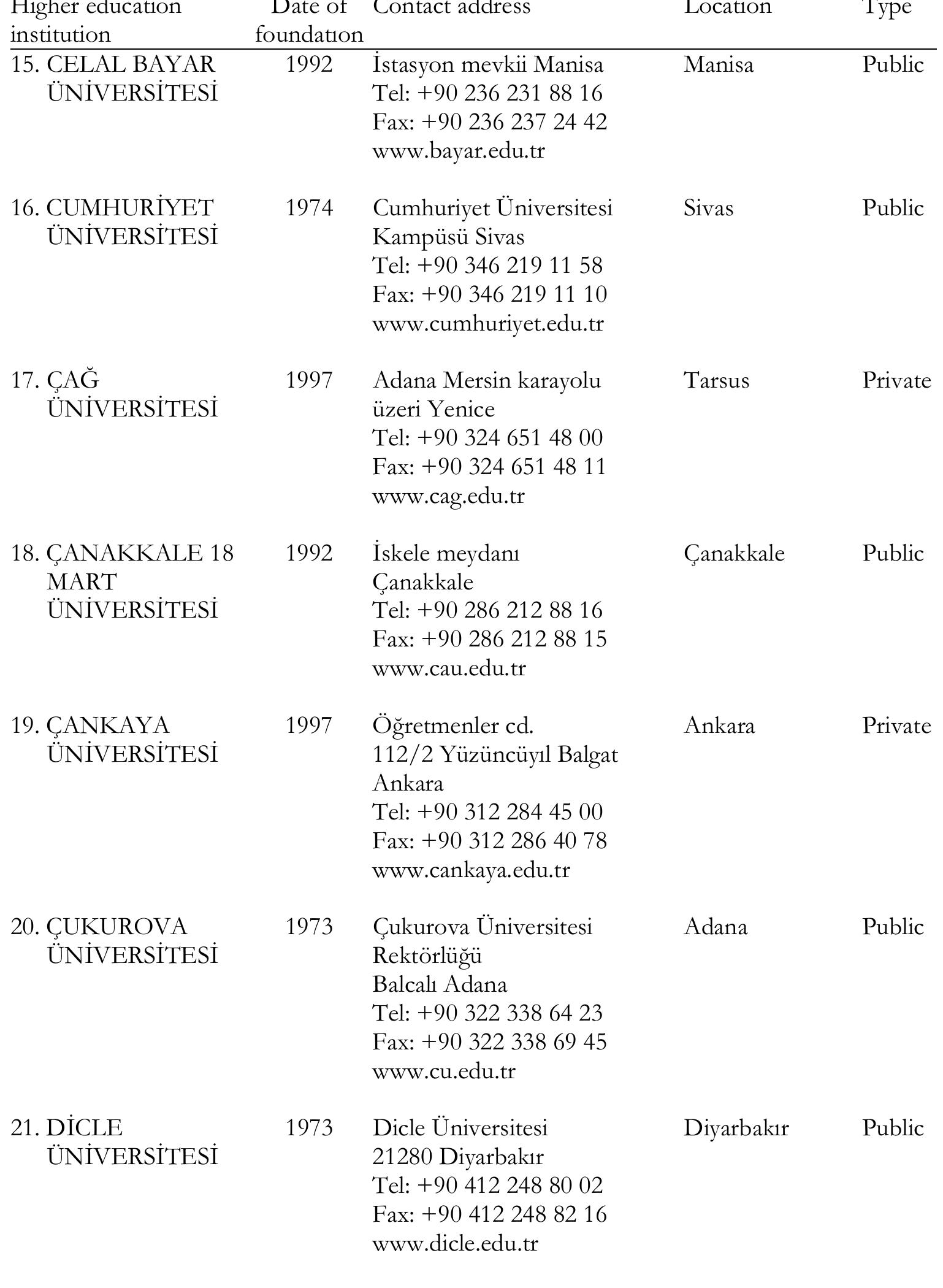
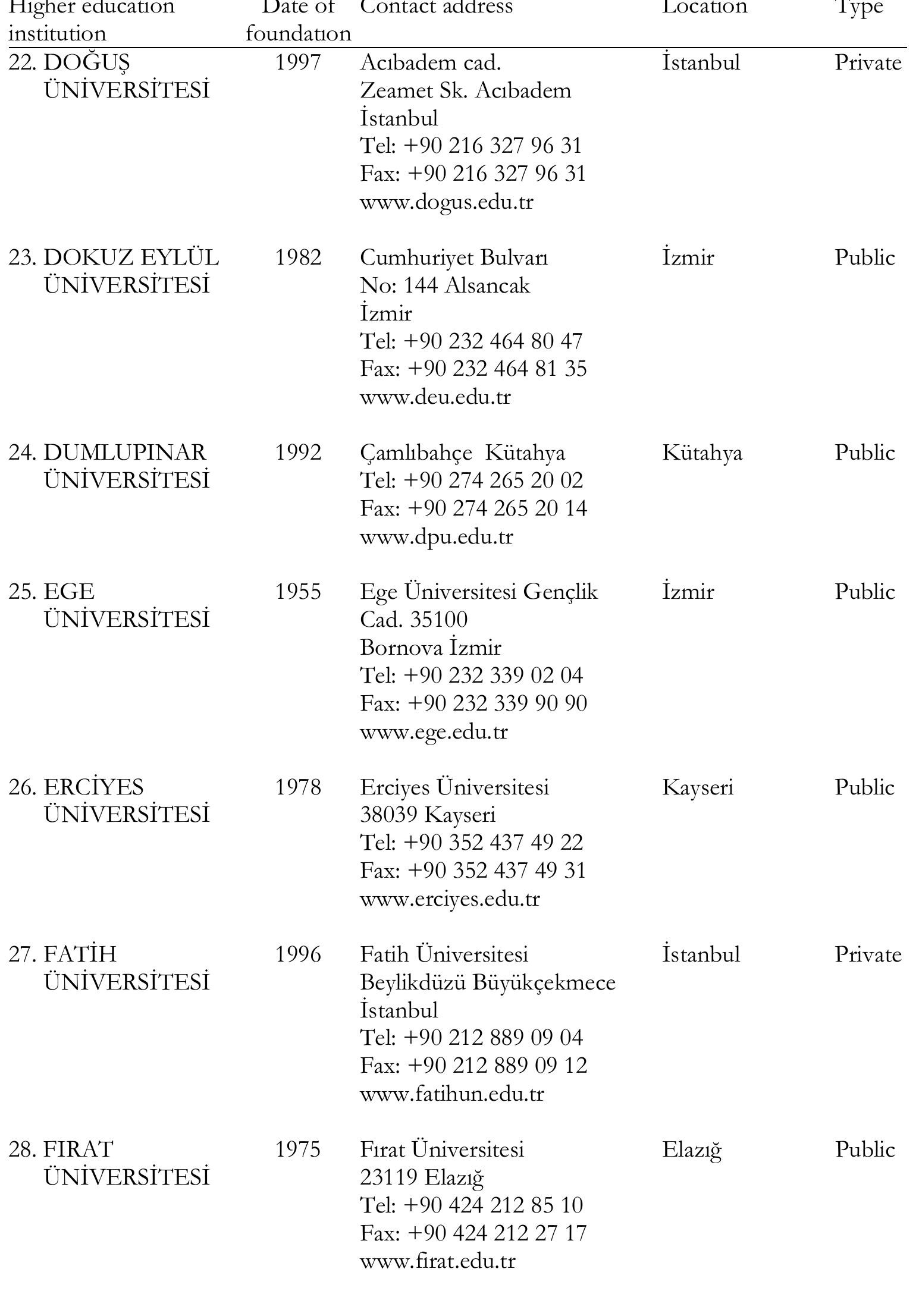
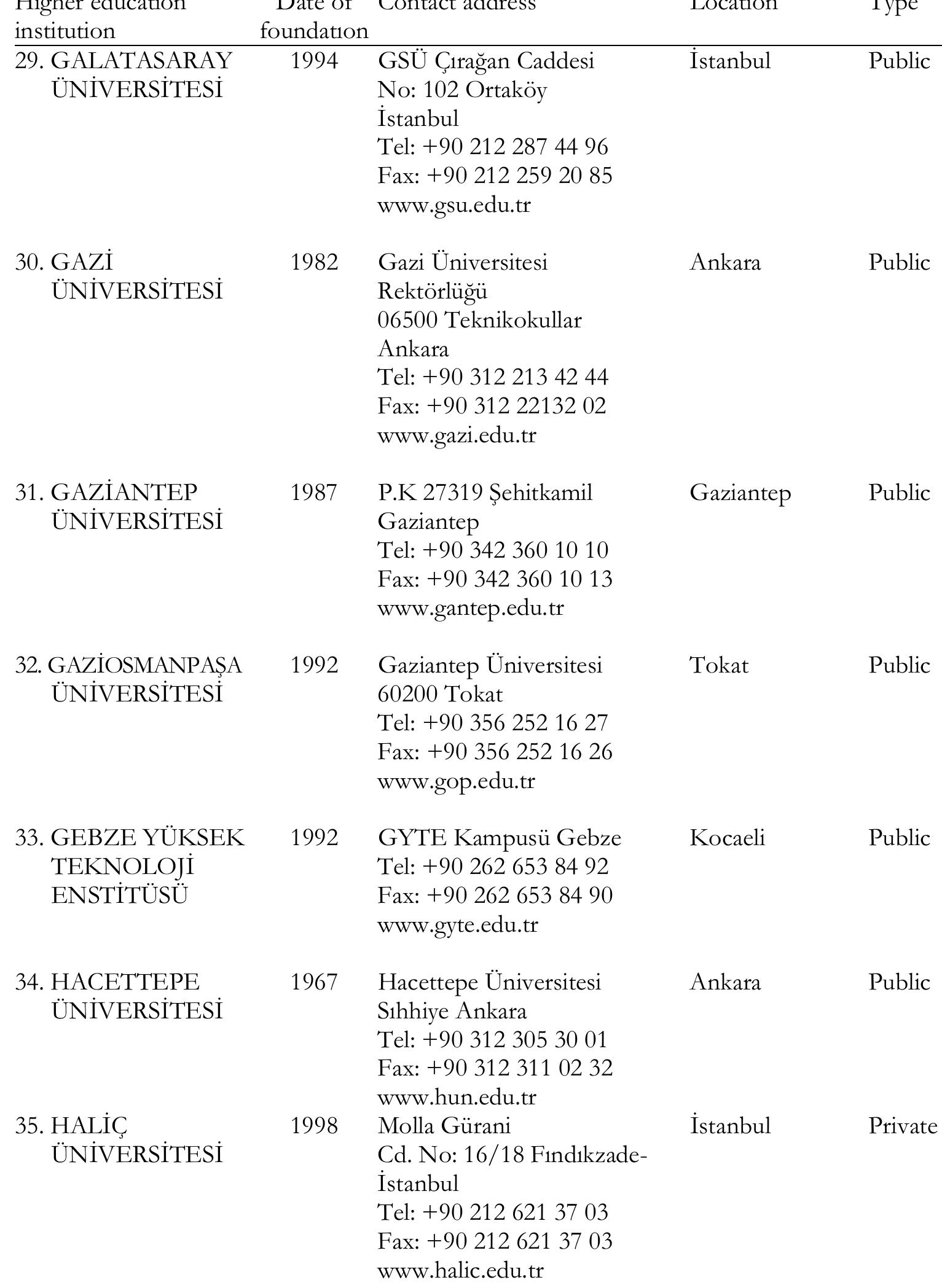
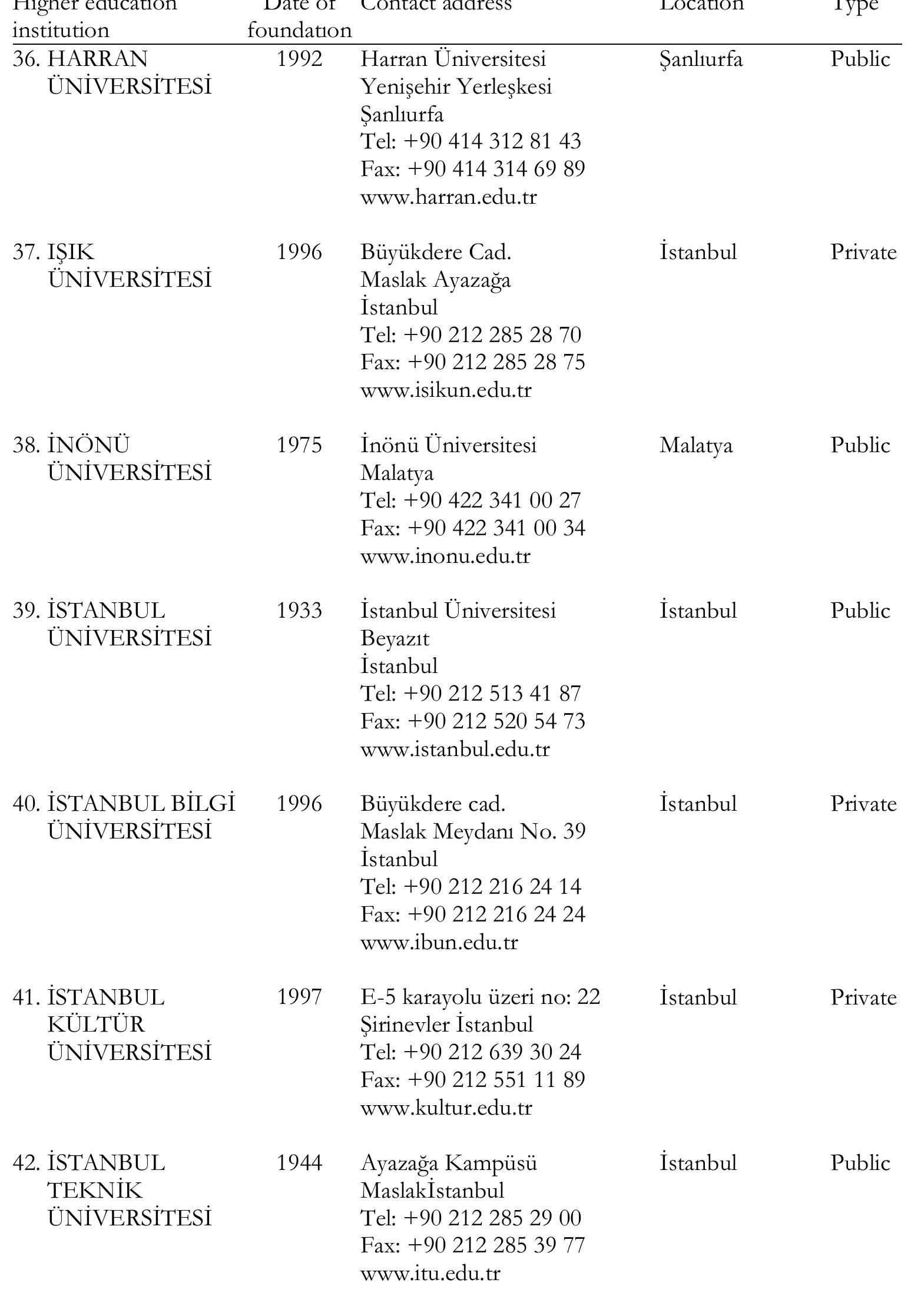
References (43)

  1. ALMQVIST, J., BAUMANN, B., PONTES, P., LAO, B, NEETENS, S., and PUSKÁS, P. European Student Surveys on the Bologna Process. Brussels: ESIB, 2003.
  2. ARAŞTIRMA PLANLAMA VE KOORDINASYON KURULU BAŞKANLIĞI (MEB) [Ministry of National Education Research Planning and Coordination Directorate].
  3. Milli Eğitim Sayısal Veriler 2004 [Statistical Indicators 2004] Ankara: MEB, 2004a.
  4. AYSIT, T. and GÜNGÖR, N.D. "Brain Drain from Turkey: Survey Evidence of Student Non-Return". Working paper 0307. Economic Research Forum. Cairo, 2002. Retrieved on 1 February 2005 from <www.erf.org.eg/ uploadpath/pdf/0307>.
  5. Bologna Process Stocktaking. Report 2005. Report from a working group appointed by the Bologna Follow-up Group to the Conference of European Ministers Responsible for Higher Education, Bergen: 2005.
  6. COMMISSION OF THE EUROPEAN COMMUNITIES. Communication from the Commission to the Council and the European Parliament. Recommendation of the European Commission on Turkey's Progress Towards Accession. COM (2004) 656 Final. Brussels, 2004.
  7. EUROPEAN PARLIAMENT DIRECTORATE-GENERAL FOR RESEARCH (EPDGR). Statistics on Student Mobility within the European Union (Working Paper). Brussels: EPDGR, 2003.
  8. EUROPEAN TRAINING FOUNDATION (ETF). An Overview of Vocational Education and Training in Turkey. Produced with the involvement of Dr. Xavier Matheu. Turin, Italy: ETF, 1999. Retrieved on 26 Apr 2005 from <http://www.etf.eu.int/etfweb.nandf/pages>.
  9. EUROPEAN UNIVERSITY ASSOCIATION (EUA). Salamanca Convention 2001 - The Bologna Process and the European Higher Education Area. Downloadable from <http://www.eua.be/eua/jsp/en/upload/SALAMANCA_final.10693 42668187.pdf>.
  10. GÜRÜZ, K., ŞUHUBI, E., SENGÖR, A.M.C., TÜRKER, K, and YURTSEVER, E. Türkiye'de ve Dünyada Yükseköğretim, Bilim ve Teknoloji [Higher Education, Science and Technology in Turkey and the World]. İstanbul: Tüsiad, 1994.
  11. HIGHER EDUCATION COUNCIL. Selection and Placement of Students in Higher Education Institutions in Turkey. Student Selection and Placement Center (ÖSYM): Ankara, 2000. <http://www.osym.gov.tr/BelgeGoster.aspx?F6 E10F8892433CFFAAF6AA849816B2EFC3C6D81741DBEB05>.
  12. HIGHER EDUCATION COUNCIL. Selection and Placement of Students in Higher Education Institutions in Turkey. Student Selection and Placement Center (ÖSYM): Ankara, 2004.
  13. HIGHER EDUCATION CREDIT AND HOSTELS INSTITUTION (YURTKUR). Retrieved on 25 May 2005 from <http://www.kyk.gov.tr>.
  14. KÖK, M. V. The R&D Actors in Turkey. TÜBİTAK European Union Sixth Framework Programme meetings, 28 June 2004, Paris.
  15. KÜLAHÇI, E. Total Quality Management in Higher Education: A Case Study at Marmara University Engineering Faculty. Unpublished Master's Thesis. İstanbul: Marmara University, 1995.
  16. MACWILLIAMS, B. "Turkey's old-fashioned distance education draws the largest student body on earth: Anadolu University uses radio, TV, and (gulp) mailed material to educate a rural population", The Chronicle of Higher Education, September 22, 2000.
  17. MEDITERRANEAN SCIENCE AND TECHNOLOGY INFORMATION NETWORK (MEDISAT). Retrieved on 30 May 2005 from <http://www.iief.de/ medisat/D1/Turkey1998>.
  18. MIZIKACI, F. "Quality Systems and Accreditation in Higher Education: An Overview of Turkish Higher Education", Quality in Higher Education 9 1 (2003): 95-106.
  19. MIZIKACI, F. "Prospects for European Integration: Turkish Higher Education", Higher Education in Europe 30 1 (2005a): 67-80.
  20. MIZIKACI, F. National Case Study: Turkey. Report presented in the UNESCO- CEPES Conference on Private Higher Education in Europe held on 3-5 November 2005 in Warsaw, 2005b. Unpublished.
  21. ORGANIZATION FOR ECONOMIC CO-OPERATION AND DEVELOPMENT (OECD). Education Policy Analysis 2003. Paris: OECD, 2003.
  22. ORGANIZATION FOR ECONOMIC CO-OPERATION AND DEVELOPMENT (OECD). IT Policy Questionnaire Turkey Report. Ankara: State Planning Organization, 2003. Retrieved 20 20 May 2005 from <www.bilgitoplumu. gov.tr/yayin/oecd_it_policy_questionnaire_turkey.pdf>.
  23. ORGANIZATION FOR ECONOMIC CO-OPERATION AND DEVELOPMENT (OECD). Education at a Glance: OECD Indicators 2004. Retrieved 20 Jan 2005 from <http://www.oecd.org/document>.
  24. TURKISH HIGHER EDUCATION COUNCIL (YÖK). The Law on Higher Education. Ankara: 1981. Retrieved on 01 Nov 2004 from <http://www.yok.gov.tr>.
  25. TURKISH HIGHER EDUCATION COUNCIL (YÖK). Üniversite Öğrencileri Aile Gelirleri, Eğitim Harcamaları, Mali Yardım ve İş Beklentileri Araştırması [A Survey on Income, Education Expenditure, Students Loans, and Job Expectations of University Students]. Ankara: YÖK, 1997. Retrieved on 20 April 2004 from <http://www.yok.gov.tr/egitim/raporlar/ailegel.html>. TURKISH HIGHER EDUCATION COUNCIL (YÖK). THE HIGHER EDUCATION EXPERTISE COMMISSION. Report of the Eight Five-Year Development Plan. Ankara: YÖK, 2000.
  26. TURKISH HIGHER EDUCATION COUNCIL (YÖK). Law No. 4652. Regulations on Graduate Education, 2003. Retrieved on 10 July 2005 from <http://www.yok.gov.tr/yasa/yonet/yonet11.html>.
  27. TURKISH HIGHER EDUCATION COUNCIL (YÖK). Towards the European Higher Education Area Bologna Process: Template for National Reports. Ankara: YÖK, 2004a. Retrieved 15 Nov 2004 from <http://www.yok.gov.tr>.
  28. TURKISH HIGHER EDUCATION COUNCIL (YÖK). Türk Yükseköğretiminin Bugünkü Durumu [Present Situation of Turkish Higher Education]. Ankara: YOK, 2004b. Retrieved on 01 Nov 2004 from <http://www.yok.gov.tr>. TURKISH HIGHER EDUCATION COUNCIL (YÖK). Regulations for Academic Assessment and Quality Improvement at Institutions of Higher Education. Retrieved on 30 May 2005 from <http://www.yok.gov.tr/duyuru/academic_ assessment.pdf>.
  29. TURKISH HIGHER EDUCATION COUNCIL (YÖK). Regulations of Universities Student Councils. Retrieved on 20 May 2005 from <http://www.yok.gov.tr>. TURKISH MINISTRY OF FINANCE. DIRECTORATE OF PRESS AND PUBLIC RELATIONS (14 April 2005). <http://www.maliye.gov.tr/basinhlk/ bilgiedinme/bilgiedinme.htm> TURKISH MINISTRY OF JUSTICE. Law No. 4689. Article 3, Amendment date 26.06.2001, Official Gazette 24451, 3 July 2001. Ankara: Ministry of Justice, 2001. <http://www.mevzuatlar.com/rga/01/07/03temmuz01.htm>.
  30. TURKISH MINISTRY OF JUSTICE. Civil Servants Law No 657. amendment date: 14.07.1965, Official Gazette 12056 (23 July 1965). Ankara: Ministry of Justice, 1965.
  31. TURKISH STATE STATISTICS INSTITUTE (DİE). Hanehalkı İşgücü Anketi Sonuçları [Household Labour Force Survey Results]. Ankara: DIE, 2004.
  32. UNESCO. EFA Global Monitoring Report 2005: The Quality Imperative. Retrieved 01 Feb 2005 from <http://www.efareport.unesco.org> and <http://portal. unesco.org/education/en/ev.php>.
  33. UNITED NATIONS DEVELOPMENT PROGRAMME (UNDP). Human Development Report (HDR). 2003. Retrieved on 02 May 2005 from <http://hdr.undp.org/ statistics/data/cty/cty_f_TUR.html>.
  34. WORLD BANK. The National Education Development Project. Accreditation and Standards in Teacher Education System in Turkey (Teacher Education Series). Ankara: Turkish Higher Education Council and the World Bank, 1999.
  35. YAŞAR, B.B. Vakıf Üniversitelerinin Türk Yükseköğretim Sistemindeki İşlevlerinin ve Eğitim Programlarının Değerlendirilmesi [Assessment of the Functions of Private Universities in the Turkish Higher Education System and Their Educational Programmes]. Unpublished Dissertation. Ankara: YÖK, 2002. Related Links and Reports Bologna Process and Turkey. <http://www.bologna-berlin2003.de/pdf/turkey. pdf>. EuroEducation website. < http://www.euroeducation.net/prof/turkco.htm)
  36. Kara Harp Okulu (Turkish Military Academy). Retrieved March 26, 2005 from <http://WWW.KHO.EDU.TR>.
  37. KIRSCH, M., BEERNAERT, Y., and NØRGAARD, S. Tertiary Short Cycle Education in Europe (EURASHE, May, 2003).
  38. MEDA. Euro-Mediterranean Partnership Programme. Retrieved May 09, 2005 from <http://europa.eu.int/comm/external_relations/euromed/meda.htm>.
  39. Polis Akademisi (Turkish Police Academy). Retrieved March 26, 2005 from <http://www.pa.edu.tr>.
  40. ÖSYM. Student Selection and Placement Center. < http://www.osym.gov.tr>. STUDENT SELECTION AND PLACEMENT CENTRE (ÖSYM). Retrieved on 20 September 2005 from <http://www.osym.gov.tr/altyapi/dosyagoster. aspx?DIL=1&BELGEANAH=6705&DOSYAISIM=OSYS_ilgili.pdf>.
  41. TÜBİTAK. The Scientific and Technical Research Council of Turkey. <http://www. tubitak.gov.tr>.
  42. ULAKBİM. Turkish Academic Network and Information Center. <http://www. ulakbim.gov.tr/eng>.
  43. YÖK. The Council of Higher Education of the Republic of Turkey <http://www.yok.gov.tr>.
Last updated
"Lucian Blaga" University of Sibiu, Department Member
Papers
75
Followers
420
View all papers from Peter J Wellsarrow_forward