Journal of Southeast Asian Studies
http://journals.cambridge.org/SEA
Additional services for Journal of Southeast Asian Studies:
Email alerts: Click here
Subscriptions: Click here
Commercial reprints: Click here
Terms of use : Click here
Protestant conversion and social conict: The case of the
Hmong in contemporary Vietnam
Tam T.T. Ngo
Journal of Southeast Asian Studies / Volume 46 / Issue 02 / June 2015, pp 274 - 292
DOI: 10.1017/S0022463415000089, Published online: 05 May 2015
Link to this article: http://journals.cambridge.org/abstract_S0022463415000089
How to cite this article:
Tam T.T. Ngo (2015). Protestant conversion and social conict: The case of the Hmong in
contemporary Vietnam. Journal of Southeast Asian Studies, 46, pp 274-292 doi:10.1017/
S0022463415000089
Request Permissions : Click here
Downloaded from http://journals.cambridge.org/SEA, IP address: 77.8.167.27 on 06 May 2015
274
Journal of Southeast Asian Studies, 46(2), pp 274–292 June 2015.
© The National University of Singapore, 2015 doi:10.1017/S0022463415000089
Protestant conversion and social conflict: The case of
the Hmong in contemporary Vietnam
Tam T.T. Ngo
This article analyses the social implications of the recent mass conversions to
Protestantism by one-third of the one million Hmong in Vietnam. The conversions
have been condemned by the Vietnamese state, while being understood by inter-
national human rights activists as acts of conscience on the part of the Hmong con-
verts. This article focuses on the internal debate and divisions surrounding conversion
among the Hmong themselves. The converts believe that Protestantism is the only way
to alter the ethnic group’s marginal status in Vietnam while the unconverted Hmong
see conversion as a betrayal of Hmong ethnicity. Such conflicting views have been
causing deep fractures in Hmong society.
One sunny day in late November 2004, during a visit to Windy Plateau,1 I acci-
dentally came across a crowd of nearly one hundred Hmong marching toward the
local commune’s People’s Committee office nearby. Near the front of the crowd
was a buffalo drawing a wooden cart in which sat a man whose hands had been
tied behind his back. As the crowd came closer to the building, people became
more and more excited. The wooden cart stopped in the front yard. Several young
men came forward and dragged the bruised man out from the cart. They made
him kneel in the yard, where people quickly encircled him. Somehow, I found myself
standing close to the innermost circle, along with my Hmong assistant. A man who
looked like a local official wormed his way through the crowd and halted right in front
of us. Pointing his finger at the kneeling man, he shouted in Hmong: ‘Talk! Confess
your lies.’ There was no response. The man shouted again several times and many
Tam T.T. Ngo is a Postdoctoral Research Fellow at the Max Planck Institute for the Study of Religious
and Ethnic Diversity, Göttingen. Correspondence in connection with this article should be addressed to:
[email protected]. The author would like to thank Peter van der Veer, Philip Taylor, John Chapman,
Hue-Tam Ho Tai, Oscar Salemink, Nguyen Van Huy, Birgit Meyer, and the two anonymous readers of
JSEAS for their comments, suggestions, and editorial work. A special note of gratitude goes to Nicholas
Tapp for his thoughtful and insightful comments on several versions of this article. I would like to thank
the Department of Social and Cultural Anthropology at the Vrije Universiteit Amsterdam, the
Netherlands Organisation for Scientific Research (NWO), the Amsterdam Institute for International
Development (AIID), the Southeast Asian Summer Study Institute (SEASSI) at the University of
Madison, Wisconsin, and the Max Planck Institute for the Study of Ethnic and Religious Diversity,
for their institutional and financial support.
1 Place and personal names have been changed or omitted to protect the identities of those who brought
me there and are also involved in the story.
PROTESTANT CONVERSION AND SOCIAL CONFLICT 275
others joined him. Still, there was no response. Keeping his eyes tightly shut, the
kneeling man lowered his bruised face. His body trembled. Drops of sweat rolled
down his temples. It was almost midday. The sun began to burn, but because of
the plateau’s altitude, the air was still cold. When the shouting died down a bit, an
older man nearby pointed at the kneeling man and said, ‘Yesterday he said Vaj
Tswv is very powerful. He can protect anyone who follows him. Let’s tie him tighter
and see how his God can help him.’ Right away, two young men came with another
rope and tightened it around the man’s arms closer to his elbows. The man bit his
lower lip, but as the rope reached his elbows, his arms became seriously twisted,
and he let out a scream. Tears ran down his cheeks as he cried out, ‘I confess. I con-
fess. I lied.’
As I gathered from my assistant’s translation of the trembling confession, from
members of the crowd, and from other local people, the kneeling man, whom I
shall call Giang Seo Lử, was a Christian Hmong from Sơn La province. He had arrived
in Windy Plateau the previous day and stayed with a family of the Giang clan in the
commune. From the moment he arrived, he had only talked to the family about Vaj
Tswv and why they should all follow Vaj Tswv’s way. Feeling that the family was lis-
tening to him, Giang Seo Lử urged them to go and call on other families to spread his
message. He also suggested that his host kill one of his chickens for their dinner. The
family complied, but were not happy. The next morning, his host secretly sent his son
to the commune’s security officials, who quickly came to arrest Giang Seo Lử. At first,
they just kept him at his host’s house and challenged him about the veracity of his
claims about the New Way, Christianity. When Giang Seo Lử refused to back
down, insisting on how powerful his Christian brothers and sisters were, not only
in Vietnam but also abroad, he began to irritate the security officials, who started
to beat him up. It was at that point that the head of the commune — the man
who would later make his way through the crowd and demand that Giang confess
— arrived and immediately stopped the beating. He ordered the others to bring
Giang to the People’s Committee office so that he could confess his lies in public.
This shocking incident in Windy Plateau was just the beginning of what I came
to witness as the disturbing consequences of Protestant conversion among the Hmong
community in Northern Vietnam. The conversion to Protestantism by hundreds of
thousands of Hmong in Vietnam is perhaps the most striking of all the changes
that have affected this ethnic group in the last few decades. This religious movement
started in 1989 with a small number of Hmong Protestants, but rapidly spread; rough-
ly one-third of a million Hmong now refer to themselves as Protestant, while the rest
of the Hmong see themselves as ‘traditional Hmong’ (Hmoob uas kev lig kev cai).
Crucially, despite the great importance of ethnic solidarity nurtured by virtually all
Hmong people, conversion has ripped apart many families, clans, and communities.
Although up until my last visit to the field in 2011 anti-Christian conflicts appeared to
have become less violent, certainly in comparison to the incident above, they
remained prevalent.
The widespread conversions have unintentionally led to ongoing social conflict
within the Hmong community. This discord has given the Vietnamese state author-
ities one more reason to suppress this religious movement. While missionaries and
international human rights advocates respectively praise the conversions and converts
276 TAM T.T. NGO
as the miraculous work of God or a sign of human agency,2 the state views it as a
troublesome phenomenon in various ways. While acutely recognising the socio-
cultural problems which conversion causes for both the converted and unconverted
Hmong, the government fails to acknowledge the importance of human agency in
this religious movement.
The official view is clearly filtered through and reinforced by many Vietnamese
scholars who argue that the Hmong people, with their extreme ‘economic poverty’
(nghèo đói), their socio-cultural ‘backwardness’ (đời sô´ng văn hóa xã hội còn lạc
hậu), and ‘superstitious mentality’ (đâu ̀ óc còn đâỳ mê tín di ̣ đoan), are ‘lured’ (bi ̣
lợi dụng) into following a religion foreign to their cosmology and beyond their com-
prehension.3 In the view of such scholars, the illegal missionaries and foreign-linked
activists are predators who use religion to provoke ethnic conflicts and anticommu-
nism and create social and political instability.4 Social conflict in the Hmong commu-
nity is cited as evidence of the problematic nature of conversion. Some state-employed
analysts view the Hmong as simple-minded and illiterate, questioning their capacity
to acquire, understand, and internalise the rather abstract Christian teachings.5
Questioning the converts’ ability to understand and absorb religious doctrine in
turn implies that the Christian Hmong are not committed to their new faith. Such
perspectives on conversion become truly problematic when they form the basis of pol-
icies designed to distract the Hmong from Protestantism. Hmong areas where conver-
sions have occurred have been subject to strict censorship and prohibition of
evangelical missions on the one hand, along with development, education, and polit-
ical propaganda programmes on the other. Yet these socio-cultural and economic
2 See for example, http://freedomhouse.org/religion/news/bn2003/bn-2003-10-01.htm; http://www.
evangelicalfellowship.ca/pch/alert_viewer.asp?Alert_ID=103 (last accessed 1 Nov. 2013); and http://www.
christianpost.com/news/vietnam-tries-to-portray-cult-gathering-as-christian-50143/ (last accessed 11 Feb
2015). Hmong conversion is often used by these organisations to criticise Vietnam’s religious policies.
The United States has also designated Vietnam a ‘Country of Particular Concern’ under the International
Religious Freedom Act in 2004, 2005, and 2014: http://www.uscirf.gov/sites/default/files/Vietnam%
202014.pdf.
3 Nghiem Van Dang, ‘Vê ̀ Việc Truyêǹ Bá Đạo Vàng Chứ Hay Giả Tinh Lành’ [About the proselytisa-
tion of the Vang Chu cult or fake-Protestantism], in Nhu˜ ̛ng Vâ´n Đê ̀ Liên Quan Đê´n Hiện Tươn
̣ g ‘Vàng
Chứ’ [Issues relating to the ‘Vàng Chứ’ phenomenon] (Hanoi: Institute of Religious Studies, 1998); Huu
Son Tran, Văn Hóa Hmong [The culture of the Hmong] (Hanoi: Nha Xuat Ban Van Hoa Dan Toc,
1996); Duy Quang Vương, ‘Ý Kiê´n Của Một Cán Bộ Người Hmong Vê ̀ Vâ´n Đê ̀ Người Hmong Theo
Đạo Hiện Nay’ [Opinion of a Hmong cadre on the issue of Hmong conversion], in Nhu˜ ̛ng Vâ´n Đê ̀
Liên Quan Đê´n Hiện Tươn ̣ g ‘Vàng Chứ’; Duy Quang Vương, Văn Hóa Tâm Linh Của Người Hmông
Ở Việt Nam Truyêǹ Thô´ng Và Hiện Tại [The spiritual culture of the Hmong in Vietnam: Past and pre-
sent] (Hanoi: Cultural Publishing House and Institute of Cultural Studies, 2005).
4 Government Committee for Religious Affairs, Religion and policies regarding religion in Vietnam
(Hanoi: Government Committee for Religious Affairs, 2006). See also Oscar Salemink, ‘Enclosing the
highlands: Socialist, capitalist and Protestant conversions of Vietnamese highlanders’, paper presented
at the Politics of the commons: Articulating development and strengthening local practices conference,
Chiang Mai, 2003, http://hdl.handle.net/10535/1787 (last accessed 1 Nov. 2013); Oscar Salemink,
‘Christian conversion in Southeast Asian uplands: A comparative exploration’, paper presented at
EUROSEAS conference, Paris, 2004; Tam T.T. Ngo, ‘The New Way: Becoming Protestant Hmong in con-
temporary Vietnam’ (Ph.D. diss., Vrije Universiteit Amsterdam, 2011).
5 Dang, ‘Vê ̀ Việc Truyêǹ Bá Đạo Vàng Chứ Hay Giả Tinh Lành’; Vương, Văn Hóa Tâm Linh Của
Người Hmông Ở Việt Nam.
PROTESTANT CONVERSION AND SOCIAL CONFLICT 277
policies do not pay enough attention to the religious needs of the Hmong and con-
sequently have little chance in succeeding.
In the vast and fast-growing literature on ethnic minorities in Asia, conversion to
various Christian denominations is often seen as an act of redrawing ethnic bound-
aries. C.A. Kammerer, for example, observes that the practices of Christianity
among tribal minorities of Southeast Asia and China have resulted in ‘dialogues of
identity’.6 One such dialogue is inter-ethnic, with dominant lowland majorities, in
which Christian conversion and affiliation are claims to difference and equality.
The other type of dialogue is intra-ethnic, in which tribal Christians also engaged
in dialogues of identity with traditionalist members of their own group, as in the
Akha studied by Kammerer.7
Protestant conversion has also generated multiple dialogues on Hmong identity. I
have analysed in detail elsewhere the inter-ethnic dialogue in which conversion to
Protestantism is the way in which many Hmong converts in Vietnam seek to distance
themselves from their marginal and subordinate position in relation to the Kinh,
Vietnam’s dominant lowland group. I have also showed how Protestant conversion
promised them a double membership, of the global Protestant community and of a
transnational Hmong community, both imagined to be beyond Vietnam.8 In this art-
icle, I focus instead on the intra-ethnic dialogue on Hmong conversion, which as the
vignette at the beginning of the article shows, is not limited to discussion. By exam-
ining both the physical and discursive aspects of this dialogue, I hope to demonstrate
that both conversion and resistance to Christianity have been intimately influenced by
the establishment of Kinh political and cultural domination; the resistance to such
domination; and other aspects of Hmong–Kinh power relations. Similarly, the diffu-
sion and ultimate institutionalisation of religious innovations within a society are sig-
nificantly affected by its internal power relations. It is important to take into
consideration the agency of both those who choose to convert and those who refuse
to do so.
The material presented in this article comes from my ethnographic fieldwork.9 I
shall explore how social divisions and conflicts can be traced back to the different,
sometimes contrasting, perceptions of Protestantism and of the act of conversion
by the Hmong. I shall show how these views interrelate and interact, how this in
turn affects the outcome of and/or resistance to conversion, and, last but not least,
how both conversion and resistance to Christianity are related to various dilemmas
6 C.A. Kammerer, ‘Customs and Christian conversion among Akha highlanders of Burma and
Thailand’, American Ethnologist 17, 2 (1990): 277–91, and ‘Discarding the basket’: The reinterpretation
of tradition by Akha Christians of Northern Thailand’, Journal of Southeast Asian Studies 27, 2 (1996):
320–33.
7 Kammerer, ‘Customs and Christian conversion among Akha’.
8 Tam T.T. Ngo, ‘Ethnic and transnational dimensions of recent Protestant conversion among the
Hmong in Northern Vietnam’, Social Compass 57, 3 (2010): 332–44.
9 I carried out fieldwork, mainly participant observation and extensive interviews, for fifteen months in
Vietnam and six months in the United States, along with eight short field trips to the other side of the
Chinese border, one visit to Chiang Mai, Thailand, and one trip to several provinces in Laos. I studied the
Hmong language at Madison, Wisconsin in 2006, while visiting Hmong communities in Milwaukee,
Sheboygan, Wausau, St. Paul, and Minneapolis. The contacts established in that year formed the core
of my fieldwork networks in 2008.
278 TAM T.T. NGO
that the Hmong face in contemporary Vietnam. But first, let me provide a brief over-
view of the Hmong, their traditional religion, and how they were introduced to
Evangelical Protestantism.
The Hmong and Protestantism
In 2009 there were 1,068,16910 Hmong in Vietnam; they belong to one of the
country’s 54 officially recognised ethnic groups. Originally from China, where they
are members of the Miao group, the Hmong migrated to Vietnam during the nine-
teenth and twentieth centuries and made their home in the highlands near the border
between Vietnam and China. Based on some minor distinctions in their customs and
the colour of their clothing, the Hmong are divided into a few subgroups or ‘cultural
divisions’, to borrow Robert Cooper’s term.11 Although several dialects are spoken by
the different Hmong groups, most of them are closely related. The group discussed
here refer to themselves as the ‘Flower Hmong’ — Hmoob Leeg in the Hmong
Romanised Popular Alphabet (HRPA).12
Most Hmong traditionally believe in ancestral spirits dwelling in realms such as
houses, forests, mountains, rivers, who can be contacted by shamans. Many also
believe in the existence of Fuab Tais, their mythical saviour, who is also known as
Vaj Tswv.13 Enshrined in Hmong folklore as the ‘Lord of the Sky’, Fuab Tais has
been at the core of their messianism, which is based on the belief that in time imme-
morial the Hmong had their own country somewhere in China. Ruled by a kind-
hearted and powerful Hmong king, the kingdom was prosperous and unified. The
Hmong had their own writing. Then, as the story goes, the evil Han Chinese came,
10 National Population and Housing Census Directing Committee, ‘Appendix ii’, in Official Report of
the Result of National Population and Housing Census 01/04/2009 (Hanoi: National Population and
Housing Census Publishing House, 2009).
11 Robert Cooper, Resource scarcity and the Hmong response: Patterns of scarcity and economy in tran-
sition (Singapore: Singapore University Press, 1984), p. 28; Tran, Văn Hóa Hmong.
12 In this article, I use HRPA, which was invented and improved by a number of Catholic and
Protestant missionaries in the 1950s and used to transcribe the Bible and other religious materials.
HRPA has been widely adopted by the Hmong in Laos and Thailand as well as in the West (mostly
in North America, France, and Australia). In China and Vietnam this script was only adopted in the
early 1990s, thanks to increasing contact with the Hmong diaspora, Hmong-language media, and reli-
gious materials. See Joakim Enwall, ‘Hmong writing systems in Vietnam: A case study of Vietnam’s
minority language policy’ (Stockholm: Working paper No. 40, Center for Pacific Asia Studies at
Stockholm University, 1995).
13 Fuab Tais (or Huab Tais) means ‘great ruler, emperor, legendary Hmong King, Lord’. See Ernest E.
Heimbach, White Meo–English dictionary (Ithaca: SEAP Data Paper No. 75, Cornell University, 1969),
p. 56, and Thomas A. Lyman, Dictionary of Mong Njua, a Miao (Meo) language of Southeast Asia
(The Hague: Mouton, 1974), p. 115. The term is often used to address the supreme deity Fuab Tais
Ntuj (Lord of the sky), which Catholic priest Yves Bertrais translated as equivalent to the Christian
God in Dictionnaire Hmong–Français (Vientiane: Mission Catholique, 1964). Vaj means king and
Tswv means lord, master, owner, or proprietor; together, the words usually refer to God. Vietnamese
scholars insist that Vàng Trứ (Vaj Tswv) originates in the Chinese expression ‘Miao Wang Chu Shi’
(Miêu Vương Xuâ´t Thê´; ‘the Hmong King is coming’), probably used in documents about the Hmong
involvement in millenarian movements in southwest China. I agree with Nicholas Tapp (pers. comm.,
Dec. 2005), however, that it is flawed to translate Vaj Tswv as ‘the King comes’ as neither the Hmong
nor the Chinese would construct such a linguistically incomplete expression. See also Nicholas Tapp,
Sovereignty and rebellion: The White Hmong of Northern Thailand (Singapore: Oxford University
Press, 1989).
PROTESTANT CONVERSION AND SOCIAL CONFLICT 279
treacherously trapped and killed the beloved king, and stole their writing.14 Ever since,
the Hmong have lived in exile, in a state of suffering and illiteracy. However, the king
announced before his death that he would return one day to rescue his people from
their lives of suffering and bring back the righteous Hmong kingdom and its magical
script. This messianic belief has fuelled Hmong involvement in numerous millenarian
movements in the past.15 In Vietnam this messianic tendency continues to arouse
state suspicion and suppression.
Some Hmong groups in China, Vietnam, Thailand, and Laos have been
Christianised since the late nineteenth century. In early-twentieth-century China,
Samuel Pollard of the Bible Christian China Mission wrote about thousands of A
Hmao in Yunnan (a subgroup of the Miao closely related to the Hmong), whom
Pollard himself brought to Jesus Christ. Pollard mentions that poverty and political
and social suppression at the hands of Yi landlords made the A Hmao particularly
appreciative of the Protestant missionaries’ material and political support.16 But
mass conversion only came about when thousands of A Hmao read the Bible —
translated into a Miao vernacular script that Pollard had devised based on their spo-
ken language — as their long-lost book now returned to them.
In French Indochina, Catholicism was promoted by the colonial authority, but
missionary work among the Hmong in both Vietnam and Laos had only modest
results.17 Besides compiling the massive monograph Histoire des Miao, Francis
Savina, the French missionary who came to open a parish in the hill station of Sa
Pa, Lào Cai province, could only convert some dozen Hmong families in the area
to Catholicism.18 Despite having had little influence on the sociocultural life of the
Hmong, the few early conversions and the presence of two Catholic churches in Sa
Pa and Tram Tau have often been cited by Vietnamese authors as evidence of
Hmong willingness to accept colonial rule.19
14 James Scott in The art of not being governed: An anarchist history of upland Southeast Asia (New
Haven, CT: Yale University Press, 2009) argues that for the Hmong as well as other ethnic minorities
in Zomia who share this myth about the loss of literacy, the legibility of the state was best resisted by
deliberately dispensing with the written arts. In Sovereignty and rebellion, Tapp provides an alternative
reading of this narrative of literacy loss as a manifestation of the Hmong’s inferiority complex
vis-à-vis the highly literate Chinese which tells us more about upland peoples’ knowledge of writing
in nearby state systems.
15 Millenarian beliefs have been a feature of Chinese religions and continue to be manifested in groups
like the Hmong which migrated to Southeast Asia. Hue-Tam Ho Tai states in Millenarianism and peas-
ant politics in Vietnam (Cambridge, MA: Harvard University Press, 1983) that the Miao were known for
their tradition of rebellion, which often went hand in hand with millenarianism. Robert Jenks, in
Insurgency and social disorder in Guizhou: The ‘Miao’ Rebellion, 1854–1873 (Honolulu: University of
Hawai‘i Press, 1994), pp. 58–73, points out that less than half of the followers of the
late-nineteenth-century ‘Miao Rebellion’ in China were Miao, the majority being Han or other
non-Miao. Millenarian religion, Jenks argues, offered justifications for the non-Miao crossing ethnic
boundaries to participate in the rebellion as well as its organisational framework.
16 Samuel Pollard, The story of the Miao (London: Henry Books, 1919) and Tight corners in China
(London: Andrew Crombie, 1921).
17 Jean Michaud, ‘French missionary expansion in colonial Upper Tonkin’, Journal of Southeast Asian
Studies 35, 2 (2004): 287–310.
18 Francis Savina, Histoire des Miao (Paris: Société des Missions-Étrangères, 1924); Tran, Văn Hóa
Hmong.
19 Tran, Văn Hóa Hmong; Dang, ‘Vê ̀ Việc Truyêǹ Bá Đạo Vàng Chứ Hay Giả Tinh Lành’.
280 TAM T.T. NGO
Protestant missionaries (mostly from the American Baptist churches and the
Christian and Missionary Alliance) also explored potential converts in upland
Indochina. While their work yielded some small success among the Hmong popula-
tion in Laos,20 there were no reported Protestant conversions of the Hmong in Upper
Tonkin (Northern Vietnam).21 It was only in the early 1990s that the Vietnamese
state authorities were suddenly alarmed by reports about thousands of Hmong who
had abandoned their traditional beliefs to convert to Protestantism, called ‘the New
Way’ (Kev Cai Tshiab) in Hmong or the ‘Good News Religion’ (Đạo Tinh Lành)
in Vietnamese.
This mass conversion to Protestantism among the Vietnamese Hmong was not
due to the intense missionary efforts that have been reported elsewhere, however.22
Instead, conversion was initiated by accidental listening to an Evangelical radio sta-
tion, the Far East Broadcasting Company (FEBC). In the late 1980s FEBC, a
California-based radio ministry, began a proselytising programme in the Hmong lan-
guage, produced by Hmong preachers in California, but aired from its broadcasting
station in Manila. The programme was not meant for Hmong listeners in Vietnam,
but for Laotian Hmong, who were hiding in the jungles of Laos or waiting in
refugee camps in Thailand. After the Secret War in Laos, hundreds of thousands of
Hmong became refugees in the West, the majority resettling in the United States.23
Although these Hmong came mainly from Laos, their ethnic networks extended
well beyond that country’s national boundaries. As part of an older diaspora, the
Hmong in Vietnam share with their Laotian, Thai, and Burmese counterparts a his-
tory of southward migration from China and a memory of a historic homeland, both
of which influence messianic tendencies.24 There are interesting connections between
overseas Hmong groups with those left behind in Southeast Asia; many of these twice
migrants have close links to Christian broadcasting radio. FEBC makes use of the
emotional repertoire of the Hmong migrant experience to win the sympathy and
hearts of the Hmong in Asia. A number of Hmong in Vietnam have told me how con-
vincing, heartening, and moving it is to listen to these programmes. ‘Never anywhere
else can you find such empathy. They know all our sentiments, emotions, thoughts
and it seems that they live here with us daily to witness our daily hardship and needs.’
It was by accident that the message about Vaj Tswv, the name that FEBC broad-
casters consistently use to refer to God, was caught by short-wave receivers owned by
Hmong in the highlands of Vietnam. At first, Hmong listeners primarily interpreted
20 See George Linwood Barney, ‘Christianity and innovation in Meo culture: A case study in missioni-
zation’ (M.A. diss., University of Minnesota, Minneapolis, 1957).
21 Tran, Văn Hóa Hmong; James F. Lewis, ‘The Evangelical religious movement among the Hmong of
Northern Vietnam and the government response to it: 1989–2000’, Crossroads: An Interdisciplinary
Journal of Southeast Asian Studies 16, 2 (2002): 79–112.
22 Siu-woo Cheung, ‘Millenarianism, Christian movements, and ethnic change among the Miao in
southwest China’, in Cultural encounters on China’s ethnic frontiers, ed. Steven Harrell (Seattle:
University of Washington Press, 1993), pp. 217–47; Jean Comaroff and John Comaroff, Of revelation
and revolution: Christianity, colonialism and consciousness in South Africa (Chicago: University of
Chicago Press, 1991); Webb Keane, Christian moderns: Freedom and fetish in the mission encounter
(Berkeley: University of California Press, 2007).
23 In 2010, there were approximately 260,000 Hmong in the United States; http://www.census.
gov/prod/cen2010/briefs/c2010br-02.pdf.
24 Tapp, Sovereignty and rebellion.
PROTESTANT CONVERSION AND SOCIAL CONFLICT 281
as messianic the messages broadcast by FEBC, which skilfully employed an ‘indigen-
ization of Christianity’25 by weaving biblical stories into Hmong folklore. Identifying
the Christian God with their mythical messiah Fuab Tais/Vaj Tswv prompted thou-
sands of Vietnamese Hmong to join various millenarian movements. When Hmong
broadcasters identified Vaj Tswv as the father of Jesus Christ and emphasised that
believing in Vaj Tswv requires believing in Jesus Christ as well, thousands upon thou-
sands of Vietnamese Hmong began the arduous journey to become Protestants.26
Today, after two decades of massive growth, Protestantism is the claimed religion
of roughly one-third of a million Hmong in Vietnam.
Conversion
In answer to my question about why he become a Christian, a former shaman in
his 60s told me:
Twenty years ago, when I was still living in Bac Ha, my father passed away. At that time I
could still do a ‘fresh funeral’ (laig dab) for him. I planned to do the ‘dried funeral’ (nyuj
dab) for him a few years later once I had more money. But then we had three more children
and the last one was sick all the time. Most of the chickens we raised were used to do ua
neeb [shamanic healing ritual]. Once we even had to sacrifice a young buffalo when the
spirit tortured my son by making him both hot and cold. It even took his soul away some-
times. Luckily the spirits did not ask for a white buffalo because — I remember — there was
no white buffalo in the whole region. But my child died anyway. We lost everything, our son
and all the money we saved for doing nyuj dab for my father. My uncles and brothers con-
stantly asked me to be ready soon to perform the ceremony. So in 1990, when communal
cadres told us that the soil in Phong Hai was much richer than in Bă´c Hà, that we could
grow more maize and rice, we could also join the state-owned tea farm and we could have a
regular income in cash — opium was not allowed to be grown there anymore — we moved.
But five years later I still could not do nyuj dab for my father because we did not have that
much more maize to sell and no cash income because we could not speak Vietnamese well
enough to work with Kinh people. We could raise barely enough pigs for family use
let alone have spare ones to sell because the weather is much hotter here than up there
in Bă´c Hà. So not only did we get sick more often but so did our pigs. Around that
time, I heard from Hmong radio [FEBC] that if I prayed to the Lord about our difficulties,
he would protect us so that we would not have to do nyuj dab and still not suffer any pun-
ishment. In 1996, after some consideration, we signed the form that my wife’s friend gave us
to register at the Protestant Church in Hanoi.27
In this narrative, the shaman’s decision to convert to Christianity was not induced by
a miraculous or tragic experience, but by the economic and spiritual distress that his
25 Lewis, ‘The Evangelical religious movement’; Charles Keyes, ‘Being Protestant Christian in Southeast
Asian worlds’, Journal of Southeast Asian Studies 27, 2 (1996): 280–92; Salemink, ‘Christian conversion in
Southeast Asian uplands’; Tran, Văn Hóa Hmong; Anthony Walker, Merit and the millennium: Routine
and crisis in the ritual lives of the Lahu people (New Delhi: Hindustan Publishing Corp., 2003)
26 See further Tam T.T. Ngo, ‘The short-waved faith: Christian broadcastings and the transformation of
the spiritual landscape of the Hmong in Northern Vietnam’, Mediated piety: Technology and religion in
contemporary Asia, ed. K.G. Francis Lim (Leiden: Brill, 2009).
27 Interview, Phong Hai, 18 Jan. 2005.
282 TAM T.T. NGO
family suffered at the end of the 1980s and the beginning of the 1990s. The shaman’s
conversion to Christianity cannot be divorced from his membership of a poor and
marginalised ethnic group. The end of the 1980s and the beginning of the 1990s
were the beginning of a difficult time for the majority of Hmong in Vietnam. Since
the economic reforms began in 1986, many subsidised programmes in the mountain-
ous regions were deregulated. From then on, the Hmong and other ethnic groups had
to pay cash for necessities such as salt, sugar, medicines, at the price demanded by
itinerant traders. Opium, which had been until then the main source of cash income
for Hmong families, was soon banned. Shortly after that, the National Land Law
implemented in 1993 imposed tighter conditions and stricter regulations on land
use. In mountainous areas, the Law designated that each family could only claim
usage of up to 10 hectares of forest land which, like all land in Vietnam, belongs to
the state. In reality, there was hardly enough land for such large allocations: the
Northern Highlands of Vietnam saw a dramatic population increase, partly thanks
to higher birth rates but also due to a massive relocation of Kinh (the majority
Vietnamese ethnic group) from crowded provinces in the Red River delta to the high-
lands. Making use of the Land Law to privatise and commoditise land use rights,
many Kinh immigrants to the highlands used cash to obtain control of more land
of a better quality. When all the land in the region technically had owners, the
Hmong’s traditional livelihood of shifting cultivation faced a dead end.
The implementation of the Land Law has also seen the intensification of forced
sedentarisation, through a programme designed especially for the Hmong called Hạ
Sơn (‘bringing ethnic minorities, mainly the Hmong, down from the mountains’).28
The ideology underlining Hạ Sơn is that the traditional Hmong lifestyle based on
shifting cultivation results in deforestation, and that living in the highlands results
in their social and cultural isolation. The shaman and his family above are among
tens of thousands of Hmong families who have either been forced or encouraged
to move down from the mountains, a move which has affected their lives in several
negative ways. First, there is the hardship during the transition from one mode of pro-
duction to another, and adaptation to a new environment. The Hmong need time to
clear their new fields and adapt to sedentary cultivation, and to the much smaller
pieces of land that they are often assigned. Second, the programme also breaks up
the traditional clan or kinship-based structure of Hmong villages: a Hạ Sơn village
is often made up of at least three to four clans instead of one. Hạ Sơn has resulted
in the geographic dispersal of clans, with a resulting loss of closeness and mutual sup-
port. One notable phenomenon is that the rate of conversion among the newly
resettled communities is extremely high. In five Hạ Sơn villages that I surveyed, relo-
cated families often chose to convert if their new neighbours were Christians despite
the ongoing persecution of converts by the authorities. If they convert, they will be in
conflict with relatives they have left behind who remain traditionalists. If they do not
convert, they will face difficulties and be marginalised by their new neighbours.
28 Salemink, in ‘Enclosing the highlands’, describes a similar development in the Central Highlands.
There the sedentarisation programme completely changed the demographic composition and negatively
impacted ethnic relations, which indirectly facilitated the massive rise of Protestant conversions among
the minorities.
PROTESTANT CONVERSION AND SOCIAL CONFLICT 283
Still, many Hmong in Hạ Sơn villages have decided to move back to their former
villages or other places. Since 1997, an increasing number of Hmong have migrated
spontaneously to Đă´c Lă´c and Kon Tum, in the Central Highlands. Given the com-
plicated dynamics of Hmong conversions in the North and the ethnic unrest in the
Central Highlands in 2001 and 2004, allegedly involving Protestantism,29 such spon-
taneous migration has been strictly prohibited. It is ironic that migration to the
Central Highlands has become a channel for Christian Hmong escaping the pressures
and interventions of the Northern Highlands authorities. I was told by several officials
that a number of key congregational leaders had escaped to the Central Highlands and
crossed the border into Cambodia, and were later given refugee status in America.
This information could not be verified, but what is important is that it created a
rumour which was soon taken to be fact by some officials and, more importantly,
also by some Hmong. That is, by going to the Central Highlands, one could cross
the border into Cambodia and from there look for the Lord in the Philippines or
America, in the language of the Christian Hmong — or become foreign reactionaries,
in the language of government officials.
Socioeconomic dislocation was the direct cause of the spiritual distress which fur-
ther attracted many Hmong people to Christianity. Because of his poverty, the sha-
man in the case described above could no longer afford the cost of conducting
traditional ancestral and healing rituals even for his own sick child. Again his predica-
ment is not unique among his peers. The financial demands of Hmong tradition
include, for example, a high bride price and expensive weddings. Many of my infor-
mants confided that they converted to Christianity in order to be exempted from pay-
ing a high bride price. During my fieldwork, I observed an increasing number of
young Hmong men who were considering conversion because they could not afford
the bride price still asked by non-Christian parents, as well as the high cost of a trad-
itional wedding, which often requires a lot of alcohol. Protestant Hmong do not drink.
Exemption from paying the bride price is but one of the perceived attractions of
Christianity. Conversion also seems to promise an escape from the hierarchy based on
seniority usually found in non-Christian Hmong communities. Younger Hmong are
often the first to receive the gospel and be converted, but it is still not common for
younger converts to be supported and followed in their new faith by more senior
members of a community. But when an entire community does convert, younger con-
verts can earn their community’s respect because of their theoretical knowledge, lin-
guistic skills (fluency in HRPA and in Vietnamese), and socio-political skills needed
to lead their church communities under state persecution. These skills are more often
possessed by younger Hmong who have been to school and travelled. All the active
church leaders in my fieldwork area, for example, are men in their 30s or 40s,
while among the ordinary members of their church are men of significant seniority
who would be leaders in the traditional social hierarchy.
Becoming Christian seems to be more attractive for women than for men as it
can be a path to empowerment; women play a leading role in many cases of conver-
sion. Many women explained to me that their lives would change significantly for the
better if they, and ideally their husbands, were to become Christian. As a Christian, a
29 See Salemink, ‘Enclosing the highlands’.
284 TAM T.T. NGO
Hmong woman could enjoy a Sunday free from labour. She would also not have to
spend money to host all kinds of ceremonies which often involve lots of cooking
and cleaning. If her husband is Christian, in theory, he would give up drinking alco-
hol. The Lord also prohibits men from beating women and from having two wives, so
some Hmong women contemplate conversion as a form of protection against domes-
tic violence and having to share their husbands with other women.
It is clear that the increased poverty and intensified marginality of Hmong com-
munities directly and indirectly influence the decision to convert. Radical socio-
economic dislocation has been cited as the cause of conversion in many cases of
rapid Christianisation elsewhere.30 As Pollard noted in 1904 economic despair in
the aftermath of the suppression of the A Hmao rebellion encouraged this group to
convert.31 Since Pollard, scholars have consistently pointed out that for the Hmong
Christianity often seems to have carried with it something of a mass appeal, particu-
larly in situations of severe economic distress. In his account of this process in several
Hmong villages, Robert Cooper states that Christianity appealed to the poor and that
the six families whose members converted to Christianity in the village of Khun Sa
were the poorest in the community.32 The attraction of becoming Christian, according
to Cooper, was not only about gaining the support and resources which missions and
missionaries could provide. Conversion was also a means of escaping costly tradition-
al ritual obligations. Cooper suggests, in line with the findings above, that the poor
Hmong of Khun Sa were led to convert because it spared them from paying the
bride price and having to provide animals for sacrifice in traditional ceremonies.33
Similarly, based on research on the Hmong in Thailand in the 1980s, Nicolas Tapp
raised the question of the connection between economic deprivation and the enthu-
siasm for Christianity.34 He describes the major reason for conversion as being
relieved of the economic burdens of tradition. The same explanations are also offered
in scholarly analyses of the conversion of Hmong in the United States and Canada.35
While economic pragmatism, spiritual distress, and aspirations for empowerment
provide the cause and context for the Hmong converts’ change of religion, it is their
agency that carries them through the arduous process of becoming Protestant, during
which they have to endure the sometimes unbearable consequences of their choice.
On the one hand, the shaman above saw his family’s economic betterment as the
reward for becoming Protestants. On the other hand, although he was not punished
by the ancestors for not performing the nyuj dab for his father, the punishment from
his living relatives was clear. His uncles and their children, as well as four of his own
brothers, officially cut off their relationship with him. Although he stood by his
30 Cheung, ‘Millenarianism, Christian movements, and ethnic change’; Joel Robbins, Becoming sinners:
Christianity and moral torment in a Papua New Guinea society (Berkeley: University of California Press,
2004).
31 Pollard, The story of the Miao and Tight corners in China.
32 Cooper, Resource scarcity and the Hmong response, pp. 82, 169, 179.
33 Ibid., p. 51.
34 Tapp, Sovereignty and rebellion.
35 Vayong Moua, ‘Hmong Christianity: Conversion, consequence and conflict’, 1995, http://www.drug-
war.com/akhahmong.shtm (last accessed 11 Feb 2015); Daphne Winland, ‘Christianity and community:
Conversion and adaptation among Hmong refugee women’, Canadian Journal of Sociology 19, 1 (1994):
21–41.
PROTESTANT CONVERSION AND SOCIAL CONFLICT 285
decision, the shaman expressed to me on numerous occasions that the joy of being
redeemed by Christ was not and is still not able to compensate for his sorrow over
the family breakup.
Similarly, while Protestantism promises a better position for women compared to
that offered by traditional Hmong religion, not all conversions initiated by women are
destined to be successful. In one of my host families, the mother was the first person
in the household who heard about Protestantism and converted in the early 1990s
with the help of her sister in the neighbouring commune. Soon after she successfully
guided her grown up children to follow her new belief. Her husband was at first not
convinced about this ‘strange behaviour’, but changed his mind when their oldest son
met a Protestant girl whom he really wanted to marry. The girl’s parents were willing
to marry her off to the son for a small bride price36 on the condition that the father
would also become Christian. The bride would also be given a sizeable dowry by her
parents. Under pressure to secure their son’s prospects and given his wife’s ceaseless
persuasion, my host converted a week before the wedding. A few years later, however,
he reverted to his old religion. There were various reasons for this reconversion. It had
turned out to be difficult for him to learn the Hmong script in which the Bible and
other religious materials are written. Therefore he could not really acquire the
Christian message. Besides, since his wife was more knowledgeable about Christian
doctrine and practice, she could win the obedience of their children more than he
could. Moreover, he realised that his non-Christian kinsmen now hesitated to come
to his house. Lastly, the most important reason for his reconversion was that in
1997 he was asked to join the local ‘Fatherland Front’ (Ủy ban mặt trận tô ̉ quô´c
xã), one of whose tasks was and still is to propagate against conversion. He is quite
happy with the new position except that his new colleagues constantly criticise his
family’s Christianity.
Latin American studies of conversion assert that Protestantism, especially
Pentecostalism, provides its followers attractive ecstasy in the domain of private life
and discipline as well as social mobility through enhanced educational opportunities.37
Protestantism’s appeal lies precisely in the promise of economic betterment combined
with the re-creation of a kin-like voluntary community, which, because of its apolitical
stance, creates a ‘free cultural space’ for these groups. David Martin identifies the social
groups in Latin America that are most liable to Pentecostalism’s ‘peaceable cultural
transformation’ as the ‘poor and marginalised’ groups consisting of independent produ-
cers, rural-to-urban migrants and minority groups — often tribal groups in remote areas
— for whom evangelical Christianity is an opening to the often dangerous wide world
and the broader national community.38
Such a positive assessment is not shared by Charles Keyes in his overview of
Protestantism in Southeast Asia.39 Conversion, in his view, does not create ‘free
36 This was only VND1,600,000 (about US$150 at the time) and 100 kg of pork. This is much less than
the standard bride price of at least VND5 million, excluding some silver coins, pork, and one buffalo.
37 Paul Freston, ‘Pentecostalism in Latin America: Characteristics and controversies’, Social Compass
45, 3 (1998): 335–58; David Martin, Tongues of fire: The explosion of Protestantism in Latin America
(Oxford: Blackwell, 1990).
38 Martin, Tongues of fire, pp. 202–11.
39 Keyes, ‘Being Protestant Christian in Southeast Asian worlds’: 288.
286 TAM T.T. NGO
space’, but is more a response to either personal or collective crises, which in Keyes’s
view, are connected to prevailing crises of political and religious authority and legit-
imacy.40 He detects crises at multiple levels, in different contexts, and for different
groups. These complex and multiple crises require solutions, not just at the instru-
mental (social and economic) levels, but also at a deeper existential level. One example
of such a crisis concerns tribal groups whose ‘practice of localized animistic religions
is markedly disjunctive with the world in which they now live’.41 Several scholars
share Keyes’s view in their analyses of Southeast Asian peoples who convert once
they realise that their old beliefs no longer enable them to navigate the new world
that they have come to live in.42 They opt then for a new belief system, which they
perceive to be better suited to their current circumstances. Protestant conversion,
then, becomes a form of ‘modernisation’ through an alliance with a major world reli-
gion that is different from the dominant religion of the nation-state and thus allows
for ethnic differentiation without inferiority.43
For the Hmong in Vietnam, the attraction of a Christian modernity promised by
Protestantism is hard to miss. The way the Evangelical message was electronically
delivered and attractively packaged has something to do with Hmong acceptance of
it. The FEBC programme over the years has been carefully tailored to Hmong inter-
ests, needs, and psychology. Until 1994, when the Vietnamese government launched
its first Hmong-language programme, the only radio broadcast in the medium was
transmitted by FEBC. Even after the government station began competing for
Hmong listeners, FEBC’s strong signal, lively music, and easy-listening format contin-
ued to appeal to the Hmong. Portions of letters written to FEBC are often read aloud,
thereby creating an empathetic bond with the listeners and their difficulties. The
husband-and-wife Hmong broadcasting team addresses practical issues such as abor-
tion, marital difficulties, and believers’ conflicts with non-believers. Broadcasters pray
by name for those whose letters express ill health or other practical needs.44
Government radio programmes, by comparison, are thought by many to be boring
and unappealing.
However, acts of conversion cannot be simply equated to opening up for mod-
ernisation.45 Protestantism is a mixed blessing, since it brings not only modern atti-
tudes but also a new set of demands that can confuse and burden the new converts. At
the same time, modern conditions can help to propagate traditional religions, which
not only continue to thrive and expand globally but to innovate. Laurel Kendall has
40 Asian visions of authority: Religion and the modern states of East and Southeast Asia, ed. Charles
Keyes, Laurel Kendall and Helen Hardacre (Honolulu: University of Hawai‘i Press, 1994).
41 Keyes, ‘Being Protestant Christian in Southeast Asian worlds’: 288.
42 Tapp, Sovereignty and rebellion; Keane, Christian moderns; Lorraine V. Aragon, Fields of the Lord:
Animism, Christian minorities and state development in Indonesia (Honolulu: University of Hawai‘i
Press, 2000); Kammerer, ‘Customs and Christian conversion among Akha highlanders’; Kammerer,
‘Discarding the basket’.
43 Salemink, ‘Enclosing the highlands’.
44 A border police cadre admitted, ‘Foreign radio has studied the Hmong psyche very thoroughly. They
understand the Hmong and that’s why their programmes are so eagerly received. Plus almost every
Hmong household has a radio receiver now. When Hmong cadres come along, the household immedi-
ately switches to another station so we can never catch them.’
45 Peter van der Veer, ‘Afterword: Global conversions’, in Mixed messages: Materiality, textuality, mis-
sions, ed. Jamie S. Scott and Gareth Griffiths (New York: Palgrave Macmillan, 2005), pp. 221–32.
PROTESTANT CONVERSION AND SOCIAL CONFLICT 287
shown how the global financial crisis actually gave new opportunities for shamanism
to flourish in Christian Korea.46 While Hmong evangelists penetrate the heartland of
Hmong society in Asia, Hmong shamans and ritual specialists from China, Laos,
Thailand, and even recently from Nghe An province in Vietnam are being flown
all over the world to provide services to the diaspora.47 To some extent, perhaps
thanks to the fact that they dwell in the new context of Christianity, many traditional
religious practices are today being redefined and restructured and are gaining new
strength to rebound onto the global religious stage. For example, Christian missionary
expansion on Sumba in eastern Indonesia resulted in spirit worship being redefined
by its practitioners as ‘religion, moving from adhesion to ritual practice to conversion
to a rational reflective belief’, while Buddhist revival in the former Soviet Buryatia has
brought Buryatian shamans together to promote their local Tengeri — connoting both
sky and the highest god in the shamanic pantheon in Buryatia — in a multinational
space.48
To sum up, economic and spiritual distress, as well as the perceived advantages
(literacy, gender equality, and membership in the global Christian community), con-
stitute the context in which many Hmong are led to believe that conversion to
Christianity is a way to speed up their pursuit of a better life, and of modernity.
Protestantism or the New Way has become the most powerful vehicle for transform-
ing Hmong life, collectively, and in very significant ways, individually.
Conflicts and dilemmas
As sweeping as its expansion has been, however, Protestantism has only been able
to claim a third of the Hmong population. Some 700,000 Hmong still see themselves
as ‘traditional’ and many also strongly oppose Protestantism. Their resistance is
expressed verbally or physically, as in the incident in Windy Plateau. Most
non-Christian Hmong perceive conversion as an act of betrayal or apostasy. First,
they denounce the converts’ repudiation of ancestral worship and spirit offerings.
This behaviour is thought to be morally wrong as well as leading to serious conse-
quences not only for the converts themselves but also for the rest of the community
in the form of acts of vengeance and punishment from ancestors and spirits. When I
met with unconverted Hmong, I constantly heard their criticisms of the strange and
alienated behaviour of their polluted cousins and neighbours who sang their wishes to
Jesus Christ. A Hmong man said to me:
46 Laurel Kendall, Shamans, nostalgias, and the IMF: South Korean popular religion in motion
(Honolulu: University of Hawai‘i Press, 2009).
47 I was told of a Hmong shaman association based in Sacramento, California, whose task is to identify
powerful Hmong shamans and herbalists around the world. When possible, the association will facilitate
the tours of shamans from Asia in the United States or Australia to conduct rituals for Hmong commu-
nities there. When a shaman cannot travel abroad, the association will help Hmong patients from the
diaspora go to Asia and find the shaman. Even the son of a prominent Hmong scholar in Minnesota
travelled all the way to a remote village in Guizhou to obtain both spiritual and herbal treatment
from a shaman there.
48 Janet Hoskins, ‘Entering the bitter house: Spirit worship and conversion in West Sumba’, in
Indonesian religions in transition, ed. R.S. Kipp and S. Rodgers (Tuscon: University of Arizona Press,
1987), pp. 136–60; Justine Buck Quijada, ‘Opening the roads: History and religion in Post-Soviet
Buryatia’ (Ph.D. diss., University of Chicago, 2009).
288 TAM T.T. NGO
I am so worried for those who worship ‘Western ghosts’ (dab fabkis). They must be out
of their minds to be able to burn their ancestral altars. They are insulting the people who
gave birth to them. I ask you, who are closer to you, your parents or people whom you’ve
never met. Who is more important? Your parents, right? So your parents’ spirit must be
closer to you and therefore can protect you better than the spirit of Western people who
live so far away.
A 70-year-old man whose sons converted ten years ago said:
I often cannot sleep because I am scared. Many times when I have dreamt about my par-
ents and grandparents who constantly confront me [and ask me] if I die who will wor-
ship them? I am also worried for myself. If I die, my sons will not do nyuj dab [cow
sacrifice ritual] for me and I will not be able to enter the village of ancestors. I will
have to wander without knowing where to go.
Conversion is seen as damaging the solidarity of the group and destroying Hmong
culture and identity. Similar to Jan Ovesen’s observations of Laotian Christian
Hmong, the non-Christian majority feels that the most serious issue is the refusal
of Christian converts to participate in common ritual obligations towards relatives,
particularly in connection with funerals.49 The Hmong believe that it is very import-
ant to provide for deceased relatives to ensure their safe passage to and reception in
the village of the ancestors, for which the sacrifice of a number of farm animals is
necessary. Such animal sacrifice is not tolerated by Christians, which means that
many elders whose sons have converted or whose daughters have married
Christians are both resentful and more than a little concerned about their posthu-
mous fate. The practice of animal sacrifice is deprecated by Christians as not just sin-
ful but also irrational and wasteful. Moreover, the Christians refuse to participate in
ritual ceremonies because they do not want to risk having to eat sacrificial meat and
food, which they are prohibited from doing.
Most of the converts tend to make a radical break from their pre-Protestant life;
this has an unintended consequence of separation from the groups to which they once
belonged. One young non-Christian Hmong told me that he was willing to be my
guide and interpreter in his home village but not in the neighbouring one. This
was not because of the inconvenience of distance — the two villages are separated
from each other by a 20-metre wide road yet belong to two different administrative
units — but because of mutual antagonism: ‘I can’t even come close to these guys
— the Christian Hmong — not to mention talk to them. They don’t want to talk
to us. If they talk, they call us “the long tails” (bọn dài đuôi).’ This is a term of mock-
ery developed since Protestantism was introduced to the Hmong. The Protestant
Hmong ridicule the non-Christian Hmong for still dragging behind them the long
tail of traditional burdens. I observed in several communes young Hmong
Protestants who refuse to pursue or marry a non-Protestant partner. Some explained
that this was because ‘they [the non-Christian Hmong villager] laughed at us and
ridiculed us as “Hmong with wings”. They often provoked us by shouting to their
49 Jan Ovesen, ‘A minority enters the nation state: A case study of a Hmong community in Vientiane
province, Laos’ (Uppsala: Uppsala Research Reports in Cultural Anthropology, No. 14, 1995).
PROTESTANT CONVERSION AND SOCIAL CONFLICT 289
friends in our presence “Look! Look! They are flying!” or ‘Why don’t you stay home
and eat your Lord’s words instead of coming here to work in the field?’ The reference
to ‘wings’ and ‘flying’ is a way to shame the converts because when they first listened
to FEBC’s programme, many of them had mistakenly interpreted the Christian mes-
sage as being about the coming of the Hmong King. Practising to fly was one of their
most extreme preparations for the return of the King.
The disapproval of the converts is partly the result of political pressure. The mes-
sianic character of Hmong Christianity not only causes anxiety within the Hmong
community but also intensifies external political pressure upon both the converted
and unconverted Hmong. In many cases, condemnation only became significant
when the unconverted were made responsible for the behaviour of their converted
family members or kinsmen. The use of forced public confessions, the commune
head told me, was taught to him and other local officials at a number of government
meetings on how to prevent conversions in their community. More than 90 percent of
the Windy Plateau residents are Hmong. With a very small number of Christians until
2006, many communes in Windy Plateau were praised as ‘model communes’ in the
Lào Cai government’s campaigns against conversion. It is unclear which level of
the authorities was responsible for detailing how to carry out such public confessions,
especially the more violent method. But it is clear that what happened in Windy
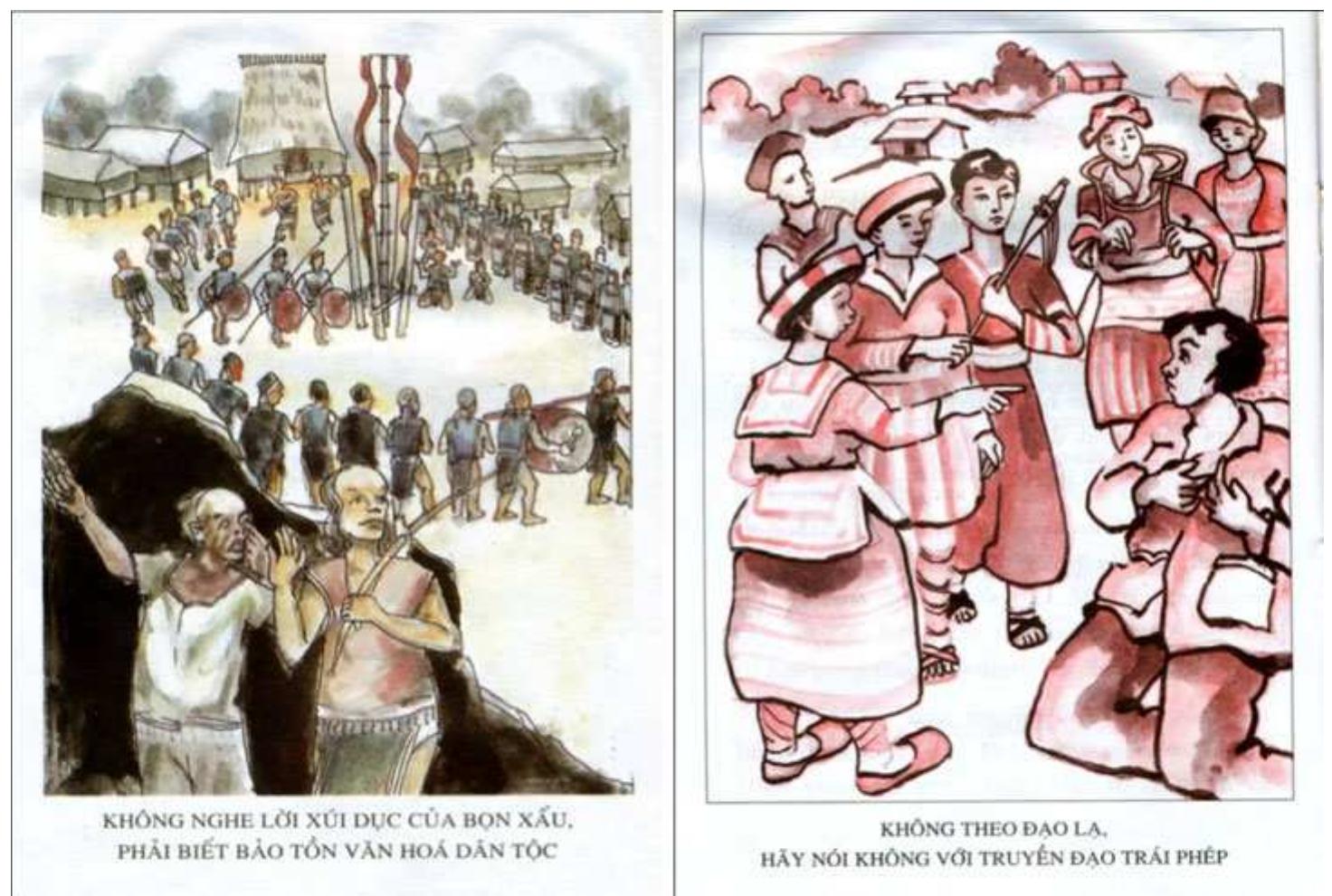
Plateau was a disturbing enactment of the propaganda that the central government
had published and distributed to local administrations (Figure 1).
Neither the converts nor the non-converts intend to cause social conflict and div-
ision, however. Continuing a strong tradition of ethnic solidarity, the converts believe
that Christianity is the answer to the Hmong’s current problems and that conversion
will help them gain a powerful spiritual resource, one which will enhance and strength-
en the unity of their community. The unconverted Hmong, however, do not share this
view even if they share the wish for a strong and unified people. Their commitment to
traditional beliefs and practices — not to mention the government discrimination
against the converts — makes it difficult for them to associate practically and spiritually
with the Protestant members of their community.
Yet, a complete break between the converts and the non-converts is impossible,
as most Hmong still need to rely on clan-based relationships for social and economic
survival. Although solidarity can in general be expected from fellow clansmen, sub-
stantial assistance in economic and social matters requires the presence of blood rela-
tions. The Hmong primarily turn to close relatives for money, practical assistance, and
consolation in times of need. A man wishing to relocate his household will almost
invariably have relatives in the new area who should be prepared to sponsor his
entry by giving or loaning him land, rice or money and helping him to build a
house. The importance of relatives also applies to spiritual matters. Ovesen observes
that ‘[a] Hmong can only be really happy when he is together with his relatives, since
such close contacts represent emotional assurance, social support, spiritual comfort as
well as the greatest possible economic security.’50
This explains why conversion creates a dilemma for the entire Hmong commu-
nity. For those who choose not to become Christian, the conversion of relatives and
50 Ovesen, ‘A minority enters the nation state’, pp. 22–3.
290 TAM T.T. NGO
Figure 1. Propaganda. The caption on the left reads: ‘Don't listen to bad ele-
ments, one must know to preserve national culture.’ On the right, it reads: ‘Do
not follow a strange religion, say no to illegal proselytising.’
Reproduced with permission from: Cục Va˘ n Hóa Thông Tin Cơ Sở [Ministry
Department of Grassroots Level Culture and Information], D̵ừng Theo Kẻ Xâ´u
[Don't follow bad elements], (Hanoi: National Cultural Publishing House, 2004),
pp. 8; 12.
acquaintances often signals the need for broad changes in Hmong social and cultural
life — even if Christianity itself is not seen as the solution. These conflicts with
non-Christian Hmong, who are sometimes one’s parent or one’s spouse, gives rise
to tensions which have no foreseeable end. For the converts, the divisions and con-
flicts with their unconverted kin are the most painful consequences of the process.
Still, many unconverted Hmong also understand the readiness of others to accept
the Christian faith as connected to various state campaigns. Even more than internal
migration, greater changes in traditional Hmong culture have resulted from cam-
paigns against ‘superstitious’ practices. Tran, for example, tells us that from the
1960s to 1990, the government forbade any festivals or ceremonies and restricted
the Hmong of Lào Cai to celebrating the New Year for only a few days rather than
the traditional month, officially to avoid wastage.51 Resistance to such measures
was often severely punished. Authority over the lives of ethnic minorities has become
increasingly ‘extra-local’ as decisions about economic, agricultural, social, and cultural
matters have been taken over by Vietnamese government programmes and cadres.52
51 Tran, Văn Hóa Hmong, pp. 174–8.
52 Trong Cuc Le and Terry Rambo, Bright peaks, dark valleys: A comparative analysis of environmental
PROTESTANT CONVERSION AND SOCIAL CONFLICT 291
These policies led the Hmong to a further loss of control over their religious life.
For years they were forced to see their traditions as ‘superstitious’ and outlawed.
When part of the Hmong community opted to become Protestants, new policies iron-
ically demanded that they partially return to ancient traditions previously forbidden,
as a way to deny their choice of a new faith. Loss of autonomy in these matters has left
many Hmong frustrated and resentful. As one of my unconverted Hmong hosts once
complained:
They [government officials] don’t want us to worship Jesus Christ or to uas neeb [con-
duct shamanic rituals]. They ask us to organise communal festivals, but when we did,
they complained that we did it wrongly. For each festival, they sent us their researchers
who told us to do this and to do that. Lately, I attended a meeting in the district cultural
office about what to do to bring our Hmong people away from Christianity. I asked
them, since all gods/spirits are forbidden, can we Hmong people worship Uncle Ho,
for example? Next day, our commune officers came and warned me not to attempt
mocking the national leader. I did not mean to mock anyone when I proposed to
them to let us worship Uncle Ho.
Conclusion
This essay discusses some of the complexities presented by conversion to
Protestantism for the Hmong community in Vietnam. The ongoing marginalisation
of the Hmong provides a context for understanding the converts’ desire to seek in
Christianity a way out of their difficulties. Conversion for those who choose it repre-
sents a passage to a new landscape of modernity.53 Hmong conversion is intrinsically
connected to the ongoing globalisation of Christianity, a movement which involves
the conversion of tribal and non-state peoples to more expansively organised
‘world’ religions.54 Throughout my encounters with the Hmong in Vietnam, I have
realised that they are increasingly aware of the changing world as well as of their chan-
ging place in that world. Not only are they aware of their own marginality, they also
see the Hmong diaspora in the West as successful members of a global Hmong com-
munity. Converting to Christianity has come to be seen as a way to become members
of this greater transnational community.
Yet, despite the huge number of converts, at least two-thirds of the Hmong popu-
lation remains unconverted and many are quite critical of Christianity. The continued
co-location of Christian and non-Christian Hmong in many areas has had a direct
impact on the establishment of a Protestant Hmong community. Although more
than two decades after the first big wave of conversion, the majority of Hmong con-
verts are determined to remain Christian, some continue to slide back, lapsing into
millenarianism or reconverting altogether. One of the consequences of reconversion,
and social conditions and development trends in five communities in Vietnam’s northern mountain region
(Hanoi: National Political Publishing House, 2001).
53 Peter van der Veer, ‘Introduction’, in Conversion to modernities: The globalization of Christianity, ed.
Peter van der Veer (London: Routledge, 1996), pp. 1–21.
54 Robert Heffner, ‘Introduction: World building and the rationality of conversion’, in Conversion to
Christianity: Historical and anthropological perspectives on a great transformation, ed. Robert Hefner
(Berkeley: University of California Press, 1993), pp. 3–44.
292 TAM T.T. NGO
as I show elsewhere,55 is the revitalisation of Hmong tradition. At the same time,
Christianity and the global connectivity provided by modern technology and media
expose the Hmong in Vietnam to millenarianism, as in the case of a recent uprising.56
Such episodes often draw unfavourable attention from the state and the Kinh major-
ity; this can hinder the earnest efforts of other Christian Hmong to establish their
faith.
To sum up, in the process of establishing their church and new community, the
Hmong converts in Vietnam have been trying to connect to the rest of world. These
attempts, however, have brought the Hmong into deeper conflict both with the
Vietnamese state and amongst themselves. Thus, while becoming Protestant does pro-
vide a possible solution to their marginality, it does not simply end it. On the con-
trary, being a Hmong convert has meant being mistrusted by both the state and
their fellow Hmong who remain traditionalists.
55 Ngo, ‘The New Way’.
56 Ibid., chap. 4.