Students’ Aims of Internet Usage: A Cross-Age Study

2010, Education Sciences

Abstract

In this study, the change in computer and internet usage aims, frequencies, and positive and negative contributions of computer and internet to 5 th and 8 th primary school students and 10 th grade high school students were searched according to their different grades. A cross-age method was used. The study was conducted with 199 students. Data tool comprising of two sections and first section was used purposes and frequencies of students in terms of using computer and internet were searched by means of 8 open-ended questions. In the second section, a scale was used consisting 34 statements which are 5 point likert type. It is revealed that there is no significant difference in terms of using internet according to grades. It was decided in the analysis made with regard to subscales of the scale that there is no significant difference in terms of commercial, informational usage and negative contributions according to grades. However, there is a significant difference in terms of social use and positive contributions according to grades. This difference is on behalf of 10 th grade students. It is a surprising result that 5 th grade students have the highest level of computer and internet usage in commercial terms.

Key takeaways
sparkles

AI

  1. The study analyzed computer and internet usage among 199 students across grades 5, 8, and 10.
  2. No significant differences were found in commercial, informational, and negative usage across grades.
  3. Significant differences in social usage and positive contributions favor 10th grade students.
  4. 5th grade students have the highest commercial usage, surprising given their age.
  5. Students generally start using computers and the internet around 3rd grade.
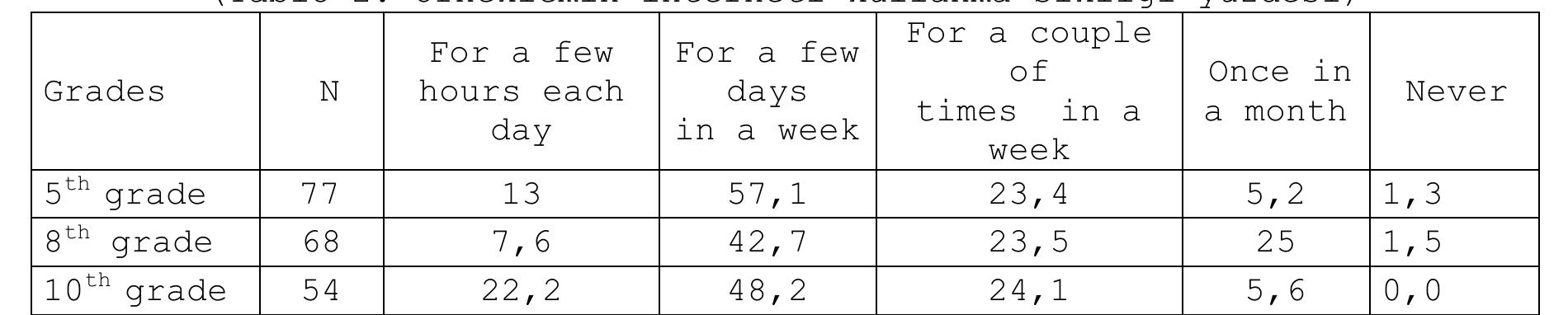
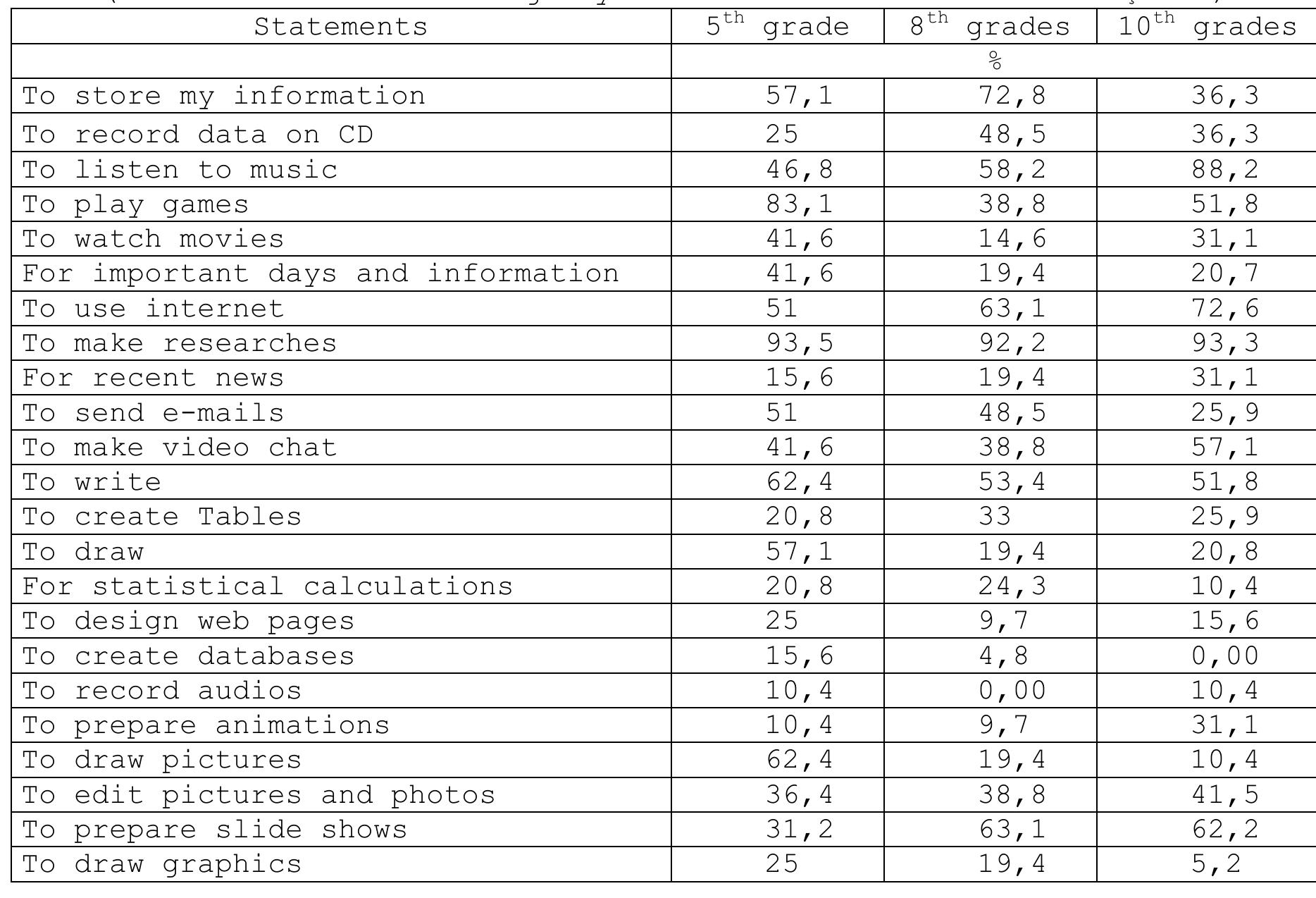
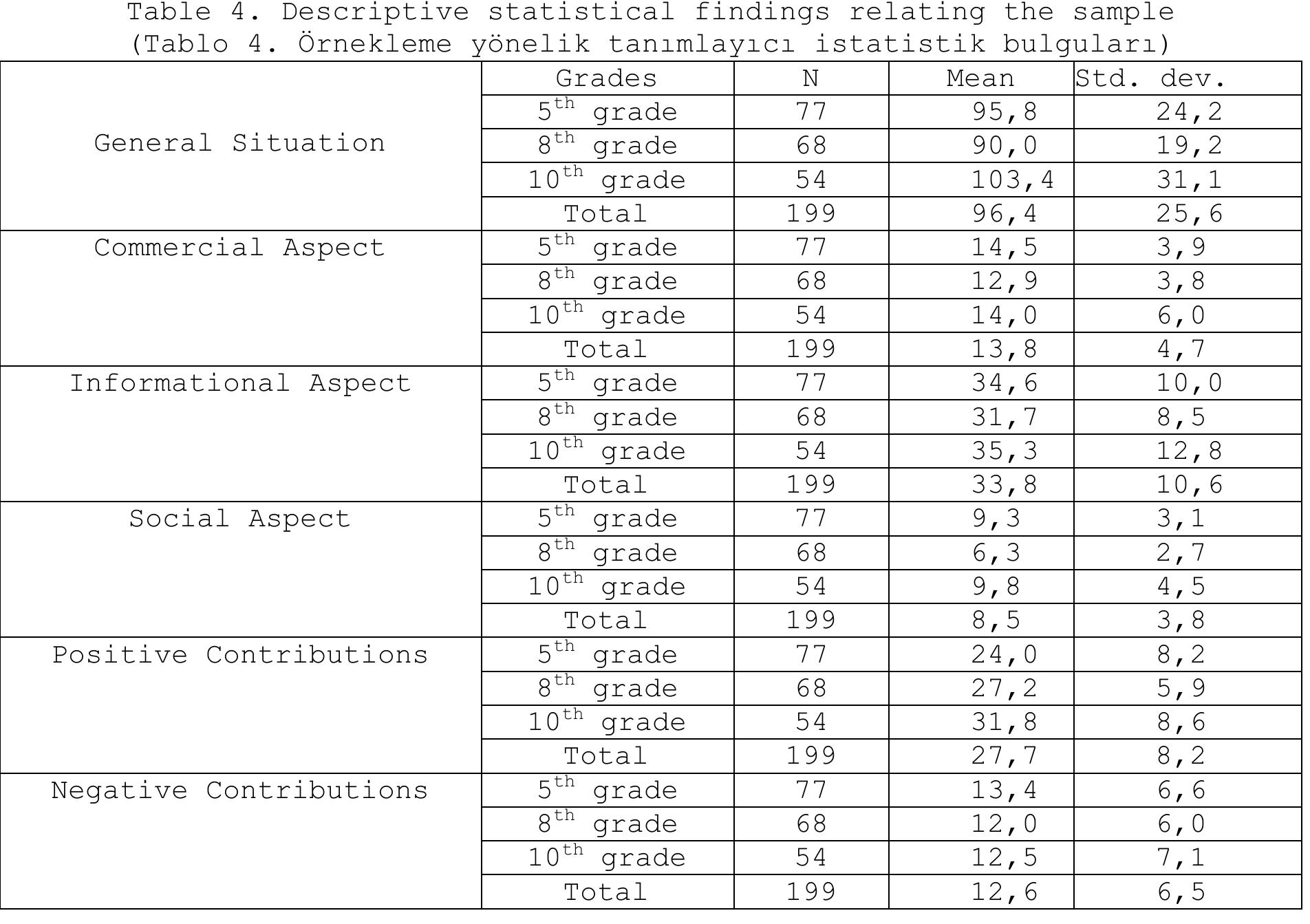
ISSN:1306-3111 e-Journal of New World Sciences Academy 2010, Volume: 5, Number: 4, Article Number: 1C0231 EDUCATION SCIENCES Received: August 2010 Accepted: September 2010 Series : 1C ISSN : 1308-7274 © 2010 www.newwsa.com Tuncay Özsevgeç Hava İpek Lale Cerrah Özsevgeç Salih Çepni Karadeniz Technical University [email protected] Trabzon-Turkey STUDENTS’ AIMS OF INTERNET USAGE: A CROSS-AGE STUDY ABSTRACT In this study, the change in computer and internet usage aims, frequencies, and positive and negative contributions of computer and internet to 5th and 8th primary school students and 10th grade high school students were searched according to their different grades. A cross-age method was used. The study was conducted with 199 students. Data tool comprising of two sections and first section was used purposes and frequencies of students in terms of using computer and internet were searched by means of 8 open-ended questions. In the second section, a scale was used consisting 34 statements which are 5 point likert type. It is revealed that there is no significant difference in terms of using internet according to grades. It was decided in the analysis made with regard to subscales of the scale that there is no significant difference in terms of commercial, informational usage and negative contributions according to grades. However, there is a significant difference in terms of social use and positive contributions according to grades. This difference is on behalf of 10th grade students. It is a surprising result that 5th grade students have the highest level of computer and internet usage in commercial terms. Keywords: Internet, Internet Usage, Effects of the Internet, Internet Literacy, Cross-age ÖĞRENCİLERİN İNTERNETİ KULLANMA AMAÇLARI: KESİTSEL BİR ÇALIŞMA ÖZET Bu çalışmada 5., 8. ve 10. sınıf öğrencilerinin bilgisayar ve interneti kullanma amaçları, kullanma sıklıkları, kullanımın olumlu ve olumsuz etkilerinin neler olduğu karşılaştırılmalı olarak araştırılmıştır. Çalışmada kesitsel yöntem kullanılmış olup örneklem 199 öğreciden oluşmaktadır. Iki bölümden oluşan ölçme aracının ilk bölümünde öğrencilerin bilgisayar ve interneti kullanma amaçları ve sıklıkları 8 açık uçlu soru ile araştırılmıştır. Ikinci bölüm 5‟li likert tipi 34 önermeden oluşan bir ölçektir. Çalışmada öğrenim kademelerine göre öğrencilerin interneti kullanım amaçları arasında istatistiksel olarak bir farklılık olmadığı tespit edilmiştir. Ölçeğin alt faktörlerine yönelik yapılan çoklu karşılaştırmada ticari, bilginin kullanımı ve olumsuz etkileri başlıklı alt faktörlerinde sınıflar arasında anlamlı fark bulunamamıştır. Bununla birlikte sosyal kullanım ve olumlu etkileri başlıklı alt faktörlerinde 10. sınıf öğrencilerinin lehine anlamlı farklılık tespit edilmiştir. İnterneti ticari amaçla en fazla ilköğretim 5. sınıf öğrencilerinin kullanması çalışmada dikkat çeken bir sonuç olmaktadır. Anahtar Kelimeler: İnternet, İnternet Kullanımı, İnternetin Etkileri, İnternet Okuryazarlığı, Kesitsel Çalışma e-Journal of New World Sciences Academy Education Sciences, 1C0231, 5, (4), 1701-1709. Özsevgeç, T., İpek, H., Özsevgeç, L.C. ve Çepni, S. 1. INTRODUCTION (GİRİŞ) Computer is an electronic machine which runs rapidly, stores various information-data in appropriate spaces and restores them when required thanks to software loaded on it, and makes arithmetical and logical operations (İşman et al., 2004). Internet is defined as an international web connecting all the computers in the world by means of a computer and a telephone line and it provides communication between all computers as mentioned in the related literature (Gölge and Arlı, 2002; Atav et al., 2006: Balamuralithara and Woods, 2010; Fidalgo-Neto et al., 2009). Computer and internet has became two tools whose usages are increasing day by day thanks to their services and facilities (Gölge and Arlı, 2002; İlban et al., 2006; Gupta, 2006). They are used intensely at all levels of our both social and educational life (İşman et al., 2004; İşman et al., 2007). In recent past, they were mainly used by university students; however, now they are prevalently used in our life by primary school students even, children start to use it in pre-school education. With the rapid development of technology and rapid globalization of the world during this process, the role and importance of internet in our educational life has increased. This situation changed the required human profile that should be adaptive to both technological and scientific developments. Education faculties are one of the institutions where individuals adaptive to these changes are raised. Candidates who have graduated from teacher training faculties should be trained in such a way to enable them to be equipped with skills and qualifications of attaining and producing information. It is really important during this process that students should be computer and internet literate starting from 1 st grade of primary education (Atav et al., 2006). In order to make their students equipped with technological information, skills and proficiencies and to raise them as productive members in the world of business, teachers should be aware of computer and/or internet literacy levels of their students and they also should have a good level (Creighton et al., 2006; Schofield, 1999). 2. RESEARCH SIGNIFICANCE (ÇALIŞMANIN ÖNEMİ) It should not be forgotten that determining computer and internet usage purposes, frequencies and benefiting levels of students during this process will constitute a base for future studies. When literature of Turkey is examined, it‟s seen that there are not many studies relating the change in computer and internet usage purposes, frequencies, and benefiting levels according to different educational grades. It was believed that searching computer and internet usage purposes, frequencies and positivenegative contributions of using internet to primary, elementary and secondary school students will eradicate this lack of literature. The purpose of this study is to make a comparative examination on computer and internet usage purposes, frequencies and positive-negative contributions of computer and internet to 5th and 8th grade primary school students and 10th grade high school students according to their different educational levels. 3. METHODOLOGY (YÖNTEM) 3.1. Sample and Instrument (Örneklem ve Ölçme Aracı) The study was conducted by means of developmental research method within the scope of descriptive approach. This study was conducted according to cross-age method and it consisted of 5th, 8th, and 10th grade students. Sample of the study is composed of 199 in total 77 of which were 5th grade and 68 of which were 8th grade primary school students and 54 of which were 10th grade high school students. A questionnaire comprising of 1702 e-Journal of New World Sciences Academy Education Sciences, 1C0231, 5, (4), 1701-1709. Özsevgeç, T., İpek, H., Özsevgeç, L.C. ve Çepni, S. two sections was used in this research as data collection tool. In the first section, computer and internet usage purposes, frequencies, and positive-negative contributions of internet usage of students were researched by means of 8 open-ended questions. In the second section, a scale consisting 34 statements which are 5 point likert type and developed by Çavuş and Gökdaş (2006) was used. The scale consisted of five subscales: (a) commercial aspect, (b) informational aspect, (c) social aspect, (d) positive contributions and (e) negative contributions. The sample was to rate the items on a Likert scale that comprised five points ranging from Absolutely Agree (5 point) to Absolutely Disagree (1 point). Cronbach Alpha coefficient of the scale which consisted of five subtitles was calculated as .84. Percentage of answers of students given in the first section to open-ended questions was calculated and presented in tables. The second part of the scale had nominal values and it was suitable for statistical analyses. This situation was to allow statistical comparisons, and the total and subscale scores of the CLS for each grades was computed and inputted into SPSS 15.0., ANOVA, which is a statistical test for comparing groups on the scores collected in multiple subtests. It has assumptions of normality, homogeneity of variance, random sampling, and independency of observations. This was followed by statistical analyses using one-way ANOVA to determine if significant differences existed. Post hoc, comparisons were conducted among grades and subscales of the questionnaire by using the Tukey HSD test. The findings of the ANOVA results were presented in tables. 4. RESULTS AND DISCUSSION (BULGULAR VE TARTIŞMA) There are findings obtained by means of data collection tools under this title. In the first section of the scale, findings relating computer and internet usage purposes and frequencies are presented. SPSS analyses, one-way ANOVA, which were examined for the findings of the second section of the scale, are conveyed to the reader in tables. Fifth grade students‟ average year of internet usage is 3.97 years, 8th grade students is 5.73 years and it is the 10th grade students who have the highest rate of using internet is 7.74 years. Computer usage frequency of the sample was mentioned through percentage in Table 1. Table 1. Percentage of the sample in terms of computer usage frequency (Tablo 1. Örneklemin bilgisayarı kullanma sıklığı yüzdesi) For a few For a few For a few Grades N hours in a hours in a hours in a I do not use day week month 5th grade 77 23,4 70,1 6,5 0,00 8th grade 68 13,3 66,2 19,1 1,47 10th grade 54 22,2 68,5 9,3 0,00 When we examine computer usage frequencies of 5 th, 8th and 10th grade students, it is seen that the sample intensely use computer for a few hours in a week. Internet usage frequency of the sample is presented in percentages in Table 2. 1703 e-Journal of New World Sciences Academy Education Sciences, 1C0231, 5, (4), 1701-1709. Özsevgeç, T., İpek, H., Özsevgeç, L.C. ve Çepni, S. Table 2. Percentages of internet usage frequencies of the sample (Tablo 2. Örneklemin interneti kullanma sıklığı yüzdesi) For a couple For a few For a few of Once in Grades N hours each days Never times in a a month day in a week week 5th grade 77 13 57,1 23,4 5,2 1,3 th 8 grade 68 7,6 42,7 23,5 25 1,5 10th grade 54 22,2 48,2 24,1 5,6 0,0 As seen from Table 2, percentages of the internet usage of sample each day are 22,2% for 10th grade students, 13% for 5th grade students, and 7,6% for 8th grade students. The fact that 25% of 8th grade students use internet once in a month is notable. Computer and internet usage purposes of the sample are given in Table 3. Table 3. Computer and internet usage purposes of the sample (Tablo 3. Örneklemin bilgisayarı ve interneti kullanma amaçları) Statements 5th grade 8th grades 10th grades % To store my information 57,1 72,8 36,3 To record data on CD 25 48,5 36,3 To listen to music 46,8 58,2 88,2 To play games 83,1 38,8 51,8 To watch movies 41,6 14,6 31,1 For important days and information 41,6 19,4 20,7 To use internet 51 63,1 72,6 To make researches 93,5 92,2 93,3 For recent news 15,6 19,4 31,1 To send e-mails 51 48,5 25,9 To make video chat 41,6 38,8 57,1 To write 62,4 53,4 51,8 To create Tables 20,8 33 25,9 To draw 57,1 19,4 20,8 For statistical calculations 20,8 24,3 10,4 To design web pages 25 9,7 15,6 To create databases 15,6 4,8 0,00 To record audios 10,4 0,00 10,4 To prepare animations 10,4 9,7 31,1 To draw pictures 62,4 19,4 10,4 To edit pictures and photos 36,4 38,8 41,5 To prepare slide shows 31,2 63,1 62,2 To draw graphics 25 19,4 5,2 As can be seen from Table 3, when we look at computer and internet usage purposes of students; 72,8 % of 8th grade students use it to store information, 48,5% of them use it to save data and 63,1% of them use it to prepare slide shows when compared to the other students. 83,1% of 5th grade students use it to play games and 41,6% of them use it to watch movies while 88,2% of 10th grade students use it to listen to music and 72,6% of them use it to use internet. Students of the sample benefit from computer and internet in the least to keep up with recent news, to create tables, to make statistical calculations and to prepare web pages or animations, to make recordings and 1704 e-Journal of New World Sciences Academy Education Sciences, 1C0231, 5, (4), 1701-1709. Özsevgeç, T., İpek, H., Özsevgeç, L.C. ve Çepni, S. to draw graphics. Descriptive analyses relating internet usage purposes of the sample are given in Table 4. Table 4. Descriptive statistical findings relating the sample (Tablo 4. Örnekleme yönelik tanımlayıcı istatistik bulguları) Grades N Mean Std. dev. 5th grade 77 95,8 24,2 General Situation 8th grade 68 90,0 19,2 10th grade 54 103,4 31,1 Total 199 96,4 25,6 Commercial Aspect 5th grade 77 14,5 3,9 8th grade 68 12,9 3,8 10th grade 54 14,0 6,0 Total 199 13,8 4,7 Informational Aspect 5th grade 77 34,6 10,0 8th grade 68 31,7 8,5 10th grade 54 35,3 12,8 Total 199 33,8 10,6 Social Aspect 5th grade 77 9,3 3,1 8th grade 68 6,3 2,7 10th grade 54 9,8 4,5 Total 199 8,5 3,8 Positive Contributions 5th grade 77 24,0 8,2 8th grade 68 27,2 5,9 10th grade 54 31,8 8,6 Total 199 27,7 8,2 Negative Contributions 5th grade 77 13,4 6,6 8th grade 68 12,0 6,0 10th grade 54 12,5 7,1 Total 199 12,6 6,5 When we look at arithmetic averages, 10th grade students use internet most while 8th grade students use internet least. When we examine subscales, 5th grade students use internet commercially most, 10 th grade students use it in informational terms most, and 5 th and 10th grade students use it in social terms most. Results of test of one-way ANOVA for aim of internet usage of sample are represented in Table 5. Table 5. One-way ANOVA results (Tablo 5. Tek yönlü varyans analizi bulguları) Groups df F p. Sig. dif. Between groups 2 General 1,76 ,179 None Within groups 196 Situation Total 198 By means of one-way ANOVA analysis, it was searched whether or not there is a significant difference between grades in terms of internet usage purpose. As a result of the analysis, we revealed that there is no significant difference between grades according to the scores obtained from the scale. Variance analyses relating subscales of the scale and multiple comparisons are presented in Table 6. 1705 e-Journal of New World Sciences Academy Education Sciences, 1C0231, 5, (4), 1701-1709. Özsevgeç, T., İpek, H., Özsevgeç, L.C. ve Çepni, S. Table 6. Variance analyses and multiple comparisons of subscales (Tablo 6. Tek yönlü varyans analizleri ve alt faktörlerin çoklu karşılaştırılmaları) Subscales Groups df F p. Sig. difference* Commercial Aspect 2 ,73 ,48 None Informational Aspect 2 ,79 ,46 None Between groups Social Aspect 2 7,5 ,001 10th grade Positive Contribution 2 6,4 ,003 10th grade Negative Contribution 2 ,27 ,76 None *p<0.05 It is seen in Table 6 that there is no significant difference between grades in commercial and informational terms and with regard to the negative contributions of internet which constitute the subscales of the scale. There is a statistical difference in social terms and with regard to the positive contributions only on behalf of 10th grade students (F (2,196) = 7,5, p<.05, and F (2,196) = 6,4, p<.05). It was revealed that 5th and 8th grade primary school students and 10th grade high school students use computer for “a few hours in a week”. This situation may stem from the fact that primary school students may not have computer in their houses therefore they use computer only in school during their computer courses or other courses (Toprakçı, 2007). Besides, it is also seen that almost half of the students from each grade use internet at least for a day in a week and this result is supported in the literature (Gölge and Arlı, 2002). Both access variables, home access and years online, are related to internet use and expertise. Thus, students who have home access and spent more years online use the internet more often, spend more time online per day and have a higher level of online skills and selfefficacy. Home access and years online do not directly influence opportunities and risks students experience online. However, they do have an indirect effect through intermediating variables such as frequency of internet use and time spent online (Livingstone, Bober and Helsper, 2005). Recently, rapid improvement of technology increased the use of computer and internet by all age groups. It is seen that 5th and 8th grade primary school students and 10th grade high school students have been using internet since their 3rd grade in primary school. In general terms, it is possible to say that computer and internet usage durations of students are close to each other. The use of computers and internet has become pervasive and essential in today‟s world. Students view computers as essential tools for communication and research (Eagleton, 2002). Also, the internet has become an essential literacy task for today‟s school students. The World Wide Web is a uniquely rich resource for authentic inquiry, but students must learn to orchestrate sophisticated strategies to become literate in this complex environment (Eagleton, 2002). Although many students may be fluent with word processing or instant messaging, we cannot assume that students know how to find information efficiently on the Internet, and students who cannot find relevant information quickly will be disadvantaged in today‟s information society (Leu, 2000). It seems that „access‟ internet to the internet is not as simple as turning on the computer and clicking on Google. A range of skills, some more complex than others, is required to access the range of online facilities. These skills are variably, and unequally, distributed across the population, with age, gender and socioeconomic status all associated with differences in literacy (Livingstone, Bober and Helsper, 2005). The aim of 5th grade primary school students in terms of using computers differ from 8th and 10th grade students. It is seen that students of this grade use computer usually for entertainment and at a level which 1706 e-Journal of New World Sciences Academy Education Sciences, 1C0231, 5, (4), 1701-1709. Özsevgeç, T., İpek, H., Özsevgeç, L.C. ve Çepni, S. requires low level of information relating computers compared to other students of different grades. This may be explained by the fact that 5th grade primary school students learn how to use computer and internet at that age and therefore their interests are focused on learning how to use these two tools (Sade and Kira, 2007; Sade and Kira, 2009). Eight grade primary school students commonly use computer and internet to store information, to record data and prepare slide shows which are related to preparation of course materials when compared to students of other grades. When the importance of central examinations within our educational system is taken into consideration, it is clear that 8th grade students focus on SBS (Examination for Entrance to Secondary Education) examination and they study regarding that exam. It is thought that students limit the time they spare their school courses therefore they also limit their duration of using computer and internet which affects their usage purposes (Özsevgeç, 2007; Altun and Çakan, 2008). It is seen that 10th grade high school students more often use computer and internet for entertainment compared to other grades. It is thought that these groups of students use computer and internet more since they constitute intermediary grade. In addition, it is also possible to say that students use them for different purposes in the next stages since their experiences improve and they may find the opportunity to apply what they learn. In other words, as it is noted by Çavuş and Gökdaş (2006), as the level of computer usage increases, the rate of benefiting from internet also increase. Wambach (2006) concluded from his research that whatever type of computer system is used (such as desktops, laptops, or tablets), and wherever the computer is used (in a lab or on a classroom), students‟ desire to have one-to-one access to internet and to consider internet as learning tools are as essential as a pencil or a calculator. Since commercial aspect includes shopping on internet by means of credit cards and etc., it is a surprising result that 5 th grade students have the highest level of computer and internet usage in commercial terms. It is thought that students of this grade use course materials more and the need for obtaining them in addition to shopping for games may be the reasons behind this results (Dugger et al., 2003; Doe, 2005). It was determined that there is no significant difference between grades in terms of internet usage purpose. However, there is a statistical difference in social terms and with regard to positive contributions of internet on behalf of 10th grade students. This proves that as the grades increases, social aspect and proper use of computer and internet also increases. The fact that socialization becomes prominent during secondary education and social identities of the students are created in this grade may have an effect on this result. 5. CONCLUSION AND SUGGESTIONS (SONUÇ VE ÖNERİLER) As a result of the study, it was revealed that frequency of computer and internet usage of students are relatively close to each other and the year which they start using them is 3rd grade. Grades and classes of students affect their purpose of using/utilizing computer and internet. While 5th grade primary school students utilize these two tools to attain new information and course preparation, 8th grade students use them to prepare course materials. The purpose of utilizing computer and internet differ mostly in 10th grade students in social terms. In addition, as the grade increases, the experience of students with computer and internet also increases and therefore they find opportunity to apply what they learn. When total scores of internet usage purpose are taken into consideration, it was revealed that there is no significant difference between grades. In the analysis conducted according to subscales of the 1707 e-Journal of New World Sciences Academy Education Sciences, 1C0231, 5, (4), 1701-1709. Özsevgeç, T., İpek, H., Özsevgeç, L.C. ve Çepni, S. scale, it was revealed that there is no significant difference between grades in terms of commercial, informational and negative usage. There is a significant difference on behalf of 10th grade students in terms of social usage and positive acquisitions. The following suggestions may be made in accordance with the conclusion of the study; With the increase of computer courses in primary level, computer literacy of students can be increased and courses may be more productive. Including “Internet Literacy” into the primary and secondary curriculum may lead students to take more active roles in developing and changing global world. Computer laboratories in school should be kept open in order to enable students to use computer and internet more often. Also, there should be laboratory attendants who can solve the problems they encounter. Students should be informed about negative and positive aspects of internet and their awareness should be raised in order for them to utilize internet at the highest level. Parents should be aware of negative and positive contributions of computer and internet to their children by controlling their computer and internet usage. When they realize that there are negative contributions, they should take precautions to prevent them. REFERENCES (KAYNAKLAR) 1. Altun, S.A. and Çakan, M., (2008). Factors Affecting Student Success on Exams: The case of Successful cities on LGS/ÖSS Exams. Elementary Education Online, 7(1), 157-173. 2. Atav, E., Akkoyunlu, B. ve Sağlam, N., (2006). Öğretmen Adaylarının İnternete Erişim Olanakları ve Kullanım Amaçları. Hacettepe Üniversitesi Eğitim Fakültesi Dergisi, 30, 37-44. 3. Balamuralithara, B. and Woods, P.C., (2010). An Investigation on Adoption of the Engineering Simulation Lab Exercise: A Case Study in Multimedia University, Malaysia. Computer Applying Engineer Education, On-line first. Retrieved June 2010, from http://www3.interscience.wiley.com/cgi-bin/fulltext/ 123234469/ PDFSTART 4. Çavuş, H. ve Göktaş, İ., (2006). Eğitim Fakültesi‟nde Öğrenim Gören Öğrencilerin İnternetten Yararlanma Nedenleri ve Kazanımları. Yüzüncü Yıl Üniversitesi, Eğitim Fakültesi Dergisi, 3(2), 56-78. 5. Creighton, W., Kilcoyne, M., Tarver, R., and Wright, S., (2006) Computer Literacy Levels of Students Enrolling in a Post-Secondary Computer Applications/Information Technology Course, Information Technology. Learning, and Performance Journal, 24(1), 15-23. 6. Doe, C., (2005). Technology and Textbooks: Cutting-edge Early Literacy Technology. Multimedia & Internet@Schools, 12(5), 26-29. 7. Dugger, W.E., Meade, S.D., Delany, L. and Nichols, C., (2003). Advancing Excellence in Technological Literacy. Phi Delta Kappan, 8(4), 316. 8. Eagleton, M.B., (2002). Making Text Come to Life On the Computer: Toward An Understanding of Hypermedia Literacy. Reading Online, 6(1). Retrieved May 2010, from http://www.nereading.org/inquiryArticle/abstract.htm. 9. Fidalgo-Neto, A.A., Tornaghi, A.J.C., Meirelles, R.M.S., Bercot, F.F., Xavier, L.L., Castro, M.F.A., and Alves, A.L., (2009). The Use of Computers in Brazilian Primary and Secondary Schools. Computer & Education, 53(3), 677-685. 10. Gölge, E. ve Arlı, M., (2002). Üniversite Öğrencilerinin Üniversite Dışında Bilgisayar ve Internet Kullanma Durumları. VIII. “Türkiye‟de Internet” Konferansı. Retrieved May 2010, from http://inettr.org.tr/inetconf8/bildiri/135.doc. 1708 e-Journal of New World Sciences Academy Education Sciences, 1C0231, 5, (4), 1701-1709. Özsevgeç, T., İpek, H., Özsevgeç, L.C. ve Çepni, S. 11. Gupta, G.K., (2006). Computer Literacy: Essential in Today‟s Computer-Centric World. ACM SIGCSE Bulletin, 38(2), 115-119. 12. İlban, O., Yıldırım, B. ve Sapar, V., (2006). Students‟ Preferences on Computer Using and a Survey on Variables Impacting the Preferences. The Turkish Online Journal of Educational Technology, 5(3), 34-40. 13. İşman, A., Çağlar, M., Dabaj, F., and Altinay, Z., (2004). Attitudes of Students toward Computers. The Turkish Online Journal of Educational Technology, 3(1), 11-21. 14. İşman, A., Yaratan, H., and Caner, H., (2007). How Technology is Integrated into Science Education in a Developing Country: North Cyprus Case. The Turkish Online Journal of Educational Technology, 3(5), 15-26. 15. Leu, D.J., Jr., (2000). Our Children‟s Future: Changing the Focus of Literacy and Literacy Instruction. The Reading Teacher, 53(4). Retrieved May 2010, from http://readingonline.org/electronic/elec_index.asp?HREF=/electronic/ RT/focus/index.html. 16. Livingstone, S., Bober, M., and Helsper, E., (2005). Internet Literacy among Children and Young People: Findings from UK Children Go Online Project (online). London:LSE Research Online. Retrieved June 2010, from http://eprints.lse.ac.uk/397/1/UKCGOonlineLiteracy.pdf. 17. Özsevgeç, T., (2007). Determining Effectiveness of Guided Materials About “Force and Motion” Unit Based on the 5E Model for Elementary Students, Unpublished Doctorate Thesis, Karadeniz Technical University. 18. Sade, R. and Kira, D., (2007). Mediating the Impact of Technology Usage on Perceived Ease of Use by Anxiety. Computer & Education, 49(4), 1189-1204. 19. Sade, R. and Kira, D., (2009). Computer Anxiety in e-learning: The Effect of Computer Self-Efficacy. Journal of Information Technology Education, 8, 177-191. 20. Schofield, J.W., (1999). Goals, Computer Use, and Education A Socioc ultural Issue. The Journal of Learning Science, 8(1), 171-175. 21. Toprakçı, E., (2007). The Profiles of the Use of the Internet for Study Purposes among University Students. The Turkish Online Journal of Educational Technology, 6(3), 129-144. 22. Wambach, C., (2006). Smart Classroom: From Revolutionary to Evolutionary: 10 years of 1-to-1 Computing. T.H.E. Journal, 33, 14. Retrived June 2010 from http://thejournal.com/Articles/2006/09/01/Smart-Classroom--FromRevolutionary-to-Evolutionary-10-Years-of-1to1Computing.aspx?sc_lang=en&Page=2. 1709

References (22)

  1. Altun, S.A. and Çakan, M., (2008). Factors Affecting Student Success on Exams: The case of Successful cities on LGS/ÖSS Exams. Elementary Education Online, 7(1), 157-173.
  2. Atav, E., Akkoyunlu, B. ve Sağlam, N., (2006). Öğretmen Adaylarının İnternete Erişim Olanakları ve Kullanım Amaçları. Hacettepe Üniversitesi Eğitim Fakültesi Dergisi, 30, 37-44.
  3. Balamuralithara, B. and Woods, P.C., (2010). An Investigation on Adoption of the Engineering Simulation Lab Exercise: A Case Study in Multimedia University, Malaysia. Computer Applying Engineer Education, On-line first. Retrieved June 2010, from http://www3.interscience.wiley.com/cgi-bin/fulltext/ 123234469/ PDFSTART
  4. Çavuş, H. ve Göktaş, İ., (2006). Eğitim Fakültesi"nde Öğrenim Gören Öğrencilerin İnternetten Yararlanma Nedenleri ve Kazanımları. Yüzüncü Yıl Üniversitesi, Eğitim Fakültesi Dergisi, 3(2), 56-78.
  5. Creighton, W., Kilcoyne, M., Tarver, R., and Wright, S., (2006) Computer Literacy Levels of Students Enrolling in a Post-Secondary Computer Applications/Information Technology Course, Information Technology. Learning, and Performance Journal, 24(1), 15-23.
  6. Doe, C., (2005). Technology and Textbooks: Cutting-edge Early Literacy Technology. Multimedia & Internet@Schools, 12(5), 26-29.
  7. Dugger, W.E., Meade, S.D., Delany, L. and Nichols, C., (2003). Advancing Excellence in Technological Literacy. Phi Delta Kappan, 8(4), 316.
  8. Eagleton, M.B., (2002). Making Text Come to Life On the Computer: Toward An Understanding of Hypermedia Literacy. Reading Online, 6(1). Retrieved May 2010, from http://www.nereading.org/inquiryArticle/abstract.htm.
  9. Fidalgo-Neto, A.A., Tornaghi, A.J.C., Meirelles, R.M.S., Bercot, F.F., Xavier, L.L., Castro, M.F.A., and Alves, A.L., (2009). The Use of Computers in Brazilian Primary and Secondary Schools. Computer & Education, 53(3), 677-685.
  10. Gölge, E. ve Arlı, M., (2002). Üniversite Öğrencilerinin Üniversite Dışında Bilgisayar ve Internet Kullanma Durumları. VIII. "Türkiye"de Internet" Konferansı. Retrieved May 2010, from http://inet- tr.org.tr/inetconf8/bildiri/135.doc.
  11. Gupta, G.K., (2006). Computer Literacy: Essential in Today"s Computer-Centric World. ACM SIGCSE Bulletin, 38(2), 115-119.
  12. İlban, O., Yıldırım, B. ve Sapar, V., (2006). Students" Preferences on Computer Using and a Survey on Variables Impacting the Preferences. The Turkish Online Journal of Educational Technology, 5(3), 34-40.
  13. İşman, A., Çağlar, M., Dabaj, F., and Altinay, Z., (2004). Attitudes of Students toward Computers. The Turkish Online Journal of Educational Technology, 3(1), 11-21.
  14. İşman, A., Yaratan, H., and Caner, H., (2007). How Technology is Integrated into Science Education in a Developing Country: North Cyprus Case. The Turkish Online Journal of Educational Technology, 3(5), 15-26.
  15. Leu, D.J., Jr., (2000). Our Children"s Future: Changing the Focus of Literacy and Literacy Instruction. The Reading Teacher, 53(4). Retrieved May 2010, from http://readingonline.org/electronic/elec_index.asp?HREF=/electronic/ RT/focus/index.html.
  16. Livingstone, S., Bober, M., and Helsper, E., (2005). Internet Literacy among Children and Young People: Findings from UK Children Go Online Project (online). London:LSE Research Online. Retrieved June 2010, from http://eprints.lse.ac.uk/397/1/UKCGOonlineLiteracy.pdf.
  17. Özsevgeç, T., (2007). Determining Effectiveness of Guided Materials About "Force and Motion" Unit Based on the 5E Model for Elementary Students, Unpublished Doctorate Thesis, Karadeniz Technical University.
  18. Sade, R. and Kira, D., (2007). Mediating the Impact of Technology Usage on Perceived Ease of Use by Anxiety. Computer & Education, 49(4), 1189-1204.
  19. Sade, R. and Kira, D., (2009). Computer Anxiety in e-learning: The Effect of Computer Self-Efficacy. Journal of Information Technology Education, 8, 177-191.
  20. Schofield, J.W., (1999). Goals, Computer Use, and Education A Socioc ultural Issue. The Journal of Learning Science, 8(1), 171-175.
  21. Toprakçı, E., (2007). The Profiles of the Use of the Internet for Study Purposes among University Students. The Turkish Online Journal of Educational Technology, 6(3), 129-144.
  22. Wambach, C., (2006). Smart Classroom: From Revolutionary to Evolutionary: 10 years of 1-to-1 Computing. T.H.E. Journal, 33, 14. Retrived June 2010 from http://thejournal.com/Articles/2006/09/01/Smart-Classroom--From- Revolutionary-to-Evolutionary-10-Years-of-1to1- Computing.aspx?sc_lang=en&Page=2.

FAQs

sparkles

AI

What distinguishes internet usage purposes among different student grade levels?add

The study found no significant differences in internet usage purposes across grades, except for social use, which was notably higher in 10th graders.

How does internet usage duration vary among students in different grades?add

Fifth graders average 3.97 years of internet use, eighth graders 5.73 years, while tenth graders have 7.74 years.

What approaches were used for data collection in this study?add

Data was collected through an 8-question open-ended survey and a 34-item Likert-type scale, achieving a Cronbach Alpha of .84.

Which student group predominantly uses the internet for commercial purposes?add

Surprisingly, fifth grade students were identified as utilizing the internet most for commercial activities, such as shopping.

What role does social interaction play in internet use for high school students?add

The findings indicate that social interactions increased significantly for 10th graders, highlighting this age group's social focus.

Trabzon University, Faculty Member

Tuncay ÖZSEVGEÇ is Professor of Science Education at Trabzon University. He has a wide range of research interests in science education. He found as a visiting scholar in the USA at Western Michigan University during six months. He was President of The Turkish Science Education and Research Association (SERA). He is the author of more than 150 papers and acts as reviewer for a range of journals, and is on editorial/advisory/review boards.

Papers
189
Followers
610
View all papers from Tuncay ÖZSEVGEÇarrow_forward