Papers by Philipp Seyr
Bulletin archéologique des Écoles françaises à l’étranger, 2025
Presses universitaires de Liège eBooks, 2024
Die bibliothekarische Schreibweise der Signatur enthält keine schließende runde Klammer hinter "(... more Die bibliothekarische Schreibweise der Signatur enthält keine schließende runde Klammer hinter "(1-3". 2 Siehe hierzu die Dokumentation der Universitätsbibliothek der LMU München: 4 o Cod. ms. 996 (9,2): Ausführliches Verzeichnis der Cimelien der UB München, Teil 2 (Cim. 45-107), Einträge zu Cim. 93 (= 8 o Cod. ms. 431). Die Kenntnis dieser hieratischen Papyrusfragmente verdanken wir Dr. Sven Kuttner (Leiter der Historischen Sammlungen der UB München). Zusammen mit Dr. Klaus-Rainer Brintzinger (Leiter der UB München) ermöglichte er uns die hier vorgelegte Bearbeitung und stellte hierfür alle nötigen Materialien und Auskünfte zur Verfügung. Des Weiteren danken wir Dr. Claudius Stein (Universitätsarchiv der LMU München) für Hinweise zur Sammlung Orban sowie den Zugang zu Archivalien des Universitätsarchivs.
This paper presents a glimpse into the earliest settlement of the ancient town of Kom Ombo discov... more This paper presents a glimpse into the earliest settlement of the ancient town of Kom Ombo discovered by the Egyptian-Austrian mission. In area s/9 North, the rubbish from a settlement dating to the second half of the 2nd Dynasty was excavated. This refuse ran over the Nile bank and as a result the eastern bank of the river gradually shifted westwards. Subsequently, the area was levelled, and the first architectural structures, dating from the late 2nd to the early 3rd Dynasty were built. The dating of the phases is based on the pottery, which has its closest parallels with material from Elephantine. On seal impressions found here in phase 19, the title ḥm-nzw and trian- gular labels abound, while those of phase 18 display only the title mjtr/mjtr.t. This indicates a change in the function of area s/9 North from dumped material from a (royal?) foundation to an Old Kingdom urban quarter.

The beginnings of Kom Ombo
Egypt at its Origins 7: Proceedings of the Seventh International Conference “Origin of the State. Predynastic and Early Dynastic Egypt”, Paris, 19th – 23rd September 2022, Orientalia Lovaniensia Analecta 323, 2024
This paper presents a glimpse into the earliest settlement of the ancient town of Kom
Ombo discov... more This paper presents a glimpse into the earliest settlement of the ancient town of Kom
Ombo discovered by the Egyptian-Austrian mission. In area s/9 North, the rubbish
from a settlement dating to the second half of the 2nd Dynasty was excavated. This
refuse ran over the Nile bank and as a result the eastern bank of the river gradually
shifted westwards. Subsequently, the area was levelled, and the first architectural
structures, dating from the late 2nd to the early 3rd Dynasty were built. The dating of
the phases is based on the pottery, which has its closest parallels with material from
Elephantine. On seal impressions found here in phase 19, the title ḥm-nzw and triangular
labels abound, while those of phase 18 display only the title mjtr/mjtr.t. This
indicates a change in the function of area s/9 North from dumped material from a
(royal?) foundation to an Old Kingdom urban quarter.
Quittung an die Dorfältesten über den Einsatz von Arbeitern
APF, 2023
![Research paper thumbnail of Graphetic Compounding in the First Intermediate Period: The Microhistory of [hiero] ḥtr.wy "span" and the Process of Sign Decomposition](https://attachments.academia-assets.com/104901757/thumbnails/1.jpg)
Hieroglyphs, 2023
open access journal: http://cipl-cloud37.segi.ulg.ac.be/index.php/hieroglyphs/article/view/3/7
T... more open access journal: http://cipl-cloud37.segi.ulg.ac.be/index.php/hieroglyphs/article/view/3/7
This paper details the circumstances by which ‘composite hieroglyphs’ developed and the factors that may have influenced their subsequent evolution. It is organized into two complementary sections. In the first sec-tion, I offer a fine-grained contextual analysis of the sign [hiero] ḥtr.wy “span (of one pair of oxen)” and its variants in the First Intermediate Period. This analysis suggests two possible scenarios for the development of this sign, an inductive local one (scenario a) and a deductive global one (scenario b). In the second section, I describe the process by which composite signs decomposed within the same period and propose distinguishing ‘compound splitting’ from ‘component merging.’ The results of this systemic approach are used to assess the probabilities of the two scenarios envisioned for the case-study and to plead in favour of the inductive local position.
Spuren der altägyptischen Gesellschaft, Studies in honour of Stephan Seidlmayer, 2022
Since 2017 the Austrian Archaeological Institute/Austrian Academy of Sciences, Cairo in cooperati... more Since 2017 the Austrian Archaeological Institute/Austrian Academy of Sciences, Cairo in cooperation withthe Ministry of Tourism and Antiquities (MOTA) is working at the town of Kom Ombo, in southern Egypt. Excavations have uncovered part of a cemetery and a large administrative building of the First Intermediate Period containing silos north of the modern temple enclosure wall. While this administrative building dates to the later First Intermedi-ate Period/early Middle Kingdom, the cemetery has a longer use, and is built on top of a town quarter from the Old Kingdom. Some of the most interesting and numerous finds from the recent work in both domestic and cemetery contexts are sealings, which shed a new light on the importance of the town of Kom Ombo in the Old Kingdom. Int his paper we discuss an official seal issued under Neferirkara, reconstructed from three seal impressions, whichprovides evidence for apr-šnꜥinstallation at Kom Ombo – probably connected to the “royal repast” – in the 5th Dy-nasty. Apart from its economic significance, its historic value lies in being the earliest attestation of the ancient name of Kom Ombo currently known.
Prague Egyptological Studies, 2021
This paper discusses the wooden statue JE 100373, which was recently re‑discovered in the basemen... more This paper discusses the wooden statue JE 100373, which was recently re‑discovered in the basement of the Egyptian Museum, Cairo. Based on the statue’s stylistic analysis and its identification in the unpublished excavation report MSS Gunn XXII, we re‑identify it as part of the statue ensemble of the overseer of the two granaries Ihy, found in a cache within a Ptolemaic tomb at Saqqara. As a result, the investigation proves the provenience of the statue from Cyril M. Firth’s excavations south of the Step Pyramid complex in 1926. Combining conservation science and traditional Egyptological approaches, the paper finally provides evidence for the continuity of the manufacture of large‑sized high‑quality wooden statuary by residential workshops until the final years of Pepy II or slightly later.
تناقش هذه الورقة التمثال الخشبى الذى يحمل رقم 100373
بالقاهرة. واستناداً إلى الدراسة التحليلية للأسلوب الفنى للتمثال، وكذلك تحديد هوية صاحبه من خلال تقرير الحفائر الخاص
أعدنا تحديده كجزء من تمثال المشرف على شونتى الغلال المدعو إيحى، والذى عثر ،MSS Gunn XXII به غير المنشور
عليه بخبيئة داخل مقبرة تعود للعصر البطلمى بمنطقة سقارة. نتيجة لذلك، يثبت بحثنا هذا مكان العثور على التمثال من خلال
حفائر سيسيل مالابى فيرث التى أجراها إلى الجنوب من المجموعة الهرمية للهرم المدرج فى عام 1926 . كما تقدم الورقة من
خلال الجمع بين علم الترميم والتناول الأثرى التقليدى دليلاً على استمرارية تصنيع التماثيل الخشبية كبيرة الحجم ذات الجودة
الفنية العالية بالورش حتى السنوات الأخيرة من عصر الملك بيبى الثانى أو بعد ذلك بقليل.
Jahreshefte des Österreichischen Archäologischen Instituts, 2020
Bibliografische Information der Österreichischen Nationalbibliothek und der Deutschen Nationalbib... more Bibliografische Information der Österreichischen Nationalbibliothek und der Deutschen Nationalbibliothek: Die ÖNB und die DNB verzeichnen diese Publikation in den Nationalbibliografien; detaillierte bibliografische Daten sind im Internet abrufbar. Für die Österreichische Bibliothek: ‹http://onb.ac.at›, für die Deutsche Bibliothek: ‹http://dnb.ddb.de›. Alle Rechte, insbesondere das Recht der Vervielfältigung und Verbreitung sowie der Übersetzung, sind dem Verlag vorbehalten. Kein Teil des Werks darf in irgendeiner Form (durch Fotokopie, Mikrofilm oder ein anderes Verfahren) ohne schriftliche Genehmigung des Verlags reproduziert oder unter Verwendung elektronischer Systeme gespeichert, verarbeitet, vervielfältigt oder verbreitet werden.
Für die Ewigkeit! Altägyptische Steingefäße / Aegyptiaca Kestneriana 1, 2020
"For Eternity! Ancient Egyptian Stone Vessels" - Aegyptiaca Kestneriana (AegKestner) Band / Vol. ... more "For Eternity! Ancient Egyptian Stone Vessels" - Aegyptiaca Kestneriana (AegKestner) Band / Vol. 1 (2020) - Publication in conjunction with the exhibition of the same title at Museum August Kestner, Hannover / Germany (25 June - 27 September 2020) - for always the latest version see: www.aegyptiaca-kestneriana.de/b1/ - (in German)
Mannheimer Geschichtsblätter, 2018
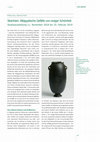
Die Sonderausstellung "SteinHart" in den Reiss-Engelhorn-Museen Mannheim widmet sich der herausr... more Die Sonderausstellung "SteinHart" in den Reiss-Engelhorn-Museen Mannheim widmet sich der herausragenden Altägyptischen Gefäßkunst des 4. und 3. Jahrtausends v. Chr. und macht dabei zahlreiche Stücke erstmalig einem größeren Publikum zugänglich. Im Fokus steht die extrem hohe ästhetische Qualität der einzelnen Stücke, die bis heute durch ihre Schlichtheit und Modernität beeindrucken. Die Objekte bestechen dabei durch die Materialbeherrschung seitens der altägyptischen Handwerker, die einst diese hochwertigen und auch seltenen Steine unter großem Zeitaufwand formten. Die unterschiedlich gestalteten Gefäße sind im besten Sinne des Wortes Design-Objekte, die materialtechnische Kompetenz mit hohem künstlerischem Anspruch verbinden. In Ägypten gehören Steine der unterschiedlichsten Art zu einem festen Bestandteil der Lebenswelt. Bereits in vordynastischer Zeit, zu Beginn des 4. Jahrtausends v. Chr., übten diese widerstandsfähigen Materialien eine so große Anziehungskraft aus, dass man zahlreiche Artefakte aus ihnen herstellte.
Conference announcements by Philipp Seyr
by Hany Rashwan, Rita Lucarelli, Beatrice De Faveri, Walid Elsayed, Marina Sartori, Andrea Pasqui, Nicky van de Beek, Panagiotis Kousoulis, Guilherme Borges Pires, Nikolaos Lazaridis, Jordan Miller, Barbara Richter, Stéphane Polis, Philipp Seyr, Federica Pancin, Francesca Iannarilli, Alvarez Christelle, Rune Nyord, Edyta Kopp, Silvia Zago, and Ludwig Morenz The conference is hosted by the Institute of Archaeology (UCL) and the Department of Middle Easte... more The conference is hosted by the Institute of Archaeology (UCL) and the Department of Middle Eastern Languages and Cultures (UC Berkeley).
With special thanks to the conference team: Rachel Barnas (University of California, Berkeley), Beatrice De Faveri (University of California, Berkeley), Walid Elsayed (Sohag University), Maysa Kassem (Fayum University), Jason Silvestri (University of California, Berkeley).
The conference will be live-streamed on Thursday18, Friday 19 and Saturday 20, November 2021



Uploads
Papers by Philipp Seyr
Ombo discovered by the Egyptian-Austrian mission. In area s/9 North, the rubbish
from a settlement dating to the second half of the 2nd Dynasty was excavated. This
refuse ran over the Nile bank and as a result the eastern bank of the river gradually
shifted westwards. Subsequently, the area was levelled, and the first architectural
structures, dating from the late 2nd to the early 3rd Dynasty were built. The dating of
the phases is based on the pottery, which has its closest parallels with material from
Elephantine. On seal impressions found here in phase 19, the title ḥm-nzw and triangular
labels abound, while those of phase 18 display only the title mjtr/mjtr.t. This
indicates a change in the function of area s/9 North from dumped material from a
(royal?) foundation to an Old Kingdom urban quarter.
This paper details the circumstances by which ‘composite hieroglyphs’ developed and the factors that may have influenced their subsequent evolution. It is organized into two complementary sections. In the first sec-tion, I offer a fine-grained contextual analysis of the sign [hiero] ḥtr.wy “span (of one pair of oxen)” and its variants in the First Intermediate Period. This analysis suggests two possible scenarios for the development of this sign, an inductive local one (scenario a) and a deductive global one (scenario b). In the second section, I describe the process by which composite signs decomposed within the same period and propose distinguishing ‘compound splitting’ from ‘component merging.’ The results of this systemic approach are used to assess the probabilities of the two scenarios envisioned for the case-study and to plead in favour of the inductive local position.
تناقش هذه الورقة التمثال الخشبى الذى يحمل رقم 100373
بالقاهرة. واستناداً إلى الدراسة التحليلية للأسلوب الفنى للتمثال، وكذلك تحديد هوية صاحبه من خلال تقرير الحفائر الخاص
أعدنا تحديده كجزء من تمثال المشرف على شونتى الغلال المدعو إيحى، والذى عثر ،MSS Gunn XXII به غير المنشور
عليه بخبيئة داخل مقبرة تعود للعصر البطلمى بمنطقة سقارة. نتيجة لذلك، يثبت بحثنا هذا مكان العثور على التمثال من خلال
حفائر سيسيل مالابى فيرث التى أجراها إلى الجنوب من المجموعة الهرمية للهرم المدرج فى عام 1926 . كما تقدم الورقة من
خلال الجمع بين علم الترميم والتناول الأثرى التقليدى دليلاً على استمرارية تصنيع التماثيل الخشبية كبيرة الحجم ذات الجودة
الفنية العالية بالورش حتى السنوات الأخيرة من عصر الملك بيبى الثانى أو بعد ذلك بقليل.
Conference announcements by Philipp Seyr
With special thanks to the conference team: Rachel Barnas (University of California, Berkeley), Beatrice De Faveri (University of California, Berkeley), Walid Elsayed (Sohag University), Maysa Kassem (Fayum University), Jason Silvestri (University of California, Berkeley).
The conference will be live-streamed on Thursday18, Friday 19 and Saturday 20, November 2021