Métal et matériaux périssables : actes des journées d’études, CORPUS, Strasbourg et Sélestat, 21-23 mars 2018, 2022
The amphitheater of Nîmes, built around 100 A.D., is in the state of our knowledge whitout doubt ... more The amphitheater of Nîmes, built around 100 A.D., is in the state of our knowledge whitout doubt the penultimate major element of the monumental program of the Roman city of the High Empire. In spite of multiple restoration campaigns over more than two centuries, the Heritage department could only note the multiple signs of deterioration of this building. An extensive restoration project was decided on and an archaeological monitoring of the works started in 2009 on the front part of the facades (and the bleachers) of the bays 43 to 53 located at the south-west of the monument, the bay 45 corresponding to the longitudinal axis of the ellipsis. It is currently continued on bays 54 to 57.
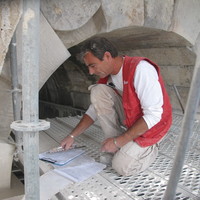
This restoration work has resulted in the discovery of 38 butterfly or dovetail cramps that stapled the massive masonry blocks on the facade. They are all crafted in oak, which had become completely anhydrous. Some are sometimes so perfectly preserved that they seem to have just been installed, while others are very altered although their location in the building does not necessarily justify it.
Specific studies of shaping technique, xylology or dendrochronology, were carried out on these cramps and 36 of them were dated by AMS before stabilization. The results obtained show that a large number of these wood objects probably comes from previous building(s). The other wood artefacts have permitted a more precise evaluation of the period of construction of the amphitheater, which was still uncertain. Surprisingly, these cramps also provide information on the construction process and life on the site. Some 80 to 100,000 cramps must have been be necessary for about 30,000 limestone blocks.


Uploads
Papers by Richard Pellé
Au sein d’un programme d’archéologie spatiale, une dizaine d’auteurs analysent la Vaunage au prisme de l’aménagement agraire, de l’habitat, des voies de communication, de la société perçue au travers de l’épigraphie, des archives agraires médiévales ainsi que des méthodes de la géographie quantitative et de l’analyse statistique.
l’échelle provinciale de ce type d’édifice de spectacle, dont les concepteurs devaient être fortement influencés par le récent chantier de la capitale impériale, celui du Colisée, ou celui, plus proche et de peu antérieur, de l’amphithéâtre d’Arles.
Des études et fouilles menées en 2019 et 2020 ont permis de mieux cerner ses coulisses
souterraines et de questionner la présence d’un édifice antérieure à sa construction.
ou fouilles préventives effectués depuis 2005 sur
de nombreux segments de l’enceinte ou à ses abords, ainsi
que plus récemment une fouille programmée ﴾2014‐2019﴿,
réalisés tant en plaine que sur les collines, ont livré des
informations insoupçonnées sur l’architecture militaire et
l’occupation des lieux et ont permis une révision progressive du tracé de l'enceinte ou de la morphologie des tours.
Cet article présente ces découvertes
récentes, aborde
des aspects comparatifs avec des monuments contemporains
et avance quelques hypothèses de recherches sur
les modalités d’édification de cet ouvrage titanesque, l'évergétisme impérial et l'ouverture de l'atelier monétaire nîmois.
This restoration work has resulted in the discovery of 38 butterfly or dovetail cramps that stapled the massive masonry blocks on the facade. They are all crafted in oak, which had become completely anhydrous. Some are sometimes so perfectly preserved that they seem to have just been installed, while others are very altered although their location in the building does not necessarily justify it.
Specific studies of shaping technique, xylology or dendrochronology, were carried out on these cramps and 36 of them were dated by AMS before stabilization. The results obtained show that a large number of these wood objects probably comes from previous building(s). The other wood artefacts have permitted a more precise evaluation of the period of construction of the amphitheater, which was still uncertain. Surprisingly, these cramps also provide information on the construction process and life on the site. Some 80 to 100,000 cramps must have been be necessary for about 30,000 limestone blocks.
Montaury Hill in Nîmes was located near the western gate
of the Augustan enclosure. The rampart, which has been
preserved over a length of several hundred metres, was
excavated between 2014 and 2019 with a burial space
extending from its base. In the burial space, excavated
between 2017 and 2019, more than 60 graves were revealed
within a small 100 m2 area. These date from the end of the
1st century BC to the beginning of the 3rd century AD.
While the burials in the earliest graves, dating to the time of
construction of the rampart, are indiscriminate, this area
very soon became a specific space for the burial of very
young children, from the end of the 1st century AD. The
very specific funerary practices are complex and highly
variable, showing that great care was given to these burials.
They are highly selective: foetuses (sometimes between 5
and 6 months in utero) share the burial space with children
who all died before the age of 6 months. The graves of four
dogs were found together with the children’s tombs. This
preliminary study attempts to understand the societal issues
underlying this kind of burial space dedicated to young
children, and to gain a better knowledge of the peri-urban
landscape of the city through its burial spaces and what
they tell us about the organization of Roman society.
This mausoleum is in all respects remarkable. Owing to its chronology, it constitutes a category of monument with an underground funeral chamber, which seems to be rare in Gaul or in the western part of the Empire and remains exceptional for this important time of the change of era.
(Lattes, Hérault, Languedoc-Roussillon).
Located on the side of an ancient villa, the site gave a road and some buildings of the imperial age
with the remains of a tower-mausoleum.
This one, dated 10-5 BC by dendrochronology performed on pilings, has been dismantled between
the late second century. A.D. and the beginning of the third century. A.D. In the foundation pit,
the filling has delivered 509 lapidary pieces: fragments of a statue of white marble, shelly limestone
blocks in squared-stone masonry belonging to the foundation of the base and 470 pieces in oolitic
limestone, architectural mouldings blocks or bas-relief elements, all belonging to the superstructure
of the mausoleum.
The shaping of the sculptures seem created by two artists (technical cutting), members of a team of
workshop of Nîmes, 45 km away (material, choice of motifs and compositions).
The stone-cutters try to reproduce the formal and officials models, but make use of regional characteristics
(typologies of acanthus, flattened cauliculus, etc...) and maintain local traditions Italo-Western
or Hellenistic (cornice), despite the introduction of novelties (dentils).
It is an example of a aedicula tomb similar to the mausoleums of Glanum or Beaucaire, with three
levels or spire roof, while it is atypical with a tympanum (and pediment) for Gallia Narbonensis
during this period.
Nel 2010, uno scavo archeologico è stato condotto dall’ INRAP sul sito della Cougourlude (Lattes,
Hérault, Languedoc-Roussillon).
Situato accanto ad una villa antica, il sito ha restituito una via ed alcuni edifici di epoca imperiale
fra cui i resti di un mausoleo-torre.
Quest’ultimo, datato c. 10-5 a.C. grazie alla dendrocronologia effettuata sui pali di fondazione, è
stato smantellato tra la seconda metà del II sec. d.C. e l’inizio del III sec. d.C. Il riempimento della
fossa di fondazione ha restituito 509 elementi lapidici frammentari: diversi frammenti di una statua
di marmo bianco, blocchi di calcare conchiglifero in opera quadrata appartenenti alla fondazione
dello zoccolo e 470 pezzi in calcare oolitico, blocchi architettonici sagomati o elementi in bassorilievo,
tutti appartenenti alla sovrastruttura del mausoleo.
La sagomatura delle sculture sembra realizzata da due artisti (tecniche di taglia), probabilmente
appartenenti ad una squadra di un’officina di Nîmes, distante di 45 km (materiale, scelta di motivi
e composizioni).
Gli scalpellini cercano di riprodurre i modelli formali ed ufficiali, ma fanno uso di particolarità regionali
(tipologie dell’acanto caulicolo appiattito, ecc...) e mantengono tradizioni italo-occidentali o
ellenistiche locali (cornicioni), nonostante l'introduzione di novità (dentelli).
Si tratta di un esempio di tomba ad edicola simile ai mausolei di Glanum o di Beaucaire, a tre livelli
e con copertura a cuspide, mentre il timpano (e frontone) è inusuale in Gallia Narbonensis per questo
periodo.
Cette note montre que la quantite de blocs reutilises devait etre beaucoup plus importante que les hypotheses avancees en 2009 par le meme auteur et il propose de voir un monument de taille exceptionnelle, peut-etre un stade ou un cirque situe hors les murs, qui aurait servi de carriere a la construction du castrum.
In Nimes, repair work done for an apartment located on 33 rue de l’Aspic in 2009 had led to the discovery of an unknown segment of the wall of amphitheater’s castrum dating back Late Roman Empire or Early Middle Ages. This large wall, revealed in 1976 during construction of the Law Courts, was then seen on 46 m length in the area of the project and also observed elevation inside two courtyards of Valfons’ hotel.
A new intervention in 2014 above the wall studied in 2009 continues to enrich the folder of that particular rampart.
This note shows that the amount of reused blocks needed to be much more important than the assumptions made in 2009 by the same author and he offers to see an exceptionally large monument, perhaps a stadium or a circus located outside the walls, which would have served as quarry in the construction of castrum.
In 2007, before the construction of a car park, a large preventive exca- vation took place in Nîmes and uncovered a part of ancient roman city. Among the discoveries, an altar carved 2000 years ago has been found in a well, located in the courtyard of a splendid roman house, in the neigh- bourhood of a blacksmiths’ area. This altar shows a first ever group of three roman and local deities.
Many stone architectural elements and sculptures were found in the foundations of stables that were built around 1760. A group
of sculptures caught our attention: two headless statues, sculpted in the round from oolitic limestone, with the front shaped and
the backside only roughly-hewn. Without knowing to which monument this group belongs, it is interesting to note the similarity
of workmanship that demonstrates a single hand.
These statues are larger than life-size with one in a toga and the other in military uniform. There are also some fragments
belonging to a female figure in a long tunic. The two people dressed in civic clothing do not provide elements for identification,
but do provide some clues for dating. The third character is wearing armor without a cinctorium, with the paludamentum thrown
over the right forearm, and an emblem on the front plate: the gorgoneion. This could be an imperial statue, an officer of high rank,
or the representation of a warrior deity.
The objective of this campaign is the excavation inside the towers and their surroundings, the release of the curtain wall and adjacent structures possible and the built study that will provide information on constructive manner, the organization of the worksite and its evolution.
The multidisciplinary study of a dump area (DEP4080) comprises the detailed inventory of the archaeological artefacts which is compared with the data obtained by each specialist. Results provide information on the formation of this dump located along the Domitian’s way (Via Domitienne) and in the vicinity of the “Porte d’August” (entrance named after August). Its setting, in an abandoned mausoleum, is relatively original, without being new in Nîmes. The refuse accumulated in this area, between 70 and 110 AD, is mainly composed of pottery and glass wares, remains of animal bones and other food waste, but also dog skeletons. They are combined with empty ‘containers’, such as amphora for alum, most probably used in the artisanal establishments located nearby. The much reduced number of metallic artefacts and rubble suggests site management, however minimal, during the Flavian period and the first years of the Antonines.
What is considered as the main face of the stone shows traces of flaking or polishing and a technical study was initiated. Eight cupmarks created by polishing are distributed across the two fragments. A deep transverse groove which continues onto the two sides of the slab is located a little more than a quarter of the distance from the top and has been cut with a special tool, probably posed and probably metal. If that is the case, the block must date at the earliest to the Chalcolithic period.
This feature suggests that the menhir is of ithyphallic form as with other known examples, all from the hinterland (menhir of Lacam des Lavagnes at Saint-Jean-de-Buèges, or that of Camprieu, for example). Its function, however, remains unknown. In Languedoc, some menhirs seem to indicate the location of a grave. A territorial marker is another possibility.