Books by Robert P Kolker
Rutgers University Press, 2021
1 On Containment, Screen Size, and the Lightness and the Dark
2 “It Was Like Going Down to the Bottom of the World”: John Garfield and Enterprise
3 “I’m a Stranger Here Myself”: Nicholas Ray and Ida Lupino
4 “Love, Hate, Action, Violence, and Death . . . in One Word: Emotion”: Joseph Losey and Samuel Fuller
5 “Put an Amen to It”: The Old Masters—Welles, Hitchcock, Ford
6 Looking to the Skies: Science Fiction in the 1950s
7 “How Can You Say You Love Me . . . ?”: Melodrama
Conclusion: “Complete Total Final Annihilating Artistic Control”—Stanley Kubrick Explodes Containment
Acknowledgments
Notes
Selected Bibliography
Index
Eyes Wide Shut: Stanley Kubrick and the Making of His Final Film (Oxford University Press), 2019
Reviews:
"Two leading Kubrick scholars have joined forces for this hugely impressive study of the filmmaker's final masterpiece. Examining the film from every conceivable angle, they offer unique insights into its form and themes - and also, more broadly, into Kubrick's working methods, his personality and his place in 20th century culture." -- Peter Krämer, author of BFI Film Classics on Dr. Strangelove and 2001: A Space Odyssey, and co-editor of Stanley Kubrick: New Perspectives
"Through obsessive research and details within details worthy of the man they chronicle in Eyes Wide Shut: Stanley Kubrick and the Making of his Final Film, film scholars Robert P. Kolker and Nathan Abrams prove decidedly that the last movie of a great film director not only sums up their career but defines and illuminates it with clarity. This is a must-read for admirers of Stanley Kubrick and his work and the cinema itself." -- Vincent LoBrutto, author of Stanley Kubrick: A Biography
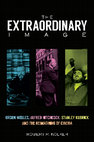
The Extraordinary Image takes readers on a fascinating journey through the lives and films of these three directors, identifying the qualities that made them cinematic visionaries. Reflecting on a lifetime of teaching and writing on these filmmakers, acclaimed film scholar Robert P. Kolker offers a deeply personal set of insights on three artists who have changed the way he understands movies. Spotlighting the many astonishing images and stories in films by Welles, Hitchcock, Kubrick, he also considers how they induce a state of amazement that transports and transforms the viewer.
Kolker’s accessible prose invites readers to share in his own continued fascination and delight at these directors’ visual inventiveness, even as he lends his expertise to help us appreciate the key distinctions between the unique cinematic universes they each created. More than just a celebration of three cinematic geniuses, The Extraordinary Image is an exploration of how movies work, what they mean, and why they bring us so much pleasure.
"This book offers far more pleasures than we can easily count, all reflecting the author's passion for film and his ability to get it into highly personal writing. He shows us how Hitchcock, Kubrick and Welles brought excitement and light to the cinema, however dark or distraught their films became, and there is something quite dazzling about the way he keeps picturing these three figures as belonging together and yet entirely different from each other."
—Michael Wood, author of Alfred Hitchcock: The Man Who Knew Too Much
"Like the three masters he loves, Kolker brings power and passion to his brilliant study of this trio of closely related and unforgettable filmmakers. It is a supremely sublime achievement."
—Bill Nichols, author of Introduction to Documentary and Speaking Truths with Film
The Altering Eye, Openbook Publishers, Full Text Online
Papers by Robert P Kolker
The Stories Told by Film I
Routledge eBooks, Feb 5, 2024
The Storytellers of Film III
Routledge eBooks, Feb 5, 2024
The Extraordinary Image
Rutgers University Press eBooks, Aug 20, 2019
Psycho
Oxford Bibliographies Online Datasets, Jan 28, 2013
Politics Goes to the Movies: Hollywood, Europe, and Beyond

Stanley Kubrick
Oxford Bibliographies Online Datasets
Media studies: an introduction
Hollywood and the blacklist
Politics Goes to the Movies, 2018
American democracy and Frank Capra
Politics Goes to the Movies, 2018
Populism, race, and The Birth of a Nation (1915)
Revolutionary cinema in Latin America
Politics Goes to the Movies, 2018
TWO. Algebraic Figures: Recalculating the Hitchcock Formula
Play it Again, Sam, 1998
Formal structures: how films tell their stories
Routledge, Aug 14, 2015
16 The ‘New’ American Cinema
Traditions in World Cinema, 2005
The Affection of Death
ReFocus: The Later Films and Legacy of Robert Altman