Papers by Rodrigo Therezo
A must read for the Derrida-Heidegger scholar... Second volume of Donner le temps I, which should... more A must read for the Derrida-Heidegger scholar... Second volume of Donner le temps I, which should have been translated as Giving Time I but that, for cognitive reasons, it wasn't.
Free to Read Otherwise: Heidegger Deciphering Hölderlin One of the many examples Heidegger gives ... more Free to Read Otherwise: Heidegger Deciphering Hölderlin One of the many examples Heidegger gives in Being and Time of the way in which Dasein falls prey to the silent "dictatorship" of "the they" and "the public way of beinginterpreted" is that of reading: "we read (lesen), see and judge literature and art the way they see and judge it." As Heidegger later points out in the "B" section of chapter V of Division One, titled "The Everyday Being of the There and The Falling Prey of Dasein," the "prattling and gossiping" (Weiter-und Nachredens) of "idle talk" (Gerede)-the everyday mode of discourse which "has lost the primary relation of being to the being talked about," so that what is publicly spoken about "spreads in wider circles and takes on an authoritative character," i.e. "things are so because one (Man) says so"-is not "restricted" to the acoustico-vocal dimension of hearing and speaking, as Heidegger's very terminological choice (Ge-rede) might misleadingly suggest, but also "spreads to what is written," that is to say, read: Idle talk is constituted in this gossiping and prattling, a process by which its initial lack of grounds to stand on increases to complete groundlessness. And this is not restricted to vocal gossip, but spreads to what is written, as "scribbling" (Geschreibe). In this latter case, gossiping is based not so much on hear-say. It feeds on sporadic superficial reading (es speist sich aus dem Angelesenen): the average understanding of the reader (Lesers) will never be able to decide what has been drawn from primordial sources with a struggle, and how much is just gossip.
Heidegger begins his first lecture course on Hölderlin in a curious manner. Lest we think Hölderl... more Heidegger begins his first lecture course on Hölderlin in a curious manner. Lest we think Hölderlin was a "pacifist," Heidegger cites two letters and a poem meant to prove that Hölderlin was ready to "throw the pen under the table" and "deny the Muses love" for the sake of the "beautiful sacrifice" of battle, should duty call. This quickly complicates, as Heidegger argues, the then common view of Hölderlin's poetry as "unheroic" and advocating the "defenselessness" (Wehrlosigkeit) of Germania, particularly in the last verses of the eponymously titled poem: "Amid your holidays / Germania, where you are priestess /and defenselessly (wehrlos) proffer all round counsel / to kings and peoples." Perhaps unsurprisingly, Heidegger bookends the lecture course with another reference to the word "defenselessly," insisting that it does not denote "the laying down of weapons, weakness, or the avoidance of struggle." In this paper, I attempt to draw connections between Heidegger's militaristic readings of "Germania" and a provocative verse from the untitled poem "As when on a holiday…" that evokes "the clang of weapons" as nature is awakened from her deep sleep. I shall be relating Heidegger's reading of this verse to a sinister "equivocality" so brilliantly diagnosed by Jacques Derrida in "Geschlecht IV." In the wake of Derrida's provocative suggestion that Heidegger's treatment of polemos can offer Hitler "the worthiest and the most thinking justification" for ontic warmongering, I look at how Heidegger's militaristic readings of Hölderlin only deepen the equivocality of polemos, and this in spite of Heidegger's efforts to dissipate any ambiguity between Kampf as he thought it and the Kampf of the author of Mein Kampf.
This paper offers a reflection on the complicated relationship between Derrida and Heidegger, par... more This paper offers a reflection on the complicated relationship between Derrida and Heidegger, particularly as concerns the issue of difference in their respective thoughts. Taking one of Geschlecht III's most stunning passages as my point of departure, I walk the reader through some of Derrida's own remarks on his relationship to Heidegger, before arriving at the différend that seems to exist between them as regards the notion of difference itself. I argue that the margins of Heidegger's text inscribe a quite radical thinking of difference not at all incompatible with Derridean différance. In conclusion, I turn to Heidegger's "Anaximander Fragment" where, in the margins of Heidegger's text, we find a marginal note that, given its content, could surely have been written by Derrida himself.
Philosophy Today, vol 64:2
This paper tracks Derrida's allusion to the "phoenix motif " in the recently published Life Death... more This paper tracks Derrida's allusion to the "phoenix motif " in the recently published Life Death seminar, showing how it foreshadows and overlaps with the political problematic of "national humanism" made explicit in Geschlecht III. I argue that, be it in Hegel, Fichte, Nietzsche, or Heidegger, biological life is always in the service of a spiritual life that finds its breath in a certain reappropriation of the German idiom. Following Derrida, I argue that this "philosophy-of-life German" (cet allemand philosophe de la vie) introduces a sinister equivocality between these thinkers and National Socialism, and this in spite of all their prudence to shield their discourses from such a co-option.
Epoché, vol 24:1 (Fall 2019)
Philosophy Today, vol 63.2 (2019)
My preface to the French edition of Jacques Derrida's recently published Geschlecht III, translat... more My preface to the French edition of Jacques Derrida's recently published Geschlecht III, translated by Katie Chenoweth and myself. Our full English translation of Geschlecht III is due to appear this year still (2018) with The University of Chicago Press.
My preface to the French edition of Jacques Derrida's recently published Geschlecht III
Research in Phenomenology, vol 48 (2018)
Book Reviews by Rodrigo Therezo
Translations by Rodrigo Therezo
An English translation of Peter Trawny's book Heidegger: eine kritische Einführung, forthcoming with Polity Press
A Translation of Hans Ulrich Gumbrecht's "A Supreme Will of the People," from the volume Heidegger's Black Notebooks: Responses to Anti-Semitism, ed. Peter Trawny and Andrew Mitchell
Books by Rodrigo Therezo
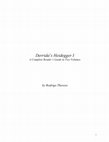
This book provides a road map to Jacques Derrida’s lifelong relationship to the thought of Martin... more This book provides a road map to Jacques Derrida’s lifelong relationship to the thought of Martin Heidegger. It follows an economic principle: it marks stations around which a number of questions gather and condense themselves, forming thematic nodal points that lend a certain structure – or stricture, as Derrida might have said – to a long itinerary spanning over forty years. Identifying, loosening, if not untying, at least some of these knots is the aim of the present study. Topics to be discussed include: the concept of reading, metaphor, time and history, sexuality and animality, Heidegger’s involvement with National Socialism, and the relationship between national idiom and what Derrida calls “philosophical nationalism.” Particular emphasis is given to recent archival discoveries and posthumous publications that shed light on motifs that have not received their due attention hitherto. Texts such as Geschlecht III, Donner le temps II, and Heidegger: The Question of Being and History, all published in the last decade, give us a new vantage point from which to reconsider the Derrida-Heidegger relationship writ large. In so doing, these texts are put in conversation with the already established corpus so as to illuminate core issues that have not been sufficiently thematized, much less problematized.
The reader should thus be aware of what this book is not meant to be: neither an exhaustive account of Derrida’s engagement with Heidegger nor a random selection of themes interspersed throughout this engagement; neither a Derridean attack on Heidegger nor a Heideggerian defense against it. Perhaps each of these projects is, up to a certain point, necessary and legitimate. Yet they presuppose the present study insofar as each of them relies on a minimal legibility of the field of study in question, a terrain yet to be constituted and whose paths and furrows have not yet been properly demarcated and flagged, missing essential signposts and milestones that alone would allow for what is cursorily known as “the lay of the land” to emerge. Such is the (modest) ambition of the present work, merely to delineate the configuration of the field in which one encounters Derrida’s Heidegger and to provide a compass for navigating through these troubled waters, indicating possible avenues for further research along the way.
It is the author’s hope that this book will provoke thought. Derrida and Heidegger are not simply two philosophers among others in the history of Western philosophy, a history they both delimit without ever presuming to stand simply outside of it. This means that, for both of them, thought is intrinsically historical and unable to do without a philosophical tradition which must be read at times against itself, in the wake of what often misleadingly appears as mere gloss or commentary. One of the insights of both Derrida’s and Heidegger’s thinking is that the moment of explication is never simply followed by a more deconstructive gesture of rupture, as though explication and rupture could be neatly kept apart. When Heidegger explicates Kant, for example, when Derrida explicates, in turn, Heidegger’s explication, and when we, finally, explicate Derrida explicating Heidegger’s explication, something other than passive commentary or ad nauseam exegesis is already taking place, as the movement of becoming explicit is something of a ticking bomb that explodes when properly activated, triggering ripple effects across a minefield in which we are always already standing, more or less aware of what reading holds in reserve. Perhaps such explosions await the reader of Derrida’s Heidegger.
The reader should thus be aware of what this book is not meant to be: neither an exhaustive account of Derrida’s engagement with Heidegger nor a random selection of themes interspersed throughout this engagement; neither a Derridean attack on Heidegger nor a Heideggerian defense against it. Perhaps each of these projects is, up to a certain point, necessary and legitimate. Yet they presuppose the present study insofar as each of them relies on a minimal legibility of the field of study in question, a terrain yet to be constituted and whose paths and furrows have not yet been properly demarcated and flagged, missing essential signposts and milestones that alone would allow for what is cursorily known as “the lay of the land” to emerge. Such is the (modest) ambition of the present work, merely to delineate the configuration of the field in which one encounters Derrida’s Heidegger and to provide a compass for navigating through these troubled waters, indicating possible avenues for further research along the way.
It is the author’s hope that this book will provoke thought. Derrida and Heidegger are not simply two philosophers among others in the history of Western philosophy, a history they both delimit without ever presuming to stand simply outside of it. This means that, for both of them, thought is intrinsically historical and unable to do without a philosophical tradition which must be read at times against itself, in the wake of what often misleadingly appears as mere gloss or commentary. One of the insights of both Derrida’s and Heidegger’s thinking is that the moment of explication is never simply followed by a more deconstructive gesture of rupture, as though explication and rupture could be neatly kept apart. When Heidegger explicates Kant, for example, when Derrida explicates, in turn, Heidegger’s explication, and when we, finally, explicate Derrida explicating Heidegger’s explication, something other than passive commentary or ad nauseam exegesis is already taking place, as the movement of becoming explicit is something of a ticking bomb that explodes when properly activated, triggering ripple effects across a minefield in which we are always already standing, more or less aware of what reading holds in reserve. Perhaps such explosions await the reader of Derrida’s Heidegger.