SNAP Work Requirements: How Food Banks are Responding
As new work requirements for SNAP lurch into effect across the country, food banks and pantries are doing what they can to ease the blow.
The timing of the new rules varies by state, but the upshot is that millions more Americans who previously qualified for SNAP will have to prove that they meet new work requirements before they can receive more than three months of SNAP benefits in three years. Groups most impacted include previously qualified adults aged between 55 and 64, as well as veterans, the homeless, and former foster kids.
Hunger relief agencies advocated heavily against the federal legislation that put the restrictions into place. But now that the law is fixed, they are turning their attention to making the transition as easy as possible for those affected – many of whom may not be fully aware that their benefits are shifting.
“At this point, we’re not able to change policy,” said Katherine Byers, Government Relations Officer at Houston Food Bank. “That’s not going to happen. So we want neighbors to be as successful as possible, given the existing conditions.”
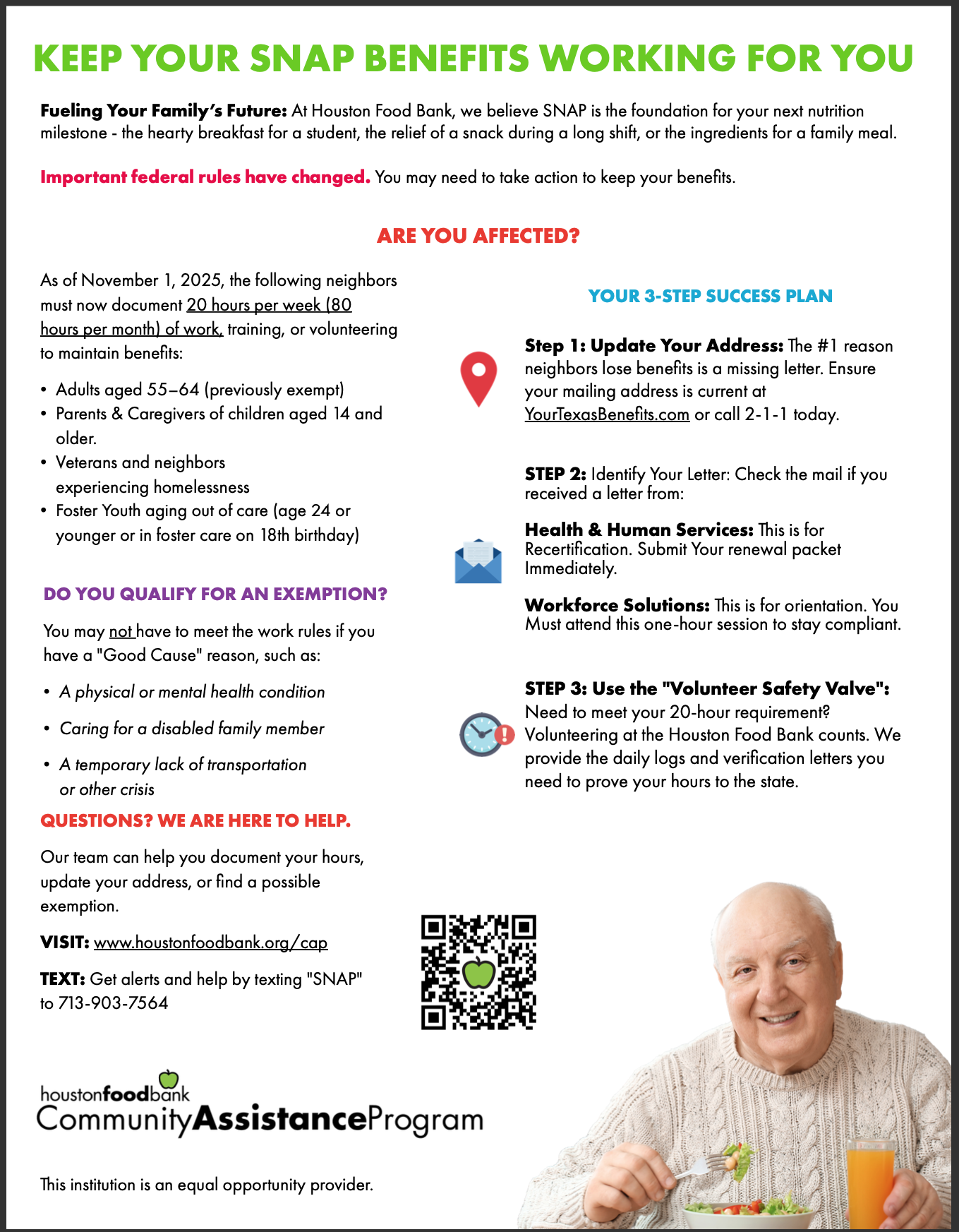
Houston Food Bank has addressed the situation by forming a “united front” with area nonprofits, including the Greater Houston Community Foundation and the local United Way, to help people stay connected with their benefits. The fourth member of the coalition, Houston-based Connective, offers software that walks people through an automated questionnaire to help them find out about the benefits they’re eligible for. Working together, the group hopes to align their efforts and keep as many people as possible connected to SNAP.
Through its agency partners and Facebook, Houston Food Bank and the coalition are also publicizing a “three-step success plan” (see flyer, left) to increase peoples’ chances of continuing to qualify. The first step is to make sure their address is up to date, so they continue to receive communications regarding their benefits. The second is to keep checking the mail for a recertification packet and a letter regarding a state-mandated, one-hour workforce orientation session. The third step is making sure people know that they can fulfill their 20-hour per week work requirement by volunteering at Houston Food Bank.
The food bank already has 90,000 unduplicated volunteers a year and the capacity to handle more. Its goal, in fact, is to push that number past 100,000. It has prepared its volunteer service department to meet SNAP-related requirements like daily logs and verification letters to prove hours served. But Byers worries that the food bank’s location in an industrial area will be difficult for people to reach, as well as costly given the rising price of gas.
In California, San Francisco Marin Food Bank has not given up on a legislative pathway to relief. Earlier this year, it introduced to its state legislature a bill that would restore California’s ability to measure statewide food insecurity, an effort that was gutted when SNAP-Ed funding was canceled. (See Food Bank News’ story on the food bank’s legislative strategy here.) The food bank hopes to be able to use the new survey data to push state policies that would broaden access to SNAP, said Noriko Lim-Tepper, Chief Strategic Partnerships, Advocacy and Voice Officer. “Is there a way, legislatively, that we could account for the cost of living in this state, to see if we can have a California-based solution to increase access?” she said.
The food bank is also hoping to introduce in the next three months a program called CalFresh Ambassadors, which would train people with lived experience of hunger to provide SNAP application assistance. It is aiming to place at least 20 ambassadors at different partner organizations to do SNAP outreach, Lim-Tepper said. “We want to be the middle person between a participant and the county to ensure there are no barriers within the application process,” she said.

In Chicago, Common Pantry has positioned staffers at its three-day-a week food distributions, engaging about 85 people over seven weeks in one-on-one discussions about the SNAP changes, said Margaret O’Conor, Executive Director. In addition to guiding people through the changes, the pantry is working to reach people who have never needed its services before. “We know that there’s going to be a lot more people who are put at risk, so we just want to make sure that people know about us and that they feel comfortable coming to us and reaching out for help,” O’Conor said.
Technology solutions offer ample opportunity to help people figure out their SNAP eligibility. One example is the Propel app, already used by one in four SNAP recipients to check their benefit balances and stay up to date about benefits changes. With the new work requirements as well as new restrictions on SNAP purchases in some states, Propel is working more closely with state agencies so it can convey clear information to its users. “Because of that reach and engagement and trust we have with folks, there’s a lot of things that we can do to build bridges between clients and state agencies,” said Justin King, Policy Director at Propel. “It creates the possibility for those households to stay connected to their benefits more easily.”
Despite all these efforts, many agencies still see confusion as an inevitable outcome. Even those tasked with providing up to date information about the changes are having trouble keeping up. O’Conor of Common Pantry relayed that the pantry’s licensed clinical social worker devoted hours of time to instructional webinars about the upcoming changes, but still had to go to a satellite arm of the Dept. of Human Services to get additional questions answered.
Delilah Guzman, Senior Benefits Access Specialist at West Side Campaign Against Hunger in New York City, affirmed in a recent webinar the heightened state of uncertainty. “This is very, very challenging for us to understand and navigate as benefits access specialists,” she said, adding, “Just imagine how it is for our customers. This is adding layer upon layer of challenges.” Like Houston Food Bank, the West Side Campaign Against Hunger is seeking to accommodate volunteers, and has registered with the city to become an approved SNAP volunteer site.
With work restrictions and other changes set to reduce SNAP spending by about $187 billion over ten years, food banks and pantries are expecting to see more people in need of food. Or perhaps not, given the general atmosphere of fear that has pervaded many places, as immigration and customs officials have stepped up their surveillance. “The fear has almost counterbalanced what we would assume would be an increase in need from folks losing their SNAP benefit,” said Byers of Houston Food Bank.
In this new environment, Houston Food Bank has been encouraging people to give themselves every chance of qualifying for SNAP. “We’re telling neighbors, ‘Don’t opt yourself out,’” she said, adding, “That’s where food banks can play the biggest role. They’re connected to the community and they can get the word out about what the requirements are and what people can do to meet them.” – Chris Costanzo
Like what you’re reading?
Support Food Bank News